Categories
Alaska News Featured Juneau News juneau Juneau Local Juneau Local Ketchikan Local News Feeds Sitka Local

Alaska lawmakers push for continued ban on Russian seafood imports

By: Yereth Rosen, Alaska Beacon

Fishing vessels are seen in Homer’s harbor on Oct. 22, 2025. A resolution passed by state lawmakers urges federal officials to extend the ban on Russian seafood imports. Russian fish competes for market share with Alaska’s fish. (Photo by Yereth Rosen/Alaska Beacon)

A legislative resolution urging a continued and better-enforced ban on Russian seafood in the United States is headed to Gov. Mike Dunleavy.

Part of a series of actions by Alaska lawmakers to try to shore up the state’s ailing seafood industry, House Joint Resolution 29 won final passage last week and was transferred to the governor on Monday.

The resolution calls for continuation of the ban on Russian seafood imports imposed in 2022, after that country’s invasion of Ukraine. The ban was expanded in 2023 to cover imports of Russian seafood to the U.S. through a third-party country, usually China, where fish are processed.

The import ban is set to expire later this year. That makes the resolution timely, supporters aid.

Among the supporters is Jeremy Woodrow, executive director of the Alaska Seafood Marketing Institute.

Woodrow, in testimony to the Senate Resources Committee on Feb. 27, said a stockpile of Russian fish that was in the U.S. before the ban went into full effect is just now being depleted.

“We need more time to really capture the U.S. marketplace. Our industry has not recovered yet,” Woodrow said. Even though last year’s fishing season was better, it was still one of the worst years in the last 20 years, he said.

“This is one measure that will help our fishermen. We’re starting to see the fruits of this ban coming into play, but we need more time to provide stability to our industry. We need more time to see it come to fruition,” he told the committee.

In addition to seeking an extension of the import ban, the resolution calls for stronger monitoring and enforcement to “ensure fair trade, protect the state’s seafood industry, and promote sustainable and ethical seafood production.”

Legislative resolutions do not have the power of law, but they can influence actions by Congress, the federal executive branch or other institutions.

The Russian seafood import ban resolution was not among the measures introduced by the Joint Legislative Task Force Evaluating Alaska’s Seafood Industry, formed in 2024. However, it addresses an aspect of international trade, one of the issues raised by the task force. The task force’s report recommended an update to a Russia-focused resolution passed by the legislature in 2022, Senate Joint Resolution 16.

Russian king crab is displayed at a Costco in Anchorage on Nov. 14, 2022. The crab, from the Barent Sea, was distributed by Arctic Seafoods of San Francisco, and was part of inventory stockpiled before the U.S. government banned fish imports from Russia. (Photo by Yereth Rosen/Alaska Beacon)

The eight-member task force, comprising Senate and House members from fishery-dependent districts, issued its recommendation report in January 2025, at the start of last year’s session. Recommendations for action resulted in the introduction of a series of bills intended to help the industry, which has struggled with low fish prices, glutted international markets, high costs and other challenges.

Other bills focus on tax credits and revenues

One of the task force’s bills, aimed at encouraging seafood product development and diversification, is headed for a vote in the Senate this week.

That measure, Senate Bill 130, concerns the state’s fisheries product development tax credit system. Currently, seafood companies are allowed to deduct the cost of new equipment used to develop value-added products from salmon, herring, pollock, sablefish and Pacific cod. The bill would expand that to all fish species, including shellfish. That is in line with the recommendation in the task force report, which identifies arrowtooth flounder, fish meal and crab shells as examples of some underused or discarded products that could be processed into something marketable.

The bill, in the amended form before the Senate, also seeks to expand the range of technology for which investment would qualify for credits, and it would extend the sunset date for the credit to 2037. Currently, the tax credit is due to expire next year.

The revenue impact of the bill, if it wins final passage, is difficult to determine because there are several unknown variables, said the fiscal note prepared by the state Alaska Department of Revenue. Estimated annual revenues losses to the state would range from $1 million to nearly $4 million, according to the fiscal note.

Another task force bill, aimed at helping fishery-dependent local governments, had not moved out of the Senate Finance Committee as of Tuesday. That measure, Senate Bill 135, would allow municipalities to increase their share of fisheries business tax and fishery resource landing tax revenues. Currently, the state and local governments split those tax revenues equally. The bill would allow local governments to get up to 75% of the tax revenues.

The legislature passed two seafood task force bills last year, each of which had wide support. However, Dunleavy vetoed one of the bills.

The bill that escaped the governor’s veto, House Bill 116, allows for the formation and operation of member-owned commercial fishing insurance cooperatives. Such cooperativesexist in other states and were used by some Alaska fishers. The bill passed unanimously.

The vetoed bill, Senate Bill 156, would have transferred $3.69 million from a defunct state loan fund to the Alaska Commercial Fishing and Agriculture Bank. The state-owned bank needed the boost to keep serving the seafood industry, bill supporters argued. But Dunleavy argued that the cost of the action was too great for the state budget to bear.

Categories
Featured Juneau News Juneau Local Ketchikan Local News Feeds Sitka Local

Number of Alaska fishers and seafood workers hits record low, state report finds

By: James Brooks, Alaska Beacon

 Commercial fishing boats are lined up at the dock at Seward’s harbor on June 22, 2024. (Photo by Yereth Rosen/Alaska Beacon)

The number of people working in Alaska’s famed seafood industry has set a new record low, surpassing last year’s record low, according to figures published this month by the Alaska Department of Labor and Workforce Development in its magazine, Alaska Economic Trends.

In 2024, an average of 5,393 people were employed as fishers, processors or other seafood workers each month in Alaska, wrote analyst Joshua Warren. That’s down by 443 jobs from the same figure in 2023.

Alaska remains the No. 1 seafood producer among U.S. states, according to federal statistics, and produces more seafood than every other state combined.

The state department of labor has kept a monthly tally of seafood jobs in the state since 2001, and industry employment has been in a steady decline since 2019 due to a variety of factors, including a lack of available fish, competition from cheaper international sources, and high operating costs that can make fishing uneconomic. 

Since the start of 2001, the high point of fishing employment was in 2015, when an average of 8,501 people were employed in the seafood industry each month.

Historically, seafood employment was significantly higher due to reduced rates of automation and the fact that Alaska seafood tended to be processed and packaged locally. 

The modern trend has been toward direct export and processing internationally, where wages are lower.

Seafood employment in Alaska is extremely seasonal, with a peak in June and July during the salmon season and a low ebb in December, before a new season of fishing in federal waters offshore.

In July 2024, only 17,361 people worked in the Alaska seafood industry, the lowest annual peak on record since January 2021. In July 2013, the highest peak, more than 25,000 people were employed in the state’s seafood industry.

Categories
Featured Juneau News Juneau Local Ketchikan Local News Feeds Sitka Local

‘Explosion’ of invasive European green crabs reported in Southeast Alaska

By: Yereth Rosen, Alaska Beacon

The carapace, or upper shell, of an invasive European green crab and a live live green crab are shown in this undated photo. Ever since Alaska’s first green crabs were found on Annette Island in 2022, numbers have exploded and the invaders have spread north. (Photo by Linda Shaw/National Oceanic and Atmospheric Administration Fisheries Service)

When a young Sealaska intern walking a beach in July 2022 found the first evidence of European green crab presence in Alaska – a discarded shell on a beach on Annette Island in the state’s far southeast corner – it was an ominous sign about the invasive species’ northward spread.

Since then, the Metlakatla Indian Community, the tribe based on Annette Island, and its partners, which include Alaska Sea Grant, have found not just more shells, but live invasive crabs. Discoveries numbered just a handful at first, then dozens, then hundreds, then thousands.

This year, the Metlakatla tribe’s team has trapped more than 40,000 of them on and around Annette Island, a representative said.

“This year we’ve had a complete explosion of green crab — over seven new locations on Annette Island we found green crab, and eight new locations off Annette Island,” said Nicole Reynolds, an environmental specialist working with the tribe, in a presentation at a three-day Anchorage meeting on invasive species in Alaska this week.

The more than 40,000 crabs removed this year compares to last year’s total of 1,800, Reynolds said.

European green crabs are small, usually measuring no more than 4 inches wide, but they  are powerful forces of destruction. They mow down eelgrass beds that are vital habitat for salmon and other native species. And they gobble up native marine life like juvenile salmon, clams, mussels and juvenile Dungeness and other crabs that are important to commercial and subsistence harvests.

“They’ll eat the baby crabs. They’re meaner and tougher than the Dungeness,” Reynolds said during a break in the annual Alaska Invasive Species Partnership Workshop.

European green crabs have already spread north of Annette Island. Last year, they were found at Gravina Island, and this summer they were found by participants in a local university class at beaches in Ketchikan that lie about 30 miles north of the initial Annette Island discovery site.

Just this month, they were found at Etolin Island, Reynolds said. Etolin Island is roughly 60 miles northwest of the city of Ketchikan, making it the northernmost North America discovery to date.

And now European green crabs appear to be entrenched in Alaska waters for good, Reynolds and Genelle Winter, a grant administrator with the tribal government, told the workshop audience.

That means the fight against green crabs will also have to be long-term, Winter said, with a permanent staff and a strategy of what is known as “functional eradication.” That is an eradication strategy that accepts the reality of the invaders’ presence in some places, but tries to keep them out of other places with resources that are most important to protect.

Nicole Reynolds and Genelle Winter of the Metlakatla Indian Community pose on Oct. 28, 2025, with a sticker bearing European green crab design created by a local artist, Elizabeth Anderson. The crab face was made intentionally angry and mean-looking, helping send the message about the destruction caused by this invasive species. Reynolds and Winter presented information at the annual Alaska Invasive Species Partnership Workshop in Anchorage about the Tribe's work to combat the spread of European green crabs. The first discovery of the crabs in Alaska was in 2022 at Annette Island in the far southeast corner of the state, and they have proliferated in Alaska waters since then. (Photo by Yereth Rosen/Alaska Beacon)
Nicole Reynolds and Genelle Winter of the Metlakatla Indian Community pose on Oct. 28, 2025, with a sticker bearing a European green crab design created by local artist, Elizabeth Anderson. The crab face was made intentionally angry and mean-looking, to help send the message about the destruction caused by this invasive species. Reynolds and Winter presented information at the annual Alaska Invasive Species Partnership Workshop in Anchorage about the Tribe’s work to combat the spread of European green crabs. The first discovery of the crabs in Alaska was in 2022 at Annette Island in the far southeast corner of the state, and they have proliferated in Alaska waters since then. (Photo by Yereth Rosen/Alaska Beacon)

Such a strategy involves “focusing all our efforts on protecting the most vital subsistence and commercial resources,” she said.

Conditions in Alaska waters, the farthest-north spots in North America where the crabs have spread, do not faze the invaders, DNA analysis shows. For that information, the tribe consulted with an expert, Carolyn Tepolt of the Woods Hole Oceanographic Institute. Tepolt has also been investigating the genetics of green crabs that have invaded Washington state.

Tepolt’s analysis found that the green crabs in Alaska are a genetic blend of those in Washington and British Columbia, diverse enough to persist in the more northern waters, Reynolds said.

“She even called it a ‘super-crab’ just because of how perfectly genetically suited it is for the environment in Southeast Alaska,” Reynolds said.

European green crabs have been altering North American marine ecosystems for a long time.

They were first found in East Coast waters in the early 1800s, likely carried there in ship ballast water. The first West Coast discovery was in 1989 in San Francisco Bay. Since then, they have been spreading north up the Pacific coast. They were first confirmed in British Columbia in 1999 and continued moving up that Canadian province’s coast before being found at Annette Island three years ago.

Beyond the accidental releases through ballast water, scientists say warming conditions are aiding the spread of green crabs. Larvae are more likely to survive in warmer waters brought on by climate change and weather events like El Nino cycles.

The 2023-2024 El Nino, which warmed Alaska waters, is a possible factor in this year’s explosion of green crabs in Southeast Alaska, the Metlakatla tribal representatives said.

Warmer temperatures than those that used to be normal in Alaska marine waters are known to encourage green crab proliferation.

study by Danish scienetists that was published in September identifies a temperature range that appears ideal for the crabs. At temperatures of 12.5 to 16.6 degrees Celsius, or 54.5 to 61.9 degrees Fahrenheit, European green crab abundance peaked, the scientists found.

Average temperatures in Southcentral Alaska’s Cook Inlet were within that range this August, an indication that conditions would be suitable for green crabs if they somehow reach that area.

Nicole Reynolds, an environmental specialist with the Metlakatla Indian Community, shows a photo stored on her phone of an unusual-looking European green crab collected this year. The Tribal government is at the forefront of the campaign to try to control the spread of the invasive species, which eats native species and damages habitat used by fish. Reynolds presented information about the Tribe's work at the annual Alaska Invasive Species Partnership Workshop in Anchorage. (Photo by Yereth Rosen/Alaska Beacon)
Nicole Reynolds, an environmental specialist with the Metlakatla Indian Community, shows a photo stored on her phone of an unusual-looking European green crab collected this year. The Tribal government is at the forefront of the campaign to try to control the spread of the invasive species, which eats native species and damages habitat used by fish. Reynolds presented information about the Tribe’s work at the annual Alaska Invasive Species Partnership Workshop in Anchorage. (Photo by Yereth Rosen/Alaska Beacon)

Preparations are already underway in Alaska for what experts believe is an inevitable spread north from the Southeast region.

In Southcentral Alaska’s Kachemak Bay, over 700 miles northwest of Ketchikan, residents this summer deployed over 60 traps in what was effectively a pre-invasion drill. The program was a cooperative effort of the Kachemak Bay National Estuarine Research Reserve, the Seldovia Village Tribe and its council member, Michael Opheim, and the U.S. Fish and Wildlife Service.

There and elsewhere, a big part of the fight against green crab infestations is public education.

European green crabs can be identified by the array of bumps on their shells. They have five sharp spikes on either side of their eyes and three lobes in between their eyes. Despite their name, they are not always green – they can be red, yellow or mottled. Some of those found by her team have even been blue, Reynolds said.

To help boost awareness, local Tsimshian artist Elizabeth Anderson has designed a green crab logo – with an angry face to reinforce the message that the species is a bad actor, Winter said.

In Metlakatla, awareness appears to be keen already, including among some of the youngest residents.

“The other day, the mayor was driving down the street and got flagged down by two little kids. And they said, ‘We found some green crab! We know its green crab because it’s 5-3-5,’” Winter said during the workshop presentation. The numbers reference the array of shell bumps on a green crab. “Those little kids absolutely knew how to identify the European green crab.”

Those crabs, found at a beach right in front of town, were stashed in a plastic bag and added to this year’s count, Winter said.

Aside from identifying, trapping, counting, measuring and analyzing the European green crabs, the inundated community faces another challenge: what to do with thousands of unwanted invaders.

In Metlakatla, the ultimate destination is the community compost heap. That is a good end use, Reynolds said. “They add heat to the compost, and because it’s cold and wet in Southeast, it’s actually really helpful to have more heat,” she told workshop attendees.

On the East Coast and elsewhere, some of the eradication work involves eating the invaders. Experts say they have little meat but can be useful for making soups. One organization, Greencrab.org, has compiled recipes and sells a cookbook and T-shirts with a catchy slogan: “If you can’t beat them, eat them.”

European green crab specimins preserved in plastic are displayed on Oct. 28, 2025, at the annual Alaska Invasive Species Partnership Workshop in Anchorage. Although they are called green crabs, they come in different colors, and heat can turn their shells orange. (Photo by Yereth Rosen/Alaska Beacon)
European green crab specimens preserved in plastic are displayed on Oct. 28, 2025, at the annual Alaska Invasive Species Partnership Workshop in Anchorage. Although they are called green crabs, they come in different colors, and heat can turn their shells orange. (Photo by Yereth Rosen/Alaska Beacon)
Categories
Featured Juneau News Juneau Local Ketchikan Local News Feeds Sitka Local

Federal court upholds State control in Cook Inlet salmon fishery dispute

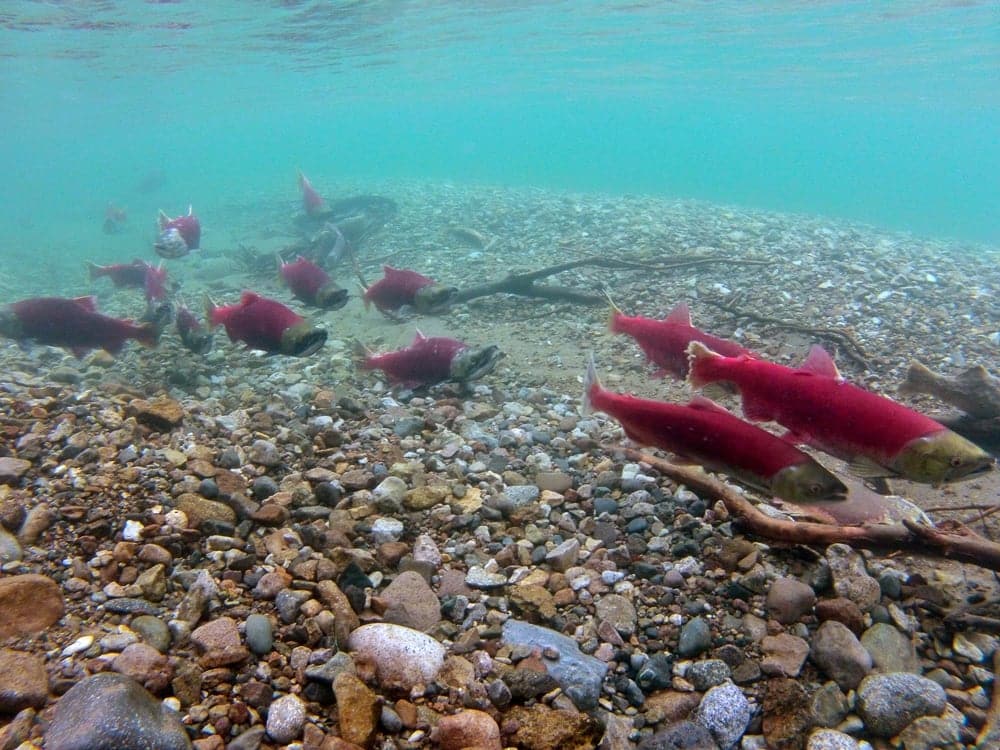
Sockeye salmon at Tazimina Lake. NPS Photo / D. Young. 2013

U.S. District Judge Sharon Gleason has sided with Alaska in a contentious case about who gets to control salmon fishing in certain waters.

Gleason upheld the National Marine Fisheries Service’s (NMFS) adoption of Amendment 16 to the federal salmon fishery plan for the Cook Inlet Exclusive Economic Zone (EEZ). The ruling confirms that NMFS is not obligated to regulate salmon fishing in state waters.

Opponents of Amendment 16 had argued that the measure violated the Magnuson-Stevens Act, which is the primary law governing marine fisheries in U.S federal waters and was created to prevent overfishing, rebuild depleted fish stocks and protect marine eco systems.

Opponents also argued the measure violated the Administrative Procedure Act (APA), a law that governs how federal agencies can create and enforce rules, claiming that NMFS should be required to manage salmon stocks across their full range or everywhere that salmon swim, including within state-managed nearshore waters.

The court disagreed. Judge Gleason affirmed that the MSA permits NMFS to manage fisheries as distinct units, and that the Cook Inlet EEZ salmon fishery qualifies. The decision also reinforced that NMFS’s jurisdiction is limited to federal waters, which begin three miles offshore.

Attorney General Treg Taylor praised the decision, calling it “a victory for Alaska and our salmon fishery.” He added, “It upheld the state’s rights and responsibilities to managing our waters. I want to congratulate the hard work and dedication of our Department of Law attorneys, especially Aaron Peterson, who have been tirelessly defending Alaska’s interests.”