Categories
Alaska News Featured Juneau News juneau Juneau Local Juneau Local Ketchikan Local News Feeds Sitka Local

Alaska Gov. Dunleavy joins Arctic research commission as focus turns to security

Yereth Rosen, Alaska Beacon
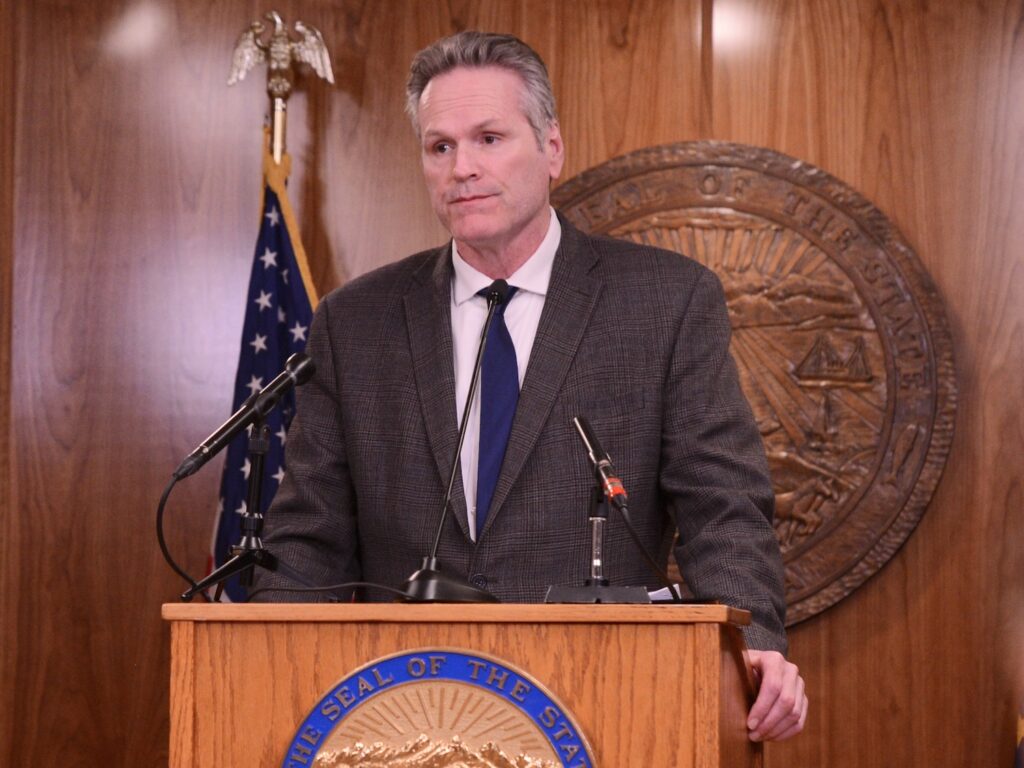
Alaska Gov. Mike Dunleavy talks to reporters during a news conference on Monday, May 19, 2025. (Photo by James Brooks/Alaska Beacon)

Alaska Gov. Mike Dunleavy has been appointed to the U.S. Arctic Research Commission at a time when the federal agency is pivoting from its longtime focus on environmental science to more emphasis on military defense and economic development.

Dunleavy is an ally of President Donald Trump. Dunleavy’s presidential appointment, announced by the commission this week, comes five months after Liz Qaulluq Cravalho’s position on the commission was terminated. Cravalho is vice president of lands at NANA Regional Corporation, the Alaska Native corporation for the state’s northwest region. She was initially appointed by then-President Joe Biden in 2021 and reappointed in 2024.

The commission, created in 1984, advises the president and Congress on research policy. Its seven commissioners are appointed by the president.

Dunleavy is the first sitting governor to be appointed to the commission, which advises the president and Congress on Arctic research. Past Alaska lieutenant governors have served on the commission, but not during their time in state office. Mead Treadwell chaired the commission prior to being elected in 2010 as lieutenant governor in the Parnell administration, and Fran Ulmer chaired it after serving as lieutenant governor in the Knowles administration and after serving as chancellor of the University of Alaska Anchorage.

In 2019, his first year in office, Dunleavy used his veto powers to cut state funding of the University of Alaska system by 41%, an action that at the time was characterized as devastating to the university’s Arctic research, among other activities. Much of the funding was later restored through a compromise Dunleavy made with the university.

In a statement released by the commission, Dunleavy praised the role of Arctic research, saying it helps Alaskans.

“Alaska sits at the forefront of the Arctic, and our communities, resources, and strategic position make us essential to advancing responsible research, economic development, and national security in the region,” he said in a statement released by the commission. “I look forward to working with fellow commissioners to ensure that Arctic research reflects the needs of Alaskans while strengthening America’s leadership in the Arctic.”

The Trump-appointed chair of the commission, speaking Wednesday at the Arctic Encounter Summit in Anchorage, said the organization is “tremendously thrilled” to have Dunleavy as a member.

Thomas Emanual Dans, appointed by President Donald Trump as chair of hte U.S. Arctic Research Commission, speaks at the Arctic Encounter Summit in Anchorage on April 15, 2026. (Photo by Yereth Rosen/Alaska Beacon)

“We’re super excited about that,” said Thomas Emanual Dans, appointed in December. “We’ve got the very experienced hand and voice at our commission, and we’re looking to do big things here.”

A pivot to security needs

Dans, who also served on the commission during the first Trump administration, expressed an expansive view of the Arctic that he likened to that of 19th century explorers.

“We want to create the conditions that really unleash human flourishing. We want more. We want human life. We want people to have big dreams,” he said.

Rather than focusing on pure science, the commission is focused on security, as Dans described it.

“Security is probably the overriding, overarching theme of things,” he said.

But security has several facets, he said. It includes military security, international security, energy security and community security, “which can be interpreted broadly in terms of health and well-being” for Arctic residents and others in the nation and the world, he said.

Dans, who lives in Texas and spent most of his career in finance, served on the U.S. Arctic Research Commission during the first Trump administration. But his comments on Wednesday indicated some gaps in his Arctic and Alaska knowledge.

He mentioned Russia’s Wrangel Island, off the northern coast of Siberia, as a security threat. Wrangel island “is close to Alaska here,” he said in his speech. “And for a long time it was incorporated as part of the United States. Today we face missiles pointing at us from Wrangel Island.”

Canadian government brochures and fliers, displayed April 15, 2026, at the Arctic Encounter Summit in Anchorage, describe that country's countribution to U.S. national defense. (Photo by Yereth Rosen/Alaska Beacon)
Canadian government brochures and fliers, displayed April 15, 2026, at the Arctic Encounter Summit in Anchorage, describe that country’s countribution to U.S. national defense. U.S. Arctic policy now has a stronger emphasis on national security. (Photo by Yereth Rosen/Alaska Beacon)

Wrangel Island was never part of the United States. There is a place with a similar name – Wrangell Island – that is located in Southeast Alaska. Since 2004, Russia’s Wrangel Island, located 300 miles from the nearest point in Alaska, has been designated as a UNESCO World Heritage Site. It is famous for its Arctic biodiversity, including the world’s largest concentration of Pacific walruses.

A decade ago, Russia built a military base on the island with a focus on radar systems to monitor airspace. The military use of the island is part of Russia’s military buildup in the Arctic, which has worried U.S. officials, and it is also considered to pose a potential threat to the natural resources there.

In his Arctic Encounter Summit comments, Dans hailed the planned expansion of the U.S. Coast Guard’s icebreaker fleet, saying the fleet has “gone from zero to maybe 14.” However, the Coast Guard for decades has operated two polar-class icebreakers: the Healy, which performs annual missions in Alaska and the wider Arctic, and the Polar Star, which usually sails in the Antarctic. The Coast Guard recently acquired another icebreaker for Arctic operations. Originally an oil industrial vessel called the Aiviq, the ship was renamed Storis and commissioned in a Juneau ceremony in August. The fleet is poised to expand: there was funding for more than a dozen new icebreakers in the Trump administration spending bill known as the One Big Beautiful Bill Act.

Concerning Russia, which holds more Arctic coastline and land than any other nation, Dans urged more cooperation and communication. “I’d love to have the younger generation in Alaska learn Russian,” he said.

Within a few miles from the Dena’ina Civic and Convention Center, where Dans spoke at the Arctic Encounter Summit, classes were being conducted in Russian language at elementary, middle and high schools through the Anchorage School District’s Russian immersion program. It was launched as a full-time program in 2024, according to the school district.

Categories
Featured Juneau News Juneau Local Ketchikan Local News Feeds Sitka Local

When permafrost thaw turns Arctic Alaska river red, toxicity levels rise, scientists find

By: Yereth Rosen, Alaska Beacon

Patrick Sullivan stands by an acid seep on July 15,2023. Sullivan is part of a team of scientists who tested water quality in Kobuk Valley National Park’s Salmon River and its tributaries, where permafrost thaw has caused acid rock drainage. The process is releasing metals that have turned the waters a rusty-looking and opaque. (Photo by Roman Dial/Alaska Pacific University)

When scientists Patrick Sullivan and Roman Dial were heading to a remote area in the Brooks Range in 2019 to map the spread of woody plants there, they were looking forward to seeing a celebrated river that author John McPhee described decades ago as having the “clearest, purest water I have ever seen flowing over rocks.”

What they found in the Salmon River, a waterway that flows through Northwest Alaska’s Kobuk Valley National Park, was much different than what McPhee described in his landmark 1976 Alaska book “Coming Into the Country.” The waters Sullivan and Dial found were reddish-orange and murky from loads of minerals flowing into them.

The Salmon River and its tributaries had become transformed into “rusting rivers,” a phenomenon caused by climate change in permafrost regions.

“The permafrost is thawing, and it’s essentially acid rock drainage that’s occurring. These sulfite minerals are being exposed to oxygen and water for the first time in thousands of years and it’s releasing acid which is leaching metals out of the rocks to the streams,” said Sullivan, who heads the Environment and Natural Resource Institute at the University of Alaska Anchorage.

The problem goes beyond aesthetics, according to further research by Sullivan, Dial, who is at Alaska Pacific University, and their colleagues.

The Salmon River, a designated wild and scenic river, and its tributaries are so tainted by acid-rock drainage that their concentration of metals is considered toxic to chronically exposed aquatic life, they found.

Water samples taken in the summers of 2022 and 2023 found that the river and almost all of its tributaries were carrying metals at levels above U.S. Environmental Protection Agency and state of Alaska standards, according to a recently published study by Sullivan and his colleagues. A variety of metals were showing up in amounts dangerous to aquatic life: iron, cadmium, aluminum, nickel, zinc and copper, their study found.

The “rusting rivers” pollution is similar to the kind of pollution that can happen from hardrock metals mining. But unlike the case with mining, it is happening in the absence of human development, and it is happening over diffuse spots, whereas a single point source at a mine that could potentially be controlled.

“This wild and scenic river in the heart of Kobuk Valley National Park, it’s about as protected as you can get and as remote as you can get. And it’s kind of falling apart,” Sullivan said.

The study, published in the journal Proceedings of the National Academy of Sciences, summarized the situation in its title: “Wild, scenic, and toxic.”

There are places around the Arctic where rust-red rivers have been that way for centuries, like Canada’s Arctic Red River, also known in the Gwich’in language as Tsiigehnjik, meaning “iron river.”

But for the Salmon River, the change was abrupt.

The Bush pilot who ferried Sullivan and Dial to the site in 2019, who described the river’s appearance as similar to sewage, said it had just happened that year.

The toxicity findings are potentially ominous for fish health.

The timing of the change suggests that thaw-induced acid rock drainage could be one of the many factors depressing western Alaska salmon runs, the study found.

The Salmon River in Kobuk Valley National Park is seen from the air on Sept. 7, 2020. (Photo by Ray Koleser/Provided by Patrick Sullivan)
The Salmon River in Kobuk Valley National Park is seen from the air on Sept. 7, 2020. (Photo by Ray Koleser/Provided by Patric Sullivan)

Salmon runs have been disastrously low in the region for the past few years, sometimes precluding even traditional subsistence harvests that are relatively small in scale but hugely important to culture and food security.

At the very least, the timing is a coincidence, Sullivan said. “It’s identical to what you would expect if these degrading streams were impacting spawning success,” he said, pointing out that most of the chum salmon that returns to the Kotzebue Sound area do so at the ages of four of five years, after emerging from the spawning rivers and swimming around in the ocean.

There is too little evidence for now to definitely link the rust-tinted waters of the Salmon River to poor salmon runs, Sullivan said. That is largely because there is too little known about that river’s fish populations, though the name suggests that the river was important to salmon in the past, he said.

It appears to have been that way in the 1970s, when McPhee was there boating there, fishing, camping and collecting information for his book.

At that time, the water was so clear that the riverbed was “as distinct as if the water were not there,” McPhee wrote. Those clear waters chock-full of oval-shaped salmon swimming upstream to spawn, he wrote. “Looking over the side of the canoe is like staring down into a sky full of zeppelins,” he wrote.

The recent proliferation of rusting rivers is not limited to Alaska and other parts of the Arctic. There are affected high-altitude areas that have permafrost, glaciers or both, including Switzerland and neighboring parts of the AlpsPeru and parts of Colorado.

In Alaska, the rusting rivers phenomenon is more pronounced in the western part of the North Slope than in the eastern part, Sullivan and Dial have found. Their past studies linked the vegetation changes in the northwest to more pronounced warming on the Chukchi Sea side of Alaska’s Arctic than on the Beaufort Sea. That spread of woody plants is detrimental to tundra caribou that eat lichen and moss, and could help explain the decline in the Western Arctic caribou herd, which has a habitat that is changing more quickly than that of the Porcupine caribou herd on the eastern North Slope, they found.

After Sullivan and Dial encountered multiple rusting rivers during their plant studies, they felt compelled to alert fellow Alaskans about the situation.

They penned a 2022 column for the Anchorage Daily News. And they embarked on their further studies, which wound up generating a small National Science Foundation grant, creating partnerships with scientists at other universities who are experts in biochemistry and, ultimately, the newly published study on toxicity.

But before then, when they were expecting to see the same conditions that McPhee did in the 1970s, Sullivan packed a fishing rod with the gear he took on the trip to the Salmon River.

His attempts to fish in the murky, opaque water proved futile, however. “I think I tried for, like, five minutes and then I quickly realized that I was wasting my time,” he said.

That experience suggests that there might be further ecological impacts of the cloudy, rusted waters, he said.

“I think it would be very hard, for instance, for a bear to fish for a salmon just because of the turbidity. Raptors would have a really hard time catching a fish if they were fishing there,” he said, citing the suspended solids that make the water opaque.

For now, Sullivan and other scientists are using satellite imagery to spot other rivers and streams that might be similarly affected. The imagery is useful not just for spotting acid-tinted streams but the point sources in the tundra, he said.

It would be helpful to have more research on the region’s fish to explore whether they are carrying metals in their bodies, he said. Another topic of study could be the response of chum salmon in the region, as the species does show the some ability to shift habitats, he said.

Yet to be determined, Sullivan said, is how long this rusting river situation will last.

“It’s possible that this will kind of run its course over some period of time. And once the unweathered sulfite minerals have been oxidized, then it’s likely that the stream will turn back to clear again,” he said. “But we have no idea when that process might reach its conclusion and how many new acid seeps might develop.”

Categories
Featured Juneau News Juneau Local Ketchikan Local News Feeds Sitka Local

Coast Guard to commission first new icebreaker in 25 Years Sunday in Juneau

Icebreaker Storis on its maiden voyage

NOTN- The U.S. Coast Guard cutter Storis, the Coast Guard’s first polar icebreaker acquired in more than 25 years, will depart Auke Bay on Saturday for its scheduled transit to downtown Juneau, where it will be permanently berthed.

The Storis hosted free public tours Thursday and Friday and will host a media ride-along Saturday.

The Coast Guard will commission this first new icebreaker in 25 years during a ceremony in Juneau on Sunday.

The Coast Guard Cutter Storis will be officially commissioned at 9:30 a.m. at Peratrovich Plaza, 292 Marine Way, the service said. The event will also be streamed online.

Adm. Kevin Lunday, acting commandant of the Coast Guard, is scheduled to attend and take part in a media availability.

The vessel expands America’s operational presence in the Arctic and will support Coast Guard missions while the service awaits the delivery of the Polar Security Cutter class of ships.

It’s the second vessel in Coast Guard history to bear the name Storis. The vessel is manned with a hybrid crew consisting of military and civilian mariners.

The acquisition of the Storis was made possible through the Don Young Coast Guard Authorization Act of 2022 and fiscal year 2024 Congressional appropriations.

The Coast Guard operates more than 250 cutters, 200 aircraft and 1,600 boats to safeguard U.S. ports, waterways and maritime borders.

Categories
Featured Juneau News Juneau Local Ketchikan Local News Feeds Sitka Local

New Alaska-bound ocean mapping ship begins construction in Louisiana

By: James Brooks, Alaska Beacon

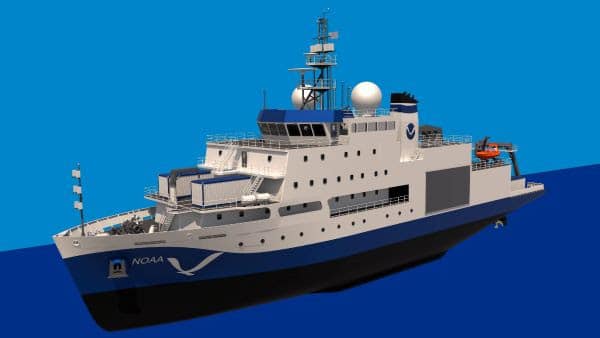
This undated image, provided by the National Oceanic and Atmospheric Administration, shows a mockup of the Surveyor, an ocean-floor-mapping ship under construction and scheduled to be homeported in Ketchikan. (NOAA image)

Next week, the National Oceanic and Atmospheric Administration is planning to host a ceremony in Louisiana to mark the start of construction on the NOAA ship the Surveyor, a new charting and mapping ship scheduled to be homeported in Ketchikan.

NOAA announced the keel-laying ceremony, scheduled for Aug. 14, by email.

The Surveyor is expected to be finished in 2027, and its sister ship, the Navigator, is expected to be finished in 2028.

NOAA operates a fleet of 15 charting, mapping and fisheries ships using an unarmed officer corps like a scientific version of the U.S. military. The Surveyor and Navigator will be used primarily for ocean mapping and nautical charting.

Two other deep-sea ships, the Oceanographer and Discoverer, are also under construction and are expected to be complete in 2026. 

All four ships are part of an ongoing effort to keep the NOAA fleet afloat; as of 2023, the fleet’s average age was 30 years old, and six of the fleet’s current ships are expected to reach the end of their service life by 2030. 

The ships will be built by Thoma-Sea Marine Constructors in Houma, Louisiana, under a $624.6 million contract that would allow NOAA to construct two more ships if funding is available.