Categories
Alaska News Featured Juneau News juneau Juneau Local Juneau Local Ketchikan Local News Feeds Sitka Local

Oil markets are second most uncertain on record, economist tells Alaska legislators

By: James Brooks, Alaska Beacon

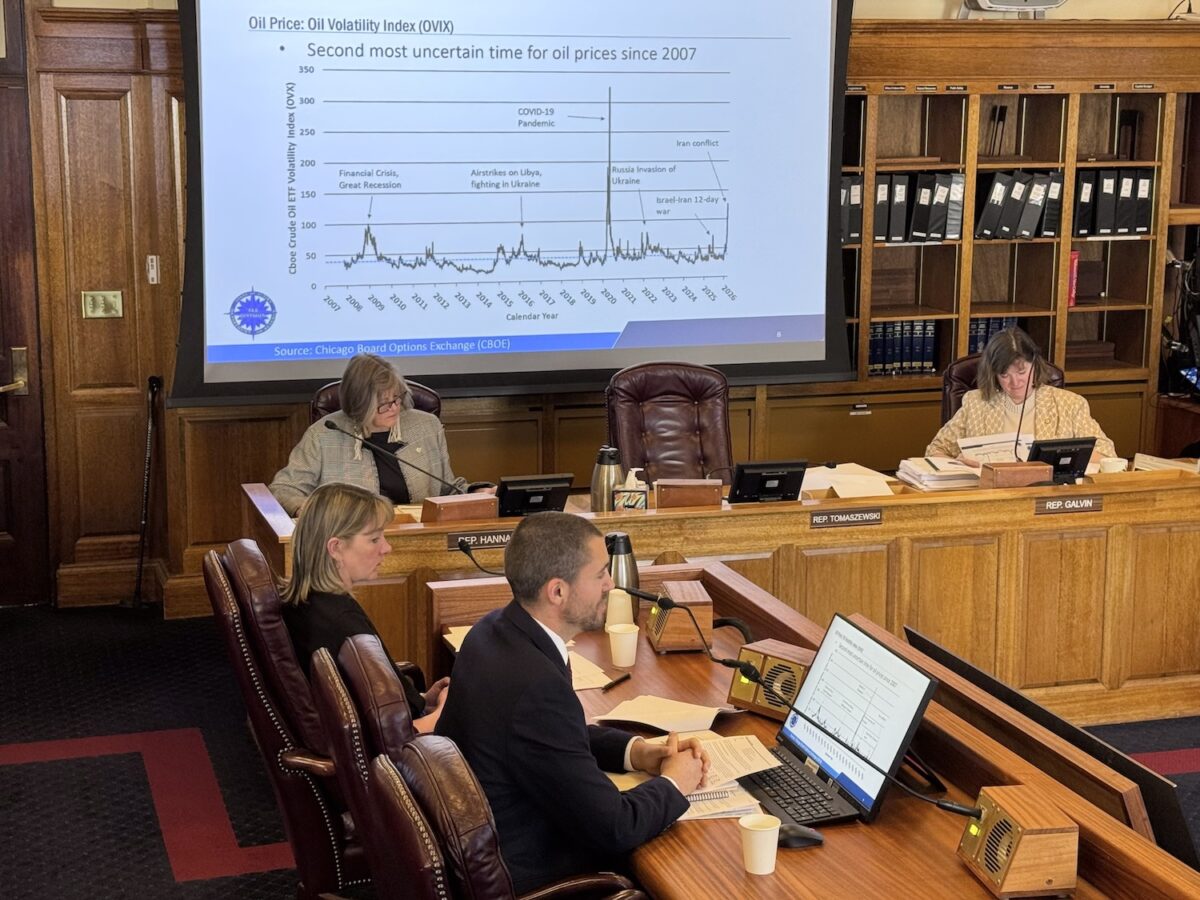
Economist Dan Stickel talks to the Alaska House Finance Committee on Monday, March 16, 2026. (James Brooks photo/Alaska Beacon)

The U.S.-Israeli war against Iran has left oil markets more uncertain than they were during the Great Recession, a state expert told the Alaska Legislature on Monday.

In a pair of hearings, Alaska Department of Revenue economist Dan Stickel told state legislators that the volatility of global oil markets is the second-highest on record, leaving future forecasts particularly unreliable.

“The level of uncertainty around future prices in the oil markets now is higher than during the peaks of the Great Recession in 2008-2009 and it’s higher than the Russian invasion of Ukraine, and it’s higher than any of the COVID spikes other than the initial April 2020 spike,” he said during a Monday morning hearing of the Senate Finance Committee.

“The message here is to plan for the possibility that revenue doesn’t come in exactly at what we forecast for the next couple of years,” Stickel said. 

Oil is the second-largest source of general-purpose revenue for the Alaska state budget, and Stickel’s testimony came days after the department released a new Alaska revenue forecast showing $545 million more in current-year revenue than projected in the fall. Most of that higher prediction is due to the price of oil.

That forecast has snarled relations in the Alaska House of Representatives, which has repeatedly postponed discussion of a bill that would fund a variety of amendments to the fiscal year 2026 budget passed by lawmakers and Gov. Mike Dunleavy last spring. 

On Monday, after more than two hours of acrimonious debate, House legislators again declined to take up the bill.

Soon after the House adjourned its floor session, Stickel testified in front of the House Finance Committee, and told lawmakers that “the level of certainty that we will hit our exact forecast is low.”

As he spoke, on the other end of the Capitol’s fifth floor, the Senate Finance Committee was simultaneously hearing from Office of Management and Budget director Lacey Sanders, who said the governor’s office was requesting another $18 million in spending for the current fiscal year.

Altogether, the governor has requested almost $427 million in additions to the budget. Add in additional spending proposed by lawmakers, and there’s only about a $30 million difference between the new revenue forecast and the additions proposed by the governor and legislators.

At the latest forecast prices, said Rep. Calvin Schrage, I-Anchorage, a $2 change in the average price of a barrel of North Slope oil is worth $30 million.

He asked Stickel what the odds were that the forecast misses low by more than $2.

“Roughly a slightly less than 50% chance that we come in more than $2 below the forecast,” Stickel said, then alluded to the fact that there’s a similar chance of coming in above the forecast.

“The level of certainty that we will hit our exact forecast is low in either direction,” he said.

Currently, members of the House majority are advocating that legislators unlock the state’s principal savings account to provide surety for some of those budget additions.

Doing so would avoid problems if oil prices turn out to be lower than forecast.

But spending from the Constitutional Budget Reserve, the state’s principal savings account, requires 30 votes in the House and 15 votes in the Senate. 

The House’s multipartisan coalition majority has 21 members, which means they need support from the all-Republican House minority caucus.

Members of that group have been arguing against unlocking the budget reserve right now, saying that the new forecast and the current balance of the state’s general-purpose accounts demonstrate it isn’t needed.

In addition, as currently written, the supplemental budget bill in the House would allow spending from savings regardless of the price of oil. That could allow the majority to dictate extra spending even if prices stay high. 

The Senate has already approved spending from the Constitutional Budget Reserve, and on Monday morning, Sen. Bert Stedman, R-Sitka and co-chair of the Senate Finance Committee, said a draw from the reserve would act as a “safety net.” 

Sen. Lyman Hoffman, D-Bethel, said senators don’t intend to spend dollars from savings unless it is needed. 

“If they are not needed, they will stay in the CBR,” he said, adding that without permission to spend from savings, there’s a chance that lawmakers would need to return in August to fix budget problems in a special session.

Categories
Featured Juneau News juneau Juneau Local Juneau Local Ketchikan Local News Feeds Sitka Local

Alaska’s Congressional delegation votes to support American-Israeli war with Iran

By: James Brooks, Alaska Beacon

 A plume of smoke rises after an explosion on Feb. 28, 2026 in Tehran, Iran. (Getty photo)

All three members of Alaska’s delegation to Congress showed their support for the new war with Iran last week, voting against resolutions intended to restrain President Donald Trump.

Sens. Lisa Murkowski and Dan Sullivan, both Republicans, voted against a measure in the Senate on Wednesday, and Rep. Nick Begich III, also a Republican, voted against a similar House resolution on Thursday.

Both resolutions failed to advance. 

The Alaska legislators’ votes were in line with their past actions. Last year, when Trump ordered a bombing campaign against Iranian nuclear facilities, all three said they supported the strikes.

The current war is significantly larger than last year’s attacks, and Trump has said he is seeking Iran’s “unconditional surrender” and wants to have a role in picking its next leader.

Neither he nor senior administration officials have given firm long-term plans, and they have not ruled out the deployment of soldiers on the ground in Iran. 

Begich issued a statement on Feb. 28 calling the war “a necessary and targeted response” and said he supports regime change in the country.

“The path forward cannot be centered on further appeasement but the removal of this corrupt, fanatical leadership that has brought suffering to the Iranian people and threatens our peace at home. In so doing, we can provide the people of Iran the opportunity to change leadership, reclaim their sovereignty, and chart a new course,” the statement said in part.

Begich is in the middle of a re-election campaign, and his two leading challengers issued statements opposing the war.

By email, Democratic U.S. House candidate Matt Schultz criticized Begich’s vote and suggested he would have chosen differently.

“Our tax dollars should build schools and hospitals here at home, not bankroll endless foreign wars. But Washington always seems to find billions for war while Alaskans pay the price with sky-high costs and watch investments in our future get delayed, downsized, or ignored,” he said.

“The cost of war isn’t just dollars and cents, it’s measured in human lives and suffering. As a pastor, I believe every life is sacred. That’s why the Constitution requires Congress to approve war: so no president can send Americans into conflict without a real plan and the support of the American people.”

A spokesperson for independent U.S. House candidate Bill Hill referenced that candidate’s posts on social media when asked about his position.

“Our leaders should be investing in lowering costs and making life better for working Americans, not putting American lives at risk in foreign wars without congressional approval,” Hill wrote in a Wednesday post on Facebook

“Six U.S. service members have died and billions of dollars have been spent in a matter of days.  Meanwhile here at home, our schools are in crisis, healthcare costs keep rising, veterans are at risk of losing benefits, and everyday costs are just too damn high,” he wrote. “We can’t afford a costly war with no end in sight.”

On the Senate side, Murkowski said the resolution presented to her this week would have required the removal of soldiers from hostilities, stopping military operations immediately.

“The abrupt cessation of all offensive operations would not leave any Americans — soldiers, diplomats, or civilians — in the Middle East in a safer position,” her statement said in part.

Murkowski said Trump has “committed U.S. troops to active engagement in combat with an enemy that has targeted and killed Americans for decades. We have lost six soldiers in this fight with the potential for more casualties. What our troops need now is for our Congress, and this country, to know that they are supported. It is for this reason that I oppose Senator Kaine’s War Powers Resolution — based on the practical implications of its passage.”

Sullivan has supported military action against Iran for years and told reporters on Feb. 28, “I’m not someone that, in general, would support kind of taking out world leaders,” he said. “But I think these guys, … my belief is that they’re less world leaders than terrorists, right?”

He reiterated his position during a Congressional hearing days later, alluding to Iranian support for anti-American insurgents during the Iraq War and in terrorist actions before that.

“This country’s been at war with us for almost a half century,” he said, referring to Iran, “and they’ve killed thousands and wounded thousands of our best and brightest.”

Sullivan is also facing a re-election campaign this year, but unlike on the House side, there isn’t a bright line between the incumbent and his leading opponent on this issue. 

Democratic U.S. Senate candidate Mary Peltola hasn’t made any public statements about the Iran war, and her campaign social media accounts have been silent on the subject.

When contacted Thursday, her campaign spokesperson said she had no comment. 

That makes it unclear whether she supports or opposes the war.