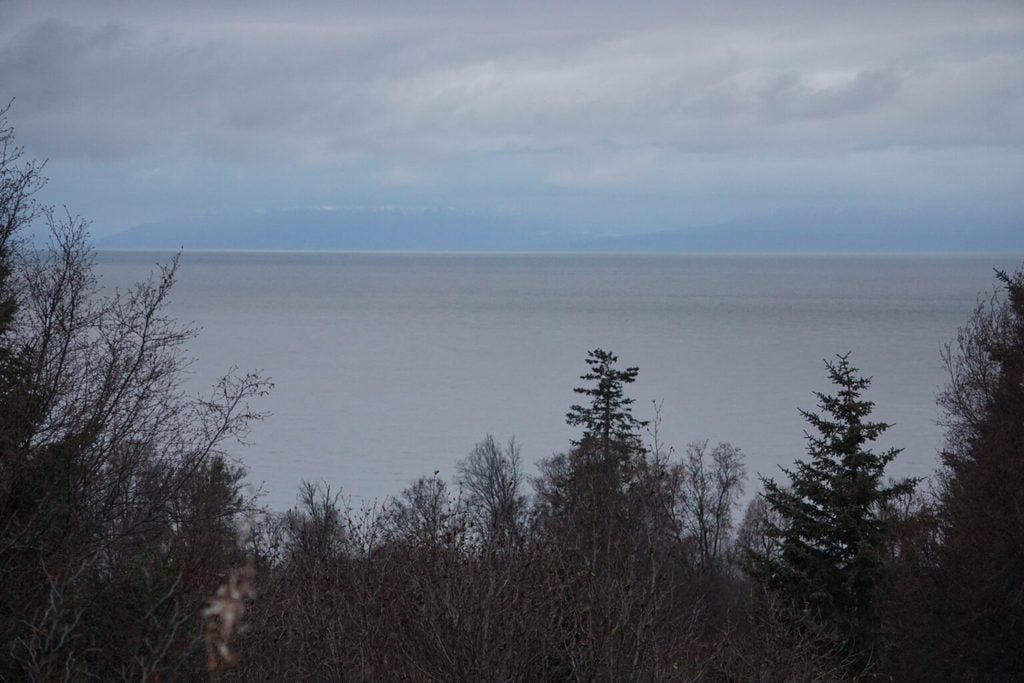
Cook Inlet near Clam Gulch is seen on Oct. 23, 2025. (Photo by Yereth Rosen/Alaska Beacon)
State and industry officials and the U.S. Coast Guard were responding on Tuesday to an unexplained oil spill roughly 60 miles southwest of Anchorage in Southcentral Alaska’s Cook Inlet.
The spill, which produced a long oil sheen on the water near the Trading Bay area on the western side of the inlet, was first spotted by a pilot on Monday. His report prompted a multiagency response.
The multiagency unified command is composed of the Alaska Department of Environmental Conservation, the U.S. Coast Guard and Hilcorp, the dominant oil and gas operator in Cook Inlet.
The sheen was seen near the idled Spark platform, one of 17 oil and gas platforms in the inlet. Six of those, including Spark, are now inactive. The Spark platform was acquired by Hilcorp as part of its 2012 purchase of Marathon Oil’s Cook Inlet assets. It has been inactive since 1992, said a statement issued by the unified command responding to the spill. The wells associated with the Spark platform were plugged and abandoned by a previous owner in 2009, the statement said.
As of Tuesday afternoon, however, the ongoing investigation has not pinpointed a source of the spill, its size or even the substance, DEC officials said.
An oil-response vessel sent by Hilcorp to the site arrived shortly after 2 a.m. on Tuesday, but its crew was not able to spot the sheen with infrared imaging technology, said the incident command statement. The spill-response vessel, the Endeavor, has been sailing in a grid pattern to search for the spilled material and its possible source, the statement said.
A closeup view of a 2022 Alaska Division of Oil and Gas map shows the pipelines and oil and gas platform locations in Cook Inlet. (Map provided by the Alaska Division of Oil and Gas)
There were no reports of impacts to fish or wildlife as of Tuesday afternoon, said a DEC situation report issued on Tuesday afternoon.
Fish could be potentially at risk, the situation report said. All five species of Pacific salmon swim in the affected waters, and coho and sockeye salmon were migrating through the area at the time the spill was reported, the situation report said.
Representatives of area environmental groups said Tuesday that the event was a warning about risks to the inlet.
Satchel Pondolfino, the clean water lead for Cook Inletkeeper, said she and others are concerned about the apparent association with the idled but still-standing Spark platform.
“It’s just another reason why it’s so important that Alaska use its authority to hold Hilcorp and every other operator accountable for dismantling the infrastructure,” she said.
Activists have called for the removal of such unused infrastructure from the inlet, but the state so far has not ordered any company to do that.
Cooper Freeman, Alaska director of the Center for Biological Diversity, said numerous natural resources continue to be at risk from the incident and others like it.
“It’s gut-wrenching to see the inlet’s beleaguered salmon and belugas take a hit they can’t afford from a miles-long oil spill,” he said in an emailed statement. “We need Cook Inlet’s fish and wildlife to recover, and we can’t keep treating their home like an industrial waste zone. This is yet another wake-up call that our over-reliance on fossil fuels imperils not just our region’s long-term energy stability, but the vitality of our environment for all future Alaskans.”
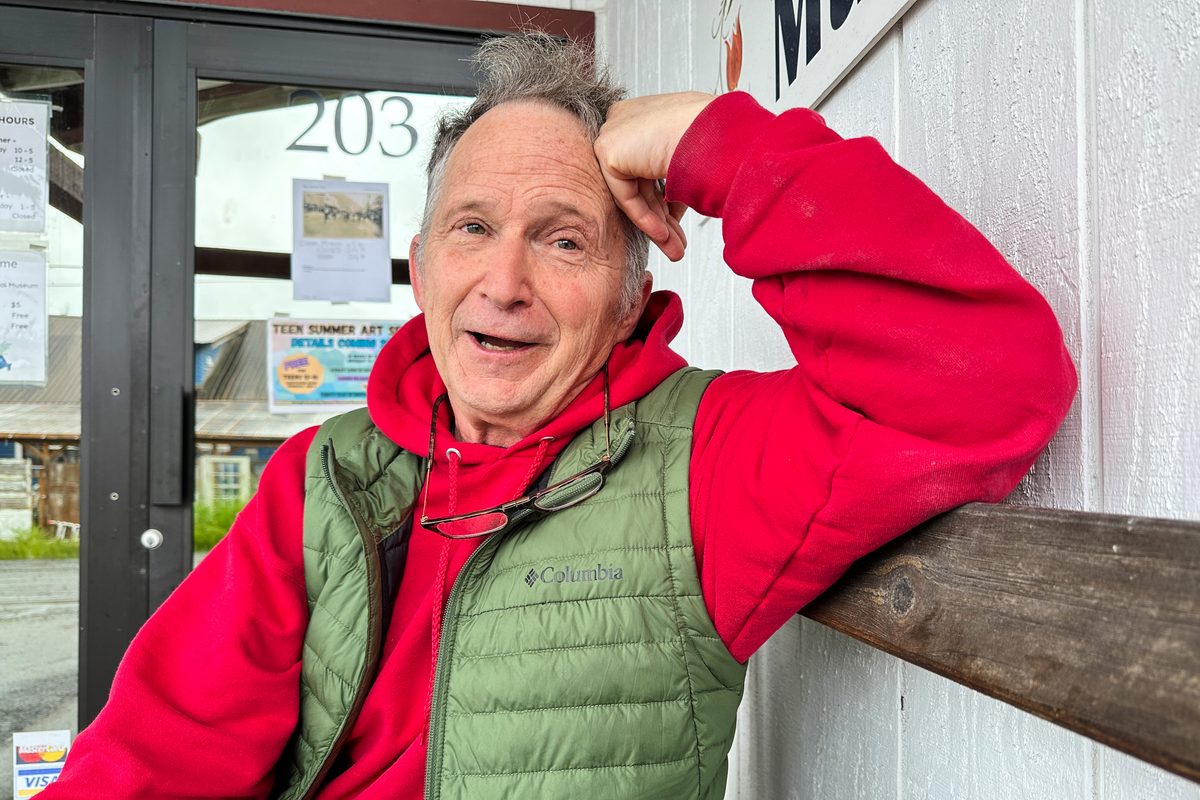
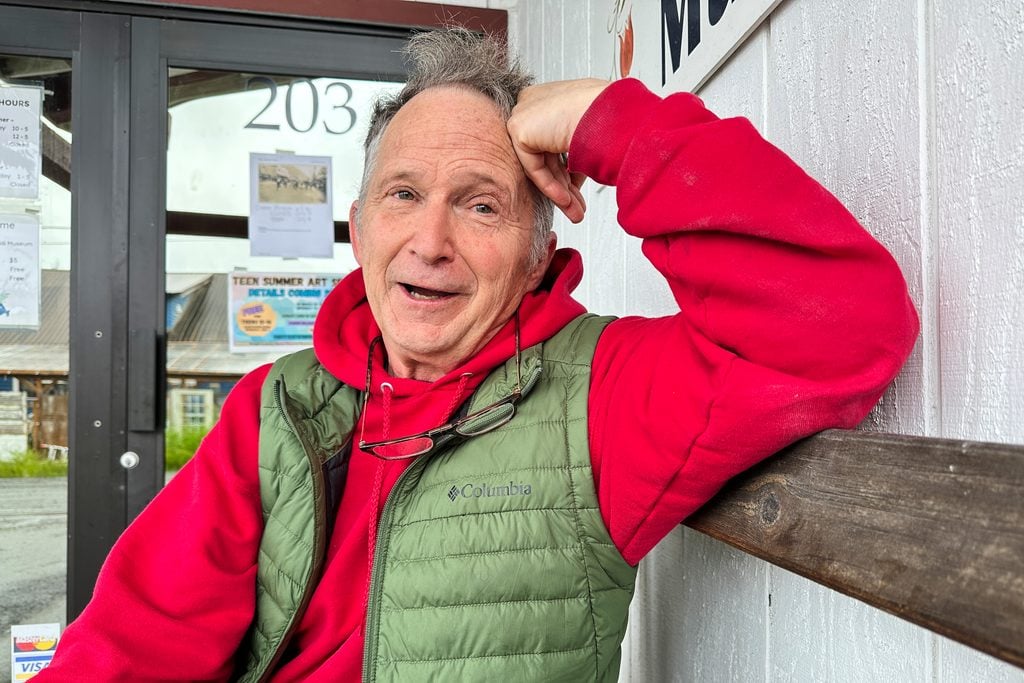
FILE - Dan Sullivan, a candidate in Alaska's U.S. Senate race who shares his name with the incumbent seeking reelection, talks with a reporter, July 3, 2026, in Petersburg, Alaska. (AP Photo/Becky Bohrer, File)
FILE – Dan Sullivan, a candidate in Alaska’s U.S. Senate race who shares his name with the incumbent seeking reelection, talks with a reporter, July 3, 2026, in Petersburg, Alaska. (AP Photo/Becky Bohrer, File)
AP- A candidate with the same name as Alaska’s incumbent U.S. senator has advanced to the general election in what will be one of the most closely watched races in the country this fall.
Dan J. Sullivan, who goes by Dan Sullivan, was among the top four finishers after the Aug. 18 primary and on Tuesday moved on to the November matchup, which is a ranked choice contest. The incumbent, Republican Sen. Dan Sullivan, and Democratic former U.S. Rep. Mary Peltola also have advanced.
The challenger Sullivan, a retired teacher from the island community of Petersburg, sued for a spot on the ballot and succeeded after a judge invalidated a decision by a top state elections official who said he had filed his candidacy with an intent to confuse voters. The allegation was driven by claims raised by the senator and his GOP allies. The state Supreme Court ultimately ordered Dan J. Sullivan eligible for the ballot.
While the challenger sought to appear on the ballot as Republican Dan J. Sullivan, the Division of Elections listed him as Daniel J. Sullivan Jr., with no party affiliation. The senator was listed as Dan S. Sullivan, Republican and incumbent.
A call seeking comment from the challenger was not immediately returned Tuesday, and emails to campaign staff for the senator also were not immediately returned.
President Donald Trump endorsed Sen. Sullivan for reelection and called the other Sullivan’s candidacy an attempt to trick voters. Dan J. Sullivan criticized the incumbent for embracing Trump’s endorsement and said the president was “more interested in raising tariffs on our allies than in lowering the cost of groceries, housing and energy.”
It was too early to determine who would fill the fourth and final slot in the Senate general election race.
The Senate race was one of three major contests on Alaska’s primary ballot, which also featured races for the state’s lone U.S. House seat and governor.
In the congressional race, Republican Rep. Nick Begich, seeking a second term, advanced earlier to the general election along with independent Bill Hill. The other two spots remained too early to call.
Democrats Jonathan Kreiss-Tomkins and Tom Begich, former state lawmakers, advanced on election night in the race for governor, topping a field of mostly Republican candidates all vying to succeed Republican Gov. Mike Dunleavy. Tom Begich is Nick Begich’s uncle. Republican Bernadette Wilson also advanced on Tuesday, with the fourth spot remaining too early to call.
The state accepts absentee and overseas ballots up to 10 days after the primary as long as they were postmarked by election day.
The incumbent Sullivan and Peltola are the leading candidates in the Senate race, after raising the most money and having statewide name recognition. It’s one of a handful of Senate races around the country considered competitive and pivotal for both parties’ hopes of controlling the chamber.
Dan J. Sullivan’s presence on the general election ballot adds a twist to the race because of Alaska’s ranked choice voting system. Under it, candidates who finish third or fourth in the general election can play a crucial role in deciding the eventual winner if their supporters rank other choices beyond them.
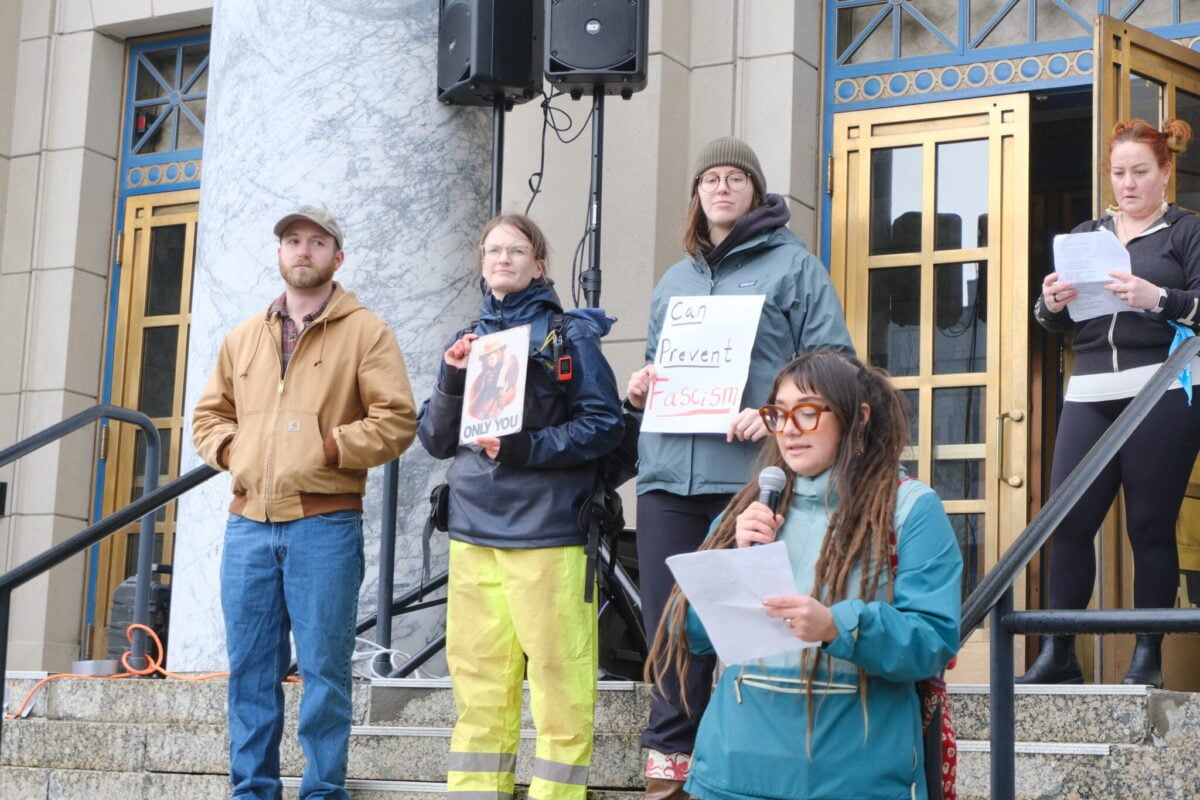
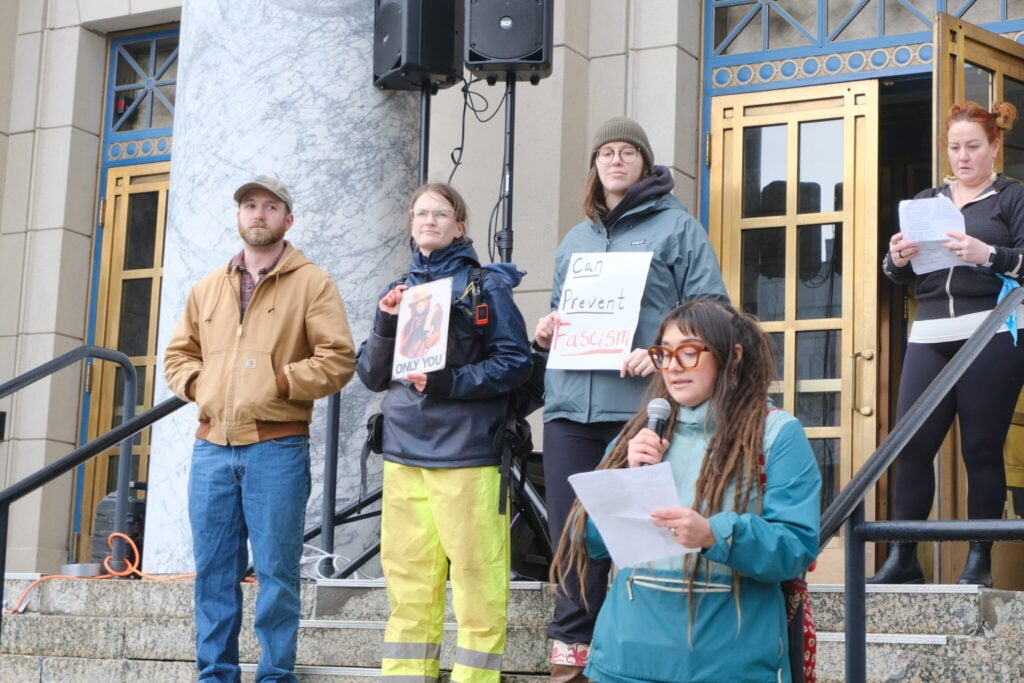
Fired federal workers formerly with the U.S. Forest Service based at the Mendenhall Glacier in Juneau speak at the Alaska State Capito; on March 21, 2025, about their experiences. The Forest Service was among the federal agencies in Alaska most heavily affected by job cuts. (Photo by Corinne Smith/Alaska Beacon)
Alaska lost a higher percentage of its federal workforce last year than almost all U.S. states to sweeping Trump administration cuts, according to a newly published analysis by the Alaska Department of Labor and Workforce Development.
By the end of 2025, Alaska’s federal workforce was 10.5% smaller than it had been at the end of the prior year, according to the analysis, published in Alaska Economic Trends, the monthly magazine of the department’s research section. In the fourth quarter of 2025, after many workers accepted buyouts or early retirement, the state’s federal workforce had dropped by 1,607 from the total in the fourth quarter of 2024, to 13,767 from 15,374 the year prior, according to the analysis.
The job losses came through mass firings and cuts made by the so-called Department of Government Efficiency, or DOGE, the government-reducing campaign led by trillionaire Elon Musk that started shortly after Donald Trump took office for his second term. To a large extent, job losses were concentrated at the end of the year.
Calculated by the annual average, Alaska lost about 4.5% of its federal jobs in 2025. Only Maryland, which lost 6.5% of its federal jobs, and New Mexico, which lost 5.8% of its federal jobs, lost more.
Federal job losses reduced Alaska’s total earnings by $36.5 million on average in 2025, according to the Department of Labor and Workforce Development analysis, and they brought federal employment in Alaska to the lowest level since at least 1990.
Much of the cutting in Alaska came in the U.S. Department of Defense’s civilian workforce. Calculated by annual average, 340 defense related jobs were lost to the DOGE cuts, but the fourth-quarter loss was calculated at 755 jobs.
The large amount of job losses in the Department of Defense category was a bit surprising, said Karinne Wiebold, the state labor economist who wrote the Trends article. “I assumed early on that the DoD might be one of the less affected departments and that our strong military presence might insulate us,” she said by email.
Federal agencies that sustained high numbers of job losses included the U.S. Forest Service, which had 180 fewer employees at the end of 2025 than in late 2024, the Bureau of Land Management, which had lost 133 jobs at the end of the year, and the National Oceanic and Atmospheric Administration, which had lost 101 of its workers by the end of 2025.
The fallout from the job losses continues, and the public does not yet have a complete picture, Wiebold said. “I do think the public is aware of the federal job losses and that they have been deep and a bit unpredictable,” she said. “I don’t know if the public generally understands what the ramifications of the cuts will be — federal employees perform a wide variety of oftentimes highly specialized work.”
Certain parts of the state were harder hit than others. The Southeast Fairbanks Census Area, which has been reliant on military-related employment, and parts of Southeast Alaska, where employment related to the Tongass National Forest is important, are among those regions with steeper job losses by percentage, according to the analysis.
Alaska’s ranking among states hit by DOGE-related job cuts could change, Wiebold said. Data from this year has yet to be fully analyzed, she said. “Even in the first parts of 2026, there are reports of the rankings shifting somewhat,” she said.
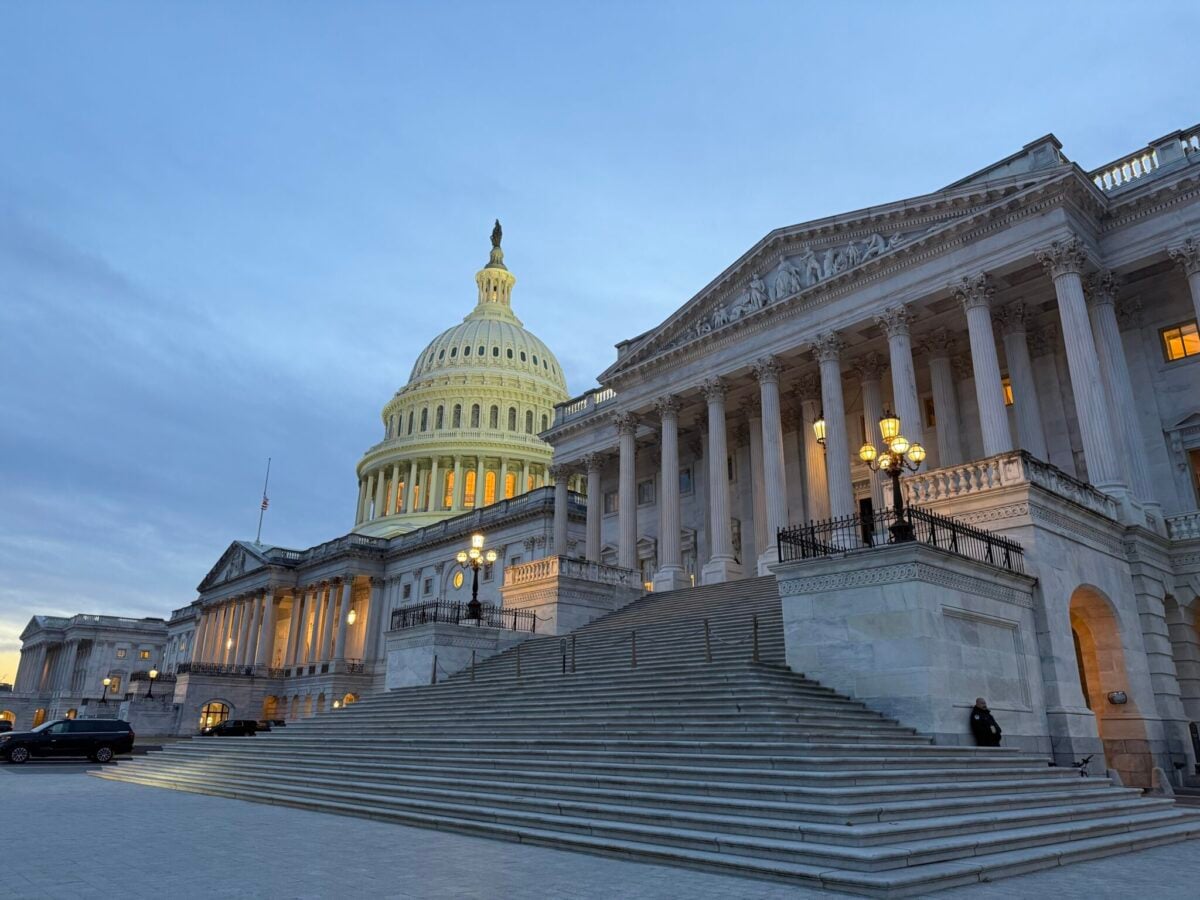
The U.S. Capitol building in Washington, D.C., on Tuesday, Jan. 13, 2026. (Photo by Jennifer Shutt/States Newsroom)
WASHINGTON — For the second time in as many weeks, a War Powers Resolution aimed at curbing President Donald Trump’s war with Iran failed to pass the U.S. Senate Thursday.
The vote breakdown, 49-50, fell along familiar lines as previous War Powers votes, with Republican Sens. Lisa Murkowski of Alaska, Rand Paul of Kentucky and Susan Collins of Maine supporting the measure.
Democratic Sen. John Fetterman of Pennsylvania voted no, as he’s done in just over a dozen similar measures.
Sen. Mitch McConnell, R-Ky., continues to be absent while in medical rehab.
A similar War Powers Resolution to rein in Trump’s military conflict in Iran passed in the U.S. House on July 23, but failed in the Senate — both led by Republican majorities.
War heats up
The regional war reignited yet again this week after Trump ordered retaliatory strikes Tuesday, along with Saudi Arabia’s armed forces, on Iran-backed militias in eastern Iraq. The strikes on “multiple terrorist logistics and weapons sites” were in response to Iranian drone attacks on U.S. forces in the region, according to U.S. Central Command.
Trump told Fox News on Wednesday, “We are going to beat the f—– s—- out of them.”
The United States launched a “heavy wave” of strikes on Iranian military sites beginning at 10 p.m. Eastern Wednesday “in response to yesterday’s attempted missile attacks on U.S. forces,” according to U.S. Central Command.
The cost of oil jumped to just over $90 a barrel Wednesday in response to renewed fighting and a continued chokehold on traffic through the Strait of Hormuz, where one-fifth of the world’s petroleum traveled prior to the U.S. and Israel launching the war in late February.
This means Americans are again paying more for fuel. According to AAA, the U.S. national average for a gallon of regular gasoline rose to $4.09 Thursday.
Before the volley of strikes began again, Trump had announced a pause, after the U.S. and Iran traded rocket fire for nearly two weeks following the collapse of ceasefire talks.
Service members killed
The president on July 22 attended the dignified transfer, in which the remains of soldiers are transferred from an aircraft arriving from the theater of operations back to the United States, for four U.S. service members killed as a result of the conflict with Iran.
Three of the service members were killed July 17 and July 18 in an Iranian strike at a U.S. airbase in Jordan, and a fourth was killed during a controlled detonation of an Iranian drone July 19 at a U.S. base in Iraq.
The most recent deaths of U.S. soldiers in the conflict bring the total killed to 18, while the number of injured increased to 653.
But the Pentagon does not recognize the four most recent deaths among those in the Iran war, dubbed by the administration as Operation Epic Fury.
Instead, the Pentagon is categorizing the latest deaths and injuries as casualties of “overseas operations starting July 7, 2026.”
The administration is asking Congress for an additional $67 billion for the war in Iran. Defense Secretary Pete Hegseth told Senate appropriators July 21 that the war has already cost $37.5 billion.
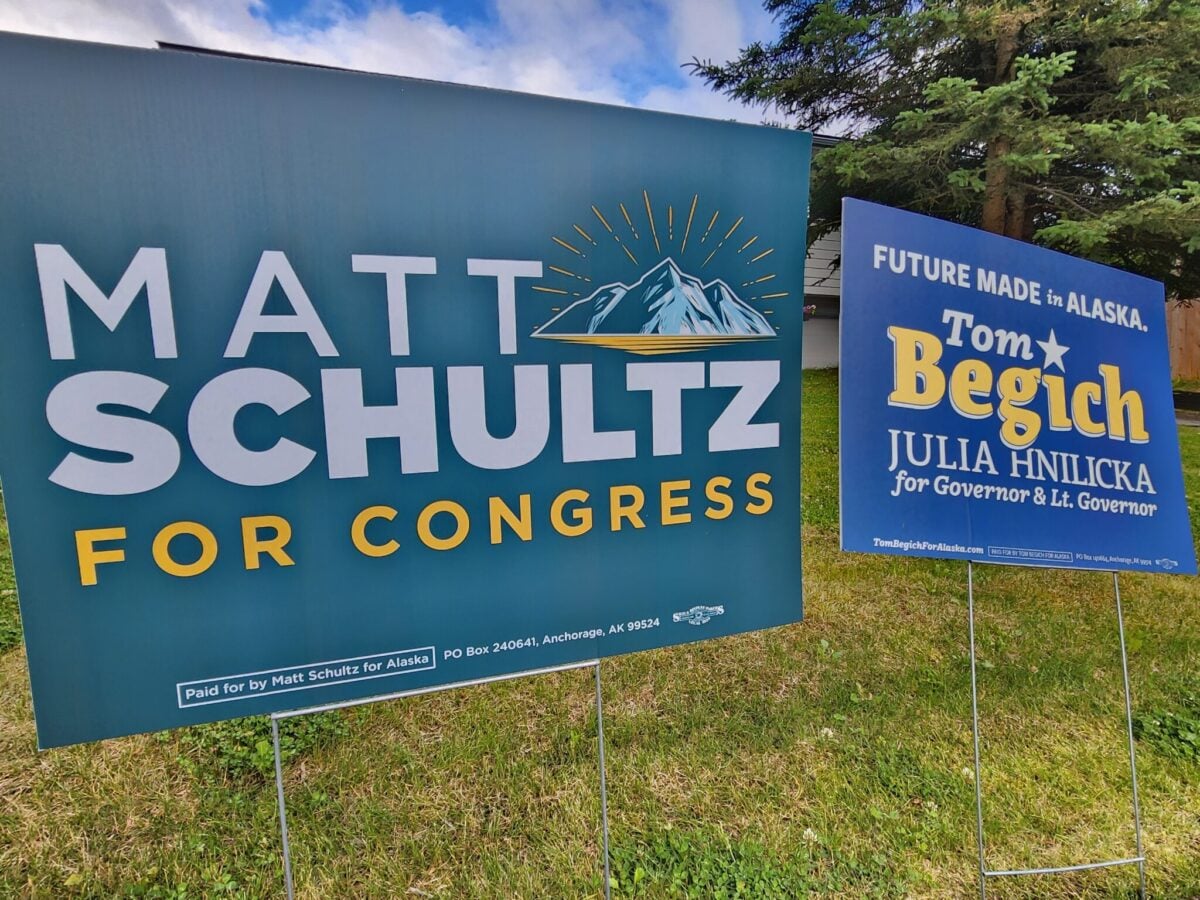
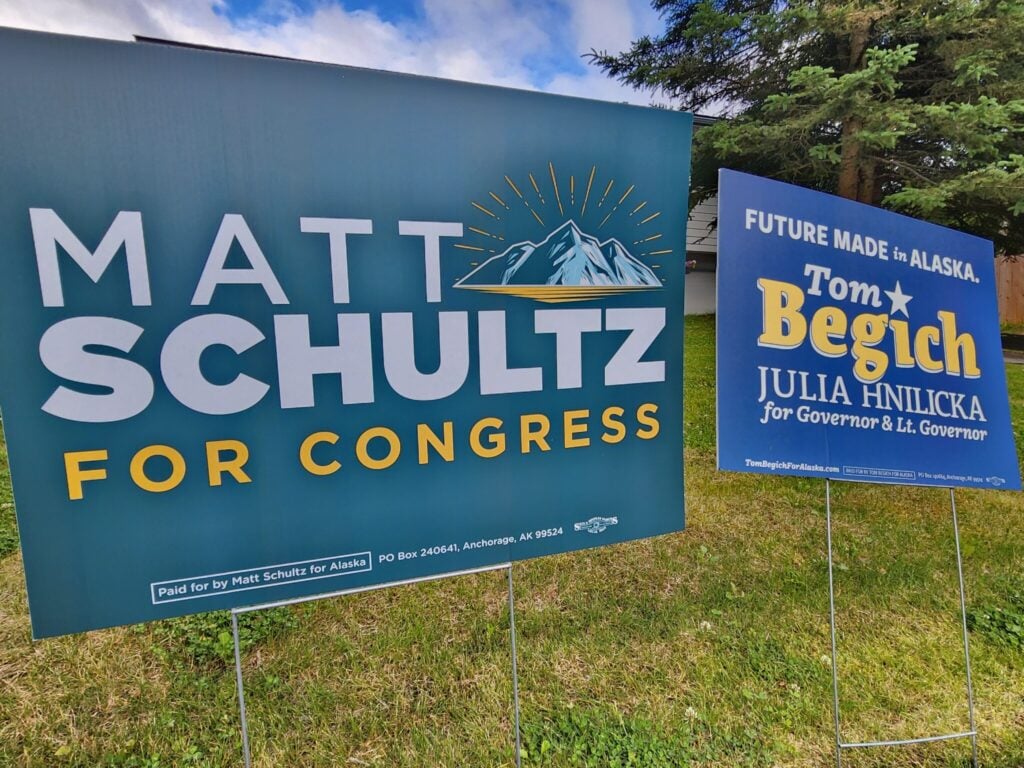
Campaign signs for Democrats Matt Schultz and Tom Begich are seen in a Midtown Anchorage yard on July 17, 2026. Schultz mounted his campaign to oust Republican U.S. Rep. Nick Begich. But he endorsed Nick’s uncle, Democratic gubernatorial candidate Tom Begich, a former state senator. Schultz suspended his campaign on July 17 and urged supporters to rally behind independent Bill Hill. (Photo by Yereth Rosen/Alaska Beacon)
On July 17, the leading Democratic candidate in Alaska’s U.S. House race suspended his campaign and announced his support for independent House candidate Bill Hill.
In an interview last week, Democrat Matt Schultz said his decision didn’t come from a lack of desire or a lack of support — it was simply a matter of money.
“One of the most disturbing things about the election process is how much … is determined by money, and I did not have a viable financial path forward,” Schultz said on July 17.
Schultz will remain on the ballot for the Aug. 18 statewide primary but is expected to withdraw after the results become final.
Campaign finance reports through June 30 showed Schultz’s campaign with $470,681 in cash on hand. Hill’s campaign had $702,626. Incumbent Republican Rep. Nick Begich’s campaign had more than $3.2 million.
Begich and Hill are also being boosted by third-party groups. In Hill’s case, Wheel Dog PAC is preparing to spend more than $1 million and has already sent mailers to voters across the state. The National Republican Congressional Committee and other groups are spending similarly to back Begich.
While Schultz has lagged in financial support, public opinion polling in the spring found him significantly ahead of Hill in Alaska’s top-four primary, but in head-to-head polling, Hill appeared to perform better against Begich than Schultz did. Neither polled ahead of Begich.
In Alaska’s election system, voters will pick one of the 14 U.S. House candidates during the Aug. 18 statewide primary. The top four vote-getters, regardless of party, advance to the general election.
“If I had made it through the primary, which — I think there’s a real good chance I would have been the the frontrunner — but I would not have had the the financial war chest required to take on Nick Begich, and the priority here is to make sure that Nick Begich does not get back into office,” Schultz said.
As a candidate, Schultz has been a solid progressive. Speaking to the Beacon and writing in a column to the Anchorage Daily News, he said he feels that some Democrats are too motivated to seek a political “middle,” even when it doesn’t make sense.
“I think that shifting to the middle is not inherently virtuous. When we think about history, there are issues like slavery or in World War II when the Nazi Party was on the rise — there’s no value in saying ‘let’s be a moderate and meet them in the middle and compromise,’” he said. “I think this is a time in history right now. The reason I was so motivated to flip the House of Representatives is because the Republican Party is pulling us into fascism. They’re attacking our democracy and handing over our freedom to billionaires and trillionaires. The stakes are so very high, and yet the folks on our side of the playing field here seem to be willing to kneel and beg for our rights instead of standing and demanding them, and I think that happened in my race as well.”
Alaska’s labor unions have backed Hill, as did the Alaska Center, a progressive environmental and pro-democracy group that hasn’t supported an independent for U.S. House since Alyse Galvin in 2020.
The Alaska Democratic Party itself declined to endorse Schultz during its April convention in Cordova, leaving open the possibility that it would support Hill instead of a party member.
The week before Schultz’s decision, the National Republican Campaign Committee signaled that it was preparing to run ads in favor of Schultz to boost his performance and help Begich.
Both Schultz and Hill released statements denouncing the strategy.
Under Alaska’s general-election system, voters are asked to rank their preferred candidates. The candidate with the lowest number of No. 1 votes is eliminated, and that candidate’s supporters have the option to give the vote to a second choice instead.
“Matt Schultz and the Alaska Democrat Party have been outspoken supporters for ranked choice voting, but when given the opportunity to present the public with their own candidate they chose to withdraw,” said Paul Smith, Begich’s campaign manager. “Despite raising nearly $1 million, making the case to progressives and traveling throughout the state, Democrats have proven that they support ranked choice voting only when it advantages them. Regardless, Alaskan voters will reject these political games and re-elect the most productive freshman Congressman on record, Congressman Nick Begich.”
Since 2022, when the system was used for the first time, statistics show that a significant number of voters have chosen to not rank a second or subsequent choice.
Hill and Schultz each said they believe that ads from the NRCC could have engendered bad feelings, reducing the odds that supporters would rank the other candidate.
Schultz said his top priority is ending Republican control of the U.S. House, and that holds whether or not he is elected.
“Once I recognized that I didn’t have a viable path forward, then it didn’t really matter what I’m being asked to sacrifice. I had to sacrifice (my candidacy) to make sure that we prevent that majority,” he said.
Reached by phone last week, Hill thanked Schultz.
“In his statement, he made it clear that it’s not about me or him. It’s about giving Alaskans the best chance to beat Nick Begich this fall,” he said.
“I think we’re both aligned on a lot of things that are not going right for Alaskans,” Hill said. “You look at things like, well, the cost of gas and groceries, the loss of health care to a lot of Alaskans who just can’t afford it with the loss of the (Affordable Care Act) premiums. There’s a lot of things that are going on in the House right now that are not benefiting Alaskans, and we definitely need to make sure that, in the long run, that there’s a change made there.”
One major difference between Hill and Schultz is that while Schultz sought to eliminate Republican control of the House, Hill is willing to join a Republican majority under certain circumstances.
“I am not committing to who I’m going to vote for (Speaker of the House, if elected), but I will tell you right up front that I’m not going to vote for Mike Johnson to be Speaker because he does not represent my values at all, and he has been the lead in doing things that have impacted Alaska negatively,” Hill said.
Asked what he will do to earn the votes of Schultz supporters, Hill said he understands that they may have concerns about his candidacy, “but I will assure them that I am there to make sure that we have a government that’s going to work on providing Alaskans with the opportunities and tools needed to build good lives, and that means things like making sure everybody has health care, to make sure that our school systems are good and solid, and providing the education that our that our children need.”
For decades, federal wildlife officials have protected old-growth forests as critical habitat for northern spotted owls. But a new interpretation of the Endangered Species Act issued by the Trump administration removes protections for wildlife habitat. (Photo by Tom Kogut/U.S. Forest Service via U.S. Fish and Wildlife Service on Flickr)
The Trump administration is removing protections from the key places where endangered species live, saying states can keep the areas safe.
But experts say states aren’t equipped for the task.
Earlier this month, the Trump administration finalized a major change to the Endangered Species Act, rolling back protections for the forests, wetlands, deserts and other critical habitats that many plants and animals rely on.
The new rule will open many landscapes to development, logging, mining and oil and gas drilling. Wildlife officials — in both conservative and liberal states — had expressed strong concerns about the proposal, saying it would threaten their plans to safeguard endangered species.
But federal officials framed the decision as a move to give “freedom” to state leaders to manage wildlife without burdensome federal regulations.
States that wish to continue protecting habitats can do so under state law, the Interior Department and other federal agencies wrote in their lengthy new regulations.
But legal experts and wildlife veterans say that almost no states have endangered species laws on the books that allow state officials to prevent habitat destruction in the name of saving wildlife.
While many states have laws to stop poaching and direct killing of wildlife, the protection of nesting trees, spawning streams and other resources has long fallen to the federal Endangered Species Act and the agencies that enforce it.
“It’s not going to be a situation where the states can easily just jump in here and fill the void,” said Robert Anderson, who served as solicitor for the Department of the Interior during the Biden administration. “It’s not going to help states, and it’s going to make it worse for the species.”
Many wildlife experts also noted that state wildlife agencies are already underfunded as it is. Taking on the massive regulatory system that prevents developers and extractive industries from destroying critical habitat would require far more resources than those agencies have available.
A coalition of environmental groups and tribal nations have filed lawsuits challenging the federal rollback.
The ‘harm’ rule
On July 10, the federal departments of Interior and Commerce announced they had finalized a rule rescinding the longstanding definition of “harm” under the Endangered Species Act.
For decades, federal officials have scrutinized logging projects that would cut old-growth trees where owls build their nests, and agriculture operations that diverted water from streams where salmon return to spawn.
But now, the feds are pivoting to a much more limited definition of “harm.” Only actions that directly injure or kill the animals themselves will be considered a violation of endangered species law.
“You can destroy the resources a species requires as long as you don’t do it when the species is at home,” said Karrigan Börk, a law professor and director of the Center for Watershed Sciences at the UC Davis Institute of the Environment. “If you drain a salmon river during the summer when the salmon aren’t in it, ultimately it has the same impact of killing off that whole species.”
In its announcement, the Trump administration framed the move as restoring the “original intent” of the Endangered Species Act and reducing regulations that punished people for “indirect or speculative impacts” to wildlife.
The Interior Department did not respond to a Stateline interview request.
A 2019 study published in Conservation Science and Practice of species added to the list of endangered species from 1975 to 2017 found that only 17% of them faced threats from direct killing, while 81% faced habitat loss.
“It’s common sense that we can’t save a species unless we save the places that they live,” said Jane Davenport, senior attorney at Defenders of Wildlife, a nonprofit conservation group that is planning to sue the federal government over the change. “This is an attempted death blow to the Endangered Species Act.”
Some industry groups praised the move. The American Petroleum Institute and other oil and gas groups said in public comments that they supported the effort to limit habitat protections, but expressed concern that the Trump administration’s move to rescind the “harm” definition without issuing a new interpretation could allow a future president or the courts to issue a more expansive reading of the law.
The groups cited Supreme Court Justice Antonin Scalia’s dissenting opinion in a landmark 1995 case that upheld habitat protections under the Endangered Species Act.
“‘Harm’ must involve a direct injury to a particular animal,” the groups wrote, arguing that it “cannot result indirectly from habitat modification nor can the term apply to a population of animals.”
States’ role
In public comments after the rule was initially proposed, wildlife agency leaders from both liberal and conservative states said the change would be a blow to their conservation efforts.
The proposed rule would have “dire consequences,” wrote Bruce Kreft, chief of the conservation and communications division with the North Dakota Game and Fish Department. “Eliminating habitat protection will lead to further population declines and, ultimately, an increase in the number of species needing (Endangered Species Act) protection.”
Wildlife officials in Arizona, Georgia, Louisiana, New Mexico, New Jersey, Vermont and Wyoming also expressed concern about the loss of habitat protections, as did the Association of Fish & Wildlife Agencies, a nonprofit that represents state wildlife managers.
Of the public comments reviewed by Stateline, only Alaska’s wildlife agency leader offered wholehearted support for the change.
In response to those concerns, federal officials wrote in their rulemaking decision that the change “does not alter the ability of States to implement their own conservation programs or to regulate habitat impacts under State law.”
But wildlife experts say states cannot replicate the habitat protections that federal law provided. Although most states have their own state-level endangered species laws, they’re largely focused on poaching or direct killing of animals.
“The state-level endangered species acts are wildly variable in what they’re supposed to cover and are uniformly under-resourced and under-enforced, because the federal Endangered Species Act has been the real baseline since the 1970s,” said Börk, the UC Davis professor.
Chris Servheen, who served as grizzly bear recovery coordinator for the U.S. Fish and Wildlife Service for 35 years, worked closely with state wildlife agencies in that position.
“It’s really disingenuous to say if states want to protect habitat, they can do so,” he said. “That’s not their role, that’s not what they do. States manage the take (killing) of the animals directly related to hunting or trapping or something like that. The federal agencies manage the land base.”
According to a 2024 analysis from the National Caucus of Environmental Legislators, only eight states plus Puerto Rico require the designation of critical habitats under their laws to protect endangered species.
California appears to be the only state with a process under state law to account for damage to wildlife habitat and require developers to offset those impacts, such as funding a restoration project nearby, said Becca Madsen, restoration economy director with the Environmental Policy Innovation Center.
“(States) don’t have this layer of federal regulations and staff and the consistency of how it’s been regulated for decades,” she said. “Now they’ve got to create their own processes and permitting and data and guidance. It’s a lot.”
Even if states were to pass laws and invest in programs to protect wildlife habitat, they would be unable to enforce those measures on federal land. Across the West, federal public lands cover vast swaths of many states and provide critical habitat for many species. If the U.S. Forest Service were to permit a logging operation on old-growth forest under the new “harm” definition, state wildlife officials could do nothing to stop it.
Meanwhile, some advocates are doubtful that state lawmakers have an appetite to take on the regulatory role once handled by the feds.
“Most state legislatures are pretty strongly captured by development and real estate interests,” said Kate Groetzinger, communications director with the Center for Western Priorities, a conservation group. “The political bar to putting something like this in place at the state level is a lot higher than it was when the Endangered Species Act was passed.”
Going to court
Last week, a coalition of environmental groups filed a lawsuit challenging the “harm” rule. A pair of tribes in Washington state filed their own lawsuit, asserting that the decision will infringe on tribal fisheries that the federal government is obligated to protect under treaty agreements.
Some legal experts expect a flood of lawsuits over specific proposed projects.
“Courts are going to have to figure out on a case-by-case basis what’s covered and what’s not covered,” said Börk, the UC Davis professor. “It’s going to lead to widespread confusion over the next decades over what’s illegal or legal, and it’s going to make it harder for developers and landowners to know whether they have liability or not.”
Some advocates expressed concern that the lawsuits challenging the Trump administration could make it to the conservative Supreme Court, which could then permanently enshrine an interpretation of the Endangered Species Act that fails to protect habitat. That would leave a future administration powerless to undo the change, unless Congress were to rewrite the law.
But some see no real alternatives.
“I’d be worried if it got to the Supreme Court, but the alternative is just acquiescence, which I don’t think is a good idea,” said Anderson, the former Interior solicitor.
Editor’s note: This story was updated to correct the spelling of Chris Servheen’s name.Stateline reporter Alex Brown can be reached at abrown@stateline.org.
This story was originally produced by Stateline, which is part of States Newsroom, a nonprofit news network which includes Alaska Beacon, and is supported by grants and a coalition of donors as a 501c(3) public charity.
The Northwest ICE Processing Center in Tacoma, which is one of the largest immigrant detention facilities in the western U.S. (Grace Deng/Washington State Standard)
U.S. Immigration and Customs Enforcement arrested an Alaska state attorney in Anchorage and is holding him in an ICE detention facility in Washington state, according to an agency spokesperson.
Shucheng Yang, a 32-year-old Chinese national, was arrested in Anchorage on July 10.
“Yang violated the terms of his admission and is a deportable alien,” said Jason Chudy, an ICE Public Affairs officer, by email on Thursday. He said Yang is currently detained in the Northwest ICE Processing Center in Tacoma, Washington, pending immigration proceedings.
Yang is an attorney with the Alaska Department of Law’s labor, business and corporations section, according to the state employee database. Yang was admitted to the Alaska Bar Association and licensed to practice law in the state in June 2025. A spokesperson for the department declined to respond to questions about his immigration status, employment status or work authorization when hired, saying the department does not comment on personnel matters.
Chudy declined to say how Yang violated the terms of admission into the country. “To be clear, work authorization does NOT confer legal status in the United States,” he said in the email.
He referred further questions about Yang’s work authorization to the U.S. Citizenship and Immigration Services. A spokesperson for USCIS referred the question back to ICE, and said the agency does not comment on individual immigration cases.
The state requires applicants to self-disclose their employment eligibility and work authorization through the I-9 verification process during hiring, according to the Alaska Department of Administration, as reported by Alaska News Source.
There are no state criminal charges against Yang, according to court records. Yang pleaded no contest on June 26 for a speeding citation.
A spokesperson for the Municipality of Anchorage confirmed the Anchorage Police Department issued the traffic ticket on April 25. “They have had no other interaction with Mr. Yang since April,” said Nora Morse, communications director for the municipality, by email on Thursday.
“The Anchorage Police Department does not ask for someone’s immigration status as part of a routine traffic stop,” Morse said.
A spokesperson for the ACLU of Alaska said they were trying to get in touch with Yang’s attorney, and had no other information on his case.
The Alaska Department of Corrections contracts with ICE to hold detainees in Alaska under an agreement with the U.S. Marshals. A spokesperson confirmed that Yang was detained in Alaska for two days after his arrest until he was transferred on July 12.
DOC has held 17 people arrested by ICE since June 1, and 73 people since the beginning of the calendar year, according to spokesperson Betsy Holley on Thursday.
A bumper sticker on a car parked in Midtown Anchorage on June 29, 2026, expresses support for the Glenfarne-Alaska Gasline Development Corp. plan for natural gas pipeline tax concessions. (Photo by Yereth Rosen/Alaska Beacon)
A few months from now, if developers of the proposed trans-Alaska natural gas pipeline move forward with the project, they will ask Alaskans for something between a few hundred million and a billion and a half dollars.
The request is optional, but if the state doesn’t chip in, Alaska’s 25% ownership of the pipeline will dwindle to a smaller fraction, and any profits will similarly shrink.
Two other requests for cash could come as soon as next year, to first fund a gas treatment plant on the North Slope and then a natural gas export facility on the Kenai Peninsula.
As state lawmakers debate a multibillion-dollar tax break for the pipeline project this week, a confidential memo and legislative testimony show the break won’t be the last financial request from Alaskans.
Keeping the state’s 25% ownership of the Alaska LNG project will cost at least $4 billion, according to estimates from the Alaska Department of Revenue.
If the state spends that money, and if the project is built and sells gas as planned, the department estimates the state will earn more than $21 billion through 2062, almost five times its initial investment.
But there’s a risk: if the pipeline project costs more than expected, the state of Alaska will be asked to pay more.
“We have reserved the option for the state of Alaska to elect to invest or not,” Frank Richards, president of the Alaska Gasline Development Corp., told the Senate Finance Committee on June 4. “The project will proceed forward without the state investment, but we wanted to give the state that opportunity should it elect to, eyes wide open.”
A potential investment for the state
Last year, the Gasline Development Corporation, a state-owned company charged with building the gas pipeline project, sold the lead role in the project to Glenfarne, a private multinational developer.
According to a confidential memo analyzing the deal, Glenfarne agreed to pay $10 million and fund the project’s development until the “Final Investment Decision,” the point at which investors start to put down money and contracts go out for construction.
Glenfarne has 75% ownership of 8 Star Alaska, the parent company of the pipeline project. The state — through AGDC — has 25% ownership. AGDC’s ownership share stays the same regardless of how many new investors come into the project.
But ownership of 8 Star Alaska may not mean much.
The Alaska LNG project includes three separate “subprojects” — a gas treatment plant on the North Slope, the pipeline itself and an export terminal on the Kenai Peninsula.
Each of those subprojects is its own subsidiary company, and not all of the subproject profits will go back to 8 Star Alaska.
“The real value is down in the three subsidiaries of 8 Star,” said Sen. Cathy Giessel, R-Anchorage, in a July 2 podcast interview.
Right now, each subsidiary is subject to the same 75-25 ownership split as 8 Star, but that changes at FID, when other investors put in their money.
At that point, said Matt Kissinger, AGDC’s commercial director, there will be enough money to build each subproject, but the state will have the opportunity to push out other investors and preserve its 25% ownership.
“All the investors will be in; they’ll all be committed, and then we’ll have 180 days for the state to decide to back them out of some of their commitment,” he said.
According to a draft analysis of last year’s Glenfarne-AGDC deal, AGDC has “the right to invest in up to 25%, but not less than 5%, of each sub-project at FID.”
The 5% minimum — if AGDC takes any share at all — was negotiated with Glenfarne, Kissinger said, because if the state is going to push out another investor, it needs to do so for a meaningful amount.GET THE MORNING HEADLINES.SUBSCRIBE
Part or all of the 25% buy-in could be taken by AGDC. The state could buy in directly, or another state-owned corporation like the Alaska Industrial Development and Export Authority, Alaska Railroad or the Alaska Permanent Fund Corp. could do so.
If the state and public corporations don’t reach the 25% maximum, then Alaska residents, Alaska Native corporations and other in-state companies would have a chance to take some or all of the remainder.
On June 25, the AGDC board voted unanimously to approve the creation of a subsidiary that will allow individual Alaskans to invest in the project through AGDC.
“No more funds are required by the State of Alaska to invest for this project to proceed forward, it’s just that we have the option to, and if Alaskans want the opportunity to invest, that’s the structure that we’re going to set up for them,” Richards told the board.
AGDC and Glenfarne expect the pipeline subproject to reach FID this year. The gas treatment plant and the export facility FIDs are expected no sooner than 2027.
Department of Revenue estimates a $4.4 billion cost
Keeping the state’s share of the project at 25% is likely to be expensive. Glenfarne estimated last month that building the pipeline alone will cost as much as $16.9 billion.
In an example scenario AGDC presented to legislators last month, the company suggested developers could take out loans for 70% of that cost.
The Alaska Department of Revenue is independently using that percentage for its baseline predictions, too.
The developers could cover the remaining 30% by selling part of the pipeline subsidiary.
If the state wants to keep 25% ownership of the whole project, that would mean buying 25% of that 30%.
Using some assumptions, “that would result in $4.4 billion in nominal terms that would be required to invest in the project,” said Dan Stickel, the Department of Revenue’s chief economist, on May 21.
That’s on top of the tens of billions of dollars in production taxes, property taxes, royalties and fees that the state would receive regardless of whether or not it takes an additional ownership share.
What happens if Alaska doesn’t buy in?
“That (25% ownership) will definitely be diluted. That’s the mechanism that was designed,” Kissinger told state lawmakers.
AGDC’s scenario, presented to legislators on June 4, suggested 8 Star Alaska would keep 35% of the pipeline subsidiary. AGDC would have a quarter of that 35%, or 8.75% of any profits after debts are paid.
If 8 Star Alaska keeps less than that 35%, then the state’s quarter would shrink correspondingly.
While investing in the project increases the potential profits, there’s also a risk, said Sen. Bert Stedman, R-Sitka, on June 16. If the project costs more than expected, the state and other investors would have to pay more money to keep their share of the project.
“If the state wishes to take that risk, and if the state wishes to be a paying member of the project … you would be paying 25% of any of the investment dollars coming in to maintain that,” Kissinger said on June 3.
Where would Alaska get the money?
Current state law allows AGDC to borrow money without legislative approval.
“Right now, under the current statutes, AGDC has extremely broad bonding authority. We can raise revenue bonds — provided there is no recourse back to the state — without any further approvals,” Kissinger said on June 26.
What’s a revenue bond?
The Alaska Constitution severely limits the kinds of government borrowing that the state is responsible for and must repay through taxes. Corporations like AGDC can instead issue revenue bonds, which are repaid by the corporation’s profits. There’s no obligation for the state to bail out a corporation that can’t pay its bond holders.
The current version of the gasline tax break being considered by state lawmakers would limit AGDC’s borrowing power.
Legislators would have to meet within 90 days — possibly in special session — to approve any bonds.
The Alaska Department of Revenue would be required to analyze the investment and make a recommendation to legislators.
Another funding possibility is that the state could offer things instead of money in order to pay for its share of the project.
“What we’re hoping to do is to utilize state materials, state assets, to be able to provide to the project in lieu of cash,” Richards told the House Finance Committee on May 27. “The gravel that will be used for access road and pipe bedding and pipe backfill and pipe storage yards and camp facilities represents about 20 million cubic yards of material, so that has a value of roughly $60 million and if we are able to then utilize that value and gain equity, then that would be a non-cash option that we would like to exercise for the state.”
In an interview on Tuesday, Richards said the state could also offer the land that the pipeline will use. Instead of paying something like $9 million per year in rent to the Department of Natural Resources, the state could simply deed the land to the pipeline operator and receive a share of the pipeline subsidiary in return.
Lawmakers could also appropriate money directly from the state treasury to AGDC in order to fund the project.
Rep. Andy Josephson, D-Anchorage, said on May 21 that in order to come up with the money for the 25% investment, the state’s independent financial adviser recommended overdrawing the earnings reserve of the Alaska Permanent Fund.
“I know that’s sacrilege to talk about, and it’ll be left for the next Legislature … but $4 billion is something this state could probably borrow or find, I guess,” he said.
“This is such a significant decision for what I call the re-electeds,” said Josephson, who is retiring and not running for re-election. “If they don’t do it, they could be chastised for decades and remembered for not doing it, but if the project has significant cost overruns, they could be chastised for that.”
“I would agree, it’s a very significant decision,” Stickel said.
Speaking June 19 on the floor of the state Senate, Sen. Jesse Kiehl, D-Juneau, said he is terrified of what might happen if the state invests and there is a cost overrun that requires more money to complete the project.
“Does it go bankrupt, and we just leave it? Nobody in this room is that naive. There’s one deep pocket around this project. There’s one entity that’s had a 50 year dream of building the pipe. There’s one place you can go for billions and billions of dollars,” he said.
Left unsaid was the name of the Alaska Permanent Fund.
A single caribou stands in 2019 amid cottongrass and other tundra plants near the Hulahula River in the Arctic National WIldlife Refuge. (Photo by Alexis Bonogofsky/U.S. Fish and WIldlife Service)
The federal government has agreed to permanently loosen rules for oil and gas lease sales in the Arctic National Wildlife Refuge, according to a draft settlement agreement filed this week in the U.S. District Court for the District of Alaska.
Adam Gustafson, an attorney with the U.S. Department of Justice, said in a statement that the agreement “means more oil leasing, more domestic energy, and more independence from foreign sources of energy.”
The document filed this week would settle lawsuits filed by the state of Alaska and its investment bank over the 2025 Arctic National Wildlife Refuge oil lease sale that drew no bids.
That sale, mandated by a 2017 law, took place after the Biden administration restricted the available acreage. The Alaska Industrial Development and Export Authority and the state of Alaska sued over the Biden-era limits.
This week’s agreement states in part that the federal government will not limit oil and gas leasing in ANWR until oil and gas equipment covers at least 2,000 acres in the refuge’s coastal plain.
“The 2017 Tax Act does not authorize (the Bureau of Land Management) to deny or unreasonably limit development of production and support facilities to the Coastal Plain until 2,000 surface acres are covered by production and support facilities,” it states in part.
That’s a small fraction of the size of the leases being put up for sale but could represent a significant length of pipeline and a large number of drilling pads.
AIDEA and the state remain in court against the federal government over the result of a 2021 ANWR lease sale. AIDEA won leases during that sale, but the Biden administration canceled those leases, then attempted to re-sell the affected land during the 2025 sale.
The ANWR leasing program overall has been challenged by a coalition of environmental groups, and that case also remains in court.
By email on Tuesday, an AIDEA spokesperson said it would be accurate to call the new agreement a victory for AIDEA and Alaska because it “includes a clear admission that the … Lease Sale ‘violated the 2017 Tax Act by preventing meaningful leasing, exploration, and development of oil and gas on the Coastal Plain, as Congress mandated.’”
Through a spokesman, acting Alaska attorney general Cori Mills noted that while Alaska’s attention has recently focused on a successful lease sale in the National Petroleum Reserve-Alaska to the west of the Prudhoe Bay oil field, the state continues to be interested in ANWR, which is to the east.
The new settlement agreement increases the odds that ANWR will stay open to drilling even when a new president comes after Trump.
“While the State is ecstatic about the progress in the NPR-A, we cannot lose sight of the potential in ANWR. The problem is not a lack of potential or even lack of infrastructure; it is the lack of a stable investment climate without burdensome and unnecessary strings attached,” Mills said by email.
“The last administration did everything they could to shut down development in ANWR that our congressional delegation and numerous state administrations had fought long and hard for. But that doesn’t have to be the future. We are grateful that the federal government recognizes the unlawful actions taken previously and was willing to enter into the settlement and essentially admit the error,” she said. “There is still hope that ANWR can provide economic prosperity and crucial resources for local communities, the state, and the nation.”
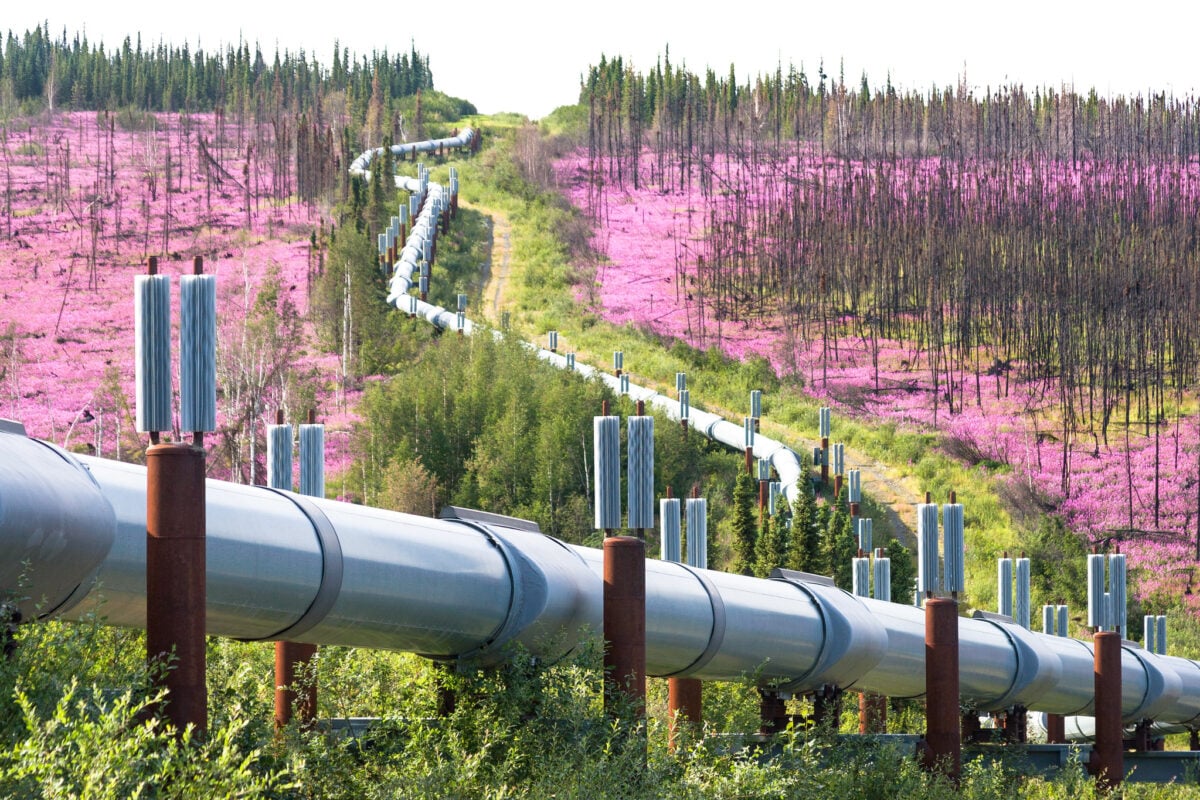
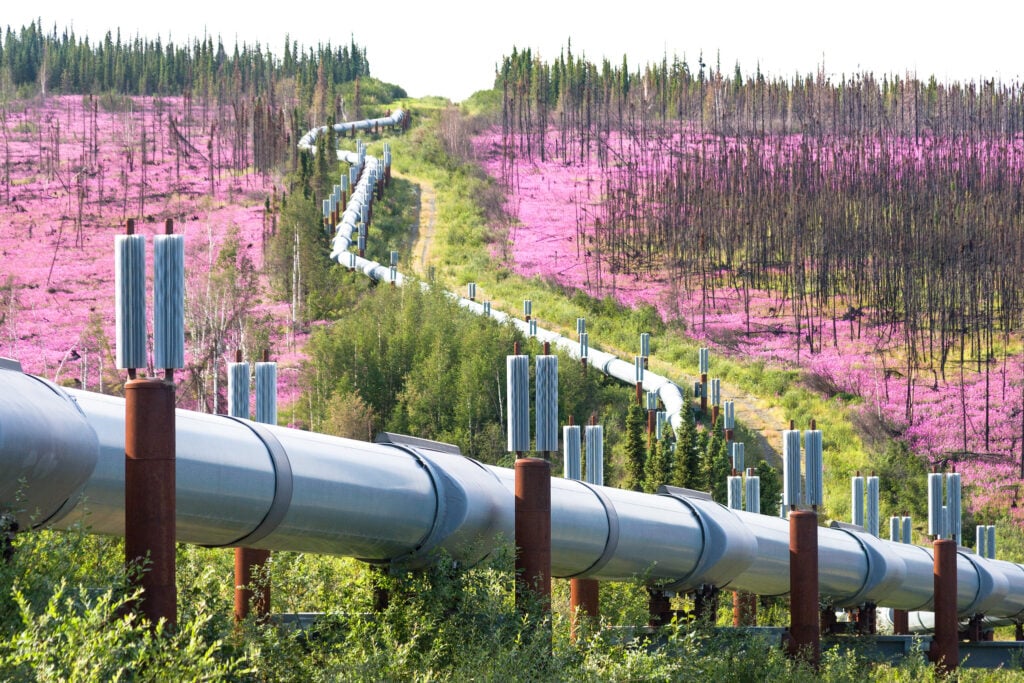
Fireweed blooms on either side of the trans-Alaska pipeline near mile post 86, Dalton Highway in 2006, two years after the 2004 Dall City fire. (Photo by Craig McCaa/BLM Alaska)
If built as proposed, the trans-Alaska natural gas pipeline is expected to create thousands of jobs. Many, if not most, will go to people who don’t live in Alaska.
A six-year-old study, commissioned by the Alaska Gasline Development Corp. as part of the project’s environmental statement, says “an estimated 22 to 68 percent of the construction jobs would likely be filled by non-residents, depending on the construction year.”
The difference is likely because specialty jobs needed during construction — pipeline welders, for example — aren’t common in Alaska. Last year, more than 42% of all welding jobs in the state were held by nonresidents, according to figures published by the Alaska Department of Labor and Workforce Development.
Joelle Hall, president of the Alaska AFL-CIO, said that while new hires might not all be Alaskans, they will have the opportunity to become Alaskans, just as the builders of the trans-Alaska oil pipeline system did.
“There will be, just as it was on TAPS — most of those were not Alaskans, they became Alaskans. That’s one of the opportunities to look at here,” she said.
As the Alaska Legislature debates a multibillion-dollar tax break for the pipeline project, legislators are considering whether to tie that tax break to labor requirements that could require pipeline developers to hire more Alaskans.
Last month, the Alaska Senate voted 16-4 to mandate a certain level of apprentice hiring, something that could increase the number of jobs available to new Alaskans or those starting to learn a trade.
The latest version of the tax-break bill, released last week by legislative negotiators, eliminates that mandate but requires project-labor agreements that maximize opportunities for Alaskans who already have needed qualifications, said Sen. Jesse Kiehl, D-Juneau and author of the apprentice hiring proposal.
Hall said she hopes the apprenticeship mandate returns, but even if it doesn’t, the project would offer young Alaskans a chance to be trained as electricians, plumbers and in other construction-related trades.
They would be able to keep those skills and replace retiring construction workers.
“We are going to have such an opportunity to get these jobs … and then they can go on to full careers,” Hall said. “The graying of the construction workforce is such a big problem, and this is an opportunity to change that graying.”
Current estimates suggest the project would create a large number of temporary and permanent jobs but significantly fewer than were created by the trans-Alaska oil pipeline in the 1970s.
“I’ve read that during the development stage, there’ll be something like 12,000 jobs attached to this project,” said Speaker of the House Bryce Edgmon, I-Dillingham, in a June 27 hearing.
Adam Prestidge, president of Glenfarne Alaska, jumped in.
“Just to clarify, when we talk about jobs created, it’s approximately 7,000 for the construction of the pipeline, an additional 5,000 for the construction of the LNG facility. When it goes into full operation, you’re looking at a much lower number, around 1,000 permanent, 1,500 permanent operational jobs,” he said.
Tim Fitzpatrick, a spokesman for Glenfarne Alaska, confirmed the figures by email and added: “These are direct jobs and these numbers do not include additional indirect jobs. Glenfarne has not provided an update to the in-state/out-of-state estimates.”
In 1978, the Alaska Department of Labor concluded that more than 23,000 people were simultaneously employed at the peak of oil pipeline construction.
As currently planned, the gas pipeline project would be built in two phases, with the pipeline first and supporting infrastructure second. That means the 12,000 jobs expected by the project won’t come all at once, and peak employment will be well below what happened during the oil pipeline boom.
In addition, Alaska’s population is much larger than it was during the 1970s, further diluting the impact of construction employment. Last year, the state had 321,500 workers in January and 360,000 in July — the boom created by pipeline employment will be smaller than the one that already occurs each summer with tourism and fishing jobs.
What would be different is the value of each job — lawmakers are planning to mandate agreements that would require workers be paid high wages.
“There’s going to be a level of rearranging of the workforce that’s going to be pretty dramatic. If you’re a guy working at the Jiffy Lube, you could probably go … and be dispatched to do the same job on the pipeline and make vastly more money,” Hall said.
A successful project would create permanent, high-paid jobs.
“Project operation would require about 980 permanent personnel per year,” AGDC estimated in 2020, predicting that most jobs would be based in Anchorage and would go to in-state residents.
For the moment, those benefits remain hypothetical, and the state’s 1978 study provides an inadvertent cautionary note.
“Construction of the proposed gas pipeline project is planned to begin in 1981 – less than three years from now,” it said. “Alaska citizens and lawmakers are now meeting to lay out guidelines in preparation for pipeline construction in an attempt to maximize stable growth and to minimize the disruption which will result from such a large scale construction project.”