Categories
Alaska News Featured Juneau News juneau Juneau Local Juneau Local Ketchikan Local News Feeds Sitka Local

Alaska Forest Service facility slated for closure amid federal restructuring

By: Yereth Rosen, Alaska Beacon
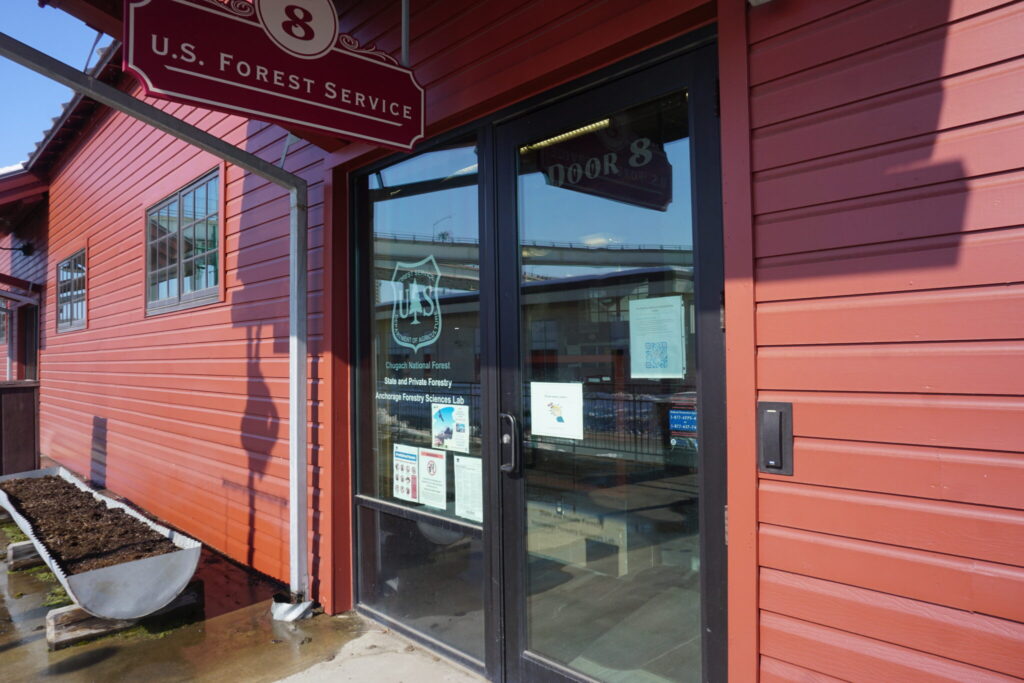

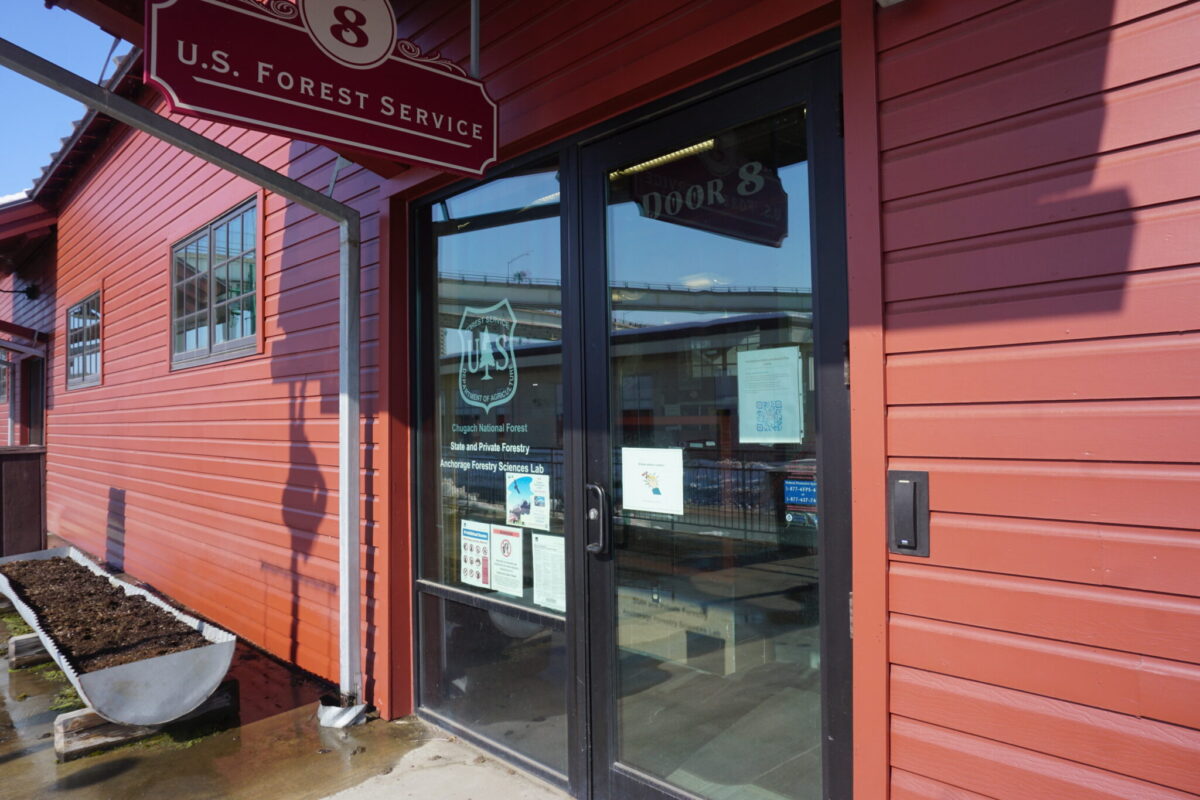
 The entrance to the Anchorage Forestry Science Laboratory is seen on April 2, 2026. The lab serves state agencies, Native corporations and private industry as well as federal agencies. The lab, in Anchorage’s Ship Creek neighborhood, is on a list of U.S. Forest Service facilities that the Trump administration plans to close. (Photo by Yereth Rosen/Alaska Beacon)

Two weeks after the Trump administration announced a U.S. Forest Service “restructuring” that would close regional offices and most of the agency’s research facilities, impacts to Alaska – home to the two largest U.S. national forests – remain unclear.

The U.S. Department of Agriculture announced on March 31 that the Forest Service’s national headquarters will move to Utah and that many of its facilities will be shuttered. Among the facilities on the closure list were two that are important to Alaska: the  and the Oregon-based  in Portland.

But other impacts on the 17-million-acre Tongass National Forest and the 5.4-million-acre Chugach National Forest were not disclosed.

A statement from the Forest Service headquarters provided few details about the Tongass, the Chugach or the visitor and recreational facilities located in either forest.

“The transition will occur in phases. Employees will receive clear information about relocation timelines, available options, and resources to support their decisions,” the statement said. “The number of relocations beyond those already identified in the National Capital Region is unknown at this time.”

U.S. Agriculture Department Secretary Brooke Rollins, whose department oversees the Forest Service, outlined the restructuring plan last year. In a July 24, 2025, memo, she said the plan included the replacement of the Alaska regional office with “a reduced state office in Juneau.” The state capital is currently the site of the Alaska regional office managing both the Tongass and the Chugach.

Three people at Begich, Boggs Visitor Center look out at Portage Lake on Aug. 30, 2025. The U.S. Forest Service's visitor center used to provide a close-up view of Portage Glacier's ice. Now the glacier has retreated so much that it is around the right corner, requiring a boat ride or mountain hike to see it in summer. A bit of Burns Glacier, which has also retreated dramatically, is visible from the visitor center. (Photo by Yereth Rosen/Alaska Beacon)
Three people at Begich, Boggs Visitor Center in the Chugach National Forest look out at Portage Lake on Aug. 30, 2025. The U.S. Forest Service’s visitor center, a popular tourist destination, used to provide a close-up view of Portage Glacier’s ice. Now the glacier has retreated so much that it is around the right corner, requiring a boat ride or mountain hike to see it in summer. A bit of Burns Glacier, which has also retreated dramatically, is visible from the visitor center. (Photo by Yereth Rosen/Alaska Beacon)

Alaska has Forest Service facilities throughout the Tongass and Chugach regions, from the southern tip of the Southeast to Anchorage.

Sen. Lisa Murkowski, R-Alaska, is also trying to learn about impacts to Alaska, a spokesperson said.

The senator and her staff are in a “fact-finding” mode and preparing to mount a “defense of the Forest Service in Alaska and make sure the employees are able to continue the good work that they’re currently doing,” said Murkowski spokesperson Joe Plesha.

The issue is expected to be managed through the Congressional appropriations process, Plesha said.

Murkowski is on the Senate Appropriations Committee and chairs the appropriations subcommittee on the Department of the Interior, Environment and Related Agencies.

The Anchorage lab that is scheduled for closure is located in the Ship Creek district of downtown Anchorage. It supports research in the Tongass National Forest, which is the nation’s largest, and the Chugach National Forest, the second largest. It also supports research on forests elsewhere, from the boreal forests of Interior Alaska to those on tiny tropical Pacific islands like Guam and Micronesia.

The lab is used not just by Forest Service scientists but by other federal agencies, state agencies, Native corporations, University of Alaska researchers and private industry, according to its website.

Tourists walk to and from a viewpoint at the Mendenhall Glacier visitor center on May 14, 2025. (Photo by Yereth Rosen/Alaska Beacon)
Tourists walk to and from a viewpoint at the Mendenhall Glacier visitor center on May 14, 2025. The visitor center in the Tongass National Forest is a top tourist destination. (Photo by Yereth Rosen/Alaska Beacon)

Up to now, the lab has had a year-round staff of about 22 scientists and administrative workers, but the numbers increase during summer field seasons.

The planned closure of the century-old Pacific Northwest Research Station in Oregon is part of a consolidation of research functions into a single site in Fort Collins, Colorado.

The Pacific Northwest facility, with about 250 employees, has an affiliated lab in Juneau. The fate of the Juneau lab remains unknown.

Among the Alaska projects undertaken by the Pacific Northwest Research station, sometimes with partner organizations, is study of the decline of yellow cedar in the Tongass and adjacent regions in the southeastern part of the state; the status of birds and rare plants in the Tongass; the study of rural Alaskans’ access to wild foods in the Chugach National Forest and the surrounding region; and the monitoring of human recreation’s impacts on brown bears.

The Forest Service closure plans follow deep cuts already made by the Trump administration’s Department of Government Efficiency, or DOGE. In the first half of 2025, the Forest Service lost 5,860 of its 35,550 employees, according to a Dec. 17, 2025,  report by the Agriculture Department’s inspector general.  

That includes losses in Alaska. As of January, Alaska’s Forest Service workforce was down to 467 from the total of about 700 before the DOGE-imposed cuts began, KTOO reported in January.
Categories
Alaska News Featured Juneau News juneau Juneau Local Juneau Local Ketchikan Local News Feeds Sitka Local

Federal law doesn’t mandate minimum amounts of logging in Alaska’s Tongass rainforest, judge says

By: James Brooks, Alaska Beacon

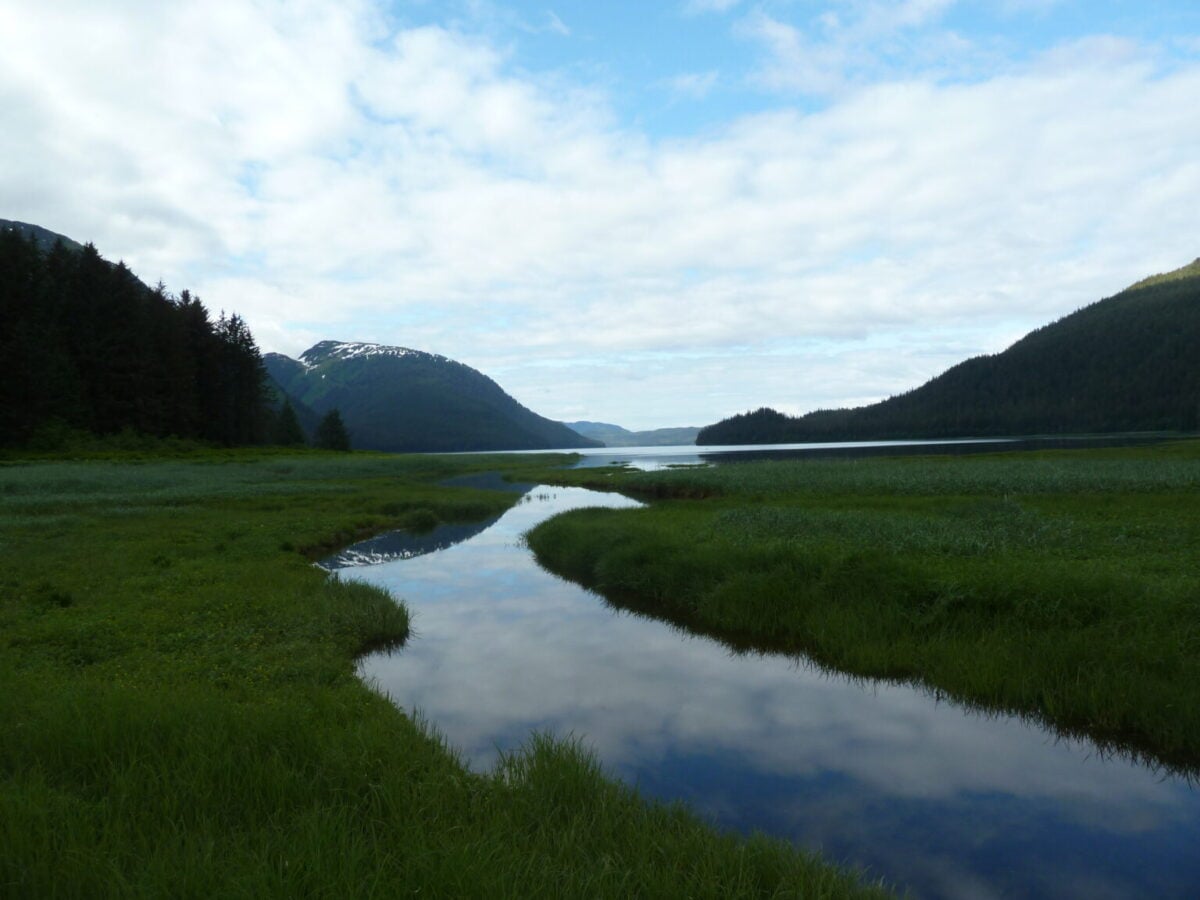
A stream reflects the clouds on June 20, 2011, in Kootznoowoo Wilderness, Admiralty Island National Monument, Tongass National Forest, Alaska. (Forest Service photo by Don MacDougall)

A federal judge in Alaska has rejected a lawsuit that sought to reinstate a management plan that would allow heavier logging in the world’s largest temperate old-growth rainforest.

The result leaves an Obama-era management plan in place, but it could be short-lived: The administration of President Donald Trump is already at work on a new plan that could allow more logging in Alaska’s Tongass National Forest. 

In an order published Friday, Judge Sharon Gleason dismissed the lawsuit filed by Viking Lumber, Alcan Timber and the Alaska Forest Association. 

The three groups sued the U.S. Department of Agriculture — the parent organization of the U.S. Forest Service — last year, alleging in part that the federal Tongass Timber Reform Act of 1990 required the Forest Service to offer enough timber sales to meet market demand.

Gleason ruled otherwise, finding that TTRA does not impose “a mandatory duty” on the Forest Service to ensure that market demand is met by Tongass timber sales.

“Whether the harvest levels are designed to actually meet market demand is a discretionary agency action, not a mandatory requirement imposed by the TTRA on the Forest Service,” she wrote.

Gleason also declined to take up plaintiffs’ argument about whether the Forest Service violated the Administrative Procedures Act, and she ruled that a 2021 announcement about Tongass strategy did not amount to formal rulemaking under law. She did not analyze whether it would have met legal standards if it had been a formal rulemaking process.

Plaintiffs were represented by Pacific Legal Foundation, which on Friday said that the Forest Service’s approach has been devastating to plaintiffs.

Kyle Griesinger, a spokesperson for the foundation, said that even with a new management plan in the works, the case isn’t moot because the old plan remains in effect until superceded.

“And, moreover, the Forest Service has not lived up to the 2016 plan so any new plan they may not live up to is no guarantee for our clients,” he said.

Marlee Goska, an attorney for the Center for Biological Diversity, agreed that last week’s ruling still has merit. 

Goska was one of several attorneys who represented tribal, tourism, fishing and environmental groups that intervened on the side of the Department of Agriculture. 

“I don’t think we have enough information yet to say the Forest Service is going to implement what the plaintiffs want. And certainly we’ll fight tooth and nail to stop that from happening,” she said of the upcoming plan change.

Goska added that last week’s ruling is important because it shows that the Forest Service does not have to meet market demand under existing law, and it shows that federal law doesn’t draw a distinction between old-growth harvests and new-growth ones.

“To the extent this administration and the Forest Service might be thinking about saying the TTRA mandates large old-growth timber sales to meet market demand, the court has already said that is incorrect,” she said.

Gleason published a final judgment on Friday. Plaintiffs have 30 days to file an appeal.