Categories
Alaska News Featured Juneau News juneau Juneau Local Juneau Local Ketchikan Local News Feeds Sitka Local

Alaska Forest Service facility slated for closure amid federal restructuring

By: Yereth Rosen, Alaska Beacon

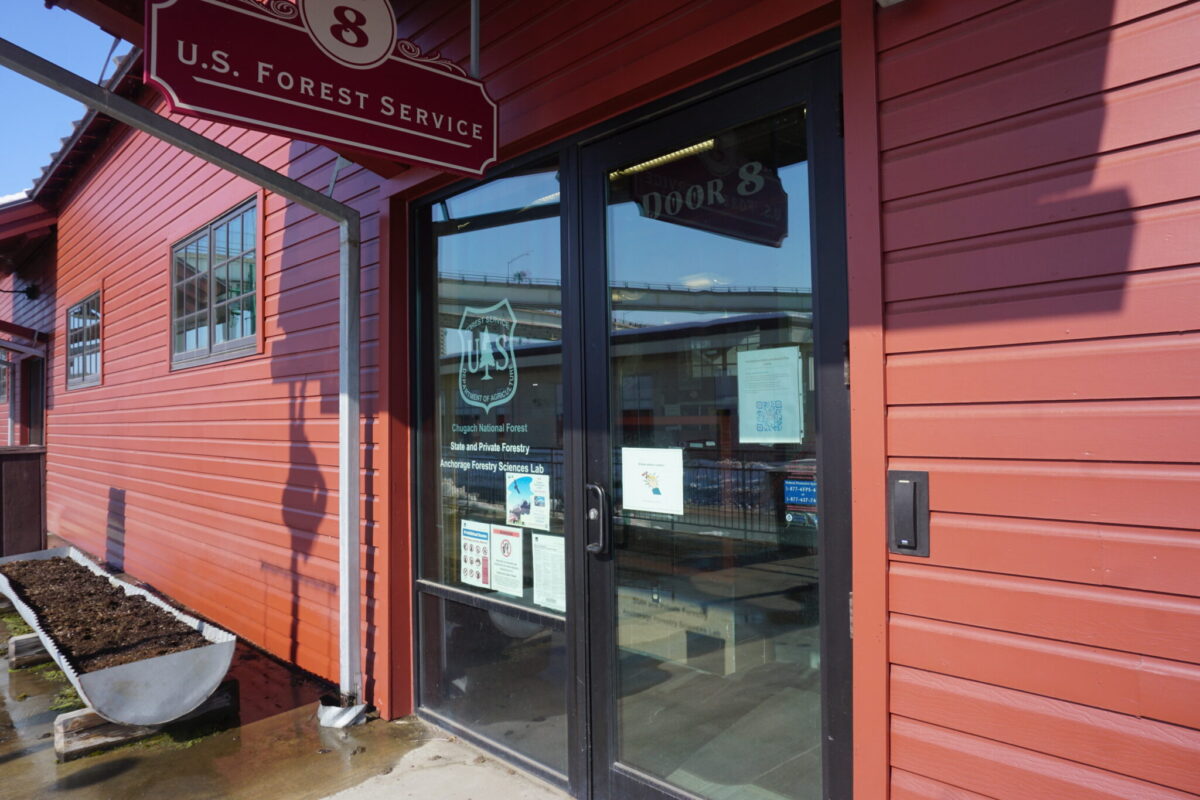
 The entrance to the Anchorage Forestry Science Laboratory is seen on April 2, 2026. The lab serves state agencies, Native corporations and private industry as well as federal agencies. The lab, in Anchorage’s Ship Creek neighborhood, is on a list of U.S. Forest Service facilities that the Trump administration plans to close. (Photo by Yereth Rosen/Alaska Beacon)

Two weeks after the Trump administration announced a U.S. Forest Service “restructuring” that would close regional offices and most of the agency’s research facilities, impacts to Alaska – home to the two largest U.S. national forests – remain unclear.

The U.S. Department of Agriculture announced on March 31 that the Forest Service’s national headquarters will move to Utah and that many of its facilities will be shuttered. Among the facilities on the closure list were two that are important to Alaska: the  and the Oregon-based  in Portland.

But other impacts on the 17-million-acre Tongass National Forest and the 5.4-million-acre Chugach National Forest were not disclosed.

A statement from the Forest Service headquarters provided few details about the Tongass, the Chugach or the visitor and recreational facilities located in either forest.

“The transition will occur in phases. Employees will receive clear information about relocation timelines, available options, and resources to support their decisions,” the statement said. “The number of relocations beyond those already identified in the National Capital Region is unknown at this time.”

U.S. Agriculture Department Secretary Brooke Rollins, whose department oversees the Forest Service, outlined the restructuring plan last year. In a July 24, 2025, memo, she said the plan included the replacement of the Alaska regional office with “a reduced state office in Juneau.” The state capital is currently the site of the Alaska regional office managing both the Tongass and the Chugach.

Three people at Begich, Boggs Visitor Center look out at Portage Lake on Aug. 30, 2025. The U.S. Forest Service's visitor center used to provide a close-up view of Portage Glacier's ice. Now the glacier has retreated so much that it is around the right corner, requiring a boat ride or mountain hike to see it in summer. A bit of Burns Glacier, which has also retreated dramatically, is visible from the visitor center. (Photo by Yereth Rosen/Alaska Beacon)
Three people at Begich, Boggs Visitor Center in the Chugach National Forest look out at Portage Lake on Aug. 30, 2025. The U.S. Forest Service’s visitor center, a popular tourist destination, used to provide a close-up view of Portage Glacier’s ice. Now the glacier has retreated so much that it is around the right corner, requiring a boat ride or mountain hike to see it in summer. A bit of Burns Glacier, which has also retreated dramatically, is visible from the visitor center. (Photo by Yereth Rosen/Alaska Beacon)

Alaska has Forest Service facilities throughout the Tongass and Chugach regions, from the southern tip of the Southeast to Anchorage.

Sen. Lisa Murkowski, R-Alaska, is also trying to learn about impacts to Alaska, a spokesperson said.

The senator and her staff are in a “fact-finding” mode and preparing to mount a “defense of the Forest Service in Alaska and make sure the employees are able to continue the good work that they’re currently doing,” said Murkowski spokesperson Joe Plesha.

The issue is expected to be managed through the Congressional appropriations process, Plesha said.

Murkowski is on the Senate Appropriations Committee and chairs the appropriations subcommittee on the Department of the Interior, Environment and Related Agencies.

The Anchorage lab that is scheduled for closure is located in the Ship Creek district of downtown Anchorage. It supports research in the Tongass National Forest, which is the nation’s largest, and the Chugach National Forest, the second largest. It also supports research on forests elsewhere, from the boreal forests of Interior Alaska to those on tiny tropical Pacific islands like Guam and Micronesia.

The lab is used not just by Forest Service scientists but by other federal agencies, state agencies, Native corporations, University of Alaska researchers and private industry, according to its website.

Tourists walk to and from a viewpoint at the Mendenhall Glacier visitor center on May 14, 2025. (Photo by Yereth Rosen/Alaska Beacon)
Tourists walk to and from a viewpoint at the Mendenhall Glacier visitor center on May 14, 2025. The visitor center in the Tongass National Forest is a top tourist destination. (Photo by Yereth Rosen/Alaska Beacon)

Up to now, the lab has had a year-round staff of about 22 scientists and administrative workers, but the numbers increase during summer field seasons.

The planned closure of the century-old Pacific Northwest Research Station in Oregon is part of a consolidation of research functions into a single site in Fort Collins, Colorado.

The Pacific Northwest facility, with about 250 employees, has an affiliated lab in Juneau. The fate of the Juneau lab remains unknown.

Among the Alaska projects undertaken by the Pacific Northwest Research station, sometimes with partner organizations, is study of the decline of yellow cedar in the Tongass and adjacent regions in the southeastern part of the state; the status of birds and rare plants in the Tongass; the study of rural Alaskans’ access to wild foods in the Chugach National Forest and the surrounding region; and the monitoring of human recreation’s impacts on brown bears.

The Forest Service closure plans follow deep cuts already made by the Trump administration’s Department of Government Efficiency, or DOGE. In the first half of 2025, the Forest Service lost 5,860 of its 35,550 employees, according to a Dec. 17, 2025,  report by the Agriculture Department’s inspector general.  

That includes losses in Alaska. As of January, Alaska’s Forest Service workforce was down to 467 from the total of about 700 before the DOGE-imposed cuts began, KTOO reported in January.
Categories
Alaska News Featured Juneau News juneau Juneau Local Juneau Local Ketchikan Local News Feeds Sitka Local Uncategorized

Alaska Advocates defend Roadless Rule

By: Grace Dumas

The Tongass National Forest

As the federal government advances plans to roll back Roadless Rule protections on 58 million acres of national forests, Southeast Alaska conservation advocates are racing to mobilize public opposition, warning that repealing the Roadless Rule could open the Tongass National Forest to expanded clear-cut logging and place subsistence, fisheries and tourism in peril.

Nathan Newcomer, Southeast Alaska Conservation Council (SEACC) Tongass Campaigner, said the current administration has signaled from “day one” that it intends to eliminate the federal Roadless Rule, a regulation that limits road-building and industrial development on certain undeveloped national forest lands.

“They signed an executive order to try to get rid of the Roadless Rule. The Secretary of Agriculture, Brooke Rollins, also issued a statement intending to rescind the Roadless Rule nationwide.”

Despite the administration’s push, the conservation group says public sentiment has been overwhelmingly in favor of keeping the rule.

A Notice of Intent, the first step in the rulemaking process, opened a 21-day public comment period nationwide. During that brief window, the public submitted more than 627,000 comments Newcomer said.

“Over half a million people submitted public comments. There’s a group called the Center for Western Priorities that did an analysis of those public comments, and they found that 99% of the public comments were in favor of keeping the roadless rule in place. When do you see 99% of American citizens agreeing on something? That just goes to show you that people really like the Roadless Rule.”

In 2001 when the Rule was enacted by the Clinton Administration, more than 600 public hearings were held around the nation, and the public provided more than 1.6 million comments on the Rule, more comments than any other rule in the nation’s history.

Now, Newcomer says, the government is trying to unwind those protections without holding any comparable meetings.

“They’re not holding any public meetings anywhere, not only for Alaska, but nothing down south either. So that’s why we’re organizing these public hearings, not just in Juneau, but throughout southeast.” Said Newcomer.

Juneau’s hearing was scheduled for yesterday evening at the JACC downtown.

The event featured a panel discussion with President Mike Jones of the Organized Village of Kasaan, Atagan Hood, Vice President of Alaska Youth for Environmental Action, Jamalea Martelle of Artemis National Wildlife Federation and Nicole Weston, Owner of NW Photography.

A moderator guided the conversation, about why roadless protections matter in their communities. The event then shifted into a public hearing where attendees offered testimony themselves.

“We’re going to have several videographers on hand that are going to document everything, record everybody’s public testimony, then we’re going to transcribe that testimony, and then we’re going to officially submit it to the public record once the public comment period for the draft EIS (Environmental Impact Statement) is open.”

If the roadless rule is repealed, Newcomer warned, “If you get rid of protections for federal public lands, you’re talking about more large scale clear cut logging, that’s the main threat. And of course, when you start to clear cut, it’s going to have huge impacts on the wildlife, on our subsistence ways of life here in the Tongass, on the tourism, recreation economy. How many people came up on cruise ships to Juneau last year?”

Despite the scale of public opposition documented in the comment record, Newcomer said he does not believe the federal government, under current leadership, is likely to change course.

“But that doesn’t mean that we shouldn’t make our voices heard and make a lot of noise and make sure that we’re all on the record saying that we don’t want this. Because there are also other elections that happen, right? And so power can shift, so it’s about demonstrating that the people care about these things, and that’s just kind of the work that I have to do, and that’s the work that we’re doing to make sure that the public’s voice is heard.”

He said he’s seen community organizing make a difference over longer timelines, even when initial decisions seemed foregone.

“Historically, Americans have said we would like to keep the Roadless Rule in place, and now this administration is trying to ram a policy through that the vast majority of us don’t want to see happen. That’s not the role of government.” Newcomer said, “Government needs to be by the people for the people. I think highlighting that is really critical, so that people understand that they have agency, Because there’s a lot going on in the world, right? And it’s really easy to get overwhelmed and to become apathetic, but you really do have agency. I’ve seen it time and time again in my life, where you might feel like the the clouds are closing in on you, and it’s getting dark and gloomy, but really, when you stand together and you speak in a solid voice in unity, it can have really powerful change. It might not happen today or tomorrow, but it could make a huge difference.”

Categories
Alaska News Featured Juneau News juneau Juneau Local Juneau Local Ketchikan Local News Feeds Sitka Local

Federal law doesn’t mandate minimum amounts of logging in Alaska’s Tongass rainforest, judge says

By: James Brooks, Alaska Beacon

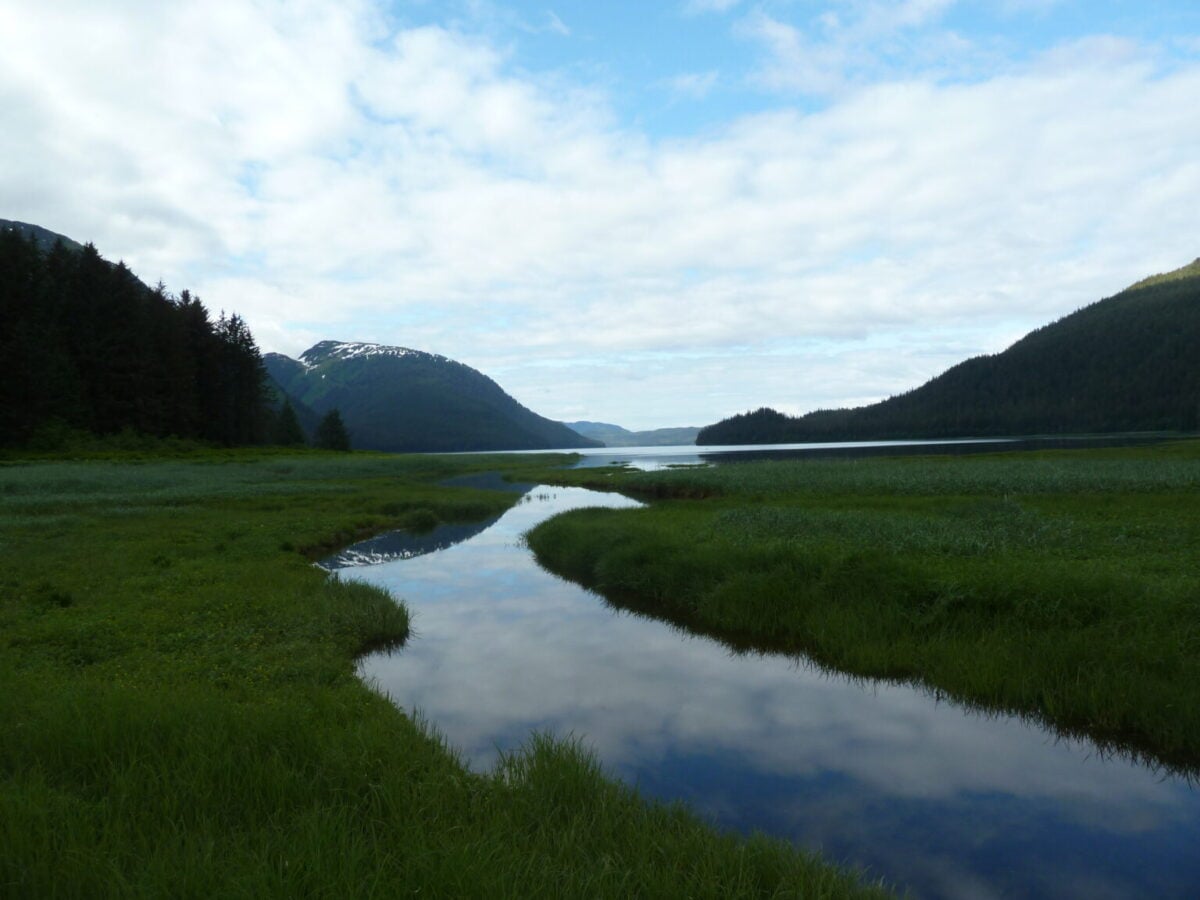
A stream reflects the clouds on June 20, 2011, in Kootznoowoo Wilderness, Admiralty Island National Monument, Tongass National Forest, Alaska. (Forest Service photo by Don MacDougall)

A federal judge in Alaska has rejected a lawsuit that sought to reinstate a management plan that would allow heavier logging in the world’s largest temperate old-growth rainforest.

The result leaves an Obama-era management plan in place, but it could be short-lived: The administration of President Donald Trump is already at work on a new plan that could allow more logging in Alaska’s Tongass National Forest. 

In an order published Friday, Judge Sharon Gleason dismissed the lawsuit filed by Viking Lumber, Alcan Timber and the Alaska Forest Association. 

The three groups sued the U.S. Department of Agriculture — the parent organization of the U.S. Forest Service — last year, alleging in part that the federal Tongass Timber Reform Act of 1990 required the Forest Service to offer enough timber sales to meet market demand.

Gleason ruled otherwise, finding that TTRA does not impose “a mandatory duty” on the Forest Service to ensure that market demand is met by Tongass timber sales.

“Whether the harvest levels are designed to actually meet market demand is a discretionary agency action, not a mandatory requirement imposed by the TTRA on the Forest Service,” she wrote.

Gleason also declined to take up plaintiffs’ argument about whether the Forest Service violated the Administrative Procedures Act, and she ruled that a 2021 announcement about Tongass strategy did not amount to formal rulemaking under law. She did not analyze whether it would have met legal standards if it had been a formal rulemaking process.

Plaintiffs were represented by Pacific Legal Foundation, which on Friday said that the Forest Service’s approach has been devastating to plaintiffs.

Kyle Griesinger, a spokesperson for the foundation, said that even with a new management plan in the works, the case isn’t moot because the old plan remains in effect until superceded.

“And, moreover, the Forest Service has not lived up to the 2016 plan so any new plan they may not live up to is no guarantee for our clients,” he said.

Marlee Goska, an attorney for the Center for Biological Diversity, agreed that last week’s ruling still has merit. 

Goska was one of several attorneys who represented tribal, tourism, fishing and environmental groups that intervened on the side of the Department of Agriculture. 

“I don’t think we have enough information yet to say the Forest Service is going to implement what the plaintiffs want. And certainly we’ll fight tooth and nail to stop that from happening,” she said of the upcoming plan change.

Goska added that last week’s ruling is important because it shows that the Forest Service does not have to meet market demand under existing law, and it shows that federal law doesn’t draw a distinction between old-growth harvests and new-growth ones.

“To the extent this administration and the Forest Service might be thinking about saying the TTRA mandates large old-growth timber sales to meet market demand, the court has already said that is incorrect,” she said.

Gleason published a final judgment on Friday. Plaintiffs have 30 days to file an appeal. 

Categories
Featured Juneau News Juneau Local Ketchikan Local News Feeds Sitka Local

Trump administration plans to close unknown number of U.S. Forest Service in Alaska

By: James Brooks, Alaska Beacon

A hiker walks on May 30, 2018, on the trail to the Tongass National Forest’s Tern Island campsite in Wrangell, Alaska. (Photo by Xavier Rivera/U.S. Forest Service)

The Trump administration is planning to close some U.S. Forest Service offices in Alaska under a national reorganization announced this summer by the U.S. Secretary of Agriculture.

Public comment on the reorganization is open through Sep. 30.

The Forest Service, which is part of the U.S. Department of Agriculture, currently has offices in Anchorage, Juneau, Cordova, Valdez, Girdwood, Seward, Craig, Hoonah, Ketchikan, Petersburg, Sitka, Thorne Bay, Wrangell and Yakutat. It isn’t clear how many of those offices will remain open after the reorganization. 

The status of the Forest Service’s tourist-focused visitor centers in Portage, Juneau and Ketchikan also isn’t clear.

Contacted for details, a spokesperson for the U.S. Department of Agriculture said by email on Friday, “Some aspects of the reorganization will take place over the coming months, while others will take more time. We will continue to provide updates as the reorganization moves forward.”

They added, “We recognize this may be difficult, but we are hopeful that affected employees will remain with us through this transition as we work to improve and continue delivering benefits to the people and communities we serve.”

In a July memo outlining the basic details of the plan, U.S. Secretary of Agriculture Brooke Rollins said she intends to close the Forest Service’s nine national regional offices “over the next year” but “will maintain a reduced state office in Juneau, Alaska, and an eastern service center in Athens, Georgia.”

Research stations, like the Juneau Forestry Science Laboratory in Auke Bay, will be closed and “consolidated into a single location in Fort Collins, Colorado.”

Nationally, Rollins said she intends to scatter more than half of the Agriculture Department’s 4,600 Washington, D.C.-based administrators to five regional hubs; one each in Utah, Colorado, North Carolina, Missouri and Indiana.

This follows prior actions by the federal Department of Government Efficiency, or DOGE, which earlier this year fired about 3,400 Forest Service employees nationally, including more than 100 in Alaska. 

Before the firings, the Forest Service had about 700 employees in Alaska. 

Rollins’ proposed Forest Service budget for the coming year calls for a 34% cut to its operations, likely requiring further layoffs.

Categories
Featured Juneau News Juneau Local Ketchikan Local News Feeds Sitka Local

Trump administration wants to cancel Biden-era rule that made conservation a ‘use’ of public land

FILE – Interior Secretary Doug Burgum listens as President Donald Trump speaks with reporters in the James Brady Press Briefing Room at the White House, Monday, Aug. 11, 2025, in Washington. (AP Photo/Mark Schiefelbein, File)

AP-Interior Secretary Doug Burgum on Wednesday proposed canceling a public land management rule that put conservation on equal footing with development, as President Donald Trump’s administration seeks to open more taxpayer-owned tracts to drilling, logging, mining and grazing.

The rule was a key part of efforts under former President Joe Biden to refocus the Interior Department’s Bureau of Land Management, which oversees about 10% of land in the U.S. Adopted last year, it allowed public property to be leased for restoration in the same way that oil companies lease land for drilling.

Industry and agriculture groups were bitterly opposed to the Biden rule and lobbied Republicans to reverse it. States including North Dakota, where Burgum served as governor before joining Trump’s Cabinet, pursued a lawsuit hoping to block the rule.

Wednesday’s announcement comes amid a flurry of actions since Trump took office aimed at boosting energy production from the federal government’s vast land holdings, which are concentrated in Western states including Alaska, California, Nevada, New Mexico, Utah and Wyoming.

Interior officials said the Biden rule had sidelined people who depend on public lands for their livelihoods and imposed unneeded restrictions.

Burgum said in a statement that it would have prevented thousands of acres from being used for energy and mineral productions, grazing and recreation. Overturning it “protects our American way of life and gives our communities a voice in the land that they depend on,” Burgum said.

“The previous administration’s Public Lands Rule had the potential to block access to hundreds of thousands of acres of multiple-use land – preventing energy and mineral production, timber management, grazing and recreation across the West,” Burgum said.

Environmentalists had largely embraced the rule that was finalized in April 2024. Supporters argued that conservation was a long-neglected facet of the land bureau’s mission under the 1976 Federal Lands Policy Management Act.

“The administration cannot simply overthrow that statutory authority because they would prefer to let drilling and mining companies call the shots,” said Alison Flint, senior legal director at The Wilderness Society.

While the bureau previously issued leases for conservation purposes in limited cases, it never had a dedicated program for it.

Critics said the change under Biden violated the “multiple use” mandate for Interior Department lands, by catapulting the “non-use” of federal lands — meaning restoration leases — to a position of prominence.

National Mining Association CEO Rich Nolan said Burgum’s proposal would ensure the nation’s natural resources are available to address rising energy demands and supply important minerals.

“This is a welcome change from the prior clear disregard for the legal obligation to balance multiple uses on federal lands,” Nolan said.

The rule also promoted the designation of more “areas of critical environmental concern” — a special status that can restrict development. It’s given to land with historic or cultural significance or that’s important for wildlife conservation.

In addition to its surface land holdings, the land bureau regulates publicly-owned underground mineral reserves — such as coal for power plants and lithium for renewable energy — across more than 1 million square miles (2.5 million square kilometers). The bureau has a history of industry-friendly policies and for more than a century has sold grazing permits and oil and gas leases.

The pending publication of Burgum’s proposal will kick off a 60-day public comment period.

House Republicans last week repealed land management plans adopted in the closing days of former President Joe Biden’s administration that restricted development in large areas of Alaska, Montana and North Dakota. Interior officials also announced a proposal aimed at increasing mining and drilling in Western states with populations of greater sage grouse. Biden administration officials proposed limits on development and prohibitions against mining to help protect the grouse.