Steller Sea lions rest on a rocky ledge in Kenai Fjords National Park on July 31, 2013. The western population of Steller sea lions is listed as endangered, and fishery managers have imposed protection to limit the impacts to the animals from commercial seafood harvest. (Photo by Kaitlin Thoresen/National Park Service)
Federal regulators plan to reevaluate fishing closure boundaries established to protect endangered Steller sea lions in Alaska, part of a national Trump administration push to cut regulation of U.S. commercial seafood harvests.
The Steller sea lion protections are among a series of rules that the administration is seeking to relax or change to carry out a mandate from President Donald Trump to increase catches, reduce regulation and ensure that the nation is “the world’s dominant seafood leader.”
The recommended changes were released on Thursday by the National Oceanic and Atmospheric Administration’s Fisheries service and are in response to Trump’s 2025 executive order titled “Restoring American Seafood Competitiveness.” They could affect oceans from New England and the Caribbean to the tropical Pacific and the Bering Sea.
Several months of public consultations resulted in a list of recommendations that “we believe will reduce burdens on domestic fishing, increase production, stabilize markets, improve access, and enhance economic profitability,” NOAA Fisheries Assistant Administrator Eugenio Piñeiro Soler said in a statement.
Steller sea lions in Alaska have suffered a population decline that extended over several decades.
The no-fishing zones intended to protect them are established around sea lion rookeries, places where the animals gather to mate and raise their pups, and major haul-out sites. There are also transit restrictions in areas where the sea lions gather, as well as seasonal harvest limits on fish that are known to be Steller sea lion food: Atka mackerel, Pacific cod and pollock.
Named for naturalist Georg Wilhelm Steller, who sailed to Alaska with explorer Vitus Bering in the 18th century, Steller sea lions are the largest of the “eared seals,” a category that includes all sea lions and fur seals.
A Steller sea lion is seen in 2013 in Alaska. (Photo provided by NOAA Fisheries)
The entire population, which ranges from Japan to California but is concentrated in Alaska, was listed as threatened in 1990. Seven years later, the population was divided; the western population from Prince William Sound to the Aleutians, which has had the most dramatic losses, was listed as endangered while the eastern population remained classified as threatened. By 2013 the eastern population had recovered sufficiently to warrant de-listing, but the western population remains classified as threatened and continues to face threats, according to NOAA Fisheries.
After Trump issued the executive order in April of 2015, NOAA Fisheries solicited comments from the regional fishery management councils and other organizations, as well as the general public.
The North Pacific Fishery Management Council, which manages harvests in federal waters off Alaska, responded to the solicitation with 20 recommended regulatory changes. Those included some changes to harvest timing, some changes to allocations among quota holders and some new allowances for record-keeping. A change to Steller sea lion protections was not on the list.
To Oceana, an environmental group focused on marine issues, the language in the NOAA list of recommendations was a bit vague, but any review of Steller sea lion conservation measures “must be grounded in the law and the best available science,” said Lauren Hynes, a marine scientist who is the organization’s North Pacific campaign manager.
“The western distinct population of Steller sea lions remains endangered, and recovery goals have not been met. If anything, more must be done to conserve and recover this vulnerable population and to protect their habitat and prey,” Hynes said by email.
Other Alaska-focused changes in the list of recommendations released Thursday by NOAA Fisheries were some tweaks to sablefish rules.
Trump has already taken other actions that overturn environmental protections to enable more commercial fishing in U.S. waters.
Greg Lange of Bismarck, North Dakota, drops off his absentee ballot and his wife’s at the Bismarck Burleigh County Office Building on June 8, 2026. (Photo by Michael Achterling/North Dakota Monitor)
The U.S. Supreme Court ruled Monday that states can count mail-in ballots that arrive after Election Day, a blow to the Trump administration and some Republican states that had urged the justices to require all ballots to arrive by the close of polls.
In a 5-4 decision, the court found that federal law does not prevent states from accepting late-arriving ballots. The ruling is a victory for Democrats and voting rights advocates, who had said setting a hard, Election Day deadline for ballot arrival would risk disenfranchising voters amid fears of deteriorating mail service.
The case, RNC vs. Watson, centered on whether federal law overrides a Mississippi law that requires mail-in ballots postmarked on or before Election Day to be counted as long as they arrive within five business days of the election. Thirteen states have similar laws, which extend a “grace period” to ballots that arrive through the mail after polls close.
Justice Amy Coney Barrett, writing for the majority, said that federal law didn’t preempt the state law because elections represent when voters make a decision, which must be done on or before Election Day. Voters who cast their ballot by mail have made a decision by Election Day, Barrett reasoned.
“The electorate’s choice is made when voting is complete, not when ballots are received,” Barrett wrote.
Barrett cautioned that the decision rested on the interpretation of federal law, not the U.S. Constitution. She noted that the court was not considering the scope of Congress’ authority to regulate federal elections — suggesting that if Congress passes a nationwide ballot arrival deadline that the justices might uphold such a law.
Barrett was joined by Chief Justice John Roberts and Justices Sonia Sotomayor, Elena Kagan and Ketanji Brown Jackson.
Justice Samuel Alito dissented, joined by Justices Clarence Thomas and Neil Gorsuch. Justice Brett Kavanaugh joined part of the dissent.
“If ballots received after election day are added to the set of ballots that dictate the election’s outcome, the electorate’s choice does not occur on election day, and the federal election-day statutes are violated,” Alito wrote.
States with grace periods
In addition to Mississippi, other states with some form of grace period include Alaska, California, Illinois, Maryland, Massachusetts, Nevada, New Jersey, New York, Oregon, Texas, Virginia, Washington and West Virginia.
David Becker, executive director of the nonpartisan Center for Election Innovation & Research, called the Supreme Court decision a win for these states, as well as 30 states that accept military and overseas ballots delivered after Election Day.
“This is a victory for all the states and for all those who respect the will of the Founders, who ensured the security of our elections by giving the power to run those elections to the states — not to one person sitting in Washington, DC,” Becker said in a statement.
Some local election officials had warned that requiring all ballots to be received by the close of polls would burden their offices as they try to quickly warn voters about the change just months before the midterms. More ballot drop boxes that let voters keep their ballots out of the mail could help, they say, but also cost money.
“Ultimately, the voters may be harmed as well,” election officials in California, Massachusetts, Oregon and Washington wrote in a court brief, warning that some ballots may not be received in time, “despite best efforts by careful and proactive administrators and local governments.”
But some Republican secretaries of state had urged the justices to strike down “grace period” laws. Louisiana Secretary of State Nancy Landry and Wyoming Secretary of State Chuck Gray wrote in a court brief that an Election Day deadline “provides the bright-line rule that effective election administration demands.”
At least 725,000 ballots were postmarked by Election Day 2024 and arrived within a legally accepted post-election window, The New York Times has reported, citing election officials in 14 of 22 states and territories where late-arriving ballots were accepted that year.
Overall, about 30% of voters cast a mail ballot in 2024, according to data gathered by the U.S. Election Assistance Commission.
RNC challenged law
The Republican National Committee challenged the Mississippi law, which was defended by Mississippi Republican Secretary of State Michael Watson. The RNC argued a longstanding federal law that sets the Tuesday after the first Monday in November as Election Day for federal offices preempted state laws that allow ballots cast by Election Day, but received later, to count.
The 5th U.S. Circuit Court of Appeals ruled in October 2024 that federal law requires ballots to be received by Election Day. President Donald Trump last year also unilaterally attempted to require mail ballots to be received by the end of Election Day in a sweeping executive order on elections. Much of that order was blocked in federal court.
The Supreme Court “rejected the RNC’s radical attempt to rewrite election laws in a way that would have resulted in the rejection of hundreds of thousands of ballots and the disenfranchisement of voters nationwide through no fault of their own,” Elisabeth Frost, litigation chair at Elias Law Group, said in a statement.
Elias Law Group represented two nonprofit voting rights groups, Vet Voice Foundation and the Mississippi Alliance for Retired Americans, that had intervened as defendants in the case.
The Supreme Court issued Monday’s decision against a backdrop of uncertainty surrounding mail ballots. Trump signed an executive order in March that would restrict voting by mail by requiring states to provide lists of possible mail ballot voters to the U.S. Postal Service in advance. A federal judge recently blocked major portions of the order, triggering a near-certain appeal.
Republican National Committee chairman Joe Gruters accused Democrats of inviting chaos by allowing elections to “drag on” for days and weeks after ballots are cast. He said Republicans wouldn’t be deterred by the decision.
“If we want fair and secure elections, Election Day should mean exactly what it says, which is why this decision makes it even more imperative that Congress pass the SAVE America Act,” Gruters said in a statement, referring to restrictive voter legislation pushed by Trump that lacks the votes to pass the U.S. Senate.
Trump said the decision was a “tremendous loss” in a social media post and again urged passage of the SAVE America Act.
Paul Clement, an attorney for the Republican National Committee, said during oral arguments at the Supreme Court in March the prospect that the outcome of an election could change because of ballots arriving after Election Day would be unacceptable to losing candidates. After the 2020 election, President Donald Trump demanded election officials not count ballots that came in after Election Day, but states kept counting ballots.
“If you have an election and the election is going to turn on late-arriving ballots in a way that means what everybody kind of thought was the result on Election Day ends up being the opposite a week later, 21 days later, the losers are not going to accept that result. Full stop,” Clement told the justices.
Attorneys for Watson argued that both legal and historical precedent supported his position. States may decide that voters have made their final choices when ballots are submitted to state officials rather than when they’re received, according to Watson.
Watson didn’t immediately respond to a request for comment.
Members of the Alaska House Judiciary and State Affairs committees held an investigatory hearing on Monday about the state’s decision to remove a candidate from the U.S. Senate election with the same name as the incumbent — Dan Sullivan.
The Division of Elections announced that Dan J. Sullivan, a retired teacher from Petersburg, was not eligible to run for the U.S. Senate. It cited complaints from the incumbent and Republican groups when it decided his candidacy was not in “good faith,” and aimed at confusing voters with the incumbent U.S. Sen. Dan Sullivan. The division cited a state regulation that forbids the Division of Elections from listing a candidate’s name “in a manner that is confusing or misleading to voters or compromises the fairness or neutrality of the ballot.”
But some lawmakers questioned the decision and the division’s authority to remove the challenger candidate. An attorney representing the Alaska Legislature issued a legal memo Wednesday saying the decision to disqualify the candidate was likely unlawful, since he did not violate the U.S. Constitution’s qualifications to run for office.
The hearing took place as Dan Sullivan of Petersburg filed an appeal of the state’s decision to disqualify him from the ballot on Monday, taking the issue before a state superior court. In the complaint, Sullivan defended his eligibility and challenged the division’s decision to remove him. He argues the action is unlawful, and is asking the court to overturn the decision and restore his name on the ballot for the August primary.
Lawmakers held a hearing in Anchorage to investigate the division’s decision. Division officials declined to appear so the committee relied on testimony from attorneys.
Judiciary committee chair Rep. Andrew Gray, D-Anchorage, opened Monday’s hearing by saying the issue under scrutiny was not the particular candidate or his motives, but about the limits of the division’s authority and whether that authority is being applied fairly.
“What authority does the Division of Elections have to remove a candidate from the ballot, and has that authority been exercised consistently?” Gray said. “Those questions matter because public confidence in elections depends on more than accurate vote counting. It depends on the public’s confidence that the rules are applied equally to everyone.”
Gray cited a previous case where the candidate’s political motives and eligibility were challenged, but the state took a different stance. When the Alaska Democratic Party sought to remove Eric Hafner, a U.S. House candidate imprisoned out of state, the division defended his right to run for office. The Alaska Supreme Court allowed him to remain on the ballot. Hafner is running for the seat again this year. Gray emphasized the difference in the state’s approach.
“When a government agency departs from positions it has taken in previous cases, the public deserves an explanation,” Gray said. “And when a government agency removes the candidate from the ballot, the public deserves a very clear explanation.”
Lawmakers called the hearing and requested the division director, Carol Beecher, appear and participate in providing further information and an explanation for removing Sullivan. Beecher declined last week, citing the division’s work preparing the ballot scheduled to be printed on June 28.
Legislators then issued a rare legislative subpoena and served Beecher on Sunday to compel her to appear before the committee.
Empty chairs for tesifiers at a June 22, 2026, hearing in Anchorage on candidate qualification. The hearing was held by the House State Affairs and House Judiciary committees. Seated in the background are Rep. Steve St. Clair, R-Wasilla, and Rep. Ky Holland, I-Anchorage. (Photo by Yereth Rosen/Alaska Beacon)
On Monday, Lt. Gov. Nancy Dahlstrom, who oversees the state’s election system, issued a letter again declining to appear and threatening legal action.
“If you refuse, we may have no choice but to seek to quash the subpoena in court due to the unreasonable timeframe provided and the lack of urgency while the appeal period is still pending,” Dahlstrom wrote.
Gray noted that division officials gave Sullivan of Petersburg only one day to respond to questions, and then removed him from the ballot four days later. He announced at the hearing that they had rescinded the subpoena and agreed that elections officials would participate in another investigative hearing scheduled for July 22.
On Monday, the committee heard from several attorneys with experience working on elections issues, including Andrew Dunmire, a legislative attorney who wrote a legal memo saying the division’s actions were likely unconstitutional.
Dunmire wrote that under the U.S. Constitution, there are three qualifications for federal candidates: they must be at least 30 years old, a U.S. citizen for at least nine years and an inhabitant of the state when elected. He said, as seen in previous cases, states are not allowed to add to those qualifications.
“The US Constitution is the supreme source of law in our country, and there’s no administrative regulation that can override a constitutional requirement,” he said.
Lawmakers discussed the state regulation cited by elections officials which prohibits the division from placing names on the ballot “in a manner that is confusing or misleading to voters or compromises the fairness or neutrality of the ballot.”
Several Republican members of the committee defended the division’s actions, including Rep. Mia Costello, R-Anchorage, who said the division has a responsibility to protect the ballot from confusing or misleading voters.
“The division does have a responsibility to determine whether or not the voters are being misled, whether it has to do with how long they’ve lived here, whether it has to do with their name,” Costello said, and questioned whether Sullivan’s motives should be further investigated by the U.S Department of Justice or the Federal Elections Commission.
“I hope that this issue is resolved, so that anybody who wants to run for office in the state of Alaska can do it, but they cannot do it in a manner that is going to confuse or undermine the importance of elections,” she said.
But Dunmire, with Legislative Legal Services, said while the state can investigate allegations of campaign misconduct, the division has no authority to investigate a candidate’s motives in running for office.
“It is not the division’s role, they have no explicit authority in situations like this to look into a candidate’s motivations,” he said.
Dunmire noted state regulation has rules for when two candidates with the same name appear on the ballot. Candidates’ names would appear with a middle initial, in this case the challenger as “Dan J. Sullivan,” and the incumbent as “Dan S. Sullivan.”
Hollis French, a former state senator and prosecutor, was invited to testify before the committee and did not mince words.
“I don’t think you would need any special legal training to smell a rat here,” French said. “If a prisoner with no ties to the state of Alaska in New York state can be put on the ballot for federal office in the state of Alaska, I think the Division of Elections is sort of foreclosed from then on, from engaging in what they’ve engaged in this case.”
French said as a prosecutor, it’s nearly impossible to prove someone’s motives. He emphasized the division can take steps to distinguish the two names on the ballot, and then it’s up to candidates to campaign and appeal to voters.
“There’s a way to designate that in a neutral manner on the ballot, and then put the burden on the candidates to remind everybody that they’re the Dan Sullivan from Fairbanks or the Dan Sullivan with an S, or the Dan Sullivan with a J,” he said.
Rep. Ashley Carrick, D-Fairbanks and chair of the House State Affairs Committee, said she was highly concerned about a subjective standard for candidates imposed by the division that may erode the trust of voters.
“I think there’s a clear risk in the longer term future to the Division of Elections and Alaska’s election integrity if we see mistakes or differences of opinion in how this authority to investigate can be utilized,” she said.
“And really, truly, my biggest concern here is that if ‘good faith,’ as was stated in the memo from the Division of Elections, becomes an additional implicit standard for candidacy, Alaska will have added more than just an additional requirement. We will have functionally added a subjective standard for qualification to run for office.”
Demonstrators gathered outside the Alaska Division of Elections in Downtown Juneau and broadcast the House Judiciary Committee’s hearing in protest of the decision to remove a candidate from the ballot they said was an abuse of power and compromising election integrity on June 22, 2026. (Photo by Corinne Smith/Alaska Beacon)
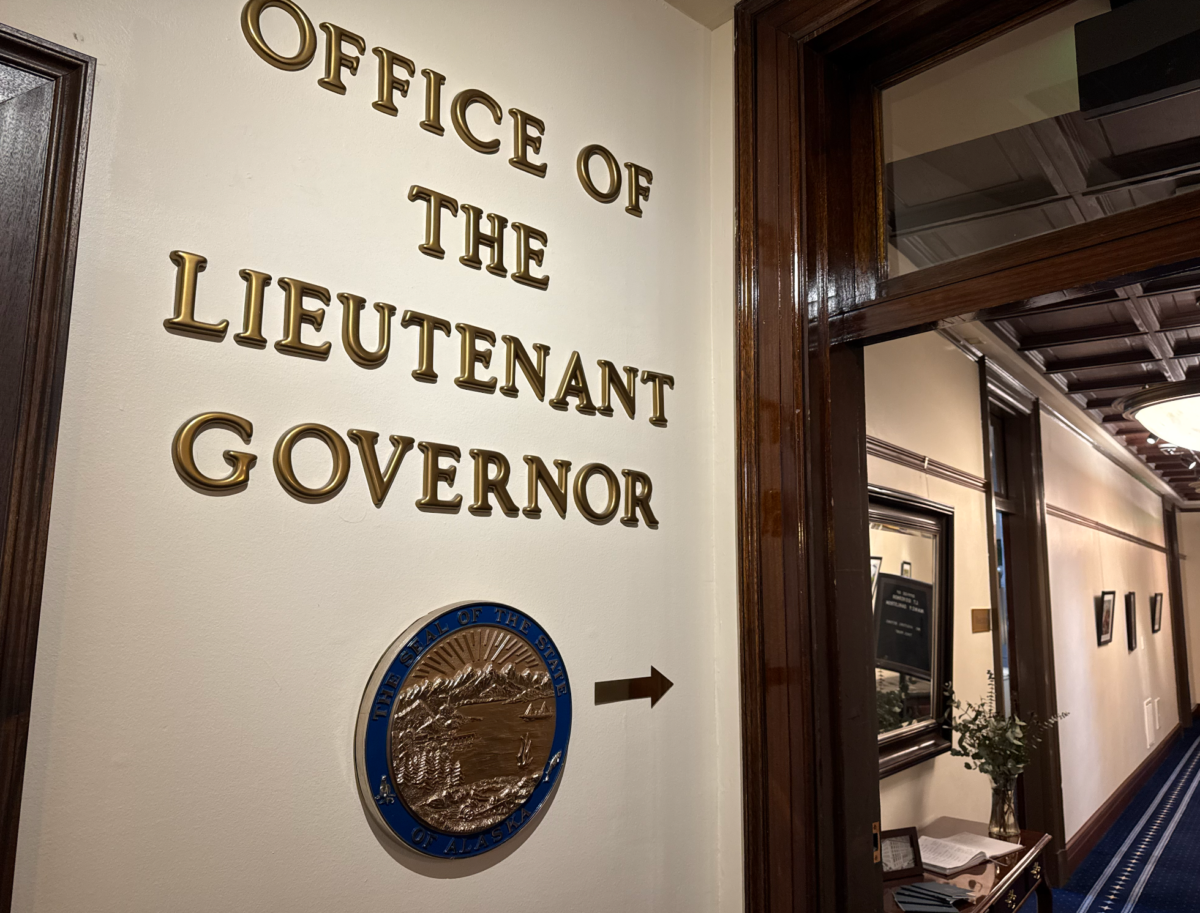
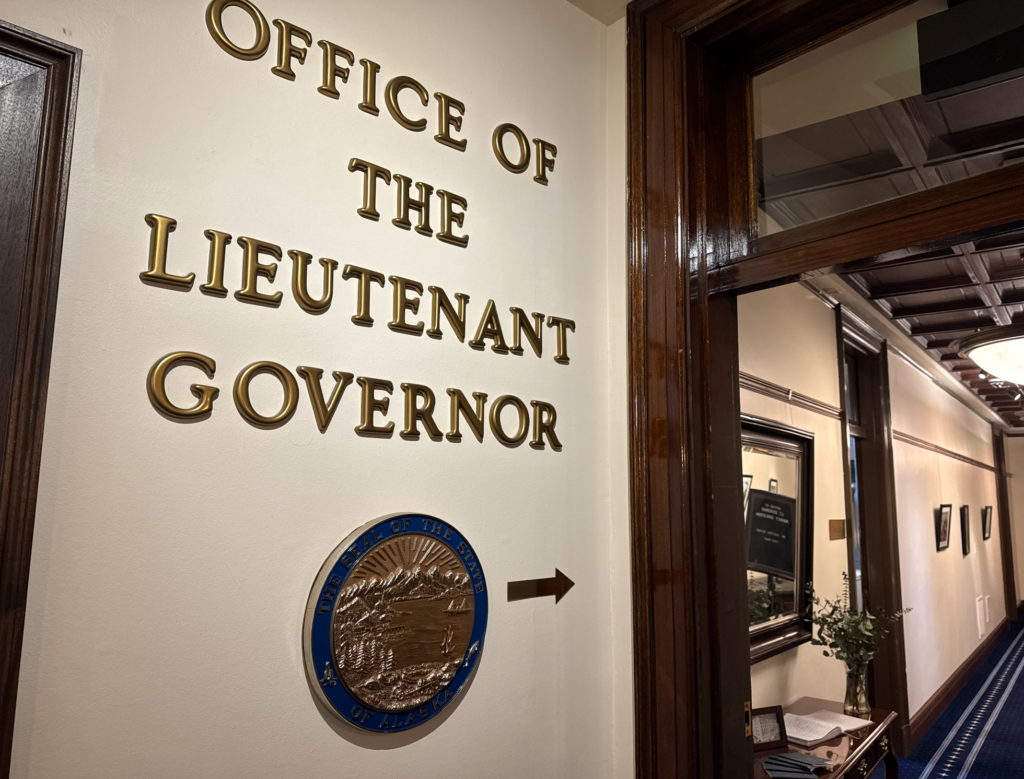
Alaska’s lieutenant governor maintains an office at the state Capitol in Juneau on the same floor as the governor. (Photo by James Brooks for Northern Journal)
Rep. Andrew Gray, D-Anchorage and chair of the House Judiciary Committee has scheduled a legislative hearing on Monday to discuss the disqualification.
In a memo to Gray, attorney Andrew Dunmire said “the Lieutenant Governor was likely not legally justified in her decision to reject Mr. Sullivan’s declaration of candidacy.”
Dan J. Sullivan of Petersburg has the same first and last name as incumbent Sen. Dan S. Sullivan.
The Alaska Republican Party filed twocomplaints against the Petersburg Sullivan, saying his candidacy was merely intended to confuse voters and he was not acting as a candidate in good faith.
Dahlstrom ultimately agreed with those complaints and disqualified Dan. J. Sullivan under a state regulation that forbids the Division of Elections from listing a candidate’s name “in a manner that is confusing or misleading to voters or compromises the fairness or neutrality of the ballot.”
Dunmire, analyzing the situation, said Dahlstrom was incorrect because state regulations cannot trump the U.S. Constitution’s requirements for candidates.
“As a general matter, the U.S. Constitution is supreme in all areas of law, and an administrative regulation cannot override or contravene a constitutional requirement. Therefore, if Daniel J. Sullivan is constitutionally entitled to be recognized as a candidate for U.S. Senate, then no regulation can prevent him from appearing on the ballot,” Dunmire wrote.
Amber Lee, a consultant working with Dan J. Sullivan, said by text message on Wednesday that the Petersburg Sullivan is still deciding what he will do after the lieutenant governor’s decision.
Students perform during a final spring concert on May 13, 2026 at Meadow Lakes Elementary, one of three schools closed by the Matanuska-Susitna Borough School District this year to address a budget deficit. (Photo by Elise Giordano/Mat-Su Sentinel)
Alaska saw an unprecedented wave of school closures this year. District officials grappling with severe budget shortfalls have opted to close 12 elementary and middle schools across the state — in Anchorage, Wasilla, Sutton, Seward, Sterling, Soldotna, Kasilof and Ketchikan.
With those closures, hundreds of students and staff will bus or commute to new schools next year, class sizes will grow as grades are combined and districts across the state are cutting programs, teachers, health aides, custodians, sports, library services and extracurriculars like music.
Officials in four districts say the closures were incredibly complex and difficult decisions but necessary to combat millions in budget shortfalls and years of state funding not meeting districts’ surging costs to operate schools.
“It was an incredibly trying time,” said Randy Trani, superintendent of the Matanuska-Susitna Borough School District that closed three elementary schools this year to address a $28 million budget shortfall. “Non-winnable… we did this to save teaching positions,” he said.
“This is devastating to everyone,” said Kylie Wilcox, a Soldotna mother of five. Her middle and high schoolers attended River City Academy, one of four schools closed on the Kenai Peninsula. “The district does not want to do this, the administration doesn’t want to do this, we just, it’s the reality of what we’re working with.”
At the same time, superintendents said it’s still unclear whether the closures and cuts have balanced district budgets because Gov. Mike Dunleavy has yet to sign off on next year’s increased budget for education funding. Last year, lawmakers flew back to Juneau for a special session, overruled Dunleavy’s veto and restored an education funding increase in a historic override vote in August, just weeks ahead of the first day of school.
This year, the Alaska Legislature approved one-time additional funding of $144 million for K-12 schools, including $29 million to offset rising energy costs, to total $1.8 billion approved for education next year. Lawmakers passed a budget with higher-than-expected state oil revenues driven by the Iran war, which is now before Dunleavy for his consideration.
Education Commissioner Deena Bishop said that the state has seen declining enrollment for more than 15 years, and as a result districts close schools due to what she called “excess capacity.” Bishop has served as commissioner under the Dunleavy administration since August 2023.
Deena Bishop, commissioner of the Alaska Department of Education and Early Development, speaks at a news conference Friday, March 15, 2024, with Gov. Mike Dunleavy. (Photo by James Brooks/Alaska Beacon)
“We’ve had several schools at 50% capacity, 55% capacity, that were within two miles of each other. And understanding that you want to use the majority of your money, you don’t want to put into facilities — the majority of your money you want to put into classrooms,” she said. “And so decisions, you know, things were weighed, and districts, hopefully working with their parents and communities, made decisions that they felt were the correct ones.”
Bishop said more families are opting for homeschool programs, and districts need to figure out how to provide education services for families that want choices for more flexibility.
Nearly one in six Alaska students were homeschooled last year, totaling an estimated 23,600 students, according to data compiled by the Association of Alaska School Boards.
“So we can’t really be upset that, you know, ‘Oh no, they’re not going to our schools,’” Bishop said. “Obviously they’re going to a school that their needs are met, if they’ve chosen that, so how do we work with it? You know, what does education look like, and what does it look like in serving a community? And more and more we’ll find that one size doesn’t fit all that schools really want to offer, and districts are starting to offer different programs.”
Alaska students have the option to enroll in homeschool or correspondence programs across the state, not necessarily with the district where they reside. While district officials say they are working to adapt and provide homeschool education services, districts receive less state funding per homeschool student which is contributing to district-wide deficits.
Matanuska-Susitna Borough School District closes three schools
The Matanuska-Susitna Borough School District, the state’s second largest district with almost 20,000 students, faced a $28 million budget deficit this year, prompting cuts across the district.
The school board closed Meadow Lakes and Larson elementary schools in Wasilla and Glacier View School in Sutton, affecting roughly 415 students and dozens of staff.
That comes after the district cut roughly 160 staff positions last year, said Superintendent Randy Trani. He said the district would have had to cut an additional 225 positions this year, which was unworkable.
“The very last thing that we wanted to do was lay off teachers, and the second last thing we wanted to do was close schools, but we’re to the point where if we didn’t close schools, it was only going to result in more teacher layoffs,” he said.
Trani said the district went through a process of evaluating schools based on a number of metrics, including number of students, costs to maintain and opportunities to bus students to schools nearby, in order to decide which schools to close. “The schools that we were forced to shut down were fantastic schools. This wasn’t a decision on academic merit. This was a decision about logistics and being forced into a really impossible choice,” he said.
Trani said closing the three schools wasn’t even enough to make up for the budget shortfall and the district had to cut deeper.
The school board considered various scenarios from cutting sports programs to transitioning to a four-day school week, Trani said, which were rejected by the school board. “These are all horrible choices,” he said.
While the Matanuska-Susitna Borough continues to have the fastest growing population in the state, Trani said declining birth rates combined with an ongoing wave of families opting to homeschool is leaving the district with declining enrollment of full-time students and reduced funding for the district. Roughly 3,200 students, or 16% of the district’s students, were enrolled in Mat-Su correspondence programs this year.
Trani said another cost driver had been double digit increases to healthcare insurance costs resulting in roughly $6 million more to the deficit, bumping it to $28 million.
But he emphasized the largest driver of the deficit was insufficient state funding. “State funding has not kept up with inflationary pressures, and it is by far the biggest driver,” he said. “Unless there is a long term fix to how K-12 education is funded this problem is going to continue.”
Ketchikan closes two of four elementary schools, with more cuts to come
Ketchikan serves roughly 1,800 students in the Southeast Alaska island community that is only accessible by plane or boat. This year, the district enacted major cuts, including 76 staff positions across the district to address a $3 million budget shortfall, plus $5 million in debt to the local borough. It closed two of the four elementary schools.
Point Higgins Elementary School was one of the two elementary schools closed this year in Ketchikan due to budget cuts. Staff and volunteers helped move out the school in early June 2026. (Photo by Niki Suomala)
The district closed Point Higgins and Fawn Mountain elementary schools, leaving one elementary, one middle and one high school in the community.
Niki Suomala, a third generation Ketchikan resident, attended Point Higgins elementary school, located 15 miles north of town. She said it was a special experience for her two children to go there — until the closure.
Her kids will be in the second and sixth grades next year, and they plan to commute into town for school. She said there were some tears at the news, but she said her children are adapting. She said she’s disappointed overall, but feels compassion for the district.
“It’s like, gosh, couldn’t we see this? Couldn’t we have seen this coming, and couldn’t we have tried to do something different?” she said. “But I also feel compassion, because I don’t know the answer to that question.”
Sheri Boehlert, the interim superintendent of Ketchikan Gateway Borough School District, also served as the principal of Point Higgins, spoke by phone after a full week of packing up and clearing out the schools. She said the reaction to the closures has been mixed: while there’s some in the community who want to see deeper cuts to balance budgets, there’s also a lot of grief in saying goodbye to neighborhood schools.
“It’s hard to dismantle something that was a big part of your career,” she said. “But on the flip side of that, the staff and community has really, by and large, been overwhelmingly supportive. We have tons of volunteers that are helping teachers pack and move, and they’re going to make something great at the next school for students, and there’s optimism out there.”
Class sizes will be effectively doubling in Ketchikan, Boehlert said, from about 15 students to class numbers in the twenties for elementary school and thirty students or more in the middle and high schools.
Boelert said the district has seen rising costs to operate, including for fuel, utilities and special education services. She said in particular the cost of staff health insurance is up 112% this year. Previous cost overruns for health insurance discovered last year created the over $5 million debt to the borough which the district will pay over over the next several years. “That is a unique situation,” Boehlert said. “They need their money back.”
Boehlert said with essentially flat state funding not meeting cost increases, the district cut roughly 26% of staff this year: “So it’s teachers, it’s principals, it’s custodians, health aides, like maintenance staff. No work group was unaffected.”
Even so, with the debt repayment, and this year’s state budgets still uncertain, Boehlert said Ketchikan faces more cuts across the district — unless there’s a significant population increase.
“We have a difficult road ahead of us in Ketchikan,” she said.
Four schools closed across the Kenai Peninsula
In the Kenai Peninsula Borough, the state’s third largest school district stretches across roughly 25,000 square miles — an area about the size of West Virginia — and serves nearly 8,400 students.
This year, the district faced an $8.5 million budget shortfall, after an $17 million deficit last year. The district is still in the midst of budget negotiations and determining cuts. An additional $3.3 million from the local borough and yet-to-be-determined one-time state funding this year may restore some programs, but officials opted to close four schools.
The district closed River City Academy in Soldotna, Tustumena Elementary School in Kasilof and Sterling Elementary School, sending students to other schools in Soldotna and Kenai. On the eastern side, the district closed Seward Middle School where classes will be consolidated into the elementary and high schools.
“The response was overwhelmingly that parents do not want these schools to close down. Communities did not want the schools to close down,” said Kari Dendurent, assistant superintendent of the Kenai Peninsula School District.
One of those parents is Kylie Wilcox, a mother of five living in Soldotna. Two of her children attended River City Academy, which was a standards-based school serving grades seven through 12. She said they liked the supportive environment and had hoped to continue through high school there.
River City Academy, a standards-based school serving grades 7 through 12 in Soldotna, was one of four schools closed by the Kenai Peninsula School District in May 2026. (Photo courtesy of Kylie Wilcox)
“They were starting to make friends at River City, and so they were really sad, like ‘I’ve got to start over again.’” she said. “And they were angry. They talked a lot about, you know, ‘why can’t they just give money to schools? Don’t they think that we’re worth it?’ My oldest was upset enough that they were willing to testify in the district meeting as well. I was really, really proud of them for doing that.”
Dendurent, the assistant superintendent, said the district worked through a transition plan to help students and families plan where to attend schools next year. She said some teachers from River City Academy transferred to Skyview and will be in homerooms with former students. She said it’s a difficult process with cuts across the district, including reading programs, library aides, English language learning programs, swimming pools and others.
“It’s very, very difficult, and it impacts everybody, and the other part that also makes it difficult is we are in contract negotiations right now with our certified and our classified employees as well,” she said.
Dendurent said the district has seen more students and families opt for homeschool programs, resulting in less state funding for the district. “It’s a borough issue, it’s a state issue, and it’s a national issue with declining enrollment,” she said.
She said rising health care costs is also a major factor for the district budget, as well as fuel and utilities costs. Even with the school closures, Dendurent said the district’s financial picture is still uncertain. “Predictable, sustainable funding is what I think all of us are looking for,” she said.
Wilcox said she has empathy for district officials and they handled the process fairly well, but wishes there was more support from the Kenai Peninsula Borough and from state leaders. She said her family is still evaluating options, but will likely homeschool her two middle and high school age students, with her 10th grader also pursuing classes at the Kenai Peninsula College.
“Honestly it feels sometimes like there are people in our state government that would rather see public schools fail, and rather see more homeschool and private school options happen for kids. And I feel like that’s not going to serve all of Alaska’s kids,” she said.
“Like, homeschool is a great option for a lot of people. I am a homeschool graduate,” she added. “But I know that there are families where that’s just simply not an option, and they deserve the support of the state for their child’s education, that’s one of our rights.”
Anchorage closes three elementary schools, with deep cuts across the district
In the state’s urban center, the Anchorage School District made severe cuts this year to address a $90 million deficit and opted to close three elementary schools. It is the largest school district that serves nearly 42,000 students.
The closures were at Fire Lake, Lake Otis and Campbell STEM elementary schools. A parent group filed a lawsuit challenging the district’s decision to close Campbell STEM, which is still under dispute. It’s the only one of the three schools without plans to move a charter school into the building.
Andy Ratliff, the district’s financial officer, said closing the three schools accounted for just a fraction of the deficit, and cuts were made across the district — including almost 500 staff positions, or about 10% of the district’s staff.
“We reduced millions of dollars in administrative costs. We’ve increased our class sizes by four. We reduced a lot of our IT positions, maintenance, everything,” he said. “Mental health, our teaching and learning department was cut by like 45 or 55%. Yeah, I mean it’s just kind of all across the board, even into our special education realm.”
Ratliff said the district has spent down its savings, and the small increase in state funding last year didn’t meet the district’s rising costs. He said health insurance rose in the double digits and now is about 20% of the total budget. “It’s really just this inconsistent funding that’s really just kind of dictated by the state that has put us in this position,” he said.
Ratliff noted the state’s energy relief funds are contingent on oil revenues and likely won’t reach districts until September. He said the uncertainty of funding this late in the year is challenging for staffing and determining what cuts if any can be restored.
“They did approve money, but we don’t have it yet,” he said. “So it’s hard for districts to do any sort of restoring of the cuts that they’ve made at this point.”
State legislature approves $144M in one-time next year, but funding still uncertain
District officials said the Legislature’s boost of $700 per student in the state’s funding formula last year was welcome, but did not significantly affect districts’ overall financial challenges.
A school bus drives by the Alaska State Capitol on Jan. 21, 2026. (Photo by James Brooks/Alaska Beacon)
The 12 school closures this year comes after five schools were closed last year in Kodiak, the Kenai Peninsula Borough and Fairbanks.
Many district officials, education advocates and lawmakers have emphasized that state funding has not kept pace for years with school districts’ needs and costs for providing public education.
But Bishop, education commissioner for the Dunleavy administration, rejected the notion that school funding has been flat.
“Over time in our state, because of the fluctuations of how we get resources to provide to schools, I think that’s exactly why money is either in the formula or out of the formula, but over time you will see that generally there’s been an increase in funds every year,” she said.
She acknowledged the rising costs of school districts, and said at the same time the governor and Legislature have competing priorities for the state budget. “Everybody in the state has to look at the picture as a whole,” she said.
“Hopefully when we can create new revenue, continue to really thrive in schools and innovate programs to match needs that families are seeking, that we’ll be able to move into the future,” she said.
This year, lawmakers seemed to have less appetite for taking on another education funding battle with Dunleavy, particularly among competing priorities of election reform and reviving the state’s pension system. Both initiatives were vetoed by Dunleavy and a legislative veto override effort failed for both. Citing increased oil revenues due to the Iran war, the Legislature passed $144 million in additional one-time funding and nearly $150 million for K-12 school maintenance and repairs.
Rep. Rebecca Himschoot, I-Sitka, speaks in favor of a veto override on House Bill 69 on Tuesday, April 22, 2025. (Photo by James Brooks/Alaska Beacon)
Rep. Rebecca Himschoot, I-Sitka, is a former teacher and vocal proponent of increasing education funding. She co-chairs the bipartisan task force on education funding launched last year.
“Closing a school feels like a death, and it is,” Himschoot said.
Himschoot pointed to budget problems, loss of enrollment and the shift to homeschool, but said the state, in her view, is not funding education as it should.
Himschoot said the task force is investigating short and long term funding solutions. The state approved an adequacy study this year to determine how much funding is needed to support schools, to be completed in the next few years. Another bill to allow districts to budget based on a three year average of student counts, failed in the Legislature this year, but Himschoot said the policy is likely to be revived next year to allow districts to set budgets earlier in the year. “It would take some of the uncertainty out and I think that’s going to have an impact on outcomes,” she said.
She said the task force is continuing its work looking at the problems and funding mechanisms, gathering input and evaluating solutions to address issues in the funding formula, major maintenance and rising costs like health care. Recommendations are due next January.
“The pain is felt by the students. That’s a straight line from state funding to what students get or don’t get,” she said. “It keeps me awake at night.”
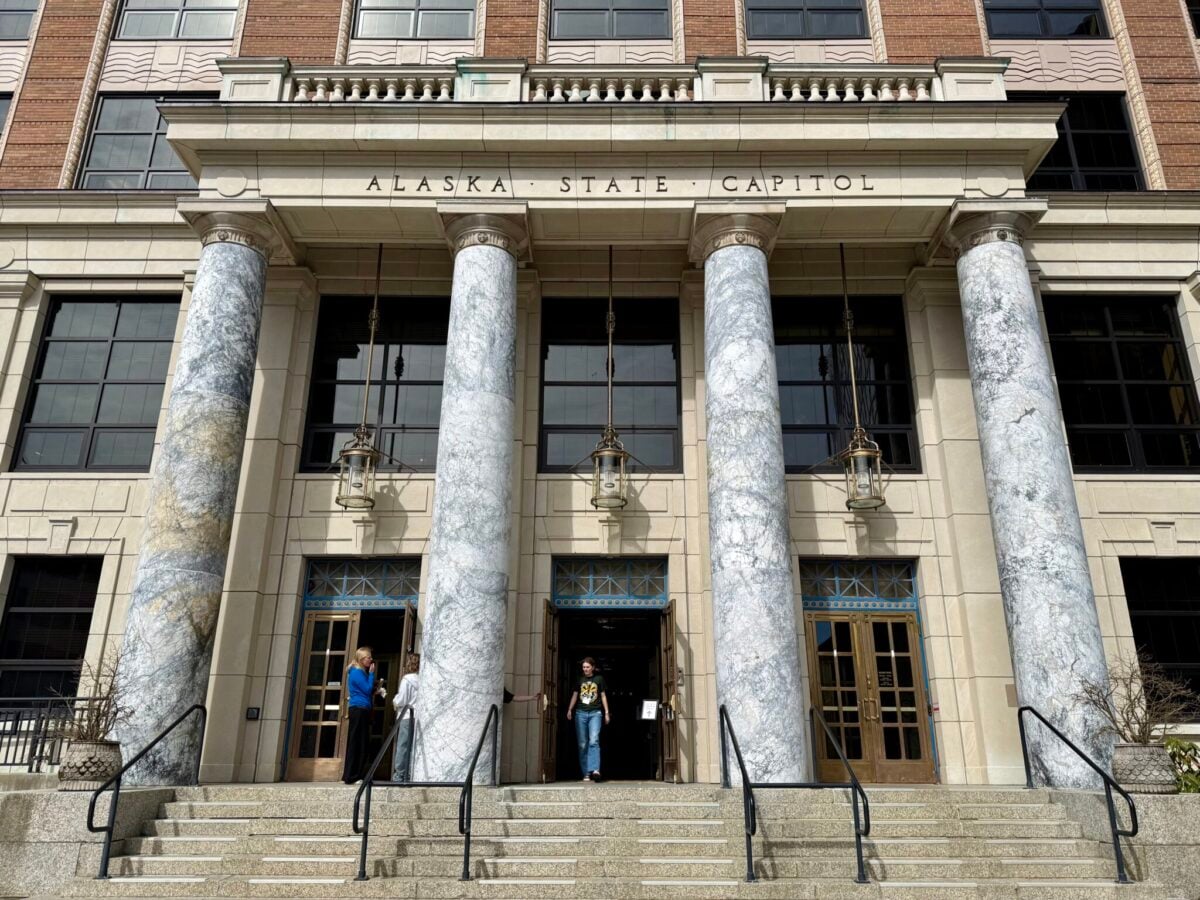
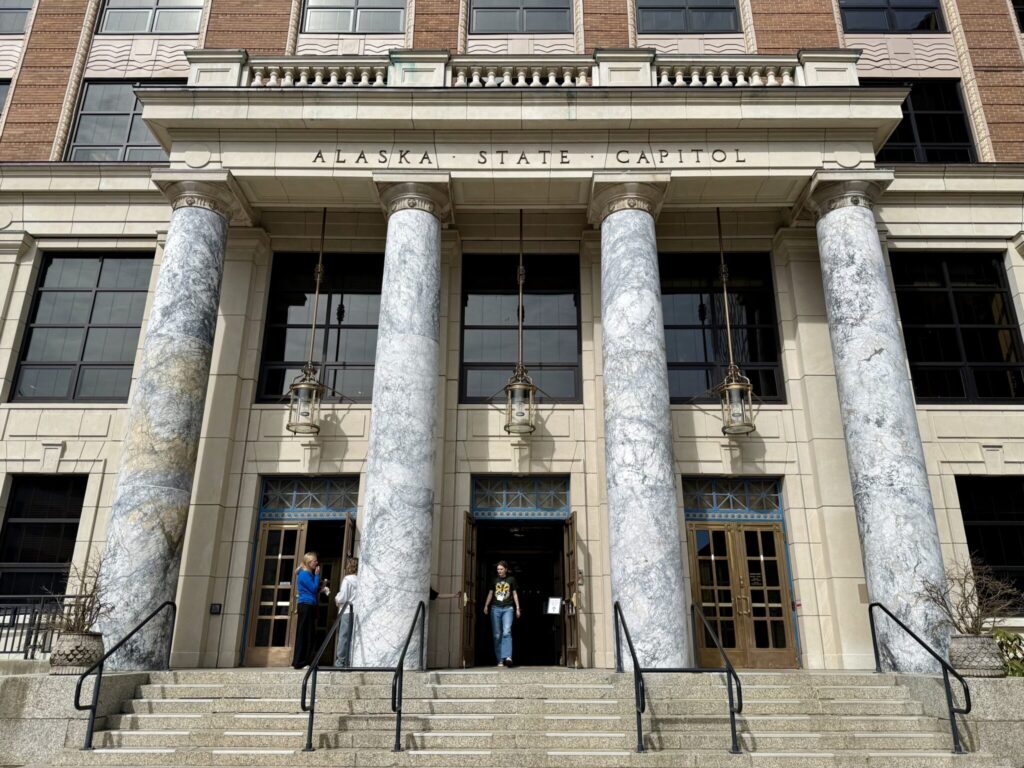
The Alaska State Capitol in Juneau is seen on Apr. 24, 2026. (Photo by Claire Stremple/Alaska Beacon)
Less than two years after Alaskans approved a ballot measure creating a mandatory sick leave law, the Alaska House of Representatives has voted to partially repeal it.
By a 22-18 vote on Saturday, the House approved an amendment that would cancel the law’s application for seasonal workers and for workers employed by a business with nine or fewer employees. The cancellation would take effect immediately, if the bill is signed into law.
Seasonal workers are defined as those who work at a specific job for less than six months per year.
All of the House’s Republican members voted for the amendment, including Reps. Chuck Kopp, R-Anchorage, and Louise Stutes, R-Kodiak, who are members of the House’s predominantly Democratic majority caucus. Speaker of the House Bryce Edgmon, I-Dillingham, also voted for the amendment.
All of the House’s Democratic members and its remaining independents opposed the amendment.
The amendment was to House Bill 193, which would create a mandatory paid leave program for new parents, starting in 2030. That bill advanced from the House on a 36-4 vote and was scheduled for a hearing in the Senate Finance Committee on Monday afternoon.
The four opposition votes all came from Republican lawmakers in the House’s minority caucus.
It was not immediately clear whether the bill had the necessary support to pass the Senate before the end of the legislative session on Wednesday night.
The amendment, introduced by Rep. Julie Coulombe, R-Anchorage, was largely identical to House Bill 161, a rollback measure that failed to advance in the Capitol this year despite significant lobbying efforts from business groups.
The state’s fishing industry, tourism industry, construction industry, the state chamber of commerce and several local chambers of commerce all haveadvocated HB 161.
Speaking ahead of the vote, several Republican lawmakers said they were heeding that call and voting yes on the amendment to HB 193.
“It’s actually been my number one priority since I got back here this year,” said Rep. Will Stapp, R-Fairbanks, speaking about the rollback.
Much of the desire for the rollback, Stapp explained, is because during its first year, seasonal employees saved their sick leave until the end of their term, then used it right before their departure, leaving employers short-staffed.
“That is creating a workforce crisis at the end of the season that is going to progressively get worse and worse and worse for our fishing industry, for our tourist industry, for our construction industry,” he said.
Speaking on the floor ahead of the vote, Coulombe said she had hoped to cancel sick leave for all workers at businesses with fewer than 50 employees, but she received a legal memo indicating that doing so would be illegal because Alaska’s constitution prohibits the Legislature from repealing a ballot measure within its first two years, and such a large exemption would have covered roughly half of the state’s workers.
Rep. Sarah Vance, R-Homer, said the sick leave law is “gutting the small businesses in my community.”
“We need to be listening to our business community right now, that so many of them (came to us) and said, ‘We need help,’” she said.
Rep. Zack Fields, D-Anchorage, was among the lawmakers who urged the House to reject the amendment.
“I think it’s very problematic to substantially gut a ballot initiative less than two years after it was passed by voters,” he said.
Exempting seasonal workers means exempting multinational tourism and fishing businesses that operate in Alaska, he noted.
“Do we really need to exempt all the employees of massive multinational businesses like Holland America Princess?” he asked.
During the COVID-19 pandemic emergency, fish processing plants and cruise ships were hotspots of infection and disease. Outside the COVID-19 pandemic, tourism occasionally brings waves of influenza and norovirus to coastal communities.
“When we have a tourism dependent economy, it is not in our interest to push sick people to come to work when they’re serving food, when they’re doing hospitality,” Fields said.
In 2024, Rep. Genevieve Mina, D-Anchorage, was one of the key organizers behind the sick leave ballot measure. Like her Democratic colleagues, she opposed the sick leave rollback but ultimately voted for the underlying bill even though it contained the rollback.
“The bill is a great bill, and you can just see the strong bipartisan support,” she said. “This whole building is an area of trying to figure out compromises and figuring out the ways where we can do good things that are supportive for families and can really address these issues about migration that our state has been facing. It’s not over for the bill or for paid sick (leave), so we’ll just see what happens on the Senate side.”
Stak Energy’s data center would sit roughly one mile west of the Dalton Highway, which connects urban Alaska to the state’s North Slope oil fields. (Arthur T. LaBar, CC BY 2.0)
One of the largest data centers in the nation has been proposed on Alaska’s Arctic North Slope, where boosters say it could take advantage of abundant land, cold temperatures for cooling and a huge supply of natural gas for power.
The $500 million development would occupy an entire square mile with multiple buildings in a remote area off the Dalton Highway, some 25 miles south of the North Slope’s major infrastructure. That’s according to documents released this week by the state, which on Tuesday issued a preliminary decision to lease the property to the project’s operator.
A newly built pipeline would carry natural gas to fuel the data center’s power plant — which, according to the documents, could use more than twice as much of the fuel as urban Alaska consumes for electrical generation and home and commercial heating. The project could ultimately produce up to three gigawatts of power for its own use, making it competitive with some of the largest data centers under development in the Lower 48.
The company behind the project is Stak Energy, which last year proposed a far smaller project more narrowly focused on digital mining of cryptocurrency. It now says it plans to support “large-scale AI and cloud computing operations,” including training of large-scale machine learning models and high-performance scientific and analytical computing.
The company in November proposed its lease to the Alaska Department of Natural Resources, which subsequently published a notice to solicit competing bids. None came in, so the department is now proceeding with the leasing process, with a public comment period on the preliminary decision open through June 15.
Stak has not disclosed who would finance its new project, though it previously said it was raising money from Anchorage firm McKinley Alaska Private Investment.
Stak has expanded significantly in recent months, making a number of politically connected hires including Gov. Mike Dunleavy’s former natural resources commissioner, John Boyle, and a former special assistant at the natural resources department, Jim Shine.
The company’s founder and chief executive, Sparrow Mahoney, grew up in Alaska and attended Wasilla High School.
Stak officials declined to respond to specific questions about its proposal. But the company shared a prepared statement that describes itself as having “deep Alaska roots, built on decades of combined experience across the state’s energy and infrastructure landscape — and proud to help build Alaska’s next era of prosperity.”
The lease application, the company said, “reflects an important milestone for anchoring Alaska as America’s at-scale energy solution — a meaningful step toward bringing opportunity, jobs, and revenue home to stay.”
“Stak Energy is committed to responsible development, expanding opportunity, and contributing to a more diverse and resilient Alaskan economy,” the company said.
Energy experts said that Stak’s lease application, released by the state, is thorough. But it also raises a number of questions.
One is how quickly the company can secure the natural gas-powered turbines that it would use to generate electricity. Rising demand for those turbines, prompted by the rush to build new data centers and the overall expansion of natural gas-fired power, is leading to manufacturing backlogs as long as seven years; Stak says it wants its initial operations to begin in 2028.
Then, there’s the question of where, exactly, Stak will get its natural gas supply.
Alaska’s North Slope oil fields contain huge deposits of natural gas. But historically, petroleum companies have almost exclusively extracted oil from those fields, as it’s more energy-dense and can be shipped down the 800-mile trans-Alaska pipeline; minimal infrastructure exists to move North Slope natural gas to market.
Companies presumably would be willing to sell gas to a project like Stak’s, according to Antony Scott, a former commercial petroleum analyst for the Alaska Department of Natural Resources.
But details of Stak’s land lease application makes clear that at the time it was submitted, the company hadn’t yet struck a firm deal for gas supply, he added. Stak says its gas pipeline could run anywhere between 25 and 90 miles, which implies that it could connect to any number of different petroleum fields on the North Slope.
“That means they don’t have a gas supply,” Scott said.
Scott added, though, that the project’s remote location — and the fact that it wouldn’t connect to Alaska’s urban power grid and risk driving up demand and prices for electricity, like data centers have in the Lower 48 — help smooth the project’s path.
“The issue of data centers and the effect on normal humanity’s electricity bills is causing real angst,” Scott said. On Alaska’s North Slope, he added, “we avoid all of that. You can just step into this friendly environment.”
Stak’s application and supporting material say its project has another leg up on Lower 48 developments.
Outside projects have faced increasingly strident opposition in response to their enormous consumption of water for cooling. The company says in its lease application materials that its North Slope location is a “crucial design advantage” because of an average annual temperature of 12F — allowing it to use air for cooling instead of depending on water.
Air cooling, the company says, is expected to reduce water consumption by 90% or more, “compared to industry norms.” Stak isn’t proposing any formal use for the project’s waste heat for now, but it says that “potential applications” include keeping greenhouses warm or supporting aquaculture.
One comparative disadvantage for Stak: It would be powering its computer infrastructure with fossil fuels. Some technology companies with carbon emissions targets are making efforts to run their data centers on non-fossil energy like nuclear power, wind and solar, though other projects have also tapped into natural gas.
Stak, in its application, says it’s monitoring developments in technology that could allow it to capture and store its carbon emissions. But at least initially, a dearth of infrastructure and a lack of understanding of the region’s geology for storing carbon are among the obstacles it faces, the company said.
Dunleavy’s administration, which has pushed to develop a data center industry in Alaska, has issued a preliminary, formal decision that the project is in the state’s “best interest” — a necessary step before it can issue the 50-year land lease that it’s currently considering.
The preliminary decision cites a peak construction workforce of 1,500 people, with some 60 permanent jobs that would be created by the project.
Stak will have to complete additional permitting before the project can move forward — namely, a federal Clean Water Act authorization needed to create the company’s gravel pad that will elevate its power plants and computer systems at least five feet off the tundra.
The project would require an enormous amount of gravel — some 7 million cubic yards worth, according to the state leasing documents.
That’s nearly twice as much as petroleum company ConocoPhillips is authorized to use for its big Willow oil project, Stak says.
Nathaniel Herz welcomes tips at natherz@gmail.com or (907) 793-0312. This article was originally published in Northern Journal, a newsletter from Herz. Subscribe at this link.
Attorney General designee Stephen Cox answers questions from the House Judiciary Committee during a confirmation hearing on May 4, 2026. (Photo by Corinne Smith/Alaska Beacon)
As Alaska state lawmakers consider Gov. Mike Dunleavy’s pick for attorney general, several have questioned a potential conflict between his involvement with a private, religious school and his role in the state’s top legal office.
Stephen Cox currently leads the Alaska Department of Law, which is defending the state in a lawsuit that challenges the constitutionality of spending state homeschool funds on religious and private school tuition.
He is also the treasurer and a founding member of the Thomas More Classical School, a private Christian school for grades Kindergarten through sixth grade, slated to open in Anchorage in the fall, whose website invites the use of state homeschool funding for nonreligious courses.
Cox has served in the role since his appointment in August, and appeared before lawmakers in a series of legislative hearings last week and Monday, ahead of a confirmation vote for attorney general, expected in the next week.
Sen. Löki Tobin, D-Anchorage, who chairs the Senate Education Committee, noted the apparent conflict between the state constitution and the school’s financial plans at a May 1 hearing.
“Our constitution directly says ‘schools and institutions so established shall be free of sectarian control. No money shall be paid from public funds for the direct benefit of any religious or private education institution,’” she read.
She pointed to his role as treasurer as a direct conflict with the state constitution because the school’s “tuition assistance” web page said it anticipates accepting payment through state allotment funds for courses “that do not use religious-based publishers and/or content.”
The lawsuit that will decide whether that spending is constitutional is currently underway.
Cox said he was not aware of the school’s tuition information.
“I am on the board of that school. I am not involved in the day-to-day operations,” he said, adding that he was involved in hiring a headmaster and the formation of the school. “I am not aware of that part of the website and I’m also not aware of any decisions with respect to allotment programs.”
He declined to comment further saying the issue was in active litigation.
Each homeschooled student is eligible for up to $4,500 per year, to be spent on curriculum, supplies or other educational resources. But the question on whether that money can go toward religious or private institutions is currently being decided.
A group of parents brought the lawsuit to prohibit state money from going to such institutions against the state in 2023, and a judge ruled the allotment system unconstitutional in 2024, but that ruling was overturned by the Alaska Supreme Court. The case moved back to a lower court — four school districts were named as defendants — and last fall a judge denied a motion to dismiss the lawsuit, citing need for evidence of how allotments are actually spent. A discovery period for both sides to collect evidence is open until June 1.
At a Monday hearing before the House Judiciary Committee, Rep. Ted Eischeid, D-Anchorage, pressed the question.
“Does that mean that under Alaska ethics law, you would recuse yourself about decisions that might benefit your school, financially related to public money going to private schools?”
Cox answered a slightly different question. He told lawmakers, for background, he had already looked into the question of recusal given his three children are homeschooled through the Anchorage School District’s correspondence program, Family Partnership Correspondence School. He said that he was advised it wasn’t necessary.
“The advice that I received back from my ethics supervisor after an analysis was that it was not a reason for recusal, because I think there are, like, 25,000 Alaskan students that benefit from the allotment, and so the fact that my kids benefit in piano class and tutoring and whatnot wasn’t itself a reason to recuse,” he said.
Cox is Catholic, and is a parishioner at the Holy Family Catholic Church in Anchorage, according to the school’s website.
Cox said he learned that the Thomas More Classical School was anticipating receiving allotment funds during confirmation hearings last week. He said he was not directly involved with the state’s defense in the lawsuit and that he would seek ethics advice about recusing himself from the case.
“I will say that I’m not involved in any of the day-to-day litigation, or even really any of the supervision of the strategic litigation,” he added. “Recently, last week, I learned for the first time that on the website, there was a reference to the school anticipating becoming a vendor of the correspondent school allotment programs. So I have asked my staff to take another look at that from a recusal perspective.”
On Tuesday, the tuition information on the school’s website had been changed. It now says that it still anticipates taking allotment money, but only in accordance with state law.
At the hearing on Monday, Eischeid asked Cox if the school planned to receive public allotment funds.
Cox said the issue is being litigated in court now, and whether it’s constitutional has yet to be determined.
“I want to be very careful, because this is in active litigation, and these are the issues that the judge and the judges ultimately will have to grapple with,” he said. “But as I understand it, the school districts and their correspondence schools — so for example, ASD’s correspondent schools, Family Partnership — the school districts will decide whether or not and to what extent the allotment can be used for private educational or private institutions, and vendors.”
Cox said when a court rules on the question, the Thomas More Classical School will follow the law.
Rep. Andrew Gray, D-Anchorage, noted that the Thomas More Classical school board president is Charles Gartland, who is also working at the Alaska Department of Law as the civil division director.
“Would he need to recuse from any cases dealing with allotments and private schools?” Gray asked?
Cox said he has asked the department’s ethics lawyers to research the question.
“I would assume that the same analysis that existed for me would also apply with respect to Mr. Gartland,” he said. “But I do not have an answer on that question yet.”
Officials with Alaska Department of Law did not return a request for comment on Tuesday on how decisions on recusal are made.
Gray said Monday there appeared to be a conflict of interest.
“Even if it’s all above board, as a member of the public, I see that, and I think that I would be more comfortable if the chairman of the board of a private school and the treasurer of the board of the private school wouldn’t work on those particular cases,” he said.
Gov. Mike Dunleavy speaks about at a May 4, 2026, news conference about his property tax bill intended to help draw investment in a massive natural gas pipeline. The news conference was held in his Anchorage office. (Photo by Yereth Rosen/Alaska Beacon)
Alaska Gov. Mike Dunleavy is urging state lawmakers to act on his proposal to cut state taxes by $7.2 billion over the next 36 years to subsidize construction of the proposed trans-Alaska natural gas pipeline.
Failing to act, he said, could keep the pipeline from being built at all.
“This bill is too important. This concept is too important,” Dunleavy said. “This is not setting up a tax for the lemonade stand down here in the corner by the hot dog stand. This is the biggest (natural gas) project on the planet.”
But some state lawmakers are skeptical about the size of the governor’s proposed subsidy. Two alternatives — one in the House and the other in the Senate — are advancing through committees in the final weeks of the session.
Other legislators believe the pipeline already makes financial sense and no change is needed.
As a result, four different paths await state legislators in their last weeks, and it isn’t clear which one they’ll take — or whether the governor will call legislators into special session on the issue.
There’s also been no agreement with cities and boroughs affected by the proposed tax cut. There’s also no public agreement with North Slope gas producers or the state’s labor unions.
At the core of the problem facing lawmakers is how much — if any — subsidy is needed in order to attract investors who would pay for building the pipeline project in two stages.
The first stage would involve a pipeline from the North Slope to Cook Inlet for in-state use. The second stage would construct processing plants at the north and south ends of the pipeline, allowing larger volumes of gas to be exported overseas.
If both phases of the project are built, Department of Revenue economist Dan Stickel told legislators on Tuesday, the result would be cheaper natural gas than currently available from Cook Inlet.
“If the full project goes forward, it’s a significant reduction in cost to Alaskans,” he said.
Rep. Zack Fields, D-Anchorage, noted that Alaskans could be locked into high natural gas prices if the second phase is never built or if both phases are built but no exports take place.
For a hearing last week, the Department of Revenue estimated that under that scenario, prices in Anchorage would exceed $27 per thousand cubic feet by 2033, more than double current prices.
It’s unclear how likely that worst-case scenario is.
The larger the subsidy, the greater the chance that the project is built in full and the lower the price of gas for Alaskans, project proponents say.
“Our objective is to have the lowest cost gas for Alaskans and have certainty on the project,” said Adam Prestidge, president of Glenfarne Alaska, the project’s developer.
A problem, some legislators say, is that they’re working without information. Glenfarne, an international firm that last year bought 75% of the project and became its developer, has not shared its latest estimate for how much the pipeline will cost.
“I think it’s important for us to have starting points on what the actual numbers are, because if it needs tax relief, let’s figure out what the relief is,” said Sen. Bill Wielechowski, D-Anchorage.
Legislators also don’t know how much North Slope gas producers will charge for the gas, or what international buyers will pay for it.
Some of that information is impossible to know — legislators are trying to anticipate the price of natural gas in 2033 and beyond, once the pipeline is up and running.
Other information is being kept confidential until a final investment decision or when proposed prices are submitted to state regulators, something that’s months away at the earliest.
Legislators are being asked to take action within weeks.
“We’re not really competitive in the global market if the (cost) overrun is 40%,” said Rep. Julie Coulombe, R-Anchorage, on Tuesday.
The gas pipeline’s publicly stated cost on Tuesday was $46 billion, but most legislators believe the true figure is higher.
“I think it’s really $57 billion … if not higher,” said Sen. Bill Wielechowski, D-Anchorage, relying on a prior statement from former U.S. Sen. Mark Begich.
Begich, a Democrat, lost to Gov. Mike Dunleavy in the 2018 governor’s election. Now, Begich is a paid adviser, hired by Dunleavy’s administration on a $100,000 contract.
In a Tuesday hearing, Begich said lower taxes would not increase profits for investors or developers and would simply lower the end cost of gas for consumers.
“If you lower the tax, it does not go to the return or the profit or anything of this project,” he said.
“I am just telling you right now, every dollar you save consumers is a dollar in their pocket in an economy that is struggling,” Begich said.
Under his calculations, Wielechowski said, the average Southcentral Alaska family would save $55 per year if the pipeline is built and produces gas according to the latest available cost analysis from the Department of Revenue.
The subsidy needed to create that savings amounts to a loss of $500 per Alaskan per year, he said, money that could be used for the Permanent Fund dividend or state services.
“That’s not a good deal,” he said of the exchange.
The latest available version of the Senate proposal shows an increase in revenue to the state, rather than a subsidy. Instead of earning $27.9 billion through 2062, the state would earn $42.1 billion.
“I would describe that as very burdensome for the project and potentially prohibitively so,” Prestidge said.
“I will characterize that tax at that level as something that would require some real reconsideration of the drawing board of how the project is structured and taken forward,” he said.
In the House, discussions have been less acrimonious. The House Resources Committee on Tuesday morning discussed a proposed a subsidy of less than $5.9 billion, smaller than the governor’s concept but similar in other regards.
“It would be a tax reduction but a smaller tax reduction than proposed by the governor,” Stickel said of the House proposal.
On Tuesday afternoon, the committee worked methodically through a long series of amendments to its plan, frequently consulting Prestidge and Begich about how each might affect financial negotiations.
The House and Senate bills are each in an early stage of development. If passed by the resources committees, each would have to pass through their respective finance committee before advancing to a floor vote and on to the other half of the Legislature.
Alaska Organized Militia members from across the Alaska Army National Guard, and the Alaska State Defense Force, prepare for departure from Joint Base Elmendorf-Richardson as they travel to Bethel, Alaska, while supporting storm response operations, Oct. 13, 2025. (Alaska National Guard photo by Capt. Balinda O’Neal)
Alaska will deploy 25 National Guard soldiers and airmen to Washington D.C. this month, according to a Friday update from the Alaska Department of Military and Veteran Affairs.
The deployment is part of a response to President Trump’s August declaration of a “crime emergency” in the nation’s capital. In the nine months since, 2,500 troops remain, according to NBC4 Washington. Guard members have assisted with medical emergencies, arrests and beautification projects, as well as snow removal.
The division announcement said the Alaska service members will be focused on public safety: “Guard members provide support functions such as crowd management, perimeter security, and logistical and communications support.”
Alaska National Guard members will deploy for 60 days, according to the division, as part of a joint task force with the Metropolitan Police Department and federal law enforcement partners.
Gov. Mike Dunleavy approved a verbal request in November from the U.S. Secretary of the Army for Alaska to deploy 100 service members, following a national directive by the Pentagon to all 50 states to prepare National Guard service members to train for “civil disturbance operations.”
A spokesperson for Dunleavy’s office did not respond to a request for comment on the smaller deployment, the purpose and timing of the mission on Monday.
Lawmakers had raised concerns about the Pentagon’s national directive for an estimated 20,000 National Guard service members to be trained and prepared to deploy in U.S. cities within 24 hours. Alaska was initially charged with preparing 350 service members as part of a “quick reaction force” by Jan. 1.
Rep. Andrew Gray, D-Anchorage, co-chair of the Alaska Joint Armed Services Committee, and a veteran of the Alaska National Guard, was among those who had raised concerns.
On Monday, Gray said the smaller deployment for 60 days is less of an issue.
“I don’t think it’s in the best interest of the American taxpayer to be flying service members from Alaska to D.C. to do what I don’t believe is of grave consequence,” he said.
“At the end of the day, to me, it’s sort of a nothing burger. I do think that it shows that the Dunleavy administration and General (Torrence) Saxe are in alignment with Trump. They’re showing that they support Trump’s agenda. But again, this is just not that big of a deal, in my opinion.”