Hacker using laptop. Lots of digits on the computer screen.
By: Haley Lehman, Alaska Beacon
Hacker using laptop. Lots of digits on the computer screen.
The Federal Bureau of Investigation released a report Thursday that showed Alaskans lost nearly $40 million in cyber crime in 2025.
Special Agent in Charge Matthew Schlegel of the FBI Anchorage Field Office said it is the highest financial loss ever reported in Alaska for such crimes.
“Behind these numbers are real people – Alaskan families who lost hard-earned savings, retirement funds, and financial security,” he said in a news release.
Americans lost nearly $21 billion in cyber crimes in 2025, according to the FBI Internet Crime Report issued by the Internet Crime Complaint Center.
This chart outlines IC3 loss trends over a 10-year period for Alaska, with reported losses exceeding $158 million. (FBI graph)
Alaskans reported the 2025 losses in 3,202 complaints to the Internet Crime Complaint Center, making it the highest financial losses ever reported in Alaska in one year. Losses went up by $13.6 million since 2024.
The FBI encouraged people to identify red flags of a potential scam to protect themselves from cyber threats and crime.
“To combat this ever-evolving threat, it has never been more important for residents and businesses to be diligent with cybersecurity, electronic interactions, and safeguarding personal and financial information,” Schlegel said.
The greatest losses in Alaska were from investments-related fraud, confidence or romance fraud, compromised business emails and tech support scans. Approximately 482 Alaskans lost more than $18 million to cryptocurrency crimes.
According to the report, 20% of Alaskans who reported losses from internet crimes were 60-years-old and older who lost $16.2 million.
President Donald Trump issued an executive order on March 6 directing officials to develop a plan to prevent, disrupt, investigate and dismantle Transnational Criminal Organizations in order to stop cyber-enabled criminal activity.
“Cybercrime, fraud, and predatory schemes are draining American families of their life savings, stealing the benefits of years of work, and destroying the lives of our youth,” Trump wrote in the order.
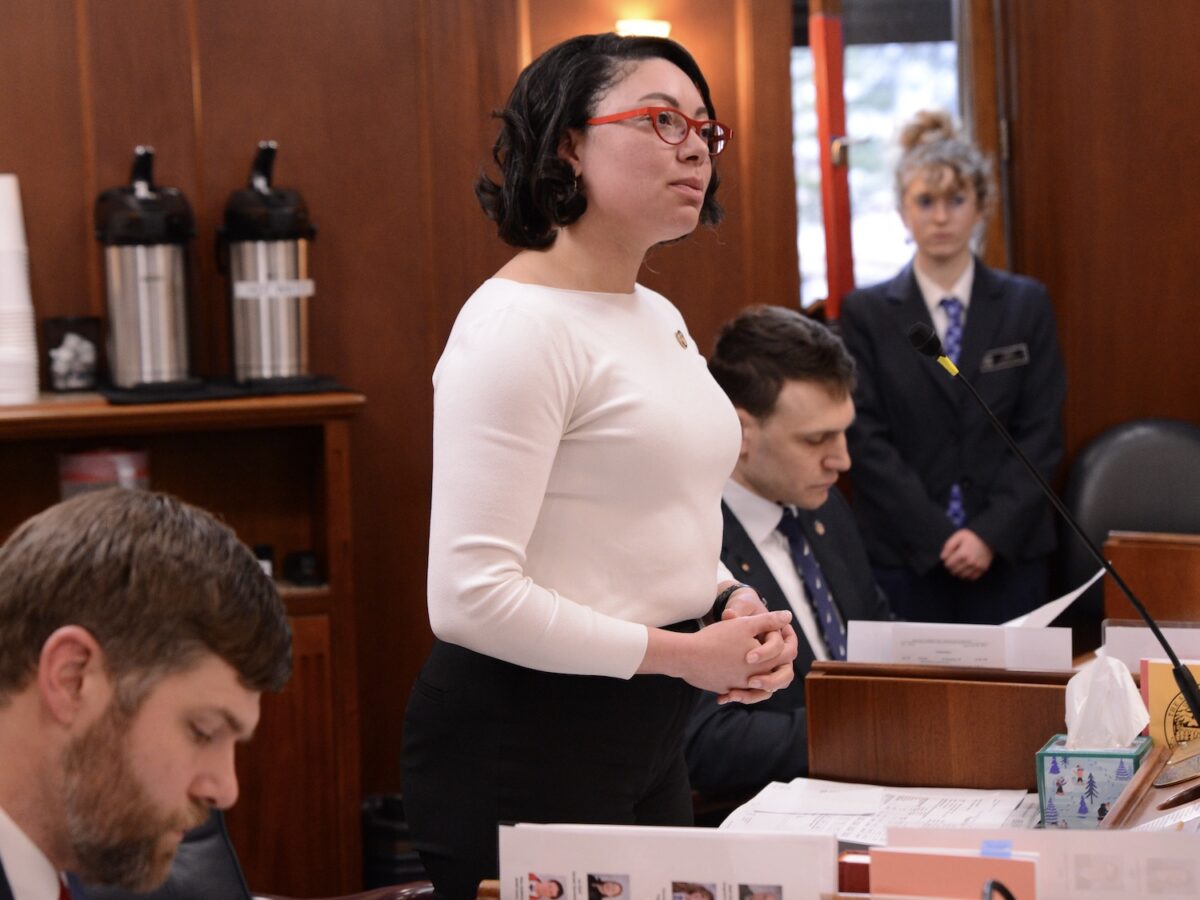
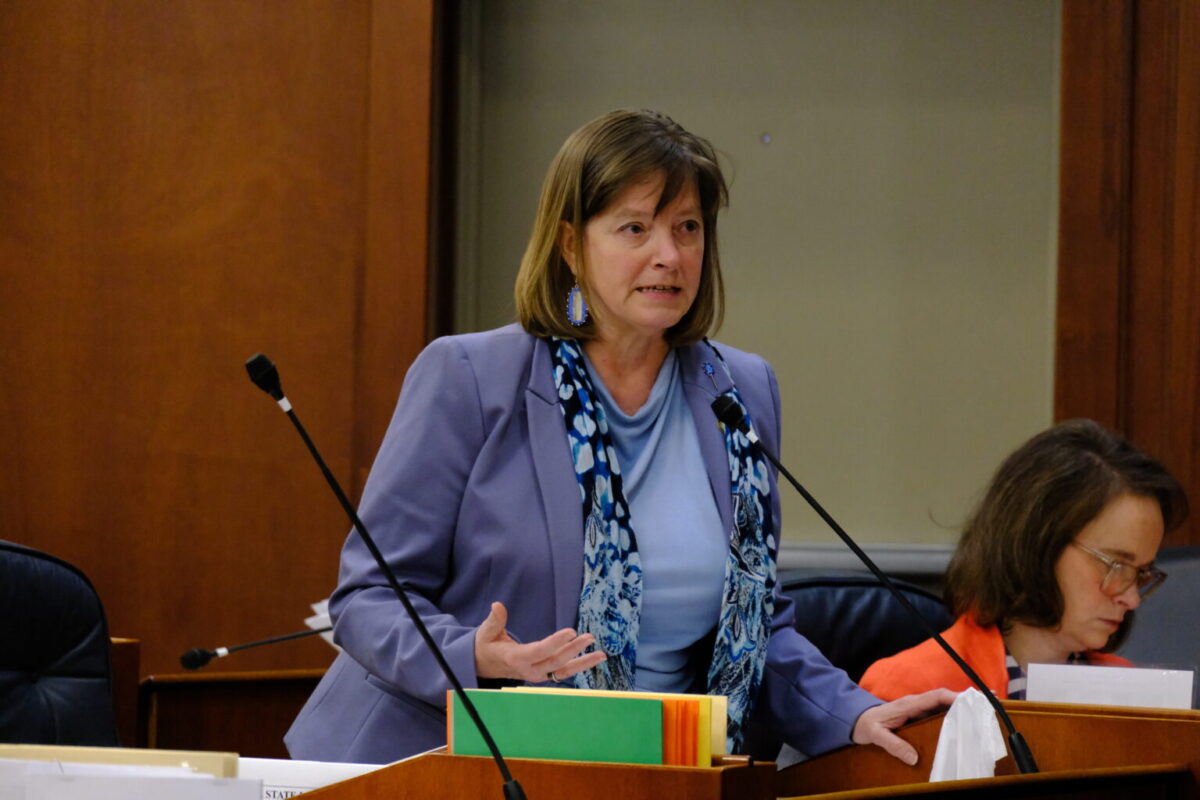
Sen. Loki Tobin, D-Anchorage, speaks in the Alaska Senate on Monday, April 28, 2025. (Photo by James Brooks/Alaska Beacon)
By: Haley Lehman, Alaska Beacon
Sen. Loki Tobin, D-Anchorage, speaks in the Alaska Senate on Monday, April 28, 2025. (Photo by James Brooks/Alaska Beacon)
The Alaska Senate advanced a resolution Monday to preserve three work visas to support Alaska’s economic security.
Alaska relies on J-1 visas to fill teacher positions, H-1B visas for highly skilled workers and the H-2B program for temporary nonagricultural workers in tourism, health care and seafood processing industries and for teachers.
Sen. Löki Tobin, D-Anchorage, said that Senate Joint Resolution 28, “puts Alaska on the record in support of these programs to fill jobs here in our state.”
The Trump administration raised the fee for highly skilled worker visas from $5,000 to $100,000 in September 2025.
Tobin said Monday that school districts in Alaska cannot absorb those costs and utilize the H-1B visa program to hire international teachers.
The Alaska House of Representatives passed a resolution in March urging the Trump administration to waive the $100,000 visa fee for international teachers. It was sponsored by Rep. Alyse Galvin, I-Anchorage.
According to Jennifer Schmitz, director of the Alaska Educator Retention and Recruitment Center, 20 school districts in Alaska employed 232 educators with J-1 visas and 341 educators with H-1B visas in 2025.
Alaska’s senior U.S. Senator, Republican Lisa Murkowski, introduced legislation in March that would exempt teachers from non-processing related fees for H-1B visas. U.S. Republican U.S. Sen. Dan Sullivan is a cosponsor.
The visa programs support other jobs, too. Marilyn Usibelli, owner of Black Diamond Resort Co. in Healy, wrote to legislators in March that J-1 visa holders play an essential role in staffing seasonal jobs in Alaska with lawful, reliable temporary workers.
“Despite extensive local recruitment, the small year-round population in the Denali Borough simply cannot meet the seasonal demand. J-1 participants fill critical roles that allow us to maintain safe, high-quality operations, support other local businesses, and contribute to the broader Denali-area economy,” Usibelli wrote.
The resolution passed the Senate with 19 yes votes with Sen. Donny Olson, D-Golovin, absent
FILE - A customs agent wears a patch for the U.S. Customs and Border Protection agency, Oct. 27, 2017, at John F. Kennedy International Airport in New York. (AP Photo/Mark Lennihan, file)
FILE – A customs agent wears a patch for the U.S. Customs and Border Protection agency, Oct. 27, 2017, at John F. Kennedy International Airport in New York. (AP Photo/Mark Lennihan, file)
AP-A refund system for businesses that paid tariffs which the U.S. Supreme Court ruled President Donald Trump imposed without the constitutional authority to do so is scheduled to launch Monday.
Importers and their brokers will be able to begin claiming refunds through an online portal beginning at 4 a.m. Alaska time, according to U.S. Customs and Border Protection, the agency administering the system.
It’s the first step in a complicated process that also might eventually lead to refunds for consumers who were billed for some or all of the tariffs on products shipped to them from outside the United States.
Companies must submit declarations listing the goods on which they collectively put billions of dollars toward the import taxes the court subsequently struck down. If CBP approves a claim, it will take 60-90 days for a refund to be issued, the agency said.
The government expects to process refunds in phases, however, focusing first on more recent tariff payments. Any number of technical factors and procedural issues could delay an importer’s application, so any reimbursements businesses plan to make to customers likely would trickled down slowly.
In a 6-3 decision, the Supreme Court on Feb. 20 found that Trump usurped Congress’ tax-setting role last April when he set new import tax rates on products from almost every other country, citing the U.S. trade deficit as a national emergency that warranted his invoking of a 1977 emergency powers law.
Customs and Border Protection said in court filings that over 330,000 importers paid a total of about $166 billion on over 53 million shipments.
Not all of those orders qualify for the first phase of the refund system’s rollout, which is limited to cases in which tariffs were estimated but not finalized or within 80 days of a final accounting.
To receive refunds, importers have to register for the CPB’s electronic payment system. As of April 14, 56,497 importers had completed registration and were eligible for refunds totaling $127 billion, including interest, the agency said.
System requires accuracy
Meghann Supino, a partner at Ice Miller, said the law firm has advised clients to carefully list in their declarations all of the document numbers for forms that went to CBP to describe imported goods and their value.
“If there is an entry on that file that does not qualify, it may cause the entire entry to be rejected or that line item might be rejected by Customs,” she said.
Supino thinks the portal going live will require composure as well as diligence.
“Like any electronic online program that goes live with a lot of interest, I would expect that there might be some hiccups with the program on Monday,” she said. “So we continue to ask everyone to be patient, because we think that patience will pay off.”
Nghi Huynh, the partner-in-charge of transfer pricing at accounting and consulting firm Armanino, said most companies claiming refunds will have imported a mix of items, and not all will qualify right away.
“It’s about having a clear process in place and keeping track of what’s been submitted and what’s been paid, so nothing falls through the cracks,” she said. “Each file can include thousands of entries, but accuracy is critical, as submissions can be rejected if formatting or data is incorrect.”
Patience with the process
Small businesses have eagerly awaited the chance to apply for refunds. Brad Jackson, co-founder of After Action Cigars in Rochester, Minnesota, said he starting compiling records and preparing to enter information into the system the minute CPB announced the launch date.
The company imports cigars and accessories from Nicaragua and the Dominican Republic. Last year, it paid $34,000 in tariffs and absorbed much of the cost instead of raising customer prices, Jackson said.
Last spring, he had a two-week delay in a shipment due to a missing document, so he is being more careful with refund documents, he said.
“My main concern is the turnaround time,” Jackson said. “A refund process that takes several months to complete doesn’t solve the cash flow problem that it is supposed to fix.”
Will consumers see refunds?
Tariffs are paid by importers, and some companies pass on the tax costs to consumers via higher prices.
The system starting up Monday will refund tariffs directly to the businesses that paid them, which are not obligated to share the proceeds with customers. However, class-action lawsuits that aim to force companies, ranging from Costco to Ray-Ban maker Essilor Luxottica, to reimburse shoppers are winding their way through the U.S. legal system.
Individuals may be more likely to receive refunds from delivery companies like FedEx and UPS, which collected tariffs on imports directly from consumers. FedEx has said it would return tariff refunds to customers when it receives them from the CPB.
“Supporting our customers as they navigate regulatory changes remains our top priority,” FedEx said in a statement. “We are working with our customers as CBP begins processing refunds and plan to begin filing claims on April 20.”
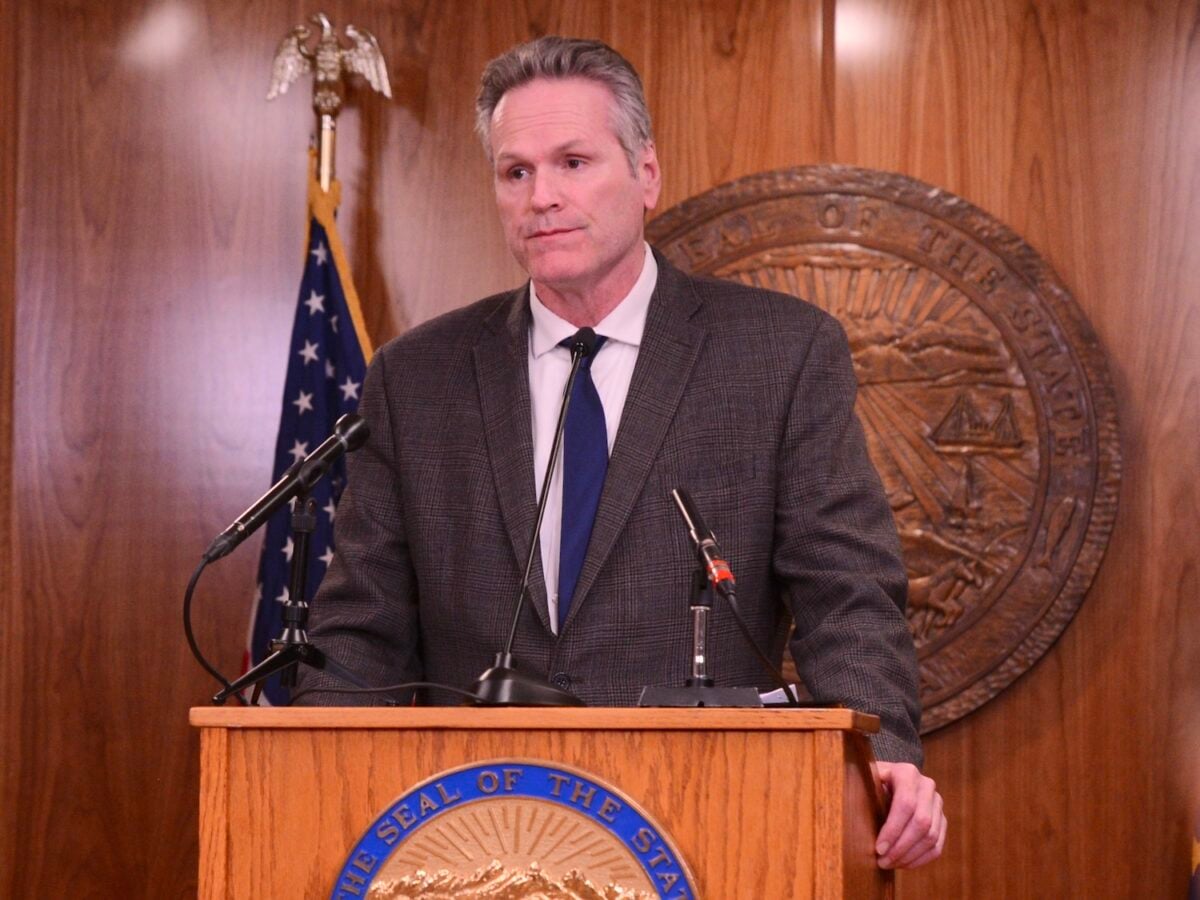
Alaska Gov. Mike Dunleavy talks to reporters during a news conference on Monday, May 19, 2025. (Photo by James Brooks/Alaska Beacon)
Yereth Rosen, Alaska Beacon
Alaska Gov. Mike Dunleavy talks to reporters during a news conference on Monday, May 19, 2025. (Photo by James Brooks/Alaska Beacon)
Alaska Gov. Mike Dunleavy has been appointed to the U.S. Arctic Research Commission at a time when the federal agency is pivoting from its longtime focus on environmental science to more emphasis on military defense and economic development.
Dunleavy is an ally of President Donald Trump. Dunleavy’s presidential appointment, announced by the commission this week, comes five months after Liz Qaulluq Cravalho’s position on the commission was terminated. Cravalho is vice president of lands at NANA Regional Corporation, the Alaska Native corporation for the state’s northwest region. She was initially appointed by then-President Joe Biden in 2021 and reappointed in 2024.
The commission, created in 1984, advises the president and Congress on research policy. Its seven commissioners are appointed by the president.
Dunleavy is the first sitting governor to be appointed to the commission, which advises the president and Congress on Arctic research. Past Alaska lieutenant governors have served on the commission, but not during their time in state office. Mead Treadwell chaired the commission prior to being elected in 2010 as lieutenant governor in the Parnell administration, and Fran Ulmer chaired it after serving as lieutenant governor in the Knowles administration and after serving as chancellor of the University of Alaska Anchorage.
In 2019, his first year in office, Dunleavy used his veto powers to cut state funding of the University of Alaska system by 41%, an action that at the time was characterized as devastating to the university’s Arctic research, among other activities. Much of the funding was later restored through a compromise Dunleavy made with the university.
In a statement released by the commission, Dunleavy praised the role of Arctic research, saying it helps Alaskans.
“Alaska sits at the forefront of the Arctic, and our communities, resources, and strategic position make us essential to advancing responsible research, economic development, and national security in the region,” he said in a statement released by the commission. “I look forward to working with fellow commissioners to ensure that Arctic research reflects the needs of Alaskans while strengthening America’s leadership in the Arctic.”
The Trump-appointed chair of the commission, speaking Wednesday at the Arctic Encounter Summit in Anchorage, said the organization is “tremendously thrilled” to have Dunleavy as a member.
Thomas Emanual Dans, appointed by President Donald Trump as chair of hte U.S. Arctic Research Commission, speaks at the Arctic Encounter Summit in Anchorage on April 15, 2026. (Photo by Yereth Rosen/Alaska Beacon)
“We’re super excited about that,” said Thomas Emanual Dans, appointed in December. “We’ve got the very experienced hand and voice at our commission, and we’re looking to do big things here.”
A pivot to security needs
Dans, who also served on the commission during the first Trump administration, expressed an expansive view of the Arctic that he likened to that of 19th century explorers.
“We want to create the conditions that really unleash human flourishing. We want more. We want human life. We want people to have big dreams,” he said.
Rather than focusing on pure science, the commission is focused on security, as Dans described it.
“Security is probably the overriding, overarching theme of things,” he said.
But security has several facets, he said. It includes military security, international security, energy security and community security, “which can be interpreted broadly in terms of health and well-being” for Arctic residents and others in the nation and the world, he said.
Dans, who lives in Texas and spent most of his career in finance, served on the U.S. Arctic Research Commission during the first Trump administration. But his comments on Wednesday indicated some gaps in his Arctic and Alaska knowledge.
He mentioned Russia’s Wrangel Island, off the northern coast of Siberia, as a security threat. Wrangel island “is close to Alaska here,” he said in his speech. “And for a long time it was incorporated as part of the United States. Today we face missiles pointing at us from Wrangel Island.”
Canadian government brochures and fliers, displayed April 15, 2026, at the Arctic Encounter Summit in Anchorage, describe that country’s countribution to U.S. national defense. U.S. Arctic policy now has a stronger emphasis on national security. (Photo by Yereth Rosen/Alaska Beacon)
Wrangel Island was never part of the United States. There is a place with a similar name – Wrangell Island – that is located in Southeast Alaska. Since 2004, Russia’s Wrangel Island, located 300 miles from the nearest point in Alaska, has been designated as a UNESCO World Heritage Site. It is famous for its Arctic biodiversity, including the world’s largest concentration of Pacific walruses.
A decade ago, Russia built a military base on the island with a focus on radar systems to monitor airspace. The military use of the island is part of Russia’s military buildup in the Arctic, which has worried U.S. officials, and it is also considered to pose a potential threat to the natural resources there.
In his Arctic Encounter Summit comments, Dans hailed the planned expansion of the U.S. Coast Guard’s icebreaker fleet, saying the fleet has “gone from zero to maybe 14.” However, the Coast Guard for decades has operated two polar-class icebreakers: the Healy, which performs annual missions in Alaska and the wider Arctic, and the Polar Star, which usually sails in the Antarctic. The Coast Guard recently acquired another icebreaker for Arctic operations. Originally an oil industrial vessel called the Aiviq, the ship was renamed Storis and commissioned in a Juneau ceremony in August. The fleet is poised to expand: there was funding for more than a dozen new icebreakers in the Trump administration spending bill known as the One Big Beautiful Bill Act.
Concerning Russia, which holds more Arctic coastline and land than any other nation, Dans urged more cooperation and communication. “I’d love to have the younger generation in Alaska learn Russian,” he said.
Within a few miles from the Dena’ina Civic and Convention Center, where Dans spoke at the Arctic Encounter Summit, classes were being conducted in Russian language at elementary, middle and high schools through the Anchorage School District’s Russian immersion program. It was launched as a full-time program in 2024, according to the school district.
Rep. Alyse Galvin, I-Anchorage, speaks on the House floor on Apr. 13, 2026. (Photo by Corinne Smith/Alaska Beacon)
The Alaska House of Representatives on Monday rejected a bill passed by the Senate that would have applied state corporate income taxes to privately owned oil and gas companies that currently do not pay them. Supporters said the bill would have generated up to $100 million in new revenue for Alaska.
The proposal would have required companies licensed as S corporations or as limited liability companies to pay state corporate income taxes for profits earned in the state, which they currently do not pay. The largest company affected would have been Hilcorp, a privately run Texas-based company that operates the Prudhoe Bay oil fields as well as most of the oil and gas operations in Cook Inlet.
The state does not levy a tax on income earned by S corporations and LLCs because their profits go to owners or shareholders. In many states, those people would pay personal income tax on the money, but Alaska does not have a personal income tax, so such companies avoid taxation on profits. Traditional corporations, or C corporations, are publicly traded and already subject to existing state tax law.
Four members of the multipartisan House majority caucus objected to the proposal, and split to join the all-Republican minority members to reject the Senate’s version of House Bill 194 by a 23 to 17 vote.
House Majority Leader Rep. Chuck Kopp, R-Anchorage, was among those to oppose the bill.
House Majority Leader Chuck Kopp, R-Anchorage, speaks on Monday, March 24, 2025, in favor of House Joint Resolution 11. (Photo by James Brooks/Alaska Beacon)
“This policy creates uncertainty at the exact moment Alaska needs more energy development,” Kopp said on Monday on the House floor. “These are the people that are actually keeping our energy crisis at bay right now.”
Kopp argued the change would potentially hamper new oil and gas development. “It’s been a cold winter in Southcentral and along the Railbelt, and this is at the same time we’re asking these folks to drill more, to produce and store more gas, to explore more and to sign long term gas contracts. So it seems shortsighted to hamstring gas producers when we need them to invest a lot more right now, just to keep our schools warm, our homes heated and our businesses going,” he said.
Anchorage Independent Rep. Alyse Galvin, and Democratic Reps. Carolyn Hall of Anchorage and Robyn Frier of Utqiagvik also joined the minority caucus to oppose the bill on Monday.
Anchorage Democrat Sen. Forrest Dunbar sponsored the amendment to levy the corporate tax on privately owned oil and gas companies on a bill that would have been a routine renewal of a state oil royalty lease agreement, which passed the Senate last month.
Dunbar criticized the House decision in a Wednesday interview, saying it was a missed opportunity to bring in revenues for Alaska.
“They took potentially $100 million or more and rather than put it towards schools or the state of Alaska, they hand it to a billionaire in Texas. I think that was a mistake,” Dunbar said. “This is some of the lowest of low hanging fruit.”
“So I’m very disappointed in their actions,” he added. “And frankly, I’m surprised that some of the members of my party voted the way they did.”
On Monday, Big Lake Republican Rep. Kevin McCabe argued against the bill saying a tax focused on specific corporations that could result in lawsuits against the state. “I would suspect that this will lead directly to the courts,” he said. “This is just plain wrong. We shouldn’t be doing this.”
Galvin, a member of the multipartisan majority caucus, said she opposed that the measure was added to the underlying bill, but said she sees the need for more revenue. “I do think that it’s confusing when we add one bill to another, and haven’t properly vetted (it),” she said.
Galvin said she has proposed legislation, House Bill 152, which would include the corporate income tax provision, as well as a 4% state income tax on individuals earning more than $150,000 and an annual $150 tax per Alaskan to help pay for state services like education. It’s now being considered by the House Finance Committee.
“In a bill that I’m working on, I’m certainly careful to not call out one company,” she said. “But we do need to look at fairness also in all of our taxation. And I think that there is a place for us to address this.”
Galvin also requested to be excused from the vote citing a conflict of interest, but there was an objection on the House floor and she was required to vote. She told the Anchorage Daily News her husband works for Great Bear Pantheon, an Alaska subsidiary of Pantheon Resources, a Texas-based oil and gas exploration company.
Several members argued in support of strengthening corporate income taxes to provide much-needed revenues for Alaska.
Rep. Ky Holland, I-Anchorage is seen during debate on the operating budget on Apr. 13, 2026. (Photo by Corinne Smith/Alaska Beacon)
Rep. Ky Holland, I-Anchorage, supported the provision saying it was a defining moment for the Legislature to take action to address what he called the “Alaska disconnect” — being a resource rich state without capturing the economic value and benefits for residents.
“I believe this is a defining question for many of us, who I think, recognize that our state has moved past looking for the fiscal cliff and is now out beyond it,” he said. “And it’s now time for us to decide, are we willing to take some difficult votes and take some difficult action?”
Holland said failing to change the tax code could create a scenario where other businesses incorporate as S corporations or LLCs to avoid corporate income taxes. “This bill offers a way to address a point of fairness in the taxation that we have,” he said.
The amended bill now returns to the Senate, which can remove or change the provision. Those acts could result in a conference committee made up of representatives from both chambers to reach agreement on the bill.
The original legislation was introduced by the governor and passed the Alaska House last year. It would renew a three-year oil royalty agreement between the state and Marathon Petroleum Corporation, for state owned oil to be processed at its refinery in Nikiski, on the Kenai Peninsula, valued at between $4 million and $18 million in state revenue.
Several lawmakers in the House, including Kopp, said the company was no longer interested in the state contract, voiding the need for the legislation. A spokesperson for Marathon declined to comment on Wednesday, saying the company does not comment on its crude oil sourcing.
The entrance to the Anchorage Forestry Science Laboratory is seen on April 2, 2026. The lab serves state agencies, Native corporations and private industry as well as federal agencies. The lab, in Anchorage’s Ship Creek neighborhood, is on a list of U.S. Forest Service facilities that the Trump administration plans to close. (Photo by Yereth Rosen/Alaska Beacon)
Two weeks after the Trump administration announced a U.S. Forest Service “restructuring” that would close regional offices and most of the agency’s research facilities, impacts to Alaska – home to the two largest U.S. national forests – remain unclear.
The U.S. Department of Agriculture announced on March 31 that the Forest Service’s national headquarters will move to Utah and that many of its facilities will be shuttered. Among the facilities on the closure list were two that are important to Alaska: the and the Oregon-based in Portland.
But other impacts on the 17-million-acre Tongass National Forest and the 5.4-million-acre Chugach National Forest were not disclosed.
A statement from the Forest Service headquarters provided few details about the Tongass, the Chugach or the visitor and recreational facilities located in either forest.
“The transition will occur in phases. Employees will receive clear information about relocation timelines, available options, and resources to support their decisions,” the statement said. “The number of relocations beyond those already identified in the National Capital Region is unknown at this time.”
U.S. Agriculture Department Secretary Brooke Rollins, whose department oversees the Forest Service, outlined the restructuring plan last year. In a July 24, 2025, memo, she said the plan included the replacement of the Alaska regional office with “a reduced state office in Juneau.” The state capital is currently the site of the Alaska regional office managing both the Tongass and the Chugach.
Three people at Begich, Boggs Visitor Center in the Chugach National Forest look out at Portage Lake on Aug. 30, 2025. The U.S. Forest Service’s visitor center, a popular tourist destination, used to provide a close-up view of Portage Glacier’s ice. Now the glacier has retreated so much that it is around the right corner, requiring a boat ride or mountain hike to see it in summer. A bit of Burns Glacier, which has also retreated dramatically, is visible from the visitor center. (Photo by Yereth Rosen/Alaska Beacon)
Alaska has Forest Service facilities throughout the Tongass and Chugach regions, from the southern tip of the Southeast to Anchorage.
Sen. Lisa Murkowski, R-Alaska, is also trying to learn about impacts to Alaska, a spokesperson said.
The senator and her staff are in a “fact-finding” mode and preparing to mount a “defense of the Forest Service in Alaska and make sure the employees are able to continue the good work that they’re currently doing,” said Murkowski spokesperson Joe Plesha.
The issue is expected to be managed through the Congressional appropriations process, Plesha said.
Murkowski is on the Senate Appropriations Committee and chairs the appropriations subcommittee on the Department of the Interior, Environment and Related Agencies.
The Anchorage lab that is scheduled for closure is located in the Ship Creek district of downtown Anchorage. It supports research in the Tongass National Forest, which is the nation’s largest, and the Chugach National Forest, the second largest. It also supports research on forests elsewhere, from the boreal forests of Interior Alaska to those on tiny tropical Pacific islands like Guam and Micronesia.
The lab is used not just by Forest Service scientists but by other federal agencies, state agencies, Native corporations, University of Alaska researchers and private industry, according to its website.
Tourists walk to and from a viewpoint at the Mendenhall Glacier visitor center on May 14, 2025. The visitor center in the Tongass National Forest is a top tourist destination. (Photo by Yereth Rosen/Alaska Beacon)
Up to now, the lab has had a year-round staff of about 22 scientists and administrative workers, but the numbers increase during summer field seasons.
The planned closure of the century-old Pacific Northwest Research Station in Oregon is part of a consolidation of research functions into a single site in Fort Collins, Colorado.
The Pacific Northwest facility, with about 250 employees, has an affiliated lab in Juneau. The fate of the Juneau lab remains unknown.
Among the Alaska projects undertaken by the Pacific Northwest Research station, sometimes with partner organizations, is study of the decline of yellow cedar in the Tongass and adjacent regions in the southeastern part of the state; the status of birds and rare plants in the Tongass; the study of rural Alaskans’ access to wild foods in the Chugach National Forest and the surrounding region; and the monitoring of human recreation’s impacts on brown bears.
The Forest Service closure plans follow deep cuts already made by the Trump administration’s Department of Government Efficiency, or DOGE. In the first half of 2025, the Forest Service lost 5,860 of its 35,550 employees, according to a Dec. 17, 2025, report by the Agriculture Department’s inspector general.
That includes losses in Alaska. As of January, Alaska’s Forest Service workforce was down to 467 from the total of about 700 before the DOGE-imposed cuts began, KTOO reported in January.
People shop for groceries at a Walmart store in Ohio. New research suggests SNAP work requirements won’t enhance employment and will push more people off of food assistance. (Photo by Marty Schladen/Ohio Capital Journal)
As states enact stricter work requirements for the federal food stamp program, a new analysis suggests those requirements won’t enhance employment and will push more people off of food assistance.
The researchers conducted a review of studies on work requirements and concluded that “the best evidence shows they do not increase employment. Moreover, this research finds work requirements cause a large decrease in participation in SNAP.”
The research from The Hamilton Project, an economic policy initiative at the left-leaning Brookings Institution, comes at a time of major upheaval for the Supplemental Nutrition Assistance Program, or SNAP. Participation is already declining as states implement changes mandated by the president’s major tax and domestic policy law enacted last summer.
Since the fall, states and counties that administer SNAP have been notifying residents who rely on food stamps that they must meet work requirements or lose their food assistance. Those changes affected exemptions to work requirements for older adults, homeless people, veterans and some rural residents, among others.
Known as the One Big Beautiful Bill Act, the law mandated cuts to social service programs, including Medicaid and food stamps.
While SNAP enrollment is declining nationally, more people will likely lose food assistance as states continue to implement the work requirements and recertify participants, said Lauren Bauer, a fellow in economic studies at Brookings Institution and the associate director of The Hamilton Project.
“Everything that we know about work requirements is that they do not increase employment among the groups that are subject to them,” she told Stateline. “All they do is make it more likely that they are disenrolled from the program. And so, should these work requirements continue to be rolled out and implemented, we would expect to see declining enrollment and no changes in employment.”
Bauer said the growing body of research on SNAP has changed her mind about its ability to affect employment. While food stamps reach millions of people each year, the program’s work requirements have proven ineffective, confusing and burdensome, she said.
“I am now of the mind that SNAP should be an anti-hunger program, and there are many, many ways to do workforce development, career ladders, career training, job search — all of those things. That’s not an anti hunger program and it shouldn’t be associated with it.”
What’s more concerning to her is how the stricter work requirements will affect people who lose jobs in an economic downturn. Traditionally, SNAP has been one of the most effective social supports for the unemployed, helping people who lose their jobs quickly gain food assistance. But laid-off workers will increasingly be told they cannot receive benefits without working.
“It’s just this dissonant, unhelpful interaction that you have with the government,” Bauer said. “I lost my job, I need food benefits. Well, you can only get food benefits if you have a job.”
At least 2.5 million low-income people, or 6% of those enrolled, have lost SNAP benefits since the legislation was signed into law, according to a study by the left-leaning Center on Budget and Policy Priorities published Wednesday.
Bauer said it’s unclear how much of that decline is directly related to the federal legislation. That’s because SNAP participation generally declines during times of economic prosperity and increases during downturns.
But the program is facing unprecedented changes: Under the new law, states have also lost funding for nutrition education programs, must end eligibility for noncitizens such as refugees and asylees, and will lose work requirement waivers for those living in areas with limited employment opportunities. States are also forced to cover more of the costs of the program.
Earlier this week, a USDA spokesperson applauded the drop in SNAP participation, noting the program’s rolls had fallen below 40 million for the first time since the pandemic. The spokesperson told States Newsroom the program would continue “to serve those with the greatest need while also strengthening program integrity.”
Republicans, including U.S. House Speaker Mike Johnson of Louisiana, have defended the legislative changes to SNAP, arguing they will help eliminate waste and fraud in the program.
In a June news release, he characterized SNAP as a “bloated, inefficient program,” but said Americans who needed food assistance would still receive it.
“Republicans are proud to defend commonsense welfare reform, fiscal sanity, and the dignity of work,” Johnson said in the release.
This story was originally produced by Stateline, which is part of States Newsroom, a nonprofit news network which includes Alaska Beacon, and is supported by grants and a coalition of donors as a 501c(3) public charity.
President Donald Trump speaks to the media in the Oval Office at the White House on Sept. 2, 2025 in Washington, D.C.
President Donald Trump on Friday called on Alaska voters to repeal ranked choice voting at the November election.
“The Wonderful People of Alaska desperately want to restore Free, Fair, and Honest Elections in their Great State, and get rid of their disastrous, and very fraudulent, “Ranked-Choice Voting,” Trump said on Truth Social.
An effort to repeal ranked choice voting in 2024 failed by just 737 votes. A separate repeal initiative, sponsored by figures aligned with the Alaska Republican Party, is set to appear on the 2026 general election ballot.
Trump gave his “complete and total support” to supporters of the repeal effort, including U.S. Sen. Dan Sullivan and Congressman Nick Begich, both Alaska Republicans running for reelection in November.
The president’s post was seized on by Republican candidates for Alaska statewide office who echoed his calls to strike down the voting system.
Alaska voters narrowly approved a ballot measure in 2020 that implemented ranked choice voting for state and congressional elections, alongside open primary elections and tougher campaign finance disclosure requirements.
Ranked-choice voting in Alaska lets voters pick candidates in order of preference rather than choosing just one. If no candidate wins a majority of first-choice votes, the lowest-ranked candidate is eliminated and those votes are redistributed until someone surpasses 50% of votes.
However, the new election system has been controversial. Opponents argue that ranked choice voting is unnecessarily complicated, while supporters say it has led to more moderate and consensus candidates elected.
Ranked voting, open primaries and the tougher campaign finance disclosure requirements would all be struck down if the 2026 ballot measure is approved by a majority of voters.
Alaska for Better Elections is a group running voter education campaigns in support of retaining ranked choice voting and open primaries. Executive Director Juli Lucky said Alaska’s election system has allowed policymakers across the political spectrum to work together without fear of challengers in partisan primaries.
“I think Alaskans will reflect on the results we’ve seen to decide whether our system of open primaries, ranked choice voting, and the strictest campaign finance laws in the country works for them,” Lucky said by text message after Trump’s post. “Ultimately, Alaskans created and enacted this system, and Alaskans will decide whether we keep it.”
NOTN- An Alaska Senate committee on Wednesday advanced a resolution backing federal visa programs that lawmakers say are critical to the state’s seasonal workforce and public schools.
Senate Joint Resolution 28, heard in the Senate Labor and Commerce Committee, puts the Alaska Legislature on record in support of the J-1 and H-1B visa programs and urges the state’s congressional delegation to work with federal policymakers to preserve and strengthen them.
A similar resolution was heard in the Senate Education committee Wednesday as well, in support of H-1B international educators.
“Senate Joint Resolution 28 very simply, recognizes the important role that visa programs such as the J1 visa program, and the H-1B program, play to the economy and the education of children and young adults across Alaska.” Said legislative aide Mike Mason, “These international visa workers are vital to filling Alaska’s diverse workforce needs. If you travel around Alaska, especially this summer, you are going to see these visa workers filling very important jobs across the state. This resolution simply puts the Alaska legislature on record as supporting these visa programs.”
The measure also objects to a steep federal fee increase on certain H-1B petitions, from $5,000 to $100,000, which supporters say has effectively shut Alaska’s public schools out of the program.
“That fee effectively ended most employers ability to fill these open jobs through this program.” Mason said.
Lawmakers adopted an amendment, to explicitly include H-2B visas, which cover temporary nonagricultural workers.
Public testimony on the resolution was brief but supportive.
Jonathan Schaffer said his experience working with J-1 participants in seasonal jobs across the country showed clear benefits for both employers and workers.
“Having worked in seasonal employment across the United States with a number of J-1 enrollees, I can say that the program, in my opinion, benefits both employers and those enrolled in it. It is remarkable the opportunities that are provided for people in small communities to learn about the world around them from the people who travel there to serve visitors, who travel from all over the place. It is remarkable the benefit that those who enroll in the J-1 program have in gaining a more positive view of the United States, which they take back to their communities around the world.”
The committee voted without objection to move the resolution.
It now heads to further consideration in the Legislature.
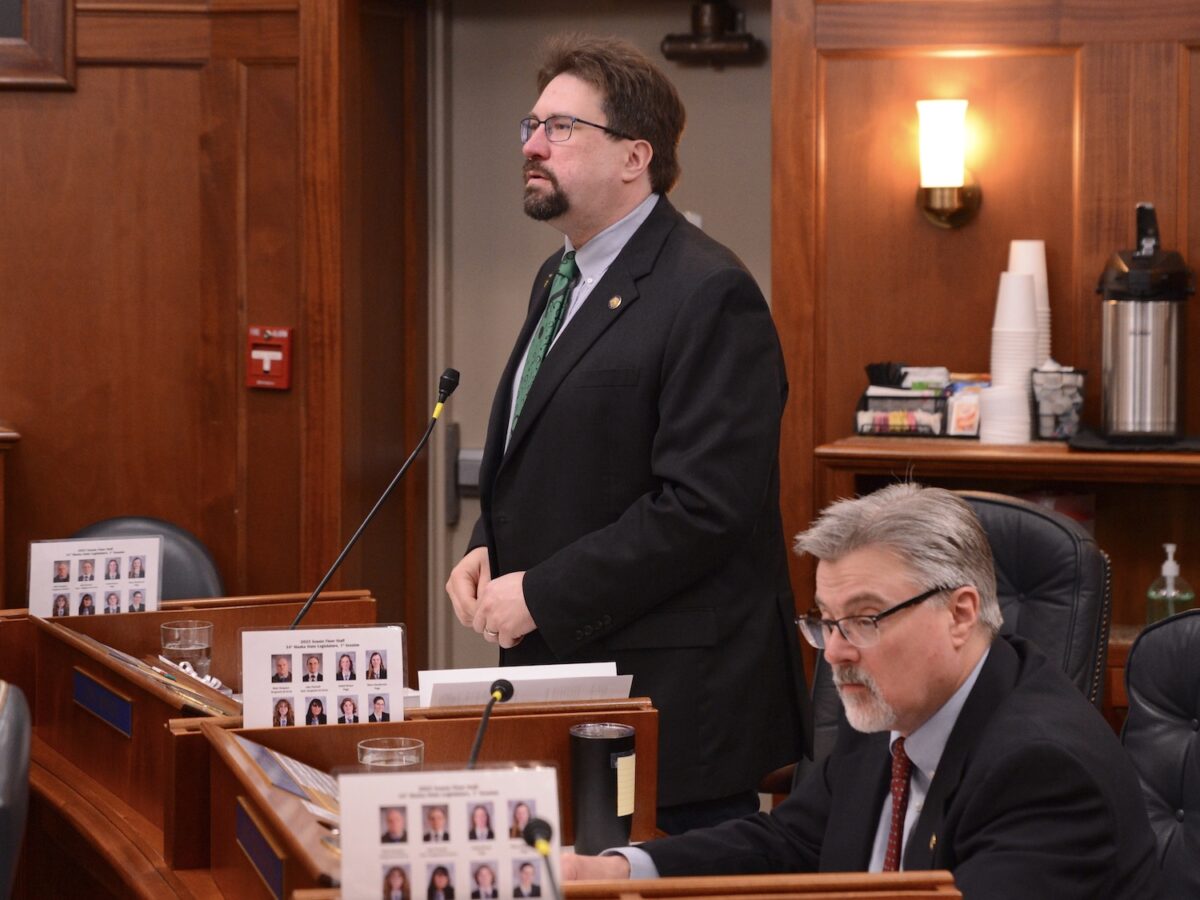
Sen. Robert Myers, R-North Pole, speaks on House Bill 57 in the Alaska Senate on Monday, April 28, 2025. (Photo by James Brooks/Alaska Beacon)
By: Sean Maguire, Alaska Beacon
Sen. Robert Myers, R-North Pole, speaks on House Bill 57 in the Alaska Senate on Monday, April 28, 2025. (Photo by James Brooks/Alaska Beacon)
The Alaska Senate last week advanced a bill that would allow for the anonymous surrendering of infants in so-called infant safety devices.
The boxes are located on the exteriors of buildings. They are climate controlled and monitored by video. When the device is opened, a 911 request is automatically made.
Alaskans have been able to surrender infants since 2008. Newborns must be given directly to police officers, firefighters, doctors or other medical personnel. They are then turned over to the Alaska Office of Children Services for adoption.
In Alaska, an infant must be aged 21 days or younger to be surrendered legally.
North Pole Republican Sen. Robb Myers is the lead sponsor of Senate Bill 9. It would allow newborns to be surrendered in climate-controlled boxes, located outside police stations, fire departments, hospitals and other locations.
Myers said that around one baby a year has been surrendered in Alaska since 2008. Despite that, three infants have been found abandoned in Alaska since 2013: Two were found dead; one newborn was discovered alive in Fairbanks in a box in winter.
Myers said safe surrender devices would help save lives. Parents can feel shame or the fear of potential recognition when giving a child to another person, he said. The climate-controlled boxes are intended to remove that barrier.
The Alaska Senate advanced the bill on an 18-2 vote. Sens. Bert Stedman, a Sitka Republican, and Löki Tobin, an Anchorage Democrat, voted no.
Tobin said the anonymity of surrendering a child into a baby box could lead to abuse of women. She said the boxes introduce the potential that traffickers could surrender babies without a mother’s consent.
“The potential misuses for these devices far outweigh the benefits,” Tobin said.
All 50 states allow for the surrendering of infants. Almost half of states allow for newborns to be surrendered in baby boxes, which has accelerated since Roe vs. Wade was overturned, particularly in Republican-led states.
If the bill passes, the Alaska Department of Public Safety would be tasked with drafting regulations for the placement of infant safety devices. Each infant safety device is estimated to cost $16,000. That excludes surveillance and security costs, which state officials say could be “significant.”
SB 9 now advances to the House for its consideration. Similar legislation has been advancing through that legislative chamber.