Juneau's Telephone Hill neighborhood is seen at center right, beneath the State Office Building, on Wednesday, Dec. 28, 2022. The neighborhood, owned by the state of Alaska, is being transferred to the City and Borough of Juneau. (Photo by James Brooks/Alaska Beacon)
Juneau’s Telephone Hill neighborhood is seen at center right, beneath the State Office Building, on Wednesday, Dec. 28, 2022. (Photo by James Brooks/Alaska Beacon)
NOTN- A Juneau judge heard arguments Tuesday in a lawsuit challenging the city’s plans to redevelop Telephone Hill.
Former residents are asking Superior Court Judge Amanda Browning to stop the city from demolishing seven residential structures and building higher-density housing on the site.
Browning said she will issue a ruling, but it may take over a week or two.
“What’s happening now is both attorneys put in motions to postpone.” Said Mayor Beth Weldon. The jury trial that had been scheduled for this week is now postponed while the judge considers the motions.
According to the proposed ordinance, when an officer-involved shooting occurs that causes death or serious injury to an officer or someone else, Juneau Police Department would release body-worn camera footage no later than 30 days after the incident. (Photo courtesy City & Borough of Juneau website)
(Photo courtesy City & Borough of Juneau website)
NOTN- The Juneau Man who was knocked unconscious during an arrest in July is now suing the city and Former JPD Officer Brandon LeBlanc, alleging he used excessive force.
The case was opened November 13, and assigned to Judge Amanda Browning according to court documents.
Christopher Williams Jr. is represented by attorney Jeffrey Barber.
No response from the City and Borough of Juneau or Brandon LeBlanc has been filed in the publicly available record as of November 18.
The video of the arrest was posted to social media, prompting widespread public outcry, from city leaders, Tlingit and Haida, and even prompting peaceful protest as well as policy and training reforms within the Juneau Police Department.
Williams was medevaced to Anchorage after being taken to the ground outside the Douglas Library.
A GoFundMe was set up for Williams’ recovery in August and raised $4,692.
LeBlanc resigned from the department a day before the body camera footage was released, and the state office of special prosecutions did not file criminal charges.
Nearly 100 protesters peacefully called for accountability and systemic police reform following his arrest with organizer Jamiann S’eiltin saying the incident reflects a broader pattern of violence against Indigenous people.
“This isn’t something new,” S’eiltin said in July. “This has been going on since almost time immemorial, since the arrival of Western European settlers. So, just want to put that out there that we are brutally attacked 10 times more than the national average.”
In a complaint filed Friday and a motion for summaryjudgment on Monday, the Legislature’s contracted attorney asks a Juneau Superior Court judge to decide whether or not a governor may issue an executive order during a special legislative session.
The lawsuit had been expected for months.
In August, Dunleavy issued an order seeking to create an Alaska Department of Agriculture, shortly before lawmakers convened for a special session called by the governor. Speaker of the House Bryce Edgmon, I-Dillingham, and Senate President Gary Stevens, R-Kodiak, rejected the validity of the order.
Representatives for the governor’s office said they believed the order was valid and that it would take effect unless lawmakers voted it down.
The leaders of the House and Senate said they did not want to take up the order, because doing so risked setting a precedent, effectively declaring that executive orders could be issued during a special session.
The question that could be decided in court is whether issuing an order in a special session is legal. And does it matter if the order is identical to one that’s already been issued and voted upon?
Alaska is one of two states without a cabinet-level Department of Agriculture, and creating one is seen as a key first step for boosting food production in Alaska.
“The parties require the court’s prompt assistance to resolve this legal dispute before January 1, 2026,” wrote attorney Kevin Cuddy. “Otherwise, there is a risk that the state will move forward with a Department of Agriculture that may have been unconstitutionally created, and thus without legal authority to act.”
The Alaska Department of Law, which will represent the governor in the case, has been served with the lawsuit but has not yet filed its reply.
Patty Sullivan, a spokeswoman for the Department of Law, said by email, “We are working on a briefing schedule with the counsel for the Legislature and the court. Our goal is to expedite the case and ensure that a decision is made before the legislative session begins.”
Alaska’s constitution forbids lawsuits by the executive branch against the legislative branch; the inverse is not true. Lawmakers have now sued Dunleavy four times since he took office in 2018.
Gov. Mike Dunleavy discusses proposed education legislation at a news conference on Jan. 31, 2025. (Photo by Corinne Smith/Alaska Beacon)
NOTN- Alaska’s governor will not withdraw an executive order proposing to create a new state Department of Agriculture, he said in a letter sent Monday to the leaders of the state House and Senate.
Gov. Mike Dunleavy’s letter comes days after a joint House-Senate panel voted to spend up to $100,000 on a lawsuit against the governor if he goes ahead with his proposal to create the department unilaterally.
Alaska is one of only two states without a cabinet-level state Department of Agriculture, and legislators have spoken favorably about the idea of creating one, but a majority of the House and Senate want to authorize that new department through law, not by the governor’s executive order.
In March, the Legislature voted 32-28 to reject an administrative order that would have created the Department of Agriculture by splitting off part of the Department of Natural Resources, the agency that currently oversees agriculture.
Shortly before the vote, lawmakers in the House and Senate introduced new legislation to create the department. Neither the House bill nor the Senate bill advanced to a final vote, and either could be taken up during the next regular legislative session, which begins in January.
When Dunleavy called lawmakers into special session in August, he reissued the executive order, but the leaders of the state House and Senate declined to accept the order as valid, saying that the Alaska Constitution does not grant the governor the power to issue an order during a special session.
Lawmakers also say they believe that it isn’t legal to reintroduce a previously rejected order.
“There clearly exists a disagreement between the executive and legislative branch as to the governor’s ability to introduce an executive order in a special session,” the governor wrote in Monday’s letter. “When such a dispute exists, it is appropriate to seek clarification from the courts.”
The governor’s letter notes that lawmakers could have met during the special session to vote down his executive order. Legislators have previously said they did not wish to do so, because taking the vote would have been the equivalent of acknowledging that the governor has the power to issue an executive order during a special session.
Rep. Sara Hannan, D-Juneau, is chair of the Legislative Council, the joint House-Senate committee that authorized the lawsuit against the governor.
By phone on Tuesday, she said she isn’t sure when the suit will be filed, but she expects it to move quickly.
The executive branch is preparing to launch the new department by Jan. 1, and legislators want to stop it before then.
“We have two prime legal issues that we think need to be addressed by a court, because the executive branch is interpreting them completely different,” she said.
Hannan said she expects that once a trial judge decides the issue, the losing party in the case will rapidly appeal to the Alaska Supreme Court for a final determination.
Regardless of who wins the case, Hannan said the state may still end up with a Department of Agriculture by June because legislators are advancing bills that would create the department.
“The 34th Legislature still may create a Department of Agriculture, but the executive order action of creating that and attempting to do it in a special session and after an executive order has been rejected, those are the legal questions that we need addressed,” she said.
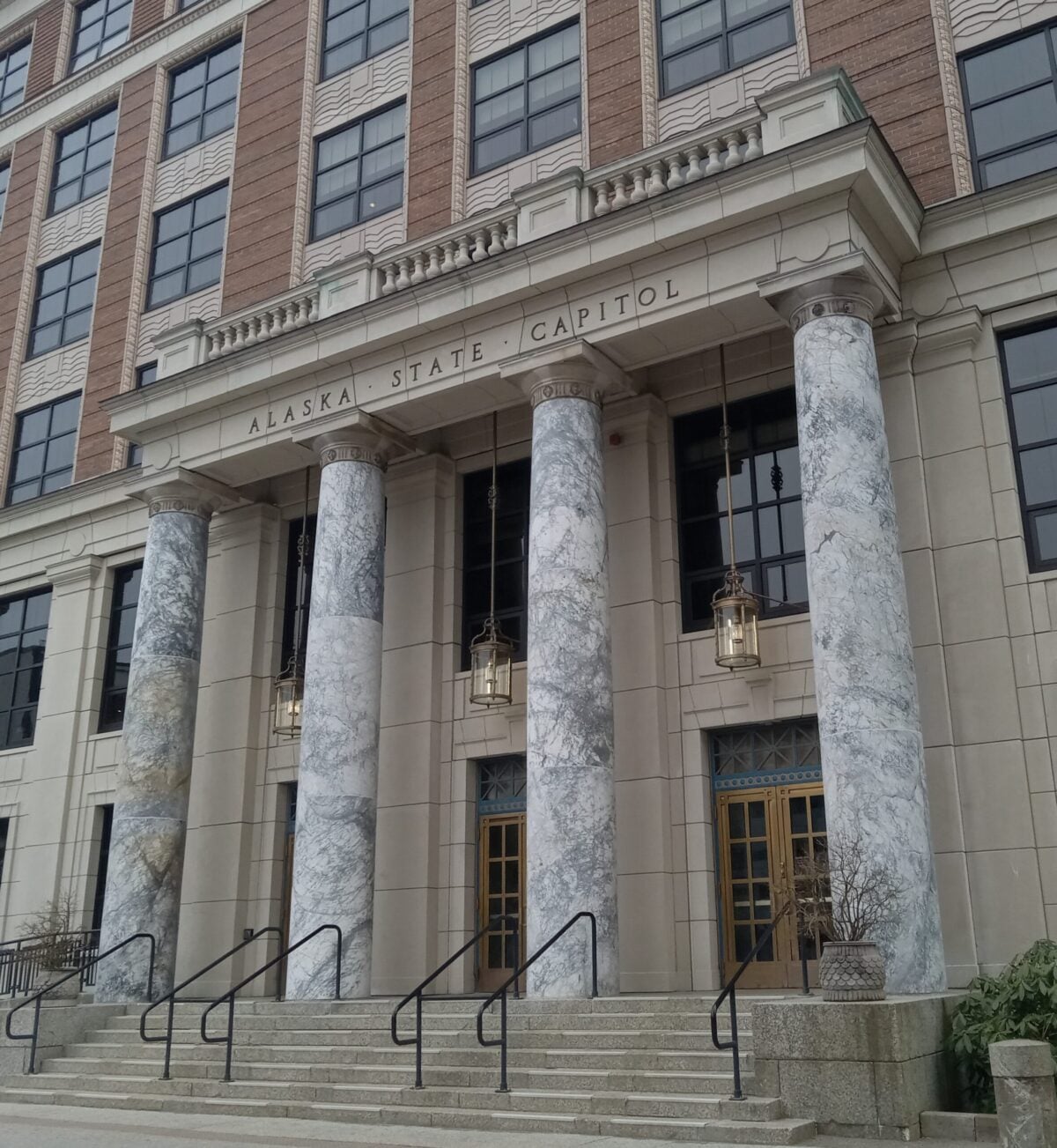
The Alaska State Capitol in downtown Juneau.
(Photo by Greg Knight/News of the North)
By: James Brooks, Alaska Beacon
The Alaska State Capitol in downtown Juneau.
(Photo by Greg Knight/News of the North)
A panel of state lawmakers voted 9-2 on Wednesday to approve spending up to $100,000 on a lawsuit against Gov. Mike Dunleavy.
The lawsuit, if filed, would challenge the governor’s decision to press ahead with plans to create a cabinet-level Alaska Department of Agriculture via executive order.
The governor issued an executive order in January, but lawmakers rejected it in a 32-28 vote in March, saying they preferred to create it through legislation instead. Creating the department through legislation, legislative leaders said, would allow lawmakers to debate and structure the department how they wish, instead of relying on the governor’s plans alone.
Dunleavy disagrees with that approach and in August filed a new executive order during a 30-day special session.
The leaders of the House and Senate refused to accept the filing, saying that it was not within the governor’s power to issue an executive order during a special session, or to reintroduce an already-rejected order.
The governor’s office has said that lawmakers’ failure to vote down the new order means that it will take effect and allow the executive branch to create the cabinet-level department at the start of 2026.
Why does the Legislature’s failure to vote on the executive order matter?
Article III, section 23 of the Alaska Constitution says that executive orders automatically take effect “unless disapproved by resolution concurred in by a majority of the members in joint session.”
The question that could be decided in court is whether lawmakers need to take that vote if an order is issued during a special session. Is issuing an order in a special session even legal? And does it matter if the order is identical to one that’s already been issued and voted upon?
Under Article III, section 23 of the Alaska Constitution, the “legislature shall have sixty days of a regular session, or a full session if of shorter duration, to disapprove” executive orders that would make a change to the functions of the executive branch.
For almost two hours on Wednesday, members of the joint House-Senate Legislative Council — a committee that makes decisions for the Legislature when it is out of session — heard about the dispute behind closed doors, then debated it briefly in open session before voting.
“It’s a disagreement between the Legislature and the governor about whether or not the governor has the authority under the Alaska Constitution to introduce an executive order during a special session,” said Emily Nauman, director of Legislative Legal Services, the legal department for Alaska’s legislative branch.
Because the House and Senate’s presiding officers returned the order to the governor without taking action, “the governor is asserting that he will give effect to the executive order because it was not specifically rejected or disapproved by the legislature, thus causing a conflict in the interpretation of the Constitution between the Legislature and executive branch.”
Rep. Louise Stutes, R-Kodiak, voted in favor of authorizing the Legislature to prepare and, if necessary, file a pre-emptive lawsuit to keep the governor from enacting the executive order.
“It’s just a question, to me, of, we said, ‘No. Don’t you understand what no means?’”
Rep. Calvin Schrage, I-Anchorage, also voted in favor of moving forward with a lawsuit. He said that while there is still time for the governor to back away from his position, “I really see it as our prerogative to protect ourselves procedurally, and for us to do that, I believe we need to file litigation.”
The two votes against Wednesday’s proposal came from Reps. Chuck Kopp, R-Anchorage, and Mike Prax, R-North Pole.
Prax said he feels as if it could set a precedent that could allow lawmakers to disapprove of a future governor’s actions in a “more urgent” situation by simply not taking action.
“We would establish a precedent that the Legislature can do something by doing nothing, and that just does not seem like a very good practice to have established for any organization,” Prax said.
Sen. Jesse Kiehl, D-Juneau, said he doesn’t think that’s a correct interpretation of the lawsuit.
“With great respect to Representative Prax, no one is asserting here that the Legislature may act by inaction. What is before us is the question of whether the second shot at an executive order came in a way that the Constitution allows. I am convinced it did not.”
Kopp said he believes the governor may be prepared to change course on his executive action, and he’s reluctant to approve a lawsuit unless the governor attempts to take action and actually create the department.
“I would like to see us not initiate this until there’s some overt action by the administration that clearly indicates their intent to move unilaterally on this issue outside of the legislative process,” he said.
As of Friday, there was no estimate as to when a lawsuit might be filed.
Under the Alaska Constitution, the executive branch may not sue the legislative branch. Lawsuits by the Legislature against the governor are rare; this would be the fourth against Dunleavy during his two terms in office beginning in 2018.
In 2019, lawmakers sued the governor over a school funding issue. The governor won that case in the Alaska Supreme Court. The following year, legislators sued Dunleavy over their failure to consider some of his appointees during the COVID-19 pandemic emergency. The Alaska Supreme Court again ruled in Dunleavy’s favor.
In 2022, lawmakers filed a ‘friendly’ lawsuit against the governor in a dispute over the proper handling of oil and gas tax settlements. That dispute, which dates to the administration of Gov. Bill Walker, has yet to be decided by the Alaska Supreme Court.