Strips of sockeye salmon harvested from the Kuskokwim River are seen on July 19, 2017. Sockeye salmon, also known as red salmon, is among the species harvested for subsistence. (Photo provided by U.S. Fish and Wildlife Service)
The U.S. Department of the Interior is considering whether to change Alaska’s unique system of hunting and fishing, which gives rural residents priority on federal land in Alaska.
According to a notice published Dec. 15 in the Federal Register, the Interior Department is conducting “a targeted review” of the program mandated by the Alaska National Interest Lands Conservation Act.
While no specific changes were identified in the notice, it prompted the Alaska Federation of Natives to react with concern.
In a message to members, it called the new proposal “a serious threat and a major step backward” in fish and game management within Alaska, according to a report Tuesday by the Anchorage Daily News.
Federal law requires rural residents to receive a priority when subsistence hunting and fishing, but because Alaska’s constitution prohibits the state from operating a system that gives one resident priority over another, the federal government uses one set of rules for hunting and fishing on federally controlled waters and lands, and the state uses another set for state-controlled water and land.
That has frequently led to conflicts between the state and federal government over management, and several lawsuits over the issue are currently in progress in federal court.
The Daily News reported that the suggestion to revise the two-tiered program came from Safari Club International, a large sport-hunting organization that has frequently sided with the state in lawsuits against the federal government.
Information posted online by the Interior Department indicates that the agency may consider:
Changing the makeup of the board that regulates subsistence hunting and fishing on federal land;
Reconsidering the rules that determine what parts of the state are “rural” and thus eligible for preferential treatment;
And the role of the Alaska Department of Fish and Game in the program.
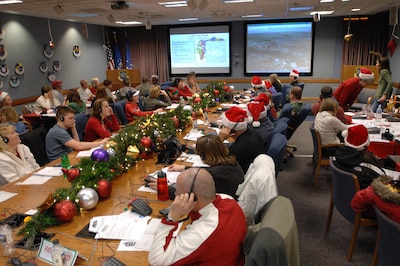
NORAD- 24 hours a day, 365 days a year, NORAD tracks everything that flies in and around North America in defense of our homelands. On Dec. 24, they have the very special mission of also tracking Santa.
NORAD has been tracking Santa since 1955 when a young child accidently dialed the unlisted phone number of the Continental Air Defense Command (CONAD) Operations Center in Colorado Springs, Colorado, believing she was calling Santa Claus after seeing a promotion in a local newspaper.
The commander on duty that night, was quick to realize a mistake had been made, and assured the youngster that CONAD would guarantee Santa a safe journey from the North Pole.
Thus a tradition was born that rolled over to NORAD when it was formed in 1958. Each year since, NORAD has reported Santa’s location on Dec. 24 to millions across the globe.
Thanks to the services and resources generously provided by numerous corporate contributors and volunteers, NORAD Tracks Santa has persevered for more than 60 years.
Each year, the NORAD Tracks Santa Web Site receives nearly fifteen million unique visitors from more than 200 countries and territories around the world. Volunteers receive more than 130,000 calls to the NORAD Tracks Santa hotline from children around the globe.
Children and the young-at-heart are able to track Santa through Facebook, Twitter, YouTube and Instagram.
“I voted” stickers are seen on display at a polling station in Juneau’s Mendenhall Valley on Tuesday, Aug. 16, 2022. (Photo by James Brooks/Alaska Beacon)
One of Rep. Nick Begich III’s uncles is endorsing his main Democratic opponent, Matt Schultz, in next year’s election. Tom Begich’s name was atop a list released to the Alaska Beacon by Schultz’s campaign this month.
Begich’s endorsement of his nephew’s opponent won’t surprise people familiar with Alaska politics — he’s a longtime figure in the state’s Democratic scene, has been publicly critical of his nephew’s actions and is running as a Democrat in the governor’s election — but Schultz’s list and a similar list of endorsements by Republicans for Begich III shows how the state’s political establishment is settling on a two-person race for U.S. House, unlike the crowded contest for governor.
“It will be awkward. It’s always awkward,” Tom Begich said of the endorsement, “ but my mom taught us to learn to live with disagreement, to move beyond it. It doesn’t change the fact that I love my nephew. Just, I’m not supporting him in this election.”
Tom Begich is among 14 people — 12 Republicans and two Democrats — who have registered to run for governor in next year’s election.
Incumbent Gov. Mike Dunleavy is term-limited and unable to run.
While there are plenty of candidates for the governor’s seat, the number of people running for federal office is tiny. Incumbent U.S. Sen. Dan Sullivan, a Republican, doesn’t have a well-known challenger yet. Former U.S. Rep. Mary Peltola, a Democrat, has been rumored as a possible opponent but has yet to file.
The same is true on the Democratic side, where support for Schultz appears almost entirely united.
“I’m very pleased to support him and glad he’s running,” said state Sen. Matt Claman, D-Anchorage and the other Democratic candidate in the governor’s race.
“I think he’s more connected with the general, broad spectrum of values in Alaska, more connected with some of the challenges we’re facing. He’s really looking carefully at how we’re dealing with homelessness, and I think he’s concerned about some of the affordability issues that are particularly a challenge in rural Alaska,” Claman said of Schultz.
Among the other people endorsing Schultz are independent state Rep. Alyse Galvin, who ran unsuccessfully for U.S. House in 2020 and 2018, and Forrest Dunbar, a Democratic state senator who ran unsuccessfully for House in 2014.
One notable absence is Peltola, who held Alaska’s U.S. House seat for one term before Begich III defeated her in the 2024 election.
Also missing is longtime Democrat Mark Begich, the incumbent Republican’s other uncle and Alaska’s U.S. senator from 2009 to 2015.
“There’s definitely been a lot of support from Democrats all around the state, and I’m very grateful for that. It seems to be a lot of coalescing support,” Schultz said by phone.
A pastor in Anchorage, Schultz spoke on the day that the U.S. House announced that it would not vote to renew subsidies for health insurance policies purchased on the federal marketplace.
Without those subsidies, the prices of many policies will spike with the start of the year.
“That’s really, really sad and disturbing,” Schultz said. “It seems like it should be a no-brainer that you start out by making sure that people can afford their lifesaving medicine.”
Schultz said that as he’s gone around seeking early support for his campaign, he’s found joy and excitement among people who want to find a common good.
“It really is this wonderful excitement to say — just like we pulled together as a nation to go to the moon, we can pull together as a state to provide food and health care to people. It’s a goal that matters so much and is so basically good at its heart that people can’t wait to start working for it,” he said. “I think there’s a hope out there that has felt absent in the last decade or so.”
Cook Inlet near Clam Gulch is seen on Oct. 23, 2025. (Photo by Yereth Rosen/Alaska Beacon)
The Trump administration on Friday affirmed a controversial federal Cook Inlet oil and gas lease sale held at the end of 2022, asserting that impacts to endangered beluga whales and other resources were adequately considered and no changes in the leasing plan are needed.
In a Federal Register notice scheduled to be published on Monday, the U.S. Bureau of Ocean Energy Management announced its decision to uphold Lease Sale 258 as held. The decision “balances the national policies mandated by Congress to expeditiously and safely develop the natural resources of the (Outer Continental Shelf), subject to environmental safeguards, in a manner that is consistent with the maintenance of competition and other national needs,” the notice said.
The lease sale, mandated by Congress in the Inflation Reduction Act of 2022, offered 193 blocks over nearly 1 million acres, but it drew only one bid. The sole bid was from Hilcorp, the dominant oil and gas operator in the inlet.
The auction went through a tumultuous history and remains a subject of debate.
Planning for the sale started in 2020, but two years later, the Biden administration canceled it, citing a lack of industry interest. The sale was resurrected by a provision in the Inflation Reduction Act of 2022 that was inserted by then-Sen. Joe Manchin, D-West Virginia. That provision required Lease Sale 258 to be held by the end of 2022; it was ultimately held on Dec. 30 of that year.
Environmental groups that sued to block the sale secured a victory after it was held. U.S. District Court Judge Sharon Gleason ruled in July 2024 that pre-sale studies failed to properly analyze impacts to endangered Cook Inlet beluga whales and other resources. Gleason ordered BOEM to do the new analysis of beluga and other resource impacts, putting the sole lease that was sold into suspension.
The agency considered three additional alternatives that would have increased protections for belugas and other resources, but it rejected those and kept the original plan in place, according to the document.
“As LS 258 has already occurred, selecting any alternatives other than those described above would not affirm that lease sale and would void the one lease issued as a result of it,” the Federal Register notice said.
In its supplemental environmental impact statement, BOEM asserted that the risks of leasing and the development that would result from it are minor for Cook Inlet belugas and other marine mammals.
“The likelihood of a large oil spill affecting Cook Inlet marine mammals is relatively low, but the consequences could affect some populations. Sea otters face the highest vulnerability from a large spill due to their dependence on fur for insulation, resulting in a moderate impact level. Cook Inlet beluga whales are at risk due to the small population size, but geographic and temporal factors substantially reduce the risk of exposure to a large spill, yielding a minor overall impact level,” the document said.
The agency’s impact statement also describes impacts of noise as minor. While Cook Inlet belugas are highly dependent on hearing other whales’ calls to navigate the murky waters, ship and industrial noise that would drown out those calls “are expected to be temporary, with anticipated localized effects on beluga behavior and no anticipated long-term effect on survival or fitness.” Additionally, no injuries to belugas are expected from lease-related activities, the document said.
A beluga mother, in front, and her darker calf swim in Cook Inlet waters in this undated photo. A federal judge ordered the U.S. Bureau of Ocean Energy Management to do more to analyze oil leasing impacts on the endangered Cook Inlet beluga population. (Photo by Janice Waite/National Oceanic and Atmospheric Administration)
The three new alternatives that BOEM considered would have added new protections for marine mammals and for subsistence and commercial fishing. Those alternatives would have reduced the available leasing territory in different increments, ranging from about one fifth to nearly half, according to the document.
The environmentalists who sued to overturn the lease sale criticized the decision and the lack of public participation leading up to it.
“BOEM’s decision to conduct the whole process in secrecy represents the federal government’s new approach to cutting the public out of decisions about our waters, and favoring the billionaire class and giant corporations over the people who call this place home. We are disgusted by this rushed and sloppy process on this final SEIS,” Bridget Maryott, co-executive director at Cook Inletkeeper, said in a statement, referring to the agency’s just-published supplemental environmental impact statement.
Hannah Foster, an attorney for Earthjustice, the environmental law firm that represented the plaintiffs, called the process leading to the decision a “black box.”
“We won our challenge against this lease sale because Interior failed to adequately consider sale alternatives and the impacts to the endangered beluga whales that will be harmed by blaring vessel noise and other oil industry operations. Yet BOEM has now reaffirmed the sale without seriously considering new alternatives or imposing any new measures to protect belugas,” she said in the statement.
Foster said Earthjustice and its clients are still reviewing the information about BOEM’s decision.
Including the lease sold in 2022, there are currently eight active leases in federal waters of Cook Inlet, all held by Hilcorp.
The Trump administration has already started planning a new Cook Inlet oil and gas lease sale, the first of six nearly annual sales mandates for the inlet through 2032 under the sweeping budget bill that was called the One Big Beautiful Bill Act.
Additionally, the administration included five Cook Inlet lease sales among the 21 it has proposed for federal waters off Alaska through 2031. Those 21 sales are proposed in the administration’s five-year outer continental shelf oil and gas leasing plan, released last month. It envisions oil development in nearly all federal waters off the state’s coasts.
The five-year plan drew praise from Gov. Mike Dunleavy, a Trump ally.
“Once again, the Trump Administration is leading the way to American energy dominance by restoring confidence in the federal government’s offshore leasing policies,” Dunleavy said at the time in a post on the social media site X.
Alaska State Troopers said in a bulletin Monday that Dr. Ryan McDonough died in a weekend fire at his home in Wasilla.
At the time of the fire, McDonough — a cardiologist formerly with Mat-Su Regional Medical Center — was on $50,000 bail after being arrested on Dec. 11 and accused of owning child sexual abuse images.
The fatal fire at McDonough’s home took place Saturday; McDonough was initially listed as missing after the fire, but firefighters found human remains at the site, and preliminary testing later identified McDonough’s body.
The cause of the fire remains under investigation, and the other people who lived at the home were unharmed.
Alaska Gov. Mike Dunleavy appointed McDonough to the state medical board in August. That month, he joined other members of the medical board in voting to impose restrictions on medical care for transgender youth in the state and to recommend that Alaska lawmakers end legal access to abortion in the late stages of pregnancy.
McDonough subsequently appeared to drop off the board; he attended its August and September meetings but was absent from its October and November ones, public records show.
McDonough’s name was removed from the board’s roster in November. A spokesperson for Dunleavy told the Anchorage Daily News that the governor’s office found out about McDonough’s alleged crimes on Friday and was not aware of any investigations at the time of his appointment.
According to an affidavit submitted in Palmer courts by a Department of Homeland Security officer, the online file storage company Dropbox sent a tip to the National Center for Missing and Exploited Children on July 31.
That tip led to the investigation of a Dropbox account linked to McDonough that contained a video of a child being sexually abused. A second tip followed another video on Aug. 10.
The Anchorage Police Department, in charge of investigating tips like those received by the National Center, obtained a search warrant for McDonough’s Dropbox, GCI and Google accounts. Subsequent searches found additional suspect videos, and McDonough’s computer was seized during a search warrant on Dec. 11, shortly before his arrest.
The Alaska Beacon typically publishes copies of court affidavits but is not doing so in this case because of their graphic contents and because they describe acts of sexual violence against children.
McDonough’s next court appearance was scheduled for Jan. 31.
U.S. House Speaker Mike Johnson, R-La., talks with reporters inside the U.S. Capitol on Tuesday, Oct. 21, 2025. (Photo by Jennifer Shutt/States Newsroom)
WASHINGTON — U.S. House Speaker Mike Johnson said Tuesday he will not allow a floor vote this week on a bipartisan amendment supported by moderate Republicans that would extend the Affordable Care Act enhanced tax credits.
Johnson was confident that blocking the amendment would not lead centrist GOP lawmakers to oppose the Republican health care bill scheduled to get a vote Wednesday.
“There’s about a dozen members in the conference that are in these swing districts who are fighting hard to make sure they reduce costs for all of their constituents. And many of them did want to vote on this Obamacare, COVID-era subsidy the Democrats created,” Johnson said. “We looked for a way to try to allow for that pressure release valve and it just was not to be.”
The enhanced ACA tax credits are set to expire at the end of the year, sharply increasing the cost of health insurance for the roughly 22 million Americans who purchase plans through the exchange and benefit from the subsidies.
The House Republican health care bill wouldn’t extend those tax credits, frustrating GOP lawmakers in that chamber who are most at risk of losing their reelection bids during the November midterm elections.
Johnson said he expects that GOP bill will pass, though he didn’t address its prospects in the Senate, where bipartisanship is needed for nearly all bills to advance under that chamber’s 60-vote legislative filibuster.
‘Idiotic and shameful’
New York Republican Rep. Mike Lawler said in a speech on the House floor that GOP leaders’ decision to let the enhanced ACA tax credits expire was “idiotic and shameful,” especially after changes were added to address fraud and reduce costs.
“So we have been forced to sign onto two discharge petitions,” he said. “And yet my Democratic colleagues will not join us, but for those that were at the negotiation table.”
Lawler then criticized House Minority Leader Hakeem Jeffries, of New York, for not encouraging Democrats to sign onto the bipartisan discharge petitions, noting that would likely get the 218 signatures needed to force a floor vote. He argued that’s because Jeffries “doesn’t actually want to solve the problem, he wants the issue.”
“This place is disgraceful,” Lawler said. “Everybody wants the upper hand. Everybody wants the political advantage. They don’t actually want to do the damn work. This problem could be solved today if everybody who says they care about extending this signs the discharge.”
GOP-only bill in 2026?
When the House returns from its two-week holiday break next year, Johnson said, leaders may try to use the complex reconciliation process they used to enact the “one big, beautiful bill” to address health care.
“What we anticipate going into the first quarter of next year is, possibly in a reconciliation package or in regular order a stand-alone, ideas just like this,” Johnson said after being asked a question about Health Savings Accounts. “We have a long list of things that we know will reduce premiums, increase access and quality of care.”
President Donald Trump said Monday he wants Republicans to use the reconciliation process or to eliminate the Senate’s legislative filibuster to address health care and other policy priorities.
“Republicans should knock out the filibuster and we should approve a lot of things,” Trump said.
Senate Majority Leader John Thune, R-S.D., has said repeatedly he doesn’t intend to change or scrap the filibuster.
Direct payments or tax breaks
Trump also reiterated during the Oval Office event he would like to see Congress send direct payments to Americans to help them buy health insurance or afford health care.
“I want all money going to the people and let the people buy their own health care. It’ll be unbelievable,” Trump said. “They’ll do a great job. They’ll get much better health care at a much lower cost.”
The Senate voted last week on two health care bills, one from Republicans and one from Democrats, but neither received the support needed to move toward a final passage vote.
Republicans’ bill would have provided direct payments to some people enrolled in either bronze or catastrophic ACA marketplace plans with up to $1,500 in payments annually for 2026 and 2027.
Democrats’ legislation would have extended the enhanced ACA marketplace tax credits for three years.
Cost most urgent issue, poll finds
A bipartisan group of senators is trying to find solutions that bridge the political divide, though they are unlikely to achieve consensus on the details before the end of this week.
A poll released Monday by the West Health-Gallup Center on Healthcare in America shows that cost is the “most urgent” health issue facing the country, followed by access and then obesity.
Just 57% of those polled said they were satisfied with how much they pay for their own health care and only 16% were satisfied with the total cost of health care.
Nearly two-thirds of those in the survey said they believe it’s the federal government’s responsibility “to make sure all Americans have healthcare coverage,” while 33% said it’s not.
Gift card displays, such as this one in a CVS in Harlem, N.Y., have been a source of concerns for lawmakers hoping to combat gift card fraud. “Card draining,” or stealing numbers from poorly packaged cards, is one of the costliest and most common consumer scams, and states are trying to combat it with consumer alerts, arrests and warning signs on store displays. (Photo by Robbie Sequeira/Stateline)
The Federal Bureau of Investigations’ office in Anchorage issued an alert warning Alaskans of scams impersonating law enforcement or government officials demanding payment. Alaskans lost an estimated $1.3 million due to this type of government impersonation scam in 2024 — more than five times the previous year’s losses.
Officials say Alaskans should not respond to calls claiming they have missed jury duty or have warrants out for their arrest. Officials say anyone targeted by such calls should not provide personal information or payment to the caller, but they should report scams to the agency.
“This scam isn’t new, but we are certainly seeing an uptick in this type of scam here in Alaska,” said Chloe Martin, a public affairs officer with the FBI Anchorage office.
In 2024, the bureau reported 6,670 fraud complaints from Alaskans, with over $26.2 million in losses.
Scammers are calling residents and identifying themselves as an FBI official, a member of state or local law enforcement, or a government official. The scammer then claims the victim has missed jury duty or that a warrant has been issued for their arrest and demands payment from the victim, Martin said.
Sometimes scammers will call using personalized information to appear official. “So when they look at their caller ID, it might actually look like it’s a caller from a legitimate law enforcement agency,” she said.
Martin said scammers use urgency, intimidation and fear to demand immediate payment in the form of cryptocurrency like Bitcoin, prepaid gift cards or wire transfers.
Martin urged Alaskans to pause, not give personal information or make payments and report the fraud to their bank and to the FBI’s Internet Crime Complaint Center, a reporting hub for cyber-crime.
“If reported immediately, it’s actually not outside the realm of possibility to recover funds, so timely reporting is key,” she said. She added that victims should contact their bank to freeze funds if they have responded to a scam.
Last year, the FBI recorded a more than five fold increase in losses from these scams, from nearly $250,000 lost in 2023 to more than $1.3 million in 2024.
Austin McDaniel, a spokesperson for the Alaska Department of Public Safety said it is common for scammers to impersonate Alaska State Troopers.
“These scammers will go through and find the name of an Alaska law enforcement officer at that agency and call, pretending to be an actual state trooper, so that they’re sophisticated,” he said.
“This happens across the state. This targets every age demographic, and it’s something that we see a lot of,” he said. “I have personally received these types of scam calls demanding that I pay some type of exorbitant fee because I missed jury service. And thankfully, I know that’s definitely a scam, but not everyone does.”
McDaniel said it’s difficult to track, investigate and prosecute scammers because some of them are calling internationally, and are difficult to trace. He urged Alaskans to be cautious and not to make payments.
“Law enforcement, the government, a utility, a bank, is never going to call you and demand money with a gift card or with Bitcoin,” he said. “If you get some type of suspicion that something’s wrong, it probably is.”
Earlier this month, the Federal Emergency Management Agency issued an alert warning Alaskans of scammers posing as government officials, insurance agents or aid workers targeting residents impacted by Typhoon Halong receiving disaster assistance.
Officials urged residents to contact FEMA to verify if a call is legitimate.
McDaniel and Martin said their departments could not confirm cases of scammers specifically targeting residents impacted by the Western Alaska storm at this time, but McDaniel emphasized his department sees scammers victimize those who may already be more vulnerable.
“We see it happen with missing persons,” McDaniel said. “Someone will call and try to defraud family members of missing people. Usually any type of situation where there’s some type of tragedy or emotional response to something, scammers will attempt to go through and exploit that.”
According to FBI data, Alaska ranked No. 1 in the nation in the number of internet crime complaints reported, at a rate of 914.7 complaints per 100,000 residents. Scammers target older residents because they can be more susceptible to scams The bureau estimates Alaskans in the age group of 60 or older lost more than $8.1 million to scams in 2024.
Cryptocurrency scams are growing nationwide, as they are difficult to trace. In 2024, the FBI estimates 45% of Alaskans’ losses, approximately $11.7 million, were related to cryptocurrency related scams.
Such scams have become a means to cheat investors, also known as “pig butchering,” according to the bureau. Scammers target victims, develop a relationship, and introduce a fraudulent investment opportunity in cryptocurrency. Victims are coached to invest more and more money into the fraudulent investment, only to then be unable to withdraw their funds.
Internet-based scams and fraud can range from emergency calls and extortion to identity theft and phishing or spoofing, where scammers identify as a trusted source and aim to gain login details or personal information to steal money or data. The FBI reports that complaints increased nationally by 33% in 2024, with $16.6 billion in losses.
The trans-Alaska pipeline, seen on Oct. 8, 2008, threads over snow-covered terrain in the Brook Range foothills. A gryfalcon is perched on one of the pipeline’s thermosphyons in the lower center of the photo. (Photo by Craig McCaa/U.S. Bureau of Land Management)
Though the state of Alaska is anticipating more oil production in the fiscal year that starts July 1, money from oil continues to make up a dwindling share of general-purpose state revenue, according to a forecast published Wednesday by the Alaska Department of Revenue.
Altogether, the state expects to earn $6.2 billion in general-purpose dollars between July 1, 2026 and June 30, 2027, the next fiscal year. Officially known as “unrestricted general fund revenue,” it’s the section of the budget where lawmakers and governors focus most of their attention.
Federal money and money designated for specific programs can sometimes be shifted around to different priorities, but not easily. General-fund dollars can (and are) assigned to different priorities each year.
The forecast for next year’s unrestricted general fund revenue is higher by almost $260 million than the current year’s expectation, but most of that increase isn’t coming from oil.
Since 2018, an annual transfer from the Alaska Permanent Fund to the state treasury has been the No. 1 source of general-purpose dollars for services and the Permanent Fund dividend.
That’s more true than ever, according to the state forecast.
In the next fiscal year, just 23% of the state’s general-purpose revenue is expected to come from petroleum revenue — royalties, property taxes and production taxes.
The Permanent Fund transfer would account for almost 66% of the general-purpose money.
That difference comes despite an expectation that oil production will rise significantly between this fiscal year and next — from an average of 457,000 barrels of oil per day to 517,800 per day on average.
According to the Alaska Department of Natural Resources, that’s due to the startup of production in the Pikka oil field and other new production on the North Slope.
Despite that new production, oil revenue is expected to rise only slightly — from $1.43 billion to $1.44 billion.
That’s because the state is expecting North Slope oil prices to average just $62 per barrel during the next fiscal year, down from $65.48 in the current fiscal year.
At the same time, the Permanent Fund transfer is rising by almost $200 million, causing oil to become a still-smaller share of state revenue.
Even though revenue is expected to rise between the current fiscal year and the next one, the projected deficit in Dunleavy’s proposed spending plan stands at more than $1.8 billion.
If oil revenue alone were needed to fill that deficit, average North Slope prices would have to be near $100 per barrel, or the state would have to produce more than 1.2 million barrels of oil per day during the next fiscal year, an amount that is geologically, economically and mechanically unfeasible. The state hasn’t posted an annual average of over 1 million barrels of North Slope oil per day since the turn of the century.
Alaska U.S. Senators Lisa Murkowski and Dan Sullivan (Alaska Beacon file photos)
Alaska Republican Sens. Lisa Murkowski and Dan Sullivan joined Senate Democrats and a handful of other Republicans on Thursday in voting to extend federal subsidies that would have prevented a major spike in health care prices at the end of the year.
Sixty votes were needed to advance a bill containing the extension, but the vote failed 51-48. An alternative Republican-backed bill, which would have offered marginal help to offset the cost increases, also failed despite support from Murkowski and Sullivan.
Barring additional action before Jan. 1, thousands of Alaskans and millions of Americans who buy health insurance through the federal marketplace will pay significantly more for health care next year.
“I would just suggest that we have failed,” Murkowski said in a floor speech following the votes.
Sullivan, in a written statement, said in part that “there is little doubt that a lot of hard-working Alaskans, families, entrepreneurs and small business owners will be negatively impacted if these enhanced premium tax credits expire.”
Both Murkowski and Sullivan said they would continue working to try to find a compromise before the end of the year.
The failed Democratic proposal would have offered a flat three-year extension of subsidies that were put in place during the COVID-19 pandemic emergency and extended during the Biden administration.
Most Republican senators opposed a flat extension and emphasized instances of fraud and abuse, saying that further changes were needed to the program.
Even with those changes, the Republican-backed proposal offered only a small cash payment and didn’t extend the subsidies; many Americans and Alaskans would still face large cost increases.
“Now that both the Republican and Democrat proposals failed to advance, I will redouble my efforts to develop a compromise solution. In the longer-term, we need to focus on getting federal government health care dollars out of the hands of insurance companies and into the hands of the people,” Sullivan said in his statement.
Health care costs. Stethoscope and calculator symbol for health care costs or medical insurance
By: Jennifer Shutt, States Newsroom
Health care costs. Stethoscope and calculator symbol for health care costs or medical insurance
WASHINGTON — The U.S. Senate in long-anticipated votes failed to advance legislation Thursday that would have addressed the rising cost of health insurance, leaving lawmakers deadlocked on how to curb a surge in premiums expected next year.
Senators voted 51-48 on a Republican bill co-sponsored by Louisiana Sen. Bill Cassidy and Idaho Sen. Mike Crapo that would have provided funding through Health Savings Accounts for some ACA marketplace enrollees during 2026 and 2027.
They then voted 51-48 on a measure from Democrats that would have extended enhanced tax credits for people who purchase their health insurance from the Affordable Care Act Marketplace for three years. A group of Senate Democrats in November agreed to end a government shutdown of historic length in exchange for a commitment by Republicans to hold a vote on extending the enhanced subsidies.
Republican Sens. Susan Collins of Maine, Lisa Murkowski and Dan Sullivan of Alaska and Rand Paul of Kentucky voted for the Democrats’ bill. Paul also voted against the GOP bill.
Neither bill received the 60 votes needed to advance under the Senate’s legislative filibuster rule.
Senate Majority Leader John Thune, R-S.D., criticized the ACA marketplace and the subsidies for leading to large increases in the costs of health insurance.
“Under Democrats’ plan insurance premiums will continue to spiral, American taxpayers will find themselves on the hook for ever-increasing subsidy payments,” Thune said. “And don’t think that all those payments are going to go to vulnerable Americans.”
Thune argued Democrats’ bill was only an extension of the “status quo” of a “failed, flawed, fraud program that is increasing costs at three times the rate of inflation.
Thune said the Republican bill from Cassidy and Crapo would “help individuals to meet their out-of-pocket costs and for many individuals who don’t use their insurance or who barely use it, it would allow them to save for health care expenses down the road.”
Schumer calls GOP plan ‘mean and cruel’
Senate Minority Leader Chuck Schumer, D-N.Y., said the three-year extension bill was the only option to avoid a spike in costs for people enrolled in ACA marketplace plans.
“By my last count, Republicans are now at nine different health care proposals and counting. And none of them give the American people the one thing they most want — a clean, simple extension of these health care tax credits,” Schumer said. “But our bill does extend these credits cleanly and simply and it’s time for Republicans to join us.”
Senate Minority Leader Chuck Schumer, D-N.Y., speaks to House Minority Leader Hakeem Jeffries, D-N.Y., during a Hanukkah reception at the U.S. Capitol Building on Dec. 10, 2025 in Washington, D.C. (Photo by Anna Moneymaker/Getty Images)
Schumer referred to the Cassidy-Crapo proposals as “stingy” as well as “mean and cruel.”
“Under the Republican plan, the big idea is essentially to hand people about $80 a month and wish them good luck,” Schumer said. “And even to qualify for that check, listen to how bad this is, Americans would be forced onto bare-bones bronze plans with sky-high deductibles; $7,000 or $10,000 for an individual, tens of thousands for a couple.”
After the votes failed, Schumer outlined some of the guardrails Democrats would put in place regarding negotiations with GOP colleagues.
“They want to talk about health care in general and how to improve it — we’re always open to that, but we do not want what they want — favoring the insurance companies, favoring the drug companies, favoring the special interests and turning their back on the American people,” he said.
Health Savings Accounts in GOP plan
The Cassidy-Crapo bill would have the Department of Health and Human Services deposit money into Health Savings Accounts for people enrolled in bronze or catastrophic health insurance plans purchased on the ACA marketplace in 2026 or 2027, according to a summary of the bill.
Health Savings Accounts are tax-advantaged savings accounts that consumers can use to pay for medical expenses that are not otherwise reimbursed. They are not health insurance products.
ACA marketplace enrollees who select a bronze or catastrophic plan and make up to 700% of the federal poverty level would receive $1,000 annually if they are between the ages of 18 and 49 and $1,500 per year if they are between the ages of 50 and 64.
That would set a threshold of $109,550 in annual income for one person, or $225,050 for a family of four, according to the 2025 federal poverty guidelines. The numbers are somewhat higher for residents of Alaska and Hawaii.
The funding could not go toward abortion access or gender transitions, according to the Republican bill summary.
Members of Congress have introduced several other health care proposals, including two bipartisan bills in the House that would extend the enhanced ACA marketplace tax credits for at least another year with some modifications.
Speaker Mike Johnson, R-La., has been reluctant to bring either bipartisan bill up for a floor vote, though he may not have the option if a discharge petition filed earlier this week garners the 218 signatures needed.
Pennsylvania Republican Rep. Brian Fitzpatrick wrote in a statement the legislation represents a “solution that can actually pass—not a political messaging exercise.”
“This bill delivers the urgent help families need now, while giving Congress the runway to keep improving our healthcare system for the long term,” Fitzpatrick wrote. “Responsible governance means securing 80 percent of what families need today, rather than risking 100 percent of nothing tomorrow.”
But Johnson said Wednesday that he will put a package of bills on the House floor next week that he believes “will actually reduce premiums for 100% of Americans who are on health insurance.” Details of those bills have not been disclosed.
Thune told reporters that if “somebody is successful in getting a discharge petition and a bill out of the House, obviously we’ll take a look at it. But at the moment, you know, we’re focused on the action here in the Senate, which is the side-by-side vote we’re going to have later today.”
Alaska’s Murkowski said lawmakers can find a compromise on health care by next week “if we believe it is possible.”
Political costs
The issue of affordability and rising health care costs is likely to be central to the November midterm elections, where Democrats hope to flip the House from red to blue and gain additional seats in the Senate.
The Democratic National Committee isn’t waiting to begin those campaigns, placing digital ads in the hometown newspapers of several Republicans up for reelection next year, including Maine’s Collins and Ohio’s Jon Husted.
“Today’s Senate vote to extend the ACA tax credits could be the difference between life and death for many Americans,” DNC Chair Ken Martin said in a press release. “Over 20 million Americans will see their health care premiums skyrocket next year if Susan Collins, John Cornyn, Jon Husted, and Dan Sullivan do not stand with working families and vote to extend these lifesaving credits.”
White House press secretary Karoline Leavitt blasted Senate Democrats’ proposal during Thursday’s press briefing, calling it a “political show vote” meant to provide cover for Democrats, whom she blamed for creating the problem.
Trump and Republicans would “unveil creative ideas and solutions to the health care crisis that was created by Democrats,” she said. “Chuck Schumer is not sincerely interested in lowering health care costs for the American people. He’s putting this vote on the floor knowing that it will fail so he can have another talking point that he can throw around without any real plan or action.”
Shauneen Miranda and Jacob Fischler contributed to this report.