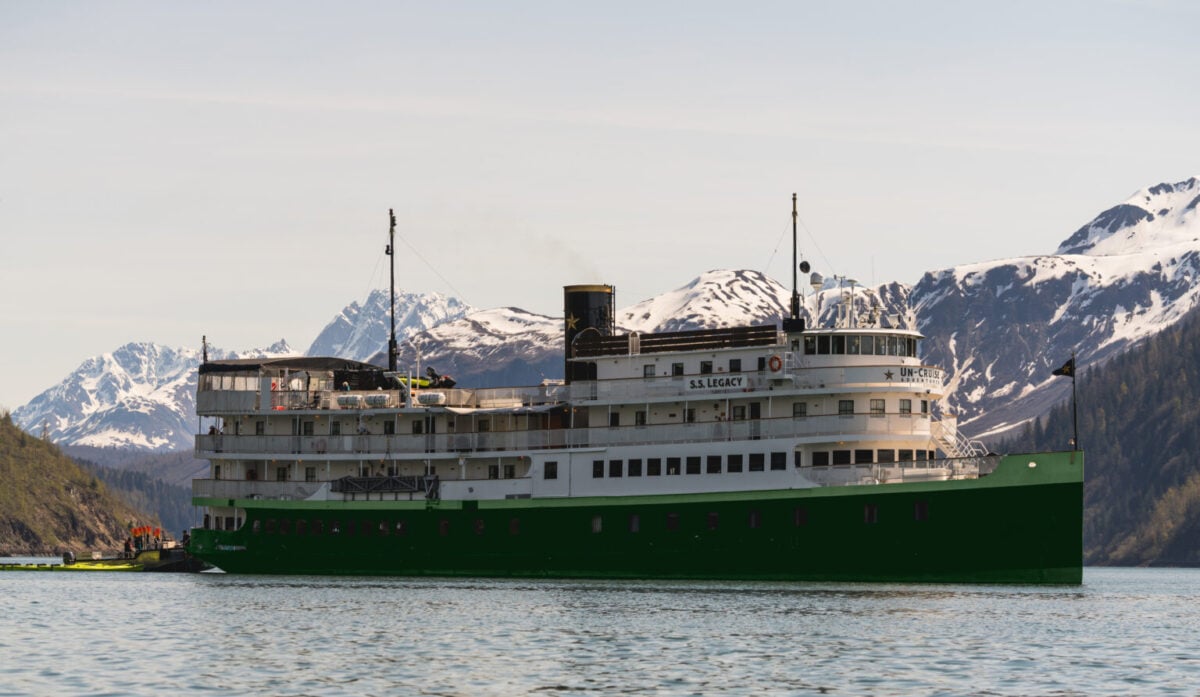
The UnCruise ship Wilderness Legacy is seen in an undated file photo provided by UnCruise. (Handout photo)
By: James Brooks, Alaska Beacon
Editor’s note: This article, initially published Friday, was updated Sunday morning with a statement from Zuckerberg.
A small cruise ship operating in Southeast Alaska made an unexpected detour on Monday night to help a 21-foot skiff that ran out of fuel between Petersburg and Juneau.
Michael Love, a software developer from New York City, was a passenger aboard the cruise ship and described the event on social media.
What got his attention the most wasn’t the rescue itself — it was when the captain announced that the yacht of billionaire Facebook owner Mark Zuckerberg was closer and hadn’t answered the radio call for help.
“There was near unanimous booing when the captain announced this,” he said in a post on the social media network Bluesky.
Vessel tracking services in the area back up that account — they show the $300 million, 387-foot yacht Launchpad slowing to a halt outside Farragut Bay as the UnCruise Adventures ship Wilderness Legacy steams around and past the Launchpad, stops at the apparent site of the skiff, then tows it into sheltered Farragut Bay.
Through a Bluesky message, Love said it was nice to be on a boat that was engaging with its surroundings in a positive way.
“Frankly, if I was Mark Zuckerberg I would be absolutely ecstatic at a chance to do something helpful for someone in need and maybe get some good PR out of it,” he said.
Social media accounts responding to Love’s account accused the yacht’s crew of violating international agreements that mandate aid from the nearest ship to one in distress.
According to the U.S. Coast Guard and the Marine Exchange of Alaska, which monitors ship traffic in Alaska, there was no distress call — just a general request for assistance.
Coast Guard Public Affairs Specialist Shannon Shepard said by email that the Coast Guard heard the call for help just after 9:30 p.m. Monday night.
“At approximately 9:56 p.m., the Coast Guard determined they were not in distress and issued a marine assistance request broadcast on their behalf,” she said.
John Hollingsworth is the chief operations officer of the Marine Exchange, which is based in Juneau and repeated the broadcast.
“We did assist the Coast Guard with callouts on our radio and (were) able to hail the Wilderness Legacy who ended up rendering assistance,” he said.
“From my experience, I know that situations like this contain myriad details for the vessels involved, so the AIS (tracking) snippet you obtained only reveals one of those details,” he said by email. “I do know that Wilderness Legacy is an UnCruise vessel and is very familiar with Alaska waters, so that may have contributed to them rendering assistance quickly.”
No information was available Friday about who may have been aboard the Launchpad on Monday evening. The Launchpad has been in Southeast Alaska for much of the summer.
After the initial publication of this article, a spokesperson for Mark Zuckerberg emailed a statement: “Mark and his family were not on board at the time of the incident. As the Coast Guard noted, the boat was not in distress, and by the time the crew reviewed the Coast Guard contact on a different radio channel from the one they were operating on, the assist was already underway. We’re grateful all parties are safe.”
The Wilderness Legacy’s detour is the second incidence of aid rendered by a small cruise ship in Southeast Alaska within two weeks. On July 30, the National Geographic Quest assisted a family who had to swim to shore in Glacier Bay National Park after a humpback whale sank their sailboat.
Dan Blanchard, who owns UnCruise, said he wasn’t initially aware of the Wilderness Legacy’s detour because “this kind of aid is such a common thing that it does not always rise to my attention.”
Sarah Scoltock, a spokeswoman for UnCruise, said the Wilderness Legacy was able to refuel the skiff after towing it into a sheltered area.
“The next day the (Wilderness Legacy’s) captain, Sean Manske, contacted them and received word they made it safely to Petersburg,” she said by email.
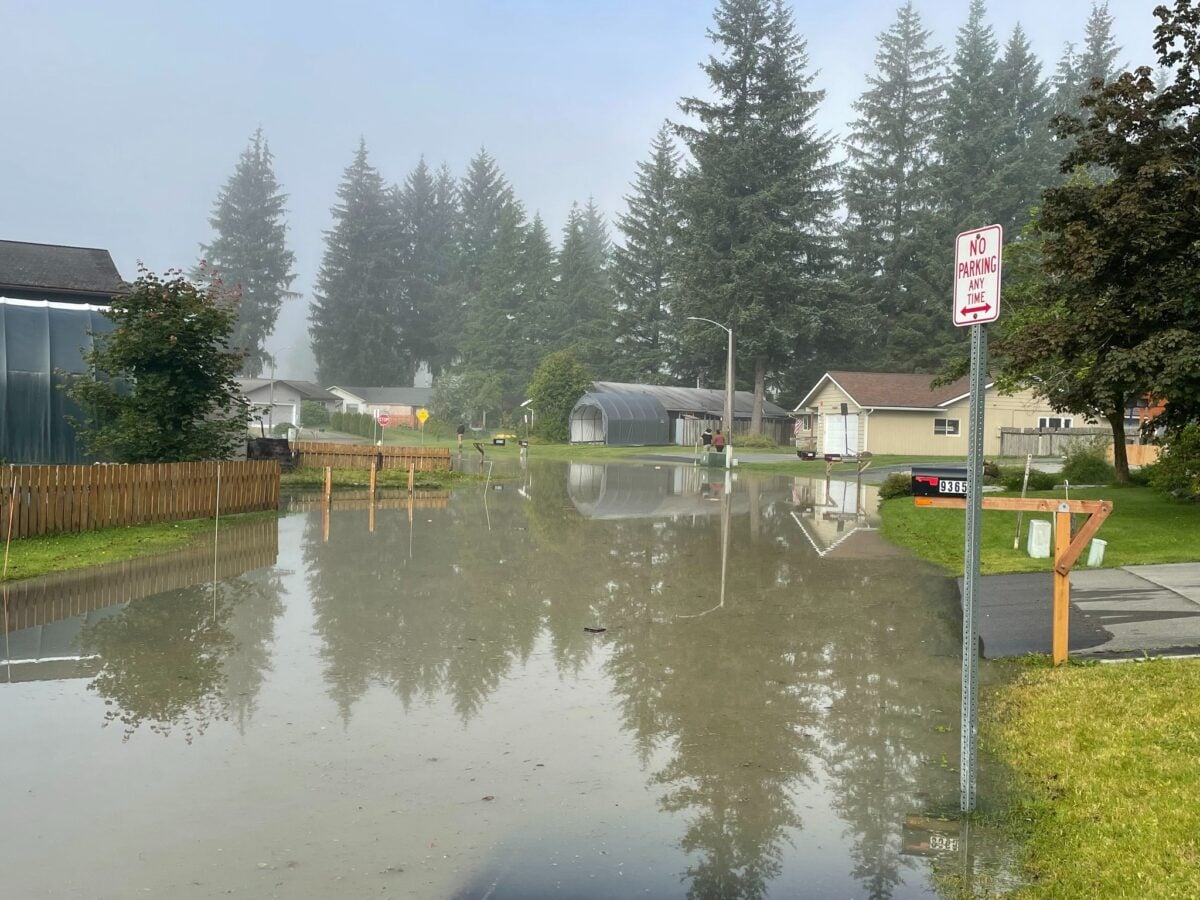
NOTN- As Suicide Basin nears capacity, the City and Borough of Juneau is urging residents in the flood evacuation zone to finalize their emergency plans.
In an interview with CBJ Emergency Programs Manager Ryan O’Shaughnessy, he said residents are encouraged to know where they’ll go if an evacuation is ordered.
“The basin is is almost full, once the basin becomes full and gets to 1350 ft, folks can expect to get an alert on their phones.” O’Shaughnessy said, “That’ll that loud, sort of jarring alert, a sort of siren that comes out of your phone for just a minute. And that’ll let people know that the basin has become full. And in our Ready, Set, Go framework, we’ve moved from Ready into Set. That means it’s time for folks to have a bag packed, it’s time to make sure your phone is charged, there’s gas in the car, and that you’re ready to go when the basin begins to release.”
We’ve put together the CBJ approved evacuation routes, take note of what’s nearest to you if you are in the evacuation zone.
Residents north of Division Street, please travel north on Riverside Drive, toward Mendenhall (Back) Loop Road and out of the inundation area.
Residents south of Division Street, travel south on Riverside Drive, turn left on Stephen Richards Memorial Drive, towards Mendenhall Loop Road.
On Rivercourt Way, travel south on Riverside Drive, toward Egan Drive
On the west side of the Mendenhall River, travel west on Mendenhall (Back) Loop Road toward Auke Bay (avoid Back Loop Bridge).
West of Brotherhood Bridge, travel west on Glacier Highway toward Auke Bay
An emergency shelter will be available at Floyd Dryden Middle School, and limited space is available there for pets. Juneau Animal Rescue can also help coordinate temporary pet sheltering.
People in the evacuation zone are also being asked to register their vehicles in advance if they plan to use the city’s temporary flood parking areas, which are located at St. Brendan’s Episcopal Church 4207 Mendenhall Loop Road, Shepherd of the Valley Lutheran Church 8198 Keegan Street, Christ Lutheran Church 10300 Glacier Hwy, Juneau Christian Center 8001 Glacier Hwy.
“We’re optimistic, and we have a tremendous amount of confidence in the HESCO barriers, but it’s not something to bet your life on. That’s why we’re really encouraging folks who live in the hazard area to evacuate and go ahead and heed that evacuation advisory when that’s issued.” O’Shaughnessy said.
Officials recommend preparing homes now by moving valuables, as well as items such as oils, paints and cleaning products, into secure waterproof containers at higher elevations.
Residents should also have a go-bag packed and ready in case an evacuation order is issued.
Officials remind residents not to drive or walk through floodwaters and to wait for an official all-clear before returning home after the event. The City and Borough of Juneau has also activated a flood information hotline for non-emergency questions. The hotline currently operates weekdays, with expanded weekend and around-the-clock hours planned once the basin fills and, if necessary, when a flood begins. United Way of Southeast Alaska is also coordinating volunteers and assistance for residents who may need help before or after the flood.
Flood waters are rising at a rate of about 3 feet per day but more information about flood preparedness is available through the City and Borough of Juneau’s flood readiness resources, the National Weather Service or by calling the flood hotline.
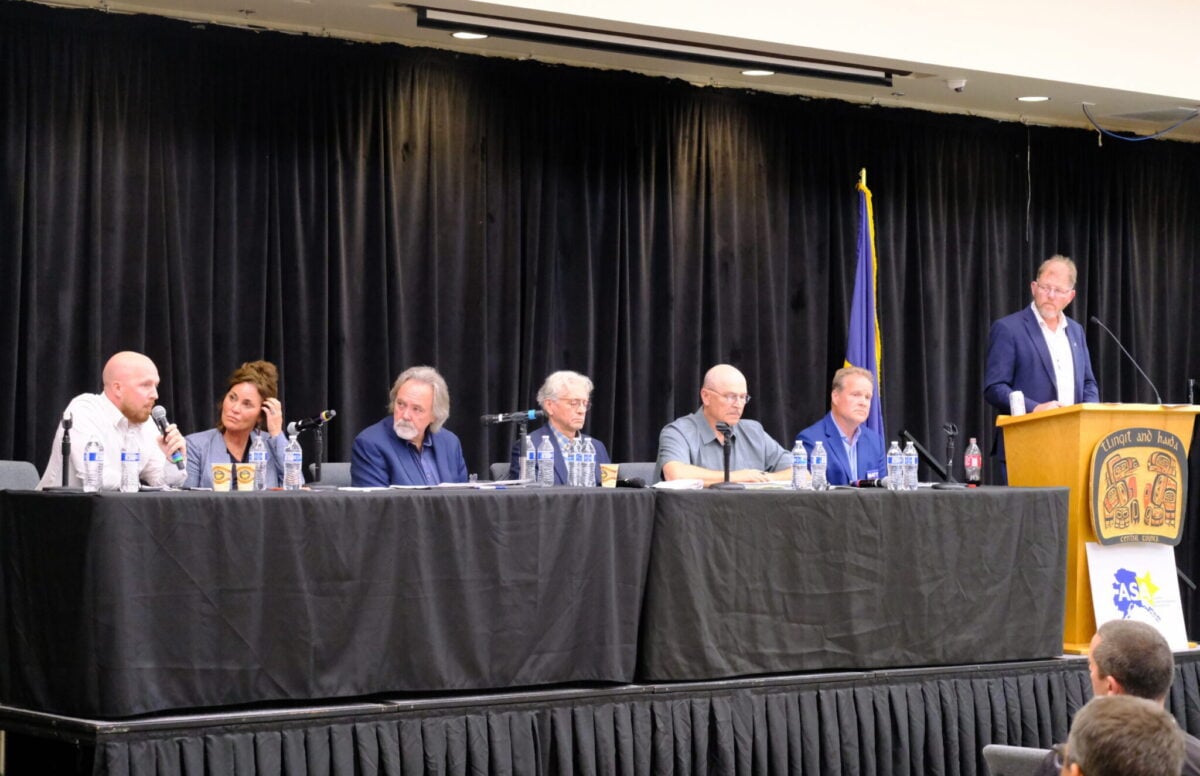
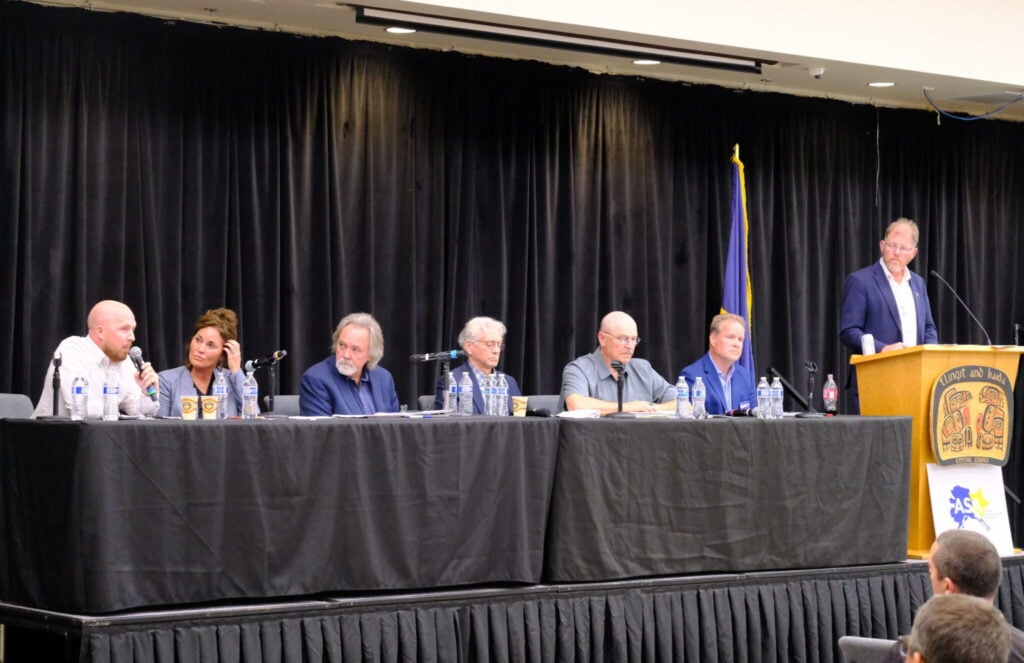
Six candidates for Alaska governor and lieutenant governor participated in a debate on education hosted by the Alaska Superintendents Association in Juneau on July 30, 2026. (Photo by Corinne Smith)
Six candidates for Alaska governor from across the political spectrum appeared side-by-side in a room full of superintendents and school officials in Juneau and promised that boosting education funding would be a priority of their administration, if elected.
Six candidates participated in the debate, out of 17 running for governor this year. Randy Hoffbeck, a candidate for Lieutenant Governor who stood in for his running mate, Bill Walker. They discussed their plans for education in a two-hour event hosted by the Alaska Superintendents’ Association on July 30. 2026 Voter Guide.
The candidates, the ballot measures, and the tools you need to cast your vote.
The gubernatorial candidates included Republican Click Bishop, Democrat Tom Begich, Republican Matt Heilala, Republican Lesil Maguire, Democrat Jonathan Kreiss-Tomkins, and Independent Hoffbeck.
The panel was moderated by Randy Trani, superintendent of the Matanuska-Susitna Borough School District, with questions organized by the board of the Alaska Superintendents Association. A group of roughly 50 superintendents and school administrators from across Alaska attended as part of the association’s summer conference event in Juneau.
All six candidates agreed Alaska education has been underfunded by the Dunleavy administration, with several candidates characterizing public education as “in crisis.”
A record 12 schools were closed this year, amid millions in budget shortfalls, and others have cut teachers, programs and extracurricular activities. Districts reported funding has not kept pace with skyrocketing operating costs, amid declining enrollment as families leave the state or move to homeschool programs.
Trani said afterward he found all the candidates “super impressive,” particularly their ideas for funding education.
“They understand that there’s a fiscal reality problem in the state and it has to be addressed,” he said. “They all have different ideas of how they’re going to do it, but at least they’re leading with it as a top priority.”
Superintendents and school officials from across Alaska gathered for a summer conference in Juneau listen to a gubernatorial candidate debate on education on July 30, 2026. (Photo by Corinne Smith/Alaska Beacon)
Luke Meinert is superintendent of the Fairbanks North Star Borough School District, which has closed seven schools in the past five years due to budget shortfalls and declining enrollment. He said he was impressed with the candidates, their willingness to invest in education and their experience working on education issues in Alaska.
“They’ve been in the game,” Meinert said. “I think maybe every one of them went to public schools here in Alaska, and so they had experienced public schools at a time where we were investing a lot in our school districts. And it was great to hear that they want to get back to those times because that can improve our retention and recruitment efforts for teachers, and then obviously student outcomes on the other end of that.”
Hoffbeck, who is running for Lieutenant Governor on Bill Walker’s ticket, did not go to Alaska public schools, but Walker did.
The candidates shared their plans for funding for Alaska districts, tackling billions of dollars in deferred maintenance, boosting recruitment and retention of teachers and staff, and providing them healthcare and retirement, as well as views on local control of school boards, fiscal plans for the state and other issues.
Funding for education
Despite Alaska school districts reporting severe budget shortfalls and cutting teachers and programs, Gov. Mike Dunleavy has opposed sustained increases to per student funding, arguing against more funding without changes to policy. He has particularly sought changes related to charter schools and homeschool programs.
Democrat Tom Begich discusses his education policy platform, with Independent Randy Hoffbeck (left) and Republican Click Bishop (right) at an education debate on July 30, 2026. (Photo by Corinne Smith/Alaska Beacon)
But all six candidates agreed that schools have not been adequately funded under the Dunleavy administration, and that stable and reliable funding for districts is essential. They all said boosting investment in education is a priority of their campaigns.
Begich, Hoffbeck, Kreiss-Tomkins and McGuire said they support “forward funding” education and providing budgets to districts earlier in the year to provide more stability to districts. The state budget is currently finalized in June.
Begich said he would advocate for an immediate boost to per student funding, known as the base student allocation — the core of the state’s funding formula — to account for rising inflation. He proposed increasing the figure by roughly 15% to $7,680 per child and tie increases with inflation each year. He said he would also support fully funding pre-K to be available in all school districts.
Bishop said he would focus particularly on investing in career and technical education, referring to his experience growing up in a family of operating engineers and working in construction. “I’m going to push that till the day I die,” he said. “Nothing wrong with four-year degrees or higher. Career and tech ed needs to be improved upon in this state, and I’m the person that can do it working with you.”
McGuire and Kreiss-Tomkins said they support reviewing and revising the state’s complex funding formula to ensure districts are adequately funded. Both McGuire and Kreiss-Tomkins as well as Heilala said education has become a politically divisive issue which has obstructed progress. Kreiss-Tomkins called education policy a “Pandora’s box” avoided by lawmakers not wanting to take political risks.
Democrat Jonathan Kreiss-Tomkins, a candidate for governor, speaks at a debate on education on July 30, 2026. (Photo by Corinne Smith/Alaska Beacon)
Kreiss-Tomkins and Hoffbeck said they support a constitutional amendment to create a special fund for education separate from the state’s budget. “A constitutional amendment’s only way to dedicate funds in Alaska that can effectively politically de-risk education funding going forward, and also largely account for inflation,” Kreiss-Tomkins said.
Hoffbeck agreed there is a lack of trust between districts and the state under Dunleavy, which he said must be repaired. He said he believes adequate funding varies by school district across the state, and he and Walker both support a review of state funding for education by an independent third party to study and assess how much funding is needed by each school.
“Just throwing more money at it doesn’t fix the problem. We need to be surgical on how we add that money,” he said. “Yes, absolutely, we are underfunded. We need more funding, but we need to fund very surgically as we go forward.”
Teacher recruitment and retention
The candidates agreed investing in hiring and retaining teachers is a major priority, but diverged on the question of whether the state should revive a defined benefit retirement plan for educators.
Bishop and Heilala said they would focus education investments on boosting teacher pay. Heilala said funding should be more focused and efficient, and directed to teachers. “I believe teachers need pay raises. I think they probably need 15 to 30% pay raises, and of course, that’ll happen with a booming economy,” he said.
Independent Randy Hoffbeck, candidate for lieutenant governor running with Bill Waker, speaks at a debate on education on July 30, 2026. (Photo by Corinne Smith/Alaska Beacon)
Hoffbeck said teacher recruitment and retention should focus on training and hiring local teachers, particularly for rural Alaska. “The local teachers would stay in the rural communities,” he said, referring to his time working in the North Slope Borough. “And so I think we need to have a robust local recruitment process, including certification programs that make it possible for somebody in the village that may not have a four-year degree.”
Bishop, Begich and Kreiss-Tomkins support reviving the defined benefit retirement system for teachers, and said they believe offering that again would boost recruitment.
The state defined benefit retirement system for public employees was ended in 2006, after the system accrued a multi-billion dollar shortfall. Lawmakers passed legislation to revive the program this year, but Dunleavy vetoed it.
Begich said he would also want the state to provide medical benefits in a new defined benefit retirement plan, as well as grants for teacher housing.
Heilala disagreed, and said the defined benefit system is the “biggest mistake.” He said a 401(k) retirement plan has greater certainty to create income.
Republican Lesil McGuire speaks at a gubernatorial candidate debate on education on July 30, 2026. (Photo by Corinne Smith/Alaska Beacon)
Hoffbeck said he has concerns about a defined benefit retirement system as some districts would not be able to afford it.
McGuire said she does not support a defined benefit retirement plan, but supports a retirement system that the state can afford. She said she supports a student loan forgiveness program for teaching in Alaska, and low interest loans for housing to boost recruitment and retention.
“I think housing is a huge issue. Let’s make Alaska the place you want to come teach,” she said.
School maintenance backlog
The candidates all agreed that addressing the state’s multi-billion dollar backlog in deferred maintenance in K-12 schools and the University of Alaska system would be a major priority of their administrations, and presented various ideas on how to fund it.
Republican Click Bishop speaks at a gubernatorial candidate debate on education on July 30, 2026. (Photo by Corinne Smith/Alaska Beacon)
Bishop said part of his plan for funding education would be to levy an “education head tax,” a flat-rate tax per Alaskan regardless of income to pay for school maintenance. He said he’d introduced similar legislation when he was a member of the Alaska State Senate.
“It’s ludicrous that we have this much of a deferred maintenance schedule,” he said.
Begich said he supports the state paying to help boroughs and districts with school bond reimbursement, which is debt incurred by voter-approved bonds to fund school maintenance. He also supports the state backing a general obligation bond to generate hundreds of millions to address the existing maintenance backlog list.
McGuire, Hoffbeck and Kreiss-Tomkins agreed issuing bonds was a good idea. Hoffbeck and Kreiss-Tomkins also said prioritizing hiring local contractors for construction and maintenance is important.
Kriess-Tomkins noted maintaining schools is an obligation under Alaska’s Constitution. He also cautioned that there will be changes to schools with declining numbers of students as a result of outward migration from the state and families having fewer children. He said he’d want to invest in a system to keep up with school repairs in order to avoid large costly repairs like roof replacements decades in the making.
Republican Matt Heilala speaks at a gubernatorial candidate debate on education on July 30, 2026. (Photo by Corinne Smith/Alaska Beacon)
Heilala said the deferred maintenance backlog is a challenge, but sees opportunities for consolidating schools with “goodwill.” He said he believes “connectivity” will change infrastructure needs and said he sees artificial intelligence as a “supersonic tsunami” hitting American society now, and creating opportunities for education. “Education is going to be disrupted and changed. I believe in a good way,” he said. “There’s a lot of great opportunity, but we need to approach it with optimism.”
McGuire said a variety of solutions are needed to address school maintenance and repairs. “We’re so far behind at this point. We’re actually bordering up against litigation,” she said.
She cited legislative hearings and public outcry around the state-run boarding school, Mt. Edgecumbe High School this year when a quarter of students disenrolled sparking public focus on deteriorating school facilities.
“It was a stomach-turning event,” McGuire said. “So I think there are a variety of solutions. We need to be brave and bold, pull it out, assess what we need to do, and then look at solutions and address it immediately.”
Fired federal workers formerly with the U.S. Forest Service based at the Mendenhall Glacier in Juneau speak at the Alaska State Capito; on March 21, 2025, about their experiences. The Forest Service was among the federal agencies in Alaska most heavily affected by job cuts. (Photo by Corinne Smith/Alaska Beacon)
Alaska lost a higher percentage of its federal workforce last year than almost all U.S. states to sweeping Trump administration cuts, according to a newly published analysis by the Alaska Department of Labor and Workforce Development.
By the end of 2025, Alaska’s federal workforce was 10.5% smaller than it had been at the end of the prior year, according to the analysis, published in Alaska Economic Trends, the monthly magazine of the department’s research section. In the fourth quarter of 2025, after many workers accepted buyouts or early retirement, the state’s federal workforce had dropped by 1,607 from the total in the fourth quarter of 2024, to 13,767 from 15,374 the year prior, according to the analysis.
The job losses came through mass firings and cuts made by the so-called Department of Government Efficiency, or DOGE, the government-reducing campaign led by trillionaire Elon Musk that started shortly after Donald Trump took office for his second term. To a large extent, job losses were concentrated at the end of the year.
Calculated by the annual average, Alaska lost about 4.5% of its federal jobs in 2025. Only Maryland, which lost 6.5% of its federal jobs, and New Mexico, which lost 5.8% of its federal jobs, lost more.
Federal job losses reduced Alaska’s total earnings by $36.5 million on average in 2025, according to the Department of Labor and Workforce Development analysis, and they brought federal employment in Alaska to the lowest level since at least 1990.
Much of the cutting in Alaska came in the U.S. Department of Defense’s civilian workforce. Calculated by annual average, 340 defense related jobs were lost to the DOGE cuts, but the fourth-quarter loss was calculated at 755 jobs.
The large amount of job losses in the Department of Defense category was a bit surprising, said Karinne Wiebold, the state labor economist who wrote the Trends article. “I assumed early on that the DoD might be one of the less affected departments and that our strong military presence might insulate us,” she said by email.
Federal agencies that sustained high numbers of job losses included the U.S. Forest Service, which had 180 fewer employees at the end of 2025 than in late 2024, the Bureau of Land Management, which had lost 133 jobs at the end of the year, and the National Oceanic and Atmospheric Administration, which had lost 101 of its workers by the end of 2025.
The fallout from the job losses continues, and the public does not yet have a complete picture, Wiebold said. “I do think the public is aware of the federal job losses and that they have been deep and a bit unpredictable,” she said. “I don’t know if the public generally understands what the ramifications of the cuts will be — federal employees perform a wide variety of oftentimes highly specialized work.”
Certain parts of the state were harder hit than others. The Southeast Fairbanks Census Area, which has been reliant on military-related employment, and parts of Southeast Alaska, where employment related to the Tongass National Forest is important, are among those regions with steeper job losses by percentage, according to the analysis.
Alaska’s ranking among states hit by DOGE-related job cuts could change, Wiebold said. Data from this year has yet to be fully analyzed, she said. “Even in the first parts of 2026, there are reports of the rankings shifting somewhat,” she said.
The Alaska Beacon, Alaska Public Media, KTOO and the Anchorage Daily News worked together this year and have created a voter guide to help Alaskans make informed choices when they vote.
The 2026 Alaska Voter Guide won’t replace debates, forums and public statements. Instead, it’s something extra, aimed at informing voters about what candidates believe and providing a tool to hold them accountable once elected.
We’ve been working for months on this and are pleased to present it to you today, on the opening day of early in-person voting.2026 Voter Guide
The candidates, the ballot measures, and the tools you need to cast your vote.
Each news organization asked its readers, viewers and listeners a basic question: What do you want candidates to talk about?
That’s what’s called the “citizens agenda” — where election reporting is less about determining who’s ahead, and more about what a candidate’s positions are and how they would affect things if elected.
We sent emails to every candidate in the first week of July and followed up by phone calls in the second week. We continued reaching out, by email, text message and phone call, throughout July.
In the end, 107 of 132 state legislative candidates responded — 81% of everyone running for the Legislature. That’s a huge improvement over two years ago, when 78 of 115 candidates answered a survey from the Beacon alone, or 67.8%. Four years ago, the Beacon’s rate was below 60%.
For the governor’s race, 14 of 17 candidates responded. For the U.S. House race, we received responses from 11 of 15 candidates, including Democratic candidate Matt Schultz, who has suspended his campaign but is still on the ballot. In the U.S. Senate race, we have answers from 11 of 16 candidates.
While it isn’t everyone — and we’ll continue pursuing answers — we’re proud to say that this questionnaire is the most complete one that you can find anywhere in Alaska.
When it comes to the Legislative races, the Beacon had the lead role and was in charge of questions. Here’s what we asked candidates and why:
Would you be willing to serve in a coalition majority where members of the other party are in leadership? Why or why not?
Whoever is in the majority controls the agenda and decides which bills advance and which bills fail. Alaska is the only state in the country with coalitions in both the House and Senate. The difference between a Republican-led majority and a coalition one is a big one in terms of what the Legislature does over the next two years.
What’s the biggest need in your district, and how would you address it?
This is an opportunity for candidates to show how much they know about local needs; it’s also a chance for them to talk about any issues we didn’t bring up.
What do you think should be done to improve public education in the state?
You, our readers, wanted candidates to talk about education more than anything else. This gave candidates a chance to talk about their platform.
How should the Alaska Legislature handle the Permanent Fund dividend?
This was probably the No. 2 issue that you brought up when we asked you what you wanted candidates to talk about.
How should lawmakers balance state revenue and expenses in the long term?
This is closely tied to the dividend question and meets your request to ask candidates about a fiscal plan.
When you look at the state budget, what’s the No. 1 thing you’d like to see cut or reduced, and what’s your No. 1 preferred way to raise new state revenue?
Like the previous question, this is a way to test candidates about their knowledge of the state budget and get their thoughts on a fiscal plan. That will be a major topic over the next two years.
What, if any, changes does the state need to make to its elections and voting system?
Voting and elections came up again and again when we asked readers what they wanted candidates to discuss. The Legislature has tried — and failed — to enact an elections bill over the past six years, so it’s a safe bet that the 35th Legislature will try again.
What threats do you see facing Alaska in the next four years?
This was our way of allowing candidates to show their priorities — what are they most worried about?
What should legislators do to make Alaska a better place for children and families?
This question came in response to your desire to see candidates talk about preschool, daycare, early childhood education and more.
As Alaska’s average age rises, what needs to be done to make the state a better place for older residents?
Alaska is the fastest-aging state in the country, and that trend is expected to continue. It’s something that the next Legislature will have to address. This question allows candidates to speak to older Alaskans directly.
What should Alaska do to keep residents and visitors safe from crime and disaster?
This question gave candidates a chance to talk about crime and climate change, data centers, energy shortages … it was really open-ended.
What, if any, change would you make to state law to support the Alaskans who are dependent on fish harvests and the fishing industry?
Candidates have been talking about fishing quite a bit this year, but it’d be a mistake to ask state-level candidates about trawling, given that most of it takes place in federal waters and there’s little the Legislature can do about it. So this question is more general.
What do people not know about you that you think they should know?
We’re not normally a fan of softball questions in these surveys, but they can be an opportunity to get to know a candidate’s personality, so this was an open-ended opportunity.
What should the Legislature do to help Alaskans with the high cost of living?
Inflation and cost of living came up as issues in a big way later in the spring, and we wanted to make sure we asked candidates about it.
How are the Trump administration’s policies working in Alaska? Where do you see them working well, and where do you see problems?
Our readers wanted very much to hear candidates talk about Donald Trump and whether they’re for or against him and his policies. This is a way to bring that question to a state level and make it applicable to the Legislature.
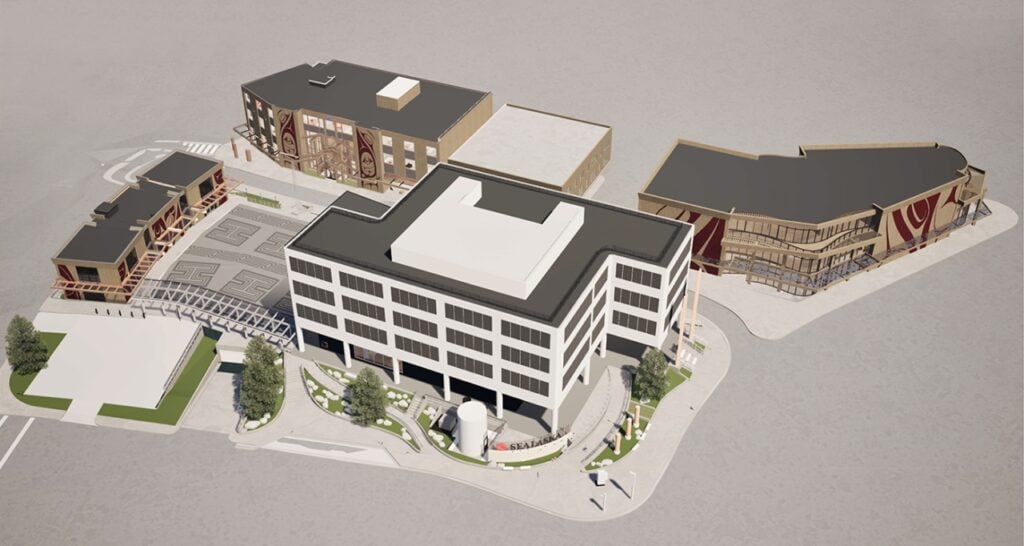
NOTN- Sealaska Heritage Institute has released new renderings of a proposed $40 million mixed-use arts and cultural center planned for the current Juneau City Hall site.
The three-story facility would feature Northwest Coast art and cultural experiences, a glass-blowing studio, gallery space, community programming and a possible new home for the Juneau-Douglas City Museum, though no agreement has happened between SHI and the city as of now.
Institute officials say the project would strengthen downtown year-round, create jobs and expand Juneau’s cultural tourism economy. The proposal depends on the City and Borough of Juneau approving the sale of the City Hall property to Sealaska Heritage for $1.5 million.
The Juneau Assembly is scheduled to hold a public hearing on the proposal Aug. 17.
The full press release by SHI can be found below;
Sealaska Heritage Institute (SHI) has released schematics of its proposed arts building envisioned for the site of Juneau’s old city hall.
The crown-jewel, mixed-use facility would encompass multi-levels, feature stunning glass walls and be adorned in monumental red formline design — elements that mirror SHI’s Walter Soboleff Building, Atnané Hít (Sealaska Heritage Arts Campus) and its Indigenous Science Building in the city’s designated Heritage Square.
The space would provide authentic educational, cultural and art experiences for locals and visitors, include a Northwest Coast art glass studio and offer space to house the Juneau-Douglas City Museum.
The project is part of SHIs efforts to make Juneau the Northwest Coast arts capital of the world, said SHI President Rosita Worl.
“We are thrilled to unveil our latest proposal to bring more Northwest Coast arts, cultural experiences and economic diversity to Juneau and to further enhance the downtown corridor,” Worl said.
The project hinges on whether the city elects to put the project out to the highest bidder or sell to SHI for $1.5 million. If the institute did purchase the land, SHI would have to raze city hall because it’s contaminated with asbestos and other toxins inside and below the dilapidated facility. The city also has delayed maintenance on the building that would cost $13 million to address.
Demolishing the building and decontaminating the site would come with a steep price tag, said SHI Chief of Operations Lee Kadinger.
“The project would require demolition and removal at considerable cost to SHI. The demolition and highly regulated removal and disposal process is estimated to cost in excess of $1 million before construction of a new facility would be possible,” Kadinger said.
The new structure would span roughly 30,000 square feet and encompass three floors. If it were built using today’s prices, it would cost approximately $32 million. Assuming it will take four years to raise capital funds, the price would be closer to $40 million, as costs rise over time, Kadinger said.
SHI would install a nicely landscaped space onsite for locals and visitors while it’s raising capital funds to build the facility, similar to when it filled in the so-called “pit” downtown while the institute raised money to construct the Walter Soboleff Building.
The institute would give the city first right of refusal to relocate the Juneau-Douglas City Museum to the second floor of the building. This would move the museum closer to cruise ship docks.
Through community oriented year-round activities, the facility will help draw locals to the downtown corridor in off-tourism months — and help to revitalize downtown, which is a priority of the City and Borough of Juneau. The institute is also considering setting aside some space for apartments in recognition of the community’s housing needs, as well as its own employees.
Cultural Tourism
The new facility would launch SHI’s planned cultural tourism programming, where visitors and locals would get hands-on experiences in Northwest Coast arts.
The structure would include a glass studio, where the famed Tlingit glass artist Preston Singletary would help to establish the program and secure partners who would create an educational structure around glass blowing. This would become a creative space for the community of Juneau — one that could grow to create opportunities for visitors and locals to make their own glass pieces. Singletary would also help create a tiered program to develop skills from beginner to advanced, teaching students to create limited production pieces that could become a cottage industry over time.
The glass studio is based on the wildly successful model created by the Museum of Glass in Tacoma, Washington, which draws nearly 100,000 visitors annually, includes a Hot Shop that hosts more than 50 visiting artists each year and has engaged more than 250,000 students through educational programs to date.
The new facility would be across from the Juneau Seawalk and Marine Park and attract more tourists to the core of downtown. The glass studio and a retail gallery for high end art would add to SHI’s monumental art and cultural tours currently offered at the Arts Campus and Walter Soboleff Building.
Community Benefits
While SHI projects and services are structured for tribal members, many of the programs benefit or are available to the entire community. Teacher trainings, lectures, art classes, summer camps, visiting scholars, concerts, academic publications, live streams, traditional ceremonies, First Fridays, Totem Pole Trail tours and Indigenous science workshops are commonly available to the public.
As the glass program grows, the facility would be open to residents who want to learn about the art of making glass and glass blowing.
SHI’s three other buildings also have transformed and beautified Juneau, adding to the visual appeal of downtown, and the plaza has been open to the public for art performances and other activities. The institute’s hope is to retain the city hall site for additional community space.
Economic Benefits
The successful completion of previous SHI capital campaigns has led to significant benefits for Juneau. In addition to its construction projects and their associated employment and economic activity, SHI has provided direct monetary contributions to the Juneau School District and University of Alaska Southeast totaling more than $13,000,000 since 2015, according to a 2025 study by McKenley Research Group, and it plans to continue the educational investments.
Today, SHI employs more than 100 staff in Juneau. An economic impact study by the same firm in 2023 demonstrated that SHI generates more than $30,100,000 in direct and induced economic activity annually in Juneau.
Because SHI’s buildings are staffed and open year-round, they support area businesses as employees patronize nearby establishments. The new building’s employees would help offset the loss of city workers who will move to the area by the Juneau-Douglas Bridge.
As with SHI’s other buildings, the new facility is expected to provide an economic boon during construction, provide new jobs, boost labor income and generate millions of dollars in direct expenditures.
The city will hold a public hearing on Monday, Aug. 17, to take public testimony on the terms of the sale.
Sealaska Heritage Institute is a non-profit tribal organization founded in 1980 to perpetuate and enhance Tlingit, Haida and Tsimshian cultures of Southeast Alaska. Its goals are to promote cross-cultural understanding by educating the general public about the Indigenous cultures of Alaska. SHI also conducts scientific and public policy research that promotes Alaska Native arts, cultures, history and education statewide. The institute is governed by a Board of Trustees and guided by a Council of Traditional Scholars, a Native Artist Committee, a Southeast Regional Language Committee and an Education Committee.
CONTACT: Kathy Dye, SHI Communications and Publications Deputy Director, 907.321.4636, kathy.dye@sealaska.com. Captions from top: The facade of the arts building. The structure as seen from Marine Way. Heritage Square, which currently includes SHI’s Atnané Hít (Sealaska Heritage Arts Campus), Walter Soboleff Building, its Indigenous Science Building and the Sealaska building. Schematics by MRV Architects, courtesy of Sealaska Heritage Institute. Note: Media outlets are welcome to use these photos for coverage of this story. For higher resolution images, contact kathy.dye@sealaskaheritage.com.
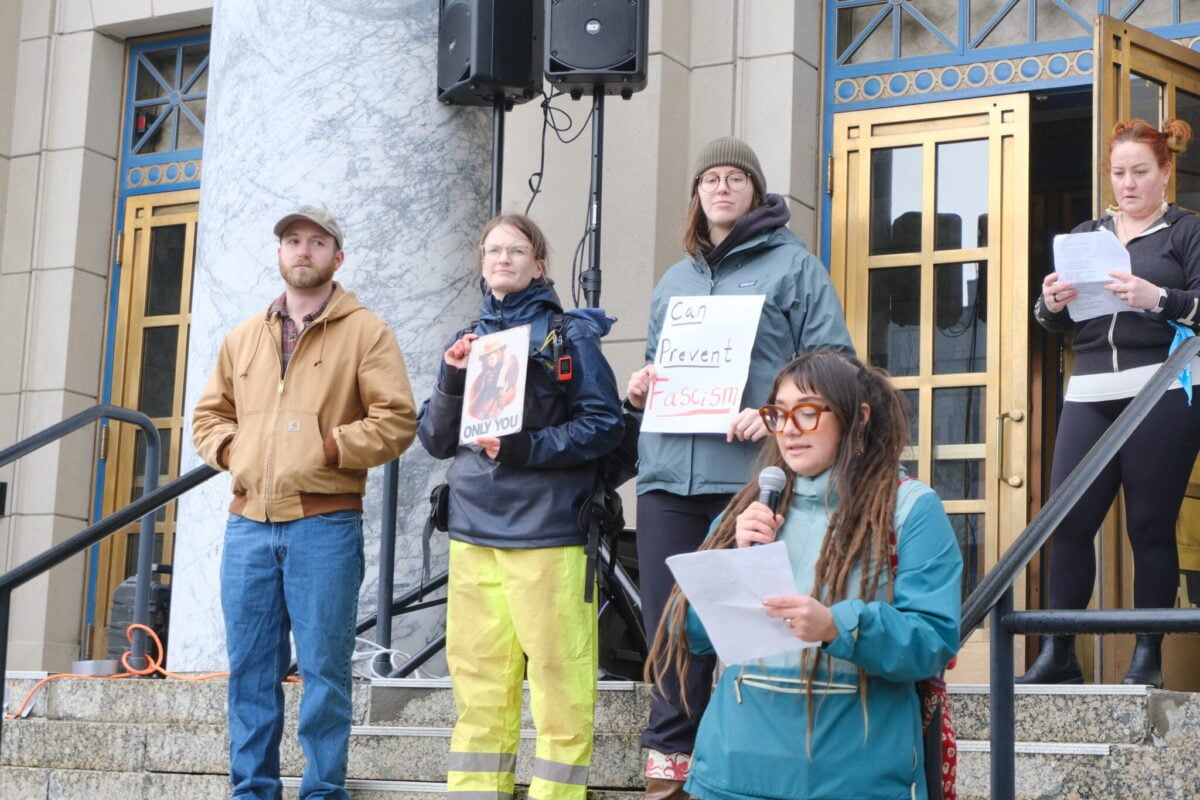
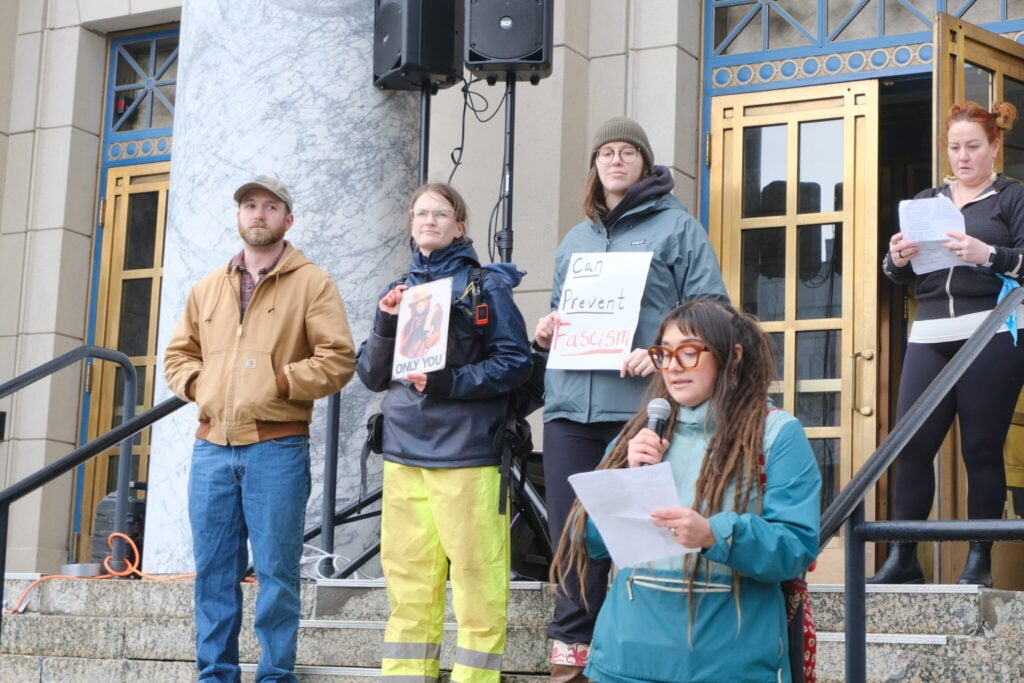
A group of pro-democracy demonstrators gathers Monday, Aug. 3, 2026, in Juneau on the first day of early voting for the 2026 Alaska primary election. (James Brooks photo/Alaska Beacon)
Early in-person voting began Monday at 10 locations in the Railbelt, Juneau and Nome for Alaska’s Aug. 18 statewide primary election. As of July 31, just under 10,000 voters had requested absentee ballots for the election, and hundreds of absentee voters had already mailed in their votes, according to figures from the Alaska Division of Elections.
What’s at stake?
This election decides the four U.S. House, U.S. Senate and governor candidates who will be in the November general election. It also decides whether Alaska will limit the amount of money that political donors can give directly to candidates.
Because the top four candidates for an office advance to the November general election — and because most of the 50 state legislative races have four or fewer candidates — the primary doesn’t mean as much for most legislative races individually.
But because the difference between a Republican-led state House and Senate and a predominantly Democratic coalition-led state House and Senate may come down to a few votes, the handful of contested legislative elections may be important.2026 Voter Guide
The candidates, the ballot measures, and the tools you need to cast your vote.
Watch Eagle River, where incumbent Republican Rep. Jamie Allard is facing four challengers, or the eastern Mat-Su, where Dunleavy-appointed Republican Rep. Garret Nelson has five opponents. In the western Mat-Su, Republican Rep. Kevin McCabe has four challengers.
In the Senate, watch southwest Alaska, where Sen. Lyman Hoffman, D-Bethel, has retired and seven candidates — including current Speaker of the House Bryce Edgmon, I-Dillingham — are running for the open seat.
Seven people are running for the state House seat that Edgmon is leaving open.
What’s the difference between absentee voting and early voting?
The difference is when your ID is verified. At an early voting location, a poll worker looks up your voter registration at a computer to verify that you’re registered to vote in a specific district, then hands you a ballot from that district.
You’ll want to bring a driver’s license, tribal ID or something else to verify your identity. Even a piece of mail with your current name and address will work. If the poll worker knows you, they can also verify your identity without ID.
When you vote absentee, you get a ballot for a district, then seal it inside an envelope and fill out the cover of that envelope with identity information.
Starting Aug. 11, review boards will begin checking the information on those envelopes to verify that those absentee ballots came from registered voters. The ballots within those envelopes will be counted once the polls close Aug. 18.
Absentee ballots can be mailed to the Division of Elections, or they can be cast in person at dozens of places across the state. While there’s only 11 early voting places in Alaska, there are many, many more places to cast in-person absentee votes, including at most city clerks offices.
Which method is best?
Mailed absentee ballots will be counted as long as they’re postmarked on or before election day and reach the Division of Elections no later than Aug. 28.
In Alaska, not all mail is postmarked on the day it is mailed, so be sure to mail your ballot a few days early.
If you’re worried about mail delays, take your absentee ballot to one of the locations listed here before election day, or do early voting in person.
You can also fax a completed absentee ballot to the Division of Elections. If you don’t have a fax machine, you can use a scan-to-fax app on your cellphone instead.
Early voting ensures your vote gets counted, since your ID is verified up front, your ballot is already scanned and ready to be counted, and there’s a paper copy for any recounts and reviews.
The drawback is that it’s only offered in 10 places within the state, and if you’re traveling Outside or not close to one of those 10 places, it’s not available.
What does the ballot look like?
Your ballot will have two sides. On the front side are the U.S. House and U.S. Senate races. On the back side are the governor, state House and state Senate races. There’s also an option for Ballot Measure 1.
Pick one candidate for each race. Ranked-choice voting, when you’ll rank up to four candidates, is in November.
Use a blue or black pen to fill in the oval. Don’t use a permanent marker.
When will results be available?
The first unofficial results will be posted online about 9 p.m. on Aug. 18. Full election day totals may take a few days to arrive as rural precincts report their results. Absentee ballots will be counted day by day, with new totals expected Aug. 25 and then on Aug. 28, when the last unofficial results will be posted.
Aug. 31 is when the division expects to certify the final results. That’s also the date for any top-four candidates to withdraw, something that has happened in prior years for strategic reasons.
Lower-finishing Republicans, in particular, have been willing to drop out of the top four to ensure that only one Republican appears on the November ballot.
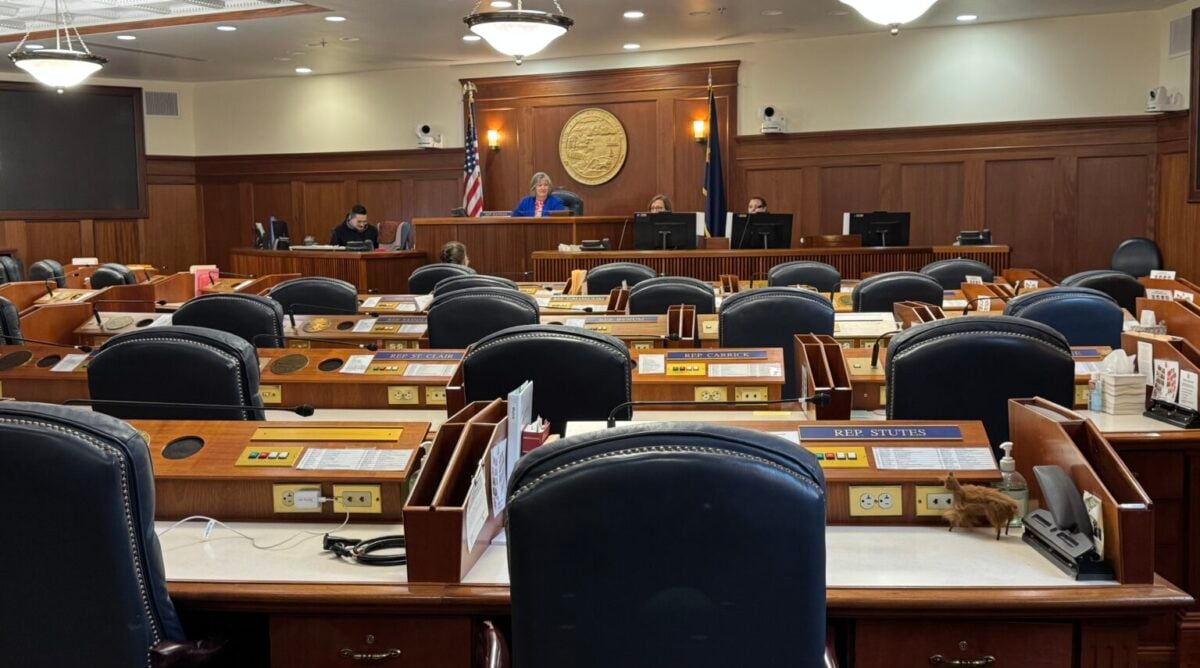
The session is for lawmakers to consider a property tax break to incentivize the proposed trans-Alaska natural gas pipeline, but Gov. Mike Dunleavy, who called the session and set the agenda, has yet to propose legislation for lawmakers to work on.
The state House failed to pass a compromise bill earlier this month, during the second special session of 2026, after Dunleavy threatened to veto it.
The governor has said he is holding closed-door negotiations to try to draft an alternative, but his office has released no details about those discussions.
Two members of the House and one member of the Senate held perfunctory “technical sessions” on Friday.
Article II, Section 10 of the state constitution requires regular meetings unless lawmakers approve a resolution allowing a different schedule.
The House has scheduled another technical session for this morning, and the Senate has scheduled one for Tuesday morning.
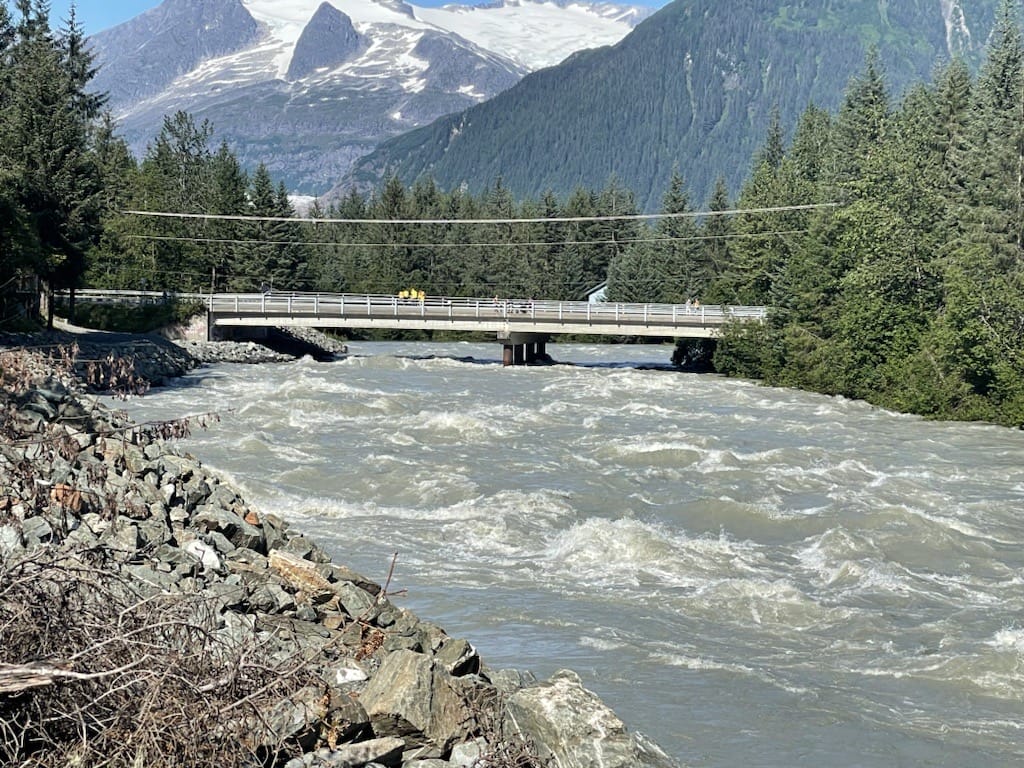
NOTN- State transportation officials say that the Back Loop Bridge will be closed to all traffic during the anticipated Glacier Lake outburst flood also known as GLOF, while Brotherhood Bridge will remain open to vehicles but closed to pedestrians for safety.
“Much like last year, we’re going to close the bridge that’s on Back Loop when the gauge level on Mendenhall Lake hits 12 feet, or at 8:30 at night if it’s predicted to go over 12 feet overnight.” Said Department of Transportation Incident Commander Travis Eckhoff, “Folks will remember last year during the flood we had some damage to an approach that totally washed the approach out on the east side of the bridge. And so, just for everyone’s safety, we’re going to go ahead and close that bridge once it hits 12 feet, and we’ll open it back up once our engineers have had a chance to go and inspect the bridge to make sure everything’s okay.”
Engineers will inspect the bridge before reopening it once water levels subside.
Eckhoff urged residents to heed evacuation boundaries, avoid driving through floodwater and sign up for alerts at 511alaska.gov and with the City and Borough of Juneau.
Drone flights will also monitor infrastructure during the event.
“When the basin releases we’ll be putting out a temporary flight restriction for a specific area. So we advise you don’t fly your drones in that area. We’ll be posting that on our socials. There will be drones in the sky, monitoring important infrastructure and HESCO barriers.” Echkoff said.
The U.S. Capitol building in Washington, D.C., on Tuesday, Jan. 13, 2026. (Photo by Jennifer Shutt/States Newsroom)
WASHINGTON — For the second time in as many weeks, a War Powers Resolution aimed at curbing President Donald Trump’s war with Iran failed to pass the U.S. Senate Thursday.
The vote breakdown, 49-50, fell along familiar lines as previous War Powers votes, with Republican Sens. Lisa Murkowski of Alaska, Rand Paul of Kentucky and Susan Collins of Maine supporting the measure.
Democratic Sen. John Fetterman of Pennsylvania voted no, as he’s done in just over a dozen similar measures.
Sen. Mitch McConnell, R-Ky., continues to be absent while in medical rehab.
A similar War Powers Resolution to rein in Trump’s military conflict in Iran passed in the U.S. House on July 23, but failed in the Senate — both led by Republican majorities.
War heats up
The regional war reignited yet again this week after Trump ordered retaliatory strikes Tuesday, along with Saudi Arabia’s armed forces, on Iran-backed militias in eastern Iraq. The strikes on “multiple terrorist logistics and weapons sites” were in response to Iranian drone attacks on U.S. forces in the region, according to U.S. Central Command.
Trump told Fox News on Wednesday, “We are going to beat the f—– s—- out of them.”
The United States launched a “heavy wave” of strikes on Iranian military sites beginning at 10 p.m. Eastern Wednesday “in response to yesterday’s attempted missile attacks on U.S. forces,” according to U.S. Central Command.
The cost of oil jumped to just over $90 a barrel Wednesday in response to renewed fighting and a continued chokehold on traffic through the Strait of Hormuz, where one-fifth of the world’s petroleum traveled prior to the U.S. and Israel launching the war in late February.
This means Americans are again paying more for fuel. According to AAA, the U.S. national average for a gallon of regular gasoline rose to $4.09 Thursday.
Before the volley of strikes began again, Trump had announced a pause, after the U.S. and Iran traded rocket fire for nearly two weeks following the collapse of ceasefire talks.
Service members killed
The president on July 22 attended the dignified transfer, in which the remains of soldiers are transferred from an aircraft arriving from the theater of operations back to the United States, for four U.S. service members killed as a result of the conflict with Iran.
Three of the service members were killed July 17 and July 18 in an Iranian strike at a U.S. airbase in Jordan, and a fourth was killed during a controlled detonation of an Iranian drone July 19 at a U.S. base in Iraq.
The most recent deaths of U.S. soldiers in the conflict bring the total killed to 18, while the number of injured increased to 653.
But the Pentagon does not recognize the four most recent deaths among those in the Iran war, dubbed by the administration as Operation Epic Fury.
Instead, the Pentagon is categorizing the latest deaths and injuries as casualties of “overseas operations starting July 7, 2026.”
The administration is asking Congress for an additional $67 billion for the war in Iran. Defense Secretary Pete Hegseth told Senate appropriators July 21 that the war has already cost $37.5 billion.