Children pick up their school lunches. (Photo by Amanda Mills/Centers for Disease Control and Prevention)
The Alaska Senate passed a bill Monday that would ban public schools in Alaska from serving certain food dyes in school breakfasts or lunches.
Lawmakers expressed concerns that certain petroleum-based food dyes in processed foods have unhealthy side effects on children.
Sen. Bill Wielechowski, D-Anchorage, the sponsor of Senate Bill 187, said Monday, “We like to sell our petroleum to fuel our cars and generate our power plants, not to feed our kids.”
Wielechowski pointed to studies that suggested that artificial dyes are linked to increased hyperactivity, inattentiveness and allergic reactions in children.
The bill would ban red dyes Nov. 3 and No. 40, yellow dyes No. 5 and No. 6, blue dyes No. 1 and No. 2 and green dye No. 3.
The U.S. Department of Health and Human Services and the U.S. Food and Drug Administration announced a campaign in April 2025 to eliminate synthetic dyes from the U.S. food supply by the end of 2027 and to authorize natural color alternatives. Alaska proposes banning the same food dye in schools that HHS and the FDA are working with the food industry to eliminate.
The bill received strong support from Alaska Community Action on Toxics and opposition from the International Association of Color Manufacturers, which maintains that synthetic dyes are safe for consumers.
Carlee Johnson McIntosh, Petersburg School District food service director, wrote in a letter to legislators that the bill aligns with work the school district is already doing to remove synthetic dyes from school meal programs. She said the bill would not create a significant burden for the school district.
“Schools should be environments where students are set up for success, and access to nutritious meals plays an important role in that success,” Johnson McIntosh wrote. “Establishing these standards in state law would demonstrate Alaska’s ongoing commitment to student health, regardless of potential shifts at the federal level.”
The bill passed the Senate with 19 yes votes. Sen. Donny Olson, D-Golovin, was excused absent.
If it passes the House and becomes law, it would go into effect in January 2028. Alaska would join states including Arizona, California, Delaware, Louisiana, Virginia and West Virginia in banning artificial food dyes in schools.
Sen. Loki Tobin, D-Anchorage, speaks in the Alaska Senate on Monday, April 28, 2025. (Photo by James Brooks/Alaska Beacon)
By: Haley Lehman, Alaska Beacon
Sen. Loki Tobin, D-Anchorage, speaks in the Alaska Senate on Monday, April 28, 2025. (Photo by James Brooks/Alaska Beacon)
The Alaska Senate advanced a resolution Monday to preserve three work visas to support Alaska’s economic security.
Alaska relies on J-1 visas to fill teacher positions, H-1B visas for highly skilled workers and the H-2B program for temporary nonagricultural workers in tourism, health care and seafood processing industries and for teachers.
Sen. Löki Tobin, D-Anchorage, said that Senate Joint Resolution 28, “puts Alaska on the record in support of these programs to fill jobs here in our state.”
The Trump administration raised the fee for highly skilled worker visas from $5,000 to $100,000 in September 2025.
Tobin said Monday that school districts in Alaska cannot absorb those costs and utilize the H-1B visa program to hire international teachers.
The Alaska House of Representatives passed a resolution in March urging the Trump administration to waive the $100,000 visa fee for international teachers. It was sponsored by Rep. Alyse Galvin, I-Anchorage.
According to Jennifer Schmitz, director of the Alaska Educator Retention and Recruitment Center, 20 school districts in Alaska employed 232 educators with J-1 visas and 341 educators with H-1B visas in 2025.
Alaska’s senior U.S. Senator, Republican Lisa Murkowski, introduced legislation in March that would exempt teachers from non-processing related fees for H-1B visas. U.S. Republican U.S. Sen. Dan Sullivan is a cosponsor.
The visa programs support other jobs, too. Marilyn Usibelli, owner of Black Diamond Resort Co. in Healy, wrote to legislators in March that J-1 visa holders play an essential role in staffing seasonal jobs in Alaska with lawful, reliable temporary workers.
“Despite extensive local recruitment, the small year-round population in the Denali Borough simply cannot meet the seasonal demand. J-1 participants fill critical roles that allow us to maintain safe, high-quality operations, support other local businesses, and contribute to the broader Denali-area economy,” Usibelli wrote.
The resolution passed the Senate with 19 yes votes with Sen. Donny Olson, D-Golovin, absent
An FBI Evidence Response Team collects and documents evidence at an alleged illicit massage parlor. (Image Courtesy of the FBI Anchorage Field Office)
Multiple law enforcement agencies arrested seven people in Anchorage and the Matanuska-Susitna Valley last week on charges of sex trafficking after a yearlong investigation found that multiple massage parlors were fronts for criminal enterprises.
“Human trafficking criminal enterprises operate in plain sight while victims are exploited for labor, services and commercial sex acts through force, fraud or coercion,” Matthew Schlegel, special agent in charge of the FBI Anchorage Field Office, said during a press conference Thursday.
Anchorage Police Department, Alaska State Troopers, the FBI Anchorage Field Office are part of a task force that investigates sex and human trafficking. Homeland Security Investigations, U.S. Customs and Border Protection, Army Criminal Investigation Division, the U.S. Coast Guard, Wasilla Police Department and the Anchorage Airport Police Department assisted in the investigation.
Officers searched Jasmine Spa, Zen Massage, Stream Health Spa of Wasilla, Phoenix Health Spa, Owl Health Spa, Renew Day Spa, Red House Massage of Anchorage and two Anchorage residences in connection with the investigation.
Law enforcement arrested Lee Merrill Van Ness, 72, of Anchorage, Terry Allen Volkman, 53, of Anchorage, Hui Zhang, 44, Hong Zhen Li, 51, of New York, Guoguo Zhang, 54, of Wasilla, Tuan Huynh, 34, of Anchorage, and Xiaotian Xiong, 40, of New York, on felony charges of sex trafficking.
Investigators collect evidence during an investigation into alleged illicit massage parlors. (Image courtesy of the Alaska State Troopers)
Alaska State Troopers Colonel Maurice Hughes said during a press conference Thursday that they targeted these illegitimate operations because they were exploiting individual and vulnerable adults.
Hughes said that the victims were offered support and connected with resources.
“These individuals were not the focus of the investigation. They were the reason for the investigation,” he said.
Law enforcement identified massage parlors that advertised commercial sexual services online during the investigation. The investigation entailed undercover officers visiting various massage parlors and posing as customers looking for sex in exchange for money, a criminal complaint stated. Law enforcement allege that the seven people arrested harbored victims of human and sex trafficking and forced them to pose as masseuses.
The massage parlors may be linked to international organized crime organized out of Flushing, New York, and Monterey Park, California, according to charging documents. Law enforcement may file additional charges as the investigation continues.
Anchorage Police Chief Sean Case attributed the length of the investigation to the complex nature of the allegations.
Alaska Bureau of Investigation Commander Tony Wegrzyn said that investigators have “a mountain of evidence to go through.”
According to Wegrzyn, all victims were from outside of Alaska.
Sandy Snodgrass gives a presentation on her advocacy work and raising awareness of the dangers of fentanyl at the Alaska State Capitol on Apr. 15, 2025. (Photo by Corinne Smith/Alaska Beacon)
An Anchorage mother whose son died from a fentanyl overdose is continuing to champion national and statewide action to raise awareness around the dangers of the synthetic opioid and prevent future deaths.
On Wednesday, Sandy Snodgrass was recognized with a legislative citation of honor at the Alaska State Capitol by Anchorage Democratic Senator Bill Wielechowski for her advocacy work.
In December, Snodgrass attended the signing of a package of legislation, including Bruce’s Law, which directs federal funds toward youth education and community-based treatment and recovery programs. It’s named after her son who died in 2021 and was sponsored by Alaska’s U.S. senators and signed by President Donald Trump.
Sandy Snodgrass is honored with a legislative citation by Sen. Bill Wielechowski for her advocacy work to raise awareness around the dangers of fentanyl on Apr. 15, 2026. (Photo by Corinne Smith/Alaska Beacon)
“This is a different world we live in with fentanyl now,” Snodgrass said in a lunchtime presentation after receiving the award. “We live in a world where one pill, one half pill can kill you. And it’s not a tolerance, you know, it’s one time and you can die.”
Trained as a clinical psychologist, Snodgrass founded the Alaska Fentanyl Response Project aimed at raising awareness about overdose deaths, particularly among young people, sharing stories of those who have died and advocating for legislation and resources for prevention and addiction treatment.
“I talk about it as a three legged stool,” she said. She described demand reduction, law enforcement and treatment as the three legs of the stool. “And if we don’t do all three, the stool will fall over,” she said.
She said her focus is demand reduction. “So I am not law enforcement,” she added. “I don’t have a treatment center. But I did have a child that died from fentanyl poisoning, and so I can tell my story to anybody, anywhere, anytime.”
“You can never die from an illicit drug if you never try an illicit drug,” she said.
Snodgrass’ son, Robert Bruce Snodgrass, died at the age of 22 in 2021, during a wave when Alaska saw the highest increase in opioid deaths nationwide, a 75% increase from 2020 to 2021, according to the U.S. Centers for Disease Control and Prevention.
Fentanyl is a synthetic opioid, clinically prescribed for pain, and is more potent than other opioids like morphine or heroin. As little as two milligrams — an amount the size of a few grains of salt — can be fatal.
The Alaska wave of fentanyl deaths peaked in 2023, according to state data, with 357 reported deaths. Last year, there were 245 deaths reported from 2024 to 2025, according to the most recently available data, with the majority in Anchorage.
Sandy Snodgrass holds a photo of her son Bryce, who died from a fentanyl overdose in 2021. President Donald Trump signed the photo when he signed a package of legislation, including Bruce’s Law, to direct funding to prevention education and treatment and recovery programs in Dec. 2025. Snodgrass is seen at the Capitol on Apr. 15, 2026. (Photo by Corinne Smith/Alaska Beacon)
Thousands more non-fatal overdoses were reported each month, with many surviving thanks to the use of emergency naloxone, known as Narcan, a life-saving drug that can quickly reverse an opioid overdose.
She said it’s a difficult message to convey the risks to young people, like her son.
“Bruce was an Alaskan boy, through and through — all the Alaskan things. He was a free solo mountain climber. He was a certified mountain guide. He was an extreme sport, high adrenaline young man, just like so many of our Alaskan boys and girls, he lived on the edge and loved it,” she said.
She said she thought she’d get a call about him being injured in some kind of rock climbing accident. “That’s not the call I got. He was safe out there. He was not safe less than a mile away from our home in Anchorage,” she said.
Snodgrass said she’s glad to see law enforcement investigating more fentanyl overdose deaths as drug induced homicides, and recent legislative action to increase criminal penalties to second degree murder. But she said she recognizes it can be accidental.
“That guy, whoever gave my son the drugs, is almost as much a victim as my son is. He likely didn’t know there was fentanyl. He likely didn’t want to kill my son. He did not do it intentionally. But that’s what happened. So I don’t call it ‘accidental overdose,’ I call it poisoning,” she said.
She said she mentioned the idea of fentanyl as a “chemical weapon” and a “weapon of mass destruction” to President Trump when they met in the Oval Office in December — weeks later he issued an executive order designating fentanyl as a weapon of mass destruction.
It directs attorneys general to pursue prosecutions of fentanyl sales, including manufacturing, distribution and illicit sale of precursor chemicals, and directs the military and Department of Homeland Security to consider fentanyl in its response to chemical incidents and to conduct counter-fentanyl operations.
Snodgrass cited estimates of hundreds of people dying across the U.S. every day from overdoses. An August 2025 estimate by the CDC showed 77,648 drug overdose deaths occurred in the 12 months ending in March 2025. Fentanyl remains the leading cause of overdose deaths.
“We’ve got to change that,” she said. “It’s as if a jet airliner, a jumbo jet airliner, was crashing in this country every single day, day after day after day.”
Sandy Snodgrass gives a presentation on her advocacy work and raising awareness of the dangers of fentanyl at the Alaska State Capitol on Apr. 15, 2025. (Photo by Corinne Smith/Alaska Beacon)
Snodgrass said she’s especially focused on doing more school presentations and raising awareness in rural Alaska, which she said drug dealers target for the high retail prices for fentanyl.
“When this reached my son in Anchorage, I was shocked, and the fact that it’s now reaching our rural communities to the extent that it is, is shocking,” she said, citing recent deaths in Nome, Dillingham and Togiak.
“I could not get over the statistics in Togiak of the number of seizures that the DEA was making, 3,000 pills at a time in a backpack on a plane to Togiak. Togiak has 800 people in it. It just was terrifying to me,” she said.
“It devastates the community to lose even one person. And so the numbers coming out of those rural communities are terrifying. They’re horrible, and it just keeps happening,” she said.
Snodgrass said she’s supportive of Senate Bill 288, sponsored by Sen. George Raucher, R-Sutton, that would require opioid abuse and prevention curriculum for students in grades 6 through 12, during an annual drug awareness week known as Red Ribbon Week. It’s currently being considered by the Senate Education Committee.
“They’re innocuous little pills, unless someone tells you that pill is going to kill you, or could potentially kill you,” Snodgrass said. “It’s a little blue pill, and it looks harmless, and you may take it to change the way you feel. That’s all they’re doing. And so the only thing I can do as one person is keep telling that story over and over and over again, and so that’s what I’m here to do.”
FILE - A customs agent wears a patch for the U.S. Customs and Border Protection agency, Oct. 27, 2017, at John F. Kennedy International Airport in New York. (AP Photo/Mark Lennihan, file)
FILE – A customs agent wears a patch for the U.S. Customs and Border Protection agency, Oct. 27, 2017, at John F. Kennedy International Airport in New York. (AP Photo/Mark Lennihan, file)
AP-A refund system for businesses that paid tariffs which the U.S. Supreme Court ruled President Donald Trump imposed without the constitutional authority to do so is scheduled to launch Monday.
Importers and their brokers will be able to begin claiming refunds through an online portal beginning at 4 a.m. Alaska time, according to U.S. Customs and Border Protection, the agency administering the system.
It’s the first step in a complicated process that also might eventually lead to refunds for consumers who were billed for some or all of the tariffs on products shipped to them from outside the United States.
Companies must submit declarations listing the goods on which they collectively put billions of dollars toward the import taxes the court subsequently struck down. If CBP approves a claim, it will take 60-90 days for a refund to be issued, the agency said.
The government expects to process refunds in phases, however, focusing first on more recent tariff payments. Any number of technical factors and procedural issues could delay an importer’s application, so any reimbursements businesses plan to make to customers likely would trickled down slowly.
In a 6-3 decision, the Supreme Court on Feb. 20 found that Trump usurped Congress’ tax-setting role last April when he set new import tax rates on products from almost every other country, citing the U.S. trade deficit as a national emergency that warranted his invoking of a 1977 emergency powers law.
Customs and Border Protection said in court filings that over 330,000 importers paid a total of about $166 billion on over 53 million shipments.
Not all of those orders qualify for the first phase of the refund system’s rollout, which is limited to cases in which tariffs were estimated but not finalized or within 80 days of a final accounting.
To receive refunds, importers have to register for the CPB’s electronic payment system. As of April 14, 56,497 importers had completed registration and were eligible for refunds totaling $127 billion, including interest, the agency said.
System requires accuracy
Meghann Supino, a partner at Ice Miller, said the law firm has advised clients to carefully list in their declarations all of the document numbers for forms that went to CBP to describe imported goods and their value.
“If there is an entry on that file that does not qualify, it may cause the entire entry to be rejected or that line item might be rejected by Customs,” she said.
Supino thinks the portal going live will require composure as well as diligence.
“Like any electronic online program that goes live with a lot of interest, I would expect that there might be some hiccups with the program on Monday,” she said. “So we continue to ask everyone to be patient, because we think that patience will pay off.”
Nghi Huynh, the partner-in-charge of transfer pricing at accounting and consulting firm Armanino, said most companies claiming refunds will have imported a mix of items, and not all will qualify right away.
“It’s about having a clear process in place and keeping track of what’s been submitted and what’s been paid, so nothing falls through the cracks,” she said. “Each file can include thousands of entries, but accuracy is critical, as submissions can be rejected if formatting or data is incorrect.”
Patience with the process
Small businesses have eagerly awaited the chance to apply for refunds. Brad Jackson, co-founder of After Action Cigars in Rochester, Minnesota, said he starting compiling records and preparing to enter information into the system the minute CPB announced the launch date.
The company imports cigars and accessories from Nicaragua and the Dominican Republic. Last year, it paid $34,000 in tariffs and absorbed much of the cost instead of raising customer prices, Jackson said.
Last spring, he had a two-week delay in a shipment due to a missing document, so he is being more careful with refund documents, he said.
“My main concern is the turnaround time,” Jackson said. “A refund process that takes several months to complete doesn’t solve the cash flow problem that it is supposed to fix.”
Will consumers see refunds?
Tariffs are paid by importers, and some companies pass on the tax costs to consumers via higher prices.
The system starting up Monday will refund tariffs directly to the businesses that paid them, which are not obligated to share the proceeds with customers. However, class-action lawsuits that aim to force companies, ranging from Costco to Ray-Ban maker Essilor Luxottica, to reimburse shoppers are winding their way through the U.S. legal system.
Individuals may be more likely to receive refunds from delivery companies like FedEx and UPS, which collected tariffs on imports directly from consumers. FedEx has said it would return tariff refunds to customers when it receives them from the CPB.
“Supporting our customers as they navigate regulatory changes remains our top priority,” FedEx said in a statement. “We are working with our customers as CBP begins processing refunds and plan to begin filing claims on April 20.”
An empty classroom at Juneau-Douglas High School: Yadaa.at Kalé in Juneau, Alaska (Photo by Lisa Phu/Alaska Beacon)
A professor at Furman University told the Alaska Legislature Task Force on Education Funding Wednesday afternoon that standardized test results might not be the most appropriate set of data on which to base education policy decisions.
During a routine presentation on the National Assessment of Educational Progress, known as the Nation’s Report Card, Paul Thomas backed a principle that legislators should not make decisions about students and schools based on a single standardized test.
“The key to understanding test data in Alaska is the information on poverty,” Thomas said.
Alaska’s NAEP scores of fourth- and eighth- grade Alaskans ranked lower than the national public in mathematics and reading in 2024. According to the Nation’s Report Card, approximately 69% of students performing below the 25th percentile are economically disadvantaged while economically disadvantaged students make up 48% of Alaskan students.
“Education policy and socioeconomic policy are really strongly connected,” Thomas said. “Test scores are a reflection of the socioeconomic status of the students.”
State education officials led legislators through a practice test of the Alaska System of Academic Readiness, commonly referred to as the AK STAR. Each fall, winter, and spring, Alaskan students in grades 3-9 take the MAP Growth assessment and each spring, Alaskan students take the AK STAR.
Kelly Melin, who works for the Department of Education and Early Development’s Assessments and Standards Administration, said the state’s standardized tests are designed to satisfy federal requirements set forth in the Every Student Succeeds Act.
“We’ve taken the power of an interim assessment and the need for a summative assessment as was dictated through ESSA and connected those to come up with what we have as AK STAR,” Melin said.
Kelly Manning, the department’s Director of Innovation and Education Excellence, said that the purpose of assessments is to measure the state’s ability to close the achievement gap and measure students’ ability to read at grade level by the third grade.
Statewide, about 33% of students tested at or above grade level expectations in language arts and 32% in math in 2025. Students in ninth grade demonstrated the greatest need for support in language arts and math.
The esting window for Alaska students closes on May 1. AK STAR results will be available to school districts in July and statewide in the fall.
Sen. Lyman Hoffman, D-Bethel, is seen in the Senate Finance Committee on Tuesday, April 25, 2023. A co-chair of the Senate Finance Committee, Hoffman is in charge of the state's capital budget. (Photo by James Brooks/Alaska Beacon)
By: Corinne Smith, Alaska Beacon
Sen. Lyman Hoffman, D-Bethel, is seen in the Senate Finance Committee on Tuesday, April 25, 2023. A co-chair of the Senate Finance Committee, Hoffman is in charge of the state’s capital budget. (Photo by James Brooks/Alaska Beacon)
The Alaska Senate Finance committee advanced a draft capital budget on Tuesday that would put nearly $250 million toward state facilities and maintenance projects next year.
The draft budget adds $88 million to Gov. Mike Dunleavy’s proposed capital budget of $159 million, with the largest additions going toward K-12 schools and university facilities maintenance.
That was a focused effort by the finance committee, said co-chair Sen. Bert Stedman, R-Sitka, who called funding for education facilities maintenance a “heavy concentration” on Wednesday.
Earlier this year, students and school officials testified to lawmakers that decades of deferred maintenance has reached crisis levels — with many rural school districts in particular grappling with deteriorating facilities, failing water and sewer systems — which they say is degrading student and staff morale. Lawmakers have expressed support and increased funding in recent years, but point to Gov. Mike Dunleavy’s history of vetoes as a roadblock for funding education.
The Senate draft includes $57.8 million in additional funding toward K-12 school maintenance through the Alaska Department of Education and Early Development and $17 million toward the University of Alaska. It also includes $5.7 million for the Alaska Court System’s facilities and $8 million for community infrastructure and workforce development programs through the Alaska Department of Commerce, Community, and Economic Development.
The Legislature relies on state ranked lists to prioritize where to direct funding to capital projects for K-12 schools, the university system and the court system.
For K-12 schools, the state’s current major maintenance list totals over $400 million needed for 103 school projects and repairs. Stedman said he recognized this year’s capital budget will only fund a fraction of those.
“Hopefully we get a quarter of it done, or something like that, but it’d be nice to retire the entire list,” Stedman said.
The draft budget would fund the top 15 school projects on the list, plus funds for three other schools in need of emergency fuel tank repairs. The top projects range from roof and boiler replacements to septic systems, fire suppression and safety upgrades in schools from Fairbanks to the Aleutian Islands.
In order to distribute funds more widely, members of the finance committee reduced funding for one project in Galena, in the Western Interior of Alaska, from roughly $35 million to $5 million for renovations to the Sydney C. Huntington Elementary and High Schools. They also allocated $17 million towards rebuilding the school in Stebbins in Western Alaska, after it burned down in 2024.
Mt. Edgecumbe High School student housing in Sitka is seen on Oct. 6, 2025. (Photo by Corinne Smith/Alaska Beacon)
The Senate draft also adds nearly $14 million in funding for the state-run Mt. Edgecumbe High School, which has been the focus of public attention and concern after a quarter of students disenrolled this year. The additional facilities dollars include $10 million to remodel the dining hall, $3.1 million to replace dorm windows, $460,000 to replace dorm furniture, $50,000 to replace mattresses and $125,000 to replace aging laundry machines.
Finance members added $17 million to fund the top nine projects across the University of Alaska system — three projects each within the three major campuses.
Sen. Jesse Kiehl, D-Juneau, serves on the finance committee and his district includes University of Alaska Southeast. He described the proposed funds as a “nickel” compared to the “colossal” deferred maintenance needs of the university system.
“That’s been built by Legislatures and Boards of Regents for 40 years,” he said on Wednesday, adding that it is a shared responsibility to put funding towards repairs and upgrades.
“The Constitution makes them a separate body within the executive branch that puts a lot of responsibility on them, too, more than the general state government,” he said “So university major maintenance is its own huge problem.”
The draft budget also includes $5.7 million for upgrades to state court facilities, mostly targeted to Anchorage and Sitka. It contains nearly $10 million for workforce development programs geared at the construction and oil and gas sectors, including for the Fairbanks Pipeline Training Center and Alaska Vocational Technical Center in Seward.
An amendment to add $25 million to the draft budget for the Port of Anchorage, sponsored by Sen. Kelly Merrick, R-Eagle River, was voted down on Tuesday by a 5 to 2 vote.
Before voting against the proposal, finance co-chair Sen. Lyman Hoffman, D-Bethel, said during committee deliberations the priority this year is to fund as many school maintenance projects on the list as possible, saying “schools are falling apart” and must be maintained to prevent further deterioration.
“Students that are trying to learn deserve better,” Hoffman said. “And if we are not able to provide this major maintenance, we are going to see these schools continue to crumble, and the financial burden to the state of Alaska will be hundreds of millions of dollars to rebuild schools.”
More funding for school maintenance and other capital projects could be added by the Alaska House of Representatives, who will take up the draft budget bill after it’s approved by the Senate in the coming weeks.
NOTN- A fire inside Bartlett Regional Hospital forced evacuations and canceled surgeries, but no serious injuries were reported.
According to a press release issued by Bartlett, officials say the fire started just before 2 p.m. in a utility closet in the Surgical Services unit after a worker accidentally cut into electrical heat tape.
A Code Red alert was issued, and hospital staff, patients, and visitors were evacuated as a precaution.
The fire was quickly contained by maintenance crews and Capital City Fire and Rescue.
An all-clear was given later in the afternoon, but outpatient appointments were canceled for the rest of the day, and all elective surgeries scheduled for tomorrow have been called off.
One worker was treated and released, and no patients or visitors were hurt.
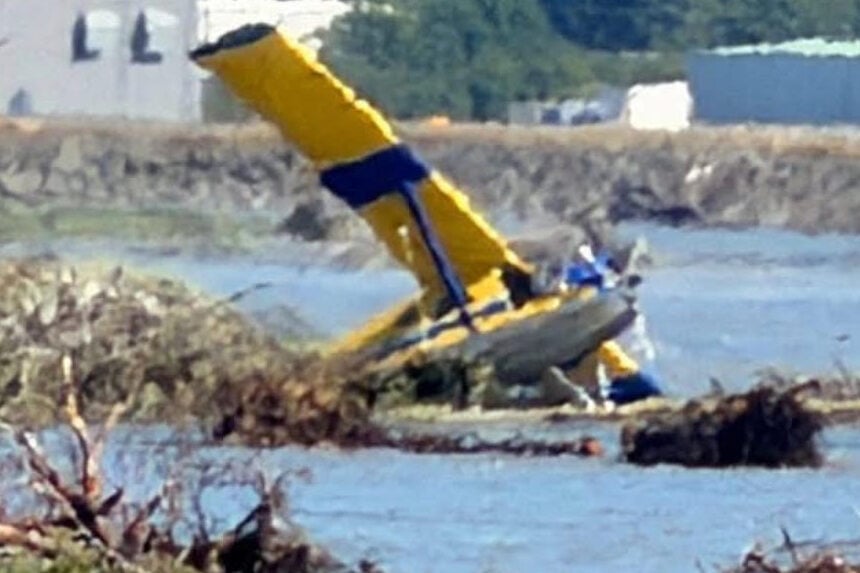
NOTN- A plane crash in Southeast Alaska sent one person to the hospital Thursday morning.
The U.S. Coast Guard received a report just after 10 a.m. of a downed aircraft near Shelter Island in Lynn Canal, KINY was sent a note from an internal source close to 12:00 p.m., as of yet the pilot’s condition has not yet been released.
The plane, operated by Ward Air, was carrying only the pilot.
The pilot was pulled from the water by another Ward Air seaplane and taken to a hospital for treatment, there are unconfirmed claims that the pilot may have suffered a head injury, though this is currently hearsay.
It’s been reported the plane was a float plane, but an unnamed source has said it was a Wheel Plane, specifically a CESSNA 206, KINY is unable to substantiate that claim, Ward Air representatives declined to comment when contacted by phone this afternoon.
Alaska Gov. Mike Dunleavy talks to reporters during a news conference on Monday, May 19, 2025. (Photo by James Brooks/Alaska Beacon)
Yereth Rosen, Alaska Beacon
Alaska Gov. Mike Dunleavy talks to reporters during a news conference on Monday, May 19, 2025. (Photo by James Brooks/Alaska Beacon)
Alaska Gov. Mike Dunleavy has been appointed to the U.S. Arctic Research Commission at a time when the federal agency is pivoting from its longtime focus on environmental science to more emphasis on military defense and economic development.
Dunleavy is an ally of President Donald Trump. Dunleavy’s presidential appointment, announced by the commission this week, comes five months after Liz Qaulluq Cravalho’s position on the commission was terminated. Cravalho is vice president of lands at NANA Regional Corporation, the Alaska Native corporation for the state’s northwest region. She was initially appointed by then-President Joe Biden in 2021 and reappointed in 2024.
The commission, created in 1984, advises the president and Congress on research policy. Its seven commissioners are appointed by the president.
Dunleavy is the first sitting governor to be appointed to the commission, which advises the president and Congress on Arctic research. Past Alaska lieutenant governors have served on the commission, but not during their time in state office. Mead Treadwell chaired the commission prior to being elected in 2010 as lieutenant governor in the Parnell administration, and Fran Ulmer chaired it after serving as lieutenant governor in the Knowles administration and after serving as chancellor of the University of Alaska Anchorage.
In 2019, his first year in office, Dunleavy used his veto powers to cut state funding of the University of Alaska system by 41%, an action that at the time was characterized as devastating to the university’s Arctic research, among other activities. Much of the funding was later restored through a compromise Dunleavy made with the university.
In a statement released by the commission, Dunleavy praised the role of Arctic research, saying it helps Alaskans.
“Alaska sits at the forefront of the Arctic, and our communities, resources, and strategic position make us essential to advancing responsible research, economic development, and national security in the region,” he said in a statement released by the commission. “I look forward to working with fellow commissioners to ensure that Arctic research reflects the needs of Alaskans while strengthening America’s leadership in the Arctic.”
The Trump-appointed chair of the commission, speaking Wednesday at the Arctic Encounter Summit in Anchorage, said the organization is “tremendously thrilled” to have Dunleavy as a member.
Thomas Emanual Dans, appointed by President Donald Trump as chair of hte U.S. Arctic Research Commission, speaks at the Arctic Encounter Summit in Anchorage on April 15, 2026. (Photo by Yereth Rosen/Alaska Beacon)
“We’re super excited about that,” said Thomas Emanual Dans, appointed in December. “We’ve got the very experienced hand and voice at our commission, and we’re looking to do big things here.”
A pivot to security needs
Dans, who also served on the commission during the first Trump administration, expressed an expansive view of the Arctic that he likened to that of 19th century explorers.
“We want to create the conditions that really unleash human flourishing. We want more. We want human life. We want people to have big dreams,” he said.
Rather than focusing on pure science, the commission is focused on security, as Dans described it.
“Security is probably the overriding, overarching theme of things,” he said.
But security has several facets, he said. It includes military security, international security, energy security and community security, “which can be interpreted broadly in terms of health and well-being” for Arctic residents and others in the nation and the world, he said.
Dans, who lives in Texas and spent most of his career in finance, served on the U.S. Arctic Research Commission during the first Trump administration. But his comments on Wednesday indicated some gaps in his Arctic and Alaska knowledge.
He mentioned Russia’s Wrangel Island, off the northern coast of Siberia, as a security threat. Wrangel island “is close to Alaska here,” he said in his speech. “And for a long time it was incorporated as part of the United States. Today we face missiles pointing at us from Wrangel Island.”
Canadian government brochures and fliers, displayed April 15, 2026, at the Arctic Encounter Summit in Anchorage, describe that country’s countribution to U.S. national defense. U.S. Arctic policy now has a stronger emphasis on national security. (Photo by Yereth Rosen/Alaska Beacon)
Wrangel Island was never part of the United States. There is a place with a similar name – Wrangell Island – that is located in Southeast Alaska. Since 2004, Russia’s Wrangel Island, located 300 miles from the nearest point in Alaska, has been designated as a UNESCO World Heritage Site. It is famous for its Arctic biodiversity, including the world’s largest concentration of Pacific walruses.
A decade ago, Russia built a military base on the island with a focus on radar systems to monitor airspace. The military use of the island is part of Russia’s military buildup in the Arctic, which has worried U.S. officials, and it is also considered to pose a potential threat to the natural resources there.
In his Arctic Encounter Summit comments, Dans hailed the planned expansion of the U.S. Coast Guard’s icebreaker fleet, saying the fleet has “gone from zero to maybe 14.” However, the Coast Guard for decades has operated two polar-class icebreakers: the Healy, which performs annual missions in Alaska and the wider Arctic, and the Polar Star, which usually sails in the Antarctic. The Coast Guard recently acquired another icebreaker for Arctic operations. Originally an oil industrial vessel called the Aiviq, the ship was renamed Storis and commissioned in a Juneau ceremony in August. The fleet is poised to expand: there was funding for more than a dozen new icebreakers in the Trump administration spending bill known as the One Big Beautiful Bill Act.
Concerning Russia, which holds more Arctic coastline and land than any other nation, Dans urged more cooperation and communication. “I’d love to have the younger generation in Alaska learn Russian,” he said.
Within a few miles from the Dena’ina Civic and Convention Center, where Dans spoke at the Arctic Encounter Summit, classes were being conducted in Russian language at elementary, middle and high schools through the Anchorage School District’s Russian immersion program. It was launched as a full-time program in 2024, according to the school district.