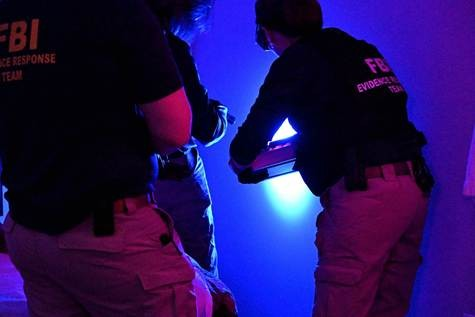
An FBI Evidence Response Team collects and documents evidence at an alleged illicit massage parlor. (Image Courtesy of the FBI Anchorage Field Office)
Multiple law enforcement agencies arrested seven people in Anchorage and the Matanuska-Susitna Valley last week on charges of sex trafficking after a yearlong investigation found that multiple massage parlors were fronts for criminal enterprises.
“Human trafficking criminal enterprises operate in plain sight while victims are exploited for labor, services and commercial sex acts through force, fraud or coercion,” Matthew Schlegel, special agent in charge of the FBI Anchorage Field Office, said during a press conference Thursday.
Anchorage Police Department, Alaska State Troopers, the FBI Anchorage Field Office are part of a task force that investigates sex and human trafficking. Homeland Security Investigations, U.S. Customs and Border Protection, Army Criminal Investigation Division, the U.S. Coast Guard, Wasilla Police Department and the Anchorage Airport Police Department assisted in the investigation.
Officers searched Jasmine Spa, Zen Massage, Stream Health Spa of Wasilla, Phoenix Health Spa, Owl Health Spa, Renew Day Spa, Red House Massage of Anchorage and two Anchorage residences in connection with the investigation.
Law enforcement arrested Lee Merrill Van Ness, 72, of Anchorage, Terry Allen Volkman, 53, of Anchorage, Hui Zhang, 44, Hong Zhen Li, 51, of New York, Guoguo Zhang, 54, of Wasilla, Tuan Huynh, 34, of Anchorage, and Xiaotian Xiong, 40, of New York, on felony charges of sex trafficking.
Investigators collect evidence during an investigation into alleged illicit massage parlors. (Image courtesy of the Alaska State Troopers)
Alaska State Troopers Colonel Maurice Hughes said during a press conference Thursday that they targeted these illegitimate operations because they were exploiting individual and vulnerable adults.
Hughes said that the victims were offered support and connected with resources.
“These individuals were not the focus of the investigation. They were the reason for the investigation,” he said.
Law enforcement identified massage parlors that advertised commercial sexual services online during the investigation. The investigation entailed undercover officers visiting various massage parlors and posing as customers looking for sex in exchange for money, a criminal complaint stated. Law enforcement allege that the seven people arrested harbored victims of human and sex trafficking and forced them to pose as masseuses.
The massage parlors may be linked to international organized crime organized out of Flushing, New York, and Monterey Park, California, according to charging documents. Law enforcement may file additional charges as the investigation continues.
Anchorage Police Chief Sean Case attributed the length of the investigation to the complex nature of the allegations.
Alaska Bureau of Investigation Commander Tony Wegrzyn said that investigators have “a mountain of evidence to go through.”
According to Wegrzyn, all victims were from outside of Alaska.
Gift card displays, such as this one in a CVS in Harlem, N.Y., have been a source of concerns for lawmakers hoping to combat gift card fraud. “Card draining,” or stealing numbers from poorly packaged cards, is one of the costliest and most common consumer scams, and states are trying to combat it with consumer alerts, arrests and warning signs on store displays. (Photo by Robbie Sequeira/Stateline)
The Federal Bureau of Investigations’ office in Anchorage issued an alert warning Alaskans of scams impersonating law enforcement or government officials demanding payment. Alaskans lost an estimated $1.3 million due to this type of government impersonation scam in 2024 — more than five times the previous year’s losses.
Officials say Alaskans should not respond to calls claiming they have missed jury duty or have warrants out for their arrest. Officials say anyone targeted by such calls should not provide personal information or payment to the caller, but they should report scams to the agency.
“This scam isn’t new, but we are certainly seeing an uptick in this type of scam here in Alaska,” said Chloe Martin, a public affairs officer with the FBI Anchorage office.
In 2024, the bureau reported 6,670 fraud complaints from Alaskans, with over $26.2 million in losses.
Scammers are calling residents and identifying themselves as an FBI official, a member of state or local law enforcement, or a government official. The scammer then claims the victim has missed jury duty or that a warrant has been issued for their arrest and demands payment from the victim, Martin said.
Sometimes scammers will call using personalized information to appear official. “So when they look at their caller ID, it might actually look like it’s a caller from a legitimate law enforcement agency,” she said.
Martin said scammers use urgency, intimidation and fear to demand immediate payment in the form of cryptocurrency like Bitcoin, prepaid gift cards or wire transfers.
Martin urged Alaskans to pause, not give personal information or make payments and report the fraud to their bank and to the FBI’s Internet Crime Complaint Center, a reporting hub for cyber-crime.
“If reported immediately, it’s actually not outside the realm of possibility to recover funds, so timely reporting is key,” she said. She added that victims should contact their bank to freeze funds if they have responded to a scam.
Last year, the FBI recorded a more than five fold increase in losses from these scams, from nearly $250,000 lost in 2023 to more than $1.3 million in 2024.
Austin McDaniel, a spokesperson for the Alaska Department of Public Safety said it is common for scammers to impersonate Alaska State Troopers.
“These scammers will go through and find the name of an Alaska law enforcement officer at that agency and call, pretending to be an actual state trooper, so that they’re sophisticated,” he said.
“This happens across the state. This targets every age demographic, and it’s something that we see a lot of,” he said. “I have personally received these types of scam calls demanding that I pay some type of exorbitant fee because I missed jury service. And thankfully, I know that’s definitely a scam, but not everyone does.”
McDaniel said it’s difficult to track, investigate and prosecute scammers because some of them are calling internationally, and are difficult to trace. He urged Alaskans to be cautious and not to make payments.
“Law enforcement, the government, a utility, a bank, is never going to call you and demand money with a gift card or with Bitcoin,” he said. “If you get some type of suspicion that something’s wrong, it probably is.”
Earlier this month, the Federal Emergency Management Agency issued an alert warning Alaskans of scammers posing as government officials, insurance agents or aid workers targeting residents impacted by Typhoon Halong receiving disaster assistance.
Officials urged residents to contact FEMA to verify if a call is legitimate.
McDaniel and Martin said their departments could not confirm cases of scammers specifically targeting residents impacted by the Western Alaska storm at this time, but McDaniel emphasized his department sees scammers victimize those who may already be more vulnerable.
“We see it happen with missing persons,” McDaniel said. “Someone will call and try to defraud family members of missing people. Usually any type of situation where there’s some type of tragedy or emotional response to something, scammers will attempt to go through and exploit that.”
According to FBI data, Alaska ranked No. 1 in the nation in the number of internet crime complaints reported, at a rate of 914.7 complaints per 100,000 residents. Scammers target older residents because they can be more susceptible to scams The bureau estimates Alaskans in the age group of 60 or older lost more than $8.1 million to scams in 2024.
Cryptocurrency scams are growing nationwide, as they are difficult to trace. In 2024, the FBI estimates 45% of Alaskans’ losses, approximately $11.7 million, were related to cryptocurrency related scams.
Such scams have become a means to cheat investors, also known as “pig butchering,” according to the bureau. Scammers target victims, develop a relationship, and introduce a fraudulent investment opportunity in cryptocurrency. Victims are coached to invest more and more money into the fraudulent investment, only to then be unable to withdraw their funds.
Internet-based scams and fraud can range from emergency calls and extortion to identity theft and phishing or spoofing, where scammers identify as a trusted source and aim to gain login details or personal information to steal money or data. The FBI reports that complaints increased nationally by 33% in 2024, with $16.6 billion in losses.