NOTN- An Italian man is missing after falling into a rushing stream on Mendenhall Glacier and being swept into a narrow opening in the ice, authorities said.
Alaska Wildlife Troopers said they received a report around 1:45 p.m. Tuesday that the man had slipped into the water and disappeared into a roughly 2-foot-wide vertical hole. The two people traveling with him told officials they could no longer see him once he fell inside.
Juneau Mountain Rescue deployed a technical ice rescue team, which determined the hole was filled with fast-moving water and too dangerous to search.
Authorities said efforts are ongoing to notify the man’s next of kin in Italy.
Pictured above, the Asian Giant hornet, or Murder Hornet, and pictured below is the Native Yellow Horned Horntail.
NOTN- online speculation on Facebook about Murder hornets, also known as Asian giant hornets, in Juneau, Alaska Department of Fish and Game Officials are clearing things up.
While Asian giant hornets, often dubbed murder hornets, are a federal species of concern because of their threat to native pollinators, no positive reports have been confirmed in Alaska, said Tammy Davis, invasive species program coordinator for the state Department of Fish and Game.
“We would rather get 100 reports of something that ends up being native than miss one report of an invasive,” Davis said. “If you see something suspicious, report it.”
Davis says individuals may frequently confuse the invasive hornet with native insects such as the yellow-horned horntail. Though large and equipped with what looks like a stinger, the insect’s rear appendage is actually an ovipositor used to lay eggs in dead or dying trees.
“The commonly misidentified native species is a yellow-horned horntail, it has a long abdomen, they also have what is called an ovipositor, but it looks like it might be a stinger, and it’s used for laying eggs.” Said Davis “They don’t sting, and they’re a natural part of our forest ecology, and they’re really important for recycling in the forest environment. The female wasp uses that ovipositor, and she plunges that under the bark of dead and dying trees so that she can lay her eggs, so something that seems like a really scary Murder hornet turns into a really sweet Wasp that’s trying to help our forest.
Residents can report invasive species by calling the state hotline at 1-877-INVASIV or by filing a report online through the Alaska Department of Fish and Game. Reports are shared with state, federal, and local partners through the Alaska Invasive Species Partnership.
In addition to insects, state biologists are monitoring threats such as European green crabs, recently detected in Ketchikan with the University of Alaska Southeast “It was on the last day during our last survey that one of the professors found a tiny, little green crab, and then one of the students found another one.” said Davis in the next couple weeks, everybody was looking for green crab and finding them, and the map drastically changed.”
according to NOAA, The green crab is considered one of the most invasive species in the marine environment. It has few predators, aggressively hunts and eats its prey, destroys seagrass, and outcompetes local species for food and habitat.
“Information is power, and good information is even more powerful,” Davis said.
The U.S. Supreme Court, on Oct. 9, 2024. (Photo by Jane Norman/States Newsroom)
In 2012, Alaska State Troopers arrested Fairbanks pilot Ken Jouppi and seized his aircraft after charging him with bootlegging for shipping beer into the dry community of Beaver.
Now, after 13 years of legal disputes, the state’s decision to seize Jouppi’s airplane could be headed to the U.S. Supreme Court.
The Institute for Justice, a libertarian-leaning nonprofit public interest law firm, last week asked the Supreme Court to consider overturning an Alaska Supreme Court ruling from April. That ruling declared that the state’s decision to seize Jouppi’s plane was not an excessive fine for bootlegging.
The “petition for a writ of certiorari” — a formal document asking the U.S. Supreme Court to take up the issue — was filed last week, an official with the Institute confirmed on Tuesday afternoon.
The odds are against Jouppi — the Supreme Court takes only about 1% of the cases it receives. If cases filed with a fee waiver are excluded — those usually come from prisoners representing themselves in a last-ditch appeal — the acceptance rate is 5% or less.
Now 85 and retired, Jouppi was a longtime air taxi pilot in Fairbanks when he planned to ferry a passenger and her groceries from that hub city to Beaver, a village in the Interior.
Before takeoff, an Alaska State Trooper noticed a six-pack of beer visible in the baggage. Beaver had outlawed the sale, consumption and importation of alcohol in 2004. Troopers searched the plane and found three cases of beer — two Budweiser, one Bud Light — intended for the passenger’s husband, the local postmaster.
Jouppi was indicted on bootlegging charges, convicted, and sentenced. His sentence included three days in jail and a fine. State prosecutors asked that he be required to forfeit his plane, but the trial judge declined.
The state appealed that decision, and the Alaska Court of Appeals ruled in 2017 in the state’s favor. The Appeals judges sent the case back to the trial court, which again refused to order the plane’s forfeiture, citing the U.S. Constitution’s excessive fines clause.
The appeals court ordered additional proceedings by the trial court, but both Jouppi’s attorneys and state prosecutors instead asked the Alaska Supreme Court to take up the issue, which it did last year before issuing a written opinion in April.
“We hold, as a matter of law, that the owner of the airplane failed to establish that forfeiture would be unconstitutionally excessive,” wrote Justice Jude Pate on behalf of the court, which ruled unanimously in the state’s favor.
Pate and the court said that Alaska legislative debates showed that state lawmakers placed a high priority on punishments for bootleggers, and thus the seizure of an airplane was not excessive, even though a relatively small amount of beer was involved.
“Alcohol abuse in rural Alaska leads to increased crime; disorders, such as alcoholism; conditions, such as fetal alcohol spectrum disorder; and death, imposing substantial costs on public health and the administration of justice. Within this context, it is clear that the illegal importation of even a six-pack of beer causes grave societal harm,” the ruling states. “This factor strongly suggests that the forfeiture is not grossly disproportional.”
In their request for the U.S. Supreme Court to examine the case, Jouppi’s attorneys argue that the federal justices should decide whether courts should consider the seriousness of an offense in abstract, or if they should take into account a specific defendant’s circumstances.
The Alaska Supreme Court “examined the gravity of the defendant’s offense at a stratospheric level of abstraction,” they argue, when justices should have taken into account the circumstances.
The Alaska justices relied on a federal decision from the 11th U.S. Circuit Court of Appeals, Jouppi’s attorneys note, but Alaska is within the 9th U.S. Circuit Court of Appeals.
Judges for the 9th Circuit have considered the Excessive Fines clause of the Constitution and concluded that it is critical to “review the specific actions of the violator rather than by taking an abstract view of the violation.”
Because of those two differing interpretations of the Constitution, Jouppi’s attorneys say, the case is ripe for the U.S. Supreme Court to consider.
No date has been set for a court conference to determine whether Jouppi’s case will be considered by the U.S. Supreme Court.
If the court declines to consider his case, the Alaska Supreme Court decision will stand.
NOTN- According to a release, on August 31, 2025, at 9:30am, Alaska State Troopers were notified of an overdue hiker in the Juneau area.
Thomas Casey, age 69 of Arizona, was last seen Saturday morning and was reported to be on a hike.
No details about where he was going or when he would be back were provided.
His phone was pinged and it returned to a remote spot between Thunder mountain trail and Nugget Creek trail.
Juneau Mountain Rescue and SEADogs were contacted and 6 crews including 3 dog teams and 6 ground searchers were put in the field to start searches at the trail heads and the location of the ping. At 5pm September 1, Juneau Mountain Rescue and SEAdogs located Thomas deceased from injuries obtained from a fall.
He was located near the Mendenhall Glacier on the west side off the trail. The updated location for the cell phone was provided by RCC and Apple emergency services.
The body is being sent to the State Medical Examiner’s Office. Next of kin has been notified.
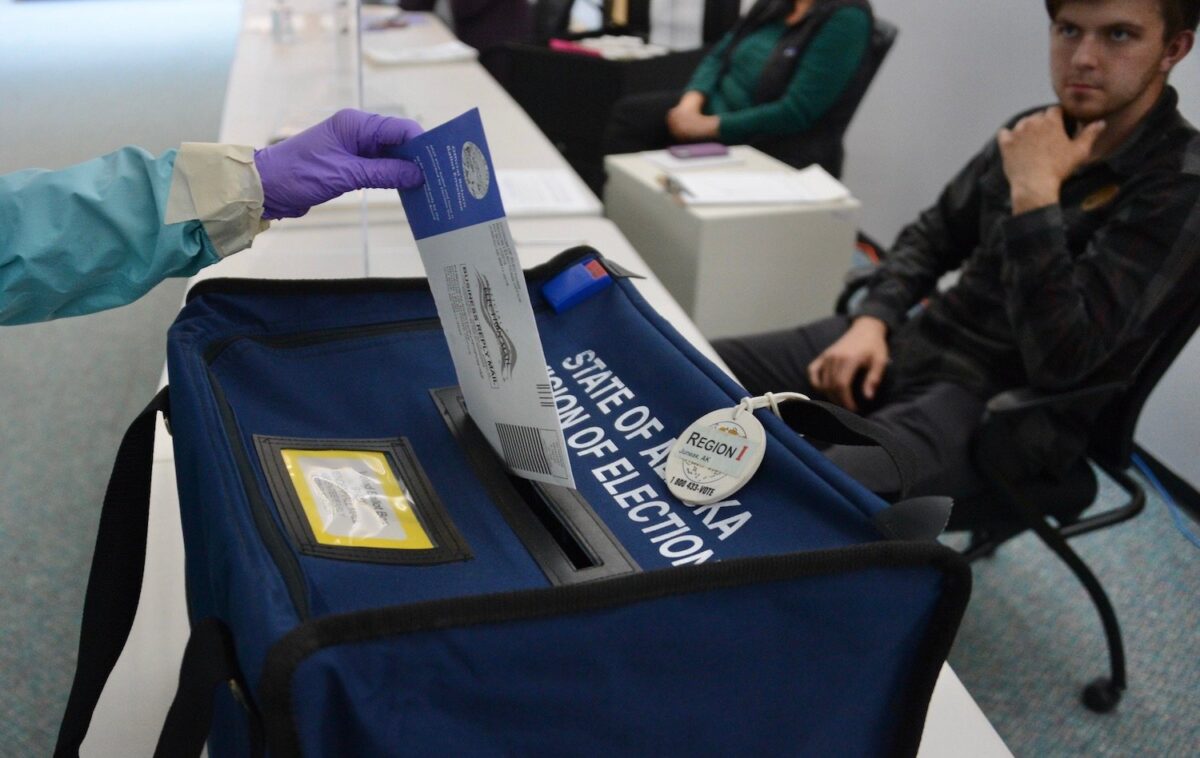
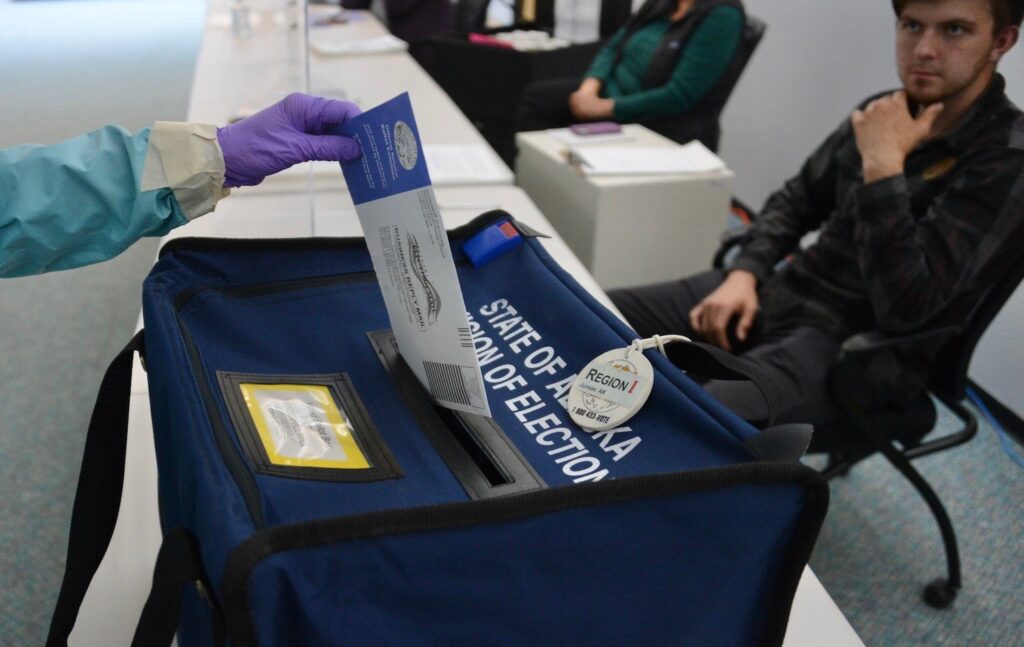
A voter in Alaska's special U.S. House primary election drops their ballot into a box on Saturday, June 11, 2022 as a poll worker observes. (Photo by James Brooks/Alaska Beacon)
A voter in Alaska’s special U.S. House primary election drops their ballot into a box on Saturday, June 11, 2022 as a poll worker observes. (Photo by James Brooks/Alaska Beacon)
NOTN- Juneau residents planning to vote in the city’s upcoming municipal election must register by Sunday, Sept. 7. That is also the deadline to update a mailing address with the state Division of Elections.
Anyone who will turn 18 by Election Day, Oct. 7, is eligible to vote but must still register by the Sept. 7 deadline. Alaska law allows residents to register up to 90 days before their 18th birthday.
The Oct. 7 election is being conducted by mail, but voters can check their status or update information
On September 19, ballots for this election will be mailed to registered Juneau voters at the mailing address they have on file with the State of Alaska Division of Elections. If you’re not sure about your registration status or mailing address, you can check online at myvoterportal.alaska.gov.
Vote Centers will open for in-person voting starting on September 22. The last day to vote is Tuesday, October 7.
Tricia Howe, a volunteer working at the Aug. 19, 2023, “weed smackdown” at Anchorage’s Tikishla Park, pulls another felled European bird cherry tree to put on a pile near the park’s softball field. European bird cherry trees, also known as chokecherry trees, are invasive plants that were once popular ornamentals in Anchorage and elsewhere but have since spread into wooded areas. (Photo by Yereth Rosen/Alaska Beacon) The invasive Prunus tree species have showy and fragrant white flowers, seen in this undated photo. (Photo provided by the Alaska Department of Natural Resources)
State officials have barred the import, transport and sale of two fast-growing invasive species that were once popular garden ornamentals but have now wreaked havoc on natural vegetation.
The Alaska Division of Agriculture on Friday said it issued a quarantine for the two species: Prunus padus, commonly known as the European bird cherry tree or mayday tree, and Prunus virginiana, commonly known as the Canada red or chokecherry tree.
An invasive Prunus tree sprouts from a fallen branch in Anchorage. (Photo provided by the Alaska Department of Natural Resources)
The order went into effect Monday.
In essence, it will extend through the state a ban that was imposed in 2017 in Anchorage. The trees have become a particular nuisance in Alaska’s largest city, where they have proliferated in greenbelts and other spaces and crowded out native species like birch and spruce.
State and local officials have been trying to remove these non-native trees, and the new policy should help that effort, said Division of Agriculture Director Bryan Scoresby.
“This quarantine prohibits the importation, transport, and sale within the state of these two trees and their parts,” Scoresby said in a statement. “Many agencies continue to pursue control measures with the goal of eliminating these invasive trees. With this quarantine, the flow of trees into Alaska will stop, making this goal more attainable.”
Invasive Prunus trees bloom along the Tony Knowles Coastal Trail in Anchorage in this undated photo. (Photo provided by the Alaska Department of Natural Resources)
The ornamentals quickly spread, displacing native vegetation, impeding animals’ access and upsetting natural food webs, according to the University of Alaska Fairbanks Cooperative Extension Service.
Their berries can be toxic to moose, causing cyanide poisoning that is sometimes fatal.
Along with those problems, the invasives might be spreading disease to other trees, according to the Division of Agriculture. A fungal disease called “Black Knot” was recently discovered on chokecherry trees on the University of Alaska Anchorage campus, making the invasive trees potential disease spreaders, the division said.
The two tree species are prime targets of annual Anchorage “weed smackdown” invasive-removal events. There is also a concerted effort to remove the trees from Fairbanks, including on the UAF campus, where officials have been methodically replacing them with native trees.
Eradicating the trees might require more than simply cutting them down because new trees can grow out of root systems below stumps, according to the Cooperative Extension Service.
For all the damage the two invasive tree species cause in Alaska, however, some people have found ways to benefit from them. The toxin in their berries can be neutralized and eaten by people.
Seedlings of invasive Prunus trees cover a forest floor by a bike trail. (Photo provided by the Alaska Department of Natural Resources)
May 14, 2018 – Wind turbines in Kodiak, Alaska. (Photo by Dennis Schroeder / NREL)
For years, urban Alaska utilities have been studying large-scale wind farms that could help break the state’s dependence on natural gas power — encouraged by the potential for hundreds of millions of dollars in tax credits from the federal government.
Next summer, however, those tax credits will largely disappear for projects that haven’t started construction, a consequence of the tax bill that President Donald Trump signed in July.
Clean energy advocates, and U.S. Sen. Lisa Murkowski, had said they hoped that Alaska wind projects could still advance in time to qualify.
But in recent weeks, board members and executives at the cooperatively owned utilities have acknowledged that the timeline now appears too short — which means any large-scale projects will now have to be built without the generous federal subsidies, or wait to see if Congress reestablishes a more favorable tax regime.
Critics say the absence of major new renewable projects will leave the state dependent on imported, liquefied natural gas and could make consumers vulnerable to price spikes.
“There’s an argument to be made that these electric cooperatives, whose boards have a fiduciary responsibility to the member-owners, have really frittered away one of the greatest opportunities they’ve ever had to deliver hundreds of millions of dollars of value to their members,” said Phil Wight, an energy historian and professor at University of Alaska Fairbanks. “At the highest level, I think that’s a fair argument.”
Since Congress approved expanded tax credits in 2022, Alaska has seen no large-scale wind or solar projects begin construction, while other states like Wyoming and Texas have received billions of dollars in clean energy investment.
At a recent meeting, board members at Golden Valley Electric Association, the utility that generates power for Fairbanks area residents and mines, rejected a developer’s bid to advance a large-scale wind farm on a schedule driven by the expiring tax credits. Utility officials said there was still too much uncertainty about final pricing and whether the project could capture the credits.
Meanwhile, officials at Anchorage-based Chugach Electric Association, the state’s largest power utility, say that another large wind project they’ve been studying with the same developer also won’t be ready to start construction in time to qualify for the credits.
Jim Nordlund, a Chugach Electric Association board member, said that if the Anchorage-area project had captured the credits, it was still far from clear that it could have provided power more cheaply than his utility’s existing natural gas plants.
That’s even assuming prices will rise when local fuel supplies dry up and utilities begin importing liquefied natural gas in the next few years, added Nordlund, a self-described clean energy advocate.
The price of renewable power generally, he said, “is really high.”
Alaskans who are frustrated about the pace of wind and solar development shouldn’t blame the urban utilities, Nordlund added. Private companies, not the utilities themselves, have been advancing projects that failed to materialize, he said, and politics also played a big role.
“If you want to blame anybody for this, it would be that big bad bill. That’s what Trump wanted to do, and it worked,” Nordlund said. “It shut down, at least for the time being, our projects.”
But renewable energy boosters say that the urban utilities deserve at least some share of the blame for not advancing projects more urgently while the tax credits were in place.
The utilities could have developed large wind developments themselves, those advocates argue — or they could have done more to create a stable and attractive market for private developers.
“The utilities are uniquely bureaucratic and expensive in their own self-development. And they’re uniquely bureaucratic and obstinate and slow if a private company is developing,” said Ethan Schutt, who formerly managed the energy assets of an Indigenous-owned regional corporation.
Advocates say utility leaders have also failed to endorse, and in some cases outright opposed, legislation proposed multiple times in recent years to establish renewable energy quotas — which they say could have encouraged more private developers to work in the state.
Large-scale power projects “need to be thoughtfully implemented,” Natalie Kiley-Bergen, energy lead at an advocacy organization called Alaska Public Interest Research Group, said in an email.
“Had more progress been made in the last five years — even the last 15 years — to create a competitive market environment with regulatory and economic certainty for these projects, we could have seen responsible project commitments regardless of federal changes,” Kiley-Bergen said. “Not capitalizing on these tax credits is a product of years of moving slowly on the tremendous opportunities to diversify our energy generation.”
A risk of price spikes?
After its initial discovery in the 1950s, Cook Inlet, the offshore and onshore petroleum basin southwest of Anchorage, produced huge quantities of natural gas.
There was enough fuel to generate not just the vast majority of the region’s electric power, but also to supply plants that produced fertilizer and exported gas in liquefied form to Asia.
But those plants have now closed amid Cook Inlet production declines. And for more than a decade, the urban electric utilities have been contending with risk that gas supply won’t be adequate to meet demand.
Generous state tax credits temporarily approved by lawmakers in 2010 helped stimulate new drilling, but only temporarily, and they were subsequently repealed. Three years ago, Cook Inlet’s dominant producer, Hilcorp, warned utilities that they should not expect new long-term commitments of gas when their existing contracts expire in the coming years.
Clean energy advocates say that Alaskans’ dependence on gas-fired power — Chugach Electric Association generates 87% of its power from the fuel — makes residents vulnerable to both supply disruptions and fluctuations in price.
The utilities have responded to the looming local gas shortfall with plans for new infrastructure that could offload imported liquefied natural gas, known as LNG, shipped from Canada or the Gulf of Mexico.
But unlike gas from Cook Inlet, which producers have long sold at a fixed cost, utilities would likely have to buy LNG at rates that swing with the market, similar to the price of oil, according to Antony Scott, an analyst at the Renewable Energy Alaska Project advocacy group who once studied petroleum pricing for Alaska’s state government.
Given the risk of price spikes that could translate into higher electricity prices for consumers, diversifying with new wind and solar development should be a “no-brainer,” Scott said.
“It’s just like an investment portfolio. Do you want to invest only in Tesla?” Scott said. “A rational, prudent investor would have a diversified portfolio.”
Scott’s advocacy group, and others in Alaska, have pushed the utilities to diversify, in part through lobbying for the creation of the renewable energy quotas.
They cite analyses like a study released last year by the National Renewable Energy Laboratory, which found that new renewables would be cheaper than burning gas in existing plants and, by 2040, could meet up to 80% of demand.
“Ratepayers in Alaska have been saying, for a long time, that we need renewable energy projects here at home, and we need to be capturing energy here at home,” said Alex Petkanas, clean energy and climate program manager at the Alaska Center conservation group. “This is not something that is a surprise — that our local natural gas supply is ending, and we need to replace that with new generation.”
A rejected agreement
Utility staff and board members agree that they need to diversify away from gas, with the chief executive of Matanuska Electric Association saying in 2022 that it was “untenable” to continue generating 85% of power from one type of fuel.
Chugach Electric Association aims to cut its carbon emissions in half by 2040, which would likely require sharp reduction in its use of natural gas. And a Golden Valley Electric Association strategic plan approved last year calls for the utility to finalize agreements with private developers to bring on “large-scale wind resources” at prices that will lower members’ power costs.
None of those utilities have moved to build major wind or solar farms themselves; instead, they’ve looked to private companies to do the construction and sell the power onto the grid.
Just one firm, Longroad Energy, has advanced large-scale wind projects on a timeline that could have qualified for the expiring tax credits. One is outside Anchorage in Chugach Electric Association’s region, and one is outside Fairbanks, in Golden Valley Electric Association’s region.
The Fairbanks area project, known as Shovel Creek Wind, could produce one-third of the power consumed by Golden Valley’s members — and even generate more than 100% of their demand at certain times, depending on the size of the development, said Golden Valley’s chief executive, Travis Million.
But at a July board meeting, Golden Valley’s board members rejected an agreement that Longroad had proposed to keep the project on a timeline to qualify for the credits.
Golden Valley, said Million, still needed more time to finish a study of how much it would have to spend on infrastructure upgrades and its existing fossil fuel plants in order to accommodate power from the new wind project. Utilities must balance swings in power production that stem from the natural variability of wind.
“Without having that step done, there’s just so much uncertainty about the cost. And not knowing what that end result would be to our members, we just could not commit,” Million said in a recent interview. The details of the proposed agreement — including Longroad’s estimated pricing — are confidential under a non-disclosure agreement.
There was additional uncertainty, Million added, about whether the Trump administration, which has been hostile to wind power, would grant the credits even if Shovel Creek advanced on the required timeline.
But Million also acknowledged that the utility could have done more work earlier to speed up the process.
“We should have done a lot of these studies on the front end, to really understand sizing and needs on Golden Valley’s system, before we really started going down this path with trying to find developers,” Million said.
Longroad, through an Anchorage-based consultant, declined to comment. Million said that Golden Valley plans to finish its study and hasn’t ruled out advancing Shovel Creek on a slower timeline than Longroad’s proposal.
The utility is also studying a substantial, if smaller, wind project that could still qualify for the tax credits.
“We have to take control”
In Anchorage, meanwhile, officials with Chugach Electric Association said that Longroad’s work on the nearby Little Mount Susitna wind project slowed as the company focused on advancing Shovel Creek.
The developer, said Chugach board member Nordlund, isn’t ready to make the initial investment in Little Mount Susitna and couldn’t do the continuous work required in order to take advantage of the tax credits — though the utility, he added, hasn’t given up on the project moving forward in the future.
Nordlund ran for the Chugach board in 2023 as an advocate for wind and solar, saying then that “the time to act on renewables is now.”
But he said in a recent interview that there’s “misinformation” circulating that utilities are dismissing proposed wind and solar developments that would generate power more cheaply than natural gas, when that’s not clearly the case.
Chugach has its own non-disclosure agreement with Longroad that Nordlund said bars him from getting specific about prices.
But speaking generally, he added, Alaska is a tough market for private developers, compared to the Lower 48 and foreign countries where they otherwise might invest.
Construction costs in Alaska are higher given the remote setting, harsh environment and lack of contractors competing for business, Nordlund said; the relatively small consumer base also means that developers can’t capture economies of scale.
“I think we need to create a better climate for independent power producers to do business in Alaska,” Nordlund said. The stalled legislation to establish renewable energy quotas could have helped, he added, by giving those private developers more certainty that the utilities were “serious” about bringing on wind and solar projects.
“More could have been done,” he said.
Nonetheless, Nordlund said he thinks the inherently “conservative” culture of Alaska’s utilities is changing, with executives increasingly open to accommodating wind and solar power.
Chugach officials say the utility is still pursuing renewables and remains open to proposals from developers — though they are now refocusing on more modest projects that they can advance in-house, at least in the early stages. Viable projects could then, potentially, be handed off to private developers.
At meetings in recent weeks, board and staff members have discussed a small-scale solar farm that Chugach is studying at the site of one of its existing gas power plants on the far side of Cook Inlet.
They’ve also heard a presentation from a consultant who is examining potential sites for new hydroelectric development, though those projects would face a lengthy permitting process.
“We now have to take control and get in the lead,” Dustin Highers, Chugach’s vice president for corporate programs, said at a recent board meeting.
But some experts like Wight, the energy historian, remain skeptical that those efforts will end up displacing very much gas, with the exception of the smaller wind project in the Fairbanks area that he said could still “make a real difference.”
Pursuing smaller projects with better coordination between regions could be a better strategy, Wight said. But failing that, he said he expects utilities to largely continue their dependence on natural gas — whether through imported LNG, or through a proposed pipeline project from Alaska’s North Slope that’s struggled to secure commitments from investors.
“They’re going to dabble a little bit in renewables here and there, and then they’re just going to hope for cheap gas,” Wight said. “As a state, we’ve been so oil- and gas-dependent for so long that I do think there’s a cultural barrier there, to bring in the new folks who want to think differently.”
Nathaniel Herz welcomes tips at natherz@gmail.com or (907) 793-0312. This article was originally published in Northern Journal, a newsletter from Herz. Subscribe at this link.
This is a copy of an information release by the City and Borough of Juneau
Today, the City and Borough of Juneau released body-worn camera footage and related materials from the July 30, 2025 incident in which a Juneau Police Department (JPD) officer used force during an arrest that resulted in a serious head injury to the arrested individual. The officer, who was in his probationary period, resigned on August 28, 2025.
This release is part of the City’s ongoing commitment to transparency and accountability and in accordance with CBJ Code (Ordinance 2025-05(c)(am)). In addition to the body-worn video, the City has published dashboard camera footage and applicable JPD policies. All materials are available online at bit.ly/jpd-incident-july30. City Manager Katie Koester stated, “This has been a painful event for our community. The officer’s resignation reflects the seriousness of what occurred, and our obligation to uphold the standards of conduct our community expects. Accountability means not only reviewing the facts but acting on them. I want to be clear: the Juneau Police Department is full of good and hardworking people who serve with professionalism, empathy and integrity. One incident does not define the department. We’re committed to using this moment to strengthen relationships and to listen and learn from all impacted voices.”
She added, “Chief Bos has been in contact with the family of the individual who was injured, and we are keeping them in our thoughts. Out of respect for their privacy, we will defer any questions regarding his condition or legal matters to the family.”
The officer was placed on administrative leave following the incident. JPD immediately requested an investigation of the incident by an independent third party. That investigation is ongoing.
JPD Chief of Police Derek Bos stated, “What happened on July 30 was not consistent with department policy, values or the conduct we expect from our officers. As Chief, I take responsibility for ensuring our department earns and maintains the public’s trust. We have already begun reviewing JPD directives, implementing policy clarifications as well as additional training focused on de-escalation, proportionality in use-of-force, and medical response protocols.”
As part of the City’s commitment to long-term healing and improved relationships, the Juneau Police Department will also participate in cultural sensitivity training. This training is designed to deepen officers’ understanding of Indigenous history, values, and lived experiences in Juneau, and to reinforce the department’s role as a respectful and responsive community partner.
“This training is not a checkbox. It’s a step toward meaningful connection,” said City Manager Katie Koester. In addition, Tlingit & Haida has offered to co-host a community dialogue with the City to create space for open and respectful conversations about the community’s relationship with law enforcement. The event will be designed to elevate voices, share perspectives, and chart a path forward rooted in trust, accountability, and shared values.
“We need to approach the dialogue in a thoughtful manner and recognize that it will be difficult for many in our community who have experienced trauma. We’re grateful to Tlingit & Haida for their leadership and willingness to engage with us on this important work,” said Manager Koester. Details about the training and dialogue event will be shared in the coming weeks.
Alaska Gov. Mike Dunleavy talks to reporters during a news conference on Monday, May 19, 2025. (Photo by James Brooks/Alaska Beacon)
NOTN – Governor Mike Dunleavy is criticizing the Alaska Legislature for failing to take action on education reform, pointing out that the state remains last in the nation for student outcomes.
In a letter to legislators Friday, he emphasized that increasing funding won’t improve results without meaningful policy changes, and called on lawmakers to act immediately.
According to lawmakers who spoke with News of the North, Dunleavy has declined to call a second special session this year.
Dunleavy warned that if the legislature does not pass education reforms during the next regular session, he is prepared to call additional special sessions in 2026 until changes are made, stressing that each year of inaction affects an entire cohort of students.
A sign marking the east entrance of the The streetside east entrance of the James M. Fitzgerald United States Courthouse and Federal Building is seen on July 8, 2024. (Photo by Yereth Rosen/Alaska Beacon)
A trial underway in Anchorage this week is challenging the Alaska Office of Children’s Services and the foster care system, with plaintiffs claiming the system is failing Alaskan children and violating their rights.
“We hope that this trial will lead to significant reforms in Alaska’s foster care system. Alaska’s foster children deserve far better childhoods. It can be done,” Marcia Lowry, an attorney for the plaintiffs and with the nonprofit A Better Childhood, said in a written statement ahead of the trial.
There are about 2,500 children in Alaska foster care, a system that aims to provide a temporary placement environment after a child has been determined to be unsafe or at risk of maltreatment in their family home. Some placements are temporary, and families can seek reunification. If not possible or unsafe, OCS staff are tasked with finding other forms of permanent, safe placement for the child.
Alaska Native children make up a disproportionately high number of those in state custody – in July, the number was two thirds, or 68% of all children in custody, or 1,712 children.
The plaintiffs, who include five foster youths, are representing a class-action case that seeks wide-ranging changes to the system. The lawsuit, first filed in 2022, was brought on behalf of all Alaska children whom OCS has or will have in state custody.
The suit names Alaska’s Department of Family and Community Services (DFCS) and Office of Children’s Services (OCS) as defendants, as well as agency directors including OCS Director Kim Guay and DFCS Commissioner Kim Kovol.
The lawsuit, Mary B. et al. v. Kim Kovol, et al., alleges OCS is chronically understaffed and overburdens caseworkers, which poses a risk of harm to children. They argue the agency’s systemic failures include high vacancies and staff turnover, infrequent or poor quality caseworker visits, insufficient caseworker planning, and lack of adequate placements.
“Defendents knew and were aware of the serious harm to children, and ignored that harm,” said Julia Tebor, an attorney for the plaintiffs, during opening arguments on Monday, according to court transcripts. “Defendants have a policy and a practice of maintaining overburdened caseworkers. These caseworkers have 51 to 100 children, sometimes. They cannot do their job. They cannot keep children safe.”
Child welfare advocates, lawmakers, and foster youth themselves have raised alarm at inappropriate placements, including unnecessarily long stays at psychiatric facilities, homeless shelters, hotels with hired security guards and even overnights at OCS offices.
“Defendents fail to recruit and retain placements. They fail to connect children with services. And this places children at unnecessary risk of institutionalization,” Tebor said.
In defense of OCS, lawyers with the Alaska Department of Law are arguing that the child welfare system in Alaska is a complex network of government agencies and private partners, including Alaska Native tribes, working on children’s behalf — not just OCS.
They argue that superior court judges are routinely reviewing children’s cases and whether families are getting visitation, services and case planning, as required by law.
They say OCS is not ignoring the challenges presented by a shortage of caseworkers, caseplanning and access to services. But there are difficult logistics related to delivering services in Alaska, due to the vast geography, remote communities off the road system, and weather complications that can delay or complicate OCS staff’s work.
The lawsuit also alleges OCS overlooks or fails to seek out placements within an Alaska Native child’s family or community, instead placing them in non-Native households, violating their rights under the federal Indian Child Welfare Act.
Lawyers for the plaintiffs are arguing that “deliberate indifference” within OCS poses a substantial risk of harm to all foster children across the state.
The state rejects the claim, saying there is no deliberate indifference by OCS staff, and they are not violating children’s rights under federal child welfare laws, the Indian Child Welfare Act or the Americans with Disabilities Act.
Foster youth testify in court
A foster youth named Matthew was the first to take the stand on Monday. He entered OCS custody at 15 years old. In three years, he said, he was moved between 13 and 14 placements, including staying at an OCS office.
“Mentally, it took a toll on me because I couldn’t get schoolwork done,” he said. “There was a lot that I could have got done, that I never got done because I was moving around so much, and mentally took a toll on me.”
He described a placement called the “Ramen House” where kids only got two packs of ramen to eat for the entire day. “And if you ate the two ramen packs in the morning, then you’d have no food for the rest of the day,” he said. When he reported it to OCS, there was little response. “I told them multiple times, and they didn’t move me until I sat in the office and was like, I’m not moving until you guys put me in a new foster home, because I couldn’t do it anymore.”
Matthew said during his time in foster care he attended four or five schools in the Anchorage and Matanuska-Susitna Borough areas, and did not have regular access to medical care, like for a potential broken bone or to see a dentist. Now at 20, he’s still working on finishing high school.
In court on Monday, he recounted sleeping in OCS offices in Wasilla multiple times, where he was sometimes locked in. In one instance, he said “there was no couch — or there were no pillows or blankets or anything like that. They never gave me a pillow or blanket or anything like that.”
He said he had three or four caseworkers, some he never met in person.
Asked why he chose to testify, he said “so another kid doesn’t have to go through what I went through.”
Social workers’ caseload burden
OCS has five regional offices — Anchorage, Wasilla, Fairbanks, Bethel and Juneau — and 22 regional offices across the state.
Between January 2018 and January 2024, an average of 45% of OCS caseworkers had caseloads with more than 30 children, and an average of 25% of caseworkers had between 51 to 100 children, according to the lawsuit. At one point in 2023, the OCS Western Region had three caseworkers for the 309 out-of-home foster children in the region.
Kim Guay, director of OCS, took the stand on Monday and argued the state is working to make improvements to the system. She said caseworkers often work with partners, including tribal organizations and village public safety officers to make visits in remote locations. She said high caseload data requires context.
“They’re good things to look at, but it doesn’t tell the whole story. More needs to be looked into, what’s going on with the case, that office, the staff. There’s a whole context besides just the data and the numbers,” she said.
Guay herself began at OCS in 2000 as a caseworker.
“A one-kid case may sound easy, although that child may be extremely medically complex or have behavioral health problems or actively suicidal, and they will spend an enormous amount of time on a one-kid case as compared to maybe a family of six that are in a relative’s home,” Kovol said.
When asked if a caseworker having more than 100 children poses a “risk of substantial harm,” Kovol replied it depends on the situation. “Would I like to see caseloads lower than that? Sure. I think everyone would. But it, the cases are — you know I don’t like to use the words ‘it depends,’ but it does depend on the situation.”
Kovol also pointed to ongoing challenges with recruiting and hiring OCS caseworkers. “We need more workers,” she said.
Attorneys with the Department of Law and the plaintiffs were not immediately available to comment on Thursday.
“Defendents will try to argue that there are factors outside their control that affects the child welfare system,” Tebor said on Monday. “But that is not an excuse for failing children and failing to ensure their substantive due process rights and their statutory rights.”