UAS’s Whale statue with a light dusting of snow, photo courtesy of UAS’s Facebook page
The University of Alaska Southeast spotlighted rapid Arctic environmental change at its Evenings at Egan lecture Friday, featuring UAS’s new professor of forest ecology, Dr. Logan Berner.
His research tracks how northern ecosystems are reshaping in a warming world.
Berner, who grew up in Gustavus and studied as an undergraduate at UAS before returning as faculty.
“Growing up on the edge of Glacier Bay National Park, you know, you’re right there on the edge of the Arctic.” Berner said, “Seeing glaciers receding and these mounting impacts of climate change in Southeast Alaska was something that really drew me to the science of forest ecology and global change ecology.”
Berner said the Arctic has warmed three to four times faster than the rest of the planet, in recent decades.
“This long term warming trend has had all sorts of impacts on these northern ecosystems, which are otherwise the coldest ecosystems that we have on our planet.” Said Berner, “Not surprisingly, as temperatures rise, we see all sorts of ecological impacts occurring. We see trees and shrubs expanding across northern landscapes. We see impacts on wildlife as habitat changes, and all of that then influences people who live in the North as well as broader global society.”
Berner said caribou populations have declined by more than 60% across much of the Arctic in recent decades as expanding shrubs outcompete lichens crucial to winter forage
However, he said species tied to woody habitat, moose and beaver, are pushing north and, in some cases, reaching Alaska’s Arctic coast.
“It’s not all necessarily doom and gloom in terms of wildlife change, right? while caribou might be really suffering under these warmer, shrubbier environments, moose and beaver are thriving.” He said, “The animals that are historically more used to living in the boreal forest, it’s been possible for them to expand northward, up into the Arctic tundra, as those northern landscapes have become progressively dominated by woody plants.”
While Berner says not all change is negative for wildlife, the pace of transformation requires careful attention.
Berner’s work combines field ecology, satellite remote sensing, and ecological informatics to understand terrestrial ecosystems in the warming world.
His past research projects included field work in various parts of Alaska, as well as northern Canada, Finland, and Russia.
Though his work primarily centers the Arctic, Berner says Juneau serves as a point of research at the ‘edge of the Arctic.’
“If you go up into the mountains around town, these are Arctic tundra ecosystems, they’re fingers of mountain ranges that push out of the Arctic and have many of the same plant communities as you find in the more polar north.” Berner said, “Juneau really is part of the Arctic ecologically. Juneau offers a unique opportunity to study those changes in those kinds of ecosystems at the edge of the Arctic, and there are certainly folks at UAS who are studying various aspects of ecosystems around Juneau, from changes in Glacier dynamics, outburst floods, to wildlife populations, to the kind of biogeochemistry of rivers. There’s a lot of research that happens at UAS focused on understanding ecosystems at the edge of the Arctic.”
UAS’s Evenings are free to the public and have accessible attendance options including livestreams.
The series concludes Dec. 12 with a “Winter Fire Showcase” of local writers and artists.
Rayann Martin, a 10-year-old displaced from the village of Kipnuk by ex-Typhoon Halong, left, talks with new classmate Lilly Loewen, 10, right, as they work in the Yup’ik language at College Gate Elementary, Thursday, Oct. 30, 2025, in Anchorage, Alaska. (AP Photo/Lindsey Wasson)
AP- Rayann Martin sat in a classroom hundreds of miles from her devastated Alaska Native village and held up 10 fingers when the teacher asked the pupils how old they were.
“Ten — how do you say 10 in Yup’ik?” the teacher asked.
“Qula!” the students answered in unison.
Martin and her family were among hundreds of people airlifted to Anchorage, the state’s largest city, after the remnants of Typhoon Halong inundated their small coastal villages along the Bering Sea last month, dislodging dozens of homes and floating them away — many with people inside. The floods left nearly 700 homes destroyed or heavily damaged. One person died, two remain missing.
As the residents grapple with uprooted lives very different from the traditional ones they left, some of the children are finding a measure of familiarity in a school-based immersion program that focuses on their Yup’ik language and culture — one of two such programs in the state.
“I’m learning more Yup’ik,” said Martin, who added that she’s using the language to communicate with her mother, teachers and classmates. “I usually speak more Yup’ik in villages, but mostly more English in cities.”
There are more than 100 languages spoken in the homes of Anchorage School District students. Yup’ik, which is spoken by about 10,000 people in the state, is the fifth most common. The district adopted its first language immersion program — Japanese — in 1989, and subsequently added Spanish, Mandarin Chinese, German, French and Russian.
After many requests from parents, the district obtained a federal grant and added a K-12 Yup’ik immersion program about nine years ago. The students in the first class are now eighth-graders. The program is based at College Gate Elementary and Wendler Middle School.
A principal’s connection makes a difference
The principal at College Gate Elementary, Darrell Berntsen, is himself Alaska Native — Sugpiaq, from Kodiak Island, south of Anchorage. His mother was 12 years old in 1964 when the magnitude-9.2 Great Alaska Earthquake and an ensuing tsunami devastated her village of Old Harbor. He recalls her stories of joining other villagers at high ground and watching as the surge of water carried homes out to sea.
His mother and her family evacuated to a shelter in Anchorage, but returned to Kodiak Island when Old Harbor was rebuilt. Berntsen grew up living a subsistence life — “the greatest time of my life was being able to go out duck hunting, go out deer hunting,” he said — and he understands what the evacuees from Kipnuk, Kwigillingok and other damaged villages have left behind.
He has also long had an interest in preserving Alaska Native culture and languages. His ex-wife’s grandmother, Marie Smith Jones, was the last fluent speaker of Eyak, an indigenous language from south-central Alaska, when she died in 2008. His uncles had their hands slapped when they spoke their indigenous Alutiiq language at school.
As the evacuees arrived in Anchorage in the days after last month’s flooding, Berntsen greeted them at an arena where the Red Cross had set up a shelter. He invited families to enroll their children in the Yup’ik immersion program. Many of the parents showed him photos of the duck, goose, moose, seal or other traditional foods they had saved for the winter — stockpiles that washed away or spoiled in the flood.
“Listening is a big part of our culture — hearing their stories, letting them know that, ‘Hey, I live here in Anchorage, I’m running one of my schools, the Yup’ik immersion program, you guys are welcome at our school,’” Berntsen said. “Do everything we can to make them feel comfortable in the most uncomfortable situation that they’ve ever been through.”
Displaced students join Yup’ik immersion classes
Some 170 evacuated children have enrolled in the Anchorage School District — 71 of them in the Yup’ik immersion program. Once the smallest immersion program in the district, it’s now “booming,” said Brandon Locke, the district’s world language director.
At College Gate, pupils receive instruction in Yup’ik for half the day, including Yup’ik literacy and language as well as science and social studies. The other half is in English, which includes language arts and math classes.
Among the program’s new students is Ellyne Aliralria, a 10-year-old from Kipnuk. During the surge of floodwater the weekend of Oct. 11, she and her family were in a home that floated upriver. The high water also washed away her sister’s grave, she said.
Aliralria likes the immersion program and learning more phrases, even though the Yup’ik dialect being spoken is a bit different from the one she knows.
“I like to do all of them, but some of them are hard,” the fifth-grader said.
Also difficult is adjusting to living in a motel room in a city nearly 500 miles (800 km) from their village on the southwest coast.
“We’re homesick,” she said.
Lilly Loewen, 10, is one of many non-Yup’iks in the program. She said her parents wanted her to participate because “they thought it was really cool.”
“It is just really amazing to get to talk to people in another language other than just what I speak mostly at home,” Loewen said.
Bridging the gap between generations
Berntsen is planning to help the new students acclimate by holding activities such as gym nights or Olympic-style events, featuring activities that mimic Alaska Native hunting and fishing techniques. One example: the seal hop, in which participants assume a plank position and shuffle across the floor to emulate how hunters sneak up on seals napping on the ice.
The Yup’ik immersion program is helping undo some of the damage Western culture did to Alaska Native language and traditions, he said. It’s also bridging the gap of two lost generations: In some cases, the children’s parents or grandparents never learned Yup’ik, but the students can now speak with their great-grandparents, Locke said.
“I took this as a great opportunity for us to give back some of what the trauma had taken from our Indigenous people,” Berntsen said.
Third in a three-story series on mining in Alaska published in a partnership between Inside Climate News and Northern Journal. Read parts one and two.
By: Max Graham, Northern Journal
The Johnson Tract is a private parcel with a worker camp and airstrip, surrounded by the vast Lake Clark National Park. (Photo by Max Graham/Northern Journal)
COOK INLET, Alaska—High in a mountain valley on the far west side of this tidal inlet sits an unusual plot of land.
It’s a private parcel, with a gravel airstrip and four or five buildings that make up a small worker camp. But there are no towns in sight. Known as the Johnson Tract, the property is fully surrounded by the vast Lake Clark National Park—millions of wild acres marked by the broad white peaks of a volcano, sprawling glaciers and a muddy ocean coastline patrolled by brown bears.
Beneath the Johnson Tract lies a potential fortune. For decades, geologists have eyed gold, copper and zinc deposits thought to be worth billions of dollars. But they’ve never been tapped.
Now, amid surging gold prices and rising demand for metals like copper, the prospect is generating new excitement—and concern.
A prominent Alaska mining company is leasing the Johnson Tract from its Indigenous owners, and the property, some 125 miles southwest of Anchorage, has emerged as one of the most promising mining prospects in Southcentral Alaska.
But conservationists, commercial salmon fishermen and local lodge owners fear a mine, encircled by the federal protected area, could disrupt harvests and harm wildlife, including an endangered population of beluga whales.
Getting the Johnson Tract’s minerals to buyers will require trucking ore through a now-roadless corner of the national park to a future port.
Critics point out that the bay where the mining company, Contango Ore, Inc., wants to build a shipping terminal is an important winter habitat for the endangered belugas. Concern for the whales, among other objections, led mine opponents to sue federal regulators earlier this year over a permit that Contango received to build a short access road and expand an airstrip at the site.
Mount Iliamna, a volcano in Lake Clark National Park, rises above Tuxedni Bay and a commercial fish camp on Chisik Island. (Photo by Max Graham/Northern Journal)
Still, the project is advancing.
The land is owned by Anchorage-based Cook Inlet Region, Inc., or CIRI, one of 12 Indigenous-owned regional corporations created by Congress as part of a wider land claims settlement with Alaska’s Native people in 1971.
Contango, based in Fairbanks, started leasing the land from CIRI last year. With gold prices surpassing a record high of $4,000 per troy ounce this year, the mining company is already planning new roads and a tunnel to allow underground drilling on the Johnson Tract.
If a mine gets built, both Contango and CIRI’s nearly 10,000 Indigenous shareholders are poised to profit.
“The stars might be aligned right now,” said Margie Brown, a former CIRI president who also worked for the corporation’s lands department in the 1970s, when the company acquired the prospect.
The conflict reflects a deeper tension between two competing visions for Alaska—one of environmental preservation, the other of industrial development. Both visions extend back to a time when Congress set aside large tracts of the state’s wilderness for protection but also carved out areas for resource extraction, often intended to benefit Alaska’s Indigenous-owned corporations. Rooted in a series of landmark bills in the 1970s and 1980s, the Johnson Tract saga echoes some of the state’s other, higher-profile environmental battles, including over a mining road and oil development in the Arctic.
As Contango forges ahead, CIRI is asserting its right to profit from lands long intended for development, while opponents say that mining imperils a still-wild slice of Alaska.
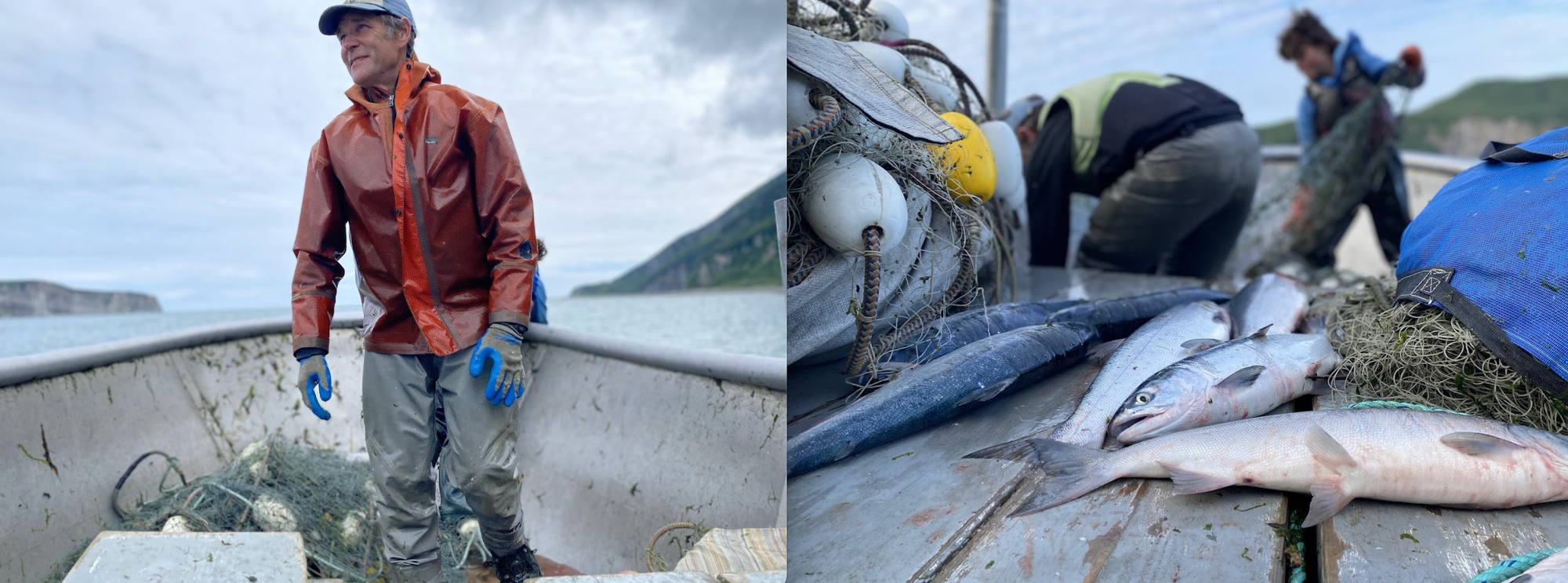
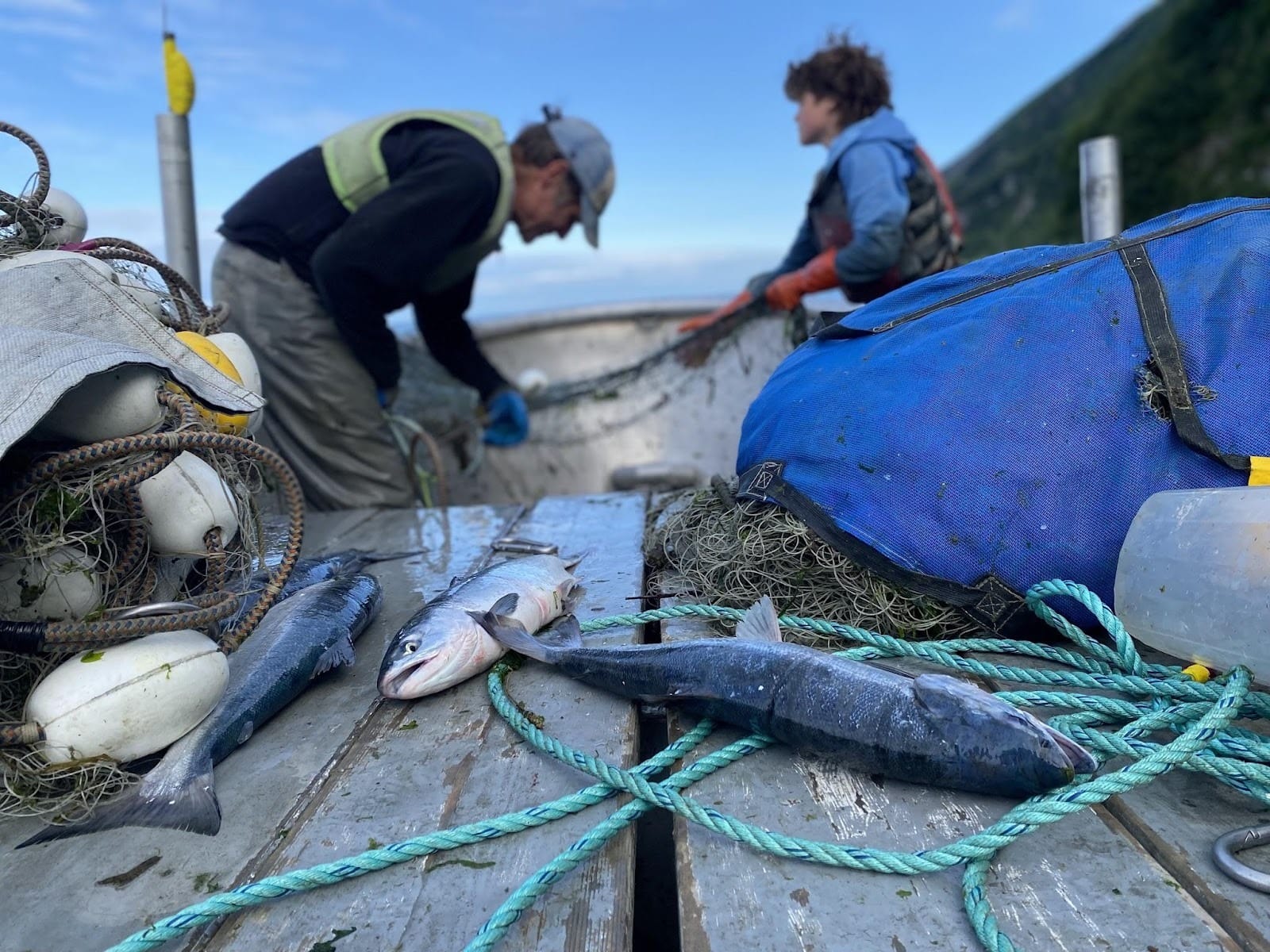
Commercial fisherman Dustin Solberg, left, walks across the bow of his skiff at the mouth of Tuxedni Bay. Solberg fishes with his son, Leif. (Photos by Max Graham/Northern Journal)
Among critics of the mining project is Dustin Solberg, a commercial fisherman and environmental advocate who spends summers with his family setting nets for salmon along the beaches of Tuxedni Bay, about 10 miles northeast of the Johnson Tract. Contango could one day load ore onto ships from the same shore where Solberg and other fishermen haul fish out of the bay.
Standing on a quiet Tuxedni beach one day this summer with dramatic cliffs looming overhead, Solberg imagined mining trucks rumbling down a road nearby.
“I think it would irreversibly change this place,” he said.
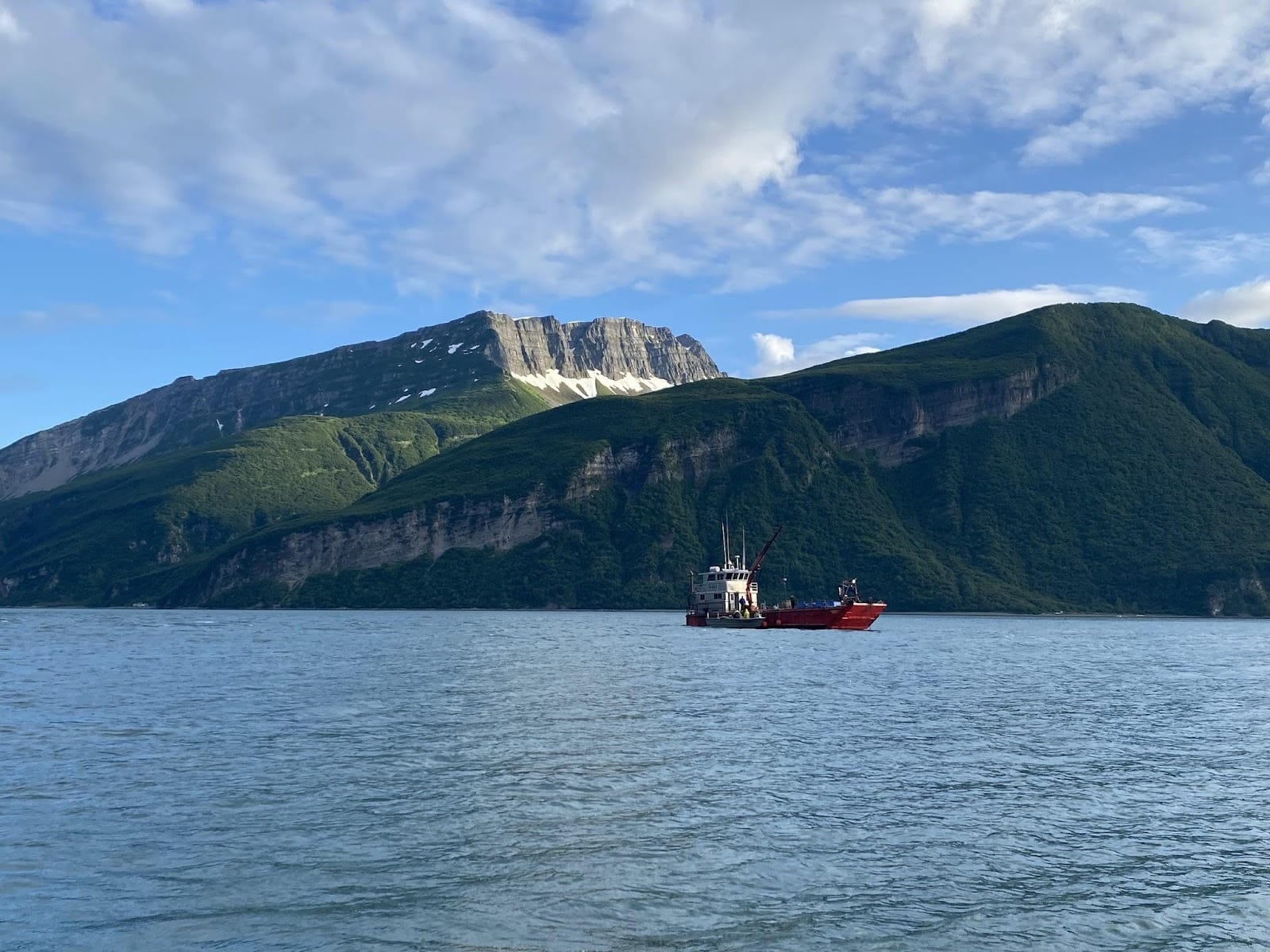
A fishing tender anchored in Tuxedni Channel, with Lake Clark National Park in the background. The tender buys salmon from the bay’s fishermen and transports it across the inlet to a processing plant in the town of Kenai. (Photo by Max Graham/Northern Journal)
A pivotal deal
The Johnson Tract fight is rooted in the Alaska Native Claims Settlement Act.
Intended to resolve disputes over Indigenous land claims in Alaska, the federal legislation in 1971 established 12 for-profit Alaska Native corporations, each owned by Indigenous shareholders with ties to a region in the state. More than 200 other Indigenous companies tied to Native villages also formed.
The act promised to compensate the corporations with nearly a billion dollars and millions of acres of land, to be chosen by the companies’ elected leaders.
Those leaders quickly moved to obtain traditional hunting and fishing grounds and areas with cultural value, but they also sought land thought to be rich in minerals and other resources that they could convert into profits for shareholders.
In the Arctic, Native corporations acquired land with oil deposits. In Southeast Alaska, they logged vast stands of cedar and spruce.
But in CIRI’s region, around Anchorage and neighboring Cook Inlet, the pickings were sparse. The southcentral region is the state’s most populous, and by the time of the settlement, military bases and wildlife refuges had been set aside by the federal government, prime real estate was in the hands of private developers and other parcels had been snatched up by the state.
“You just had so much pressure for lands within the Cook Inlet region,” said Brown, who now serves on CIRI’s board.
The corporation’s leaders argued that they were largely left with glaciers and mountain ridges — dim prospects for shareholders.
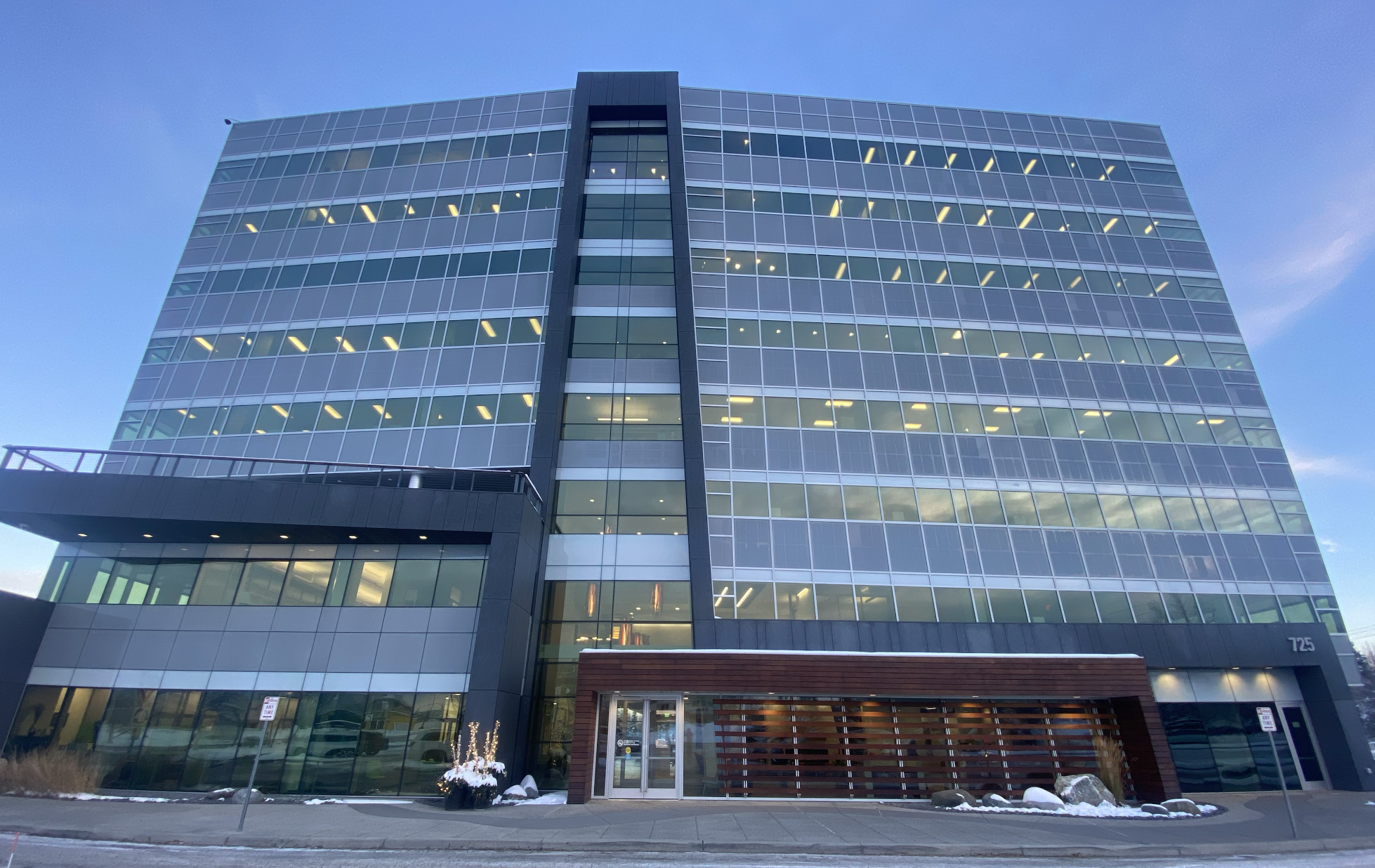
CIRI’s headquarters in Midtown Anchorage. (Photo by Max Graham/Northern Journal)
Two years after Congress approved the settlement, CIRI sued the U.S. interior secretary, arguing that his agency had not made adequate property available for CIRI to develop. Tense negotiations ensued, producing a sprawling agreement between CIRI and the state and federal governments: the Cook Inlet Land Exchange.
The deal called for CIRI to give up half the property around Cook Inlet that the corporation was entitled to under the original settlement, Brown said. Some of that foregone land would be folded into Lake Clark National Park and Preserve when Congress created it a few years later.
In return, CIRI would be able to acquire land elsewhere in Alaska, and even outside the state.
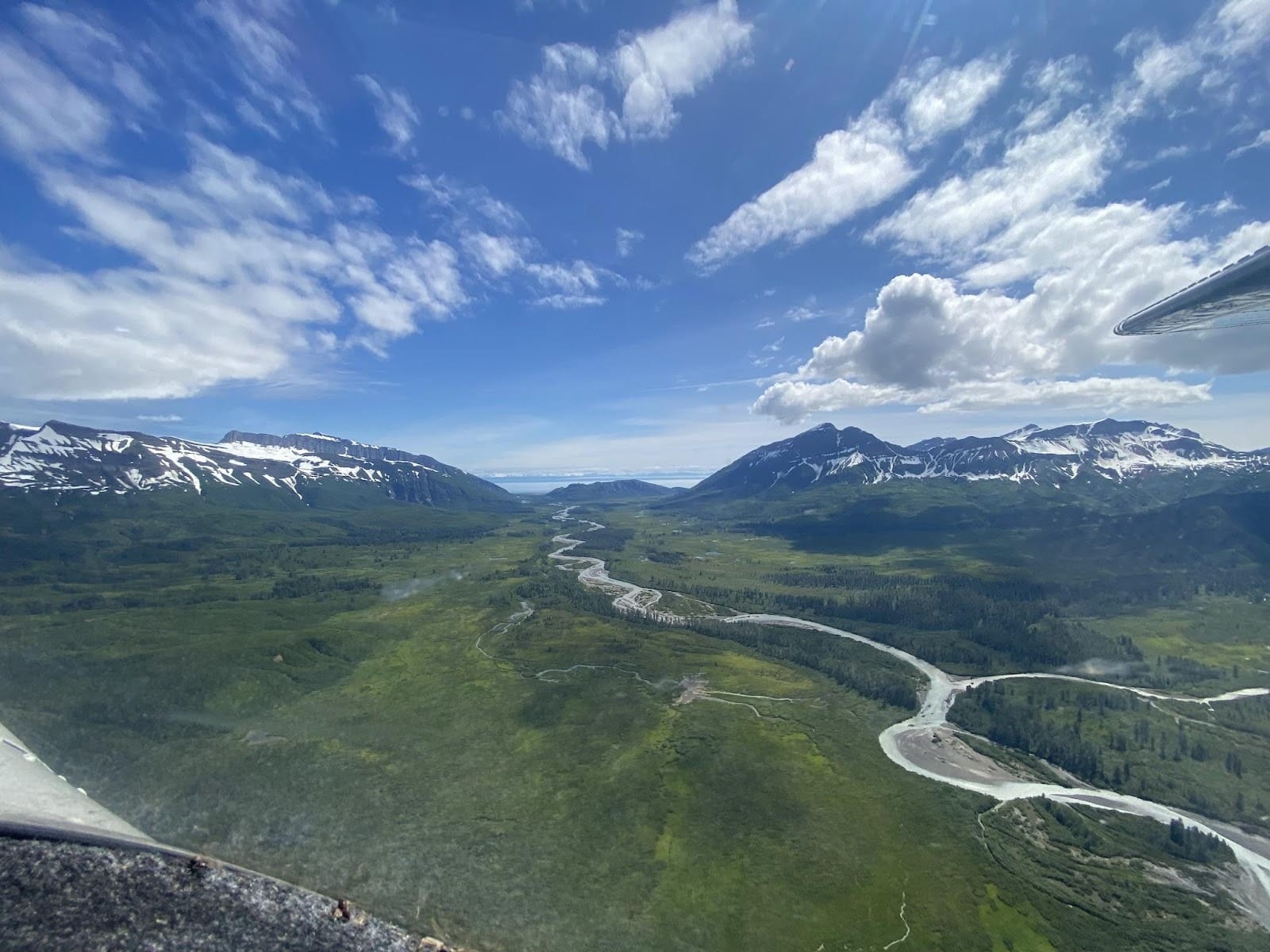
The Johnson River flows about a dozen miles from the Johnson Tract through Lake Clark National Park into Cook Inlet. (Photo by Max Graham/Northern Journal)
The deal also allowed CIRI to pick up some key assets around Cook Inlet, including the Johnson Tract, which the corporation chose specifically for its mineral potential. CIRI’s early leaders viewed the land swap as a hard-fought compromise, and Brown called the Johnson Tract “key to the bargain.”
“The ability to use the land in the way Congress intended is something that needs to be preserved,” she said. “It’s unfortunate that as we move further and further from congressional intent, it’s harder and harder for people to remember that.”
The Johnson Tract is really two adjacent parcels, totaling about 33 square miles. CIRI—now a huge business, with nearly $1 billion in assets—owns the minerals beneath both parcels, and the surface of the south tract, where the main deposit sits. The federal government retained surface ownership of the north tract.
Citing a provision in the land exchange, the Department of Interior earlier this year granted CIRI the rights to transport ore through the park, with certain restrictions to limit environmental impacts. CIRI and Contango have not formally proposed building a haul road and port, which would require additional permits.
An “Awesome” Deposit
Soon after CIRI acquired the Johnson Tract, the corporation began scouring it for more minerals, seeking enough to justify building a mine.
In the early 1980s, CIRI partnered with Anaconda Minerals, a subsidiary of the global oil giant ARCO, to evaluate the prospect.
Anaconda found promising amounts of gold, zinc and copper and at one point—given the area’s prolific amount of snow—envisioned an underground tunnel or aerial tram to move ore the dozen miles from a mine to a port on the coast. But Anaconda went out of business. And aside from another unsuccessful effort to develop the Johnson Tract in the 1990s, the land sat largely dormant until 2019.
That year, CIRI signed a lease with a Vancouver-based mineral exploration company, which quickly handed over the operations to a spinoff firm, HighGold Mining Inc. HighGold spent tens of millions of dollars on exploration and drilled more than 150 core samples before Contango bought the company last year in a deal worth some $35 million.
The Johnson Tract appealed to Contango’s chief executive, Rick Van Nieuwenhuyse, because it seemed to be a good fit for the company’s unconventional development model, which involves shipping raw ore to a processing plant off site, rather than crushing and processing ore next to the deposit, as most mines do.
The approach avoids some of the more expensive and hard-to-permit components of a typical mine, like a mill and a big waste pond. In theory, it keeps construction costs low and makes permitting easier, Van Nieuwenhuyse said. But shipping unprocessed ore also risks higher transportation costs, so Johnson Tract’s close proximity to the ocean and shipping routes made it attractive.
“It’s an awesome deposit,” Van Nieuwenhuyse said, citing the prospect’s high ratio of valuable minerals to rock and its thickness, which he expects will make the mining process more efficient.
Van Nieuwenhuyse is a veteran of Alaska’s mining industry, having worked over the past four decades on some of the state’s most prominent early-stage projects.
He played major roles in advancing Western Alaska’s Donlin project — the state’s biggest proposed gold mine — and high-profile prospects in Northwest Alaska at the end of the controversial proposed Ambler Road. He also led development of the Rock Creek gold mine near Nome, which closed in 2008 soon after opening amid a slew of challenges.
At Contango, where Van Nieuwenhuyse was named chief executive in 2020, he partnered with the multinational Kinross Gold Corp. to spearhead the construction of Alaska’s first large mine in more than a decade, a project in the Interior called Manh Choh.
Unlike that open-pit mine, Johnson Tract would be an underground operation. Several years of exploratory drilling, permitting and engineering are expected before a final decision on building a mine, Van Nieuwenhuyse said.
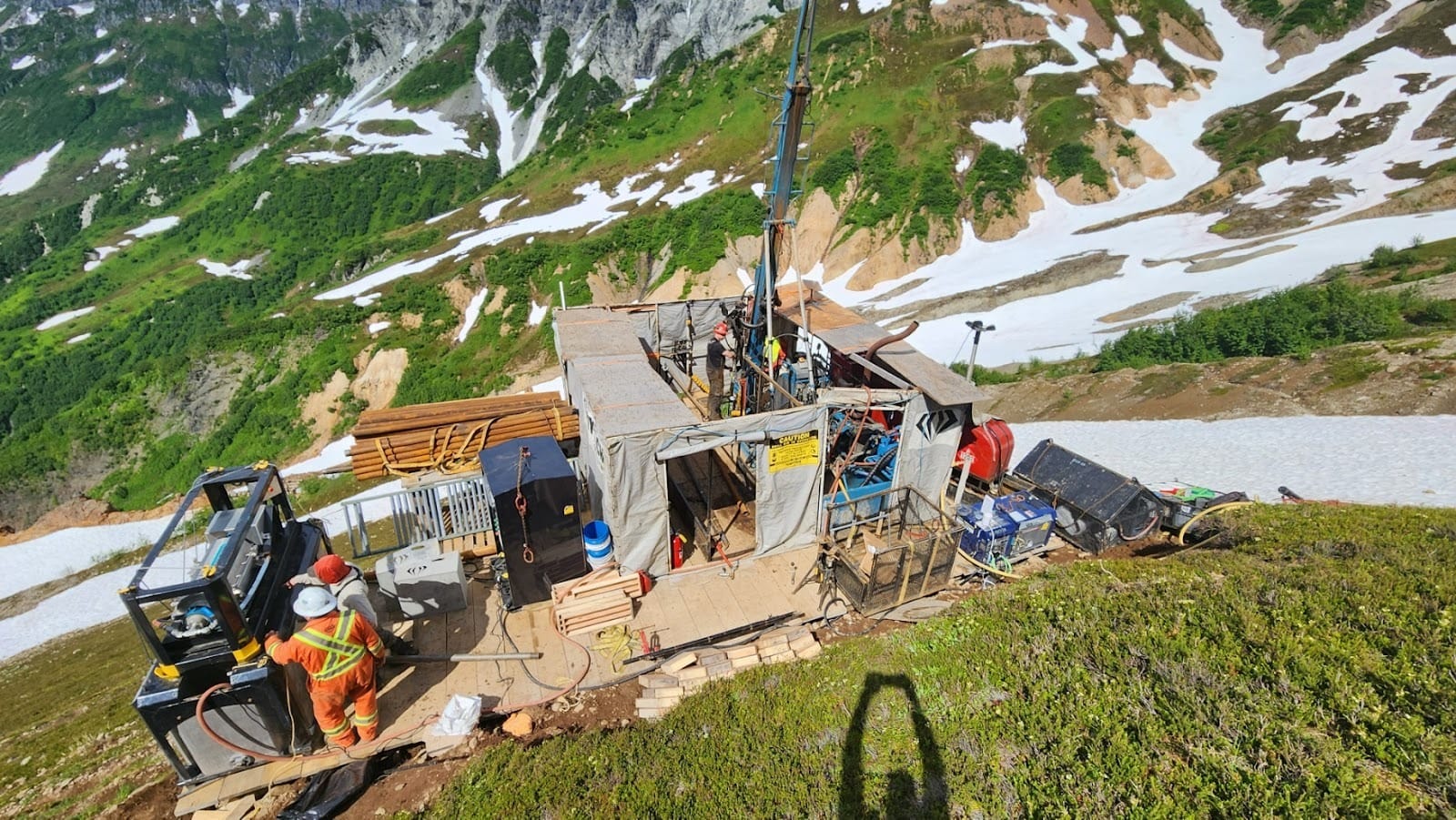
A drilling pad at the Johnson Tract project. (Photo from Contango Ore)
The mine, according to Contango’s preliminary plans, would operate for seven years and would be small compared to other major Alaska mines. Contango would share royalties on mineral sales with CIRI, which has an option to buy as much as a 25 percent stake in the mine.
CIRI declined interview requests about the Johnson Tract, and the corporation’s executives have made few public statements about it.
The project “presents an opportunity to responsibly develop mineral resources to benefit our shareholders while respecting the environment and preserving the land,” CIRI said in a brief update last year. “The Johnson Tract project reflects decades of hard work to build a foundation of self-determination and financial stability.”
“We’re Here Because it’s Beautiful”
Dustin Solberg, the fisherman and mine opponent, was motoring to a net he’d set on the west side of Tuxedni Channel one afternoon last summer when he spotted a brown bear on a rocky beach ahead.
“I think it smells the fish, Dad,” 12-year-old son and deckhand Leif Solberg called out.
Far more worrisome to the elder Solberg is the future of the beach where the bear was roving—near a site that Contango is studying as a port.
Solberg, his family and others who fish in the channel each summer have growing concerns about Contango’s vision. They fear that a new road and industrial dock, and the traffic and noise from trucks and ships, would mar the wild character of the bay and the park around it.
Dustin and Leif Solberg haul salmon out of Tuxedni Channel. (Photo by Max Graham/Northern Journal)
As Solberg looked across the channel, it was remarkably quiet, aside from a few fishing skiffs and an occasional float plane that landed at a bear-viewing lodge on Chisik Island. Other than the lodge and a few fishing cabins, Chisik is a federally designated wilderness area, home to a prolific seabird colony.
A dozen or so crews fish commercially for salmon in the bay. Two or three times a week, from June through August, they set, pick and pull nets along pebbly beaches on either side of Tuxedni Channel, with fishing periods that can last 12 hours or more.
It’s hard labor, Solberg said, but the season moves at a slower pace than Alaska’s bigger-volume salmon fisheries, like Bristol Bay, where boats sometimes work 24-hour shifts.
Dustin and Leif Solberg work their net behind freshly caught salmon in Tuxedni Channel. (Photo by Max Graham/Northern Journal)
“If you wanted to make money, you would fish somewhere else,” said Ann Harding, Solberg’s wife. “We’re here because it’s beautiful.”
The area has “phenomenal” mountains and a striking density of birds and bears, added Harding, a seabird biologist who sometimes fishes alongside Solberg.
Ann Harding handles a freshly caught salmon as Dustin Solberg pulls another out of his net. (Max Graham/Northern Journal)
The family uses a cabin a mile or two down the shoreline from where the bear had been walking. It’s a small plywood structure beneath an A-frame roof, surrounded by an electric fence to keep away curious ursine visitors. The cabin is about a hundred feet back from the water and set fully within Lake Clark National Park.
Solberg and Harding bought the structure several years ago. They don’t have title to the land beneath it or a formal permit from the park service. But the cabin existed before the park was established, and past owners had an informal arrangement with federal officials to keep using it, Solberg said.
A cabin used by fisherman Dustin Solberg and his family stands in Lake Clark National Park, near the shore of Tuxedni Channel. (Photo by Max Graham/Northern Journal)
The cabin now sits in an easement that the Department of Interior earlier this year granted CIRI for a mining port. Solberg doesn’t think his small business will amount to much of an obstacle.
“This is just a little shack that doesn’t really compete with the value of an operation like that,” he said, referring to the mining plans. “So, I don’t expect this to get in the way of anything.”
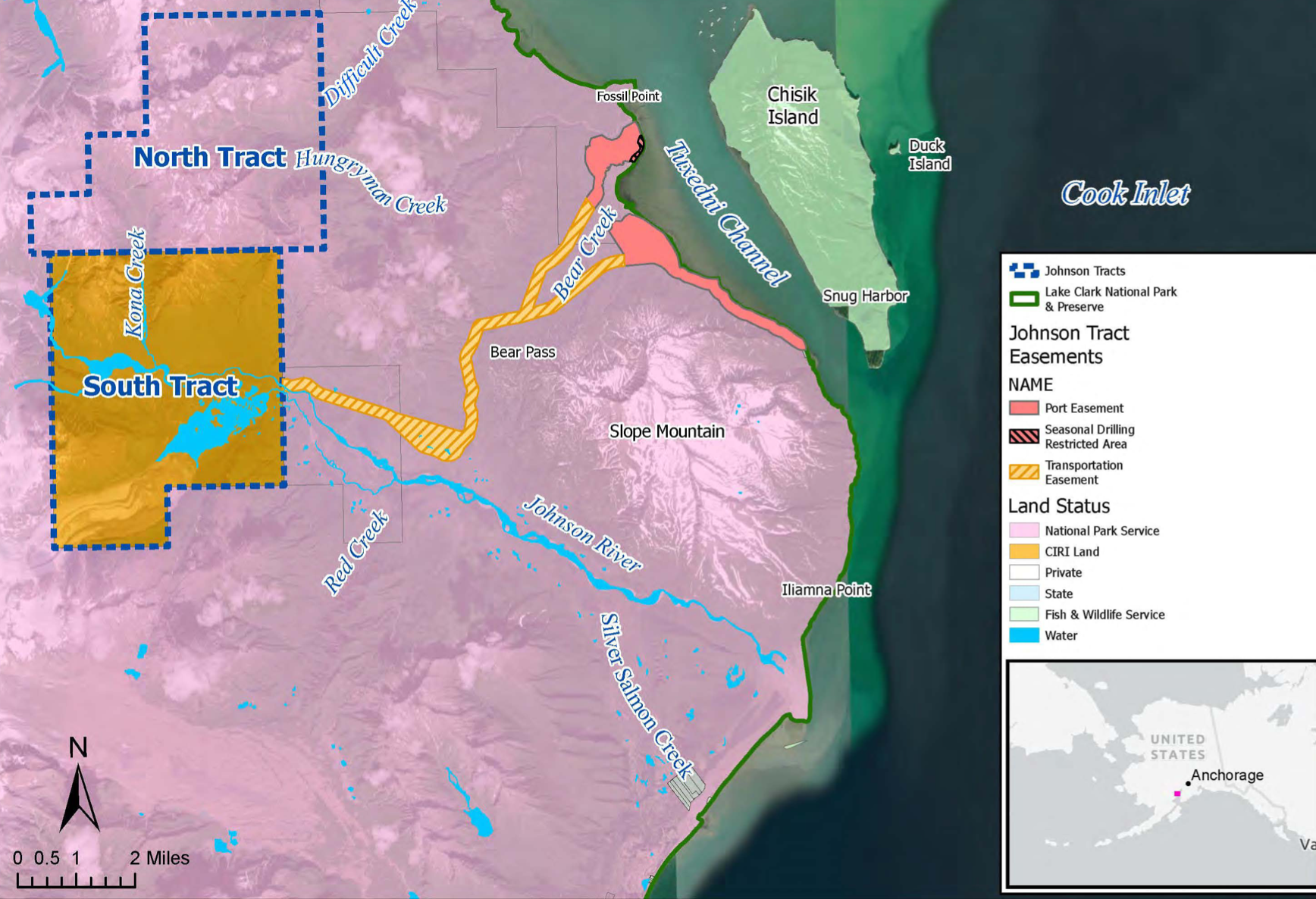
A National Park Service Map of the Johnson Tract, as well as easements where an access road and port serving a mine could one day be built.
CIRI and Contango have not made a final decision about where to put the port, and a CIRI environmental document said last year that there is “considerable uncertainty” about future construction.
Van Nieuwenhuyse, the Contango mining executive, said his company recognizes the rights of the setnetters, and he believes a mine can co-exist with the fishery.
“I would ask that everybody recognize CIRI’s rights as well,” he added.
Where Belugas “Hang Out”
As it gathers pace, Contango is facing opposition not just from the commercial fishermen but also from conservation groups and some tribal governments in the region.
A national group, the Center for Biological Diversity, along with the Homer-based nonprofit Cook Inletkeeper and the Chickaloon Village Traditional Council, a tribal government, are suing the U.S. Army Corps of Engineers for issuing a key permit to Contango.
Several tribal leaders also have raised concerns about the project and have asked the Trump administration to suspend the permit.
A core concern among those opponents is that a mining operation could threaten Cook Inlet’s beluga whales, which are treasured by many Anchorage residents and local wildlife viewers.
The inlet’s belugas—which are genetically distinct from other beluga populations—once numbered around 1,300 animals, but their numbers sharply declined in the 1990s. They were listed as endangered in 2008 and still have not significantly recovered. The population now stands at some 330 whales.
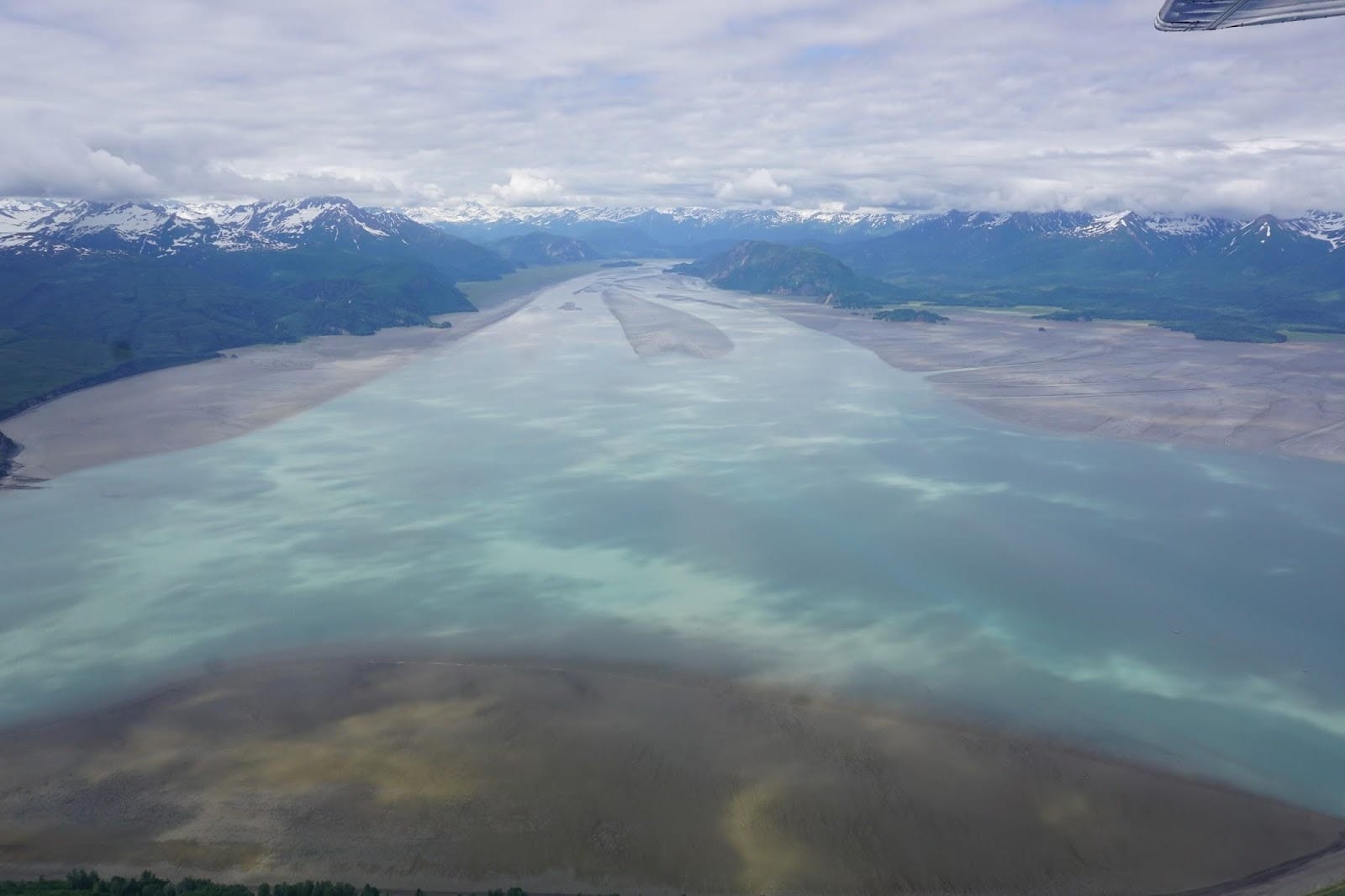
Tuxedni Bay, ringed by the mountains of Lake Clark National Park, is an important winter habitat for an endangered population of beluga whales, according to recent federal research. (Photo by Max Graham/Northern Journal)
During the summer, the belugas are commonly spotted feasting on fish at the mouths of salmon-bearing streams near Anchorage. Where they go in winter has been a mystery.
But last year federal scientists announced a big discovery in a study that analyzed underwater sound recordings.
The researchers, affiliated with the National Oceanic and Atmospheric Administration, identified Tuxedni Bay as the only known foraging ground for the whales between late fall and late spring. They warned that human-caused noise is a “key threat” to the belugas, which use sound to navigate and communicate, and that industrial activity could affect the quality of the whales’ habitat.
NOAA Fisheries, which led the study, declined interview requests. One of its scientists, in a press release announcing the study, said that “maintaining the status quo” may be all that’s needed to help the beluga population recover.
As Contango studies sites for a port, it’s now funding a new beluga survey by biologists working for the state of Alaska, which has often been more friendly to the mining industry than the federal government.
The survey is focused on the narrow channel where Contango is considering shipping ore, while the NOAA-led study looked more broadly at the 10-mile-long Tuxedni Bay.
“We want to know where the belugas like to hang out,” Van Nieuwenhuyse said.
One of the loudest voices advocating for the belugas and against development at the Johnston Tract is Cooper Freeman, a Homer resident and the Alaska director at the Center for Biological Diversity. The center is a 35-year-old nonprofit that aims to protect wildlife and ecosystems across the country, and it’s a participant in nearly a dozen active lawsuits in Alaska’s federal court.
In an interview, Freeman acknowledged CIRI’s right to the minerals at the Johnson Tract. But he noted that federal environmental laws still apply and argued that CIRI does not have an “absolute right” to build a mine.
In his view, the area is too ecologically rich—with its important beluga habitat and high density of brown bears, seabirds and shorebirds—to risk.
“It’s just an incredibly, biologically, intensively rich and completely intact area—one of the only remaining places like it in all of Cook Inlet,” he said. “I don’t think there’s any amount of money that’s worth destroying this place.”
Chisik Island is a federally designated wilderness area, aside from a few commercial fish camps and a bear-viewing lodge. (Photo by Max Graham/Northern Journal)
There are no towns within 40 miles of the Johnson Tract—just roadless mountains, glaciers, forests and streams.
Aside from seasonal fishermen, CIRI and Contango’s neighbors include Silver Salmon Creek Lodge, a bear-viewing and sport-fishing business that’s near the mouth of the Johnson River, a dozen or so miles downstream of the mineral deposit.
Longtime lodge owners David Coray and Joanne Edney have kept loose tabs on the prospect for decades and have grown more concerned as Contango’s project advances.
In a recent interview, Coray and Edney said they’re worried that a mine could pollute the Johnson River and disrupt bear habitat.
“We understand their interest, and we understand their rights,” Edney said of CIRI and Contango. But a mining operation could come into “direct conflict” with her family’s business, she said.
CIRI declined to respond to questions about opposition to the project, and about how it’s gauging the views of its shareholders, some of whom have spoken out against it.
Van Nieuwenhuyse said Contango is committed to protecting wildlife.
“We’ll develop this deposit with minimal impacts to the environment, which we recognize as pristine,” Van Nieuwenhuyse said. “We’re all from Alaska. We enjoy the outdoors. That’s why we all became geologists.”
For Solberg, the fisherman, the convergence of competing interests in the area is “endlessly fascinating—and really complicated and really unfortunate.”
In a conversation after the fishing season, Solberg acknowledged a tension between CIRI’s rights to the Johnson Tract’s minerals and the spectre of a mine transforming the landscape and bay that his family has come to know and love.
Solberg said he feels “really torn” about the issue and that he respects CIRI’s land claims. But as one of the few Alaskans who spends long stretches of time in Tuxedni Bay, he feels obligated to speak in defense of its wildness and beauty.
“I just want decisionmakers to have their eyes wide open,” he said. “And to realize what’s at stake.”
This story was supported by a grant from the Alaska Center for Excellence in Journalism.
Northern Journal contributor Max Graham can be reached at max@northernjournal.com. He’s interested in any and all mining related stories, as well as introductory meetings with people in and around the industry.
This article was originally published in Northern Journal, a newsletter from Nathaniel Herz. Subscribe at this link.
One of the outdoor sculptures at the University of Alaska Anchorage campus is integrated into a fountain, pictured here on May 16, 2022. More than half of the University of Alaska system schools attend UAA or one of its satellite campuses. (Photo by Yereth Rosen/Alaska Beacon)
The University of Alaska is anticipating an increase of up to 10% for health care costs this fiscal year, on par with what employers are anticipating nationally, according to officials presenting to the Board of Regents at their meeting on Nov. 6.
Nikole Conley, chief of human resources for the university system, gave a presentation outlining the university system’s health care costs so far, and projections for the rest of this fiscal year, ending in July 2026. Her presentation included medical, dental and pharmacy care.
“We do see health care costs across the nation going up and increasing, and we’re not necessarily expecting this to decline anytime soon,” she said.
The university is projecting 8% to 10% overall cost increases across the system for this fiscal year. That means health coverage for 3,442 employees is estimated to cost $85.5 million.
A screenshot from a University of Alaska presentation on health care costs on Nov. 6, 2025, shows a rise in costs in recent years.
“We are seeing trend increases of 8% for medical, 13% for pharmacy and 4% for dental. We’ll do another recast in January of 2026 and hopefully try to firm up that figure and what that’s going to look like,” Conley said.
Nationally, employers are expecting an 8.5% increase in medical costs and an 11% increase in pharmacy costs, she said, so the university’s costs and projections are mirroring that trend.
Health care costs in Alaska are among the highest in the nation, according to state data. Since 2023, the average cost of a health insurance marketplace plan in Alaska rose by more than 16% each year. In 2023 alone, the cost went up by an average of 18.4%.
The university has a cost split for health care with 18% paid by employees in premiums, and 82% paid by the universities. Conley presented total cost projections to the board.
Conley said the number of university employees isn’t growing, but more people are opting into the university’s health care plan. She said system-wide the largest cost increase is in pharmacy claims, but her department is expecting to renegotiate pharmacy costs, which could save the university about $3 million.
Last year, the university saw pharmacy spending increase 11.2% from the year before. Over the last five years, overall pharmacy costs more than doubled from $9.2 million to $19.2 million, she said.
Conley said that’s partly due to a rise in prescriptions for drugs used for weight loss and to treat diabetes, known as GLP-1 drugs like Ozempic. They were the second highest pharmacy claim within the university’s plan, totaling $4.1 million last fiscal year.
“We’re also looking at the potential elimination of GLP-1s, because they are a major cost driver for us,” she added.
University of Alaska Regent Karen Perdue pushed back against that idea, pointing out that weight loss can also improve employees’ health outcomes and result in less health care costs. “It’s not just a plus, there can be a minus on the bottom line as well,” she said.
A screenshot from a University of Alaska presentation on health care costs on Nov. 6, 2025 shows the highest claims for medical and pharmacy care
University of Alaska President Pat Pitney also pointed out other high pharmacy costs last year. The largest costs were on inflammatory diseases, with the highest cost at $4.3 million, and cancer treatments at $1.3 million.
The highest medical costs for the university last fiscal year were for muscle, joint and bone claims at $10.7 million, followed by cancer at $7 million, and behavioral health and disorder treatments at $5.3 million.
Last year, the university’s total costs came in at $80.1 million, which was $1.1 million over the university’s projection. Conley said next year’s premiums will go up to recover those costs.
Conley said her department is working to push more education and use of wellness programs and preventative health care.
“Not only are we seeing this growth of 8% to 10% in cost, but we’re also seeing less use, for some reason, of our preventative health care. And so we’re really trying to encourage folks to use preventative health care, because that will help minimize some of our costs in the future,” she said.
According to university data presented by Conley, only half of health care participants used preventative screenings, like annual physical exams or checkups; nearly 38% of emergency room visits could have been avoided with better primary care or urgent care use; and 38% of participants are categorized as pre-obese or obese.
The university is insured through Premera Blue Cross, and Conley said her department discusses health care plan changes with the university’s Joint Health Care Committee, an advisory committee made up of representatives from the faculty union, management and staff.
The university is also expecting a health care rebate, which is a benefit paid back to employees if they utilize the prevention programs throughout the year, like cancer screenings, dental care, and regular check ups.
“We’re estimating about a $1.5 million rebate,” Conley said, for this year, ending in July 2026. “We’re going to see up to a $2.5 million rebate increase in FY27 with new rates. So that’s a good positive.”
The debate around national health care, federal tax credits, and costs for Americans has been at the heart of bitter negotiations around ending the longest government shutdown in U.S. history. The U.S Congress approved a stopgap spending bill ending the shutdown. Democrats have introduced a discharge petition to force a vote to extend tax credits for three years under the Affordable Care Act. White the Senate Majority leader has promised a vote by the end of the year, leaders of the Republican-majority House have remained opposed, and discussions on health care are ongoing.
NOTN- The City and Borough of Juneau is preparing to implement major sales tax changes as a result of Ballot Proposition 2, which exempts food and utilities from local sales taxes starting Nov. 20.
Deputy City Manager Robert Barr says the city wants the transition to be as seamless as possible.
“Residents won’t have to do anything. You just simply won’t see sales tax on your receipts or your bills for food and utilities.” He said, “There’s a couple of exceptions for utilities that you buy in person, like wood or wood pellets or the retail purchase of fuel. For those specific exemptions folks will have to come downtown or go online and get a card number from us, because, while food is exempt for everyone, utilities aren’t.”
Barr said the city’s utility vendors are working to ensure that most billing adjusts automatically, though Barr noted some cases may require clarification between residential and commercial customers.
Below is the summary of what residents can expect, posted by CBJ;
Essential Food
Proposition 2 follows the same definition of “essential food” utilized by the Supplemental Nutrition Assistance Program (SNAP) and defined by the federal Food and Nutrition Act of 2008 (7 U.S.C. § 2012(k). No action is required by residents to receive the essential food sales tax exemption. Residents do not need to obtain an exemption card or number.
Examples of exempt foods include dairy products, fruits and vegetables, meat, poultry, fish, bakery items, cereals, snack foods, cold sandwiches for off-premises consumption, seeds and plants that grow food, and items with a Nutrition Facts label.
Non-exempt items include hot prepared foods, restaurant meals, foods intended to be eaten on-site, pet food, vitamins, cough drops, alcohol, tobacco and tobacco products, and items with a Supplement Facts label.
It may take merchants time to adjust point-of-sale systems to reflect the new sales exemption. For this reason, senior sales tax exemption cardholders are encouraged to continue carrying their card until this transition is complete.
Noncommercial Essential Utilities
Proposition 2 defines “essential utilities” as those sold to individuals for non-commercial use within the City and Borough of Juneau. This includes the sale of electricity, heating fuel, water and wastewater service, refuse and recycling collection at a City and Borough of Juneau resident’s principal place of abode, and the non-commercial use of landfill facilities by CBJ residents.
Because most, if not all, utilities already designate commercial and residential rates for billing purposes, and to ensure that the intent of the ballot sponsors and the will of the voters is honored, CBJ is working with utilities to utilize their definition of residential and commercial while maintaining the intent of the ballot initiative. CBJ also provided definitions for guidance where utilities do not already designate rates as commercial or residential.
In practice, this means that residents are not required to obtain an exemption number or card to receive the exemption for billed utility use (electricity, water, etc.). However, residents may choose to apply for an exemption card if they intend to make retail purchases of eligible essential utilities (wood pellets, propane, etc.). If residents believe they are mistakenly designated as commercial by billed utilities, they may also apply for a utility sales tax exemption card and submit their exemption card to the utility to receive the exemption. Essential utilities exemption card application details will be available at juneau.org/finance/sales-tax and at the CBJ Sales Tax Office prior to the November 20 enactment date.
CBJ is working with utility providers on the implementation process as quickly as possible. It may take time for providers to apply the new exemptions to their many thousands of accountholders.
NOTN- University of Alaska President Pat Pitney formally announced her retirement.
She was appointed the University system’s 17th president in 2022 and served as interim president in 2020.
Previously Pitney served as the state’s Director of the Division of Legislative Finance. She was the former Vice Chancellor of Administration, University of Alaska Fairbanks and worked at UA Statewide for 17 years. In all, Pitney spent 23 years with the University of Alaska before leaving to serve as the State Budget Director in the administration of former Governor Bill Walker.
Pitney moved to Fairbanks in 1987 from Billings, Montana. She earned her MBA from UAF and an engineering physics degree from Murray State University (Kentucky). She has three adult children and four grandchildren. All three of her children are UA graduates, with degrees from UAF, UAA and UAS.
Before moving to Alaska, she was a member of the 1984 U.S. Olympic Team and won a gold medal in women’s air rifle.
Below is the email announcing Pitney’s retirement;
Dear UA Community – It has been my honor and privilege to serve as University of Alaska president for the past five years. When the Board hired me in 2020, I wasn’t seeking either the interim or permanent president position, but I felt my skill set would be an asset to UA and our mission. I committed initially to two years of service, and more than five years later, I’m proud of how far we’ve come and excited about the opportunities ahead. There’s much to celebrate, but it is time for me and the UA system to be looking toward the next chapter. Several months ago, I informed the Board of Regents that I plan to retire after their May 2026 board meeting. I’m confident that the University of Alaska will continue to thrive long after I step away. As an alum, and the parent of alums from each of our three universities, it’s been one of the greatest honors of my life to serve all of you and the people of Alaska. Since 2020, we’ve made some incredible progress.
We’ve reversed enrollment declines and grown student headcount for three straight years.
We’ve stabilized our budget after a period of uncertainty compounded by a once-in-a-century pandemic.
We’ve substantially increased our competitive research position.
And we’ve reminded Alaskans of UA’s vital role in empowering our workforce, economy, and communities.
There’s still work to do, but the future is strong. The Board’s recent focus on student recruitment, retention, and graduation, along with expanded scholarships and financial aid, is already paying off and positioning UA for success. Retirement will be bittersweet. I’m looking forward to spending more time with my kids, my grandkids, and my mom, and exploring the state I love so deeply. But until May, I’ll remain full-speed ahead: advocating for our budget priorities in Juneau, and working closely with the Board to ensure a seamless leadership transition in my role and at the Universities.
In the weeks ahead, the Board will share more about the presidential search and how you can take part in shaping UA’s next chapter. I hope you’ll stay engaged in that process. For over three decades, I’ve seen how the University of Alaska empowers this state. Our education, research, and partnerships make a difference in every community. Serving as your president has been the honor of my career. I look forward to finishing this chapter strong and cheering you on as you continue UA’s work to empower Alaska. Thanks for all you do for our students and our state.
The northern lights fill the sky behind the Saint Joseph the Woodworker Shrine (AP Photo/Charlie Riedel)
AP- Solar storms brought colorful auroras to the Northern U.S. but also to some unexpected places on Tuesday and Wednesday night.
Space weather forecasters confirmed that storms reached severe levels, triggering vibrant northern lights in Europe including Hungary and the United Kingdom. In the U.S., the hues were spotted as far south as Kansas, Colorado and Texas.
There were some impacts to GPS communications and the power grid, Shawn Dahl with the National Oceanic and Atmospheric Administration said in a video posted on X.
The uptick in solar activity forced NASA on Wednesday to postpone the launch of Blue Origin’s new rocket carrying Mars orbiters until conditions improve.
Over the past few days, the sun has burped out several bursts of energy called coronal mass ejections. Two have reached Earth, but at least one more is still on the way and could arrive sometime on Wednesday.
Forecasters think this solar outburst could be the most energetic of the three and have issued a severe storm alert. How bright the auroras are and how far south they are visible will depend on when the burst gets here and how it interacts with Earth’s magnetic field and atmosphere.
How northern lights happen
The sun is at the maximum phase of its 11-year activity cycle, making the light displays more common and widespread. Colorful northern lights have decorated night skies in unexpected places and space weather experts say there are more auroras still to come.
Aurora displays known as the northern and southern lights are commonly visible near the poles, where charged particles from the sun interact with Earth’s atmosphere.
Skygazers are spotting the lights deeper into the United States and Europe because the sun is going through a major face-lift. Every 11 years, its magnetic poles swap places, causing magnetic twists and tangles along the way.
Last year, the strongest geomagnetic storm in two decades slammed Earth, producing light displays across the Northern Hemisphere. And soon afterward, a powerful solar storm dazzled skygazers far from the Arctic Circle when dancing lights appeared in unexpected places including Germany, the United Kingdom, New England and New York City.
The sun’s active spurt is expected to last at least through the end of this year, although when solar activity will peak won’t be known until months after the fact, according to NASA and NOAA.
How solar storms affect Earth
Solar storms can bring more than colorful lights to Earth.
When fast-moving particles and plasma slam into Earth’s magnetic field, they can temporarily disrupt the power grid. Space weather can also interfere with air traffic control radio and satellites in orbit. Severe storms are capable of scrambling other radio and GPS communications.
In 1859, a severe solar storm triggered auroras as far south as Hawaii and set telegraph lines on fire in a rare event. And a 1972 solar storm may have detonated magnetic U.S. sea mines off the coast of Vietnam.
Space weather experts aren’t able to predict a solar storm months in advance. Instead, they alert relevant parties to prepare in the days before a solar outburst hits Earth.
Consider aurora-watching in a quiet, dark area away from city lights. Experts recommend skygazing from a local or national park. And check the weather forecast because clouds can cover up the spectacle entirely.
Taking a picture with a smartphone camera may also reveal hints of the aurora that aren’t visible to the naked eye.
Research biologists pause among the wetlands of the Arctic National Wildlife Refuge coastal plain, with the Brooks Range in the background. (Photo by Lisa Hupp/USFWS)
AP- Alaska Native tribes and conservation groups sued the federal government Wednesday, seeking in at least three separate lawsuits to overturn a land exchange aimed at allowing a road to be built through a national wildlife refuge.
Legal challenges to the land exchange agreement reached last month between Interior Secretary Doug Burgum and an Alaska Native village corporation include claims that it was not properly analyzed, that it poses risks to sensitive habitats and that it could threaten migratory birds that some Alaska Natives rely on for food.
King Cove, a community of about 870 people near the Izembek National Wildlife Refuge, has for years pushed to have a road built through the refuge for access to an all-weather airport at Cold Bay, about 18 miles (29 kilometers) away.
Alaska’s governor and congressional delegation have supported the cause, calling it a life and safety issue that would allow for emergency medical evacuations. The delegation has said King Cove’s airstrip can frequently be closed for bad weather, and that high seas can make travel by water between King Cove and Cold Bay challenging.
Terms of the agreement include conveyance by the government of about 490 acres (199 hectares) to King Cove Corp. for a potential road corridor, while the corporation would convey about 1,739 acres (703.7 hectares) to the refuge and relinquish selection rights to additional land. A decision document, signed by Burgum, says the proposed road would be about 19 miles, much of which would be within the refuge. It says it would be up to the corporation to obtain the necessary permits and funding for a road.
Elizabeth Peace, an Interior Department spokesperson, said by email Wednesday that the department doesn’t comment on litigation.
One of the lawsuits was filed by the Native Village of Hooper Bay, Native Village of Paimiut, Chevak Native Village and the Center for Biological Diversity, a conservation group. The tribal governments are hundreds of miles north of King Cove but have expressed concern that a road could impact migratory birds they rely on that stop along the way at the refuge.
Angutekaraq Estelle Thomson, traditional council president of the Native Village of Paimiut, in a statement called the refuge’s eelgrass wetlands “a lifeline for emperor geese, black brant and other birds that feed our families and connect us to Indigenous relatives across the Pacific.”
“We are joining this lawsuit because defending Izembek is inseparable from defending our subsistence rights, our food security and our ability to remain Yup’ik on our own lands,” she said.
Lawsuits also were filed by a coalition of conservation groups, represented by Trustees for Alaska, and by Defenders of Wildlife.
A single caribou walks across the treeless tundra in the Arctic National Wildlife Refuge in 2019. (Photo by Alexis Bonogofsky/U.S. Fish and Wildlife Service)
As Kristen Moreland waited for the livestream to buffer, her thoughts drifted to the years she’d devoted to defending Arctic National Wildlife Refuge, the northeastern sweep of Alaska where the mountains give way to the coastal plain. On screen, the chatter of aides stilled as men in dark suits gathered behind a lectern. Then Secretary of the Interior Doug Burgum announced plans to open the area, roughly the size of South Carolina, to drilling.
It marked another round in the decades-long tug-of-war over developing one of the country’s largest remaining protected areas — an effort that came to a head during President Donald Trump’s first term, and ground to a halt when President Joe Biden took office. Burgum also restored seven oil and gas leases that a state-funded corporation bid on during the final days of the first Trump administration, and that his successor later revoked.
Moreland, a Gwich’in leader and executive director of the tribal committee dedicated to protecting the Nation’s sacred coastal plain, sat stunned as the YouTube stream continued. The place she grew up — where generations have lived on the tundra alongside the caribou, weaving their history into the land — had been reduced to a line item on someone’s balance sheet. When Burgum said opening the refuge would benefit northern communities, “it felt like a slap in the face,” she said.
“They’ve never reached out to us to listen to how this would affect our livelihood,” she said. Moreland fears development will drive the herd that the Gwich’in rely on out of range and contaminate rivers in a region where hunting and fishing are a matter of survival. For her, it felt like erasure. “It’s another disrespectful action from decision-makers,” she said. “It ignores our voice as Gwich’in and violates our rights as Indigenous people.”
As the fight over development in the Arctic continues, federal officials are racing to fulfill Trump’s “energy dominance” agenda. Though the government is shut down and many employees are not getting paid, officials continue approving permits for extractive industries. In a wood-paneled Beltway office, Burgum framed his “sweeping package of actions” as a declaration that “Alaska is open for business.”
To that end, the administration also signed permits for the controversial 211-mile Ambler Road to mineral deposits, including one owned by Trilogy Metals — which the Trump administration now holds a 10 percent stake in — and authorized a land exchange that will allow for construction of a road through Izembek National Wildlife Refuge, at the tip of the Alaskan Peninsula. “I told the president it’s like Christmas every morning,” Republican Governor Mike Dunleavy said. “I wake up, I go to look at what’s under the proverbial Christmas tree to see what’s happening.”
Last week’s announcement may not end up being the gift the governor is hoping for.
The fight over drilling in the refuge began almost as soon as President Dwight D. Eisenhower established the site, once called Arctic National Wildlife Range, in 1960. The most recent volley began in 2017, when Trump signed a tax bill requiring two oil and gas lease sales there within seven years. When the first sale was held in 2021, the state corporation Alaska Industrial Development and Export Authority, or AIDEA, was the only major bidder. It hoped to keep drilling prospects in the region alive, despite weak industry interest. The sale ultimately generated less than $12 million — a fraction of the nearly $2 billion projected by the Tax Act for the last decade.
The Biden administration later found the leasing program’s environmental review inadequate. It conducted a new analysis, then canceled the leases in 2023, citing “fundamental legal deficiencies” and its failure to “properly quantify” greenhouse gas emissions. The second mandated sale, in early 2025, received no bidders. Compounding the challenge, major banks and insurers have refused to finance or underwrite projects in the refuge, citing environmental risks. Oil majors have also steered clear: In 2022, Chevron and the company that took over BP’s leases on private land within the refuge paid $10 million to walk away from them. That same year, Exxon Mobil told shareholders it has “no plans for exploration or development” there.
Still, this spring Trump issued an executive order calling for the reinstatement of AIDEA’s leases, and a federal court ruled that their cancellation was handled improperly. The state-funded investment firm remains the sole holder of leases in the refuge.
The problem is AIDEA doesn’t have the capital or technical expertise to build out these areas on its own. It has authorized spending nearly $54 million to develop them and move permitting for Ambler Road forward. That includes hiring consultants for seismic testing to map oil and gas deposits. But first it must get permission from the U.S. Fish and Wildlife Service to harass polar bears, something that has sparked viral protests in the past. AIDEA authorized another $50 million for Ambler following Burgum’s announcement.
Ultimately, the state corporation is spending public money on infrastructure that private firms would normally fund, while sidestepping oversight, said Suzanne Bostrom, a senior staff attorney at Trustees for Alaska. The watchdog legal organization accused AIDEA of having redirected money toward refuge leases and Ambler from accounts within its Arctic Infrastructure Development Fund, and later its Revolving Fund, to avoid the need for legislative approval. Randy Ruaro, AIDEA’s executive director, wrote in an email that it was not legally required to seek authorization.
All of that aside, AIDEA’s track record is pretty grim. Financial records suggest the corporation lost at least $38 million on its last oil and gas venture, the Mustang field on the North Slope west of the refuge. After oil prices fell in 2020, the corporation foreclosed on the project. The state provided another $22 million in a 2023 bailout before AIDEA sold the field for an undisclosed sum. Bostrom says AIDEA has “no actual plan for seeing a return” on its spending in the refuge. In fact, the people of Alaska often lose money in its deals; one analysis found that almost half of the agency’s investments have been written off as worthless. The economists who crunched those numbers found the state would have come out about $11 billion ahead if that money had been put to work elsewhere.
In an email, Ruaro called the analysis a “hit piece” and said the corporation has recorded its best financial performance in six decades over the past two years. He said that analysis “failed to account for the billions of dollars generated in economic benefits” by the Red Dog Mine, which produces lead and zinc in northwest Alaska. The corporation poured $160 million — about one-third of the project’s startup costs — into infrastructure to support the operation. At the same time, AIDEA’s own consultants concluded that the mine would be built regardless, and the investment was unnecessary. “AIDEA loves to point to the Red Dog mine as a shining example of their success,” Bostrom said, but even taking those claims at face-value “doesn’t erase that AIDEA still has no viable financial plan in place to cover the cost of building the Ambler Road.”
Ultimately, any plans for the refuge and Ambler Road — which the Bureau of Land Management has said would harm Indigenous and low-income communities — raise questions about who benefits from such development. AIDEA has, for example, proposed financing the private Ambler road through Gates of the Arctic National Park with bonds repaid by tolls, a plan critics call unrealistic, given the cost could hit $2 billion. “It’s hugely problematic for the state to issue bonds with no viable plan for repayment,” Bostrom said. “That’s not a good investment decision.”
But Ruaro wrote that is only one of several options, and that he is “confident the mines … have billions of dollars in minerals needed by the nation.” He also said AIDEA now estimates the cost at $500 to $850 million, and said the road can be built in phases.
Even with prudent financial strategies, the economics of extraction remain precarious — especially as domestic oil prices dropped below $60 a barrel this summer. Given the average breakeven price of $62, new Arctic production may not be profitable — though it would extend the life of the Trans-Alaska Pipeline that carries crude from the North Slope. The U.S. is already the world’s top producer, and more output won’t necessarily lower consumer fuel prices, says Boston University’s Robert K. Kaufmann, because OPEC and other nations still influence global markets. (As to the “energy emergency” that Trump declared, Kaufmann said, “I want what he’s smoking.”) Instead, the leases will bring more production online when “any rational scientist is calling for reducing carbon emissions.
Despite the risks, some communities in the region support new oil and gas projects. Arctic National Wildlife Refuge sits within North Slope Borough, which is larger than 39 states. Voice of the Arctic Iñupiat — a nonprofit funded by the regional Alaska Native Corporation — notes that 95 percent of the borough’s tax revenue comes from the industry, funding things like schools and clinics. Fossil fuel royalties directly benefit Indigenous communities like Kaktovik, funding essential services. “When Uncle Doug [Burgum] calls, I answer,” Josiah Patkotak, the borough’s mayor, said in a statement praising the Interior secretary’s announcement.
It can be difficult to disentangle genuine local support from efforts quietly backed — or directly compensated — by the industry itself. During a legislative hearing earlier this year, state Representative Ashley Carrick said one person who testified as a community advocate was paid by AIDEA, something Ruaro confirmed to her that it routinely does. This can create the impression these projects are widely embraced.
“There’s this wide consensus that [Iñupiat] people all want the oil and gas projects. It’s not true,” said Nauri Simmonds, executive director of Sovereign Iñupiat for a Living Arctic. Many of those adversely impacted by drilling stay silent for fear of losing work or social standing, she said — and some who have spoken out have faced threats and violence.
Simmonds says what might be lost by developing the refuge can’t be counted in dollars. AIDEA now holds leases in a part of the refuge where the Porcupine caribou herd gathers to bear its young. The Gwich’in name for the region, where cool coastal winds protect the newborns from insects and heat, translates to “the sacred place where life begins.” Beyond its shelter, calves are 19 percent more likely to die. Scientists and Indigenous peoples fear the clamor of development will drive the herd away, severing a bond that has sustained people and animals alike for millenia. Even as climate change reshapes one of the country’s last undisturbed ecosystems, it is political forces that now endanger it most.
“One of the most wounding pieces is that this wouldn’t be something that the companies would have gone after on their own,” Simmonds said. “It is the enticements from Alaska, from the corporations, from the political landscape, that creates the appeal.”
President Donald Trump signs the funding bill to reopen the government, in the Oval Office of the White House, Wednesday, Nov. 12, 2025, in Washington. (AP Photo/Jacquelyn Martin)
The signing ceremony came just hours after the House passed the measure on a mostly party-line vote of 222-209. The Senate had already passed the measure Monday.
The shutdown magnified partisan divisions in Washington as Trump took unprecedented unilateral actions — including canceling projects and trying to fire federal workers — to pressure Democrats into relenting on their demands.
Democrats wanted to extend an enhanced tax credit expiring at the end of the year that lowers the cost of health coverage obtained through Affordable Care Act marketplaces. They refused to go along with a short-term spending bill that did not include that priority. But Republicans said that was a separate policy fight to be held at another time.
Here’s the latest:
Trump’s new ambassador visits head of Greece’s Orthodox Church
Kimberly Guilfoyle, the first female U.S. ambassador to Greece and a close ally of President Trump, visited the head of Greece’s Orthodox Church on Thursday, telling him he was the first person she called after being nominated to her new post.
Guilfoyle’s visit to Archbishop Ieronymos II came just over a week after she took up her new position in Athens. A former California prosecutor and Fox News host who was once engaged to Donald Trump Jr, the 56-year-old presented her diplomatic credentials to Greece’s president on Nov. 4.
“It’s wonderful to be here and I’m just very grateful that President Trump has blessed me with the opportunity to serve the United States here in Greece, for the relationship that we have and for that growing and blossoming going forward,” Guilfoyle said during the meeting with the 87-year-old archbishop.
Ieronymos extended his thanks “to the president for the opportunity that he gave us today. May God bless these relations.”
Medicare telehealth waivers that allow millions of older adults to get virtual health care without leaving home were restored through Jan. 30 in the government funding bill, after lapsing during the 43-day shutdown.
Patients and caregivers reacted with relief — but called for more action.
“We are pleased that Congress has worked together to temporarily restore the telehealth funding, but we hope they can make this a permanent part of the healthcare system,” said Martha Swick, a full-time caregiver for her husband Bill, who uses the program for speech therapy to treat his degenerative brain disease.
The deal also restored funding through Jan. 30 for a Medicare program that allows some patients to receive hospital-level acute in-person care at home.
Essential federal workers expected to get backpay soon, White House official says
Federal workers deemed essential, including Capitol Police officers, TSA workers and air traffic controllers, had been forced to work without pay during the shutdown.
But Kevin Hassett, chair of the National Economic Council at the White House, said their checks should soon be on the way.
“I think that the payments will come probably come in the next week,” Hassett said. “Maybe even before.”
Health care debate ahead
It’s unclear whether the parties will find any common ground on health care before the December vote in the Senate. House Speaker Mike Johnson has said he will not commit to bringing it up in his chamber.
Some Republicans have said they’re open to extending the COVID-19 pandemic-era tax credits as premiums will soar for millions of people, but they also want new limits on who can receive the subsidies. Some argue the tax dollars for the plans should be routed through individuals rather than go directly to insurance companies.
Sen. Susan Collins, R-Maine, chair of the Senate Appropriations Committee, said Monday that she was supportive of extending the tax credits with changes, such as new income caps. Some Democrats have signaled they could be open to that idea.
A bitter end after a long stalemate
The frustration and pressures generated by the shutdown was reflected when lawmakers debated the spending measure on the House floor.
Republicans said Democrats sought to use the pain generated by the shutdown to prevail in a policy dispute.
“They knew it would cause pain and they did it anyway,” House Speaker Mike Johnson said.
Democrats said Republicans raced to pass tax breaks earlier this year that they say mostly will benefit the wealthy. But the bill before the House on Wednesday “leaves families twisting in the wind with zero guarantee there will ever, ever be a vote to extend tax credits to help everyday people pay for their health care,” said Democratic Rep. Jim McGovern of Massachusetts.
Federal workers deeply felt the impacts of the shutdown
The shutdown created a cascade of troubles for many Americans. Throughout the shutdown, at least 670,000 federal employees were furloughed, while about 730,000 others were working without pay, according to the Bipartisan Policy Center.
The plight of the federal workers was among several pressure points, along with flight disruptions and cuts to food aid, that in the end ratcheted up the pressure on lawmakers to come to an agreement to fund the government.
Throughout the six-week shutdown, officials in President Trump’s administration repeatedly used the federal workers as leverage to try to push Democrats to relent on their health care demands. The Republican president signaled that workers going unpaid wouldn’t get back pay. He threatened and then followed through on firings in a federal workforce already reeling from layoffs earlier this year. A court then blocked the shutdown firings, adding to the uncertainty.
Federal workers question whether the longest government shutdown was worth their sacrifice
Jessica Sweet spent the federal government shutdown cutting back. To make ends meet, the Social Security claims specialist drank only one coffee a day, skipped meals, cut down on groceries and deferred paying some household bills. She racked up spending on her credit card buying gas to get to work.
With the longest shutdown ever coming to a close, Sweet and hundreds of thousands of other federal workers who missed paychecks will soon get some relief. But many are left feeling that their livelihoods served as political pawns in the fight between recalcitrant lawmakers in Washington and are asking themselves whether the battle was worth their sacrifices.
“It’s very frustrating to go through something like this,” said Sweet, who is a union steward of AFGE Local 3343 in New York. “It shakes the foundation of trust that we all place in our agencies and in the federal government to do the right thing.”
The Office of Personnel Management posted on X that federal workers are expected to be back to the grind on Thursday, with Trump signing a measure ending the record 43-day shutdown.
“Federal agencies in the Washington, DC area are open. Employees are expected to begin the workday on time. Normal operating procedures are in effect,” the OPM posting says.