The State Office Building in Juneau is seen on Thursday, Feb. 20, 2025. (Photo by James Brooks/Alaska Beacon)
NOTN-Alaskans who rely on the Supplemental Nutrition Assistance Program, known as SNAP or food stamps, did not receive their November benefits as scheduled Saturday.
In a social media post Friday afternoon, President Trump said he would ask the courts for additional guidance before releasing SNAP funds to states.
Alaska Governor Mike Dunleavy issued a state disaster to ensure food security, this 30 day declaration will allow the state to work with the federal contractor that manages SNAP benefits, loading funds onto EBT cards weekly instead of monthly so families can continue to buy food.
The Department of Health will also coordinate with food banks to fill any gaps in aid. The full declaration can be found below.
November 3, 2025 (Anchorage, AK) — Governor Mike Dunleavy has issued a state disaster declaration to deal with the food security issue as a result of inaction on the federal budget in Washington D.C. The Governor will declare a 30 day disaster declaration that ensures food security in two ways for the thousands of Alaskan households that utilize Supplemental Nutrition Assistance Program (SNAP) benefits. The Dunleavy Administration will work with the federal contractor responsible for loading EBT cards to deposit benefits on a weekly schedule. This ensures Alaskans will not struggle to put food on the table during the shutdown The Alaska Department of Health will begin discussions with food banks and work with them to ensure the resources are available to assist Alaskans that may otherwise fall between the cracks The Governor has been meeting with Speaker Edgmon and President Stevens to ensure the process for Legislative concurrence is expedited. Those discussions have gone well and demonstrate that the executive and legislative branches work well when Alaskans are in need. “I want to thank Speaker Bryce Edgmon and President Gary Stevens for working with me the past few days to craft an approach to deal with this issue,“ said Governor Mike Dunleavy. “I’m grateful and deeply relieved that help will reach Alaskans in need without further delay,” said House Speaker Bryce Edgmon (I-Dillingham). “I want to thank the Governor and Senate President for acting swiftly and working together to make this happen.” “Alaskans shouldn’t have to worry about how they’ll feed their families because of a federal stalemate,” said President Gary Stevens (R-Kodiak). “I appreciate and support the Governor’s declaration to ensure that Alaskans are not left behind because of inaction in Washington, D.C. Congress must reconcile their differences and act quickly so Alaskans, and all Americans, can continue to have the support and stability to care for their families.” The disaster declaration will last no longer than 30 days or as soon as the federal government reopens. Click here for a copy of the disaster declaration and the legislative notification.
AP- Back from a week abroad, President Donald Trump threw himself into the shutdown debate, calling on the Senate to scrap the filibuster and reopen the government, an idea swiftly rejected Friday by Republican leaders who have long opposed such a move.
Trump pushed his Republican Party to get rid of the Senate rule that requires 60 votes to overcome objections and gives the minority Democrats a check on GOP power. In the chamber that’s currently split, 53-47, Democrats have had enough votes to keep the government closed while they demand an extension of health care subsidies. Neither party has seriously wanted to nuke the rule.
“THE CHOICE IS CLEAR — INITIATE THE ‘NUCLEAR OPTION,’ GET RID OF THE FILIBUSTER,” Trump said in a late night social media post Thursday.
Trump’s sudden decision to assert himself into the shutdown now in its 34th day — with his highly charged demand to end the filibuster — is certain to set the Senate on edge. It could spur senators toward their own compromise or send the chamber spiraling toward a new sense of crisis. Or, it might be ignored.
Republican leaders responded quickly, and unequivocally, setting themselves at odds with Trump, a president few have dared to publicly counter.
Senate Majority Leader John Thune has repeatedly said he is not considering changing the rules to end the shutdown, arguing that it is vital to the institution of the Senate and has allowed them to halt Democratic policies when they are in the minority.
The leader’s “position on the importance of the legislative filibuster is unchanged,” Thune spokesman Ryan Wrasse said Friday.
A spokeswoman for Wyoming Sen. John Barrasso, the No. 2 Republican, said his position opposing a filibuster change also remains unchanged. And former GOP leader Mitch McConnell, who firmly opposed Trump’s filibuster pleas in his first term, remains in the Senate.
House Speaker Mike Johnson also defended the filibuster Friday, while conceding “it’s not my call,” from his chamber across the Capitol.
“The safeguard in the Senate has always been the filibuster,” Johnson said, adding that Trump’s comments are “the president’s anger at the situation.”
Broad GOP support for filibuster
Even if Thune wanted to change the filibuster, he would not currently have the votes to do so in the divided Senate.
“The filibuster forces us to find common ground in the Senate,” Republican Sen. John Curtis of Utah posted on X Friday morning, responding to Trump’s comments and echoing the sentiments of many of his Senate Republican colleagues. “Power changes hands, but principles shouldn’t. I’m a firm no on eliminating it.”
Debate has swirled around the legislative filibuster for years. Many Democrats pushed to eliminate it when they had full power in Washington, as the Republicans do now, four years ago. But ultimately, enough Democratic senators opposed the move, predicting such an action would come back to haunt them.
He said in his post that he gave a “great deal” of thought to his choice on his flight home from Asia and that one question that kept coming up during his trip was why “powerful Republicans allow” the Democrats to shut down parts of the government.
But later Friday, he did not mention the filibuster again as he spoke to reporters departing Washington and arriving in Florida for a weekend at his Mar-a-Lago home.
While quiet talks are underway, particularly among bipartisan senators, Trump has not been seriously involved. Democrats refuse to vote to reopen the government until Republicans negotiate an extension to the health care subsidies. The Republicans say they won’t negotiate until the government is reopened.
House Democratic Leader Hakeem Jeffries said on CNN that Trump needs to start negotiating with Democrats, arguing the president has spent more time with global leaders than dealing with the shutdown back home.
“People are stressing,” said Sen. Lisa Murkowski of Alaska, as food options in her state grow scarce.
“We are well past time to have this behind us.”
Money for military, but not food aid
The White House has moved money around to ensure the military is paid, but refuses to tap funds for food aid. In fact, Trump’s “big, beautiful bill” signed into law this summer, delivered the most substantial cut ever to the Supplemental Nutrition Assistance Program, known as SNAP, projected to result in some 2.4 million people off the program.
Agriculture Secretary Brooke Rollins said Friday the agency cannot release contingency funds to keep SNAP running, but two judges ruled nearly simultaneously Friday that the administration must continue to fund the food aid program. How quickly that might happen remains to be seen, as further consultation with the courts is expected on Monday.
Trump, in a social media post, said administration lawyers will be asking the courts “to clarify how we can legally fund SNAP as soon as possible.”
“If we are given the appropriate legal direction by the Court, it will BE MY HONOR to provide the funding,” Trump said.
“We are holding food over the heads of poor people so that we can take away their health care,” said Rev. Ryan Stoess during a prayer with religious leaders earlier this week at the U.S. Capitol.
“God help us,” he said, “when the cruelty is the point.”
Deadlines shift to this week
The House remains closed under Johnson with no plans to resume the session, and senators left for the weekend and are due back Today.
The next inflection point comes after Tuesday’s off-year elections — the New York City mayor’s race, as well as elections in Virginia and New Jersey that will determine those states’ governors. Many expect that once those winners and losers are declared, and the Democrats and Republicans assess their political standing with the voters, they might be ready to hunker down for a deal.
If the shutdown continues into this week, it could surpass the 35-day lapse that ended in 2019, during Trump’s first term, over his demands to build the U.S.-Mexico border wall.
The downtown Anchorage skyline is seen on June 3, 2022. (Photo by Yereth Rosen/Alaska Beacon)
The owner of an Anchorage business destroyed during a building fire in March has filed suit against Denali Disposal, owned by Republican gubernatorial candidate Bernadette Wilson, and two other businesses that also used the destroyed building.
The lawsuit, by auto repair firm 2nd II None LLC, accuses all three defendants of negligence that contributed to the fire and seeks a judgment worth more than $100,000. The exact value is to be proven at trial.
According to a report by the Anchorage Fire Department, the fire — which destroyed a building owned by Restaurants Northwest, one of the defendants — was aggravated by several factors, including the fact that the building’s sprinkler system had been turned off.
Seventy-five firefighters, plus ambulance crews and police, responded to the fire, but their work was hampered by a water main break that reduced water pressure to the point that they couldn’t extinguish the blaze before it destroyed the building.
Total losses were estimated at $8 million, the report states.
The case was filed in Anchorage Superior Court on Oct. 23 and has been preliminarily assigned to Judge David Nesbett.
2nd II None is being represented by attorney William Earnhart, who declined comment on the case when reached by phone. State business records show 2nd II None as being owned by Darien Carter.
The lawsuit alleges “the fire started in a location under the exclusive control of Denali Disposal” and that “a structure fire ordinarily does not occur absent negligence.”
Wilson, reached by phone, declined to comment on the lawsuit, citing the need to avoid affecting legal proceedings.
The claim that the fire started in Denali Disposal’s rented section of the building does not match the fire department’s report, which states that officials were “unable to determine the exact origin and cause of the fire” but that “the fire originated inside the south half … of the structure.”
The building, at 501 West Potter Drive in Anchorage, was owned by Restaurants Northwest, which is one of the three defendants. State business records list former Anchorage Assemblyman and state Representative Larry Baker as the firm’s owner. Baker did not return a message left at his listed cellphone number.
According to the fire department’s report, the building’s sprinkler system had been disconnected for repairs in fall 2024 after a sprinkler head broke in a part of the building being used by Living Waters Plumbing and Mechanical, the third defendant in the lawsuit.
During a post-fire inspection, investigators found the sprinkler system was still switched to the off position.
State business records list Tim Thomas as Living Waters’ owner. He did not return an email seeking comment.
The legal complaint filed by 2nd II None states that “Living Waters and/or Restaurants Northwest knew or should have known the water valve was closed … having the water valve closed for no reason was negligent.”
Further proceedings in the case have not yet been scheduled.
NOTN- The deadline for Residents living in the historic Telephone Hill neighborhood passed Saturday, and the city will move forward with plans to demolish the houses in December.
“Most of it just comes down to trying to get housing downtown.” said Weldon, “So instead of 14 units, we’re looking for over 100 units, its a leap of faith.”
Opponents who have been testifying over the past few months and who have collected over 800 signatures opposing the redevelopment plan have criticized the plan’s cost and the displacement of current residents, highlighting that no developer has yet signed on.
“They have been very good with their testimony, very heartfelt, agonizing testimony.” Said the Mayor.
The city maintains that the redevelopment is necessary to address Juneau’s housing shortage.
“We do have a timeline. This is a tough topic for people, because we are doing evictions, but in the spirit of trying to get more housing downtown.” Weldon said.
The Juneau Assembly paused the eviction process in October after city officials said proper legal procedures weren’t followed, with at least one tenant not receiving proper notice of eviction.
“It was determined that our property manager had not taken appropriate evidence or proof of posting eviction notices.” Said Deputy Mayor Greg Smith, “Legally, and to make sure that was all correct, we extended that to November 1. Obviously, this is a very challenging situation.”
The Assembly has appropriated $5.5 million toward the redevelopment.
City leaders say the redevelopment plans remain on track and the Assembly will take up the issue again tomorrow night at 6 p.m. to discuss demolition timelines, developer options and more community concerns.
Sen. Mike Shower, R-Wasilla, speaks Friday, April 12, 2024, on Senate Bill 187, the capital budget. (Photo by James Brooks/Alaska Beacon)
Senate Minority Leader Mike Shower, R-Wasilla, will resign from the Alaska Senate on Monday, according to a resignation letter submitted to Senate President Gary Stevens, R-Kodiak.
The resignation was expected. Shower was named the lieutenant governor candidate for Republican gubernatorial candidate Bernadette Wilson in September, and he said he would resign from his seat early.
Shower did not immediately respond to a phone call and text messages seeking comment on Thursday afternoon.
Under Alaska law and Republican Party rules, party officials in Shower’s district will nominate possible replacements to Gov. Mike Dunleavy, who will select the replacement.
It’s a process Dunleavy will be familiar with: Before being elected governor in 2018, Dunleavy served in the Senate and resigned early to focus on his election. Then-Gov. Bill Walker nominated Mike Shower to fill Dunleavy’s seat and Shower went on to win the next election in his own right.
Shower’s possible replacements must be Republicans, because Shower is a Republican, and otherwise meet the Alaska Constitution’s requirements for office.
The governor’s selection must be confirmed by the Senate’s other Republicans before being seated. That includes the other five Republicans in the Senate’s six-person minority caucus, as well as the five Republicans in the bipartisan Senate majority caucus.
Confirmation isn’t guaranteed: In 2018, Republican senators rejected Walker’s first choice to replace Dunleavy. Walker’s second choice withdrew his name from consideration.
In 2019, Republicans rejected Dunleavy’s first choice to replace Anchorage Republican Sen. Chris Birch, who died in office.
Each of Alaska’s state senate districts consists of two House districts. Reps. George Rauscher, R-Sutton, and Kevin McCabe, R-Big Lake, respectively represent each of the House districts within Shower’s Senate district, and both men said they will be putting their names forward for consideration.
Rauscher had already announced his intention to seek Shower’s seat in the 2026 election.
It was not immediately clear on Thursday if additional candidates would be proposed for consideration by party officials.
If either Rauscher or McCabe are chosen, it would set off a domino effect: Dunleavy would then be able to select a new House representative to replace the person who moved to the Senate.
Sen. Robert Myers, R-North Pole, said he believes Shower has been talking to Dunleavy about possible options.
“I think the expectation at this point is Rep. Rauscher, but I don’t want to weigh in any further than that,” Myers said of his preference.
Myers said the resignation makes sense.
“Honestly, it makes some relationships a little bit awkward if you’re still in the Legislature while running for a statewide seat like that. It could have potentially complicated next year’s session a little bit,” he said. “I wish him well on what he embarks on for the future, whether that’s politically or personally.”
While the Senate minority caucus will now need to pick a new leader, Myers said he doesn’t expect the next legislative year will have other significant changes because there’s someone new in Shower’s seat.
“The (senate) majority has already laid out what their priorities are,” he said. “I don’t see votes changing, numbers changing, majority-minority votes on major bills, or anything like that.”
At least one more Senate resignation is expected soon. Sen. Shelley Hughes, R-Palmer, is running for governor and has said she will resign in time for a replacement to be selected before the legislative session begins in January.
“I typically put in about 40 hours of work, even during the interim, 40 hours or more. And so, juggling that along with the governor electoral campaign is tricky, but there’s certain things I want to finish up and make sure I’m leaving things in good order as I pass out of the district,” she said.
At the same time, she wants to leave time for Dunleavy to pick both her replacement and a replacement for a House member if he selects either Reps. Cathy Tilton, R-Wasilla, or DeLena Johnson, R-Palmer, to replace her.
Tilton has already filed to run for Senate in 2026.
Hughes said that regardless of the replacement, she doesn’t think the Senate will change significantly. She also said that she’s going to stay out of the discussion of who will replace Shower as Senate Minority Leader.
“That’s up to that group to decide,” she said. “I’m not going to be one of them. I’m not going to meddle and try to tell them who should or should not be Senate Minority Leader.”
A federal judge in Boston ruled Friday that the U.S. Department of Agriculture’s plan to pause a food assistance program for 42 million people was illegal — but gave the Trump administration until Monday to respond to her finding before she decides on a motion to force the benefits be paid despite the ongoing government shutdown.
At nearly the same time Friday, a Rhode Island federal judge in a similar case brought by cities and nonprofit groups ordered USDA to continue payments and granted a request for a temporary restraining order.
In Massachusetts, in a Friday afternoon order, District Court of Massachusetts Judge Indira Talwani said she would continue to take “under advisement” a coalition of Democratic states’ request to force the release of funds from a contingency account holding about $6 billion.
Her ruling came a day before a cutoff of Supplemental Nutrition Assistance Program, or SNAP, benefits to low-income households.
Because Congress is locked in a stalemate over a stopgap spending bill and did not appropriate money for the fiscal year that began Oct. 1, administration officials say the program cannot provide federal funds beginning Saturday. In states, SNAP benefits are loaded onto cards on varying dates, but the cutoff would be effective for November benefits.
Talwani, who was appointed by former President Barack Obama, called the administration’s conclusion it can’t provide SNAP funding “erroneous,” and said the reserve fund was sufficient for SNAP benefits to flow to states and the vendors that add money to debit-like cards issued to the program’s beneficiaries that are used to purchase groceries.
The law creating the program mandated that benefits continue, she said.
“Defendants are statutorily mandated to use the previously appropriated SNAP contingency reserve when necessary and also have discretion to use other previously appropriated funds,” Talwani wrote.
Talwani ordered the administration to say by Monday whether it would provide at least partial benefits for November.
The 25 states that sued were Massachusetts, California, Arizona, Minnesota, Connecticut, Colorado, Delaware, Hawaii, Illinois, Maine, Maryland, Michigan, Nevada, New Jersey, New Mexico, New York, North Carolina, Oregon, Rhode Island, Vermont, Washington state, Wisconsin Kansas, Kentucky and Pennsylvania. The District of Columbia also sued.
In Rhode Island, where the judge granted a temporary restraining order, the advocacy group Democracy Forward, which was among those bringing the suit, praised the move.
“A federal court today granted a temporary restraining order blocking the Trump-Vance administration’s unlawful effort to halt the Supplemental Nutrition Assistance Program (SNAP) during the ongoing government shutdown,” the group said. “The decision ensures that millions of children, seniors, veterans, and families will continue to receive essential food assistance while the case proceeds.”
The judge in that case, John James McConnell Jr., said the administration’s actions violated a key federal administrative law against arbitrary and capricious executive action and federal spending laws “by disregarding Congress’s direction that SNAP must continue operating,” Democracy Forward said.
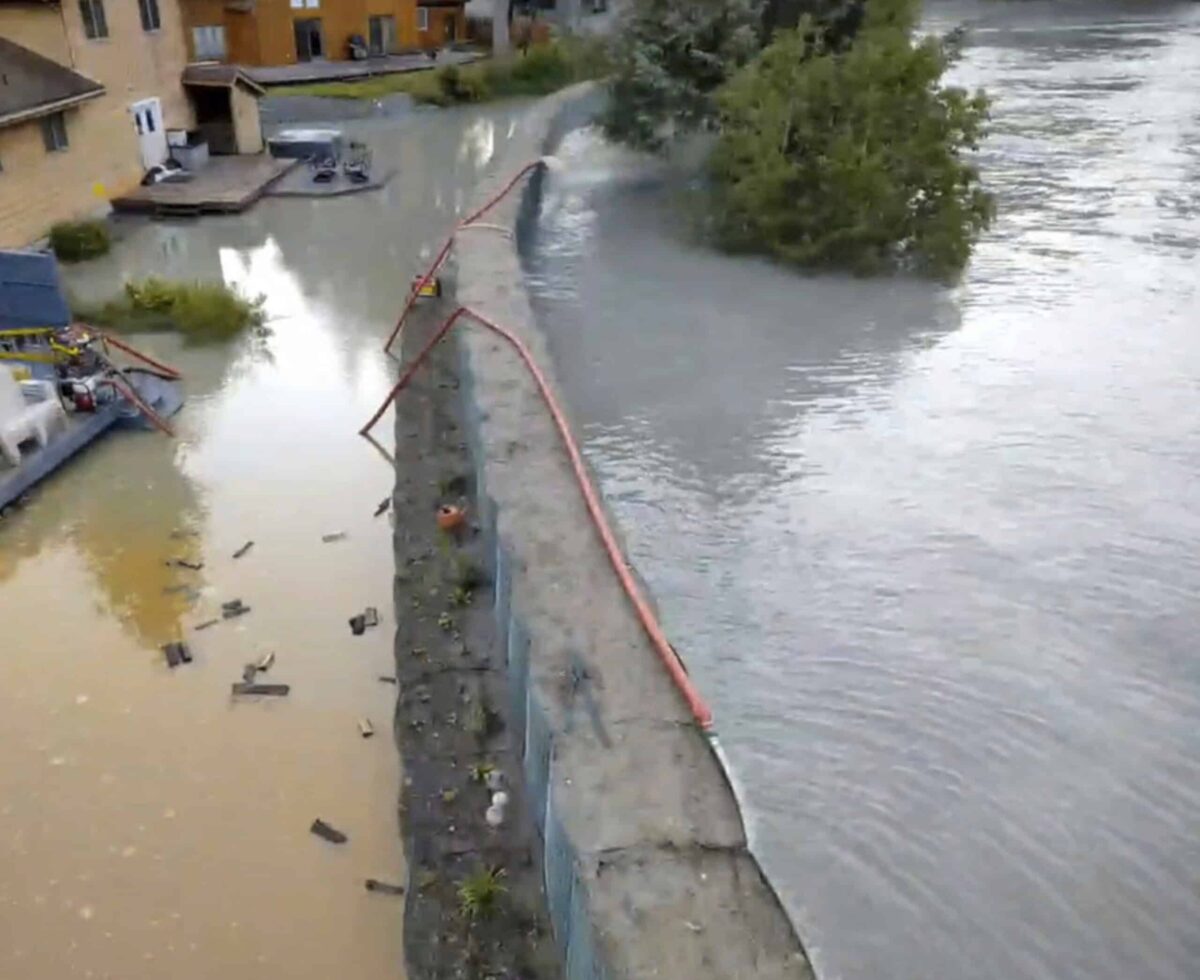
NOTN- The City and Borough of Juneau formally accepted Advance Measures Assistance from the U.S. Army Corps of Engineers, to begin Phase 2 of the temporary flood barrier project along the Mendenhall River, city officials announced Thursday.
This marks the next major step in the city’s ongoing effort to protect homes and infrastructure from recurring glacial outburst floods or GLOFs originating from Suicide Basin.
“The Army Corp has committed to helping, really, really substantially with phase two of our short-term mitigation efforts.” Said Deputy City Manager Robert Barr, “And also, to really pursue a quite ambitious timeline for an enduring solution, solutions that would mitigate GLOFS, in such a way that we won’t be seeing these massive 15, 16 plus flood events. So thats really, really good news.”
The Army Corps will provide 100% federally funded assistance to install new riverbank armoring and temporary flood barriers along unprotected sections of the Mendenhall River. The agency will also offer technical support and repairs to the existing flood barrier system completed earlier this year under Phase 1.
“The Phase 2 project is almost three times the size of the first,” said Mayor Beth Weldon.
Construction could begin as early as next spring, Weldon said.
Thursday night’s briefing also featured presentations from scientists and engineers with the University of Alaska Southeast and the National Weather Service.
“The science presentations we received from the university and the weather service were just phenomenal. They’ve been such impressive partners and so important in this work.” Said Barr, “It’s hard to imagine where we would be were it not for the work, it’s really guided and advised us and everyone that’s been working in emergency response and policy management. So really huge kudos to the university and the geological service and the weather service.”
The Army Corps, and the Natural Resources Conservation Service also presented. The NRCS discussed its Emergency Watershed Protection Program, which could provide funding for potential buyouts of flood-prone properties on View Drive.
Phase 2 of the temporary flood barrier would extend protection to remaining populated areas along the river not covered in the first phase.
The carapace, or upper shell, of an invasive European green crab and a live live green crab are shown in this undated photo. Ever since Alaska’s first green crabs were found on Annette Island in 2022, numbers have exploded and the invaders have spread north. (Photo by Linda Shaw/National Oceanic and Atmospheric Administration Fisheries Service)
When a young Sealaska intern walking a beach in July 2022 found the first evidence of European green crab presence in Alaska – a discarded shell on a beach on Annette Island in the state’s far southeast corner – it was an ominous sign about the invasive species’ northward spread.
Since then, the Metlakatla Indian Community, the tribe based on Annette Island, and its partners, which include Alaska Sea Grant, have found not just more shells, but live invasive crabs. Discoveries numbered just a handful at first, then dozens, then hundreds, then thousands.
This year, the Metlakatla tribe’s team has trapped more than 40,000 of them on and around Annette Island, a representative said.
“This year we’ve had a complete explosion of green crab — over seven new locations on Annette Island we found green crab, and eight new locations off Annette Island,” said Nicole Reynolds, an environmental specialist working with the tribe, in a presentation at a three-day Anchorage meeting on invasive species in Alaska this week.
The more than 40,000 crabs removed this year compares to last year’s total of 1,800, Reynolds said.
European green crabs are small, usually measuring no more than 4 inches wide, but they are powerful forces of destruction. They mow down eelgrass beds that are vital habitat for salmon and other native species. And they gobble up native marine life like juvenile salmon, clams, mussels and juvenile Dungeness and other crabs that are important to commercial and subsistence harvests.
“They’ll eat the baby crabs. They’re meaner and tougher than the Dungeness,” Reynolds said during a break in the annual Alaska Invasive Species Partnership Workshop.
European green crabs have already spread north of Annette Island. Last year, they were found at Gravina Island, and this summer they were found by participants in a local university class at beaches in Ketchikan that lie about 30 miles north of the initial Annette Island discovery site.
Just this month, they were found at Etolin Island, Reynolds said. Etolin Island is roughly 60 miles northwest of the city of Ketchikan, making it the northernmost North America discovery to date.
And now European green crabs appear to be entrenched in Alaska waters for good, Reynolds and Genelle Winter, a grant administrator with the tribal government, told the workshop audience.
That means the fight against green crabs will also have to be long-term, Winter said, with a permanent staff and a strategy of what is known as “functional eradication.” That is an eradication strategy that accepts the reality of the invaders’ presence in some places, but tries to keep them out of other places with resources that are most important to protect.
Nicole Reynolds and Genelle Winter of the Metlakatla Indian Community pose on Oct. 28, 2025, with a sticker bearing a European green crab design created by local artist, Elizabeth Anderson. The crab face was made intentionally angry and mean-looking, to help send the message about the destruction caused by this invasive species. Reynolds and Winter presented information at the annual Alaska Invasive Species Partnership Workshop in Anchorage about the Tribe’s work to combat the spread of European green crabs. The first discovery of the crabs in Alaska was in 2022 at Annette Island in the far southeast corner of the state, and they have proliferated in Alaska waters since then. (Photo by Yereth Rosen/Alaska Beacon)
Such a strategy involves “focusing all our efforts on protecting the most vital subsistence and commercial resources,” she said.
Conditions in Alaska waters, the farthest-north spots in North America where the crabs have spread, do not faze the invaders, DNA analysis shows. For that information, the tribe consulted with an expert, Carolyn Tepolt of the Woods Hole Oceanographic Institute. Tepolt has also been investigating the genetics of green crabs that have invaded Washington state.
Tepolt’s analysis found that the green crabs in Alaska are a genetic blend of those in Washington and British Columbia, diverse enough to persist in the more northern waters, Reynolds said.
“She even called it a ‘super-crab’ just because of how perfectly genetically suited it is for the environment in Southeast Alaska,” Reynolds said.
European green crabs have been altering North American marine ecosystems for a long time.
They were first found in East Coast waters in the early 1800s, likely carried there in ship ballast water. The first West Coast discovery was in 1989 in San Francisco Bay. Since then, they have been spreading north up the Pacific coast. They were first confirmed in British Columbia in 1999 and continued moving up that Canadian province’s coast before being found at Annette Island three years ago.
Beyond the accidental releases through ballast water, scientists say warming conditions are aiding the spread of green crabs. Larvae are more likely to survive in warmer waters brought on by climate change and weather events like El Nino cycles.
The 2023-2024 El Nino, which warmed Alaska waters, is a possible factor in this year’s explosion of green crabs in Southeast Alaska, the Metlakatla tribal representatives said.
Warmer temperatures than those that used to be normal in Alaska marine waters are known to encourage green crab proliferation.
A study by Danish scienetists that was published in September identifies a temperature range that appears ideal for the crabs. At temperatures of 12.5 to 16.6 degrees Celsius, or 54.5 to 61.9 degrees Fahrenheit, European green crab abundance peaked, the scientists found.
Average temperatures in Southcentral Alaska’s Cook Inlet were within that range this August, an indication that conditions would be suitable for green crabs if they somehow reach that area.
Nicole Reynolds, an environmental specialist with the Metlakatla Indian Community, shows a photo stored on her phone of an unusual-looking European green crab collected this year. The Tribal government is at the forefront of the campaign to try to control the spread of the invasive species, which eats native species and damages habitat used by fish. Reynolds presented information about the Tribe’s work at the annual Alaska Invasive Species Partnership Workshop in Anchorage. (Photo by Yereth Rosen/Alaska Beacon)
Preparations are already underway in Alaska for what experts believe is an inevitable spread north from the Southeast region.
In Southcentral Alaska’s Kachemak Bay, over 700 miles northwest of Ketchikan, residents this summer deployed over 60 traps in what was effectively a pre-invasion drill. The program was a cooperative effort of the Kachemak Bay National Estuarine Research Reserve, the Seldovia Village Tribe and its council member, Michael Opheim, and the U.S. Fish and Wildlife Service.
There and elsewhere, a big part of the fight against green crab infestations is public education.
European green crabs can be identified by the array of bumps on their shells. They have five sharp spikes on either side of their eyes and three lobes in between their eyes. Despite their name, they are not always green – they can be red, yellow or mottled. Some of those found by her team have even been blue, Reynolds said.
To help boost awareness, local Tsimshian artist Elizabeth Anderson has designed a green crab logo – with an angry face to reinforce the message that the species is a bad actor, Winter said.
In Metlakatla, awareness appears to be keen already, including among some of the youngest residents.
“The other day, the mayor was driving down the street and got flagged down by two little kids. And they said, ‘We found some green crab! We know its green crab because it’s 5-3-5,’” Winter said during the workshop presentation. The numbers reference the array of shell bumps on a green crab. “Those little kids absolutely knew how to identify the European green crab.”
Those crabs, found at a beach right in front of town, were stashed in a plastic bag and added to this year’s count, Winter said.
Aside from identifying, trapping, counting, measuring and analyzing the European green crabs, the inundated community faces another challenge: what to do with thousands of unwanted invaders.
In Metlakatla, the ultimate destination is the community compost heap. That is a good end use, Reynolds said. “They add heat to the compost, and because it’s cold and wet in Southeast, it’s actually really helpful to have more heat,” she told workshop attendees.
On the East Coast and elsewhere, some of the eradication work involves eating the invaders. Experts say they have little meat but can be useful for making soups. One organization, Greencrab.org, has compiled recipes and sells a cookbook and T-shirts with a catchy slogan: “If you can’t beat them, eat them.”
European green crab specimens preserved in plastic are displayed on Oct. 28, 2025, at the annual Alaska Invasive Species Partnership Workshop in Anchorage. Although they are called green crabs, they come in different colors, and heat can turn their shells orange. (Photo by Yereth Rosen/Alaska Beacon)
Longtime Juneau broadcaster Pete Carran, a voice synonymous with “News of the North” and a cornerstone of Alaska journalism for more than five decades, died Wednesday October 22.
He was an Alaska Broadcasters Association Hall of Fame inductee, recognized for his lifelong contributions to radio and television news across the state.
Pete’s path to the microphone ran through service as a young man, he trained at the Defence Information School and was assigned to Alaska during the Vietnam era, a twist of fate he called the most fortuitous of his life.
Carran’s career stretched from Anchorage to Homer to Juneau, , Carran worked on the air at KFQD-AM, KAKM-TV, KTNX Radio, and KTUU-TV, all in Anchorage. He also took a year and put KBBI public radio on the air in Homer. There, he served as General Manager.
Here in Juneau, Carran’s career included stints at KJNO, KTOO-TV and most recently KINY.
Listeners across Southeast Alaska knew Carran as the familiar voice behind KINY’s “News of the North,” a program he helmed for more than 20 years. He also hosted the community talk show “Action Line” and served as a mentor to generations of young broadcasters and journalists.
His induction into the Alaska Broadcasters Association Hall of Fame cemented his legacy as one of the state’s most respected and enduring voices.
Carran had been battling Idiopathic Pulmonary Fibrosis.
CBJ- Several Glacial Lake Outburst Flood (GLOF) mitigation topics will be presented by local experts and federal agencies during a Special GLOF Assembly Committee of the Whole Meeting on Thursday, Oct. 30.
The special meeting agenda includes presentations on recent key studies and understanding of the science of Suicide Basin from University of Alaska Southeast and the National Weather Service. Representatives from two branches within the United States Army Corps of Engineers (USACE) will be present to walk through next steps for their respective programs, including both short-term mitigation and progress toward identification of an enduring solution.
The Natural Resources Conservation Service (NRCS) will present on the Emergency Watershed Protection Program and the potential buyout program for View Drive.
Thursday’s meeting will begin at 6 p.m. in City Hall Assembly Chambers and online at the link below. As is standard with Committee of the Whole meetings, public testimony is not included in the agenda, however, members of the public are invited to share questions and comments on the topic at boroughassembly@juneau.gov and emergencyresponse@juneau.gov.