NOTN- Capital City Fire/Rescue responded to another trailer fire in the Switzer Creek area earlier today, and according to a statement released on their social media, extremely cold temperatures have complicated firefighting and emergency response operations.
The post said the severe cold can cause firefighters to fatigue more quickly and can even lead to equipment freezing or malfunctioning. Accessing structures also proves more difficult due to weather conditions.
CCFR reported receiving medical calls during the fire, stretching available resources and requiring crews to triage incidents as the fire response continued.
The statement said, “If it’s not a time-sensitive emergency or they are in a clinic setting, we will have to delay responses and get to them as quickly as we can, we apologize for some of the delays, however that’s the reality of a small town without neighboring departments to help fill it.”
NOTN- Juneau’s Parks and Recreation Department has a full slate of programs this winter, even as city officials prepare for difficult budget decisions that could affect long-term funding.
Mark Wheeler, recently appointed director of City and Borough of Juneau Parks and Recreation, said as the City and Borough of Juneau continues discussions on its upcoming budget, funding remains the department’s biggest challenge.
“Our biggest constraints are funding with our budget.” said Wheeler, “If you care about parks and Rec, we would love to have your voice be heard.”
Parks and Recreation operates multiple facilities and programs across the community, and future citywide cuts could force some difficult decisions.
The city will roll out a three phase public engagement process to better understand community priorities, facing next fiscal year.
“We are doing a public process, we will try and figure out what we need to know from the residents and how they can engage with us about these services and other things that are going to be affected by the budget cuts.” Said Juneau Mayor Beth Weldon, “So what we hope to achieve is basically gathering community input to have a deeper understanding and depth of knowledge of our CBJ services.”
In January, residents can expect an online survey, with QR codes distributed throughout the community for easy access.
The final phase will involve in-person engagement, featuring small interactive workshops, limited to 25 participants each for deeper discussion as well as a community listening session where citizens can testify about the budget.
Even facing the upcoming funding challenges, the department is promoting several winter offerings designed to keep residents active through Juneau’s bitter cold this December, including its winter recreation pass.
The Parks and Recreation winter pass is available for $200 and provides unlimited access through March 31 to city pools, the Treadwell Arena, the Dimond Park Field House and the Mt. Jumbo Gym. Wheeler described the pass as one of the department’s best values.
“It’s a great bargain,” he said.
Parks and Recreation staff are also encouraging residents to follow the department online for updates on programs, facility schedules and upcoming events as the season progresses.
NOTN- A 38 year old man has died following a residential structure fire Saturday night in Juneau.
According to an information release, the Juneau Police Department said officers were called to a report of a structure fire in the 6500 block of Glacier Highway at about 7:30 p.m. on Dec. 20, after a caller reported that a resident might still be inside the home.
Police and Capital City Fire/Rescue responded to the scene. After firefighters extinguished the blaze, they located the body of a 38-year-old man inside the residence.
Sunday, first reported by the Juneau Independent, the deceased was identified as Calvin Olsen. Next of kin have been notified.
The cause of the fire remains under investigation.
Cook Inlet near Clam Gulch is seen on Oct. 23, 2025. (Photo by Yereth Rosen/Alaska Beacon)
The Trump administration on Friday affirmed a controversial federal Cook Inlet oil and gas lease sale held at the end of 2022, asserting that impacts to endangered beluga whales and other resources were adequately considered and no changes in the leasing plan are needed.
In a Federal Register notice scheduled to be published on Monday, the U.S. Bureau of Ocean Energy Management announced its decision to uphold Lease Sale 258 as held. The decision “balances the national policies mandated by Congress to expeditiously and safely develop the natural resources of the (Outer Continental Shelf), subject to environmental safeguards, in a manner that is consistent with the maintenance of competition and other national needs,” the notice said.
The lease sale, mandated by Congress in the Inflation Reduction Act of 2022, offered 193 blocks over nearly 1 million acres, but it drew only one bid. The sole bid was from Hilcorp, the dominant oil and gas operator in the inlet.
The auction went through a tumultuous history and remains a subject of debate.
Planning for the sale started in 2020, but two years later, the Biden administration canceled it, citing a lack of industry interest. The sale was resurrected by a provision in the Inflation Reduction Act of 2022 that was inserted by then-Sen. Joe Manchin, D-West Virginia. That provision required Lease Sale 258 to be held by the end of 2022; it was ultimately held on Dec. 30 of that year.
Environmental groups that sued to block the sale secured a victory after it was held. U.S. District Court Judge Sharon Gleason ruled in July 2024 that pre-sale studies failed to properly analyze impacts to endangered Cook Inlet beluga whales and other resources. Gleason ordered BOEM to do the new analysis of beluga and other resource impacts, putting the sole lease that was sold into suspension.
The agency considered three additional alternatives that would have increased protections for belugas and other resources, but it rejected those and kept the original plan in place, according to the document.
“As LS 258 has already occurred, selecting any alternatives other than those described above would not affirm that lease sale and would void the one lease issued as a result of it,” the Federal Register notice said.
In its supplemental environmental impact statement, BOEM asserted that the risks of leasing and the development that would result from it are minor for Cook Inlet belugas and other marine mammals.
“The likelihood of a large oil spill affecting Cook Inlet marine mammals is relatively low, but the consequences could affect some populations. Sea otters face the highest vulnerability from a large spill due to their dependence on fur for insulation, resulting in a moderate impact level. Cook Inlet beluga whales are at risk due to the small population size, but geographic and temporal factors substantially reduce the risk of exposure to a large spill, yielding a minor overall impact level,” the document said.
The agency’s impact statement also describes impacts of noise as minor. While Cook Inlet belugas are highly dependent on hearing other whales’ calls to navigate the murky waters, ship and industrial noise that would drown out those calls “are expected to be temporary, with anticipated localized effects on beluga behavior and no anticipated long-term effect on survival or fitness.” Additionally, no injuries to belugas are expected from lease-related activities, the document said.
A beluga mother, in front, and her darker calf swim in Cook Inlet waters in this undated photo. A federal judge ordered the U.S. Bureau of Ocean Energy Management to do more to analyze oil leasing impacts on the endangered Cook Inlet beluga population. (Photo by Janice Waite/National Oceanic and Atmospheric Administration)
The three new alternatives that BOEM considered would have added new protections for marine mammals and for subsistence and commercial fishing. Those alternatives would have reduced the available leasing territory in different increments, ranging from about one fifth to nearly half, according to the document.
The environmentalists who sued to overturn the lease sale criticized the decision and the lack of public participation leading up to it.
“BOEM’s decision to conduct the whole process in secrecy represents the federal government’s new approach to cutting the public out of decisions about our waters, and favoring the billionaire class and giant corporations over the people who call this place home. We are disgusted by this rushed and sloppy process on this final SEIS,” Bridget Maryott, co-executive director at Cook Inletkeeper, said in a statement, referring to the agency’s just-published supplemental environmental impact statement.
Hannah Foster, an attorney for Earthjustice, the environmental law firm that represented the plaintiffs, called the process leading to the decision a “black box.”
“We won our challenge against this lease sale because Interior failed to adequately consider sale alternatives and the impacts to the endangered beluga whales that will be harmed by blaring vessel noise and other oil industry operations. Yet BOEM has now reaffirmed the sale without seriously considering new alternatives or imposing any new measures to protect belugas,” she said in the statement.
Foster said Earthjustice and its clients are still reviewing the information about BOEM’s decision.
Including the lease sold in 2022, there are currently eight active leases in federal waters of Cook Inlet, all held by Hilcorp.
The Trump administration has already started planning a new Cook Inlet oil and gas lease sale, the first of six nearly annual sales mandates for the inlet through 2032 under the sweeping budget bill that was called the One Big Beautiful Bill Act.
Additionally, the administration included five Cook Inlet lease sales among the 21 it has proposed for federal waters off Alaska through 2031. Those 21 sales are proposed in the administration’s five-year outer continental shelf oil and gas leasing plan, released last month. It envisions oil development in nearly all federal waters off the state’s coasts.
The five-year plan drew praise from Gov. Mike Dunleavy, a Trump ally.
“Once again, the Trump Administration is leading the way to American energy dominance by restoring confidence in the federal government’s offshore leasing policies,” Dunleavy said at the time in a post on the social media site X.
NOTN- Santa Claus will come to Juneau this weekend aboard a Capital City Fire/Rescue engine.
According to Capital City Fire/Rescue the Santa Run will take place tonight from 5:30 to 7:45 pm and tomorrow from 4:00 to 7:55 pm.
There has been adjustments due to the weather, instead of walking the routes, CCFR is inviting residents to join Santa at one of the designated stops throughout Juneau.
On Saturday, Santa will stop at Gruening Park, the Tram parking lot and will conclude his visit at Gastineau Elementary schools.
Firefighters say Santa will be accompanied by the Grinch, and candy canes will be handed out to children throughout the evening.
Event details and stop information are available on the Capital City Fire and Rescue Facebook page.
T.J. Duffy Organist and musician at the Alaska State Office Building, photo courtesy of T.J. Duffy
This story has been corrected, the Organ was stationed at the Gross Alaska Theater, not Goldtown.
Longtime Juneau organist and State employee T.J. Duffy will perform his final noon organ concert tomorrow, closing a chapter that has spanned nearly 16 years of weekly performances in downtown Juneau.
Duffy, who has been a fixture of Juneau’s music scene since arriving in 2009, said the concerts have been one of the great joys of his career.
While he is retiring from the series, he emphasized that he is not stepping away from music entirely.
“I have loved giving these concerts.” Duffy said, “But since I’m retiring, I’ve got my sights set on some other things.”
The noon organ concerts trace their roots back decades. The instrument is housed in an office building but it has lived in other locations across the capital city including at Gross Alaska Theater.
The organ was donated to the city on the condition that it remain in Juneau.
Early performances sometimes coincided with visits from dignitaries.
Over the years, Duffy’s concerts have drawn a wide range of listeners, Duffy is a classically trained musician and has played across genres in his career, with his noon concerts showcasing classic rock anthems from Metallica to Twisted Sister.
One memory stands out for him involved a concertgoer who was both deaf and blind.
“He comes to the concerts. And when he does, he likes to press his body up against the instrument and feel the vibrations.” Duffy said.
As he prepares for his final performance, Duffy expressed hope that the tradition of noon organ concerts will continue with a new generation of musicians.
“Organists, we’re a dying breed, what I hope is any promising music student who’s in music school right now, might come up for a visit and consider staying.” Duffy said.
Duffy said his final concert will be a celebration. He plans to invite the audience to sing along and will provide lyric sheets featuring familiar Christmas music.
“I’m really hoping for a big crowd,” said Duffy, “If you love to sing, come out tomorrow.”
The concert will mark the end of an era for a longtime Juneau musical tradition, one that Duffy helped sustain and shape for nearly two decades.
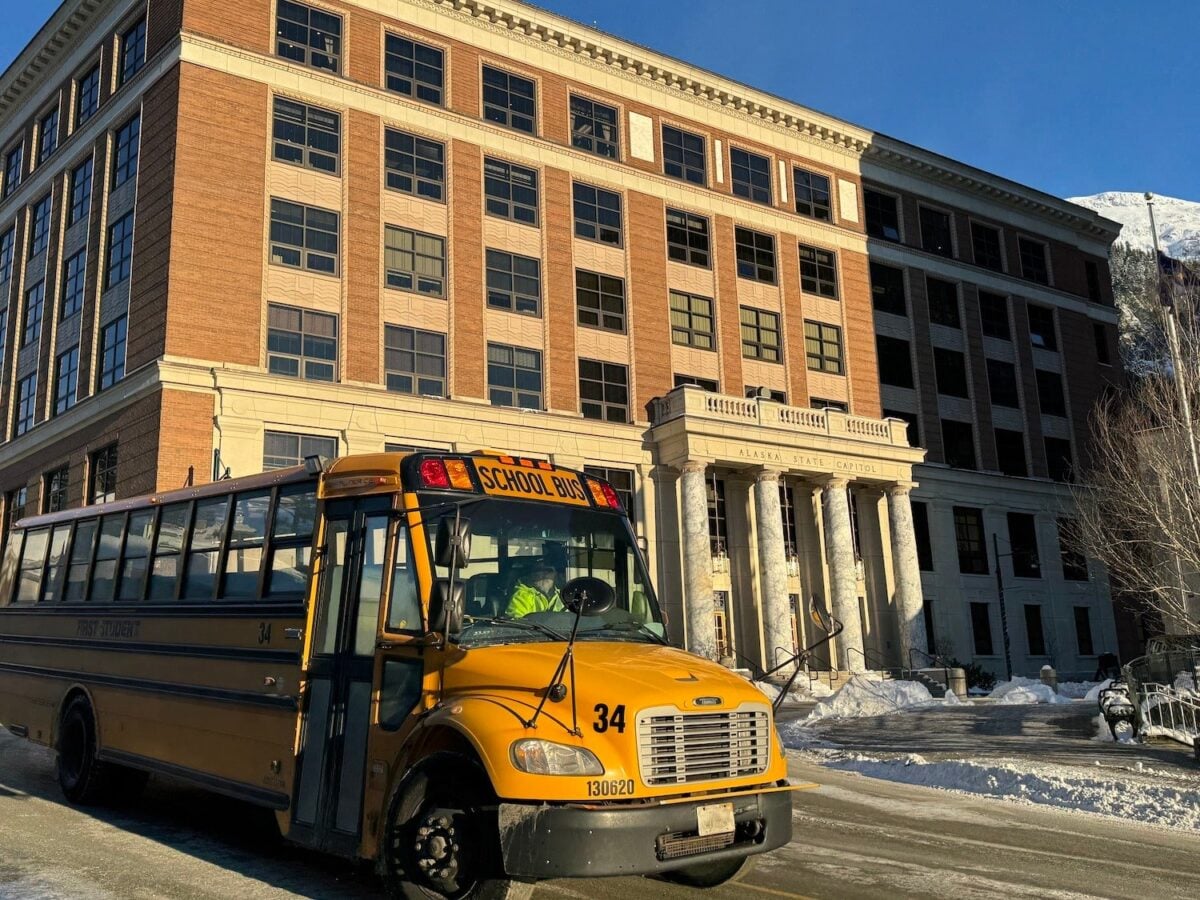
A school bus drives in front of the Alaska State Capitol on Monday, Feb. 3, 2025. (Photo by James Brooks/Alaska Beacon)
A school bus drives in front of the Alaska State Capitol on Monday, Feb. 3, 2025. (Photo by James Brooks/Alaska Beacon)
NOTN- The Juneau School District has begun work on a new five-year strategic plan aimed at guiding the district through academic, organizational and financial challenges ahead.
“Strategic planning is a really important process for school districts being able to plan for the future.” Said Board of Education member David Noon, “Everyone is focused on the direction and the vision, where a district wants to go.”
Superintendent Frank Hauser said the planning process comes as the district concludes its previous strategic plan, adopted in 2020. School district strategic plans are typically updated every five years.
The current planning process began last spring and has included focus groups, surveys and meetings with community members, staff and district stakeholders. The goal, Hauser said, is to define clear priorities and outcomes for the next phase of the district’s work.
Noon said the plan centers on several key areas, “There’s a couple of major areas that we are aiming to focus our attention on over the course of the next five years, obviously starting first with the students, the second couple of which deal with the organization itself, the district staff. How do we recruit talented teachers? How do we as an organization act in a responsible way that’s driven by integrity? And then there’s also the financial, fiscal and operational sort of security that we’re trying to guarantee.” Noon said, “So we definitely are using the experience of the consolidation and thinking about the atmosphere of education funding in Alaska and, of course, nationwide as we develop this plan for the next five years. We can’t predict the future, but we can create a structure that allows us to adapt to whatever happens over the next couple of years while not just reacting to it.”.
Hauser said the strategic plan will also play a critical role in guiding budget decisions based on community priorities.
“From a budget perspective, when the community comes together and develops that strategic plan and everyone gets behind that, the board, through the budgeting process, can identify what the primary goals are.” Hauser said.
The draft strategic plan is now in its final phase and is expected to be presented to the Board of Education for a first reading in January, followed by a second reading shortly after.
Public input remains part of the process. The draft plan is available on the Juneau School District website, and community members may provide feedback during regular board meetings, held on the second Tuesday of each month, or by contacting board members directly.
Hauser, who announced earlier this year that he will be leaving the superintendent position, said the strategic plan is intended to provide continuity as leadership transitions occur.
“We’ve done a lot of great work here, the Juneau school district staff are some of the best staff in the world.” Hauser said, “Consolidation was hard. Those were really tough decisions. But I think, in looking at the future, we’re on much better financial footing. There are still challenges with the budget, but I think coming together and putting together a fiscal plan that is more focused, and having opportunities for kids, and even through the consolidation, being able to maintain those opportunities for our students and still see growth, those are the things I’m really proud of.”
Road construction is seen on March 12, 2017, at ConocoPhillips’ Greater Mooses Tooth Unit in the National Petroleum Reserve in Alaska. (Photo by Sarah LaMarr/U.S. Bureau of Land Management)
Alaska Gov. Mike Dunleavy’s administration is proposing to divert money from a program intended to compensate North Slope communities for the side effects of oil and gas drilling on federal land near them.
As Dunleavy prepares to unveil a long-term fiscal plan, the state is proposing to use at least some of that money across Alaska instead.
“Definitely a big deal,” said Alexei Painter, director of the Legislative Finance Division, which analyzes the budget on behalf of legislators.
It’s funded through revenue generated by oil production on federal land in the North Slope, and it is expected to grow significantly in coming years as more oil is produced from projects like Willow, which is located in the vast petroleum reserve between Utqiagvik and the Prudhoe Bay oil field.
The Willow project alone, for example, is expected to generate $3.1 billion for the grant program between 2029 and 2053, a boon for the borough’s 10,583 residents.
But in documents published recently, the Department of Revenue has reclassified money for the program as “unrestricted,” meaning it could be spent in a variety of ways.
During a Wednesday meeting of the Alaska Permanent Fund Corp. board of trustees, CEO Deven Mitchell told the board that he had just heard “that there’s been a federal law change” that could see more money end up in the Permanent Fund.
Mitchell couldn’t recall where he had read about that change, but it appears in the state’s newly published revenue forecast, which covers the fiscal year that starts July 1.
In several footnotes, the Department of Revenue describes a shift in policy. Currently, revenue from the leasing of federal land in the petroleum reserve is deposited in “a special revenue fund” dedicated to a particular purpose.
That changes with the new fiscal year, when “these payments will be divided between unrestricted revenue (74.5%), the Permanent Fund (25%) and Public School Trust Fund (0.5%).”
That would mean money from NPR-A would end up in the state’s general-purpose accounts, usable for services statewide or the Permanent Fund dividend.
Last year, the department wrote, “The federal government dictates that shared NPR-A revenue must be used for specific purposes, and therefore it is considered restricted revenue in this forecast.”
This year, that sentence doesn’t appear.
Comparing the two forecasts shows the difference. Last year, the department labeled NPR-A revenue as “restricted,” or locked in to a particular purpose. In the new fall forecast, it’s “unrestricted,” or available for general use.
While only $9.6 million in NPR-A revenue is expected in the next fiscal year, the state forecasts that amount will rise significantly after the end of the decade — to more than $200 million per year by 2033.
Speaking to reporters last week, an official with the Office of Management and Budget said the Alaska Department of Law was evaluating how changes to federal law in the Big Beautiful Bill Act will change the distribution of revenue to the state and local communities.
That act, passed with the enthusiastic endorsement of Republicans in Congress and President Donald Trump, calls for the state to receive 70% of revenue from oil and gas leases on federal land in the National Petroleum Reserve, Arctic National Wildlife Refuge and Cook Inlet, starting in fiscal year 2034.
The Department of Revenue concluded that clause will ultimately have little effect.
“Since all current and forecasted production in the NPR-A is located on leases issued before 2025, only a small portion of revenue within the current forecast period is expected to receive the 70% share,” the department wrote in its new forecast.
More important for the short term, the Act contains a clause stating that “for each of fiscal years 2025 through 2033, 50 percent (of federal-land oil revenue) shall be paid to the State of Alaska.”
Previous federal law contained a 50-50 split but also contained a clause stating that “in the allocation of such funds, the State shall give priority to use by subdivisions of the State most directly or severely impacted by development of oil and gas leased under this Act.”
That priority doesn’t appear in the Big Beautiful Bill.
As a result, the Alaska Department of Law is determining whether the state may choose to keep that money for direct uses instead of sending it to communities, the OMB official said.
As a precondition for the interview, reporters agreed to allow the official to speak on background and not be quoted directly.
The Alaska Department of Law did not respond to an emailed inquiry about the effort, nor did staff for any of Alaska’s three members of Congress, who were instrumental in adding that language to the Big Beautiful Bill Act.
The North Slope Borough was unable to comment before deadline Wednesday. Officials from VOICE of the Arctic Inupiat, an organization that has acted as a local booster for oil production, also did not return a message seeking comment.
Alaska State Troopers said in a bulletin Monday that Dr. Ryan McDonough died in a weekend fire at his home in Wasilla.
At the time of the fire, McDonough — a cardiologist formerly with Mat-Su Regional Medical Center — was on $50,000 bail after being arrested on Dec. 11 and accused of owning child sexual abuse images.
The fatal fire at McDonough’s home took place Saturday; McDonough was initially listed as missing after the fire, but firefighters found human remains at the site, and preliminary testing later identified McDonough’s body.
The cause of the fire remains under investigation, and the other people who lived at the home were unharmed.
Alaska Gov. Mike Dunleavy appointed McDonough to the state medical board in August. That month, he joined other members of the medical board in voting to impose restrictions on medical care for transgender youth in the state and to recommend that Alaska lawmakers end legal access to abortion in the late stages of pregnancy.
McDonough subsequently appeared to drop off the board; he attended its August and September meetings but was absent from its October and November ones, public records show.
McDonough’s name was removed from the board’s roster in November. A spokesperson for Dunleavy told the Anchorage Daily News that the governor’s office found out about McDonough’s alleged crimes on Friday and was not aware of any investigations at the time of his appointment.
According to an affidavit submitted in Palmer courts by a Department of Homeland Security officer, the online file storage company Dropbox sent a tip to the National Center for Missing and Exploited Children on July 31.
That tip led to the investigation of a Dropbox account linked to McDonough that contained a video of a child being sexually abused. A second tip followed another video on Aug. 10.
The Anchorage Police Department, in charge of investigating tips like those received by the National Center, obtained a search warrant for McDonough’s Dropbox, GCI and Google accounts. Subsequent searches found additional suspect videos, and McDonough’s computer was seized during a search warrant on Dec. 11, shortly before his arrest.
The Alaska Beacon typically publishes copies of court affidavits but is not doing so in this case because of their graphic contents and because they describe acts of sexual violence against children.
McDonough’s next court appearance was scheduled for Jan. 31.
The sun at midnight in early July reflects on the Chukchi Sea and slabs of sea ice near the coastline of Utgiagvik. Credit: Lisa Hupp/USFWS.
The National Oceanic and Atmospheric Administration issued its annual Arctic Report Card on Tuesday, which documents the way rising temperatures, diminished ice, thawing permafrost, melting glaciers and vegetation shifts are transforming the region and affecting its people. The agency has released the report for 20 years as a way to track changes in the Arctic.
“The Arctic continues to warm faster than the global average, with the 10 years that comprise the last decade marking the 10 warmest years on record,” Steve Thur, NOAA’s acting administrator for oceanic and atmospheric research and the agency’s acting chief scientist, said at a news conference Tuesday.
The report card is a peer-reviewed collaboration of more than 100 scientists from 13 countries, with numerous coauthors from the University of Alaska Fairbanks. It was officially released at the American Geophysical Union’s annual meeting in New Orleans, where Thur and other officials held the news conference.
The report is the first under the second Trump administration, at a time when the federal government’s commitment to documenting Arctic climate change has diminished: The president has repeatedly called climate change a hoax and federal departments are cancelling climate change-related research and projects, as well as scrubbing climate information from public view.
Under directives from the Trump administration, NOAA no longer provides information that the National Snow and Ice Data Center once used to monitor sea ice and snow cover, for example. The Colorado-based center now relies on satellite information from the Japan Aerospace Exploration Agency for its sea ice reports, and it has reduced its analysis.
A national dataset about the melt of the Greenland Ice Sheet has also been lost to the Trump administration’s cutbacks, said Rick Thoman of the UAF’s Alaska Center for Climate Assessment and Preparedness, one of the report’s main editors. The ice sheet is still being monitored by European satellites, but the data is not equivalent, he said.
Government entities like NOAA’s Alaska Fisheries Science Center, which regularly provides scientific information that goes into the Arctic Report Card, have endured deep budget cuts and staff firings.
On Tuesday, Russel Vought, President Donald Trump’s Office of Management and Budget Director, said the administration plans to close the National Center for Atmospheric Research, a Colorado research facility that has operated since 1960. The facility “is one of the largest sources of climate alarmism in the country,” Vought said in a post on the social media site X.
And this year, unlike the other years since 2006 when NOAA published the first Arctic Report Card, the agency declined to issue a news release about it.
Thur, asked if NOAA will continue to publish report cards in the future, said the agency will continue the work that goes into the annual documents.
“What I would say in response to that question, is that we’re here today and that we have released the 2025 version,” he said. NOAA has continued its long-term environmental observations in the Arctic, both with satellite observations, he said. “So I think one of the things that the community can rely upon is that our efforts to continue to observe the planet will remain present,” he said.
The Mendenhall River is seen at flood levels, just a few hours after the record-breaking peak of 16.65 feet, from the Brotherhood Bridge in Juneau on Aug.13, 2025. The flood, caused by an outburst of meltwater from Mendenhall Glacier, was mentioned in the 2025 Arctic Report Card as one of the impacts of glacial melt. (Photo by Corinne Smith/Alaska Beacon)
Thur also demurred when asked whether NOAA still stands by the statements about fossil fuels made by the agency’s prior administrator, Rick Spinrad. When last year’s report was issued at the end of the Biden administration, Spinrad said the changes in the Arctic were directly related to fossil-fuel emissions. Thur did not mention fossil fuels.
“What I would say in response to that question is that we recognize that the planet is changing dramatically,” he said during the news conference. “Our role within NOAA is to try to predict what’s going to occur in the future by documenting what’s occurring today,” he said. “There is a human role, as our administrator currently, Dr. Neil Jacobs, said during his congressional confirmation hearing, for humans in influencing those changes.”
Matthew Druckenmiller of the National Snow and Ice Data Center, another lead editor of the report, made no such equivocations.
“Let us start by first acknowledging that the warming of our planet driven by human greenhouse gas emissions into our atmosphere is amplified in the Arctic,” he said near the start of the news conference. “The Arctic continues to warm much faster than the globe overall, amplified by the loss of reflective sea ice and snow, causing more of the sun’s heat to penetrate into land and ocean.”
Druckenmiller also said the Trump administration did not interfere with drafting of the report.
“I can say that in producing the Arctic report card in 2025, we did not receive any political interference with our results,” he said.
Lower sea ice, more precipitation, more melt and thaw
Some of the main messages in this report concern superlatives, while others describe a continuation of long-term changes.
It was the Arctic’s hottest year in a record dating back to 1900, the report said. The past year’s winter sea ice maximum was the lowest in the satellite record, which dates back to the late 1970s, and sea ice is much thinner and younger than it was in the past, the report said.
The region set a record for precipitation for the 12 months that ended in September, despite an unusually dry summer in parts of northern Canada and Eurasia. Warmer air holds more moisture, and a long-term trend of higher precipitation continues, the report said.
Across the Arctic, June snow cover extent has declined by 50% over the past six decades, since the 1960s. “Even though you’re starting out in season with more snow, it’s melting faster,” Thoman said.
For rain, there is another pattern: more heavy rain events. Those included last January’s powerful, northward pushing “atmospheric river” that stretched from the Aleutian Islands through mainland Alaska, bringing midwinter rain and flood conditions to Anchorage and elsewhere.
Alaska figures prominently in this year’s report card, as it has in past years’ reports.
Patrick Sullivan stands by an acid seep on July 15,2023. Sullivan is part of a team of scientists who tested water quality in Kobuk Valley National Park’s Salmon River and its tributaries, where permafrost thaw has caused acid rock drainage. The process is releasing metals that have turned the waters a rusty color. A chapter in the 2025 Arctic Report Card described “rusting rivers” phenomenon. (Photo by Roman Dial/Alaska Pacific University)
One chapter is devoted to changing conditions in the Northern Bering Sea and the Chukchi Sea, where a warming-related process termed “borealization” is ongoing. That refers to the transition from an Arctic ecosystem to a more southern ecosystem.
In both seas, the report said, boreal species ranging from commercially important fish like Alaska pollock and Pacific cod to tiny organisms that make up the base of the food web, have been pushing out the more cold-adapted Arctic species like Arctic cod, saffron cod and snow crab. There are impacts to people and marine mammals, the report noted.
“Warming temperatures, declining sea ice, and shifting productivity in the Chukchi and northern Bering Seas drive ecosystem changes with significant implications for fisheries, food security, and Indigenous subsistence,” the report said.
In both seas, about a third of the boreal species groups examined over time increased, while about a third of the Arctic species groups decreased. Some of those boreal species populations spiked in recent years. That long-term trend is evident despite a lot of year-to-year variation and anomalously cold conditions in the Chukchi over the past year.
A chapter about mountain glaciers, a major contributor to global sea level rise, highlights this summer’s glacial outburst flood in Juneau, a phenomenon that has become an annual occurrence in Alaska’s capital city. Glacial outburst floods are increasing in frequency and severity in certain parts of the Arctic and subarctic, said Gabriel Wolken of UAF at the news conference.
Glacial melt is also tied to another extreme event that happened this summer in Southeast Alaska: the collapse of a mountainside along narrow Tracy Arm, which generated a local tsunami that rose nearly 1,600 feet up the opposite side.
“Glacier retreat combined with slope instability can lead to landslides,” Wolken said, adding that those slides can lead to far-reaching tsunamis. “The August 10th, 2025 landslide in Southeast Alaska’s Tracey Arm illustrates the sheer power of these hazards,” he said.
A chapter in the report is devoted to “rusting rivers,” a permafrost-related phenomenon documented throughout the Arctic but especially in Northwestern Alaska. The name comes from the conversion of clear streams to rust-colored waterways, the product of iron and other chemicals that leech out from rocks because of permafrost thaw. There are more than 200 such rusting watersheds in Alaska, said Abagael Pruitt, a University of California, Davis scientist studying the subject.
Another chapter in the report describes the Indigenous science monitoring being done at the community level. That includes work by the Aleut Community of St. Paul Island, a tribal government that has established its own lab to screen traditional foods for mercury contents.
While much of the report was devoted to impacts within the Arctic and to people living in the region, its coauthors pointed out that rapid climate change in the far north affects latitudes far to the south. Sea level rise, disrupted weather patterns and shocks to commercial fisheries that are important global food sources are among the far-ranging effects of melt, thaw and other changes, they said.
Wolken, at the news conference, put it this way:
“From the deep oceans to the highest peaks, the Arctic cryosphere is undergoing rapid, interconnected and unprecedented change, and those changes matter far beyond the Arctic.”