Longtime Juneau broadcaster Pete Carran, a voice synonymous with “News of the North” and a cornerstone of Alaska journalism for more than five decades, died Wednesday October 22.
He was an Alaska Broadcasters Association Hall of Fame inductee, recognized for his lifelong contributions to radio and television news across the state.
Pete’s path to the microphone ran through service as a young man, he trained at the Defence Information School and was assigned to Alaska during the Vietnam era, a twist of fate he called the most fortuitous of his life.
Carran’s career stretched from Anchorage to Homer to Juneau, , Carran worked on the air at KFQD-AM, KAKM-TV, KTNX Radio, and KTUU-TV, all in Anchorage. He also took a year and put KBBI public radio on the air in Homer. There, he served as General Manager.
Here in Juneau, Carran’s career included stints at KJNO, KTOO-TV and most recently KINY.
Listeners across Southeast Alaska knew Carran as the familiar voice behind KINY’s “News of the North,” a program he helmed for more than 20 years. He also hosted the community talk show “Action Line” and served as a mentor to generations of young broadcasters and journalists.
His induction into the Alaska Broadcasters Association Hall of Fame cemented his legacy as one of the state’s most respected and enduring voices.
Carran had been battling Idiopathic Pulmonary Fibrosis.
CBJ- Several Glacial Lake Outburst Flood (GLOF) mitigation topics will be presented by local experts and federal agencies during a Special GLOF Assembly Committee of the Whole Meeting on Thursday, Oct. 30.
The special meeting agenda includes presentations on recent key studies and understanding of the science of Suicide Basin from University of Alaska Southeast and the National Weather Service. Representatives from two branches within the United States Army Corps of Engineers (USACE) will be present to walk through next steps for their respective programs, including both short-term mitigation and progress toward identification of an enduring solution.
The Natural Resources Conservation Service (NRCS) will present on the Emergency Watershed Protection Program and the potential buyout program for View Drive.
Thursday’s meeting will begin at 6 p.m. in City Hall Assembly Chambers and online at the link below. As is standard with Committee of the Whole meetings, public testimony is not included in the agenda, however, members of the public are invited to share questions and comments on the topic at boroughassembly@juneau.gov and emergencyresponse@juneau.gov.
FILE – Bear sculptures sit outside the Boney Courthouse, where the Alaska Supreme Court hears cases, in downtown Anchorage, Alaska, Sept. 10, 2024. (AP Photo/Mark Thiessen, File)
AP- The Alaska Supreme Court is weighing a case that is expected to determine who can provide abortion care in the state.
The court heard arguments Wednesday in a 2019 case challenging the constitutionality of a law that states only a doctor licensed by the State Medical Board can perform an abortion in Alaska.
The law, dating to the 1970s, was struck down as unconstitutional by Superior Court judge Josie Garton last year, a victory for the group that brought the challenge, Planned Parenthood Great Northwest, Hawaii, Alaska, Indiana, Kentucky. The state appealed Garton’s ruling.
Planned Parenthood has argued there is no medical justification for the restriction and that it unfairly burdens those seeking an abortion by limiting the pool of those qualified to provide care. In 2021, Garton granted the group’s request to allow advanced practice clinicians — health care workers, such as nurse practitioners and physician assistants — to provide medication abortion pending her decision in the underlying case. They have continued to do so and since the 2024 ruling also have been able to provide procedural abortions, Planned Parenthood says.
Advanced practice clinicians routinely provide care similar in risk and complexity to that of providing abortion services, and in 25 states can provide medication abortion, attorneys for Planned Parenthood said in court documents. Planned Parenthood’s advanced practice clinicians seek to provide abortion care in just the first trimester, the attorneys said.
Since Garton’s 2021 decision, advanced practice clinicians have been providing “nearly all” medication abortions in Alaska, and Planned Parenthood clinics in the state have been able to offer medication abortion each day they’ve been open, the attorneys wrote. Before that, doctors hired by Planned Parenthood on a per diem basis — at the clinics on limited days — were able to offer medication abortions perhaps once or twice a week at each clinic, they wrote.
A vital statistics report released by the state this year shows that the total number of abortions in Alaska has been fairly consistent — 1,229 in 2021, 1,247 in 2022, 1,222 in 2023 and 1,224 last year. The report says that could include cases where medication was provided to manage a miscarriage, but without providing a number. It also says reasons for ending pregnancies are not reported to the state.
The U.S. Supreme Court in 2022 overturned a federal right to abortion, leaving it up to each state to regulate.
Access to health care has been a longstanding concern in Alaska, with travel — sometimes covering hundreds of miles — required for many residents. Compounding that are ongoing challenges to recruit and keep medical providers.
Most Alaska communities are not connected to the state’s main road system, and health care in many small communities is often limited, requiring residents to fly to larger cities, such as Anchorage or Seattle, for more options or for specialized care. Roundtrip flights can easily cost hundreds of dollars. In remote communities, fog or poor weather can cause flight delays.
Planned Parenthood has two clinics in Alaska, in Anchorage and Fairbanks. It closed its clinic in Juneau last year.
The Alaska Supreme Court has long interpreted the right to privacy in the state’s constitution as encompassing abortion rights.
But attorneys for the state argued in court filings that Planned Parenthood did not show that the law at the center of the legal challenge had “inhibited women in Alaska from exercising their right to choose an abortion.” Planned Parenthood could have hired more doctors but chose not to, wrote the attorneys, including Laura Wolff, an assistant attorney general.
“Even if an occasional patient were prevented from getting an abortion, the physician-only law is not unconstitutional as applied to all women who are not significantly affected by the law because the law has a plainly legitimate sweep,” the filing states.
Wolff and Camila Vega, an attorney representing Planned Parenthood, argued their respective sides in court Wednesday. The court did not indicate when it might rule.
The shore of Kuskokwim Bay on the Bering Sea is seen Monday, Oct. 27, 2025, near Kongiganak, Alaska. (AP Photo/Lindsey Wasson)
AP-A fragment of a mask that was preserved for hundreds of years in permafrost sat in the muck of a low tide in the western Alaska community of Quinhagak. Wooden spoons, toys, a fishing lure and other artifacts were strewn, in some cases for miles, along the beach.
The Yup’ik community near the edge of the Bering Sea was spared the widespread devastation wrought by the remnants of Typhoon Halong on its neighbors further west earlier this month. But it suffered a different kind of blow: The lashing winds and storm surge devoured dozens of feet of shoreline, disrupting a culturally significant archaeological site and washing away possibly thousands of unearthed artifacts.
About 1,000 pieces, including wooden masks and tools, were recovered in Quinhagak after the storm ravaged parts of southwest Alaska on Oct. 11 and 12. But many more pieces — perhaps up to 100,000 — were left scattered, said Rick Knecht, an archaeologist who has worked on the Nunalleq, or old village, project for 17 years. That’s roughly the number of pieces previously recovered from the archaeological site.
Meanwhile, freezing temperatures and ice have settled into the region, stalling immediate efforts to find and recover more displaced artifacts on searches done by four-wheeler and foot.
Knecht called what happened a major loss. The site has yielded the world’s largest collection of pre-contact Yup’ik artifacts. Much of what’s known about Yup’ik life before outsiders arrived stems from the project, said Knecht, an emeritus senior lecturer in archaeology at the University of Aberdeen in Scotland.
“When there are holes or disturbances in the site, it’s like trying to read a book with holes in the pages. You’re going to miss a few things,” he said. “And the bigger those holes are, the weaker the story gets. There’s a few holes in the book right now.”
While the name of the original village isn’t known, it was attacked by another village and burned around 1650, he said. Knecht has worked with elders and others in Quinhagak to combine their traditional knowledge with the technology and techniques used by the archaeology teams to study the past together.
Quinhagak has about 800 residents, and subsistence food gathering is critically important to them.
The storm dispersed artifacts from a site long preserved by permafrost, Knecht said. A longstanding concern has been the threat that climate change — melting permafrost, coastal erosion, the potential for more frequent or stronger storms — has posed to the site, he said.
It poses risks to the community itself. Erosion threatens major infrastructure in Quinhagak, including a sewage lagoon, homes and fish camps. Thawing permafrost is also unsettling and undermining buildings, according to a 2024 report from the Alaska Native Tribal Health Consortium.
The excavation project itself began after artifacts began appearing on the beach around 2007. Part of the site that washed out had been excavated previously.
“There was a big chunk where we’d only gone about halfway down and left it for later because we prioritized parts of the site that were most at risk from marine erosion,” Knecht said.
When he left in July, there was a roughly 30-foot buffer to the sea. The storm took out the buffer and another 30 feet of the site, he said. It also left what Knecht described as piano-sized clumps of tundra on the tidal flats.
Knecht didn’t recognize the site at first after Halong.
“I just drove right by it because all the landmarks I’m used to on the beach and at the site were gone or changed,” he said.
Work to preserve the rescued artifacts has included soaking the marine salts from the wood and placing the pieces in special chemicals that will help them hold together when they dry out, he said. If one were to just take one of the wooden artifacts off the beach and let them dry, they’d “crack to pieces, sometimes in a matter of hours.”
There is a lab at the museum in Quinhagak where the artifacts are kept.
Archaeologists hope to return to the site next spring for a “rescue excavation” of layers exposed by the storm, he said. In some ways, it feels like when teams saw the site in 2009: “We’ve got this raw site with artifacts popping off in every way,” he said. “So we’re starting from scratch again.”
Sweetheart Lake, Photo courtesy of Juneau Hydropower
NOTN- The City and Borough of Juneau Planning Commission on Tuesday night heard public testimony and reviewed a Conditional Use Permit request from Juneau Hydropower, Inc. for a proposed hydroelectric project at Sweetheart Lake, south of Juneau.
The Juneau Borough Planning Commission has approved that conditional use permit.
Deputy Mayor Greg Smith confirmed Wednesday morning that the commission approved the project with two conditions: establishing a landform barrier to control sound and light emissions, and requiring a flood zone development permit before construction begins.
“The Planning Commission met to decide on a conditional use permit for the Sweetheart Lake hydropower project. The planning commission for the conditional use permit is a review to say, does this project meet adopted city plans? Does it meet land use and zoning code? and it did.” Said Smith, “They and the director make a recommendation, and they recommended approval with conditions.”
The hydropower project, targeting commercial operations by 2028, is not designed to provide direct consumer electricity choice but will serve specific industrial needs. Smith noted the project cannot power cruise ships docked in the area due to service area limitations.
The Sweetheart Lake Hydroelectric facility proposal calls for the construction of a 280-foot-wide, 111-foot-high dam and related infrastructure at the lake’s natural outlet. The project would also include extending transmission lines from the Lena Point Substation north to Cascade Point, Echo Cove, and the Kensington Mine in Berners Bay, to deliver hydroelectric power.
The Planning Commission evaluated the proposal for compliance with Juneau’s Land Use Code and took public comments from residents and stakeholders. The public comment period, which began Oct. 7, closed on Oct. 24, with all submitted testimony forwarded to commissioners for review ahead of the hearing.
Juneau Hydropower, Inc. was officially granted public utility status by the Regulatory Commission of Alaska in the summer.
According to Juneau Hydropower, Sweetheart Lake Hydroelectric Facility, is designed to produce 19.8 megawatts of renewable energy and generate an average of 116,000 megawatt-hours annually, a projected 25% increase over Juneau’s current electrical generation.
Juneau Hydropower says, the project is intended to help meet the city’s growing demand for electricity while reducing reliance on diesel-based generation. Hydropower, unlike fossil fuels, does not emit greenhouse gases during operation, and proponents argue that the facility will offer both economic and environmental benefits, including lower long-term energy costs and reduced pollution.
However there have been concerns about securing funds for the project before its construction, and building a reliable customer base.
Managing Director Duff Mitchell called the decision “a positive turning point for Juneau’s energy future,” as the project aims to replace diesel generation and expand sustainable power across the region.
NOTN- Monday evening’s Assembly meeting saw the approval of several major funding measures.
By a narrow 5–4 vote, the Assembly approved transferring $3.5 million from the city’s Seawalk project to Marine Park improvements.
“The $3.5 million transferring from the Seawalk to the marine park improvements passed by the skin of its teeth, five to four.” said Mayor Beth Weldon, “Some of us didn’t like the total cost of the project, but it did pass.”
Members also passed an ordinance shifting $5 million from the proposed Capital Civic Center to maintenance and repairs of the city’s HESCO flood barriers.
Additional funds included $700,000 for St. Vincent de Paul to renovate its sobering center and $125,000 for Juneau’s cold weather emergency shelter, supplementing earlier funding to help house residents from homeless encampments during winter.
“Just so people understand what that does, it allows the homeless encampments to go to the shelter during the winter. We already put $435,000 so we had to add another $125,000.” Said Weldon, “Just so people understand, that’s how much it cost to take care of that. Because sometimes we get accused of not doing anything, we do what we can do is we can give money towards something, and that’s what we do.”
Alaska attorney Aaron Peterson, seen here in a February 2024 photo, is expected to be nominated by President Trump to one of two vacancies on Alaska’s federal court bench. (Alaska Division of Forestry photo)
President Donald Trump plans to nominate Aaron Peterson, an attorney with the Alaska Department of Law’s natural resources division, for one of two open federal judgeships on the bench of the U.S. District Court for the District of Alaska.
Trump himself has not formally announced Peterson’s nomination, but state and federal officials confirmed the president’s plans with the Beacon.
Reuters reported that Trump is preparing to nominate two federal judges in other states as well as Peterson.
A message left on Peterson’s work phone was not returned Tuesday afternoon.
According to a copy of Peterson’s questionnaire, a member of Gov. Mike Dunleavy’s federal transition team encouraged him to apply to a committee formed by Sen. Dan Sullivan, R-Alaska, to vet possible candidates for the federal judiciary.
According to state voter records, Peterson is a Republican. He identified himself in the questionnaire as a member of the Federalist Society, whose members generally follow Republican legal principles and support President Donald Trump.
Records published by the Federal Elections Commission and the Alaska Public Offices Commission do not list any political contributions by Peterson.
Attorney General-designee Stephen Cox served on the Sullivan committee. By email, he called Peterson an “outstanding choice.”
“He’s demonstrated a remarkable ability to navigate complex issues with fairness and integrity, including during his representation of the Board of Fisheries. His extensive understanding of both civil and criminal law, honed through his experience as a prosecutor, makes him uniquely qualified for this position. Alaska needs judges who are equipped to handle the complex cases before them and the realities of our state, and I am confident that Aaron will be an excellent addition to the bench,” Cox wrote.
Alaska has three federal judgeships but only one sitting federal judge. Judge Timothy Burgess retired at the end of 2021, and Judge Joshua Kindred resigned in disgrace in 2024 amid a sexual scandal.
Since then, Alaska’s two U.S. senators have been divided about who to pick as replacements and how to pick those replacements. Under longstanding Senate tradition, judge picks normally advance only with the assent of both home state senators.
As a result of the senators’ disagreements and Sullivan’s decision to not attempt to fill a vacancy under President Joe Biden, the judgeship vacated by Burgess is now the fifth-oldest vacancy among 50 in the federal court system.
Sullivan has not disclosed the names of judicial candidates that he examined through a special committee designed to serve as an alternative to the Alaska Bar Association’s traditional review process.
Through a spokesperson, Murkowski said she learned about Peterson’s nomination from the White House.
“After speaking extensively with him last week about his many qualifications, I informed the White House that I would support his nomination. Alaska’s District Court has had two vacancies for far too long, and I hope the White House will soon announce a second qualified nominee whom I can support to fill out the bench,” Murkowski said.
According to Peterson’s questionnaire, he met with Murkowski on Oct. 23, seven months after being interviewed by Sullivan and four months after his initial interview by the White House Counsel’s Office. Since September, according to the questionnaire, he has been in regular contact with White House and Department of Justice officials.
By email, Sullivan said Peterson has “extensive legal experience.”
“Throughout his career, which includes military service, Aaron has demonstrated a commitment to the rule of law and federalism. He also understands the principle that the job of a federal judge is to interpret the law, not to make policy,” Sullivan said. “I’d like to thank each of the members of the Alaska Federal Judiciary Council, who worked with me to fully vet a number of well-qualified Alaska nominees, including Aaron. The council’s diligent work and input are invaluable in ensuring Alaskans are represented by jurists and citizens of the highest caliber. I also want to thank President Trump and his team for working closely with my office on identifying outstanding judges who will serve Alaska and our country well.”
According to the information Peterson submitted to the U.S. Senate’s judiciary committee, he was born in Anchorage in 1981 and served in the U.S. Air Force from 2000 to 2003 before attending the University of Alaska Anchorage, graduating in 2007. He attended Gonzaga University School of Law and graduated in 2010.
After graduation, he returned to Alaska, serving first as a clerk to Justice Michael Spaan of the Alaska Supreme Court, then as a prosecutor with the Municipality of Anchorage.
The Alaska Bar Association’s directory says he was admitted to the state bar on Nov. 16, 2010.
Peterson worked in the Anchorage District Attorney’s office starting in 2012, including on violent felonies, such as murder and sexual assault. He moved to the Department of Law’s office of special prosecutions in 2015 before beginning work with the Department of Law’s natural resources section in 2019.
Since joining that section, he’s prosecuted high-profile criminal cases, including a 2018 incident in which two Matanuska-Susitna Borough men illegally killed a black bear and her two squealing cubs within their den.
More recently, Peterson has represented the state in an ongoing case that challenges the state’s current two-tier system of subsistence fishing management. He also represented the state in a lawsuit that challenged salmon fishery management in Cook Inlet.
“If confirmed,” Peterson said in his questionnaire, “I will recuse myself from any case where I have ever played a role. Further, I will evaluate any potential conflict or issue that could give rise to the appearance of a conflict, on a case-by-case basis and determine appropriate action, including recusal where necessary.”
NOTN- City Municipal Clerk Breckan Hendricks presented the official election certification report, at Monday evenings eventful meeting, and City officials are addressing questions voters had about voter number discrepancies.
Juneau has about 28,000 registered voters despite a population of roughly 31,000.
Weldon said the difference comes from using the state voter roll, which can take up to eight years to remove inactive voters.
“So that’s why, when everybody looks at that, when the election results says only 20% of the vote, that’s not a true number, because that’s 20% of the 28,000.” Said Mayor Beth Weldon.
Only 117 ballots were rejected this year, a small number that Weldon said reflects voters’ growing familiarity with the city’s voting process.
CBJ Municipal Clerk Breckan Hendricks says that election integrity is taken seriously by the borough.
“We need to make sure that we’re transparent, that everybody has faith in our system,” Hendricks said. “A lot of people don’t understand it. We have our election rules and procedures online now, on our juneau.org elections page, and we’re trying to get more PSAs out there, trying to make people hopefully understand the process a little better to give them more faith in our system. I know that there’s a lot of hesitancy with by-mail ballots, and we really are following all the rules and regulations to make sure that there’s no gaps.”
NOTN- Juneau Mayor Beth Weldon said city officials are taking new safety precautions after a man previously banned from City Hall returned during Monday night’s Assembly meeting and caused alarm among members as well as an hour delay preceding this month’s reorganization meeting.
Weldon said the man, who has a history of making threatening remarks toward the city, appeared wearing a mask and goggles, carrying a backpack, and taking photos while standing close to Assembly members.
“He’s been trespassed from City Hall and showed up yesterday and was menacing to the assembly, looming over them and taking pictures of us.” Said Weldon “It just was very uncomfortable for all of us, because we knew his history.”
Police escorted the man out peacefully, and Weldon said he will now be trespassed from all city meeting spaces, including Centennial Hall and City Hall.
She emphasized that the incident was not connected to ongoing public testimony about the controversial Telephone Hill redevelopment project, which has drawn strong emotional responses but no threats.
“The testimony from Telephone Hill residents has been very heartfelt,” Weldon said. “At no time have we felt threatened by them.”
The meeting did however, mark the close of the 2025 municipal election cycle as newly elected members were officially sworn into office.
Ella Adkison began her first full term as Areawide Assemblymember, Greg Smith started his final three-year term representing District 1, and Nathaniel “Nano” Brooks took office for his first term in District 2. On the School Board, Steve Whitney and Melissa Cullum each began three-year terms, while Jenny Thomas will serve two years to complete an unexpired seat.
Voters approved two citizen-led propositions, one lowering the property tax cap from 12 to 9 mills, and another creating sales tax exemptions for food and essential utilities, both tax measures will be in place November 20.
A third measure, proposing a seasonal sales tax, failed.
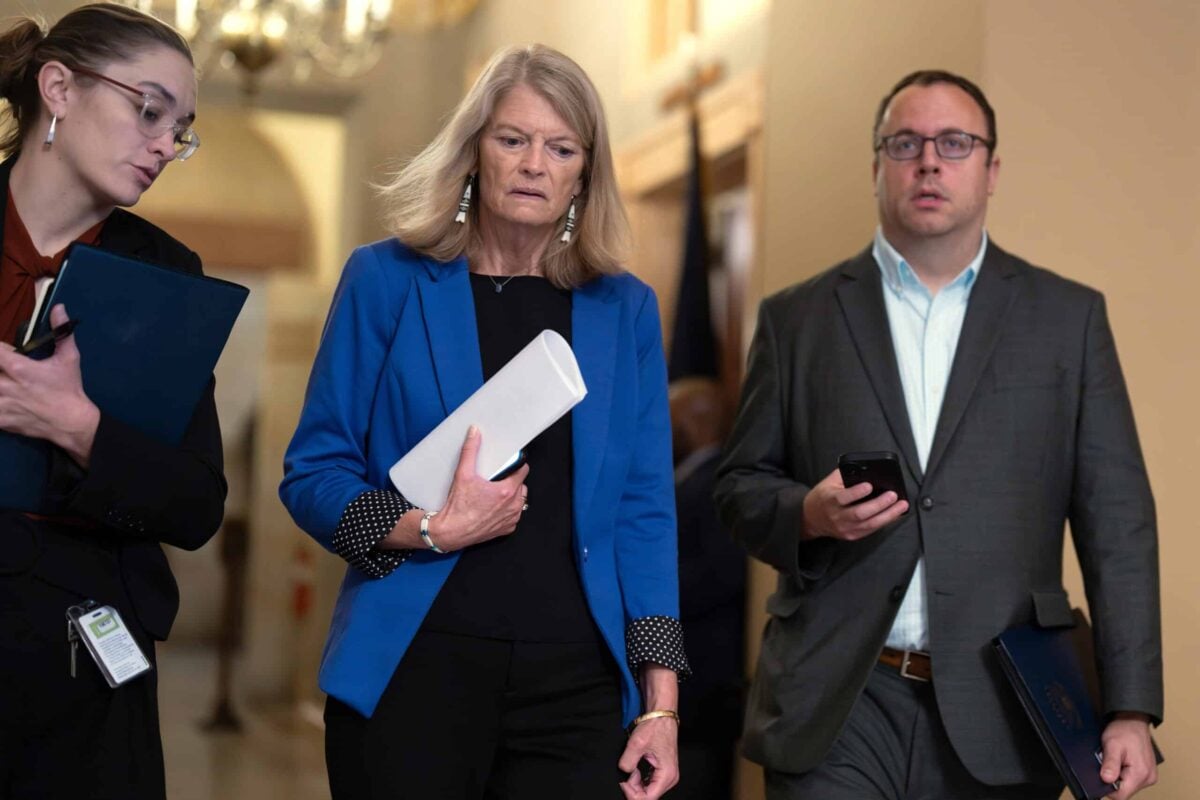
Sen. Lisa Murkowski, R-Alaska, center, a member of the Senate Appropriations Committee, arrives for a closed-door Republican meeting to advance President Donald Trump's sweeping domestic policy bill, at the Capitol in Washington, Friday, June 27, 2025. (AP Photo/J. Scott Applewhite)
Sen. Lisa Murkowski, R-Alaska, center, a member of the Senate Appropriations Committee, Friday, June 27, 2025. (AP Photo/J. Scott Applewhite)
AP- The pressure to end the second-longest federal government shutdown is gaining new urgency this week as millions of Americans face the prospect of losing food assistance, more federal workers miss their first full paycheck and recurring delays at airports snarl travel plans.
The building strain on lawmakers to end the impasse was magnified by the nation’s largest federal employee union, which called on Congress to immediately pass a funding bill and ensure workers receive full pay. Everett Kelley, president of the American Federation of Government Employees, said the two political parties have made their point.
“It’s time to pass a clean continuing resolution and end this shutdown today. No half measures, and no gamesmanship,” said Kelley, whose union carries considerable political weight with Democratic lawmakers.
Still, Democratic senators, including those representing states with many federal workers, did not appear ready to back down. Virginia Sen. Tim Kaine said he was insisting on commitments from the White House to prevent the administration from mass firing more workers. Democrats also want Congress to extend subsidies for health plans under the Affordable Care Act.
“We’ve got to get a deal with Donald Trump,” Kaine said.
But shutdowns grow more painful the longer they go. Soon, with closures lasting a fourth full week as of Tuesday, millions of Americans are likely to experience the difficulties firsthand.
“This week, more than any other week, the consequences become impossible to ignore,” said Rep. Lisa McClain, chair of the House Republican Conference.
Shutdown’s impact is set to grow dramatically
The nation’s 1.3 million active-duty service members are at risk of missing a paycheck on Friday. Earlier this month, the Trump administration ensured they were paid by shifting $8 billion from military research and development funds to make payroll. But it is unclear if the Trump administration is willing — or able — to shift money again.
Larger still, the Trump administration says funding will run out Friday for the food assistance program that is relied upon by 42 million Americans to supplement their grocery bills. The administration has rejected the use of more than $5 billion in contingency funds to keep benefits flowing into November. And it says states won’t be reimbursed if they temporarily cover the cost of benefits next month.
The Department of Agriculture says the contingency fund is intended to help respond to emergencies such as natural disasters. Democrats say the decision concerning the Supplemental Nutrition Assistance Program, known as SNAP, goes against the department’s previous guidance concerning its operations during a shutdown.
Senate Democratic leader Chuck Schumer of New York said the administration made an intentional choice not to the fund SNAP in November, calling it an “act of cruelty.”
Will lawmakers find a solution?
At the Capitol, congressional leaders mostly highlighted the challenges many Americans are facing as a result of the shutdown. But there was no movement toward negotiations as they attempted to lay blame on the other side of the political aisle.
“Now government workers and every other American affected by this shutdown have become nothing more than pawns in the Democrats’ political games,” said Senate Majority Leader John Thune, R-S.D.
The House passed a short-term continuing resolution on Sept. 19 to keep federal agencies funded. Speaker Mike Johnson, R-La., has kept the House out of legislative session ever since, saying the solution is for Democrats to simply accept that bill.
But the Senate has consistently fallen short of the 60 votes needed to advance that spending measure. Democrats insist that any bill to fund the government also address health care costs, namely the soaring health insurance premiums that millions of Americans will face next year under plans offered through the Affordable Care Act marketplace.
Window-shopping for health plans delayed
The window for enrolling in ACA health plans begins Saturday. In past years, the Centers for Medicare and Medicaid Services has allowed Americans to preview their health coverage options about a week before open enrollment.
As of Monday, Healthcare.gov appeared to show 2025 health insurance plans and estimated prices, instead of next year’s options. CMS was expected to temporarily bring back all its workers furloughed during the shutdown, in part to manage the ACA open enrollment period.
Twenty-eight senators, mostly Democrats, signed a letter urging Trump’s administration to let ACA enrollees start previewing next year’s health insurance options on its marketplace website.
Republicans insist they will not entertain negotiations on health care until the government reopens.
“I’m particularly worried about premiums going up for working families,” said Sen. David McCormick, R-Pa. “So we’re going to have that conversation, but we’re not going to have it until the government opens.”
Congressional leaders dig in deeper
Schumer said Republicans would prefer to shut the government down than work with Democrats in preventing massive spikes in their health insurance costs. He said the average American doesn’t want to pay an extra $20,000 a year to cover their health insurance.
“And we Democrats want to solve this crisis right away,” Schumer said. “So lowering health care is not a crazy demand.”
Vice President JD Vance planned to attend a Republican luncheon on Capitol Hill Tuesday. But with President Donald Trump traveling in Asia and congressional leaders dug into their positions, a quick deal appeared unlikely.
Meanwhile, some rank-and-file lawmakers urged colleagues to consider the impact of their standoff on the lives of federal employees and Capitol police officers who have not been paid for weeks.
“We have got to come together, which means we’ve got to talk to one another,” Sen. Lisa Murkowski, an Alaska Republican, said in a floor speech urging leaders to stop focusing on who was winning the political fight. “Right now, those that are losing are the American people.”