Categories
Alaska News Featured Juneau News juneau Juneau Local Juneau Local Ketchikan Local News Feeds Sitka Local

Statewide prevention initiative aims to combat Alaska’s high rates of child sexual abuse

By: Corinne Smith, Alaska Beacon

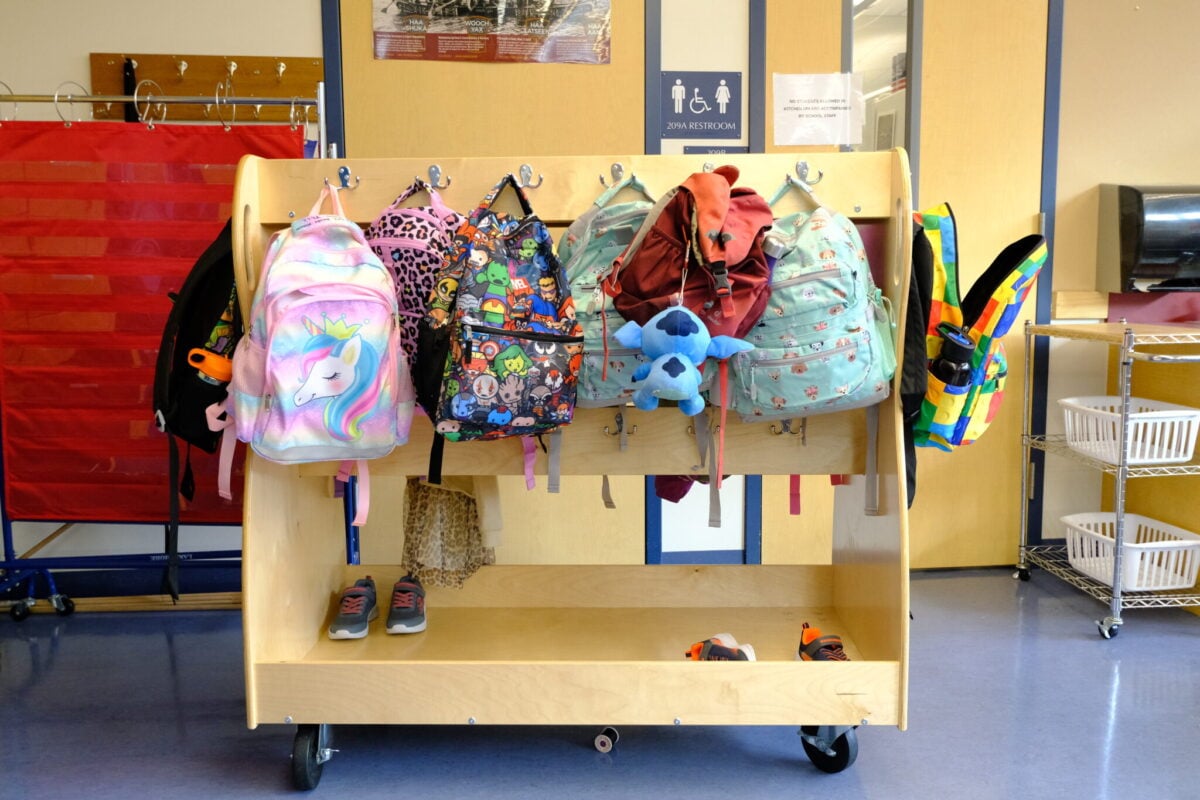
Student backpacks seen on the first day of school at Harborview Elementary School in Juneau on Aug. 15, 2025 (Photo by Corinne Smith/Alaska Beacon)

Content warning: This story contains references to sexual violence and abuse of children.

A new statewide initiative aims to prevent and reduce Alaska’s pervasively high rates of child sexual abuse.

The statewide prevention plan is led by the Alaska Children’s Trust, a non-profit advocacy group focused on supporting children and families and preventing child abuse and neglect. 

Trevor Storrs, the president and CEO of the Alaska Children’s Trust, said a coordinated effort among state and community groups, service providers, schools, caregivers and youth is needed to make serious strides in intervening and preventing abuse. 

“We should not expect children to fight off these predators. We want them equipped with the tools, but it’s our job, not just as adults, but as a community and society, to make sure kids are safe,” he said. 

If you or someone you know has experienced sexual abuse or are healing from a crisis, resources are available: 

The plan was developed last year with a variety of statewide groups, including representatives from Child Advocacy Centers, the Alaska Department of Education and Early Development, the Office of Children’s Services, which runs the state’s foster care system, law enforcement, Tribes, health care providers, lived experience experts, faith communities, and the Alaska Network on Domestic Violence and Sexual Assault. 

Storrs said the plan focuses on education and raising awareness, as well as preventing harm by developing and strengthening institutions so that questionable behavior is identified and stopped. 

“If we don’t keep strong boundaries established, that’s when we start opening the door and predators see their opportunity,” he said. “If we keep those strong and not have those potential openings, it actually prevents the predators from ever accessing, or anybody who’s had even a slight inclination —  they’re not being tempted to even try — and that is what our job is.”

The group launched the plan earlier this month and is providing an initial $100,000 in grant funding for prevention work in the three priority areas outlined by the initiative. Nonprofit organizations, tribes, local or state governments, schools and regional attendance areas are invited to apply by July 17. 

Alaska has some of the highest rates of sexual violence and rates of child abuse, neglect, and child sexual abuse, in the nation. Many victims delay or never report abuse. A U.S. Department of Health and Human Services’ Child Maltreatment report published this year noted reports of child abuse and neglect have declined somewhat since 2020, but Alaska rates in 2024 were 80% above the nationwide average.

Nationwide, American Indian and Alaska Native children have the highest rates of victimization, and in Alaska national data from the maltreatment report shows rates of abuse among American Indian or Alaska Native children are nearly three times higher than the overall statewide average.

The Alaska Children’s Trust cites a national survey by the U.S. Centers for Disease Control and Prevention from 2013 to 2015 that showed on average one in five Alaska children experience sexual abuse. A 2023 report from the Alaska Children’s Justice Act Task Force showed that an estimated one in seven children will experience an allegation of sexual abuse before their 12th birthday.

“The majority of child abuse and neglect cases that are substantiated are neglect, then it’s physical, and then it’s a small fraction of child sexual abuse,” Storrs said. But sexual abuse can have severe impacts on a child’s development, according to the CDC, with short and long term effects, including chronic health conditions, mental health issues and even post-traumatic stress disorder, or PTSD. 

Child sexual abuse is defined as any sexual activity between a child and adult or a child and another child that the child does not fully understand, does not consent to or is not developmentally prepared for and therefore cannot consent to. In Alaska, lawmakers this year changed the law to raise the age of consent to 18 years old.  

An estimated 90% of child sexual abuse is perpetrated by someone known to the child or the child’s family, according to the CDC. 

Perpetrators can exploit what Storrs calls “natural trust” to get close to a child, including people in positions like a coach, teacher, religious leader or friend of the family, in a pattern of behavior called grooming.

“Grooming is developing that relationship, developing a trust with the family that the child can be left alone with them,” Storrs said. “The trust with the child where their interactions may feel awkward, but are okay. The trust that it’s okay to keep secrets. They really build that trust and build that relationship that then allows them to abuse the child, to do what they do. And you see that in story after story when you talk to a survivor of child sexual abuse, they talk about the relationship.” 

Storrs says addressing the stigma to intervene when behavior is inappropriate, also means implementing proper protocols for adults interacting with kids. He said for example, coaches should not text youth individually, but include parents in all communications. 

That extends to online safety, he said. Nationally, there are increasing rates of predatory behavior and “sextortion,” a form of blackmail where perpetrators threaten to disclose information or images unless the victims make specific demands. Storrs said caregivers should talk with children and youth about what is and isn’t appropriate, in person and online.  

“It’s also making sure that your child understands what the expectations and rules are, as well, of what it’s like to interact with an adult, and what are those boundaries,” he said. 

Storrs said in raising awareness of potentially predatory behavior, it’s also important to trust children when they disclose inappropriate behavior. 

“A lot of kids don’t disclose that X is happening, what they start disclosing is, ‘I don’t feel comfortable, I don’t want to go. I don’t like hanging out with this person anymore.’ They don’t feel connected,” he said. “That’s a sign.”

The statewide prevention plan likens preventing child sexual abuse to wildfire prevention. That means reducing risks, setting safety codes, educating communities and monitoring high risk situations — to prevent harm. 

Three approaches to prevention

The statewide prevention plan has a three-pronged approach: educate and mobilize, cultivate safer environments and act early to prevent harm.

Storrs says all three involve children, families, and community-wide efforts, and the plan calls for local advocacy groups, service providers, schools and governments to gather community input and develop their own child sexual abuse prevention programs and resources best fit around cultural values. The initiative calls for local communities to develop and strengthen systems for children to safely report harm without fear of punishment and family disruption. 

The first prong focuses on education: increasing awareness and reducing stigma, and increasing the number of people able to take action proactively. That means training for youth-focused employees like teachers and coaches, and building in protocols for reporting and addressing inappropriate behavior. It also involves providing educational resources for parents and caregivers on healthy boundaries, warning signs, and how to respond to concerns. 

The plan calls for education and resources for children and youth on what’s appropriate. Storrs says the plan suggests children receive human development education, not necessarily sex education, so that children develop an understanding of consent, their body anatomy and healthy relationships. 

“When you talk to a child about something, it does not give a child permission to engage in something or to act inappropriately,” he said, adding that teaching kids about sex does not give them permission to have it in the same way that teaching kids about car accidents doesn’t give them permission to drive recklessly. 

Education is aimed at empowering children to identify when physical boundaries have been violated, Storrs said. “So when a kid needs to talk about any of their private areas or someone is trying to talk about it or touch it, they’re able to know what’s appropriate and what’s not appropriate,” he said. 

Similarly, reducing shame and stigma can empower children to talk with an adult or caregiver when they’ve experienced or seen adults behaving inappropriately. Children should know that adults should never ask them to keep secrets, Storrs said, and when inappropriate behavior has occurred they can get help to stop it from continuing. 

The second prong, “cultivating safer environments,” calls for state and local governments, Tribes and service organizations to support programs and policies that help families meet essential basic needs to address conditions that put children at risk for sexual abuse.

Storrs noted that children and families with unstable housing, inadequate child care or health care can create circumstances that put children at higher risk. 

“Our safety net plays a critical part in keeping kids safe, not just of child sexual abuse, but child abuse in general,” he said. “We know when families have stable housing, food security, all those things, it puts less stress on the family.”

The plan calls for increasing safety of physical and digital spaces where youth spend time, and local community organizations to hold listening sessions in communities to identify risk factors and best prevention strategies.

The third prong aims to prevent harm by increasing access to resources to respond to harmful sexual attitudes or behaviors. That includes addressing people who have harmed or are at risk of harming children.

“I truly believe there’s more gray in our world ever than there is black and white,” Storrs said. “And there are definitely individuals who are 100% predators, and it’s very clear. Then you have individuals that may have some thoughts, but don’t act on it, or it’s controlled internally by themselves and by within the society they are.”

The approach includes responding to harmful and problematic sexual behavior among youth. Storrs said with youth having access to graphic sexual material online, problematic behaviors and attitudes may arise. The plan aims to expand treatment and support services for youth to address harmful behaviors.  

“We’re seeing that kids are sexually maturing faster or becoming more hypersexual at a much younger age without the knowledge, skills, supports and resources to then deal with it or understand it,” Storrs said. “And if kids do not have an adult to talk to, or have learned this information, it starts creating hyper sexual experiences, which then can lead to this harmful sexual behavior.”

Alaska has unique challenges with rural and remote communities having less access to services, Storrs said, as well as grappling with legacies of trauma and adversity. He said the initiative aims to push a statewide focus and investment in policies and programs that support children and families that can help prevent harm. The plan is a collaborative effort, he said, and in the first year advocates with the Alaska Children’s Trust will visit communities to discuss the plan, help raise awareness, identify gaps and strengthen protocols and safer environments to prevent abuse.

“What we want to create that’s very clear in our community, in our state, that we as a community are watching and will not stand for any type of inappropriate behavior with our kids,” Storrs said. “And we will say something, we will step in, and you won’t be allowed.”

Categories
Alaska News Featured Juneau News juneau Juneau Local Juneau Local Ketchikan Local News Feeds Sitka Local

Police continue investigation into death of missing Juneau resident Dion McCabe

Dion McCabe, photo provided by family to the Juneau Police Department

NOTN- Juneau police say a body discovered in a wooded area near the end of Sherwood Lane has been identified as 29-year-old Dion McCabe, who had been reported missing earlier this month.

The full press release can be found below;

 the Juneau Police Department received a report that the deceased body of Dion McCabe had been located in a wooded area near the end of Sherwood Lane. Officers responded to the scene and confirmed the presence of the deceased individual. The area was secured, and an investigation into the circumstances surrounding the death was initiated.

The next of kin has been notified. The body will be transported to Anchorage, Alaska, where an autopsy will be conducted to assist investigators in determining the cause and manner of death.

At this time, the investigation remains ongoing. Anyone with information related to this case is encouraged to contact the Juneau Police Department. Anonymous tips can also be submitted through Juneau Crime Line at JuneauCrimeLine.com.

**********************

On June 5, 2026, the family of 29-year-old Dion McCabe reported him missing to the Juneau Police Department. Family members reported they had not seen or heard from Dion for approximately a week and a half. Dion was last seen by family on May 26, 2026, at Safeway in Juneau.

Dion is described as a 29-year-old white male, approximately 6 feet tall and 186 pounds, with brown hair and blue eyes. He was last seen wearing Rock Revival blue jeans, a white T-shirt, and UGG slipper-style shoes.

A photograph of Dion is being posted on the Juneau Police Department Facebook page to assist in locating him.

Anyone with information regarding Dion McCabe’s whereabouts is encouraged to contact the Juneau Police Department at (907) 586-0600. Anonymous tips may also be submitted through Juneau Crime Line.

Categories
Alaska News Featured Juneau News juneau Juneau Local Juneau Local Ketchikan Local News Feeds Sitka Local

Benjamin W. Stepetin’s disappearance classified as criminal as police continue search efforts this week

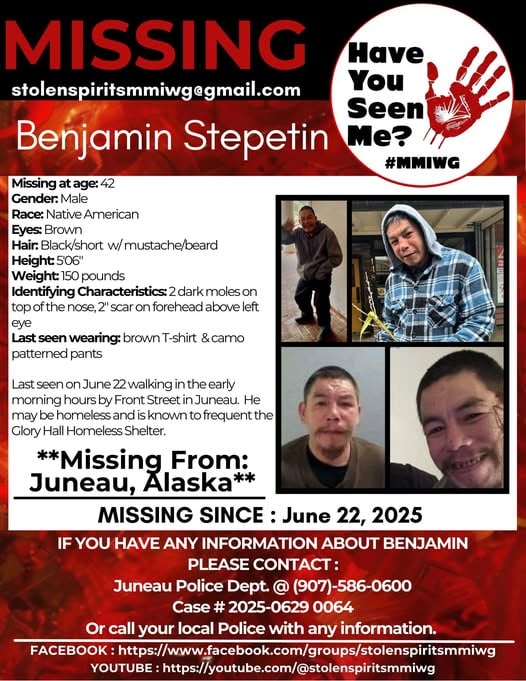
NOTN/ JPD- According to a press release, the Juneau Police Department would like to notify the public that, this week, all the way through Sunday, May 17, the Alaska Dive Search, Rescue and Recovery Team (AK Dive Rescue) will be conducting search operations by the downtown cruise ship piers. The search is related to the ongoing missing persons investigation involving Benjamin W. Stepetin, who was originally reported missing on June 26, 2025.

Benjamin was last seen downtown.

Following his disappearance his family raised money for a search of the Gastineau Channel by divers back in September.

During this operation, members of the public may observe search vessels operating in the area, including the use of sonar-equipped remotely operated underwater vehicles (ROVs), as well as divers conducting underwater search activities.

The investigation into the disappearance of Benjamin W. Stepetin is currently being investigated as a criminal investigation. During the course of the investigation, information was developed indicating it is possible Mr. Stepetin may have gone in the water in the downtown area on the night of his disappearance.

JPD detectives are coordinating the search operation with AK Dive Rescue and members of the Stepetin family.

Additional information about the Alaska Dive Search, Rescue and Recovery Team can be found on their website at AK Dive Rescue Team or on their Facebook page at Alaska Dive Search Rescue and Recovery Team Facebook Page.

Anyone with information regarding the disappearance of Benjamin W. Stepetin is encouraged to contact the Juneau Police Department at (907) 586-0600. Anonymous tips may also be submitted through Juneau Crime Line.

Categories
Featured Juneau News juneau Juneau Local Juneau Local News Feeds

Assembly OKs year-round Warming Shelter, plans tougher camping enforcement

The Warming Shelter on a foggy night, courtesy of the Warming Shelter

NOTN- The Juneau Assembly has approved an ordinance to extend funding for the Warming Shelter to stay open year round, as well as pledging tougher enforcement of public camping.

The measure, adopted Monday night without objection, The Warming Shelter operated by St. Vincent de Paul open through the year and directs staff to step up enforcement in high-impact areas such as Teal Street and near the Rock Dump.

City officials said they will move more quickly on camping in public rights-of-way and will prioritize sites that generate significant public health concerns and a high volume of complaints.

“This ordinance is only half of the piece, providing people a safe place to go, to really increase our enforcement actions in those highly visible areas where we have received a lot of complaints. So we are a complaint driven organization, so the number and the diversity of complaints for any dispersed camping would influence how quickly and aggressively we would respond to that dispersed camping. We also would look at the public impact, not just who’s complaining, but what that impact is to your to public health. And we would prioritize enforcement when those two things are high.” Said City Manager Katie Koester.

Service providers urged the Assembly to support keeping the Warming Shelter open, arguing that shelter beds give people a chance to stabilize instead of cycling between the hospital, sobering center and police contacts.

“Last winter, someone came into the Warming Shelter after days of sleeping outside, cold, exhausted and struggling. Before that, they cycled between Bartlett Regional Hospital, Juneau sobering center and calls to Juneau Police Department. Each system did its job, but no one could offer what they truly needed, a safe, consistent place to be. Without that option, people often create encampments in areas of concern without sanitation or basic services, impacting both their health and the surrounding community. At the shelter, something simple changed. They got warm, they slept, they stabilized, and they had a starting point. That’s what the warming shelter provides.” Said Deputy Director of St. Vincent de Paul Mollie Carr, “We know we can’t fix every situation, but offering a year round place for people to go is a practical, common sense step that reduces crisis and stabilizes our community. When the shelter closes, the need doesn’t disappear. It shifts to a higher cost, and systems like the ER, law enforcement and emergency services. It costs far less to provide a shelter than repeated response to crisis. Year round funding is not just compassionate, it’s responsible, efficient and necessary.”

Neighbors and business owners described escalating problems they linked to dispersed camping, including theft, vandalism, public defecation and employees who said they felt unsafe walking to and from work. Some, including business owners along Teal Street and across from the shelter, said they reluctantly backed the ordinance as long as it came with stronger police presence, clear no-camping zones near workplaces and consistent enforcement of existing code.

“‘I’m here to support the Warming Shelter, combined with not allowing the chaotic Teal street camping to go on again this summer. Last summer, I personally cleaned up thousands of pounds of trash. I tried to help people camping in terrible conditions. I tried to support my co-workers and partner agency employees who are afraid to be at work or to walk to their cars because of the chaos. Just because people are poor and homeless or work in social services does not mean that they do not deserve a safe place to live and work.” Said Logan, member of the Glory Hall team, “The warming shelter extension is not perfect, but it is the only doable thing we came up with. Not allowing dozens of tents on Teal Street is not a violation of people’s rights. It is bringing order and safety to people’s lives. It is doing what a city is supposed to do. I am now a productive and essential member of the Glory Hall team. I am a hard worker. I think on my feet, I am great in a crisis. I am a single parent of an amazing daughter. I also used to live outside on South Franklin Street, struggling. This was a long time ago. I got help along the way because of Tlingit and Haida regional housing authority. I’m about to become a homeowner. Because of the Glory Hall, I have a job and training, and I was able to get basic food, shelter and help with transportation and other needs while I figured out my life because of the Southeast Alaska Food Bank, I was able to eat at Glory Hall because of Nami Juneau, I got certified as a peer support specialist, If you’re willing to do the work for lives to stabilize. It is critical.”

Assembly members said the ordinance is not a permanent solution to homelessness in Juneau but called it a necessary step while longer-term housing, shelter capacity and camping policies continue to be debated.

“I would like to say this isn’t perfect by any means. The need is greater than what anyone can serve.” Said Assembly member Maureen Hall, “Everyone in this room should continue to look for solutions and work with partner agencies to help this happen.”

“I appreciate that everything is imperfect, and so I’m okay with this, as long as we are continuously checking, I think there were some real emergent problems that we heard from residents and neighborhoods on different kinds of camping, car camping on the street, camping in the woods, camping creates different kinds of problems, and I think those call for different kinds of enforcement.” Said assembly member Alicia Hughes-Skandijs, “I think this is a really good step, when you have a consistent, year round place, and you can really say, nope, this is our hard line. I want us to be really careful, that we’re both balancing the needs of the members of the community, that things don’t get out of hand, and that we’re fulfilling our obligation to those unhoused members of our community, who we are equally accountable to, and who are much less able at this point, in their lives, to come.”

Categories
Alaska News Featured Juneau News juneau Juneau Local Juneau Local Ketchikan Local News Feeds Sitka Local

Alaska Gov. Dunleavy’s aide and former legislative candidate arrested for drunk driving in Juneau

By: Corinne Smith, Alaska Beacon

 Forrest Wolfe is seen in an undated campaign photo for his run for the Alaska House of Representatives for District 21, in East Anchorage, in 2022. (Campaign photo provided by Wolfe)

A legislative aide to Alaska Gov. Mike Dunleavy, and a former candidate for the Alaska House of Representatives, was arrested and charged with driving under the influence of alcohol on Thursday in Juneau.

Forrest Wolfe, 40, was pulled over by Juneau Police at about 10:30 p.m. on Mar. 26, according to court documents, after driving erratically through a busy area of downtown Juneau. Wolfe was the sole occupant of the vehicle, a red Chevrolet Tahoe, when he was pulled over on Franklin Street. 

Wolfe exhibited a strong odor of alcohol and gave conflicting stories of his previous activities, then stopped answering questions, according to the police report. Wolfe failed a field sobriety test and then later a chemical test for alcohol, showing his breath alcohol level at 0.10, which is above the legal limit of 0.08. He was arrested and charged with a criminal misdemeanor. 

Wolfe serves as deputy legislative director for Dunleavy, a role he began in January, according to his public LinkedIn profile.

A spokesperson for Dunleavy’s office declined to comment on the arrest or any penalties by his employer on Monday, citing privacy as a personnel matter. 

Wolfe ran for the Alaska House in 2022 as a Republican representing District 21 in East Anchorage, and narrowly lost to Rep. Donna Mears, D-Anchorage, by just 150 votes

Prior to serving in the governor’s office, Wolfe served as a legislative liaison for the Alaska Department of Administration for about a year, in 2025. He worked as legislative staff for more than a decade, since 2012, for various Republican representatives. 

Wolfe posted a $500 bail and was released from Lemon Creek Correctional Center on Friday morning, according to Alaska Public Media.

Wolfe has had previous run-ins with Juneau Police for minor infractions, and was arrested and convicted for drunk driving in 2011.

Categories
Featured Juneau News juneau Juneau Local Juneau Local News Feeds

Police investigate report of possible intruder at Juneau apartment

NOTN- The Juneau Police Department responded earlier this morning to a report of a possible intruder at an apartment complex in the DeHartz area.

First reported by the Juneau Independent, police said a resident contacted officers after believing an unknown person might be inside the residence.

according to a Facebook post released by JPD, officers searched the apartment but did not find anyone inside.

Authorities said there is no indication at this time that anyone unlawfully entered the residence. The investigation remains ongoing.

Categories
Featured Juneau News Juneau Local Juneau Local News Feeds

Juneau Man arrested after firing rifle from residence

According to the proposed ordinance, when an officer-involved shooting occurs that causes death or serious injury to an officer or someone else, Juneau Police Department would release body-worn camera footage no later than 30 days after the incident. (Photo courtesy City & Borough of Juneau website)

NOTN- Juneau police arrested a 22-year-old man Monday night after reports that a rifle had been fired from a home on Radcliffe Road.

Police say officers were called to the 2100 block of Radcliffe Road, where a caller reported their roommate, Ethan Hagh, had fired a single round from an AR-15-style rifle out of a window.

The caller and other occupants were able to safely leave the residence but were unsure where Hagh had gone at the time of the report.

Officers searched the area for several hours, using drones and a public address system in an attempt to locate Hagh.

Those efforts were initially unsuccessful.

Just before 7:30 p.m., officers encountered Hagh walking back toward the residence. He was detained without incident. Police later found an AR-15-style rifle inside the home and a pistol on Hagh’s person.

No injuries were reported.

Hagh was taken to Lemon Creek Correctional Center and charged with one count of second-degree misconduct involving weapons and two counts of third-degree assault related to domestic violence and one count of reckless endangerment, according to the statement released by JPD.

He was arraigned today and released.

Categories
Featured Juneau News Juneau Local Ketchikan Local News Feeds Sitka Local

Juneau Police investigating burglary at local church, asking for the public to help

Photo of burglary suspects from JPD’s Facebook page

NOTN- Juneau police are asking for the public’s help identifying three suspects accused of burglarizing a local church early November 1.

First reported by the Juneau Independent, the Juneau Police Department said officers began investigating the incident after receiving a report of a burglary at the Juneau Church of Christ, located on Trinity Drive. Surveillance video showed three individuals breaking into the church between 2 a.m. and 3:30 a.m. police said.

Approximately $4,000 worth of electronics and other items were reported stolen, including an Apple MacBook Air, Panasonic HD camcorder, GoPro Hero 3, Sennheiser wireless microphone system, and various audio-visual equipment. Police said the thieves also took plastic decorative flowers and laundry detergent.

Investigators released surveillance footage in hopes of identifying the suspects, available on JPD’s Facebook page.

Anyone with information is asked to contact Sergeant Lee Phelps at the Juneau Police Department at (907) 586-0600. Anonymous tips can be submitted through JuneauCrimeLine.com.

Categories
Featured Juneau News Juneau Local Ketchikan Local News Feeds Sitka Local

Juneau police investigate crash that left woman seriously injured

NOTN- A 28-year-old Juneau woman was seriously injured early this morning in a single-vehicle crash along Egan Drive, according to the Juneau Police Department.

Police said officers were called at about 6:10 a.m. to the outbound off-ramp near the U-Haul building, where a gray Ford F-150 had gone off the road. The woman, who was the only occupant of the truck, was partially ejected and sustained life-threatening injuries.

She was taken to Bartlett Regional Hospital and later medevaced out of town for further treatment.

The intersection and right outbound lane of Egan Drive were closed for several hours during the investigation but have since reopened.

The cause of the crash remains under investigation. Police said details released so far are preliminary and subject to change as the investigation continues.

Categories
Featured Juneau News Juneau Local Ketchikan Local News Feeds Sitka Local

City holds reorganization meeting, police are called on man accused of threatening City officials

NOTN- Juneau Mayor Beth Weldon said city officials are taking new safety precautions after a man previously banned from City Hall returned during Monday night’s Assembly meeting and caused alarm among members as well as an hour delay preceding this month’s reorganization meeting.

Weldon said the man, who has a history of making threatening remarks toward the city, appeared wearing a mask and goggles, carrying a backpack, and taking photos while standing close to Assembly members.

“He’s been trespassed from City Hall and showed up yesterday and
was menacing to the assembly, looming over them and taking pictures of us.” Said Weldon “It just was very uncomfortable for all of us, because we knew his history.”

Police escorted the man out peacefully, and Weldon said he will now be trespassed from all city meeting spaces, including Centennial Hall and City Hall.

She emphasized that the incident was not connected to ongoing public testimony about the controversial Telephone Hill redevelopment project, which has drawn strong emotional responses but no threats.

“The testimony from Telephone Hill residents has been very heartfelt,” Weldon said. “At no time have we felt threatened by them.”

The meeting did however, mark the close of the 2025 municipal election cycle as newly elected members were officially sworn into office.

Ella Adkison began her first full term as Areawide Assemblymember, Greg Smith started his final three-year term representing District 1, and Nathaniel “Nano” Brooks took office for his first term in District 2. On the School Board, Steve Whitney and Melissa Cullum each began three-year terms, while Jenny Thomas will serve two years to complete an unexpired seat.

Voters approved two citizen-led propositions, one lowering the property tax cap from 12 to 9 mills, and another creating sales tax exemptions for food and essential utilities, both tax measures will be in place November 20.

A third measure, proposing a seasonal sales tax, failed.