NOTN- Monday evening’s Assembly meeting saw the approval of several major funding measures.
By a narrow 5–4 vote, the Assembly approved transferring $3.5 million from the city’s Seawalk project to Marine Park improvements.
“The $3.5 million transferring from the Seawalk to the marine park improvements passed by the skin of its teeth, five to four.” said Mayor Beth Weldon, “Some of us didn’t like the total cost of the project, but it did pass.”
Members also passed an ordinance shifting $5 million from the proposed Capital Civic Center to maintenance and repairs of the city’s HESCO flood barriers.
Additional funds included $700,000 for St. Vincent de Paul to renovate its sobering center and $125,000 for Juneau’s cold weather emergency shelter, supplementing earlier funding to help house residents from homeless encampments during winter.
“Just so people understand what that does, it allows the homeless encampments to go to the shelter during the winter. We already put $435,000 so we had to add another $125,000.” Said Weldon, “Just so people understand, that’s how much it cost to take care of that. Because sometimes we get accused of not doing anything, we do what we can do is we can give money towards something, and that’s what we do.”
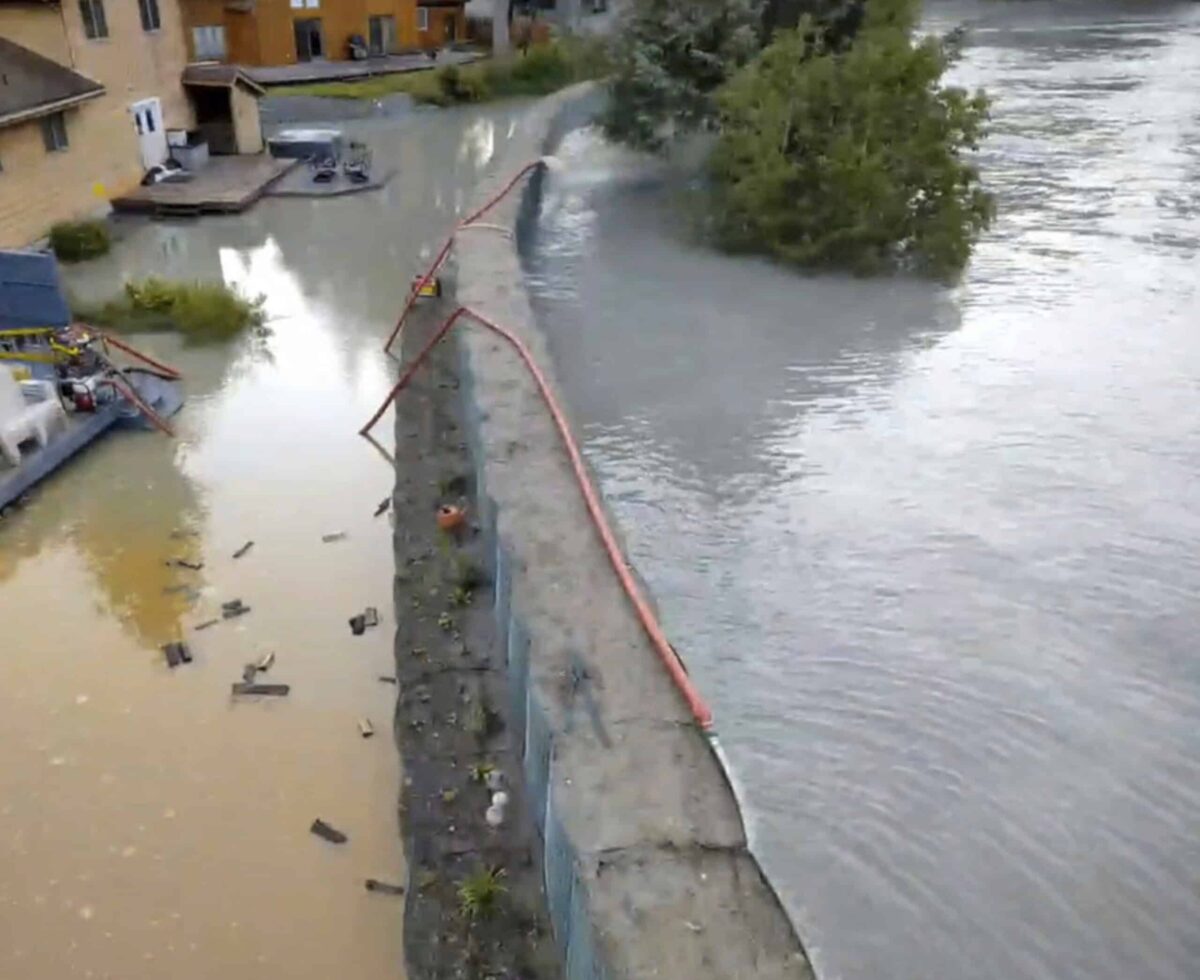
This drone image provided by the City and Borough of Juneau shows flooding from a release of water and snowmelt at Mendenhall Glacier covered some roads and threatened homes along the Mendenhall River in Juneau, Alaska on Wednesday, Aug. 13, 2025. (City and Borough of Juneau via AP)
This drone image provided by the City and Borough of Juneau shows flooding from a release of water and snowmelt at Mendenhall Glacier covered some roads and threatened homes along the Mendenhall River in Juneau, Alaska on Wednesday, Aug. 13, 2025. (City and Borough of Juneau via AP)
NOTN- Juneau officials say repairing damaged flood barriers and planning for long-term protection along the Mendenhall River will be a top priority in the wake of August’s glacier outburst flood.
At a Monday night work session, the Assembly said that Phase One of the HESCO barrier project, temporary flood walls installed to protect neighborhoods, sustained an estimated $1 million in damage.
“We are still gathering a lot of information on what happened this year, so folks are looking at, how did the basin change? How did the river change? So we still need a lot of information from our scientists before we’re ready to make any decisions.” Said Christine Woll head of the Finance Committee, “Essentially, last night, we started talking abou are we going to extend the barriers? Last year, we prioritized protecting the areas that had flooded in 2024, but as we think about the potential for this flood to increase in size, we start thinking about, do we want to extend the barriers to essentially the rest of the river? What’s the cost for that going to be and how are we going to pay for it? It starts to get kind of increasingly more expensive for the other areas of the river just because they’re trickier, and those areas are less likely to flood. So it makes for interesting policy decisions about how much the city can afford.”
The Assembly discussed whether to build barriers to a 17-foot or 18-foot model, this carries implications for construction depth, bank armoring, and overall cost. Expanding protection both north and south of the current installation could require substantial outside funding.
Members also considered long-term options for the View Drive neighborhood, where flood protection is difficult to build.
“There’s lots of challenges, but one of them is definitely View Drive, which meets the criteria of being significantly impacted every year by this flood, and yet, you know, has engineering challenges to put HESCOs up” said Woll.
Deputy City Manager Robert Barr said a potential buyout program could be pursued, but cost is the leading question.
“There’s some unanswered questions there that we need to resolve. Specifically, how much is going to cost and how many of the folks in the View Drive area need to participate for that to be a program that the federal government will participate in.” Barr said.
Last nights meeting was a Work Session however the Assembly took one actionable step, voting unanimously to shift $5 million from the Capital Civic Center project into flood mitigation. That money will help repair existing HESCO barriers and support the next phases of protection planning.
“These are decisions we’re going to have to tackle in the coming months,” he said. “We’ll keep looking for federal and state help, but ultimately we have to prepare for what may come next summer.”
The August flood, caused by an outburst from Suicide Basin above the Mendenhall Glacier, inundated neighborhoods and left behind millions in property damage.