By: James Brooks, Alaska Beacon
All four of the candidates in Alaska’s gubernatorial election this year support construction of a trans-Alaska natural gas pipeline and increased, state-backed drilling for natural gas in Cook Inlet.
But in a pair of forums held Sept. 21 and Oct. 2 in Anchorage, the four differed on a variety of other topics pertaining to the state’s energy policy, and one said he plans to borrow hundreds of millions of dollars in order to invest in projects that could pay off over decades.
Republicans Dave Bronson, Treg Taylor and Bernadette Wilson, together with Democratic candidate Jonathan Kreiss-Tomkins are each competing to replace Republican Gov. Mike Dunleavy, who is term-limited and cannot run again.
With Southcentral Alaska facing a shortage of cheap natural gas-fired electricity and rural Alaska continuing to experience high utility costs, the cost of energy is likely to be a major issue over the next four years.
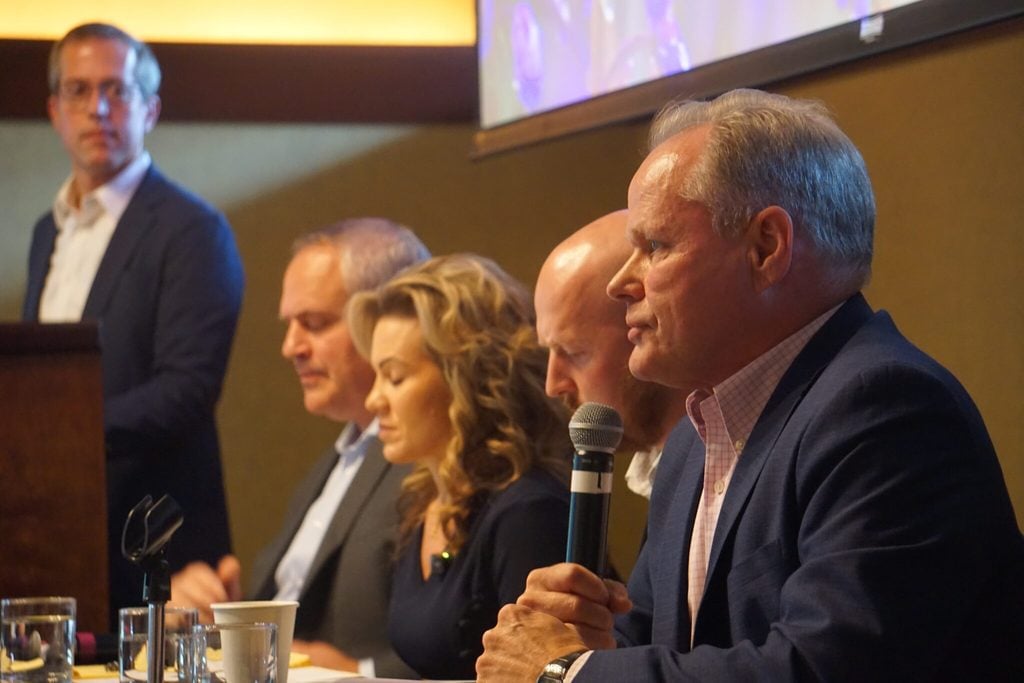
All four candidates participated in the first forum, hosted by the Renewable Energy Alaska Project, while only Bronson and Kreiss-Tomkins attended the second forum, hosted by the Alaska Power Association.
“The difference between prosperity and decline in Alaska is often measured in cents per kilowatt-hour. That’s the bottom line,” Taylor said at the REAP forum. “Without affordable, reliable energy, Alaskan families are going to struggle.”
Absentee voting by mail and fax is underway, and early voting in person will begin Oct. 19. Election Day is Nov. 3.
Cook Inlet natural gas
Southcentral Alaska relies on natural gas for electricity and heating, but production from oil and gas deposits beneath and near Cook Inlet hasn’t kept up with demand.
After a cold 2025-2026 winter, utilities are worried that regionwide supplies could run short. Even if this year’s winter passes without incident, the long-term production trend is downward, and utilities are planning to import natural gas as soon as the end of the decade.
“I think we need to immediately incentivize more exploration and capital projects in the Cook Inlet,” Taylor said on Sept. 21.
“We’ve also got to prepare — because of where we’ve put ourselves — for importing LNG, and that’s a horrible place to be when you’re an energy-rich state,” Taylor said.
Currently, the state of Alaska is directly and indirectly subsidizing natural gas production. The Alaska Industrial Development and Export Authority — the state’s development financer — has provided loans to HEX, a company drilling in the region, and the state is foregoing royalties on gas leases in the area.
“I think it is appropriate for the state to offer royalty relief to Cook Inlet natural gas producers, as is currently the case,” said Kreiss-Tomkins at the APA forum, adding that he believes “getting every last molecule out of the Cook Inlet natural gas basin is a state priority.”
Speaking after Kreiss-Tomkins, Bronson said the state needs to somehow encourage a second jack-up drilling rig in Cook Inlet to allow the drilling of more wells in Cook Inlet.
“The most important stuff is natural gas production in the near term, to provide our immediate needs as we plan on more generation and transmission going forward,” he said.
Wilson said she believes structural changes are needed to boost Cook Inlet gas.
“We most certainly need to incentivize production in Cook Inlet,” she said on Sept. 21.
“Yes, whatever we can do to incentivize HEX, whatever we can do to incentivize Hilcorp,” she said, referring to two of the three companies currently drilling for gas in Cook Inlet.
In the room at the time of the debate were some sitting state legislators who supported a proposal to raise business taxes on Hilcorp, HEX and other privately owned oil and gas firms.
Wilson said she believes the threat of a tax increase deterred those companies from drilling.
“We have to pay very close attention that when we complain and — quite frankly — bitch and moan about the gas shortage, who has brought this on? We brought it upon ourselves, and we have to change the outlook,” she said.
On the gas pipeline
If Cook Inlet natural gas is the answer for the immediate future, Bronson said on Oct. 2, “for the long-term future, it is the gas line.”
The proposed Alaska LNG project envisions a pipeline from the North Slope to Cook Inlet, bookended by a pair of industrial processing plants. The project would bring abundant gas to Southcentral and to foreign customers via an export terminal.
According to official estimates, the project is expected to cost between $44.5 billion and $54.5 billion, but skeptics — including some state legislators — believe it will cost $65 billion or more.
For now, it isn’t certain how that project will be funded, who would sell natural gas into it, or who will buy that natural gas.
“We definitely need to have a sustainable energy system. But what we can do right now — what we have to do — the first three things we’re going to do is build a gas line, build a gas line, build a gas line,” Bronson said on Sept. 21.
Earlier this year, the Alaska Legislature took up — but failed to pass — a tax cut that would have benefited the project.
“I strongly support the natural gas pipeline and support restructuring property taxes for the state of Alaska if it helps us get to yes,” Kreiss-Tomkins said on Oct. 1.
Taylor said he thinks that on energy, the state needs to “think big, like the Alaska gas line, for example, a $50 billion project that would put a lot of Alaskans to work and solve a lot of our energy needs along along the Railbelt, and with the potential to export that energy to our our allies.”
Wilson said she ultimately hopes Alaska will be able to boast about having the lowest energy prices in the country.
“A gas line obviously is front and center of that conversation,” she said on Sept. 21.
“For 40 years, we have debated if we were going to make enough money from a gas line, and in 40 years, we have made precisely $0 from a gas line, because we’re debating on ‘Are we going to get our fair share?’ Enough,” she said.
A pipeline isn’t currently expected before the end of the decade, and the first phase of the project involves building a gas import facility that would later be turned around to export gas.
“I think it’s pretty much inevitable that there are going to be LNG imports in Cook Inlet and the Railbelt. That’s obviously incredibly unfortunate,” Kreiss-Tomkins said.
Borrowing for power
Speaking about energy more broadly, Kreiss-Tomkins said that if elected, he would ask the Alaska Legislature for permission to borrow money for projects across the state.
“I believe we need to pass a statewide energy bond in Alaska and make a generational investment in energy infrastructure and transmission infrastructure,” he said on Oct. 1.
When it comes to picking which projects would be funded by that bond, Kreiss-Tomkins said he would consult experts.
“I think we can take some big swings in some projects that can set up Alaska for the next 50 to 75 years,” he said on Sept. 21.
The Democrat said he believes Alaska is too reliant on natural gas alone and wants to see the state adopt a variety of power sources.
“Diversification is a key principle I have,” he said on Oct. 2, explaining that he believes the state should be funding projects through its existing renewable energy fund. He also wants to preserve the $1 billion trust fund that subsidizes rural prices through a program known as Power Cost Equalization.
Taylor said he also supports diversification but didn’t endorse Kreiss-Tomkins’ idea of borrowing money to build projects.
“We have to approach this problem with an all-of-the-above approach. We have to pursue all the avenues, and then let the market decide the winners and the losers,” Taylor said on Sept. 21.
Taylor said he believes the state needs to think big, with both the gas pipeline and the long-shelved Susitna-Watana hydroelectric project, which would put one of the largest dams in the United States between Anchorage and Fairbanks.
While the project would have a large up-front cost, the federal government is offering large tax credits for hydroelectric projects that begin construction before 2033.
Taylor said what he’d like to see is “a unified electric grid with a dispatcher to dispatch the lowest-cost energy to Alaskans along the Railbelt.”
It was a sentiment echoed by Kreiss-Tomkins, who said, “we need to coordinate our utilities.”
Wilson did not specify her plans for rural energy or energy in general but reiterated that she wants to see fewer restrictions on development and construction.
In both forums, Bronson said he supports the construction of large-scale computing data centers because he believes they will bring their own electricity generators.
“They’ll create their own electricity. They’ll deal with the cooling and the noise problems, and I think that’ll be good for us,” Bronson said on Sept. 21.
If the state requires datacenter owners to produce more power, that electricity could be sold locally, Bronson said.
“That’s how you drive down the cost of electricity. Let private enterprise come in and invest, and you compel them to produce more than they actually need,” he said.
In the short term, he believes the state should fund the replacement of older diesel generators in rural Alaska.
“A lot of the diesel generators out there are older than the people that maintain them. I think that’s unacceptable, and the cost of electricity with the newer-generation diesel generators goes down considerably,” he said on Oct. 1.
“I’m not a big fan of wind because it’s not reliable. It’s not base load electricity. Solar isn’t either,” Bronson said.
In the longer term, Bronson said he wants to see small-scale nuclear power plants in rural Alaska away from the Railbelt. The U.S. military is already planning so-called “microreactors” at some of its Alaska bases.
Kreiss-Tomkins didn’t agree with Bronson on nuclear power.
“I think micro-nuclear is compelling … but I think by any measure, it’s still an immature technology and not anything that we can bank on,” he said.