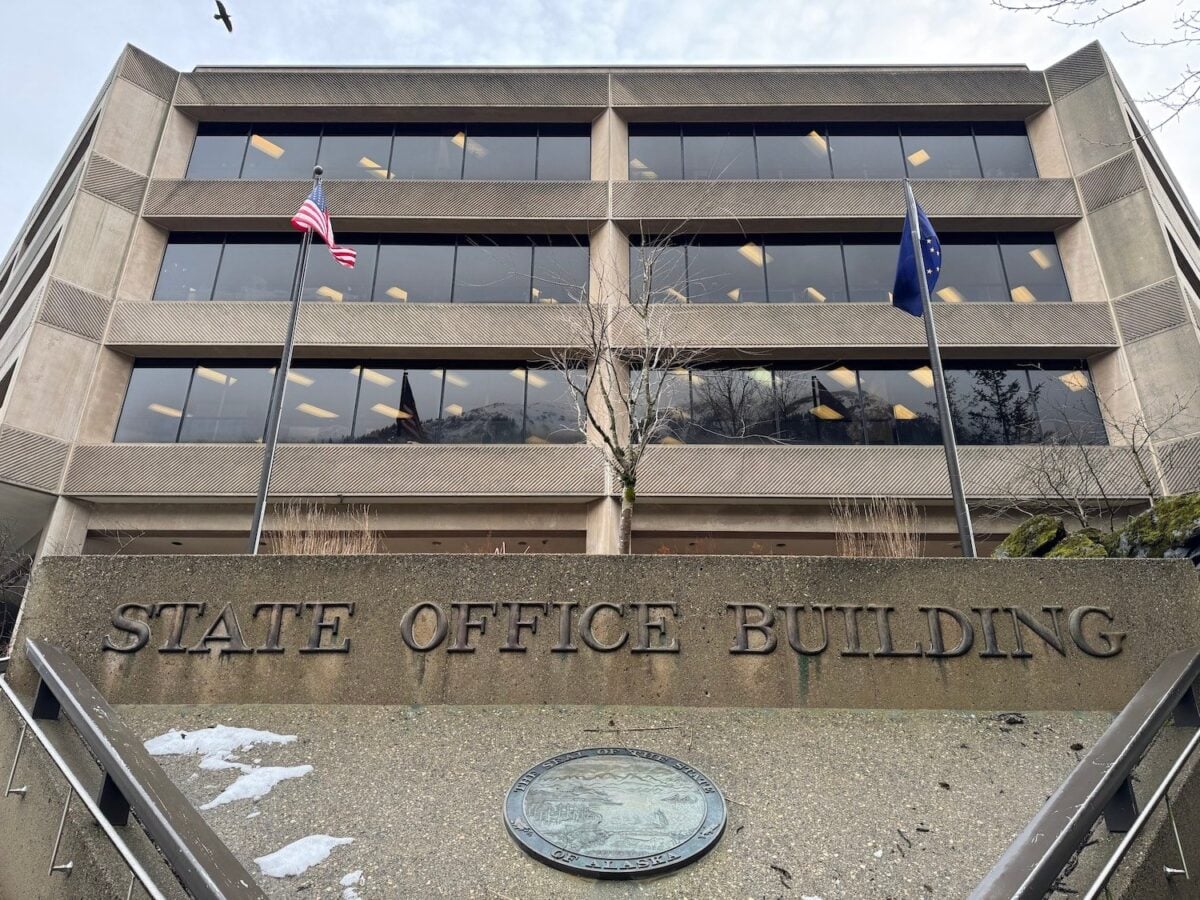
The State Office Building in Juneau is seen on Thursday, Feb. 20, 2025. (Photo by James Brooks/Alaska Beacon)
The State Office Building in Juneau is seen on Thursday, Feb. 20, 2025. (Photo by James Brooks/Alaska Beacon)
NOTN-Alaskans who rely on the Supplemental Nutrition Assistance Program, known as SNAP or food stamps, did not receive their November benefits as scheduled Saturday.
In a social media post Friday afternoon, President Trump said he would ask the courts for additional guidance before releasing SNAP funds to states.
Alaska Governor Mike Dunleavy issued a state disaster to ensure food security, this 30 day declaration will allow the state to work with the federal contractor that manages SNAP benefits, loading funds onto EBT cards weekly instead of monthly so families can continue to buy food.
The Department of Health will also coordinate with food banks to fill any gaps in aid. The full declaration can be found below.
November 3, 2025 (Anchorage, AK) — Governor Mike Dunleavy has issued a state disaster declaration to deal with the food security issue as a result of inaction on the federal budget in Washington D.C. The Governor will declare a 30 day disaster declaration that ensures food security in two ways for the thousands of Alaskan households that utilize Supplemental Nutrition Assistance Program (SNAP) benefits. The Dunleavy Administration will work with the federal contractor responsible for loading EBT cards to deposit benefits on a weekly schedule. This ensures Alaskans will not struggle to put food on the table during the shutdown The Alaska Department of Health will begin discussions with food banks and work with them to ensure the resources are available to assist Alaskans that may otherwise fall between the cracks The Governor has been meeting with Speaker Edgmon and President Stevens to ensure the process for Legislative concurrence is expedited. Those discussions have gone well and demonstrate that the executive and legislative branches work well when Alaskans are in need. “I want to thank Speaker Bryce Edgmon and President Gary Stevens for working with me the past few days to craft an approach to deal with this issue,“ said Governor Mike Dunleavy. “I’m grateful and deeply relieved that help will reach Alaskans in need without further delay,” said House Speaker Bryce Edgmon (I-Dillingham). “I want to thank the Governor and Senate President for acting swiftly and working together to make this happen.” “Alaskans shouldn’t have to worry about how they’ll feed their families because of a federal stalemate,” said President Gary Stevens (R-Kodiak). “I appreciate and support the Governor’s declaration to ensure that Alaskans are not left behind because of inaction in Washington, D.C. Congress must reconcile their differences and act quickly so Alaskans, and all Americans, can continue to have the support and stability to care for their families.” The disaster declaration will last no longer than 30 days or as soon as the federal government reopens. Click here for a copy of the disaster declaration and the legislative notification.
NOTN- Monday evening’s Assembly meeting saw the approval of several major funding measures.
By a narrow 5–4 vote, the Assembly approved transferring $3.5 million from the city’s Seawalk project to Marine Park improvements.
“The $3.5 million transferring from the Seawalk to the marine park improvements passed by the skin of its teeth, five to four.” said Mayor Beth Weldon, “Some of us didn’t like the total cost of the project, but it did pass.”
Members also passed an ordinance shifting $5 million from the proposed Capital Civic Center to maintenance and repairs of the city’s HESCO flood barriers.
Additional funds included $700,000 for St. Vincent de Paul to renovate its sobering center and $125,000 for Juneau’s cold weather emergency shelter, supplementing earlier funding to help house residents from homeless encampments during winter.
“Just so people understand what that does, it allows the homeless encampments to go to the shelter during the winter. We already put $435,000 so we had to add another $125,000.” Said Weldon, “Just so people understand, that’s how much it cost to take care of that. Because sometimes we get accused of not doing anything, we do what we can do is we can give money towards something, and that’s what we do.”
Alaska’s largest residential internet provider may soon come under the control of billionaire businessman John Malone, one of America’s biggest private landowners and wealthiest people.
On Oct. 3, Malone filed paperwork with the Regulatory Commission of Alaska asking for permission to take majority ownership of GCI Liberty Inc., the parent company of GCI Communications, Alaska’s largest internet company.
Malone already owns a majority of GCI Liberty’s voting shares, according to RCA filings, but until now has been limited by agreements that hold his voting power below 50%.
According to the filings, Malone is asking for authority to increase his voting power to “a level that would constitute control of GCI Liberty and its certificated subsidiary GCICC.”
The filings also state that both GCI Liberty and Malone have asked for a waiver that would allow them to keep their financial documents confidential.
Under state law and regulation, those documents would ordinarily be available for public inspection as part of regulators’ approval process.
Public comments on the request for secrecy are due to RCA by Tuesday, Oct. 28, and the state regulator is expected to review the takeover request after that date.
The takeover would also affect United Utilities, which provides telephone and internet service in rural Alaska, including much of the Yukon-Kuskokwim river delta region, filings show.
NOTN- The Juneau School District has launched a “Buy a Brick” campaign to help fund playground equipment at the Dzantik’i Heeni campus, where several of the city’s programs were relocated after school consolidation.
“Through the consolidation the year before last at the Juneau School District, our optional programs were moved to the Dzantik’i Heeni campus, which had previously been a middle school.” Said Juneau school district Director of Operations Kristy Germain, so we now have Montessori Borealis, which has pre-K and kindergarten through eighth grade, and we also have the Juneau Community Charter School, which is kindergarten through eighth grade, and additionally our Yaakoosge Daakahidi alternative high school, but the playground is primarily for our elementary program.”
While the playground will primarily serve elementary students, it will also be open to children in the surrounding Lemon Creek and Switzer neighborhoods, Germain says the school district partnered with the city engineering department for public design and safety concerns.
“The cost is substantial,” Germain said “We have received funding from the City Assembly, they authorized an ordinance to put $735,000 specifically toward the site preparation and the concrete base and the safety surfacing for the playground, and that’s just the safety surfacing. So the equipment is an additional cost. So the Juneau school district is taking the lead on fundraising for the actual playground equipment.”
The Buy a Brick fundraiser allows residents and businesses to purchase engraved bricks that will be installed at the site.
“We are partnering with Brick Markers, and they’re a company that has worked with other organizations in Juneau, I think notably, Rotary Park and the 911 Memorial use the same company.” Germain said, “Those bricks are holding up, so that’s a good testament to them. But we have established various levels so that individuals and community members are able to purchase a brick, and we’re also looking to our business community to support this endeavor.”
Proceeds will go toward the cost of equipment, which Germain said could push the project’s total cost beyond $1 million once installation, shipping, and materials are factored in.
The district plans to launch an online portal for the fundraiser within the week, with brick sales running through December. Officials hope to purchase and receive equipment in time for installation next summer.
“We are running into some timelines for purchasing the equipment in time for it to arrive to be installed this summer. So that is why we have a tight timeline.” Said Germain.
Community support has already begun. Juneau’s Rotary clubs recently donated $30,000 toward musical play equipment and are organizing volunteer work parties to help install it.
For those unable to buy a brick, Germain said there will be other ways to contribute, including volunteering at fundraising booths or helping with community outreach.
The interior of the borough’s ballot processing center.
NOTN- Juneau voters appear poised to approve two cost-cutting tax measures while rejecting the third that would have shifted more of the city’s tax burden onto tourists, according to preliminary results from Tuesday’s municipal election.
Early results show Proposition 2 , which would exempt food and residential utilities from city sales tax, passing by a wide margin, with roughly 70% of voters in favor.
Proposition 1, which would reduce the city’s mill rate cap from 12 to 9 mills, is also leading narrowly with 3,104 yes votes to 2,920 no’s. Proposition 3, a proposed seasonal sales tax that would have raised summer rates while lowering winter ones, is trailing with 2,534 no votes to 2,514 yes.
Both Propositions 1 and 2 were placed on the ballot through signature drives by the Affordable Juneau Coalition.
City officials have warned that the two propositions could reduce annual revenue by as much as $10 million to $12 million, potentially forcing budget cuts or limits on the city’s ability to respond to emergencies.
The seasonal sales tax proposal, which the Assembly placed on the ballot, was intended to offset those losses by collecting more from visitors during the summer tourism season.
In the Assembly races, Greg Smith secured the District 1 seat with 4,092 votes, while Ella Adkison ran unopposed for the areawide seat.
The tightest contest came in District 2, where Nathaniel “Nano” Brooks led incumbent Wade Bryson by just three votes, 2,743 to 2,740.
Steve Whitney leads in the race for the Board of Education with 3,197 votes, followed by Melissa Cullum with 2,428, Jeremy “JJJ” Johnson with 2,366, and Jenny Thomas with 2,302. Board President Deedie Sorensen, received 1,317 votes.
A total of 6,073 ballots were tallied as of late Tuesday night about 21.7% of the 28,017 mailed to registered voters.
The City and Borough of Juneau said additional ballots cast at vote centers, drop boxes, or mailed by Election Day are still being processed.
Updated unofficial results are expected Friday, Oct. 10. The election is scheduled to be certified Oct. 21.
A sign advertising the cashing of Alaska Permanent Fund Dividend, or PFD, checks hangs outside a business in Anchorage, Alaska, Tuesday, Sept. 23, 2025. (AP Photo/Mark Thiessen)
AP- The truck that arrived ahead of schedule at Allyssa Canoy’s home in Fairbanks brought enough heating fuel for the frigid winter months ahead — and a surprise bill for $2,600.
Canoy and her two sons have checks arriving that will cover that expense and leave some money for the boys, too. Starting Thursday, Alaska plans to begin distributing to residents their annual dividend derived from the state’s $83 billion oil wealth fund, a sort of bonus that Alaskans get for living in the state.
For some, it’s extra spending money for a new set of tires or a vacation to a sunnier clime during the long, dark winter. For others, it’s a vital supplement in a state where the cost for internet service, gas and groceries can be sky-high.
Here’s what to know about the Alaska Permanent Fund dividend:
This year’s payout is one of the lowest in 20 years
Alaskans are getting $1,000 per person — the lowest amount since 2020, when they each received $992. The payout has been below $1,000 only two other times since 2006.
There used to be a formula for calculating the amount, tied to the fund’s market performance. But lawmakers widely consider that formula unaffordable and within the last decade have abandoned it.
Politicians now set the amount. It’s often one of the last items settled during sensitive budget negotiations. Lawmakers must weigh the check’s size against other programs and public needs, including education, and in 2018 began using earnings from the fund — long used to pay dividends — to also help balance the budget.
This year, $1,000 is what lawmakers argued they could afford while also backing an increase in K-12 funding and trying to limit draws from savings.
Had the old formula been followed, residents would be getting about $3,800 each.
The Alaska Permanent Fund is nearly 50 years old
Voters created the fund in 1976, during the heady, early years of oil in the state. The goal was to save some of Alaska’s mineral wealth. The fund has grown through investments, and while the state constitution protects the fund’s principal, its earnings can be spent.
Dividends have been paid since 1982. Proponents saw them as a way to ensure Alaskans maintained a vested interest in the Alaska Permanent Fund.
More than 600,000 of Alaska’s roughly 740,000 residents are set to receive this year’s check. To qualify, one must meet residency and other requirements.
For some Alaskans, the check is a nice extra. Some put it into college funds or savings accounts or donate to charities. Others rely on it for necessities, such as heating oil, winter tires or snowmachines, which are critical modes of transportation in rural villages where residents rely on hunting or trapping.
Canoy, a single mom of two, is selling her home and downsizing. She had planned to fill her home’s fuel tank as a gift to the new buyers at closing, but the fuel truck came early while she was away. So instead of putting the $3,000 her family is receiving toward other projects, as she’d hoped, she’s using it to pay that bill. She plans to let her sons spend the remaining $400.
Canoy said she lives comfortably and sees the dividend as a blessing. Still, she wishes lawmakers would find a better way to set the amounts — “at least to just give Alaskans maybe a little peace of mind that, yeah, we’re actually doing everything that we can to make sure that you guys get the most out of the permanent fund dividend.”
“I do think it’s important to recognize that we should be seeing thousands of people likely lose coverage from this,” said Jared Kosin, president and CEO of the Alaska Hospital and Healthcare Association.
Speaking to a room at Juneau’s convention center, they said if federal subsidies end, the cost of health insurance would rise so much that many Alaskans will go uninsured, discouraging them from getting checkups that could prevent serious illnesses. Hospitals would see a larger number of emergencies from uninsured people, straining them. It might even lead to an exodus from the state, as people seek alternative options and cheaper places to live.
“I worry about that,” said Kim Champney, executive director of the Alaska Association on Developmental Disabilities. “Because I think people will decide to leave Alaska because we have the most expensive health care in the country.”
Anton Rieselbach, with the Juneau Economic Development Council provided an analysis of cost estimates for Juneau. In Alaska’s capital city alone, 1,389 people receive health care via insurance plans bought through the federal marketplace. Right now, those Juneauites pay an average of $124 per month. If those subsidies expire, that will rise to $1,008 per month, an increase of more than 700%.
The council, a nonpartisan organization devoted to economic growth in the capital city, is worried about what will happen if the subsidies expire.
“We want people to be working and spending money, generating economic activity,” Rieselbach said, “but this just places another huge burden on people’s ability to spend their money in other arenas besides health insurance.”
A problem years in the making
The upcoming problem stems from federal subsidies enacted by Congress in 2021 and extended through the end of 2025. Those subsidies, known as “enhanced premium tax credits,” were applied on top of subsidies included in the original Affordable Care Act, which established the federal insurance marketplace.
Now, almost anyone who buys an individual health care plan through the marketplace gets some kind of subsidy.
Generally, that includes people whose employers don’t provide health insurance, self-employed people, and people who retired early and aren’t yet eligible for Medicare, which insures people with disabilities and people 65 or older.
Subsidies helped expand the number of people on federal marketplace plans from 11.4 million in 2020 to 24.3 million this year, allowing millions of Americans to get regular health care.
They also came at a high cost to the federal treasury: Extending them for another 10 years would cost $335 billion.
But if subsidies end, Alaska would be exceptionally hard-hit. The state has the highest health-care costs in the nation, which means unsubsidized insurance rates are high.
Of the 28,736 Alaskans who have health insurance policies through the federal marketplace, 25,170 receive the enhanced subsidies, according to figures published by the Centers for Medicare and Medicaid Services.
If the enhanced subsidies expire, the poorest Alaskans will still see their plans subsidized. Middle-class Alaskans would be hard hit.
According to estimates published in March by the Alaska Division of Insurance, a single 50-year-old who earns $58,650 per year would see their monthly health insurance cost rise from $282 per month to $407 per month for a “silver” plan. If they have a “bronze” plan, their costs wouldn’t change.
But Alaskans who earn more than 400% of the federal poverty line — $78,000 per year for an individual — would see their costs skyrocket.
In 2023, 2024 and 2025, the average cost of a health insurance marketplace plan in Alaska rose by more than 16% each year. In 2023 alone, the cost went up by an average of 18.4%.
That same 50-year-old would go from paying $534 per month for a silver plan to $1,415 per month. Under a bronze plan, their cost would go from $9 per month to $890 per month.
Lori Wing-Heier, the director of the Division of Insurance at the time of those estimates, called the increase “pretty horrific” for affected Alaskans.
“It’s an insane amount,” said Rep. Genevieve Mina, D-Anchorage, talking about the increase.
This spring, Mina sponsored and the Alaska Legislature passed House Joint Resolution 9, a bipartisan letter asking Congress to extend the subsidies.
Across the state this year, the average monthly premium for Alaskans of all ages and all plans was $971.43, but the average subsidy was $866.28, the Division of Insurance said in March.
Kosin, of the hospital and healthcare association, said his group thinks it’s “really important” to extend the enhanced subsidies.
Insurance is based on the concept of sharing risks and costs. The more people in an insurance pool, the better it works. Subsidies encourage healthy people to be a part of the health insurance pool, he said. If people drop off, the cost of caring for any individual person is spread among fewer members, and rates go up.
An extension relies on congressional action
For the moment, Alaskans only have estimates of what will happen if the subsidies expire. Open enrollment on the federal insurance marketplace starts Nov. 1. There’s a “window shopping” period at the end of October that will give a sneak preview.
People must sign up by Dec. 15 to get insurance coverage that starts with the new year. Miss that deadline, and Jan. 15 is the deadline to get coverage that starts Feb. 1.
Kosin said he’s heard the argument that Alaskans could afford health care before the enhanced subsidies came into effect, and so there won’t be many people who drop their coverage.
That fails to take into account the way health insurance costs have gone up since 2020, he said.
In 2023, 2024 and 2025, the average cost of a health insurance marketplace plan in Alaska rose by more than 16% each year. In 2023 alone, the cost went up by an average of 18.4%.
“If there truly is a doubling or tripling of premiums, especially at once, I think I would have to guess it would be a higher percentage than a fifth of the population that would consider themselves priced out of the market,” he said.
U.S. Sen. Lisa Murkowski knows plenty of those people.
“If you are a 60-year-old couple (earning about) $82,000 in Alaska, you would be looking at a premium increase … without enhancements, of $44,556. My husband and I are over 60. Now, granted, we’re not on the exchange, but I have a lot of friends are in that category, and I don’t know very many of them that could swallow an additional $44,000 a year to pay for their insurance if they’re on the exchange,” she said in a Sept. 17 phone call.
Murkowski is among the members of the U.S. Senate who have been trying for months, without success so far, to find enough votes to extend the subsidies.
Impending government shutdown
The issue has now gotten entangled with the impending government shutdown. Senate Democrats have demanded — among other things — a permanent extension of the health care subsidies, without changes, in exchange for their votes on keeping the federal government open.
Sen. Dan Sullivan also supports an extension of the subsidies, but “there’s no way I would ever vote for that,” he said of the Democratic plan.
“I do think there’s bipartisan support to get this done. We’ve just got to power through these different issues,” he said by phone.
He identified three hurdles for the subsidies.
“It’s how long you extend them; are there pay-fors (budget cuts to compensate for the cost of the extension) … but the most important and complicated — and we just did a deep dive on this, and I do think there’s bipartisan support on this, is reforms,” Sullivan said.
“We are looking at ways to reform the system to make it work for the people who need it and are using it honestly, but have a disincentive against those who have been abusing it,” he said.
“We’re getting there. It’s complicated. I think the reform piece is going to be the most complicated, but I’m hopeful, and I’m putting a lot of effort into it,” Sullivan said.
Murkowski is more interested in a straight extension without changes. She introduced a standalone two-year measure and voted against both Republican and Democratic proposals to keep the government open, saying one of her conditions was an extension of the subsidy.
Speaking by phone this month, Mina noted that an extension has the support of groups as far afield as the Anchorage Chamber of Commerce.
“I think if you’re directly on the insurance marketplace, you should be concerned. But also, if you care about economic diversification and startups, you should also be concerned,” she said.
If the marketplace doesn’t work, she noted, it would increase the costs of health care for everyone in the state because hospitals are required to treat people regardless of their ability to pay. If people can’t pay, that means their costs get shifted to people who can, increasing the health insurance rates of everyone, not just those on the marketplace.
“What I fear is that we’re regressing to the state that we were in (a decade ago) when we had all of these news articles about people paying like, $800, $1,000 a month for their health insurance, and we were able to stabilize that and find solutions to help people,” Mina said. “We’re just going backwards in that regard.”
People line up outside of the downtown Anchorage Permanent Fund Dividend office on March 31, 2023, the last day to submit applications. (Photo by Yereth Rosen/Alaska Beacon)
This year’s Permanent Fund dividend will be $1,000, an amount set by the Alaska Legislature in House Bill 53, the state’s annual operating budget bill, earlier this year.
Ordinarily, lawmakers allocate an amount of money for the dividend, which makes individual payments dependent upon the number of recipients.
The Alaska Department of Revenue then announces the final amount in September.
This year, lawmakers set a specific dividend amount, which turned the Alaska Department of Revenue’s fall announcement, released Friday, into an anticlimax.
Alaskans whose PFD applications were filed electronically, whose applications were approved as of Sept. 18, and who requested direct deposit, will begin to receive their payments Oct. 2.
Those whose applications are approved by Oct. 13 will receive their dividends starting Oct. 23.
That includes people who applied for the dividend on paper forms or requested paper checks.
Paying a $1,000 dividend to all recipients was expected to cost $685.3 million, making it one of the largest single expenses in Alaska’s annual state budget.
Only the Alaska Department of Education and Early Development ($1.4 billion) and the Alaska Department of Health ($1.1 billion) are more expensive.
The 2026 dividend is expected to be larger, if lawmakers agree to spend from the state’s Constitutional Budget Reserve.
Since 2020, lawmakers have approved larger dividends in election years than in non-election years.
The Alaska Permanent Fund, an $83 billion state trust fund, is the largest source of general-purpose revenue for state services, paying for between 50-60% of state operations in an ordinary year. Oil revenue, by comparison, supplies only about a third of state revenue.
Since 1982, a portion of the fund has been paid out to Alaskans in an annual dividend. The payment was set by formula until 2016, when lawmakers — facing severe budget shortfalls — began setting it by fiat. The formula remains in state law, but legislators are not obliged to follow it.
NOTN- Juneau Assembly and Finance Committee officials say extending the downtown Seawalk remains a top community priority, and work is underway to prepare for the next phase of construction using cruise ship passenger fees.
At a work session this week, assembly members heard updates on progress toward connecting more of the waterfront walkway.
“The Sea walk has been a community priority as long as I’ve been on the assembly, anytime we do planning conversations with the community, that always comes up as a top priority, because it’s something that benefits our visitors, but our residents also use our sea walk a lot as well.” Said Christine Woll, head of the Finance Committee, “The ultimate goal is to connect the whole thing, and so we’ve been slowly negotiating leases along the water.”
Woll noted that leases are being negotiated along sections of the waterfront, including near the Huna Totem dock project, which will add its own segment of the walkway.
Deputy City manager Robert Barr says the construction of the Sea walk won’t interrupt cruise docking, however, they will be working closely with businesses along the waterfront that may see disruptions through construction in the future, like Crowley Fuels.
He said the Franklin to AJ dock connection is the last connection on the far side and will be designed in earnest soon. “That’s a long awaited extension, and it’s a long extension too.” Barr said, “It’ll really extend the sea walk all the way down to our farthest dock, I know a lot of community really enjoys that walk, and it’s a really pleasant waterside walk during the day for people that live and work downtown.”
No decisions were made this week, but Woll said the assembly is preparing to allocate funds to start building new portions of the Seawalk in coming years.
“It costs a lot of money to build sea walk, but because we have those passenger fees, we can use those, whether that’s a revenue bond or we’ve been saving that money every year for this, to get to this point where we’ve got those leases negotiated, and we can actually start building.”
NOTN- The Juneau School District Board of Education will hold a special meeting today, at noon via Zoom to consider a series of action items, from playground improvements to budget changes and contract approvals.
One of the key items up for a final vote is the acceptance of playground equipment donated by Juneau Rotary Clubs for the Dzantik’i Heeni campus. Rotary has secured $30,000 in funding to provide musical play elements for students at Montessori Borealis and the Juneau Community Charter School.
Volunteers have committed to installing the equipment this fall.
Also on the agenda is a first reading of a budget revision that would add universal free breakfast for all JSD students. The revision comes after an increase in state education funding, after the Base Student Allocation was restored to $700 per student.
The adjustment would provide an additional $1.5 million in revenue, allowing the district to potentially expand student meal programs.
The public can view the meeting online, and final adoption of the FY 2026 Budget Revision is expected at a subsequent board meeting.