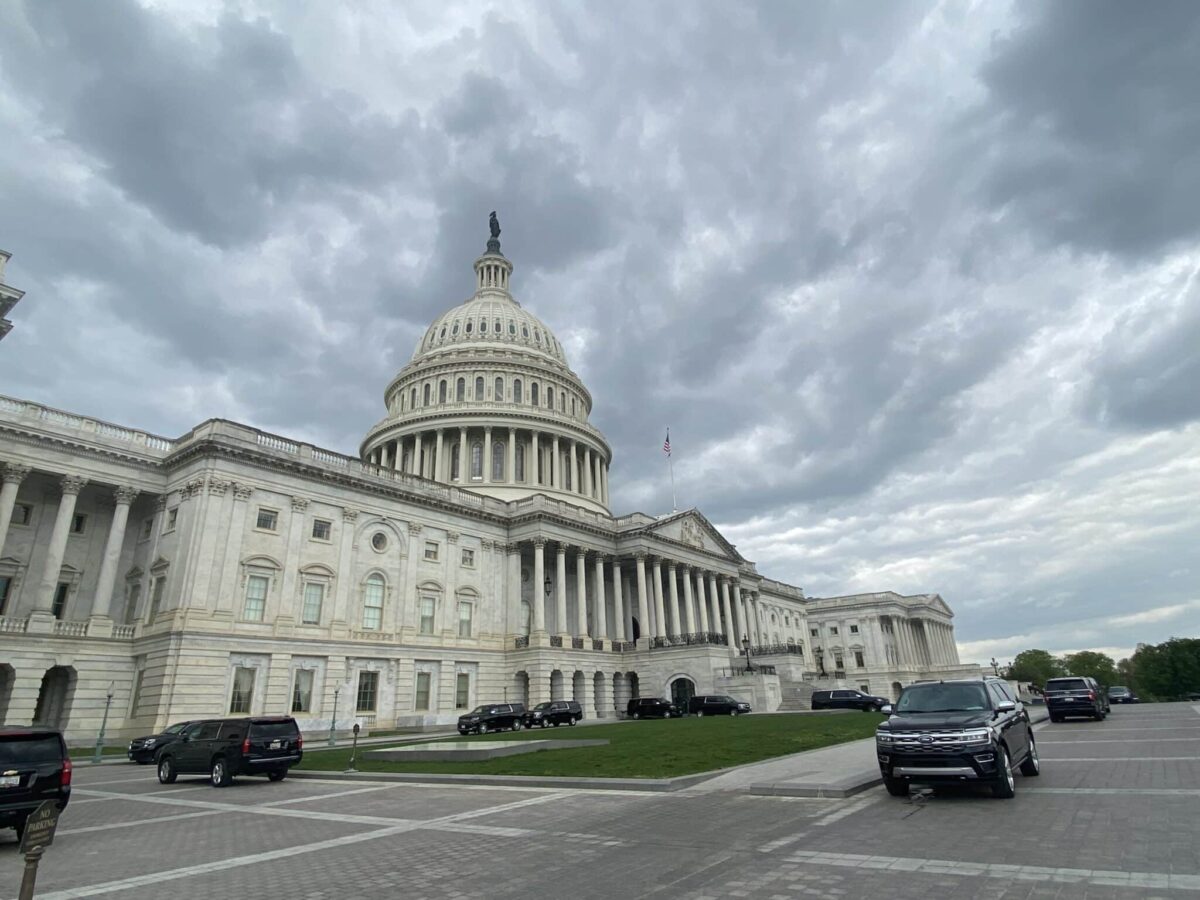
Alaska Republican U.S. Sens. Lisa Murkowski and Dan Sullivan (Alaska Beacon file photos)
Alaska Republican U.S. Sens. Lisa Murkowski and Dan Sullivan signed on to a letter with 10 other U.S. senators, calling on the U.S. Department of Education to reverse the decision to cut millions in congressionally approved grant funding for Native American-serving colleges and universities nationwide.
The letter, addressed to U.S. Secretary of Education Linda McMahon, argues that an estimated $36.1 million in grant funding already allocated under the Higher Education Act should be distributed to colleges and universities serving Native students nationwide.
Senators wrote the funds are already authorized and appropriated by Congress and should go toward its intended colleges and universities nationwide, “including dollars that are part of ongoing grants – projects, programs, and services that are already in motion and that are serving currently enrolled students,” they said.
“These institutions are statutorily authorized to receive federal support from the Department to strengthen their capacity to serve American Indian, Alaska Native, and Native Hawaiian students, and rely on this federal support to adequately serve enrolled students,” they said.
“The Department’s decision to reprogram this critical source of funding for these colleges jeopardizes not just their continued existence, but also undermines the federal government’s trust and treaty obligations to provide Native students an education,” they wrote.
Earlier this month, Sec. McMahon announced that $350 million in congressionally approved funding for minority-serving institutions, a federal grant category that includes funding for Black, Hispanic, Asian-American and Native American students, would be reallocated. McMahon cited “racial quotas” as discriminatory and unconstitutional. “To further our commitment to ending discrimination in all forms across federally supported programs, the Department will no longer award Minority-Serving Institution grants that discriminate by restricting eligibility to institutions that meet government-mandated racial quotas,” McMahon said.
The group of three Republican and nine Democratic senators rejected the claims, saying “to be clear, these grants do not impose racial quotas or restrict admissions based on race, but support institutions that deliver on the federal trust responsibility to provide an education for American Indians, Alaska Natives, and Native Hawaiians because of their unique legal status and political relationship with the United States.”
In Alaska, University of Alaska officials say they are still reviewing the extent of the funding freeze, but University of Alaska Fairbanks officials report the grant elimination totals at least $8.8 million across campuses.
Senators argued that the funding cut contradicts the Trump administration’s expressed focus on career and technical education, and said the funds boost capacity for institutions serving not only Native students, but wider student populations.
“As such, we again urge you to reverse the decision,” the senators wrote, “to release these funds, as appropriated by Congress, so that the work these schools do to support the trust responsibility, as well as the next generation of leaders as part of our nation’s bright future, can continue.
The letter was signed by Murkowski, as the chair of the US Senate Committee on Indian Affairs, and committee co-chair U.S. Sen. Brian Shatz, D-Hawaii; along with Sens. Dan Sullivan, R-Alaska; Mazie Hirono, D-Hawaii; Thom Tillis, R-North Carolina; Ben Ray Luján, D-New Mexico; Ruben Gallego, D-Arizona; John Hickenlooper, D-Colorado; Michael Bennett, D-Colorado; Mark Kelly, D-Arizona; Tina Smith, D-Minnesota; and Amy Klobuchar, D-Minnesota.
A spokesperson for Murkowski said as of Wednesday they have not had a response from the department
NOTN- The Juneau Assembly voted to purchase two floors of the Michael J. Burns Building to serve as a new City Hall, citing the need to consolidate operations and cut costs.
“The reason we’re trying to move is the buildings that we have historically leased are either no longer available or have major problems.” Said Mayor Beth Weldon, “We’re just trying to consolidate. We’re trying to cut our rent money, and this makes fiscal sense.”
The city will spend $9.3 million on the property, with an additional $2.7 million reserved for future capital projects. Weldon said the move is more cost-effective than building a new city hall, which was estimated at $48 million.
Assembly member Christine Woll, head of the Finance Committee said the city’s current office spaces are aging and expensive to maintain. “The Burns building has emerged as the most financially responsible option, and makes the most sense to bring all our city employees into a single building that’s not leaking like our other locations right now.”
The plan also includes a $600,000 condominium lease, but Weldon said overall costs will still save the city money compared to current rental expenses.
“I do think it’s important to recognize that we should be seeing thousands of people likely lose coverage from this,” said Jared Kosin, president and CEO of the Alaska Hospital and Healthcare Association.
Speaking to a room at Juneau’s convention center, they said if federal subsidies end, the cost of health insurance would rise so much that many Alaskans will go uninsured, discouraging them from getting checkups that could prevent serious illnesses. Hospitals would see a larger number of emergencies from uninsured people, straining them. It might even lead to an exodus from the state, as people seek alternative options and cheaper places to live.
“I worry about that,” said Kim Champney, executive director of the Alaska Association on Developmental Disabilities. “Because I think people will decide to leave Alaska because we have the most expensive health care in the country.”
Anton Rieselbach, with the Juneau Economic Development Council provided an analysis of cost estimates for Juneau. In Alaska’s capital city alone, 1,389 people receive health care via insurance plans bought through the federal marketplace. Right now, those Juneauites pay an average of $124 per month. If those subsidies expire, that will rise to $1,008 per month, an increase of more than 700%.
The council, a nonpartisan organization devoted to economic growth in the capital city, is worried about what will happen if the subsidies expire.
“We want people to be working and spending money, generating economic activity,” Rieselbach said, “but this just places another huge burden on people’s ability to spend their money in other arenas besides health insurance.”
A problem years in the making
The upcoming problem stems from federal subsidies enacted by Congress in 2021 and extended through the end of 2025. Those subsidies, known as “enhanced premium tax credits,” were applied on top of subsidies included in the original Affordable Care Act, which established the federal insurance marketplace.
Now, almost anyone who buys an individual health care plan through the marketplace gets some kind of subsidy.
Generally, that includes people whose employers don’t provide health insurance, self-employed people, and people who retired early and aren’t yet eligible for Medicare, which insures people with disabilities and people 65 or older.
Subsidies helped expand the number of people on federal marketplace plans from 11.4 million in 2020 to 24.3 million this year, allowing millions of Americans to get regular health care.
They also came at a high cost to the federal treasury: Extending them for another 10 years would cost $335 billion.
But if subsidies end, Alaska would be exceptionally hard-hit. The state has the highest health-care costs in the nation, which means unsubsidized insurance rates are high.
Of the 28,736 Alaskans who have health insurance policies through the federal marketplace, 25,170 receive the enhanced subsidies, according to figures published by the Centers for Medicare and Medicaid Services.
If the enhanced subsidies expire, the poorest Alaskans will still see their plans subsidized. Middle-class Alaskans would be hard hit.
According to estimates published in March by the Alaska Division of Insurance, a single 50-year-old who earns $58,650 per year would see their monthly health insurance cost rise from $282 per month to $407 per month for a “silver” plan. If they have a “bronze” plan, their costs wouldn’t change.
But Alaskans who earn more than 400% of the federal poverty line — $78,000 per year for an individual — would see their costs skyrocket.
In 2023, 2024 and 2025, the average cost of a health insurance marketplace plan in Alaska rose by more than 16% each year. In 2023 alone, the cost went up by an average of 18.4%.
That same 50-year-old would go from paying $534 per month for a silver plan to $1,415 per month. Under a bronze plan, their cost would go from $9 per month to $890 per month.
Lori Wing-Heier, the director of the Division of Insurance at the time of those estimates, called the increase “pretty horrific” for affected Alaskans.
“It’s an insane amount,” said Rep. Genevieve Mina, D-Anchorage, talking about the increase.
This spring, Mina sponsored and the Alaska Legislature passed House Joint Resolution 9, a bipartisan letter asking Congress to extend the subsidies.
Across the state this year, the average monthly premium for Alaskans of all ages and all plans was $971.43, but the average subsidy was $866.28, the Division of Insurance said in March.
Kosin, of the hospital and healthcare association, said his group thinks it’s “really important” to extend the enhanced subsidies.
Insurance is based on the concept of sharing risks and costs. The more people in an insurance pool, the better it works. Subsidies encourage healthy people to be a part of the health insurance pool, he said. If people drop off, the cost of caring for any individual person is spread among fewer members, and rates go up.
An extension relies on congressional action
For the moment, Alaskans only have estimates of what will happen if the subsidies expire. Open enrollment on the federal insurance marketplace starts Nov. 1. There’s a “window shopping” period at the end of October that will give a sneak preview.
People must sign up by Dec. 15 to get insurance coverage that starts with the new year. Miss that deadline, and Jan. 15 is the deadline to get coverage that starts Feb. 1.
Kosin said he’s heard the argument that Alaskans could afford health care before the enhanced subsidies came into effect, and so there won’t be many people who drop their coverage.
That fails to take into account the way health insurance costs have gone up since 2020, he said.
In 2023, 2024 and 2025, the average cost of a health insurance marketplace plan in Alaska rose by more than 16% each year. In 2023 alone, the cost went up by an average of 18.4%.
“If there truly is a doubling or tripling of premiums, especially at once, I think I would have to guess it would be a higher percentage than a fifth of the population that would consider themselves priced out of the market,” he said.
U.S. Sen. Lisa Murkowski knows plenty of those people.
“If you are a 60-year-old couple (earning about) $82,000 in Alaska, you would be looking at a premium increase … without enhancements, of $44,556. My husband and I are over 60. Now, granted, we’re not on the exchange, but I have a lot of friends are in that category, and I don’t know very many of them that could swallow an additional $44,000 a year to pay for their insurance if they’re on the exchange,” she said in a Sept. 17 phone call.
Murkowski is among the members of the U.S. Senate who have been trying for months, without success so far, to find enough votes to extend the subsidies.
Impending government shutdown
The issue has now gotten entangled with the impending government shutdown. Senate Democrats have demanded — among other things — a permanent extension of the health care subsidies, without changes, in exchange for their votes on keeping the federal government open.
Sen. Dan Sullivan also supports an extension of the subsidies, but “there’s no way I would ever vote for that,” he said of the Democratic plan.
“I do think there’s bipartisan support to get this done. We’ve just got to power through these different issues,” he said by phone.
He identified three hurdles for the subsidies.
“It’s how long you extend them; are there pay-fors (budget cuts to compensate for the cost of the extension) … but the most important and complicated — and we just did a deep dive on this, and I do think there’s bipartisan support on this, is reforms,” Sullivan said.
“We are looking at ways to reform the system to make it work for the people who need it and are using it honestly, but have a disincentive against those who have been abusing it,” he said.
“We’re getting there. It’s complicated. I think the reform piece is going to be the most complicated, but I’m hopeful, and I’m putting a lot of effort into it,” Sullivan said.
Murkowski is more interested in a straight extension without changes. She introduced a standalone two-year measure and voted against both Republican and Democratic proposals to keep the government open, saying one of her conditions was an extension of the subsidy.
Speaking by phone this month, Mina noted that an extension has the support of groups as far afield as the Anchorage Chamber of Commerce.
“I think if you’re directly on the insurance marketplace, you should be concerned. But also, if you care about economic diversification and startups, you should also be concerned,” she said.
If the marketplace doesn’t work, she noted, it would increase the costs of health care for everyone in the state because hospitals are required to treat people regardless of their ability to pay. If people can’t pay, that means their costs get shifted to people who can, increasing the health insurance rates of everyone, not just those on the marketplace.
“What I fear is that we’re regressing to the state that we were in (a decade ago) when we had all of these news articles about people paying like, $800, $1,000 a month for their health insurance, and we were able to stabilize that and find solutions to help people,” Mina said. “We’re just going backwards in that regard.”
NOTN- Residents filled Centennial Hall on Monday to oppose a plan to redevelop Juneau’s Telephone Hill into higher-density housing.
About 30 people testified against the proposal, which calls for replacing 14 existing units with more than 100 new units. Mayor Beth Weldon said the project is part of the city’s effort to expand downtown housing.
The Assembly has appropriated $5.5 million toward the redevelopment, though Weldon said no decisions are final.
“Most of it just comes down to trying to get housing downtown.” said Weldon, “So instead of 14 units, we’re looking for over 100 units, its a leap of faith.”
Opponents who testified criticized the plan’s cost and the displacement of current residents. The city maintains the redevelopment is necessary to address Juneau’s housing shortage.
“We do have a timeline. This is a topic for people, because we are doing evictions, but in the spirit of trying to get more housing downtown.” Weldon said.
According to Mayor Weldon, the Assembly changed the format through resident testimony so that there was more conversation between the city and the individuals who showed up to testify.
FILE – In this photo provided by the National Park Service is Grazer, the winner of the 2023 Fat Bear Contest, at Katmai National Park, Alaska on Sept. 14, 2023. (F. Jimenez/National Park Service via AP, File)
AP- After gorging all summer on sockeye salmon, the portliest brown bears on the Alaska Peninsula will battle it out to see who will be named the fattest of them all in the wildly popular online voting contest called Fat Bear Week.
Those casting votes online starting Tuesday will choose between 11 mammoth brown bears and the winner of last week’s competition for cubs, named “128 Junior.” She’s a cub of “Grazer,” the two-time defending Fat Bear Week champion at Katmai National Park and Preserve who is looking for a third title.
The contest, which began in 2014, is meant to showcase the resiliency of the brown bears, who pack on the pounds each fall to survive the harsh winter, mostly by gobbling salmon on the Brooks River in the remote preserve about 300 miles (482 kilometers) southwest of Anchorage by plane. The public can watch the bears on explore.org’s livestream cameras before deciding on their favorite creature.
How to vote for Fat Bear Week
The 12 contestants announced Monday will face off in a single-elimination, bracket-style tournament. All voting is done online at www.fatbearweek.org, with the winner declared Sept. 30.
The first round features eight bears squaring off in four separate contests. The four winners advance to the second round, where they face four bears that received first-round byes.
There are about 2,200 brown bears within Katmai, a 6,562-square-mile (16,997-square-kilometer) park on the Alaska Peninsula, which extends from the state’s southwest corner toward the Aleutian Islands. To be featured in the contest, the bears must frequent the area of the main Brooks Camp.
The contest has some colorful characters
The contestants include a number of colorful characters, from a bear nicknamed “Flotato” for a stomping dance it does, to one that will place its paw over its heart like she is pledging allegiance to the flag while waiting for fish to arrive.
Two of the contestants were once dominate males now adjusting to new realities. One was once at the top of the bear hierarchy but now is the old man of the river. The other is adapting to life with a broken jaw that will never heal properly.
The brown bears at Katmai are among the largest in the world. Mike Fitz, a naturalist for explore.org who started the Fat Bear Contest at Katmai when he was a ranger there, said that the only bears that are bigger are on nearby Kodiak Island.
A male bear at Katmai weighs about 700 to 900 pounds (318 kg to 408 kg) mid-summer and can bloat to over a 1,000 pounds (454 kg) by September or October, thanks to successful foraging. But even a 1,400-pound (635-kg) male isn’t unusual.
Female bears are about half to two-thirds the size of adult males.
But the contest isn’t always just about how big the bear is, and the past two years prove that point with “Grazer” defeating “Chunk,” one of the biggest bears on Brooks River.
Voters could consider the challenges some contestants have had to overcome, such as female bears who protect their young and produce milk for the cubs while also fattening up for winter themselves.
Abundant salmon equals fat bears
Even though factors other than girth can be considered when voting, this might be the year when weight does play a role.
Brooks Falls is famous for brown bears snagging salmon out of the air as the fish try to jump upstream to get to their spawning ground.
That didn’t happen much this year, as an exceptional salmon run reduced the need for bears to compete for fishing spots at the falls.
“We are kind of expecting really to have some of the fattest bears we’ve ever seen in the event,” Fitz said. In fact, officials refer to one contestant as “cruise ship” because of its sheer plumpness.
NOTN- In response to landslides in Alaska, the state established the Landslide Hazards Program in 2022 to assess and communicate landslide risks. A key part of this program is the Alaska Landslide Inventory, a database compiling mapped landslides from published geological reports and newly identified events reported in the news or detected through aerial imagery.
first reported by Alaska Public Media, the inventory classifies landslides by type, including slides, falls, flows, spreads, and thaw-related events, and includes metadata such as kinematic features, and event dates.
While the database is not complete, its goal is to serve as a resource for planners, researchers, and the public to identify landslide-prone areas and reduce economic losses and fatalities.
Users are encouraged to review the methods and limitations of the database, which will be updated periodically as more landslides are mapped and additional data become available.
Over the weekend, Auke lake Trail saw two landslides due to heavy rainfall and intense wind gusts, and for the second time in two years an apartment complex on Gastineau Avenue was evacuated last Wednesday after a landslide caused two trees to fall beside the apartments.
Landslide and downed trees along Auke Lake Trail
Intense weather will continue through late this evening according to the National Weather Service, bringing wind gusts up to 70 mph and heavy rain.
Alaska’s sole U.S. House Rep. Nick Begich III, R-Alaska, voted in favor of a seven-week budget extension, but that measure died in the U.S. Senate when lawmakers were unable to garner the 60 votes needed to pass the U.S. House measure or an alternative proposed by Democratic members of the Senate.
U.S. Sen. Dan Sullivan, R-Alaska, was absent from both votes. U.S. Sen. Lisa Murkowski, R-Alaska, voted against both proposals.
“I voted against both measures as I felt that they were not serious (enough) to meet the situation that we are currently in today,” she said in a recording provided by her office.
The Republican-controlled House passed its stopgap funding bill 217-212, with one Democrat voting for it and two Republicans voting against it.
“The House did its job,” Begich said in a written statement afterward. “We passed a responsible, short-term continuing resolution to keep the government open and give Congress time to complete the appropriations process. Unfortunately, Senate Democrats chose obstruction over solutions, blocking this clean measure.”
Murkowski and Sen. Rand Paul, R-Kentucky, voted against the House-passed plan, while Sen. John Fetterman, D-Pennsylvania, voted for it. Eight senators did not vote, and the measure died 44-48.
Murkowski said that counterproposal included “a Christmas list” of Democratic ideas, including items that would have reversed big parts of the Republican “Big Beautiful Bill Act” from earlier this year, which contained core tax cuts and spending policies of Trump’s second presidential term. Murkowski and Sullivan voted for that bill, which was later signed into law.
On the other side of the coin, Murkowski said the Republican plan failed to include an extension of subsidies for health care plans passed through the federal insurance marketplace, something that is critical for Alaskans. It also didn’t include additional funding for public broadcasting or opposition to President Donald Trump’s unilateral budget clawbacks, known as recissions.
“I’m going to be busy in the next 10 days, trying to build a level of consensus that keeps the government open, because there is no side — no Republican, no Democrat, the White House — nobody wins when there is a government shutdown,” she said.
“It’s possible that my proposal will equally annoy both sides, but maybe, just maybe, it will get the conversation going in a way that advances serious discussion and positive outcomes,” Murkowski said.
People line up outside of the downtown Anchorage Permanent Fund Dividend office on March 31, 2023, the last day to submit applications. (Photo by Yereth Rosen/Alaska Beacon)
This year’s Permanent Fund dividend will be $1,000, an amount set by the Alaska Legislature in House Bill 53, the state’s annual operating budget bill, earlier this year.
Ordinarily, lawmakers allocate an amount of money for the dividend, which makes individual payments dependent upon the number of recipients.
The Alaska Department of Revenue then announces the final amount in September.
This year, lawmakers set a specific dividend amount, which turned the Alaska Department of Revenue’s fall announcement, released Friday, into an anticlimax.
Alaskans whose PFD applications were filed electronically, whose applications were approved as of Sept. 18, and who requested direct deposit, will begin to receive their payments Oct. 2.
Those whose applications are approved by Oct. 13 will receive their dividends starting Oct. 23.
That includes people who applied for the dividend on paper forms or requested paper checks.
Paying a $1,000 dividend to all recipients was expected to cost $685.3 million, making it one of the largest single expenses in Alaska’s annual state budget.
Only the Alaska Department of Education and Early Development ($1.4 billion) and the Alaska Department of Health ($1.1 billion) are more expensive.
The 2026 dividend is expected to be larger, if lawmakers agree to spend from the state’s Constitutional Budget Reserve.
Since 2020, lawmakers have approved larger dividends in election years than in non-election years.
The Alaska Permanent Fund, an $83 billion state trust fund, is the largest source of general-purpose revenue for state services, paying for between 50-60% of state operations in an ordinary year. Oil revenue, by comparison, supplies only about a third of state revenue.
Since 1982, a portion of the fund has been paid out to Alaskans in an annual dividend. The payment was set by formula until 2016, when lawmakers — facing severe budget shortfalls — began setting it by fiat. The formula remains in state law, but legislators are not obliged to follow it.
The following is an advisory from the City and Borough of Juneau
Residents are advised to be aware of their surroundings and take precautions as heavy rainfall and wind may increase hazard risk in the Juneau area through late Monday night. Read the full National Weather Service (NWS) Flood Watch notice.
City & Borough of Juneau (CBJ) Parks and Recreation teams closed the Auke Lake Trail on Saturday after two landslides were observed. For their safety, residents should to stay clear of the trail and out of the lake until weather conditions improve and staff can clear the debris.
The National Weather Service also issued a Flood Advisory for Montana Creek. Significant rainfall is increasing water levels around Montana Creek, with water observed in low-lying areas and the potential for flooding on Montana Creek Road and Back Loop Road at the Montana Creek Bridge. If you see water on the road, turn around. Do not drive on flooded roadways. From the National Weather Service Flood Watch for Juneau:
“While the current periods of heavy rainfall will diminish Saturday evening, another band of heavy rain will move through on Sunday. This will result in elevated streams and the potential for minor flooding. This will be followed by a strong system on Monday which will bring with it strong winds and more heavy rain. Rainfall totals of between 3-5 inches are expected during this time, with higher amounts possible in isolated areas and at elevation.”
CBJ will remain in close contact with the NWS and our response partners and provide updates as available. Residents can also stay tuned to weather.gov/Juneau for further developments.
An early voting station is set up in the atrium of the State Office Building in Juneau, Alaska on Monday, Aug. 5, 2024, the first day of early voting for the 2024 Alaska primary election. (Photo by James Brooks/Alaska Beacon)
(Photo by James Brooks/Alaska Beacon)
NOTN- Ballots for the 2025 City and Borough of Juneau municipal election are being mailed today to all registered voters, marking the official start of the election period that runs through Oct. 7.
Voters can return their ballots by mail, deposit them in one of five secure drop boxes located around Juneau, or vote in person at City Hall or the Mendenhall Valley Public Library.
Drop boxes open today and will remain available 24 hours a day until 8 p.m. on Election Day.
This year’s ballot includes races for three Assembly seats, an areawide member, and representatives from Districts 1 and 2 , along with three Board of Education positions.
Ballots must be postmarked by Oct. 7 to be counted.
Official results are scheduled to be certified and published Oct. 21, following the review of ballots.