NOTN- Conservation and land trust leaders are raising alarms over a $28.5 million state-backed Ferry Terminal and Ore facility at Cascade Point, saying it’s advancing without key environmental review or tribal consultation and could reshape the region’s important cultural and ecological areas.
“This project kind of came up internally from DOT emails in 2019 and has moved at breakneck speed. In the last couple of years, there’s been a Memorandum of Understanding signed between Goldbelt, those are the land owners at Cascade point and the DOT.” Said Stacy Unzicker Mining Campaigner for Southeast Alaska Conservation Council, “So that would be, not only a ferry terminal, but a shared mixed use dock with an Ore dock in Berners Bay. There’s a lot of other places that money could be spent that would benefit not just Juneauites and people from Haines and Skagway, but all of Southeast Alaska, who’ve really been gutted with inconsistencies with ferry service.”
The proposal would create a mixed-use facility at Cascade Point in Berners Bay, combining a ferry terminal with an ore dock to serve a potential mine at Herbert Glacier, about 12 miles away. The funding comes from leftover money originally appropriated for the Juneau Access Road project.
Tyler Breen, an Environmental Policy Analyst with the Conservation Council, said state officials committed the money before completing the permitting, tribal consultation and federal environmental review processes that are supposed to inform whether and how such a project proceeds.
“On February 12, we gave testimony to the State House and Senate, outlining that the $28.5 million contract commits funds for this state to have momentum on this project in advance of the consultation and permitting processes that are intended to inform whether a project should happen.” Breen said, “So tribal consultation has not yet happened. By committing that $28.5 million in advance of assessing these baseline studies and doing the processes of assessing potential alternatives, they’ve constrained the potential outcome. That is, from my perspective as a policy analyst, a grave oversight.”
Tribal consultation as well as Clean Water permitting, have not been completed, the group said.
The Southeast Alaska Land Trust, which conserves about 280 acres downriver of the proposed mining expansion at Herbert Glacier, is backing the conservation council’s push for a more public comment and conversation.
Unzicker described Berners Bay as the “breadbasket of Juneau,” a place where Indigenous communities and local residents have long fished, hunted and recreated. The area supports herring runs, salmon streams and habitat for brown bears, moose and wolverines.
“These are clean, Lingít lands, specifically Wooshkeetaan lands in Berners Bay,” Unzicker said. “People actively go there to subsist and harvest from the sea and the land. We need to protect our anadromous fish because they’re the bounty that keeps giving, and mines are only there for a short time.”
In recent legislative testimony, a regional transportation official said 92% of public comments submitted during a comment period opposed the Cascade Point proposal, attributing much of that opposition to “fear of the unknown.” Conservation advocates dispute that characterization, saying the public is reacting to the information that has been made available.
“We want to make it vociferously clear that we are quite aware of everything that there has been transparency on,” Unzicker said, adding that the group is trying to maintain a constructive working relationship with transportation officials. “We believe they want to do good work, and we appreciate the ways they keep Alaska moving. We also want to make sure people aren’t getting lost in political agendas.”
To broaden the discussion, the Southeast Alaska Conservation Council and Southeast Alaska Land Trust are hosting a public event today from 6 to 8 p.m. at the Juneau Arts and Culture Center.
The first panel will feature tribal representatives speaking about their lineal connections to the land and the lack of consultation, followed by a second panel with conservation staff, a naturalist and a civil engineer taking questions from the public.
Organizers plan to livestream the event on the conservation council’s YouTube channel, with staff moderating comments so residents in communities such as Haines and Skagway can participate remotely.
“Please help us make sure that the decision makers, CBJ, legislators, DOT, all of these decision makers, need to hear from us really broadly about how this will impact us.” Unzicker said.
Judiciary presentation on March 2 on voter data sharing, photo courtesy of KTOO
NOTN- Alaska lawmakers are examining why the state turned over confidential voter information, including birth dates and parts of Social Security and driver’s license numbers to the U.S. Department of Justice.
In a joint hearing Monday of the House Judiciary and House State Affairs committees, Rep. Andrew Gray said the U.S. Justice Department’s 2025 request for complete voter registration lists from every state was unprecedented.
“This request by DOJ has never happened before, the Department of Justice has never asked for the confidential information of voters at any point in our history.” Gray said.
Alaska first sent only public voter information, but in December agreed to transmit a full electronic file with all data fields visible.
“On December 19, under the authority of Lieutenant Governor Nancy Dahlstrom, the state agreed to transmit an electronic voter file with all data fields visible, records were provided that included voter’s full names, dates of birth, residential addresses and either driver’s license numbers or the last four digits of social security numbers. Not every single state responded the way Alaska did.” Said Gray.
Attorney Libby Bakalar, who formerly represented Alaska’s Division of Elections, told lawmakers the disclosure likely conflicts with state law and Alaska’s constitutional right to privacy.
“Before I get into why this data transfer is problematic, if not unconstitutional, I just want to offer some context on the relationship between the state and federal government when it comes to running elections, the administration of elections in this country is the purview of the states. Those of you on the committee who support states’ rights would be pleased to know that states, including Alaska, maintain a lot of leeway and control over how their elections are run, issues like voter identification and voter list maintenance have historically fallen within the state’s remit. There is good reason for this.” She said, “For example, Alaska’s voter ID law allows for tribal IDs and confirmation of identity by a poll worker’s personal knowledge of the voter which aids voting in rural Alaska, where voters may not hold driver’s licenses or passports. We also have our own very detailed voter list maintenance statute that governs the way the division of elections adds and removes voters from the rolls and is supposed to determine who is eligible to vote in our state. The Alaska constitution, which affords greater protections of individual liberty than its federal counterpart, establishes a state based constitutional system of suffrage that includes provisions on the qualifications and disqualifications of voters. Perhaps most significantly, Alaska also has a specific constitutional provision that explicitly protects our citizens right to privacy.” She said.
Bakalar read from the federal agreement Alaska signed, under which the state pledged that within 45 days of receiving notice from DOJ about any “issues, insufficiencies, inadequacies, deficiencies, anomalies or concerns,” it would “clean its voter registration list by removing ineligible voters and resubmit the updated data.
“This process effectively turns Alaska’s independent voter list maintenance process into an audit and referendum by the federal government, in which the DOJ in Washington, has the final say over which Alaskans are allowed to vote here or not.” Bakalar said, “This has the potential to disenfranchise huge numbers of Alaskans at the whim of the DOJ, a whim which the DOJ may not necessarily be inclined to explain to the public’s satisfaction. And to what use will the DOJ put this data beyond just elections? We don’t know. We have seen aggressive immigration enforcement and unprecedented citizen surveillance under this administration. I think it’s fair to say that we cannot necessarily trust the federal government to use this data in good faith and for the purposes it claims.”
Election researcher Dr. Paul Manson of Portland State University warned that federal databases used to check voter eligibility are imperfect and often return non-matches that may still be U.S. citizens due to data inconsistencies.
He said that federal law bars large-scale voter removals in the 90 days before federal elections.
Lawmakers plan further questioning of state officials and experts about whether the Dunleavy administration’s cooperation was legally required and what protections now exist for Alaskans’ personal data.
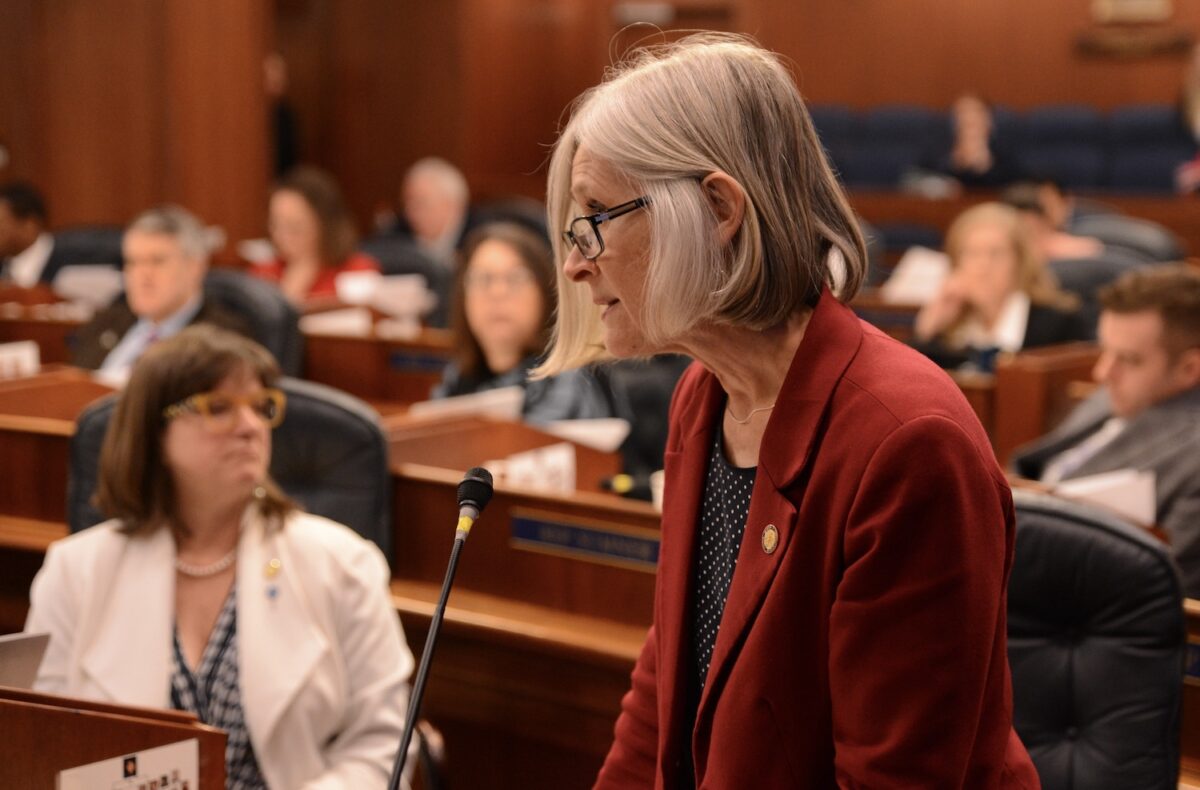
Rep. Alyse Galvin at the Alaska House Education Committee presenting HJR39, photo courtesy of Gavel Alaska
NOTN- Alaska lawmakers are urging the federal government to waive steep new fees on H-1B visas for international teachers, warning that hundreds of classrooms could be left without educators if school districts are forced to absorb the added costs.
On Monday, the Alaska House Education Committee heard testimony on House Joint Resolution 39, which calls on the state’s congressional delegation to seek an exception to a recent presidential proclamation that imposes a $100,000 annual fee per H‑1B visa holder.
Many Alaska districts, particularly in rural and remote communities, rely heavily on international teachers to fill longstanding vacancies.
Rep. Alyse Galvin, the sponsor of HJR 39, told the committee the resolution is meant to give U.S. Sen. Dan Sullivan and the rest of Alaska’s delegation a stronger hand in Washington, D.C.
“We are unfortunately without enough educators before students, and so we are facing a really tough time in recruitment and retention of teachers, especially in rural and remote communities. Many school districts across Alaska use international recruitment to fill our school vacancies, with cases of international hires filling 60% of the total teaching staff in western Alaska.” Said Galvin, “We heard last week about how hard they’re working to grow our own teachers, we are still facing this gap. Our H-1B teachers are very important to us, and with the most recent proclamation by the President, we now have an imposition of a $100,000 fee for any employer who is hiring H-1B, so any new ones coming in will be having to face that cost, at least our school districts will and this is insurmountable.”
Galvin said some districts also face deep budget holes, including an estimated $90 million deficit for the Anchorage School District alone and more than $200 million in combined shortfalls across the state. Many districts have already exhausted their reserves, she said.
The committee also heard from Dr. Lisa Parady, executive director of the Alaska Council of School Administrators, who said Alaska employs 573 international teachers, including 341 on H‑1B visas.
“Alaska is already facing a severe teacher shortage, at the start of the school year, we had at last report, 345, first day teacher vacancies, which equates to thousands of Alaska students beginning school without a teacher. Many Alaska districts, especially rural and remote communities, struggle annually to fill critical positions. International educators are not a luxury, without these educators, class sizes increase, course offerings shrink, student services are reduced, student outcomes suffer.” Said Parady.
Some lawmakers used the hearing to argue that while HJR 39 may help in the short term, it does not solve deeper problems with Alaska’s teacher workforce.
Rep. Andi Story, who co-chaired the committee Monday, heard concerns about pay and retirement. Galvin noted that unlike other states, Alaska does not have a single statewide pension system for all educators, and cited research that found Alaska’s average teacher salaries are roughly 30% lower than those in Washington state.
HJR 39 would not change the law, but would formally express the Legislature’s support for waiving or exempting Alaska school districts from the new visa fees.
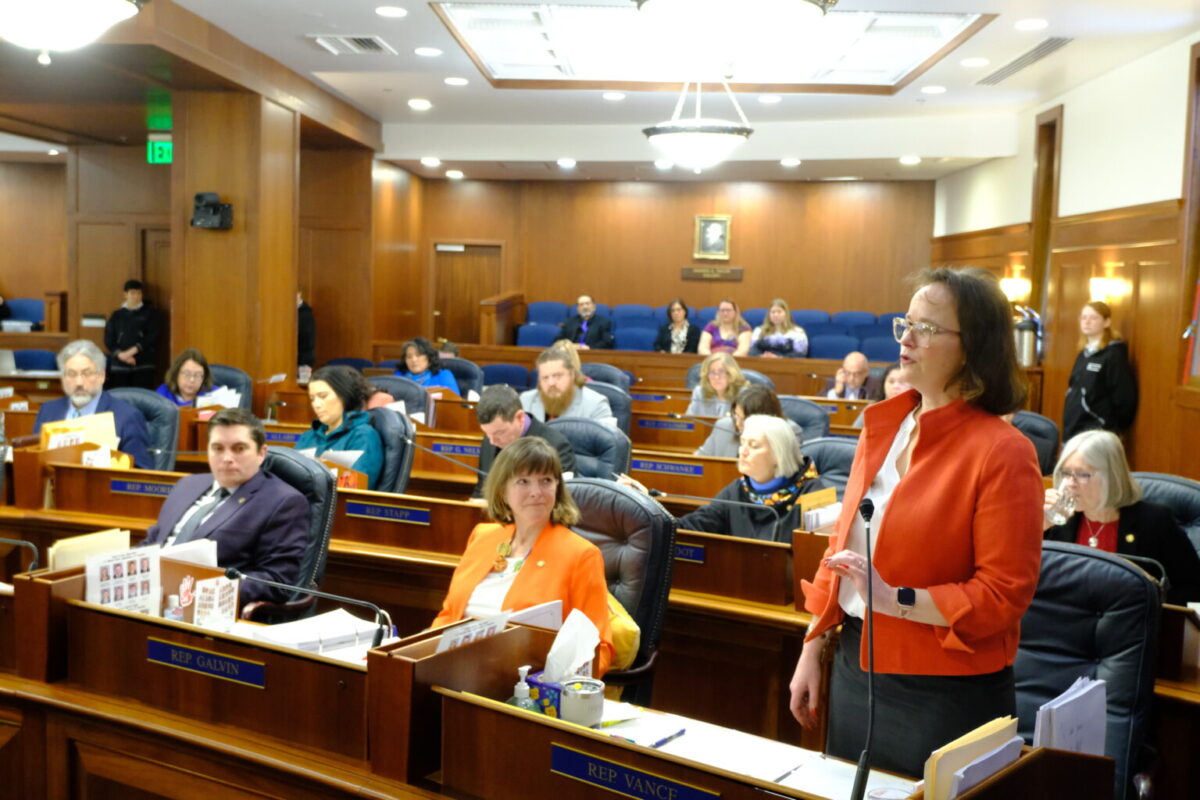
Rep. Sarah Vance, R-Homer, speaks in support of a bill she sponsored, HB 47, that would add state criminal penalties for AI-generated child sexual abuse material, on the House floor on Feb. 27, 2026. (Photo by Corinne Smith/Alaska Beacon)
Anyone that possesses, creates or shares child sexual abuse material created with artificial intelligence in Alaska would face new state felony charges under legislation advanced by the Alaska House of Representatives on Friday — plus AI companies and social media companies could face state penalties too.
House members passed House Bill 47 almost unanimously by a 39 to 0 vote, with Rep. Neal Foster, D-Nome, absent. The bill is sponsored by Rep. Sarah Vance, R-Homer, and would enact new state felony charges for creating AI-generated images or videos that visually depicts sexually explicit or obscene content involving anyone under the age of 18. Previously known as child pornography, it’s now referred to as child sexual abuse material or CSAM.
“A decade ago, we couldn’t even imagine what it is that the vulnerable and our children are facing, and tools that are being used to exploit them,” Vance said Friday on the House floor ahead of the vote. “But here we are in a fast-paced technological environment, and our prosecutors are left with very few tools,” she said.
Vance lauded the bill as closing a gap in state criminal law. Currently there are no state laws directly addressing AI-generated CSAM, though there are statutes that prohibit the viewing, possession and distribution of child sexual abuse materials. Vance emphasized that the bill would update Alaska law to penalize AI-generated CSAM, and noted it would apply regardless of whether images depict a victim or AI-generated material.
“Currently in statute, you have to prove the harm of an actual child. And what this bill does is says that anything that is generated obscene material of minors will be criminalized to the same level as if it were a real child,” Vance said.
Vance and others pointed to the recent arrest of an Alaska senator’s chief of staff for soliciting minors for CSAM on Snapchat, and the need to increase state penalties. Other lawmakers said the case demonstrates the need for more parental controls on minors’ social media.
Legislators added on and approved significant parental controls and penalties for tech companies too, through an amendment process on Wednesday.
Under the revised bill, social media companies will require age verification and parental or guardian consent for minors to create or maintain social media accounts. Parents would have full access to minors’ social media, including all minors’ messages and interactions on the platform. The bill enacts a social media curfew for minors from 10:30 p.m. to 6:30 a.m., unless modified by a parent.
Rep. Zack Fields, D-Anchorage, sponsored the amendments and said with increased parental control measures, parents and guardians will be able to intervene on potentially predatory behavior or victimization of children.
“The fundamental question is: Do parental rights supersede the rights of predators?” Fields said on the House floor Wednesday. “And do parental rights supersede the rights of multi-national corporations, which we have heard knowingly target children with addictive, destructive algorithms. We know that.”
Targeted advertising to minors on social media would also be prohibited, as would content targeting minors, addictive design or features that “encourages or rewards a minor user’s excessive or compulsive use of the platform or that exploits the psychological vulnerabilities of a minor user,” according to the bill.
Families or the state would be able to bring civil legal action against social media companies for harm due to such violations under the bill, and companies could face a penalty of up to $10,000 for each violation.
“I don’t care how hard it is. We should not back down from Big Tech when it comes to protecting our children,” Fields said.
The amendment passed with a 28 to 12 vote, with supporters and opponents spanning party lines.
Rep. Genevieve Mina, D-Anchorage, the youngest member of the House, opposed the provision.
“I absolutely agree that social media can be harmful for youth, especially given the vast environment, where there are a lot of different strangers and people on the internet. I also know I’m probably one of the only people in the body who very much grew up online,” she said Wednesday on the House floor.
“I’ve wrestled back and forth with these types of policies, especially as it relates to age verification or requiring consent from a minor,” she said, and added that she shared concerns about first amendment and privacy rights. “But I just don’t believe that age verification through government regulation is the right way.”
Vance, the sponsor of the bill, also opposed the increased parental controls provision citing First Amendment concerns.
Lawmakers also voted to approve a provision levying civil penalties on any AI organization that facilitates users creating AI-generated CSAM of up to $1 million for each instance.
Rep. Calvin Schrage, D-Anchorage, sponsored the amendment which was passed unanimously.
“I think this is something that creates an incentive for these large companies to curtail or at least put some controls and protections around what I think can be a very powerful and useful tool, but is so often used today for really malicious, nefarious and, I would say, disgusting purposes,” Schrage said.
The bill would also prohibit the distribution of generated sexual depiction of adults without their consent or participation. It would also prohibit distribution of a “forged digital likeness,” known as “deep fakes” often used as misinformation, revenge pornography, scams or blackmail.
Rep. Andi Story, D-Juneau, speaks Wednesday, May 8, 2024, on the floor of the Alaska House of Representatives. (Photo by James Brooks/Alaska Beacon)
By: Sean Maguire, Alaska Beacon
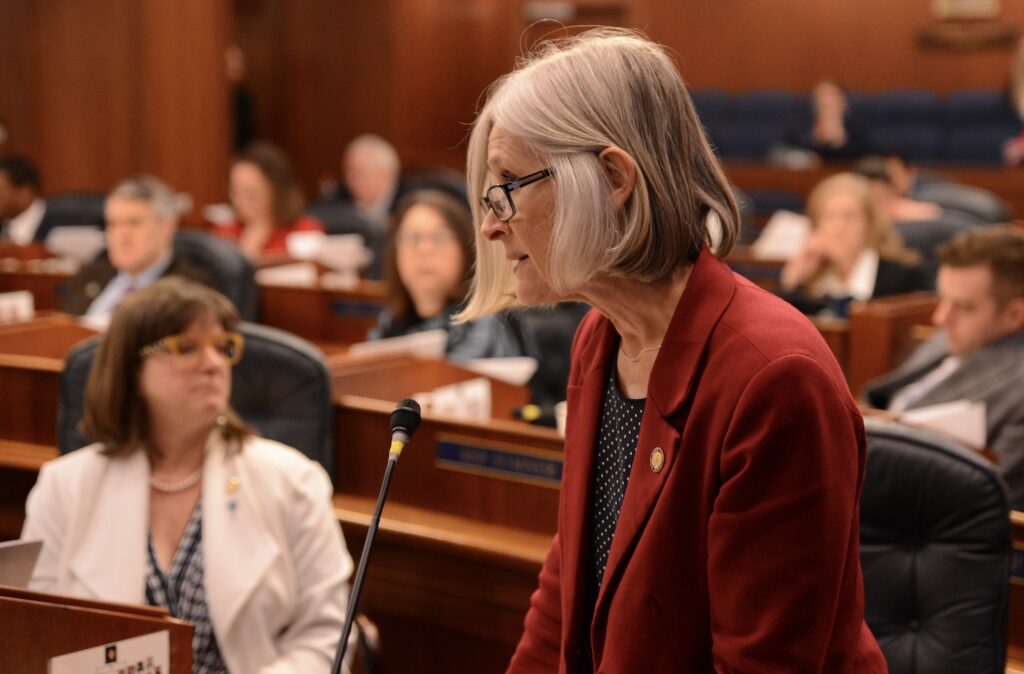
Rep. Andi Story, D-Juneau, speaks Wednesday, May 8, 2024, on the floor of the Alaska House of Representatives. (Photo by James Brooks/Alaska Beacon)
The Alaska House on Friday advanced legislation intended to increase construction of workforce housing.
Alaska has long had a severe and persistent housing shortage. House Bill 184 attempts to address that by allowing the Alaska Industrial Development and Export Authority, the state’s economic development agency, to finance construction of commercial housing with more than five units.
The House approved the bill on a 23-15 vote with two lawmakers absent.
Juneau Democratic Rep. Andi Story, the bill’s prime sponsor, said that Alaska’s housing shortage is “at crisis levels,” which is contributing to workforce challenges.
“This shortage is very discouraging to Alaskans and businesses, and it is a persistent barrier to economic growth,” she said before Friday’s final vote.
In 2023, Agnew::Beck Consulting estimated that Alaska would need to build 27,500 new units over the next decade to meet demand. However, actual construction numbers have fallen far below those targets.
HB 184 was supported by all present members of the Democrat-dominated House majority and three minority Republicans.
Supporters said the legislation would help with resource development projects and to address workforce shortages more generally. Story cited examples of health care workers who had turned down jobs in Juneau due to a lack of housing.
Rep. Jeremy Bynum, a Ketchikan Republican in the minority, voted for the bill. He said shipyard projects and fish processors in Ketchikan and Wrangell were exciting developments for Southeast Alaska, but a shortage of housing remained a concern.
“We have a tremendous need for workforce housing,” he said on Friday.
Opponents of the bill noted that AIDEA already has the authority to invest in multi-unit housing for workers.
Mark Davis, special counsel for the agency, told lawmakers last year that AIDEA does have that authority and it has invested in workforce housing in the past. He cited examples of the agency financing construction of work camps in Prudhoe Bay.
“However, we have also said that this provides clarification that we would have that power,” he said, later adding that it would be a “positive bill.”
Some opposition to the bill centered on whether new housing units would actually serve workers in critical industries or if it would direct construction of affordable housing.
A previous version of HB 184 used the U.S. Department of Housing and Urban Development definition of workforce housing: “(as) residential housing that costs the occupants less than 30 percent of the income of a household with 120 percent of the median family income.”
But that definition was removed from the bill in committee. Instead, the bill states that AIDEA should facilitate the financing of “new workforce housing facilities containing five or more dwelling units.”
Big Lake Republican Rep. Kevin McCabe on Friday suggested the legislation was a “thinly-veiled attempt” to direct AIDEA into the construction of “community housing.” He said the agency, which was established in 1967, should be focused on “job creation.” He said that HB 184 would change AIDEA’s basic structure.
McCabe attempted to amend the bill on Wednesday to limit its scope, but he was unsuccessful.
HB 184 now heads to the Senate for its consideration. A similar bill in that legislative chamber has advanced to the Senate Finance Committee.
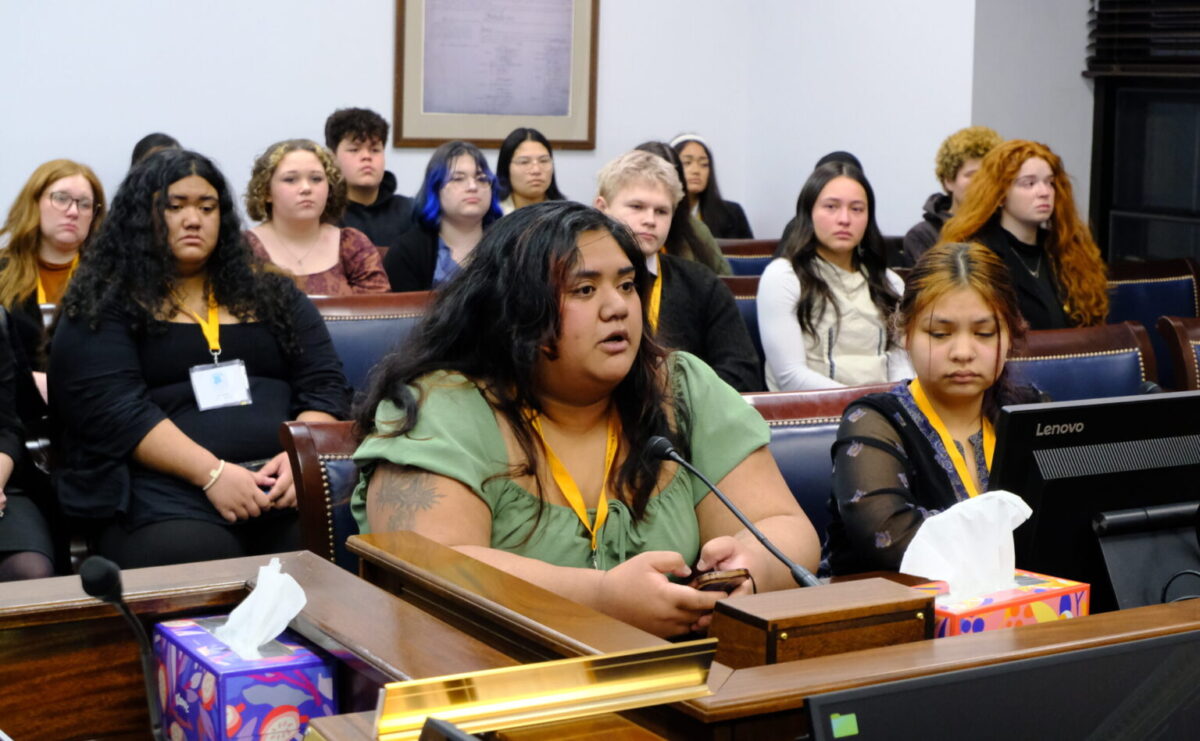
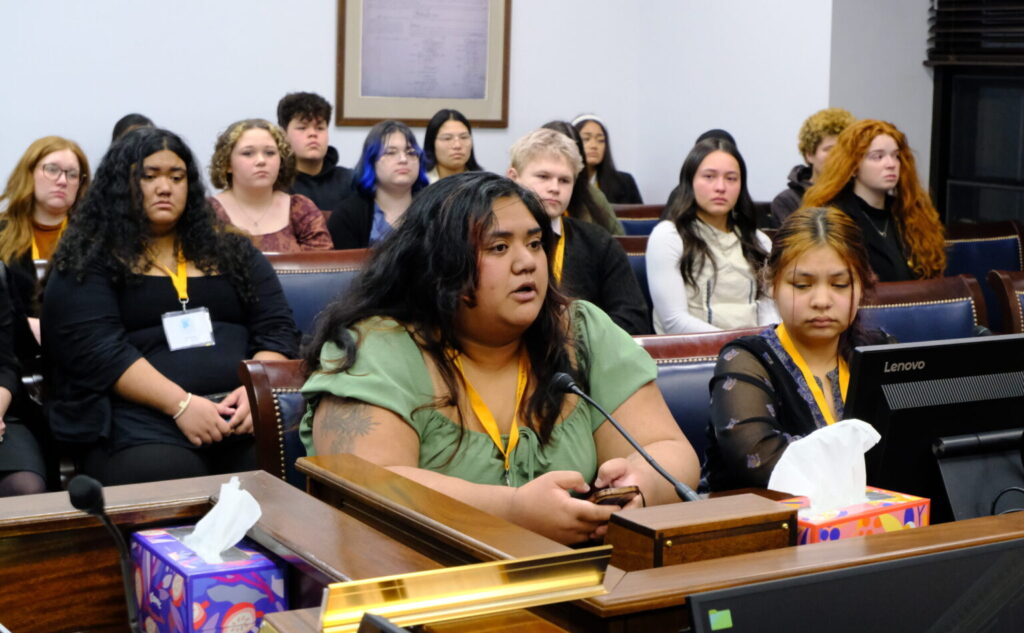
Kxlo Stone (left) and Trinity Beltz (right) testify to the importance of protecting sibling relationships in foster care to the House Judiciary Committee on Feb. 26, 2026. Stone’s sister Tali Stone sits behind her. (Photo by Corinne Smith/Alaska Beacon)
Alaska foster youth could see their ties to siblings legally protected through the adoption process, under legislation proposed last year in the Alaska House of Representatives.
House Bill 157 would maintain the legal relationship between siblings through the process of adoption, and also encourage adoptive families to support sibling relationships. It is sponsored by Rep. Andrew Gray, an Anchorage Democrat, who is a foster parent himself.
“Sibling relationships are among the most powerful and enduring connections a person can have,” Gray said, in opening remarks of a hearing on the issue on Wednesday. “For children in foster care, siblings are often a remaining link to their past, their identity and their family. These bonds provide emotional stability, comfort and a sense of belonging during an experience that is confusing and traumatic.”
Currently, under Alaska law, adoption ends the legal relationship between adopted children and their birth family, including siblings. The bill preserves the legal relationship between siblings, despite adoption and termination of parental rights. Siblings would continue to be legally recognized, including for siblings by blood, marriage or adoption by one or both parents.
Deko Harbi (left) and Lotus Nickoli (right) testify in support of HB 157 and the importance of preserving sibling relationships in foster care on Feb. 25, 2026. (Photo by Corinne Smith/Alaska Beacon)
Gray introduced the bill last year but it has not yet been scheduled for committee hearings. This week, he invited a group of current and former foster youth with Facing Foster Care in Alaska, a non-profit advocacy organization, to testify on the issue to the House Judiciary Committee on Wednesday. In an emotional hearing, youth shared personal stories of separation from siblings, and urged legal protections for maintaining sibling relationships as vital.
“When my siblings and I were separated, daily things became harder to do and life was harder to get through,” said Tali Stone, who was separated from her five siblings when they entered state custody. “I went from laughing, sharing bed with my older sister, and playing with my younger siblings, to not knowing where they lived, who they lived with, and missing huge milestones and moments in their lives.”
Lotus Nickoli of Fairbanks testified to the fear and uncertainty he felt when he was separated from his eight siblings.
“It’s just more scary, like knowing that they’re going to be going through different situations, different foster homes and whatnot, different foster parents, like you don’t know who they’re with and what these foster parents are capable of,” he said, breaking down into tears.
“Siblings should not be separated,” he said.
In Alaska, the Office of Children’s Services, which runs the state’s foster care system, is required to “make reasonable efforts” to place siblings together in a foster placement if siblings are living in the same home when taken into state custody. If siblings are not placed together, case workers must document how reasonable efforts were made. The case worker is also charged with connecting siblings and providing opportunities for contact, “if it is in the best interest of the child to maintain contact.”
Amanda Metivier, director of Facing Foster Care, said the foster youth have called for legislation to prevent sibling separation because the reality is often youth are having great difficulties in maintaining contact when taken into state custody and after adoption.
Amanda Metivier (right) director of Facing Foster Care Alaska, and Amanda Redmon (right) a former foster youth testify to the House Judiciary Committee on the importance of maintaining sibling relationships among foster youth on Feb. 25, 2026. (Photo by Corinne Smith/Alaska Beacon)
“So as a state, we’ve been experiencing a decline in the number of foster homes in recent years, and so it becomes harder and harder for OCS to keep children together,” she said.
“The unfortunate truth is that if you have a young person that moves into a foster family or a relative, and the permanent goal is going to be adoption, and their siblings are in another place, they become legal strangers,” she said.
Trinity Beltz said when OCS intervened and took her, her eight siblings and two stepsisters into state care, they were all separated in foster placements. While she could see some of her siblings, she OCS barred her from seeing her stepsisters because the agency claimed they were not related.
“Nobody updated me on where they were, and that really broke me,” she said. “I haven’t seen them since they were at least four years old, and looking at them now, they’re already almost seven to eight.”
“But I do want to still be their sister, and not be like a stranger to them,” she added. “To me, that would break my heart completely.”
The bill was introduced last year and was referred to the House Health and Social Services Committee.
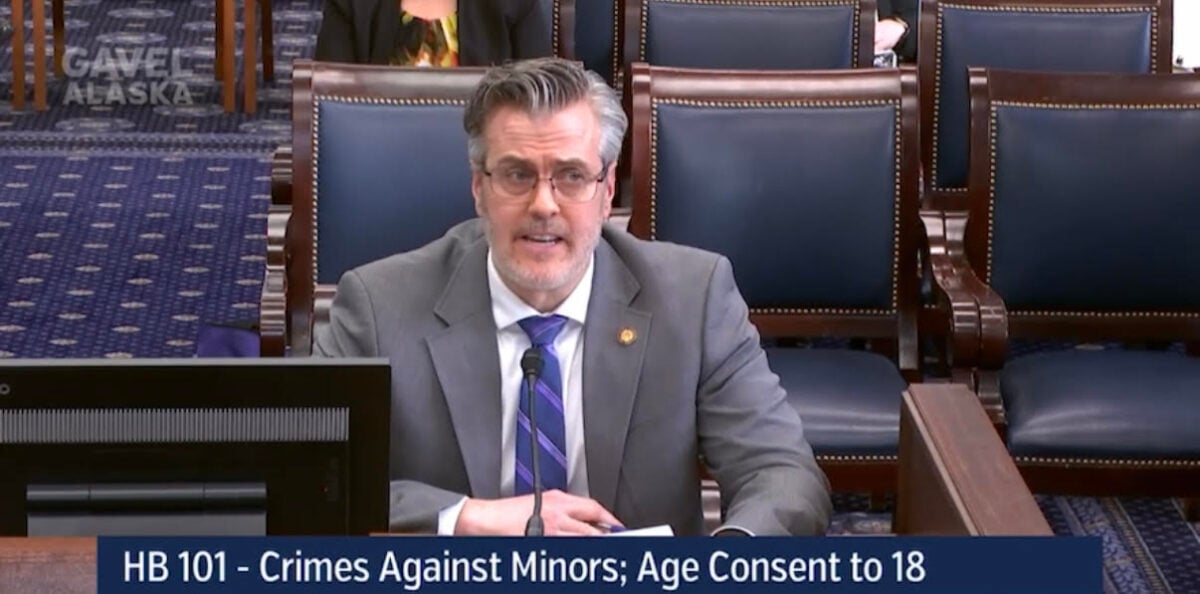
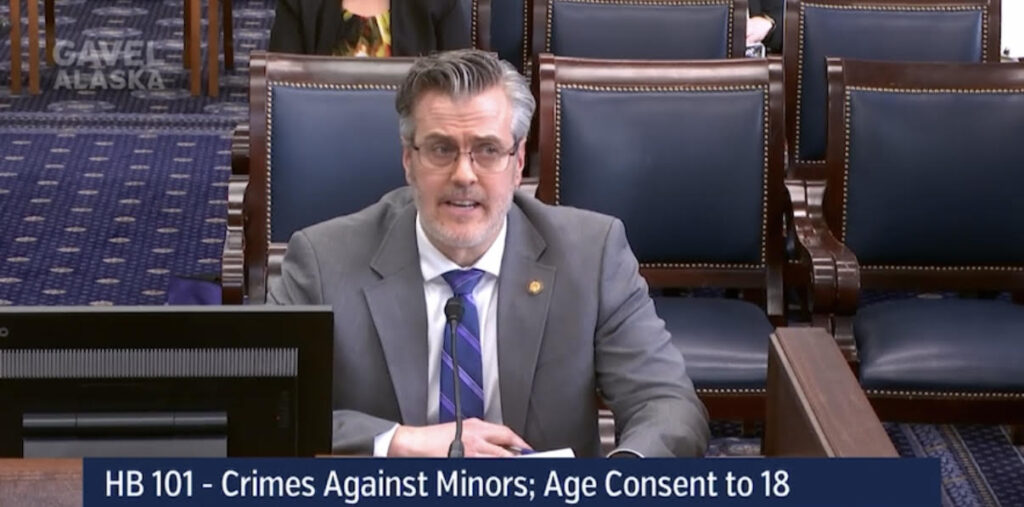
Representative Andrew Gray at a Senate Judiciary hearing for HB 101 on February 9, 2026, Photo Courtesy of Gavel Alaska.
This article mentions sensitive topics such as sexual assault and child sexual assault, resources for victims in Alaska can be found here.
NOTN- Alaska lawmakers are considering legislation that would raise the state’s age of consent from 16 to 18, a change the sponsor statement says would strengthen protections for teenagers and make it easier to prosecute sexual assault and exploitation.
House Bill 101, sponsored by Rep. Andrew Gray, was introduced as Alaska continues to report some of the highest rates of sexual violence in the country.
“Alaska has the highest rate of rape in the country, which is over 3 times the national average.” Gray said at a Senate Judiciary hearing, “We also have one of the highest rates of child sexual assault in the country, over 6 times the national average, according to the UAA Justice Centers’ Alaska Victimization Survey.”
Under current law, 16- and 17-year-olds can legally consent to sex with adults, which supporters say creates a loophole that complicates prosecutions. Survivors often must prove they did not consent, even when there is a clear power imbalance between adults and teens, which Gray says makes the successful prosecution of cases difficult.
HB 101 would close that gap by establishing that minors under 18 cannot legally consent to sexual activity with adults. The bill includes a four-year “close-in-age” exemption so consensual relationships between peers are not criminalized.
The Anchorage Police Department has formally endorsed the bill. In a letter to lawmakers, Police Chief Sean Case said officers regularly see the harm caused by sexual abuse and exploitation and that the bill would give law enforcement clearer authority to protect minors and hold offenders accountable.
“On behalf of the Anchorage Police Department, I express our strong support for House Bill 101. This legislation strengthens protections for Alaska’s youth by aligning our criminal statutes with the realities of adolescent development and the responsibility of adults to safeguard minors from exploitation and harm.” The letter said.
The Alaska House of Representatives is seen in action on Monday, May 5, 2025. (Photo by James Brooks/Alaska Beacon)
By: Sean Maguire, Alaska Beacon
The Alaska House of Representatives is seen in action on Monday, May 5, 2025. (Photo by James Brooks/Alaska Beacon)
The Alaska House on Wednesday advanced a bill that would boost state funding for a nonprofit that provides free legal aid to vulnerable Alaskans.
House Bill 48 was approved by the House on a 27-13 vote.
Supporters say the Alaska Legal Services Corporation is critical for assistance in housing disputes, financial abuse cases, for seniors, veterans and people with disabilities.
“Those services hopefully keep you housed, keep a restraining order in place, keep children in your custody, (and) help you collect your child support,” said Juneau Democratic Rep. Sara Hannan, the bill’s lead sponsor, before the final vote.
The agency is Alaska’s largest provider of legal aid for civil cases. It is also the largest provider of free legal assistance for survivors of domestic violence and abuse. Alaska has routinely had the highest rates of domestic and sexual violence in the nation.
Keeley Olson, executive director of Standing Together Against Rape Inc., said civil legal aid is “an essential service” for survivors of sexual assault to help them rebuild their lives.
“Sexual assault survivors often face significant barriers to justice, including navigating complex legal systems while dealing with the emotional and physical trauma of their experiences,” she said in support of the bill.
All 21 members of the Democrat-dominated majority supported the bill alongside six Republicans in the minority. All 13 no votes came from minority Republicans who were concerned about its costs.
State funding for the corporation comes partly from filing fees to the Alaska Court System. HB 48 would direct 25% of those fees to the agency, up from 10% currently in state law.
Court filing fees in Alaska are otherwise deposited in the state treasury and can be spent for any purpose.
In 2025, the Alaska Legal Services Corporation received just under $300,000 in filing fees. The Alaska Department of Commerce, Community and Economic Development estimated HB 48 would boost its funding by roughly $460,000 per year.
Although the Alaska Constitution guarantees the right to a defense attorney in criminal trials, there is no equivalent protection in civil cases. The corporation was founded in 1967 to bridge that gap.
The agency received $1.2 million in state funding in 1984, but that dropped below $700,000 in 2024. The number of Alaskans eligible for civil legal aid more than doubled over the same period.
Maggie Humm, executive director of ALSC, told lawmakers last year that roughly half of its applicants for help are turned away due to current funding levels.
Humm said the nonprofit provided legal help to roughly 6,200 Alaskans in 2024. A $400,000 funding boost could allow the agency to help roughly 800 additional Alaskans, she added.
Fairbanks Republican Rep. Will Stapp said that he supported the work of the Alaska Legal Services Corporation, but with Alaska facing a fiscal crisis, additional state funding would come with consequences.
“You’re going to have to fill this hole. Where are you going to fill it from?” Stapp said before Wednesday’s final vote.
Palmer Republican Rep. DeLena Johnson, the House minority leader, said using filing fees to fund the agency was “convoluted.”
“We should just fund it, if that’s what we want to do,” she said.
The funding increase for the agency is supported by the Alaska Federation of Natives, the Governor’s Council on Disabilities and Special Education and other Alaska organizations.
The Legislature failed to pass a similar bill in 2024. After passing the House on Wednesday, HB 48 now heads to the Senate for its consideration.
NOTN- Streets, schools and public safety topped the list of community priorities in the results of the recent city budget survey that, according to city leaders drew an unusually high level of public participation.
Mayor Beth Weldon said 4,400 residents responded to the survey.
“Which is quite unusual, and if you think about that, that’s half of what we usually have for voting on elections. So we did have a lot of people interested in telling us what they prioritize.” Weldon said.
According to Weldon, the number one priority identified by respondents was streets, roads and winter maintenance, followed by schools and public safety.
Rounding out the top 10 priorities were water and wastewater services, Bartlett Regional Hospital, recreation facilities, trails, the airport, national disaster response, libraries and museums.
Residents were also surveyed on areas they viewed as lower priorities or potential places to cut.
Tourism management ranked first among programs seen as candidates for reductions.
“The responses were mainly that they thought we should use more of the Marine Passenger fees to do that, rather than general fund fees.” Weldon said.
Other lower-ranked areas included climate and energy efficiency, economic development, housing development and land use planning, recreation facilities, homeless services, libraries and museums, trails, and the port and harbor.
“It was interesting seeing recreation facilities both on priority and where to cut but it totally was generational. The older you were, the less you prioritize recreational facilities.” Said Weldon.
The most popular option for raising or adjusting revenue was through property tax changes, Weldon said, with support “well into the 50%” range.
“It will be pretty tricky to do that, because one of the ballot measures capped our property tax, so we can’t do a lot there for another year or two.” Weldon said.
Weldon said the city is continuing to collect feedback through budget workshops, the final workshop takes place on March 4.
Rep. Andrew Gray, D-Anchorage, speaks Friday, April 26, 2024, on the floor of the Alaska House of Representatives. (Photo by James Brooks/Alaska Beacon)
By: Corinne Smith, Alaska Beacon
Rep. Andrew Gray, D-Anchorage, speaks Friday, April 26, 2024, on the floor of the Alaska House of Representatives. (Photo by James Brooks/Alaska Beacon)
The arrest of a Soldotna family by U.S. Immigration and Customs Enforcement, including two teens and a 5-year-old, has prompted a wave of concern and lawmakers to hold an investigatory hearing on Monday on the arrest and detention of minors in Alaska.
“As far as I am aware, the detention of children by ICE in Alaska is unprecedented,” said Rep. Andrew Gray, D-Anchorage, who chairs the House Judiciary Committee. In opening remarks, he questioned if federal agents provided full due process to the family and honored legal protections for children.
“Is Alaska about to see more children detained?” he asked.
ICE agents arrested Sonia Espinoza Arriaga at her home in Soldotna on Feb. 17, and apprehended her three children — ages 18, 16 and 5. Arriaga is married to an Alaskan U.S. citizen and was in court proceedings to gain asylum after fleeing violence in Mexico, according to news reports. The next day, Arriaga and her two younger children were deported to Jalisco, where they remain. The 18-year-old was transported and detained at the Anchorage Correctional Complex and transferred on Feb. 20 to a privately-run ICE detention facility in Tacoma, Washington, according to news reports.
The arrest comes as ICE operations are ramping up in Alaska and nationwide, amid the Trump administration’s immigration crackdown. Gray noted the agency saw a historic funding increase last year and now has a budget of roughly $85 billion.
Anna Taylor with the Alaska Institute for Justice (top left), Rev. Michael Burke with St Mary’s Episcopal Church of Anchorage (top middle), Elora Mukherjee, a clinical professor of law at Columbia and director of the Immigrant Rights Clinic (top right), Rev. Meredith Harbor with the Christ Lutheran Church in Soldotna (bottom left), Rev. Lisa Adam Sherry with the Anchorage Unitarian Universalist Fellowship (bottom center), and Soldotna parent Alison Flack (bottom right) testified to the House Judiciary Committee on Feb. 23, 2026 on the recent ICE arrest of a Soldotna family and detention of minors in Alaska. (Screenshot of Gavel)
Members of the House Judiciary Committee put questions to officials with the Alaska Department of Corrections and Department of Public Safety on the extent of the state’s involvement in ICE operations and detention of minors. They also heard testimony from community members, attorneys and clergy expressing outrage and concern at ICE operations.
Gray said the committee had invited representatives from ICE and the U.S. Department of Homeland Security to testify about the arrest and issues raised, but they declined to appear. He said his office has submitted a list of questions to the agencies, including questions about due process, and have not yet heard back.
Gray said his office will be drafting a committee resolution urging a change in federal policy, and said if ICE fails to answer the committee’s questions, the committee will “look at other options for compelling their testimony.”
State agencies questioned on policy around detaining minors and cooperation with ICE
Jen Winkelman, commissioner of DOC, said the department has an agreement with federal authorities to detain people arrested under federal charges, including with ICE for civil immigration charges.
“Does DOC detain minors?” Gray asked. Winkelman said no.
Winkelman did not say in the committee meeting whether DOC would hold children detained by ICE.
“We have the contract for the federal government to hold individuals that may come in in a non-criminal capacity,” Winkelman said. “When the ICE agents detain somebody, they will bring them to us, the individual and a piece of paper that essentially authorizes us to hold them.”
In the case of Arriaga, her husband, Alexander Sanchez-Ramos, told reporters that initially she and her two youngest children would be held in a hotel in Anchorage and guarded by federal agents, but then he learned they were flown to San Diego the same evening of their arrest, then driven to the Mexico border and deported.
ICE did not immediately respond to questions on Tuesday about the expedited deportation of the Arriaga family and plans and protocols for detaining minors and families in Alaska.
Gray said the committee had invited representatives from ICE and the U.S. Department of Homeland Security to testify about the arrest and issues raised, but they declined to appear. He said his office has submitted a list of questions to the agencies, including questions about due process, and have not yet heard back.
Zane Nighswonger, director of institutions for DOC, told lawmakers that ICE detainees are held in state prisons, but are held separately.
“They’re basically subject to the same security measures we have for our prisoners. We do keep them separate from the prisoner population, as they’re non-criminally charged,” he said Monday. “They recreate separately from other prisoners, have access to their telephone calls separately from other prisoners, and then showers and things like that.”
Nighswonger said individuals arrested by ICE are typically held in Alaska jails and then transferred to federal detention facilities within 72 hours.
The Alaska State Troopers do not participate in ICE enforcement, Leon Morgan, deputy commissioner for the Alaska Department of Public Safety, told lawmakers on Monday. “We don’t coordinate with ICE for immigration enforcement,” he said.
Morgan said for criminal cases Troopers will work with federal partners, but not cases related to immigration enforcement. He said Troopers have a policy to mitigate effects of law enforcement actions when children are involved. “In terms of how ICE does their job, or what they do, that is just beyond or outside the scope of how we operate,” he said.
Rep. Chuck Kopp, R-Anchorage asked what state legislators can do to constrain ICE action in Alaska given federal authority outweighs state law.
Elora Mukherjee, a clinical professor of law at Columbia Law School and director of the Immigrant Rights Clinic, testified that lawmakers can not only speak out, raise concerns and demand answers from federal authorities, but states are also taking action to block ICE enforcement actions and developing new detention centers.
“I think your committee is doing exactly the right thing by inviting officials from the federal government, from ICE, from DHS, to testify about what is happening in Alaska,” she said. “Right now, it seems that in Alaska, as in many states across the country, the federal government does not want local and state legislators to know what they are doing.”
Advocates call arrests and detainments a ‘grave concern’
Attorneys and immigration advocates testified that the avenues for legal immigration are being cut back by the Trump administration at every level — from travel bans, to canceling visa and refugee programs, to petitioning to end birthright citizenship — resulting in more and more people being arrested and deported.
Arriaga had reportedly applied for and was in the process of obtaining asylum for her family. A spokesperson for ICE said she had failed to appear for a court hearing in January, prompting deportation, according to news reports.
Mukherjee testified that ICE is increasingly arresting and detaining children and families.
“From January to October 2025, at least 3,800 children under the age of 18, including 20 infants, were detained by US immigration authorities,” she said, and many are held beyond the legal limit of 20 days.
She spoke about her experience representing children and families held at the privately-run South Texas Family Detention Center in Dilley, Texas, and the traumatizing conditions of detention there.
“Among my other clients at Dilley have been a two year old boy who was breastfeeding in detention. A six year old boy had a leukemia diagnosis. An eight year old girl began wetting the bed. An 11 year old girl lost hearing in one year. A 14 year old girl engaged in self harm. All of these children and their parents were detained despite being eligible for release,” she said.
“ICE has the authority to release these families who are not flight risks on parole as they seek asylum and other forms of humanitarian protections in the United States,” she noted. “None of these children or their parents had a criminal history anywhere in the world.”
A Soldotna mother, Alison Flack, whose daughter attended kindergarten with Arriaga’s five-year-old, testified he was flourishing in school and learning English, and that the community is shaken by his arrest.
“We’re all now faced with the decision of what to tell our children,” she said. “Should I tell her that he moved and just hope and pray that she doesn’t find out the truth? Our state is better than this.
“I don’t want to tell my daughter that the grown-ups have done something so terrible, the ones she’s supposed to be able to trust,” she said.
Clergy members in Anchorage and Soldotna testified that the incident and actions from federal immigration authorities raise grave moral concerns.
“We believe there’s been a serious breach of what we as clergy leaders would consider basic sacred family values,” said Rev. Michael Burke, pastor of St. Mary’s Episcopal Church of Anchorage and speaking on behalf of a multi-faith group.
“We tore a family from their community rootedness in this recent event, and this harm that was done, potential harm to children that will have a lifetime memory of trauma was not caused by any bad actors other than those of the federal government themselves,” he said. “This raises grave concerns as a matter of policy, the rule of law and our fundamental ethical commitments to one another as members of the community.”