







Categories
Featured Juneau News juneau Juneau Local Juneau Local Ketchikan Local News Feeds Sitka Local

Anchorage lawmaker pushes legislation to protect sibling ties for Alaska foster youth

By: Corinne Smith, Alaska Beacon
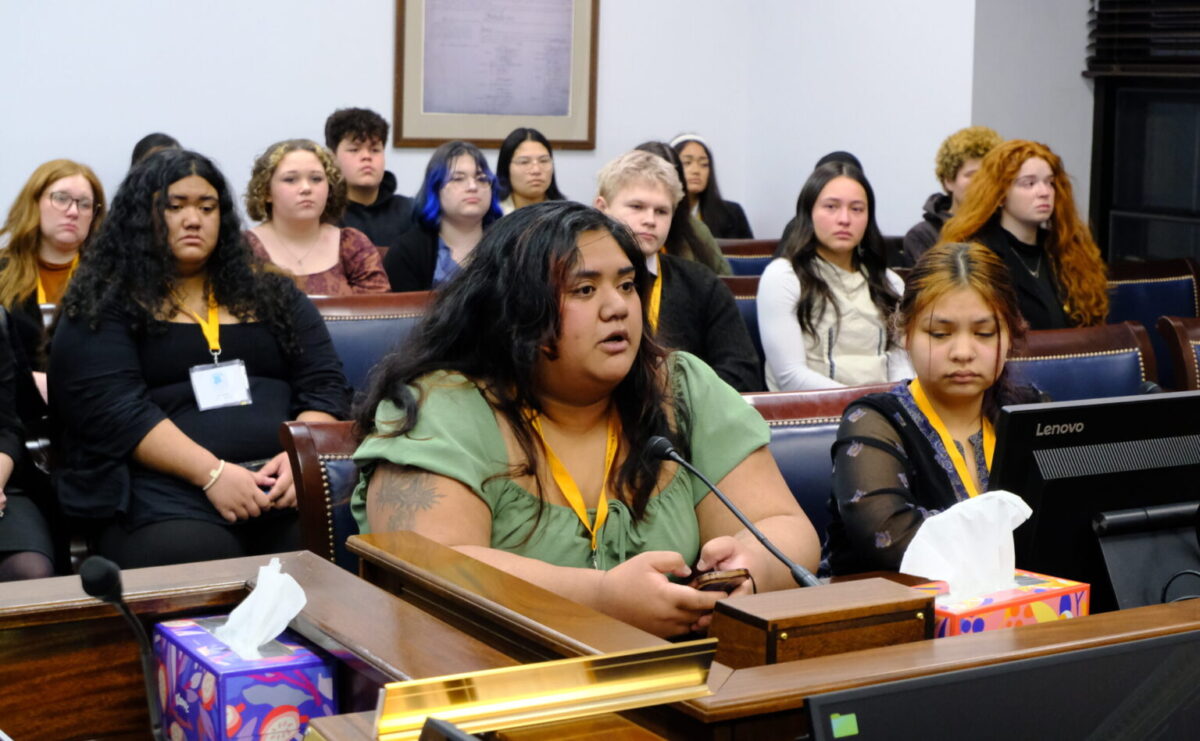
Kxlo Stone (left) and Trinity Beltz (right) testify to the importance of protecting sibling relationships in foster care to the House Judiciary Committee on Feb. 26, 2026. Stone’s sister Tali Stone sits behind her. (Photo by Corinne Smith/Alaska Beacon)

Alaska foster youth could see their ties to siblings legally protected through the adoption process, under legislation proposed last year in the Alaska House of Representatives.

House Bill 157 would maintain the legal relationship between siblings through the process of adoption, and also encourage adoptive families to support sibling relationships. It is sponsored by Rep. Andrew Gray, an Anchorage Democrat, who is a foster parent himself.

“Sibling relationships are among the most powerful and enduring connections a person can have,” Gray said, in opening remarks of a hearing on the issue on Wednesday. “For children in foster care, siblings are often a remaining link to their past, their identity and their family. These bonds provide emotional stability, comfort and a sense of belonging during an experience that is confusing and traumatic.”

Currently, under Alaska law, adoption ends the legal relationship between adopted children and their birth family, including siblings. The bill preserves the legal relationship between siblings, despite adoption and termination of parental rights. Siblings would continue to be legally recognized, including for siblings by blood, marriage or adoption by one or both parents.

Deko Harbi (left) and Lotus Nickoli (right) testify in support of HB 157 and the importance of preserving sibling relationships in foster care on Feb. 25, 2026. (Photo by Corinne Smith/Alaska Beacon)

Gray introduced the bill last year but it has not yet been scheduled for committee hearings. This week, he invited a group of current and former foster youth with Facing Foster Care in Alaska, a non-profit advocacy organization, to testify on the issue to the House Judiciary Committee on Wednesday. In an emotional hearing, youth shared personal stories of separation from siblings, and urged legal protections for maintaining sibling relationships as vital.

“When my siblings and I were separated, daily things became harder to do and life was harder to get through,” said Tali Stone, who was separated from her five siblings when they entered state custody. “I went from laughing, sharing bed with my older sister, and playing with my younger siblings, to not knowing where they lived, who they lived with, and missing huge milestones and moments in their lives.” 

Lotus Nickoli of Fairbanks testified to the fear and uncertainty he felt when he was separated from his eight siblings.

“It’s just more scary, like knowing that they’re going to be going through different situations, different foster homes and whatnot, different foster parents, like you don’t know who they’re with and what these foster parents are capable of,” he said, breaking down into tears. 

“Siblings should not be separated,” he said. 

In Alaska, the Office of Children’s Services, which runs the state’s foster care system, is required to “make reasonable efforts” to place siblings together in a foster placement if siblings are living in the same home when taken into state custody. If siblings are not placed together, case workers must document how reasonable efforts were made. The case worker is also charged with connecting siblings and providing opportunities for contact, “if it is in the best interest of the child to maintain contact.” 

Amanda Metivier, director of Facing Foster Care, said the foster youth have called for legislation to prevent sibling separation because the reality is often youth are having great difficulties in maintaining contact when taken into state custody and after adoption.

Amanda Metivier (right) director of Facing Foster Care Alaska, and Amanda Redmon (right) a former foster youth testify to the House Judiciary Committee on the importance of maintaining sibling relationships among foster youth on Feb. 25, 2026. (Photo by Corinne Smith/Alaska Beacon)

“So as a state, we’ve been experiencing a decline in the number of foster homes in recent years, and so it becomes harder and harder for OCS to keep children together,” she said.

“The unfortunate truth is that if you have a young person that moves into a foster family or a relative, and the permanent goal is going to be adoption, and their siblings are in another place, they become legal strangers,” she said.

Trinity Beltz said when OCS intervened and took her, her eight siblings and two stepsisters into state care, they were all separated in foster placements. While she could see some of her siblings, she OCS barred her from seeing her stepsisters because the agency claimed they were not related.

“Nobody updated me on where they were, and that really broke me,” she said. “I haven’t seen them since they were at least four years old, and looking at them now, they’re already almost seven to eight.”

“But I do want to still be their sister, and not be like a stranger to them,” she added. “To me, that would break my heart completely.”

The bill was introduced last year and was referred to the House Health and Social Services Committee.

Categories
Featured Juneau News Juneau Local Ketchikan Local News Feeds Sitka Local

Is Alaska’s foster care system failing children? A federal trial underway now could decide.

By: Corinne Smith, Alaska Beacon

A sign marking the east entrance of the The streetside east entrance of the James M. Fitzgerald United States Courthouse and Federal Building is seen on July 8, 2024. (Photo by Yereth Rosen/Alaska Beacon)

A trial underway in Anchorage this week is challenging the Alaska Office of Children’s Services and the foster care system, with plaintiffs claiming the system is failing Alaskan children and violating their rights. 

“We hope that this trial will lead to significant reforms in Alaska’s foster care system. Alaska’s foster children deserve far better childhoods. It can be done,” Marcia Lowry, an attorney for the plaintiffs and with the nonprofit A Better Childhood, said in a written statement ahead of the trial.

There are about 2,500 children in Alaska foster care, a system that aims to provide a temporary placement environment after a child has been determined to be unsafe or at risk of maltreatment in their family home. Some placements are temporary, and families can seek reunification. If not possible or unsafe, OCS staff are tasked with finding other forms of permanent, safe placement for the child.

Alaska Native children make up a disproportionately high number of those in state custody – in July, the number was two thirds, or 68% of all children in custody, or 1,712 children.

The plaintiffs, who include five foster youths, are representing a class-action case that seeks wide-ranging changes to the system. The lawsuit, first filed in 2022, was brought on behalf of all Alaska children whom OCS has or will have in state custody. 

The suit names Alaska’s Department of Family and Community Services (DFCS) and Office of Children’s Services (OCS) as defendants, as well as agency directors including OCS Director Kim Guay and DFCS Commissioner Kim Kovol. 

The lawsuit, Mary B. et al. v. Kim Kovol, et al., alleges OCS is chronically understaffed and overburdens caseworkers, which poses a risk of harm to children. They argue the agency’s systemic failures include high vacancies and staff turnover, infrequent or poor quality caseworker visits, insufficient caseworker planning, and lack of adequate placements.

“Defendents knew and were aware of the serious harm to children, and ignored that harm,” said Julia Tebor, an attorney for the plaintiffs, during opening arguments on Monday, according to court transcripts. “Defendants have a policy and a practice of maintaining overburdened caseworkers. These caseworkers have 51 to 100 children, sometimes. They cannot do their job. They cannot keep children safe.”

Child welfare advocates, lawmakers, and foster youth themselves have raised alarm at inappropriate placements, including unnecessarily long stays at psychiatric facilities, homeless shelters, hotels with hired security guards and even overnights at OCS offices

“Defendents fail to recruit and retain placements. They fail to connect children with services. And this places children at unnecessary risk of institutionalization,” Tebor said.

In defense of OCS, lawyers with the Alaska Department of Law are arguing that the child welfare system in Alaska is a complex network of government agencies and private partners, including Alaska Native tribes, working on children’s behalf — not just OCS.

They argue that superior court judges are routinely reviewing children’s cases and whether families are getting visitation, services and case planning, as required by law. 

They say OCS is not ignoring the challenges presented by a shortage of caseworkers, caseplanning and access to services. But there are difficult logistics related to delivering services in Alaska, due to the vast geography, remote communities off the road system, and weather complications that can delay or complicate OCS staff’s work. 

The lawsuit also alleges OCS overlooks or fails to seek out placements within an Alaska Native child’s family or community, instead placing them in non-Native households, violating their rights under the federal Indian Child Welfare Act. 

Lawyers for the plaintiffs are arguing that “deliberate indifference” within OCS poses a substantial risk of harm to all foster children across the state. 

The state rejects the claim, saying there is no deliberate indifference by OCS staff, and they are not violating children’s rights under federal child welfare laws, the Indian Child Welfare Act or the Americans with Disabilities Act. 

Foster youth testify in court

A foster youth named Matthew was the first to take the stand on Monday. He entered OCS custody at 15 years old. In three years, he said, he was moved between 13 and 14 placements, including staying at an OCS office.

“Mentally, it took a toll on me because I couldn’t get schoolwork done,” he said. “There was a lot that I could have got done, that I never got done because I was moving around so much, and mentally took a toll on me.”

He described a placement called the “Ramen House” where kids only got two packs of ramen to eat for the entire day. “And if you ate the two ramen packs in the morning, then you’d have no food for the rest of the day,” he said. When he reported it to OCS, there was little response. “I told them multiple times, and they didn’t move me until I sat in the office and was like, I’m not moving until you guys put me in a new foster home, because I couldn’t do it anymore.”

Matthew said during his time in foster care he attended four or five schools in the Anchorage and Matanuska-Susitna Borough areas, and did not have regular access to medical care, like for a potential broken bone or to see a dentist. Now at 20, he’s still working on finishing high school. 

In court on Monday, he recounted sleeping in OCS offices in Wasilla multiple times, where he was sometimes locked in. In one instance, he said “there was no couch — or there were no pillows or blankets or anything like that. They never gave me a pillow or blanket or anything like that.”

He said he had three or four caseworkers, some he never met in person. 

Asked why he chose to testify, he said “so another kid doesn’t have to go through what I went through.”

Social workers’ caseload burden

OCS has five regional offices — Anchorage, Wasilla, Fairbanks, Bethel and Juneau — and 22 regional offices across the state.

Between January 2018 and January 2024, an average of 45% of OCS caseworkers had caseloads with more than 30 children, and an average of 25% of caseworkers had between 51 to 100 children, according to the lawsuit. At one point in 2023, the OCS Western Region had three caseworkers for the 309 out-of-home foster children in the region.

Kim Guay, director of OCS, took the stand on Monday and argued the state is working to make improvements to the system. She said caseworkers often work with partners, including tribal organizations and village public safety officers to make visits in remote locations. She said high caseload data requires context.

“They’re good things to look at, but it doesn’t tell the whole story. More needs to be looked into, what’s going on with the case, that office, the staff. There’s a whole context besides just the data and the numbers,” she said.

Guay herself began at OCS in 2000 as a caseworker. 

“A one-kid case may sound easy, although that child may be extremely medically complex or have behavioral health problems or actively suicidal, and they will spend an enormous amount of time on a one-kid case as compared to maybe a family of six that are in a relative’s home,” Kovol said. 

When asked if a caseworker having more than 100 children poses a “risk of substantial harm,” Kovol replied it depends on the situation. “Would I like to see caseloads lower than that? Sure. I think everyone would. But it, the cases are — you know I don’t like to use the words ‘it depends,’ but it does depend on the situation.”

Kovol also pointed to ongoing challenges with recruiting and hiring OCS caseworkers. “We need more workers,” she said.

Attorneys with the Department of Law and the plaintiffs were not immediately available to comment on Thursday. 

“Defendents will try to argue that there are factors outside their control that affects the child welfare system,” Tebor said on Monday. “But that is not an excuse for failing children and failing to ensure their substantive due process rights and their statutory rights.”