News of the North- Two tax-related propositions will appear on Juneau’s municipal ballot this fall. One seeks to cap the city’s property tax rate at nine mills, plus any extra needed to pay off voter-approved debt.
“The cap on the mill rate will make Juneau more affordable,” local attorney Joe Geldhof said. “Instead of just raising property taxes and getting more revenue, they’ll have to start making some considered choices on what it is Juneau really needs.”
Another proposal would include a sales tax exemption on groceries for personal consumption and sales of heating fuel, including wood, wood pellets and fuel oil for non-commercial use.
“For years now, the politicians down there have been talking about eliminating taxes primarily on groceries, and they never get around to doing it,” Geldhof said. “Pretty much everybody says, gee, why should a low-income or middle-income family pay sales tax on an essential like food or on their heating fuel? And a bunch of us finally decided they can’t figure it out, so we’re going to.”
Both initiatives aim to lower the cost of living.
A third petition to reinstate in-person voting didn’t gather enough signatures.
“By-mail voting is convenient in one sense, especially for the bureaucrats,” Geldhof added. “It also turns out to be fantastically more expensive than the old way where you’d go to your polling station. It also turns out to be way slower.”
City officials warn these changes could cut millions from the city’s budget, potentially leading to reduced services, Property taxes make up roughly 40% of the city’s general fund revenue.
Voting in this year’s municipal election ends on Tuesday, Oct. 7.
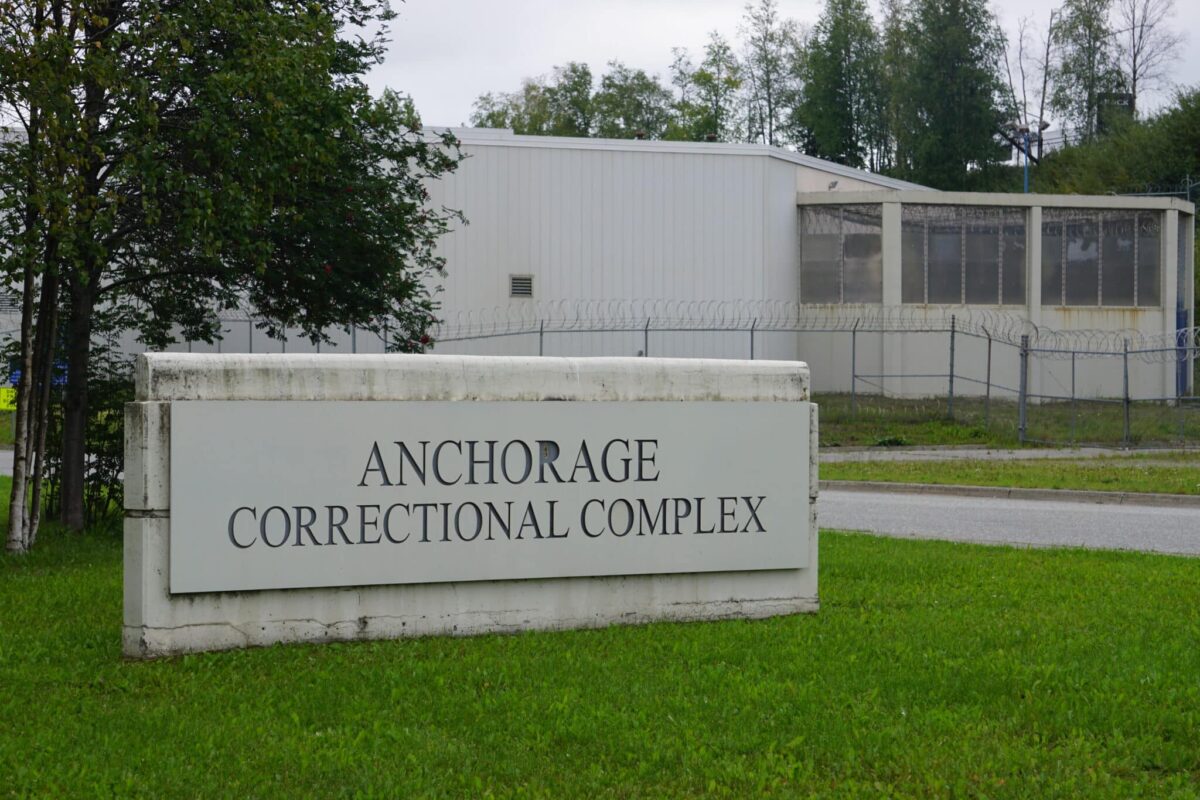
The entrance to the Anchorage Correctional Complex is seen on Aug. 29, 2022. (Photo by Yereth Rosen/Alaska Beacon)
By: Corinne Smith, Alaska Beacon
The Alaska Department of Corrections announced that 35 men that were arrested and detained by the U.S. Immigration and Customs Enforcement from out of state and held at the Anchorage Correctional Complex were transferred out of state on Monday.
ICE transferred 42 men to Alaska from out of state on June 8, as part of an ongoing agreement between the Department of Corrections and the U.S. Department of Justice, amid a nationwide deportation crackdown. The move sparked daily protests, a fact-finding hearing by the Alaska House Judiciary Committee, and concerns from attorneys and the American Civil Liberties Union of Alaska around the punitive conditions of detention, violations of due process and criminal confinement.
A spokesperson for the Department of Corrections said department Commissioner Jen Winkelman was not available for an interview on Tuesday to discuss the transfer, concerns around conditions of detention, and ongoing plans to house ICE detainees in Alaska.
“The ICE detainees who were transferred due to severe overcrowding in the Washington facility are no longer in the custody of the Alaska Department of Corrections,” said DOC spokesperson Betsy Holley in an email, in which she included the italics and underlining. She added that all questions on the details of the transfer should be directed to DHS/ICE.
Cindy Woods, a senior immigration law and policy fellow with the ACLU of Alaska, said the transfer was not unexpected, since DOC had said they agreed to hold detainees for 30 days. She also said she and several other attorneys were not notified of the transfers.
“Yesterday evening, I flagged the attorneys that I know represent folks who had been transferred, to let them know that they were being transferred again, and but none of them had been told by ICE prior to that,” she said.
Woods said all the detainees were going through civil immigration proceedings, and faced no criminal charges.
“These individuals were all in civil detention, so they were not being detained as part of an ongoing criminal proceeding. They were all in administrative immigration proceedings,” she said, and a number of the men have applied for or received asylum protections.
“And then there were also a handful of folks who were waiting for their immigration proceedings to commence,” she said. “And so (they) were waiting for the opportunity to speak with a judge about either a potential asylum claim or some other request for immigration relief.”
The ICE transfer of detainees to Alaska DOC custody raised serious concerns around standards of detention from legislators and advocates. Attorneys testified before the June 20 hearing of the Alaska House Judiciary Committee that despite no criminal charges, their clients reported that they were subject to lengthy lockdowns, overuse of handcuffs and overcrowding — sleeping three to a cell. In addition, they were denied or had limited access to calls with family and attorneys, regularly strip-searched after visits with attorneys, and subjected to use of force by DOC staff members, who pepper-sprayed a unit to stop a “verbal demonstration” on June 12, the attorneys said.
The ACLU of Alaska sent a letter on Saturday to Alaska state officials and ICE demanding detainees be removed from Anchorage Correctional Complex custody, and a stop to any additional transfers “unless and until constitutionally adequate conditions of confinement and attorney access can be guaranteed.”
The letter provided further detail on the pepper-spray incident: “This ‘verbal demonstration’ consisted of detainees requesting access to their belongings, including an individual who was trying to access his property to get the phone number for his consulate. Following the incident, many individuals experienced respiratory distress, including coughing, burning sensations in their mouth, nose, and eyes, and nosebleeds, and did not receive medical attention. They were also unable to change their clothes for an extended period of time.”
Holley said in the Department of Corrections’ emailed response to an interview request that the state did not make the call to transfer the detainees.
“The decision to transfer these detainees out of Alaska rested solely with the federal government. The decision was not influenced by the recent House Judiciary Committee hearing or the letter issued by the ACLU this past weekend,” Holley said.
“It is important to note the Alaska DOC routinely houses both civil detainees and federal prisoners. While we do not currently know whether ICE will request additional placements in the future, the Alaska DOC remains fully prepared to support DHS/ICE in coordinated efforts that prioritize public safety and the efficient use of government resources.”
The ACLU filed a class action lawsuit against the Department of Corrections in May challenging what they say is “inadequate, dangerous and inhumane” health care provided for incarcerated Alaskans.
Woods said the DOC protocols and detention conditions are unnecessary, and violated the men’s right to due process. “The conditions that they were all held in were punitive, whether or not that was the intention of the government, and such punitive nature are clearly outside the scope of the law, and especially when it comes to the standards and the requirements for civil detainees, who are not being held under criminal charges,” she said.
ICE did not respond to requests for comment about why the detainees were transferred to and from Alaska. Woods said she was able to search in the ICE inmate locator and confirm the men were transferred back to the ICE detention facility in Tacoma, Washington, with reportedly better conditions.
Woods said detainees reported the experience in DOC custody as humiliating.
“They were being held in really substandard conditions, being subjected to pepper spray and strip searches, and handcuffs, and all of those things. And so it was really hard for a lot of people to deal with that shift,” she said, referring to being transferred from Washington state to Alaska custody. “And especially because they were also largely cut off from those outside relationships that sustained them, particularly those who, you know, regularly spoke with their children and their parents and their loved ones who were not located in the United States — having that kind of completely shut off really impacted the individuals who experienced that.”
On Friday, seven U.S. congressional representatives from Washington and Oregon sent a letter to the U.S. Department of Homeland Security questioning why detainees were transferred to Alaska, as well as the cost and criteria for who is transferred. The letter also raised concerns that “ICE is wasting taxpayer dollars, flying dozens of people between detention centers thousands of miles apart, in efforts that do nothing to help protect Americans.”
The Alaska State Capitol is seen during the last week of the 2025 session on May 19, 2025. (Photo by Corinne Smith/Alaska Beacon)
By: Corinne Smith, Alaska Beacon
As many Alaska school districts grapple with steep budget deficits, and in the wake of Gov. Mike Dunleavy’s partial veto of an increase to per-student funding, the Alaska State Legislature has launched a joint bipartisan task force to focus on education funding.
The Legislature approved a $700 increase per student to the funding formula, but earlier this month the governor vetoed more than $50 million in education-related funding from the state’s budget, including a portion of the per-student increase, pushing it down to $500 per student.
Some lawmakers and education officials have expressed outrage and disappointment at the governor’s budget cuts, with leadership of both the House and Senate promising to hold a vote to override the budget veto to partially restore funding to schools, in the first five days of the January 2026 session. The Legislature previously overrode Dunleavy’s veto of a separate bill that enshrined the $700 increase as policy in state law; it required funding in the budget bill to put the increase into practice.
In the meantime, the task force, created by House Bill 57, will look at a wide range of financial challenges and school policies. It’s charged with making recommendations before the 35th Alaska State Legislature convenes in January 2027.
“This is a ‘yes, and’ moment,” said task force co-chair Rep. Rebecca Himschoot, I-Sitka, in a phone interview. “Is there a way by looking more globally at issues, that we can help contain some of those rising costs that districts have? But the fact remains that we haven’t given a significant increase to education in over 10 years.”
Rep. Rebecca Himschoot, I-Sitka, speaks in favor of a veto override on House Bill 69 on Tuesday, April 22, 2025. Himschoot also serves as co-chair of the House Education Committee and now co-chair of the education funding task force. (Photo by James Brooks/Alaska Beacon)
Education funding has been at the heart of Alaska’s ongoing political and financial debates among Dunleavy and the Legislature — as well as school officials, families and local municipalities — around state funding, policy changes, and how to improve students’ performance and learning outcomes. In a short video released the day of the line-item budget veto, Dunleavy cited declining state revenues and repeated his conviction that increasing education funding will not necessarily improve outcomes without policy changes.
The joint task force is set to start work in August, Himschoot said, and will not only look at how the state funds school districts, but also how it can address rising costs of transportation, energy, health insurance and school maintenance.
“We’re seeing double-digit increases in insurance costs, we’re seeing double-digit increases in energy costs. Is there something we can do to either arrest those increases, or a separate funding stream we should use?” she said.
“There’s been a lot of interest in trying to create some sort of an insurance pool to help with those costs,” she said, adding of the task force’s goals: “In general, examine the big picture to try to get down to that, so to speak, smaller picture of the annual funding cycle.”
Himschoot said solutions will vary as widely as Alaska’s 54 school districts, and the task force can take time on issues not afforded during the fast-paced legislative session.
“We can tweak individual levers of funding during the session. We can look at how we’re funding career and technical education and say, ‘We want to fund it more. We want to fund it less. We want to use this other mechanism or this other fund source,’” she said. “So by doing this work during the interim over the next two years, it gives us time to ask questions, which often lead to more questions, and during the session, it can be very difficult, on a very tight timeline, and bring in all the different perspectives that need to be heard.”
The task force is planning to meet monthly and meetings will be open to the public, Himschoot said. “It’s super important that this is a process that anyone and everyone can participate in,” she said. “That’s the only way that it has any real value.”
Republican member Sen. Mike Cronk, a former teacher and representative for the large Interior District R that includes nine school districts, said he sees participation from school officials as mandatory. “I’ve already talked to numerous superintendents in my district, and I am going to require some of their input on certain things, because they’re the experts,” he said, in a phone interview. “I believe that’s the buy-in. I don’t believe ‘legislators’ singular, should be making these decisions. We need buy-in from everybody.”
Then-Rep. Mike Cronk, R-Tok, speaks to a fellow lawmaker on Wednesday, Feb. 21, 2024. Cronk, now a senator, was appointed to the new education funding task force. (Photo by James Brooks/Alaska Beacon)
Cronk said he wants the task force to create an ongoing, stable fiscal plan for funding schools.
“We’re spinning our wheels. We just continue to not actually solve anything as a Legislature. We just prolong it to the next year, and the next year,” he said, after five years in the Legislature. “So that’s my desire, is to make sure that we have a fiscal plan in place where, if education needs more funding, we have the ability to get that. Or if roads need more attention, we have the ability to get more funding for that versus this. Just, ‘hey, oil prices are great, we could fund everything.’ Or ‘oil prices aren’t so good. Oh boy, we’re in a crisis situation.’ We shouldn’t be there. We should be working together, you know, for the betterment of Alaska.”
Cronk said he understands the governor’s concerns but disagreed with his partial veto of the school funding increase. “I respect the governor: He’s a separate office than the Legislature, so he has the ability to make decisions what he feels best, you know, and I feel the more we respect that, the better off we’ll all be working together,” he said. “But again, the override vote of the initial bill, I think, was pretty strong and showed that for the most part, most of us supported the increase.”
The task force will also examine student performance and accountability measures, including absenteeism, as well as policy changes sought by the governor throughout the session, like open enrollment, easing the application process for charter schools, and reading incentive grants.
Cronk said he’s open to looking at all policy changes to improve outcomes. “It’s not just straight up, how do we fund better? It’s, ‘How do we make our education system better for all students?’ So that’s what I hope to focus on,” he said.
Task force member Rep. Justin Ruffridge, R-Soldotna, said he’s interested in looking at the school funding formula. “So from some of the issues in the formula itself, like school size factor and district cost factor, which some of those haven’t been updated in decades, as well as some of the issues from the federal government, things like the disparity test,” he said, referring to the state failing a federal test and now proposing capping local municipalities’ contributions to their schools.
Rep. Justin Ruffridge, R-Soldotna, addresses the House during the debate on the school funding bill on Mar 10, 2025. He is a member of the House minority caucus and was appointed to the education funding task force. (Photo by Corinne Smith/Alaska Beacon)
“A task force is well suited to come out with some recommendations,” he said. “I think that we also need to discuss accountability measures, so things like testing, how we test, how we talk about testing … open enrollment, how does that affect Alaska schools? How does it affect military bases? There’s a lot that we have to look at.”
Ruffridge said he’s also focused on teacher recruitment and retention, and incentives for local residents to become certified teachers. “So developing an apprenticeship track to be engaged with teachers, and really growing some of our teachers in their homes and in their communities, I think, is a really good idea,” he said.
He and Cronk both said they hope the task force will be less of a political and more of an advisory body, “where … you take the time to understand these deeper, complex funding elements or other policy measures and bring forward a draft recommendation of ways that we could make things better — and then that would need to go through the political process,” Ruffridge said. “So, trying to be a little more apolitical.”
The task force also includes co-chair Sen. Löki Tobin, D-Anchorage; Sen. Jesse Kiehl, D-Juneau; and Rep. Andi Story, D-Juneau.
Many school districts are facing millions in budget shortfalls, and with Dunleavy’s budget veto, school boards are going back into budget meetings this summer to make further cuts to programs and staff.
Himschoot addressed criticism of the Legislature not calling an emergency special session this summer to override the line-item veto, saying some legislators are out of the country and unavailable and there is more of a possibility of having the votes to override in January.
“So the problem is, can we get everyone together? And if we do, will their votes hold? We know for sure we can get everyone together in January. We don’t know that we’ll have the votes, not now and not in January,” she said. “And so we are working on it.”
The task force will present recommendations in a report on the first day of the January 2027 session, the same month the task force sunsets.