A Wilson’s Snipe is seen in an undated photo published by the U.S. Fish and Wildlife Service. (Larry Pace photo/U.S. Fish and Wildlife Service)
Incorrect information provided by a Google AI overview caused a Kodiak woman to hunt snipe illegally on Sept. 5, according to a citation filed this week at the Kodiak district court.
Writing in an affidavit attached to the citation, Alaska Wildlife Trooper Alex Wick said Weaver called troopers to self-report the violation.
“Christina stated that she Googled ‘Snipe season’ on her phone and that, according to Google, snipe season began on September 1st,” he wrote.
Based on that information, she hunted three snipe but became suspicious after learning that duck season didn’t open until Oct. 8.
Snipe are small game birds common in Alaska, Canada and the northern Lower 48.
“After conducting her own research, she learned that snipes are not legal to take under the general season until October 8th. Christina then contacted dispatch to turn herself in,” Wick wrote.
He said he performed a Google search identical to Weaver’s and received identical incorrect information.
Google did not respond to an email seeking comment on the incorrect information provided by its software. The platform provides an immediate artificial intelligence generated summary of search findings.
“I feel terrible, and I have a lot of shame with it. Obviously, that’s why I immediately self-reported once I got home and dived into the regs,” she said by phone on Friday. “It’s incredibly embarrassing.”
Austin McDaniel, a spokesman for the Alaska Department of Public Safety, said the agency doesn’t keep track of cases involving false information provided by AI software.
“This is the first time that I think we have seen AI cited,” he said.
“I expect we’ll see more of this type of thing in the future,” he said of AI being at fault.
McDaniel said Weaver acted completely correctly once she learned about the AI-caused mistake. Self-reported hunting violations are punished much less severely than ones uncovered by troopers.
“The potential consequences for self-turning in versus being caught can be pretty dramatic,” he said.
Weaver pleaded no contest to the citation on Friday and was fined $150.
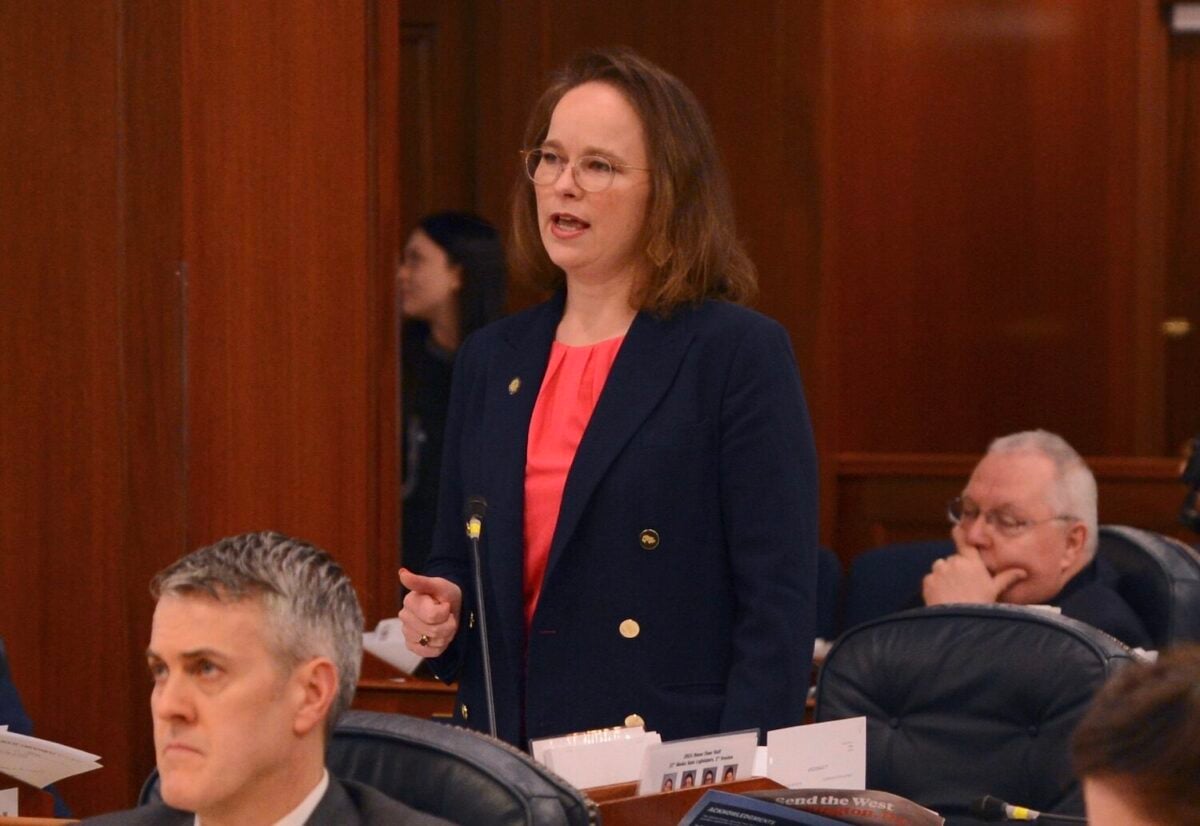
Sen. Matt Claman, D-Anchorage, speaks Wednesday, April 23, 2025, on the floor of the Alaska Senate. (Photo by James Brooks/Alaska Beacon)
By: Corinne Smith, Alaska Beacon
Sen. Matt Claman, D-Anchorage, speaks Wednesday, April 23, 2025, on the floor of the Alaska Senate. (Photo by James Brooks/Alaska Beacon)
With only four weeks left of the legislative session, the Senate Judiciary Committee has merged several bills into a wide-ranging omnibus crime bill. Even with the tight timeline, some lawmakers are optimistic about its chances for passage before the end of the session.
The new draft omnibus crime package combines ten bills ranging from raising the age of consent to increasing criminal penalties for AI-generated child sexual abuse material into one large bill supporters hope will have the momentum to pass both the House and the Senate in the next 28 days.
The Senate Judiciary Committee chair Sen. Matt Claman, D-Anchorage, introduced the 55-page omnibus bill on Friday, saying the bills have a stronger prospect as a package.
“I think that increases the likelihood we’ll be able to pass it,” he said in an interview on Monday.
With one month to go in the second year of the two-year legislative cycle, this is the last opportunity for bills to be passed by the 34th Legislature.
The draft omnibus crime bill was added to House Bill 239, sponsored by House Majority Leader Rep. Chuck Kopp, R-Anchorage, who spoke in support at the hearing on Friday.
“This bill has grown, it’s gone from the sports car to the school bus” he said. “Policies I all support as a bill sponsor.”
Gov. Mike Dunleavy sponsored two bills included in the omnibus package, but did not respond to a request for comment on Tuesday.
The bills included are in various stages. Some have passed the House, while others are being considered by various committees in the House and Senate. Several lawmakers who sponsored bills now included in the omnibus package agreed that politically it could increase chances of passage by May 20.
Rep. Sarah Vance, R-Homer, sponsored a bill that would create state felony penalties for AI-generated child sexual abuse material. It unanimously passed the House last month.
“I’m excited that it’s included in the omnibus bill, because that shows intent by the Senate to pass the bill,” Vance said on Monday. “So I have great confidence that it will cross the finish line.”
But Claman, who is running for governor, has drawn public criticism for the process of how the omnibus crime bill was put together this session.
Advocates for raising the age of consent — along with the Anchorage Daily News editorial board — criticized Claman for holding a bill to raise the age of consent to 18 in the Senate Judiciary Committee, which passed unanimously by the House last year, in order to be included in the omnibus bill. Critics urged Claman and the committee to pass the bill and allow it to move forward as a stand alone bill toward a full Senate vote and final passage.
Claman has argued that despite limited time left in the session, the bills included have been vetted and the combination package will garner more support among legislators and the governor to pass in the last few weeks of the session.
“I’ve been in the Legislature now since 2015, and so in the last 11 years, we’ve passed 11 different bills relating to public safety,” he said. “So I think there are ten different measures that we put into the bill, and if we tried to do them all individually, probably wouldn’t get them all passed.”
Claman pointed to an omnibus crime bill, House Bill 66, enacted in 2024, with support from Gov. Mike Dunleavy and across political affiliations. “That’s certainly, I think, the best example,” he said. “So I do have confidence we’ll get it passed.”
Rep. Andrew Gray, D-Anchorage, speaks Friday, April 26, 2024, on the floor of the Alaska House of Representatives. (Photo by James Brooks/Alaska Beacon)
Rep. Andrew Gray, D-Anchorage, sponsored House Bill 101, the bill that would raise the age of consent from 16 to 18 years old. Backed by advocates for sexual violence prevention, he said the change in law is essential for protecting teens from sexual exploitation and abuse. Under current law, it’s legal for an adult to have sex with a 16 or 17 year old. But when they are assaulted, teens must prove that they did not consent.
Despite previous disagreement and pushing for a stand alone bill, Gray said Monday he will back the omnibus crime bill in order to see the law changed.
“If that happens, inside an omnibus crime package that has other bills that are also worthy of passage, I’m fine with that,” he said. “I just want the policy to change.”
The draft omnibus crime bill now contains ten bills that previously stood alone:
House Bill 239 — would increase criminal penalties for hit and run incidents so that drivers that cause a death and knowingly failing to stop and render assistance, and establishes mandatory sentencing of four to seven years for a first hit and run felony conviction
House Bill 101 — would raise the age of consent from 16 to 18 years old, with provisions to allow consent to sex with someone up to six years older than them. The draft bill also allows 16 and 17 year olds to consensually exchange sexual or explicit messages within the six year close-in-age gap without penalties.
Senate Bill 247 — would create state criminal penalties for creating AI-generated images or video that depicts sexually explicit or obscene content involving anyone under 18 years old
House Bill 62 — Sponsored by Gov. Mike Dunleavy, the bill would establish a statewide tracking system for sexual assault examination kits, expedite processing times, and ensure that survivors can privately monitor the status of their own kit.
Senate Bill 100 — Also sponsored by the governor, and would establish the crime of organized theft, including mail theft and medical record theft
House Bill 242 — would redefine criminal law to prohibit any sexual contact or assault by a health care worker during professional treatment, changing the current law which only applies to patients being unaware of sexual contact or assault for criminal charges to apply.
Senate Bill 17 — would establish the crime of airbag fraud for knowingly selling, installing or manufacturing a counterfeit airbag in a vehicle
House Bill 81 — would establish minor marijuana related convictions to remain confidential on individuals personal records, under certain criteria
House Bill 384 — would expand confidentiality agreements between victims and service providers by updating the definition of “victim counseling center” to include tribal organizations
Senate Bill 233 — would reassign the Controlled Substances Advisory Committee from being administered by the Department of Law to the Department of Commerce, Community and Economic Development.
The new version of Vance’s bill focused on AI-generated child sexual abuse material included in the bill is closer to her initial proposal. Social media controls for minors added by the House were stripped out of the Senate version. Vance said she supports the amended version given First Amendment protections around social media.
“I think that was a wise decision right now, because Alaskans are very mixed on how they feel that we should address social media,” Vance said.
Rep. Sara Hannan, D-Juneau, is the sponsor of House Bill 242, and said she supports her bill being included in the Senate omnibus, but she is still pushing to advance her standalone bill in the House.
Rep. Sara Hannan, D-Juneau, speaks on the House floor on Apr. 13, 2026. (Photo by Corinne Smith/Alaska Beacon)
“I need people who didn’t serve on the two committees that heard it in the House to understand it,” she said, as the Senate draft will come back to the House for a concurrence vote. “It still helps to educate on the issue.”
Hannan’s legislation follows a high profile case in Juneau last year where the court dropped several charges against a chiropractor because under current law part of the legal definition of sexual assault by a medical provider requires the alleged victim to be unaware the assault is happening.
“Right now, the victim needs to be unaware, and the perpetrator needs to know that they are unaware,” Hannan said Tuesday. “So to change that in statute, I think is an important policy statement for us to make.”
Hannan said significant policy bills typically take several years to get through the Legislature, with public input, debate and support gathering. But she expressed confidence in the support for the omnibus crime bill in the weeks ahead.
“We’re running the clock down,” she added. “The only downside, from my perspective, is the advocates and the victims that were directly involved in the case that inspired this bill. You know, they get more acknowledgement when it’s the standalone bill… But in the end, if the goal is to change the policy, there’s no downside to it.”
The Senate Judiciary Committee will continue to hold hearings on the crime bill this week and its members have until Friday to introduce amendments before it advances to the Senate floor for a vote. Claman said he expects that to be in the last week of April.
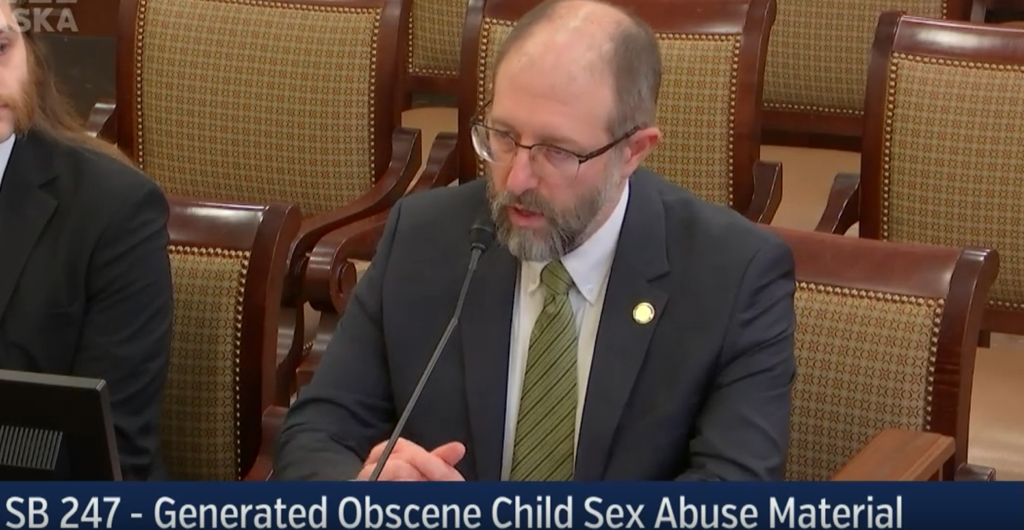
Senator Jesse Kiehl presenting SB 247 to the Senate Community and Regional Affairs Committee on Tuesday March 17, Photo courtesy of Gavel Alaska
Lawmakers are considering legislation that would expand criminal penalties for child sexual abuse material to include images generated using artificial intelligence and other digital tools.
Senate Bill 247, Sponsored by Juneau Sen. Jesse Kiehl, would create new crimes for the possession and distribution of “generated” child sexual abuse material, also known as CSAM, including images that appear to depict minors but may not involve real children.
Under the bill, distributing such material would be a felony, with harsher penalties for repeat offenders. Possession of generated CSAM would also be a felony offense.
Distribution under this bill is relatively broad and includes sharing or posting such content online.
United Nations, just this January released a warning on escalating AI threats to children.
The staggering amount of harmful AI-generated online content has prompted an urgent call from across the UN system for a raft of measures to protect children from abuse, exploitation and mental trauma.
This is a new form of sexual exploitation, the rapid progression of AI means lawmakers are struggling to craft legislation to prevent such harm from happening.
“Artificial intelligence is leading to the ability to generate images, generate videos, generate vast amounts of content, and that ability is growing fast, unfortunately, along with the ability to modify or create your own cute cat videos, some people use these technologies to terrible effect.” Said Kiehl, ” Senate Bill 247 addresses computer generated or otherwise generated Child Sexual Abuse materials. It amends Alaska law to create parity between generated Child Sexual Abuse materials and non generated Child Sexual Abuse materials, what we think of as photos or videos that have not been modified of real children. We know that artificial intelligence is, when it comes to images, a highly sophisticated collage machine, and that those images are made ultimately from things that are real, those are the data sources of millions, often billions, of real images on which these large language models, these artificial intelligences, are trained. The bill sets the punishments for generated Child Sexual Abuse materials on par with, and equal to non-generated CSAM that avoids overburdening bogging down law enforcement resources, court system resources, with the difficulty of proving that an amalgamated image has a real child under the age of 18 in it.”
The proposal also updates existing laws to include manipulated or altered images of real minors, even if the material was digitally created or modified.
In addition to criminal penalties, the bill would require the permanent revocation of teaching certificates for individuals convicted of certain sex offenses involving minors, including those tied to generated materials. It would also prohibit people convicted of those crimes from obtaining school bus driver licenses.
“The real prevalence of child sexual abuse is not known because so many victims do not disclose or report their abuse. However, adult representative or retrospective studies by the CDC has shown that one in four women and one in six men were sexually abused before the age of 18, and we know Alaska has one of the highest rates per capita of child sexual abuse in the nation.” Said Trevor Storrs, the President and CEO of the Alaska Children’s Trust, “Ai generated CSAM represents one of the most urgent and fast moving threats facing children today. In 2023 the National Center for Missing Exploited Children, received 4700 reports of AI related CSAM, by 2024 that number had grown to 67,000 and in the first half of 2025 alone, they received more than 400,000 such reports, an average of over 2000 every single day. At the same time, extortion, where offenders use real or AI generated images to blackmail children, continues to surge.”
Lawmakers say the bill is part of a broader effort to modernize Alaska law while technology continues to evolve, it’s one of several bills currently making their way through the legislature meant to strengthen protections for children.
SB 247 is set to be heard again in the legislature on Thursday.
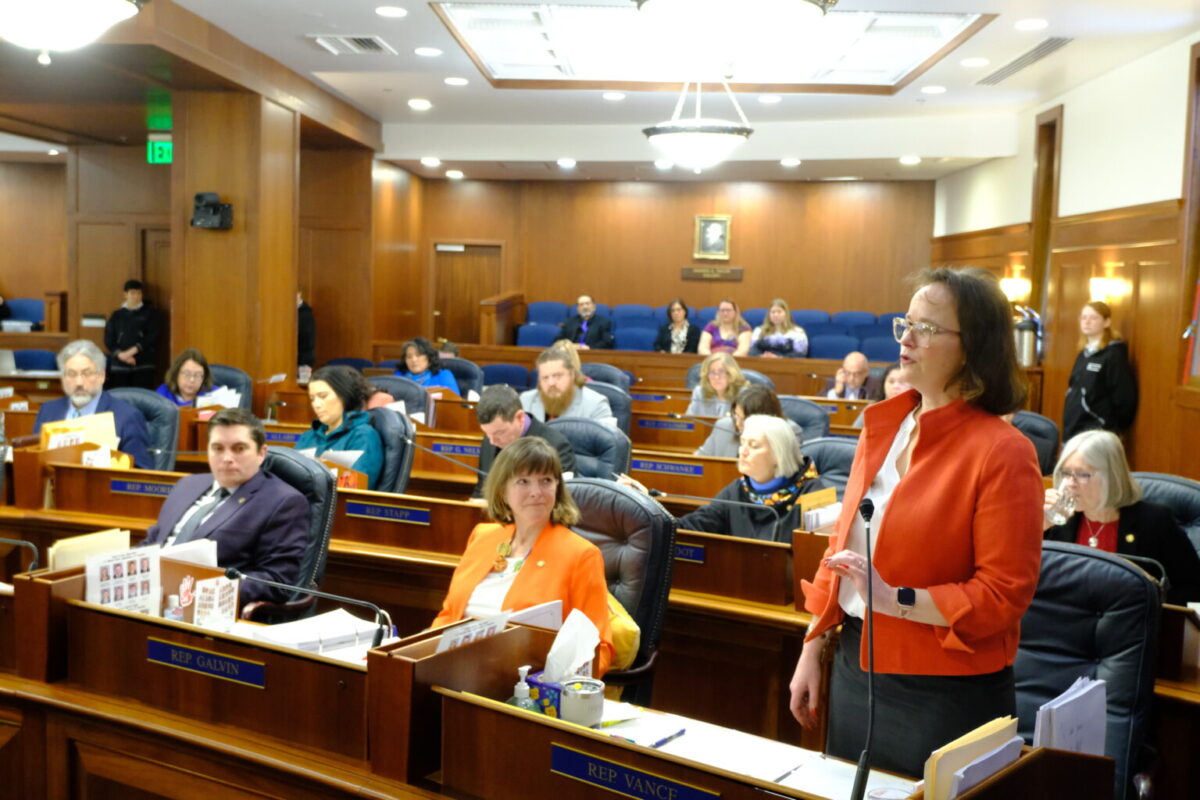
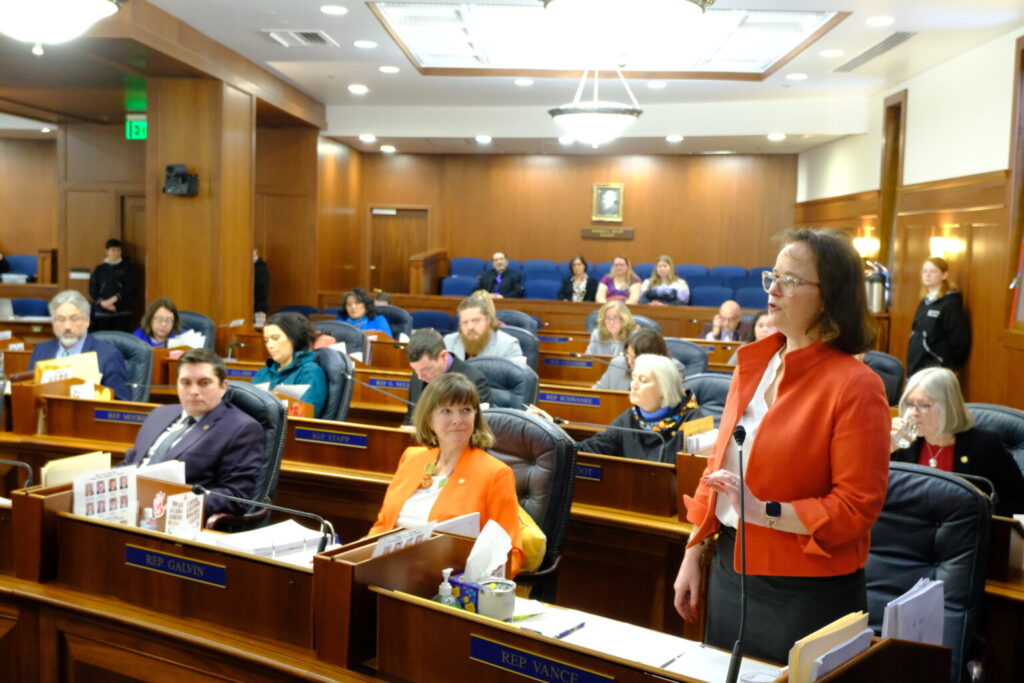
Rep. Sarah Vance, R-Homer, speaks in support of a bill she sponsored, HB 47, that would add state criminal penalties for AI-generated child sexual abuse material, on the House floor on Feb. 27, 2026. (Photo by Corinne Smith/Alaska Beacon)
Anyone that possesses, creates or shares child sexual abuse material created with artificial intelligence in Alaska would face new state felony charges under legislation advanced by the Alaska House of Representatives on Friday — plus AI companies and social media companies could face state penalties too.
House members passed House Bill 47 almost unanimously by a 39 to 0 vote, with Rep. Neal Foster, D-Nome, absent. The bill is sponsored by Rep. Sarah Vance, R-Homer, and would enact new state felony charges for creating AI-generated images or videos that visually depicts sexually explicit or obscene content involving anyone under the age of 18. Previously known as child pornography, it’s now referred to as child sexual abuse material or CSAM.
“A decade ago, we couldn’t even imagine what it is that the vulnerable and our children are facing, and tools that are being used to exploit them,” Vance said Friday on the House floor ahead of the vote. “But here we are in a fast-paced technological environment, and our prosecutors are left with very few tools,” she said.
Vance lauded the bill as closing a gap in state criminal law. Currently there are no state laws directly addressing AI-generated CSAM, though there are statutes that prohibit the viewing, possession and distribution of child sexual abuse materials. Vance emphasized that the bill would update Alaska law to penalize AI-generated CSAM, and noted it would apply regardless of whether images depict a victim or AI-generated material.
“Currently in statute, you have to prove the harm of an actual child. And what this bill does is says that anything that is generated obscene material of minors will be criminalized to the same level as if it were a real child,” Vance said.
Vance and others pointed to the recent arrest of an Alaska senator’s chief of staff for soliciting minors for CSAM on Snapchat, and the need to increase state penalties. Other lawmakers said the case demonstrates the need for more parental controls on minors’ social media.
Legislators added on and approved significant parental controls and penalties for tech companies too, through an amendment process on Wednesday.
Under the revised bill, social media companies will require age verification and parental or guardian consent for minors to create or maintain social media accounts. Parents would have full access to minors’ social media, including all minors’ messages and interactions on the platform. The bill enacts a social media curfew for minors from 10:30 p.m. to 6:30 a.m., unless modified by a parent.
Rep. Zack Fields, D-Anchorage, sponsored the amendments and said with increased parental control measures, parents and guardians will be able to intervene on potentially predatory behavior or victimization of children.
“The fundamental question is: Do parental rights supersede the rights of predators?” Fields said on the House floor Wednesday. “And do parental rights supersede the rights of multi-national corporations, which we have heard knowingly target children with addictive, destructive algorithms. We know that.”
Targeted advertising to minors on social media would also be prohibited, as would content targeting minors, addictive design or features that “encourages or rewards a minor user’s excessive or compulsive use of the platform or that exploits the psychological vulnerabilities of a minor user,” according to the bill.
Families or the state would be able to bring civil legal action against social media companies for harm due to such violations under the bill, and companies could face a penalty of up to $10,000 for each violation.
“I don’t care how hard it is. We should not back down from Big Tech when it comes to protecting our children,” Fields said.
The amendment passed with a 28 to 12 vote, with supporters and opponents spanning party lines.
Rep. Genevieve Mina, D-Anchorage, the youngest member of the House, opposed the provision.
“I absolutely agree that social media can be harmful for youth, especially given the vast environment, where there are a lot of different strangers and people on the internet. I also know I’m probably one of the only people in the body who very much grew up online,” she said Wednesday on the House floor.
“I’ve wrestled back and forth with these types of policies, especially as it relates to age verification or requiring consent from a minor,” she said, and added that she shared concerns about first amendment and privacy rights. “But I just don’t believe that age verification through government regulation is the right way.”
Vance, the sponsor of the bill, also opposed the increased parental controls provision citing First Amendment concerns.
Lawmakers also voted to approve a provision levying civil penalties on any AI organization that facilitates users creating AI-generated CSAM of up to $1 million for each instance.
Rep. Calvin Schrage, D-Anchorage, sponsored the amendment which was passed unanimously.
“I think this is something that creates an incentive for these large companies to curtail or at least put some controls and protections around what I think can be a very powerful and useful tool, but is so often used today for really malicious, nefarious and, I would say, disgusting purposes,” Schrage said.
The bill would also prohibit the distribution of generated sexual depiction of adults without their consent or participation. It would also prohibit distribution of a “forged digital likeness,” known as “deep fakes” often used as misinformation, revenge pornography, scams or blackmail.
Rep. Sarah Vance, R-Homer, speaks Friday, April 26, 2024, on the floor of the Alaska House of Representatives. (Photo by James Brooks/Alaska Beacon)
By: Corinne Smith, Alaska Beacon
Rep. Sarah Vance, R-Homer, speaks Friday, April 26, 2024, on the floor of the Alaska House of Representatives. (Photo by James Brooks/Alaska Beacon)
Alaska lawmakers advanced a bill on Friday that would create new state felony charges for the crime of using artificial intelligence to generate child sexual abuse material.
The House Judiciary Committee unanimously passed House Bill 47, sponsored by Rep. Sarah Vance, R-Homer on Friday. CSAM, formerly referred to as child pornography, is any material that visually depicts sexually explicit or obscene conduct involving a child under the age of 18.
Vance told lawmakers that AI-generated CSAM is a growing problem that is already affecting Alaska communities. “AI-generated CSAM poses serious risk to children by enabling perpetrators to produce highly realistic virtual images of child abuse,” Vance said in a presentation to lawmakers ahead of the vote. “These images are often indistinguishable from real ones, complicating identification by experts and overwhelming law enforcement’s ability to identify real victims.”
Additionally, she said AI-generated images can be used as blackmail. “These realistic, synthetic images create new avenues for predators to exploit minors and their families through extortion and financial coercion, significantly escalating harm and trauma,” she said.
Vance said she introduced the legislation after an Army soldier stationed at Joint Base Elmendorf-Richardson was arrested for creating AI-generated CSAM in 2024.
Vance said the case revealed to her that Alaska law does not have a statute addressing AI-generated CSAM. “But that soldier was prosecuted under federal law, not state law,” Vance said. “Currently, Alaska must rely on federal prosecutions due to our lack of a statute addressing this issue.”
She said she has heard from constituents that the state’s lack of AI-specific CSAM laws is a concern.
“I also had some mothers in Homer contact me probably about a year and a half ago now that their 13-year-old daughters had been subject to the use of AI,” Vance added. “They went to law enforcement, and Homer Police Department said, ‘Alaska statutes do not address AI-generated use of images.’ And so this hit really close to home for me.”
Homer Police Department officials said they investigated the case and the Kenai District Attorney’s Office charged two middle school boys with exploitation of a minor after they created AI-generated nude images of classmates.
While there is no Alaska state law specifically addressing AI-generated CSAM, there are statutes that prohibit the viewing, possession or distribution of CSAM.
“Basically, any depiction of photograph, audio, video recording, drawing, anything like that, if it depicts children being involved in certain sexual simulations or exploitation, then that’s considered exploitation of a minor,” said Lt. Ryan Browning with the Homer Police Department. “We felt like that was enough to meet the probable cause for the statute.”
Statewide, the Alaska Department of Public Safety works with local and federal law enforcement agencies to investigate each CSAM case reported, said Austin McDaniel, director of communications for the agency.
McDaniel said the department does not have data available on the number of recent cases involving AI generated materials. By email, he said the department has received reports of AI-generated CSAM, but he said those reports are not “prevalent.”
He said a team of more than ten investigators work in a unit within the Alaska Bureau of Investigation focused solely on CSAM-related crimes.
“All that they do is child sexual abuse material investigations, or CSAM investigations, and they certainly and unfortunately, stay busy throughout the year,” he said. He noted a “vast number” of cases are reported to the Anchorage Police Department.
State public safety officials received 330 reports of alleged CSAM or child exploitation related crimes in 2024, the most recent year of publicly available data. “We go through and investigate those instances, refer charges to state prosecutors, or work very closely with our federal partners when it might be better to pursue federal charges against somebody versus state charges,” McDaniel said.
Sexual violence is prevalent across Alaska — and 51% of reported victims were minors in 2024. McDaniel noted the most common age of victims of sexual offenses is 13 years old.
“So between our CSAM investigations or child sexual abuse investigations, you know, we are certainly kept very busy,” he said. “And we are working across the state, around the clock to investigate those instances and to hold anyone that victimizes Alaska’s kids accountable for their actions.”
Angela Kemp, deputy attorney general for the criminal division of the Alaska Department of Law, said currently the state has to prove that an actual child was used to create the sexual abuse material to prosecute the case. She said investigators use digital forensic tools to determine if the material is AI-generated, or whether there is a child victim.
“For cases where we cannot prove an actual child was used, law enforcement works with our federal partners to determine whether the conduct can be prosecuted under federal law,” she said.
Vance said if the legislation is passed, it would criminalize all possession of AI-generated CSAM. “It’s hard to distinguish if there was a real victim involved, or if it is all generated through AI technology, this bill would allow them to say all of it is prosecutable,” she said.
The bill would also enact new sentencing guidelines for AI-generated CSAM, and depending on the charges and prior felony convictions, offenders could face two to 99 years in prison.
The bill has been referred to the House Rules Committee, which will determine whether it will go to the full House of Representatives for a vote. If passed, the bill would need to be considered and approved by the Senate to become law.
The first-ever Bitcoin Alaska Conference was held July 5–6 at Centennial Hall in Juneau.
The conference brought together policymakers, energy experts, and Bitcoin enthusiasts to examine the role of cryptocurrency in shaping Alaska’s economy and energy future.
One of those experts was Alex Gladstein, chief strategy officer at the Human Rights Foundation.
Alex Gladstein offers an argument for technology as a critical tool for individual empowerment and freedom in an increasingly complex global landscape.
“So the organization that I worked for, the Human Rights Foundation, was founded with a very specific mission, which was to address authoritarianism.” Said Gladstein , “5.7 billion people live under an authoritarian regime in nearly 100 countries around the world, where they don’t have free speech, rule of law, separation of powers, or property rights. So while our country is not perfect, it is something that you know, billions of people aspire to, and we focus on helping human rights activists, journalists, labor leaders and environmentalists, who live under authoritarian regimes. And that often brings us to look at what the tools are that they’re using.”
Gladstein, working with the Human Rights Foundation since 2007, has witnessed firsthand the power of technology in some of the world’s most restrictive environments. His journey began with underground internet efforts in Cuba, where he and his team would smuggle contraband media and help citizens access information forbidden by authoritarian regimes.
The conversation centers on two primary technological innovations: Bitcoin and open-source AI tools. Bitcoin he says, emerges as a powerful instrument of financial sovereignty.
“even the most hardened skeptic admits that it’s got some sort of speculative investment quality to it, given that it’s been the best performing financial asset in the world since it was created, I think there’s a risk in ending the story there. I mean, that’s really what a lot of people see. They see an investment, and that’s about it.” Said Gladstein “I think what they don’t see is the freedom money part of it, which is that it doesn’t require paperwork to use. You don’t need an account. You can be any gender, any faith, any religion, any nationality, and you can use it and connect to it and trade and commerce and transact with other people. The second part of it is the censorship resistance. You know, it’s unstoppable.”
In Alaska, particularly in the North Slope, where abundant “stranded” natural gas from oil production could power cryptocurrency data centers, Stax Capital Partners, a Wasilla-based startup, recently proposed building a 50 MW Bitcoin mining facility south of Prudhoe Bay, about the same amount of electricity used as Alaska’s largest coal plant, according to the Alaska Beacon.
A New York Times investigation found that U.S. Bitcoin mining operations can require power comparable to small cities, and during crises like Texas’ 2021 Winter Storm Uri, some operations were actually paid to shut down to protect vulnerable power grids, Critics warn that large-scale installations, like those proposed in Alaska, risk similar grid strain and could push fossil fuel consumption higher.
On the technology front, according to Gladstein, it’s a double-edged sword. “there’s the centralizing force of the state, and they are using AI tools to better understand their population, map their population, surveil their population. But at the same time, these open AI tools that are available to anybody, are allowing individuals to have, essentially, a fortune 500 company in their pocket.”
Gladstein acknowledges the risks of digital intrusion and recommends people spend more time offline to reduce their digital surface area as these same technologies can pose a threat to individual privacy.
Yet, he remains fundamentally optimistic about technology’s potential to expand human freedom. “It’s going to be super empowering for individuals and small businesses that don’t have a lot of resources. I’m excited about that.”