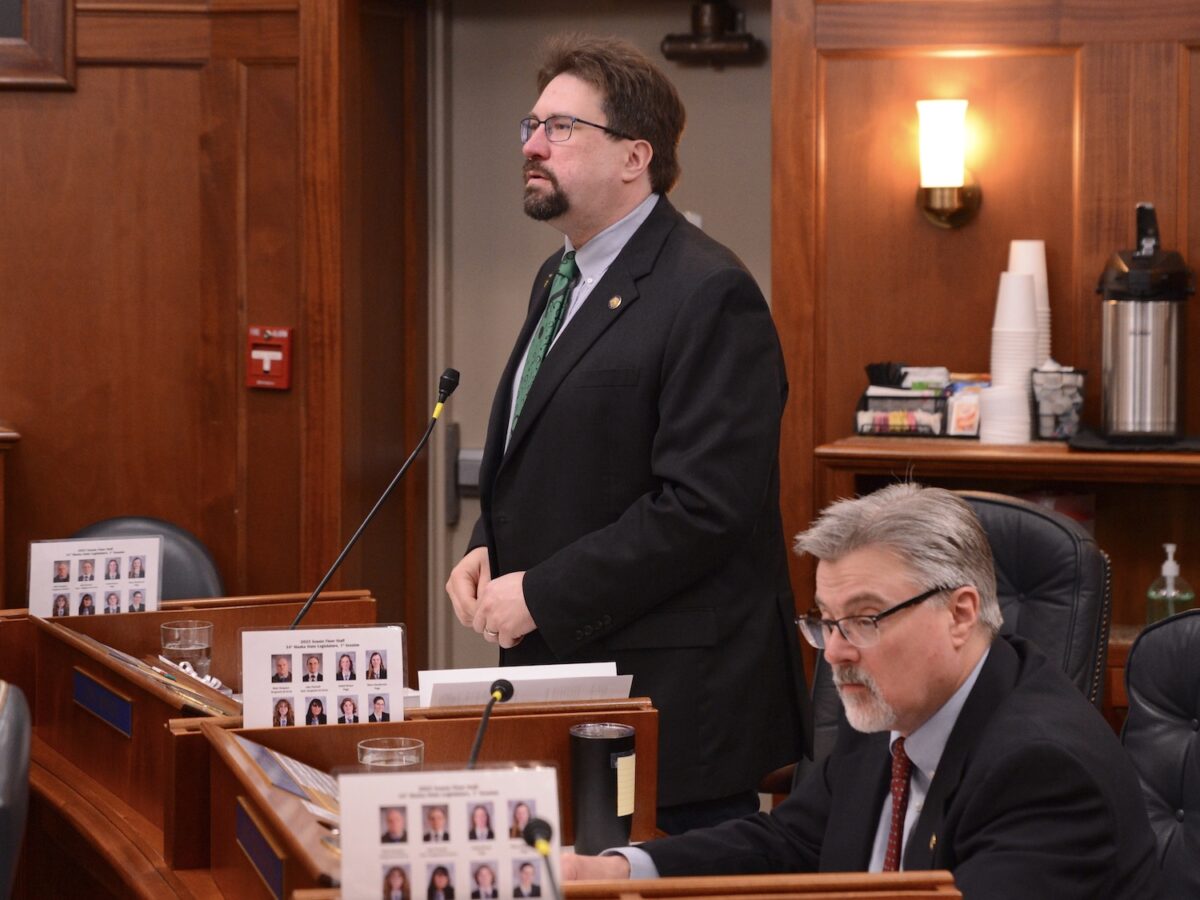
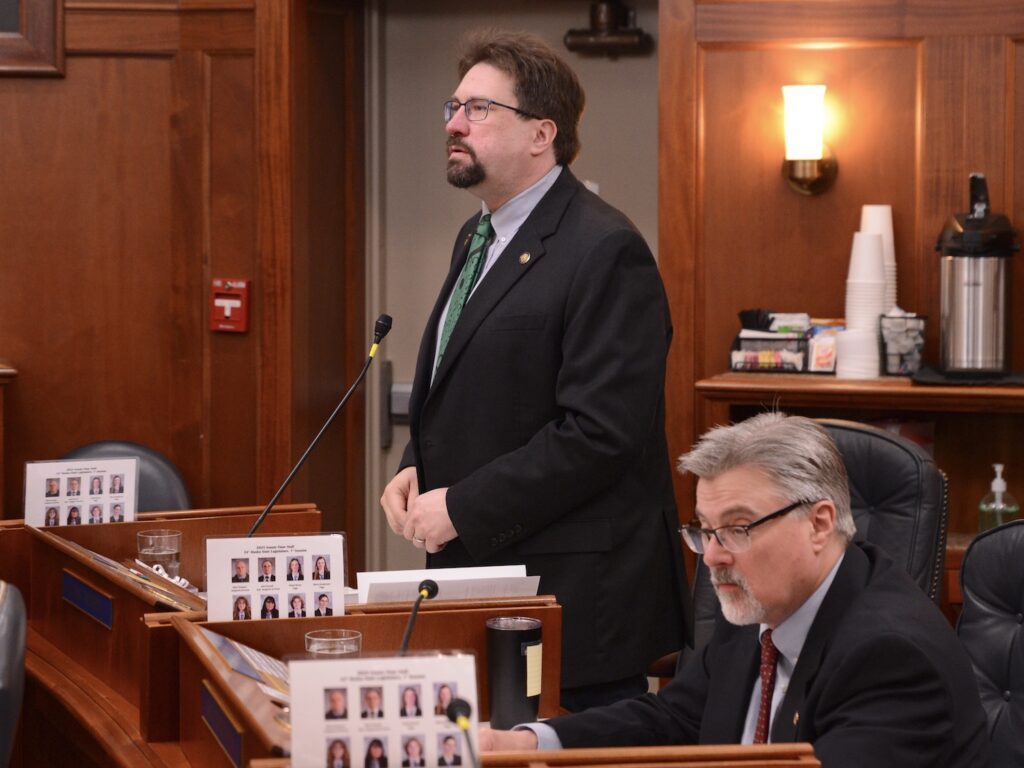
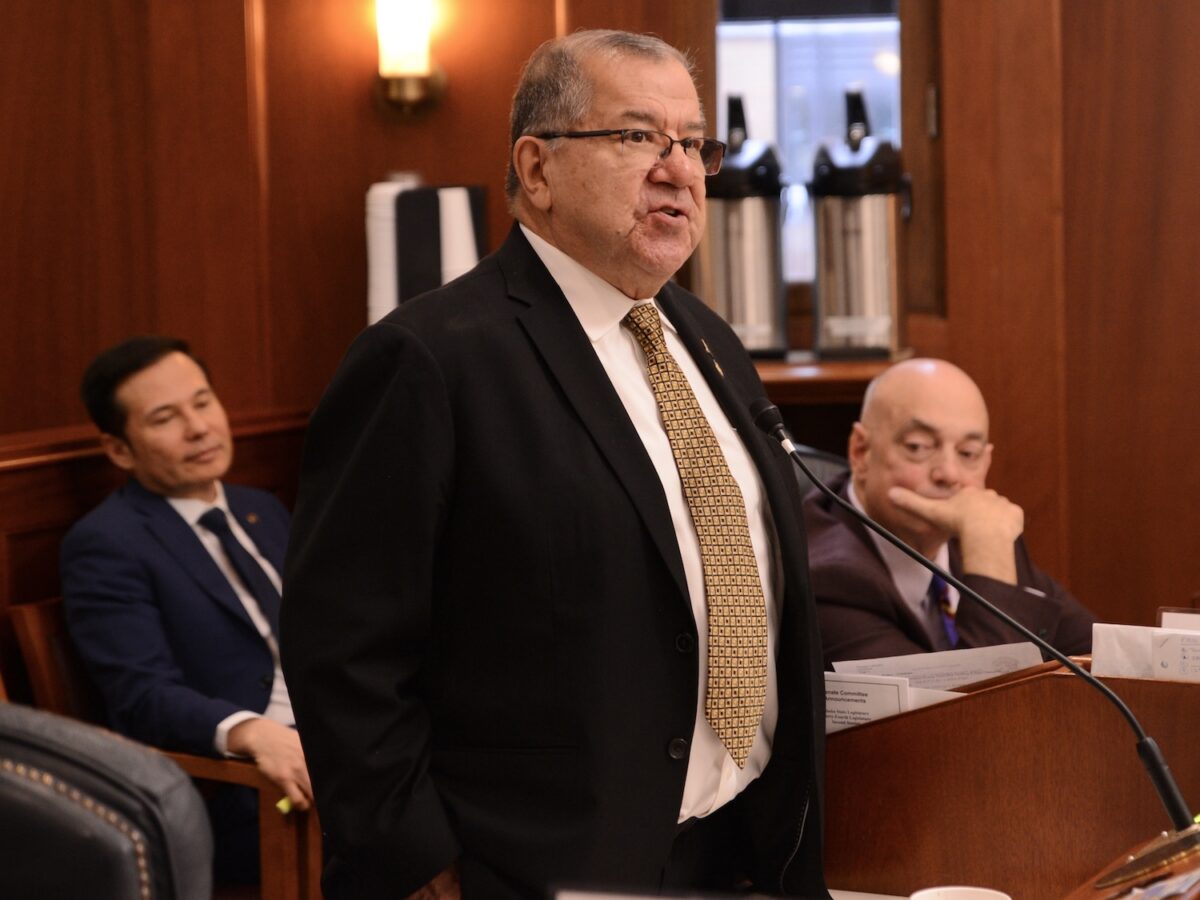
Representative Andi Story presenting to the House Education Committee, Screengrab courtesy of Gavel Alaska and KTOO
NOTN- A bill heard at 8 A.M this morning would overhaul how public schools are funded by changing how students are counted for state aid.
House Bill 261, rewrites large portions of the state’s public school funding statutes.
“We force school districts to budget in such an irrational way.” Said Representative Andi Story, “This backwards budgeting consumes a great deal of valuable time to reshuffle numbers, from personal experience this causes great pain in the community.”
In the full text of House Bill 261, available on The Alaska State Legislature Website, the measure is intended to stabilize school funding particularly through enrollment declines.
The biggest change in the bill is how Alaska calculates average daily membership, or ADM, which is the student count used to determine state education funding.
According to the Alaska Department of Education and Early Development, the ADM is a count of enrolled K-12 students taken for 20 days ending the last Friday in October of each year, the ADM is adjusted due to a few factors including school size, district cost, and special needs.
Under the bill, districts would generally receive funding based on the higher of their most recent student count or a three-year average.
“Alaska should create a 3 year averaging approach statewide to replace the current Hold Harmless Provision.” Story said during her presentation.
The Hold Harmless Provision currently protects school funding if their ADM drops by 5% or more each year, which allows the previous year’s student count to be used as a base to mitigate a drop in funding.
“It could also provide districts with greater stability and planning.” Story said, “As districts would not be so concerned about unexpected changes in enrollments at the October count period. About 19 states use an approach that either averages, combines or provides the better of multiple years of student counts.”
The bill also alters how districts are funded following school consolidations or closures, it would allow temporary offsets to soften funding losses over a period of several years.
The bill would also restrict districts from reopening schools too quickly after consolidation.
HB 261 also changes or revises how special education funding is calculated, particularly for students who require intensive services.
Using the above 3 year count, districts that identify additional students requiring intensive services midyear would be eligible for retroactive funding.
The bill applies to school districts statewide and does not directly increase the base student allocation, which is the per-student dollar amount set separately by the Legislature.
The ferry Tustumena is seen July 20, 2021, in southwestern Alaska. (James Brooks photo)
By: James Brooks, Alaska Beacon
The ferry Tustumena is seen July 20, 2021, in southwestern Alaska. (James Brooks photo)
After more than a decade of planning, design and false starts, the state of Alaska is once more attempting to build its first new mainline ferry in decades.
On Jan. 23, the Alaska Department of Transportation and Public Facilities began advertising for shipyards interested in building a replacement for the Tustumena, which sails between Homer, Kodiak and Unalaska on the longest, most remote state ferry route in the United States.
The new ship must be built in the United States and is expected to cost well over $325 million, based on a prior estimate provided by the state to the federal government and inflation since that 2022 projection.
The current bid listing states only that the “engineer’s estimate is greater than $100,000,000.”
The final operational requirements include a 330-foot-long ship with a range of 4,000 nautical miles, and a capacity of 250 passengers and 28 crew plus 58 vehicles.
A computer-generated mockup of the new Tustumena replacement ferry is seen in an undated image published by the Alaska Department of Transportation and Public Facilities. (DOT image)
The federal government is expected to pay for the majority of the project, which has been a state priority since 2013.
The Tustumena, variously nicknamed “Rusty Tusty” and “Trusty Tusty,” entered service in 1964.
The years and the rough seas of the North Pacific have taken their toll: In 2012, age-related problems sidelined the ship for months, cutting Kodiak off from the state road system. After an extended stay in drydock, it returned to service, but the experience caused the state to begin planning and designing a replacement.
Plunging oil prices and vanishing state revenue caused legislators and then-Gov. Bill Walker to slash the state’s budget, which put the replacement project on the back burner, and the Tustumena remained in service.
In 2016, part of the ship’s hull cracked badly enough that the Alaska Marine Highway System stopped sailing it in strong storms.
Subsequent repairs allowed the ship to return to full service, but the state renewed its efforts to replace the Tustumena. In late 2018, just as Walker was leaving office, the state signaled that it would soon begin soliciting bids for a replacement ship.
“The request for proposals will be issued in January 2019 and a ship builder should be selected by June-July 2019,” DOT said at the time.
Gov. Mike Dunleavy, who entered office in December 2018, froze the Tustumena replacement project and similar large-cost state projects as part of a new round of cost-cutting, and in his first years, he significantly cut the budget of the state ferry system, precluding it from going out to bid. By the end of 2021, the Dunleavy administration had relaxed its position on the Tustumena and named it a priority.
Ferry system officials said they would start a new bidding process in 2023, but that never came to pass. Plans for new bids in 2024 and 2025 also never came about.
In the meantime, the ship and its propulsion system were repeatedly redesigned, and the Tustumena is now intended to use a diesel-electric drive capable of cruising at 15 knots in moderate, 8-foot seas during the winter, with a maximum speed of 18 knots.
Eric Phillip, the boardwalk foreman for Kongiganak, Alaska, surveys infrastructure damage caused by Typhoon Halong, Oct. 18, 2025. The Alaska Organized Militia continues coordinated response operations in support of the State Emergency Operation Center following the 2025 West Coast Storm as the mission focus, pursuant to Governor Dunleavy’s declaration of disaster, shifts from lifesaving to life sustainment and stabilization of communities and survivors. (Alaska National Guard photo by Staff Sgt. Joseph Moon)
By: Corinne Smith, Alaska Beacon
Eric Phillip, the boardwalk foreman for Kongiganak, Alaska, surveys infrastructure damage caused by Typhoon Halong, Oct. 18, 2025. The Alaska Organized Militia continues coordinated response operations in support of the State Emergency Operation Center following the 2025 West Coast Storm as the mission focus, pursuant to Governor Dunleavy’s declaration of disaster, shifts from lifesaving to life sustainment and stabilization of communities and survivors. (Alaska National Guard photo by Staff Sgt. Joseph Moon)
The Trump administration has denied Alaska’s request for full reimbursement for disaster relief efforts immediately following last October’s devastating Western Alaska storms, despite the Dunleavy administration’s claim that the federal disaster declaration meant the state would be fully reimbursed.
Gov. Mike Dunleavy arrives in Bethel after visiting the storm-damaged villages of Kipnuk and Kwigillingok on Oct. 17, 2025. (Photo by Eric Stone/Alaska Public Media)
That leaves the state on the hook for millions of dollars for disaster recovery, however the full amount is still unknown.
The state’s request for federal support for 100% of disaster relief efforts in the first 90 days after the storms hit was denied on Dec. 20, according to a spokesperson for the Alaska Division of Homeland Security and Emergency Management on Thursday.
The state appealed the denial on Jan. 15, and asked for a 90% federal cost reimbursement, but has not yet gotten a response from the Federal Emergency Management Agency.
“We have not heard back from FEMA on approval or denial and there is no timeframe requirement,” said Jeremy Zidek, public information officer for the division, by email.
A spokesperson for Dunleavy’s office did not respond to a list of questions, but confirmed the appeal on Friday. “An appeal has been filed and the administration will await the federal government’s decision,” said Jeff Turner, Dunleavy’s communications director.
In the meantime, the federal government is reimbursing Alaska’s disaster recovery efforts at roughly 75%, leaving the state to cover 25% of its costs, with some exceptions for certain relief programs, Zidek said.
Following the West Coast storm disaster in October, Dunleavy quickly declared a state disaster emergency. On Oct. 22, his office announced that the Trump administration approved the state’s request for a federal disaster declaration, and the state’s full costs would be covered immediately following the storms.
“President Trump was deeply concerned with the wellbeing of Alaskans who lost their homes and livelihoods to this historic storm,” Dunleavy said in a statement along with the announcement. “I want to thank him and his administration for approving the disaster declaration because now Alaskan families have local, state and federal support for rebuilding their lives in the months ahead.”
“The federal disaster declaration authorizes a 100 percent federal cost share for all categories of relief assistance for the next 90 days,” the statement said.
Dunleavy’s office did not respond to questions about his previous statement or whether his office had communication from the Trump administration about why the request was denied.
Alaska’s Republican U.S. congressional delegation applauded the federal disaster declaration and Trump’s support for the Western Alaska disaster response last year. All three members said through spokespeople Friday that they support the state’s appeal.
U.S. Sen. Lisa Murkowski has been actively engaged with FEMA and state officials throughout the disaster relief efforts, said her communications director, Joe Plesha, in a statement on Friday. “Alaska’s vast geography and many rural communities make disaster response more challenging and recovery efforts significantly more costly,” he said. “She supports the state’s appeal and will work to secure the maximum amount of federal support available to Alaskans who have suffered so much from this devastating storm.”
A spokesperson for U.S. Sen. Dan Sullivan, Amanda Coyne, said the senator has advocated for the 100% federal cost share, as well as organized a delegation of FEMA and other Trump administration officials to visit Western Alaska.
“Given the severity of the storm and its devastating impacts on communities in Western Alaska, Senator Sullivan believes an increased federal cost share is warranted,” Coyne said. “He will continue strongly advocating with FEMA and other senior officials in the Trump Administration for an increased federal cost share as the state’s appeal goes through the process.”
A spokesperson for Alaska’s lone U.S. Representative, Nick Begich III, said on Friday that he supports the appeal and will continue to advocate for those impacted by Typhoon Halong at the Congressional level. “Our office is in communication with the Administration to ensure recovery efforts in Western Alaska remain a priority,” spokesperson Silver Prout wrote.
Western Alaska storm recovery is ongoing
The Western Alaska storms and particularly ex-Typhoon Halong brought record-breaking winds and flooding — damaging thousands of structures, roads, boardwalks, airports and other critical infrastructure. It prompted the state’s largest mass evacuation of residents from their homes to other villages, Bethel and Anchorage.
Evacuees of Kipnuk and Kwigillingok wait to board an evacuation flight from Bethel to Anchorage on Oct. 15, 2025 (Photo by Corinne Smith/Alaska Beacon)
While some Western Alaska residents are continuing to rebuild through the winter, other residents who evacuated to Anchorage are living in temporary housing. As of Thursday, the Alaska Division of Homeland Security and Emergency Management reports that 471 residents are still sheltering in hotels in Anchorage.
The state is administering public assistance programs, which reimburse costs of repairing public infrastructure and utilities, as well as provide individual disaster assistance, in partnership with other agencies, including FEMA.
FEMA has awarded $31.2 million in individual assistance to date, Zidek said.
More than 2,000 residents have been awarded state individual assistance, and 1,794 households have registered for federal assistance from FEMA.
Those applications for state and federal assistance are still open until Feb. 20.
State disaster relief funding under debate
The state’s disaster relief funding is a point of ongoing debate among lawmakers and the governor, as they kick off discussion of Dunleavy’s proposed $7.75 million budget and its $1.5 billion deficit.
Last year, legislators approved $23.3 million in state disaster relief funds, but Dunleavy vetoed $10.3 million of that sum last summer, leaving $13 million in the budget. In November, following the federal government shutdown, Dunleavy announced a state disaster to help provide food aid, transferring $10 million to the state’s disaster relief funding from the Department of Environmental Conservation’s Village Safe Water and Wastewater Infrastructure program.
This year, the governor has requested an additional $40 million in the state’s supplemental budget, which is a routine ask for additional money to pay the state’s bills for the previous year.
Sen. Bert Stedman, R-Sitka, a co-chair of the Senate Finance Committee, didn’t mince words about the governor’s back and forth with disaster spending. “Ill-advised and foolish,” he said. “It makes no sense what he did to me, frankly, and it’s embarrassing for him, his veto.”
But Stedman said he hopes the state’s federal appeal is approved, and expects legislators to pass the governor’s request for the additional $40 million. “Obviously, 100% is better than 90 and 90 is better than 75,” Stedman said of the federal cost share. “So that’s pretty much a given there. But we will fund the disaster request as the governor puts it on the table, through next week’s amendments.”
Sen. Jesse Kiehl, D-Juneau, also a member of the Senate Finance Committee, commended the governor for his record on disaster response, and echoed hope for the appeal to move forward. “There’s no question in my mind that this is exactly what the federal disaster relief programs exist for. So I think the governor’s request was the right thing, and if it came back at less than full funding from the feds, that’s the wrong call,” Kiehl said.
Kiehl described the state’s fiscal picture, with rising costs and ongoing debates on how to raise more revenues, as “bleak.” “So there isn’t cash just sitting around for disaster assistance,” he said. “We have to step up for western Alaska financially. That’s going to stink, but we have to do it, as far as I’m concerned.”
A typical cost share between the federal government and a state for disaster relief efforts is a 75% federal and 25% state cost split.
“We have dozens of federal declared disasters we are currently working on that have the 75/25 cost share structure,” said Zidek, with agency. “Large disasters are occasionally given a modified cost share structure adjustment, but it is not guaranteed. When we have a large disaster, we ask for modification to reduce the amount of state funding needed because as managers of state funds it is the responsible thing to do.”
This drone image provided by the City and Borough of Juneau shows flooding from a release of water and snowmelt at Mendenhall Glacier covered some roads and threatened homes along the Mendenhall River in Juneau, Alaska on Wednesday, Aug. 13, 2025. (City and Borough of Juneau via AP)
NOTN- City leaders are asking View Drive homeowners, the area hit hardest by glacial lake outburst flooding, to weigh in on whether they want to pursue a voluntary federal buyout program.
The City and Borough of Juneau is gauging interest in a potential buyout through the U.S. Department of Agriculture’s Natural Resources Conservation Service Emergency Watershed Protection program, (NRCS) which helps communities recover from natural disasters by purchasing at-risk properties and restoring the land.
Under the program, eligible properties would be acquired at fair market value, followed by environmental review, demolition and site restoration. NRCS would cover 75% of total project costs, but Juneau would be responsible for the remaining 25%.
The non-federal match is estimated at about $6 million if all 18 eligible structures on View Drive take part.
City Manager Katie Koester said the city wants to know whether homeowners would be willing to help assemble that non- federal match, either through their own resources or with help from nonprofits and other non-federal sources, asking owners through an informal ballot, to indicate whether they would be willing to participate if that cost share were required, though responses are not binding.
“The Assembly really hasn’t received any official communication from View Drive residents on whether or not they are even interested in participating in the program,” Koester said. “The first important step is sending them an informal ballot to gauge actual interest in participating.”
View Drive is considered one of the neighborhoods most vulnerable to annual flooding caused by glacial lake outburst floods, as it sits just outside the reach of the HESCO barriers.
Juneau officials have discussed buyouts as one possible option for residents, particularly as flooding frequency and severity increase, though Koester stressed that whether or not the city goes through with the buy-out program, officials are still committed to an enduring solution.
“I just want to make sure that the public knows that it is the number one priority for the City of Juneau, to find a permanent solution to the flooding, not just for View Drive, but for the entire valley.” She said.
Koester said the Assembly is seeking to understand whether enough property owners would participate to justify moving forward.
Participation in the program would be entirely voluntary, and Koester emphasized that not every property owner would need to opt in for the project to move forward.
“‘It’s totally feasible that four people want to participate, and we move forward, and the rest of the neighborhood does not participate.”
Property owners have until Feb. 16 to return their ballots to the city’s engineering division, those results from residents are expected to be presented at the assembly’s Committee of the Whole meeting on Feb. 23.
Rep. Kevin McCabe, R-Big Lake, reads a document entitled “Alaska’s Fiscal Options” while listening to a presentation by the Institute for Social and Economic Research of the University of Alaska Anchorage on Thursday, Jan. 29, 2026, at Centennial Hall in Juneau. (James Brooks photo/Alaska Beacon)
A new nonpartisan report by the Institute of Social and Economic Research at the University of Alaska Anchorage has concluded that raising oil and corporate taxes to balance Alaska’s budget likely has the lowest negative side effects for Alaskans’ jobs and income.
The report, eagerly anticipated by state lawmakers and experts, comes as legislators consider ways to balance Alaska’s expenses and revenue over multiple years.
Commissioned by the administration of Gov. Mike Dunleavy, the report was released days after the governor debuted a plan intended to bring Alaska’s expenses and revenue in line.
Since 2015, when oil prices plummeted, Alaska has struggled to balance its budget on an annual basis despite steep cuts to state services. At times, the tug-of-war between services and the Permanent Fund dividend has driven the state to the brink of a government shutdown.
Figures from the Legislative Finance Division, which advises the Legislature on fiscal issues, show state agencies have had their budgets cut by 16.6% when adjusted for inflation since Fiscal Year 2015.
During the same period, lawmakers have passed no significant revenue measures. Dunleavy, who opened his first year in office by proposing massive budget cuts, hasn’t proposed significant reductions in recent years and is now suggesting a statewide sales tax and other revenue measures are needed for the state to keep up with spending.
ISER’s analysis of the situation was keenly awaited by state legislators and other experts, who crowded into a ballroom at Juneau’s convention center on Thursday morning to hear its economists deliver their report.
A 2016 analysis by ISER remains widely consulted in the capitol and was a contributing factor to lawmakers’ decision to begin using the Alaska Permanent Fund as a trust fund two years later. Legislators installed an annual transfer from the fund to the treasury for dividends and services, and it’s now the No. 1 source of general-purpose state revenue for Alaska, accounting for almost two-thirds of the state’s flexible spending each year.
The report released Thursday concluded that Alaska’s unstable fiscal situation has created so much uncertainty that it’s lowered Alaska’s real gross domestic product growth by 2-3% over the past decade, the equivalent of billions of dollars, said Brett Watson, an economist with the Institute of Social and Economic Research and the lead author of the report.
Brett Watson of the Institute for Social and Economic Research of the University of Alaska Anchorage delivers a presentation about Alaska’s fiscal options on Thursday, Jan. 29, 2026, at Centennial Hall in Juneau. (James Brooks photo/Alaska Beacon)
Alaska’s GDP — the value of all goods and services in the state — is about $70 billion and ranks near the bottom of U.S. states in terms of growth over the past decade.
ISER examined 11 different options to balance the state budget, including spending cuts, cuts to the Permanent Fund dividend, income taxes, sales taxes and business taxes.
Raising business and oil taxes would have the lowest negative impact on jobs and income, while cuts to services would have the biggest negative effect on them, the report found.
Reducing the Permanent Fund dividend to balance the budget — which has been the existing legislative policy for the past several years — has similarly large negative effects on income, but smaller negative effects on employment. Poor Alaskans are affected more by a PFD reduction than rich Alaskans, making it the most regressive option.
Among statewide taxes, a progressive income tax would have the biggest negative impact on high-income Alaskans and the lowest negative impact on low-income residents.
Nonresidents would pay 27% of a statewide sales tax with many exclusions — food, utilities, and health care, for example — making it the option with the least direct impact on individual income among broad-based taxes.
Corporate and oil taxes have a lower impact overall, ISER concluded.
Making a sales tax higher in the summer and lower in the winter “shifts the burden toward visitors, reducing the impact on Alaska families by 2-5 percentage points per dollar raised,” ISER concluded.
Dunleavy’s fiscal plan includes a seasonal sales tax as one of its pillars.
ISER also concluded that its models suggest that it is possible to come up with “a budget neutral combination that stimulates growth.”
“For example,” its report states, “coupling a less distortionary revenue source (like property tax) with expansionary spending (like capital project investment) can result in a net increase in total employment.”
Alaska Gov. Mike Dunleavy opens a presentation by the Institute for Social and Economic Research of the University of Alaska Anchorage on Thursday, Jan. 29, 2026, at Centennial Hall in Juneau. (James Brooks photo/Alaska Beacon)
Imposing a statewide property tax and a broad corporate tax cut in combination, ISER suggested in a slide presented to lawmakers, would result in increased employment and personal income by 2050, it estimated.
The effect of each tax or cut was examined independently, Watson said, in $100 million chunks.
“You can think about these as items on a buffet, and you kind of scoop from them different serving sizes as you construct a plate that is a state fiscal plan,” he said.
ISER also considered things linearly — economists didn’t try to predict whether Alaskans would react differently if a sales tax went from 5% to 6% instead of from 0% to 1%.
“In reality, it is likely that there are certain important thresholds that if you turn that dial too far, consumers start reacting in more and more aggressive ways to it, but we assume that their reaction is the same, regardless of what the level set is,” he said.
Watson said there is a cost if lawmakers do nothing. In addition to the GDP penalty caused by uncertainty, the state remains vulnerable to what’s called the “Alaska disconnect.”
Imagine, he said, if “something crazy would happen and one of the Silicon Valley tech giants were to announce that they were going to create a Silicon Valley of the north somewhere in Alaska and that they would move 100,000 employees somewhere in Alaska and create this northern hub of tech.”
“It would be absolutely catastrophic from the standpoint of the state of Alaska budget,” he said. “There would be 100,000 new Permanent Fund dividends to pay, the children of 100,000 new employees to educate, more roads to maintain, more state services to provide, without any additional revenue collected for any of those individuals. And so there’s this disconnect now that’s growing between our private sector economy and what goes on in our public sector.”
Representative Sara Hannan, Andi Story and Senator Jesse Kiehl (from left to right) at Thursday evening’s Town Hall.
NOTN- Juneau residents turned out Thursday evening for a legislative town hall at the Mendenhall Valley Library with Juneau’s delegation.
State Senator Jesse Kiehl and Representatives Sara Hannan and Andi Story met with constituents to share updates from the current legislative session and hear directly from the community.
“Mostly, the reason we’ll do this is to hear your questions or hear your comments. By golly, we need to hear from you. You’re who we work for.” Said Kiehl Thursday morning.
Attendees asked about a range of issues facing Juneau and the state including disaster response, Representative Andi Story assured constituents that the legislature is speaking with Alaskaa ‘s congressional delegation to come up with long-term mitigation plan for glacier lake outburst floods.
“Everyone’s living with a lot of stress, it’s emotionally draining when its your home.” Story said, “We know August is coming around, we’re trying to repair the HESCO barriers, we are trying to do what we can.”
Most prevalent was the budget, and more specifically, the Governor’s recently proposed fiscal plan, currently making its way through the legislature.
“What we have to do is have a balanced budget.” Story said, “We don’t have to pass any policy at all, but every year we have to come together to provide a balanced budget to meet our constitutional budget requirement.”
The Governor’s sweeping fiscal plan includes Alaska’s first statewide sales tax in more than four decades. The proposal would create a year-round sales tax, 4% in the summer and 2% in the winter, running through 2034.
“It would add on top of local sales tax, and it would override any local sales tax decisions.” Kiehl said, “So Juneau voters just voted to take sales tax off of food. This will put sales tax back on all food, that’s an issue.”
If adopted the tax could potentially raise over 800 million dollars a year by the early 2030s.
The plan also includes a constitutional amendment to set a “50-50” Permanent Fund Dividend, which would amount to roughly $3200 per recipient.
“What the governor used to propose, was just take more than we can sustain out of the earnings reserve. Great, big draw.” Kiehl said, “So I applaud the Governor for saying, okay, that old idea of his doesn’t work. His proposal takes that cap, and it says we’re going to draw 5% we’re going to split it 50-50, between public services and PFDs. but you can only do that if we spend even less on services than we do now.”
Kiehl said the Governor’s proposal could underfund schools and building maintenance.
“The state’s going to crumble and fall down if we do that, the math doesn’t work.” He said,”Could we protect a dividend? Yeah, but the simple fact is, we’re not gonna get the votes to raise taxes to increase the PFD from where it’s been. We should stabilize the PFD, but if we’re talking about adding taxes to Alaskans and Alaska businesses, we’re not going to do that to pay out a bigger check than we’ve been paying.”
Representative Hannan hinted at an opportunity for residents to publicly testify at a Senate Finance meeting next Thursday, this has yet to be confirmed on the Alaska State Legislature website.
The meeting took place in person and was live-streamed on Facebook.
The Juneau School District office in downtown Juneau.
(Photo courtesy City & Borough of Juneau)
The Juneau School District office in downtown Juneau. (Photo courtesy City & Borough of Juneau)
NOTN- The Juneau School District is seeking public input as it begins its search for a new superintendent, asking parents, staff, students and community members to weigh in on priorities and desired leadership qualities.
First reported by the Juneau Independent, the district released an online feedback survey Wednesday, designed to guide the Board of Education as it recruits candidates to lead the district.
Participants are asked to describe strengths of the Juneau community and school district that prospective superintendents should know, as well as the most significant challenges facing the district.
The survey also asks respondents to identify the qualities, skills and characteristics they believe are necessary for the next superintendent to be successful.
In addition, respondents are asked to rate the importance of various areas of experience, including prior superintendent experience, work as a classroom teacher, familiarity with Alaska’s public education system, knowledge of school finance and facilities, and understanding of the district’s culture and community.
District officials say the feedback will help inform the board’s decision-making as it evaluates candidates and determines what leadership qualities best align with the district’s needs.
Current Superintendent Frank Hauser will be stepping down June 30, he said this when asked what he was most proud of in his tenure as Superintendent, “I think that we’ve done a lot of great work here, the Juneau school district staff, are some of the best staff in the world. Consolidation was hard, those are really tough decisions. But I think looking at the future, we’re on much better financial footing.” He said, “There are still challenges with the budget, but I think putting together a fiscal plan that is more focused, and having opportunities for kids, and even through the consolidation, being able to maintain those opportunities for our students and still see growth, those are the things I’m really proud of. We made it through, and we’re in a better position than we were going in.”
What will Superintendent Hauser do next? He says he’s not sure yet, but he hopes it will continue to include advocacy for education in the state.
“I have spent the last 28 years in public education, advocating for public education, I’m Alaska educated, and I will continue to advocate for public education. I don’t know in what capacity that will be right now, but it is something that I believe in.”
NOTN- Juneau’s Recycling Center remains closed today and, according to CBJ, will remain closed indefinitely while critical replacement parts are shipped to the city to repair damaged equipment.
The center, has been closed due to problems with its recycling baler.
Recycleworks said parts have been ordered to repair the center’s baler, the parts are on the way to Juneau, but no timeline has been given for when repairs will be completed or when the center will reopen.
During the closure, staff are working on deferred maintenance projects and manually baling accumulated recyclable materials already on site.
The center closed through the city’s major snow storm, and when it reopened closed once more due to a surplus of recyclables.
The center serves as a primary drop-off location for community recycling and has experienced intermittent closures in recent years due to equipment and operational challenges .
City officials acknowledged the inconvenience for residents and said updates will be posted daily here, as repairs progress.
Cars are driven on Fourth Avenue in downtown Anchorage on Oct. 7, 2024. (Photo by Yereth Rosen/Alaska Beacon)
Alaska’s population rose slightly between 2024 and 2025 and is now at its highest level since 2017, the Alaska Department of Labor and Workforce Development announced Wednesday.
Alaska had an estimated 738,737 people as of July 1, 2025, the department said in its annual state population estimate.
The rise comes despite a revision that erased thousands of international immigrants that the U.S. Census mistakenly believed had moved to Alaska.
Last year, relying on Census figures showing that thousands of people had migrated to Alaska from other countries, the department estimated Alaska’s population at more than 741,000 people.
Since then, and after prodding from Alaska state demographer David Howell, the Census Bureau retroactively lowered the number of international migrants that came to Alaska, and this year’s state population estimate is significantly lower than the one published last year.
“We think (that) is more accurate given that people crossing the southern border aren’t very often making their way to Alaska,” Howell said.
With the extra residents removed and a new baseline in place, the state’s population grew on a year-over-year basis because the number of births in the state exceeded the number of Alaskans who died.
That natural increase — births minus deaths — of 3,389 people was greater than the number of people who moved out of the state.
Between 2024 and 2025, 1,740 more people moved out of Alaska than moved here. It was the 13th consecutive year of negative net migration in Alaska, extending the longest streak of negative net migration since 1945.
Overall, the state’s population grew by 0.22%. That was less than the nation as a whole (0.5%). Compared with the other 49 states and the District of Columbia, Alaska’s population growth ranked 40th.
South Carolina (1.5%), Idaho (1.4%) and North Carolina (1.3%) had the highest growth rates among states. Vermont (-0.29%), Hawaii (-0.15%) and West Virginia (-0.07%) had the lowest and were among five states that posted population declines.
The U.S. Census Bureau has slightly different figures than the state — it estimated a 0.1% population gain between 2024 and 2025 — but the Alaska Department of Labor conducts surveys of military bases and group homes that the Census Bureau does not, Howell said. For that reason, he believes the state’s estimate is more accurate than the Census Bureau’s.
Overall, Howell said, Alaska seemed to simply extend existing population trends between 2024 and 2025.
“We’re continuing to see losses in the working-age population. … We’re really starting to see declines in the school-age population. It was growing slightly at the beginning of this decade, but at this point, there’s about 1,000 more 17-year-olds than there are 4-year olds. And so we’re just going through aging,” he said.
Alaska’s median age is 37.1, one and a half years older than it was at the start of the decade. Haines, the state’s oldest community, has a median age above 50.
As the state ages, the number of new births is dropping and the number of deaths is rising.
Howell and the Department of Labor and Workforce Development are predicting that the state’s population will start dropping steadily by the year 2050.
The number of births in the latest population estimate is the lowest since the trans-Alaska oil pipeline was built. The number of deaths dropped slightly last year, but Howell said there may be a morbid reason for that: The COVID-19 pandemic peaked in Alaska in 2021-2022 and may have killed elderly Alaskans who would have died later.
This year’s state population estimate retroactively updated the population change between 2021-2022, turning it from a small gain into a decline.
On a borough and city level, existing trends continued in the latest forecast. The Matanuska-Susitna Borough continues to be the fastest-growing large area of the state, the population of Anchorage is relatively flat, the Interior’s population is growing slightly and Southeast Alaska’s population is falling.
A road sign marks the road towards the Lower Kuskokwim School District offices and the Bethel High School. October 9, 2023. (Photo by Claire Stremple/Alaska Beacon)
While Alaska school districts are seeing improvements in kindergarten to third grade students’ reading proficiency, which officials credit to the Alaska Reads Act, some districts are struggling to access state managed funds for a federal grant program aimed at supporting literacy programs, teacher development, and student learning.
School districts awarded CLSD grants in 2025
Alaska Gateway School District
Aleutians East Borough School District
Anchorage School District
Bering Strait School District
Bristol Bay Borough School District / Chugach School District
Copper River School District
Cordova City School District
Dillingham City School District
Galena City School District
Iditarod Area School District
Kake City School District
Kashunamiut School District
Kenai Peninsula Borough School District
Kodiak Island Borough School District
Kuspuk School District
Lake and Peninsula Borough School District
Lower Yukon School District
Mount Edgecumbe High School
North Slope Borough School District
Northwest Arctic Borough School District
Petersburg Borough School District
Pribilof School District
Southeast Island School District
Yakutat School District
Yukon Flats School District
Yukon–Koyukuk School District
Lawmakers with the House Education Committee heard from two district superintendents about the successes and challenges of the Comprehensive Literacy State Development grant program — which in 2024 awarded $50 million to Alaska schools over five years.
In 2025, roughly half of Alaska’s districts, or 27 school districts, qualified for these grant funds administered through the Alaska Department of Education and Early Development, according to the department.
The program is aimed at advancing literacy for children from birth through 12th grade students, including pre-literacy skills, reading and writing. The program focuses on districts with disadvantaged children, including those living in poverty, English language learners and students with disabilities.
While all Alaska districts are required by state law to implement the Alaska Read’s Act, the policy did not come with additional state funding, said Rep. Rebecca Himschoot, I-Sitka, co-chair of the education committee, in an interview on Monday. She said some districts are struggling to fund the kindergarten through third grade reading initiatives. “I would like to see us supporting schools so that everybody gets the support they need to implement the law the way it was written,” she said.
The program isn’t new, but it has more money and it’s funding more districts now. In 2019, nearly one third of Alaska districts were awarded $25 million over five years, according to DEED.
“The literacy grant is a really powerful tool that is going to help the districts that it’s in, a lot,” Himschoot said. “I’ve heard a lot of gratitude from superintendents about having this opportunity for those who have it, but we did hear about some bumps in the rollout of it.”
District officials’ testimony prompted Himschoot to send a list of questions to DEED about how the grant is managed.
Michael Robbins, superintendent of the Bristol Bay Borough School District, which serves approximately 135 students, said the grant has been crucial for implementing the Alaska Reads Act, particularly supporting teachers’ training professional development, which helps retention. “The grant supports training, coaching and leadership development grounded in research-based instruction, including the science of reading,” he said.
“It creates consistency across classrooms in schools, helps prevent problems before they grow, and ensure that limited resources are utilized where that matters most,” Robbins said.
But Robbins said in implementing the grant, districts need more “clear, timely and reasonable guidance around allowable use of grant funds” from DEED.
He said the district would like to use the money for professional services vendors to provide training to teachers, and funding to attend conferences. “The approval process has been particularly cumbersome as some districts have had to resubmit their application multiple times, which takes valuable time from our grant leaders and administrators, as well as delaying the implementation of important activities,” he said.
Officials with DEED did not attend the legislative hearing, but department spokesperson Bryan Zadalis said by email on Monday that the department recognizes the importance of clear guidance, which is communicated through multiple channels including webinars and office hours. “DEED also aligns state-level guidance with federal updates as they are released to ensure accuracy and compliance, which can at times require sequencing information rather than issuing it prematurely,” he said.
In addition, Robbins, who formerly served as the superintendent of the Ketchikan Gateway Borough School District, said that that district did not qualify for grant funding. “The need was there, but the resources are not,” he said. “We need to find ways for all districts and all students to have access to the same level of support and opportunity.”
Robyn Taylor is superintendent of the Petersburg School District which serves approximately 420 students, and was awarded $350,000 per year through the grant program. She testified to lawmakers and echoed the need for equity in supporting reading programs across Alaska’s school districts. She said Petersburg still continues to have challenges with implementing the Alaska Reads Act, which she called “a real tension.”
“In Petersburg alone, between FY 25 and FY 26 we eliminated one of our three elementary reading interventionist positions, positions that were directly supporting Reads Act implementation and student outcomes,” she said. She said the district was told that CLSD funds were for supplementing programs not replacing funding.
“(The) restriction makes it difficult to use this grant to maintain positions or systems that are already working but are no longer financially sustainable under current funding structures,” she said.
Taylor and Himschoot both emphasized that districts who did not qualify for funding need support with the administrative work to apply. They said some schools should have easily qualified for the funding, but didn’t in part because they lack proper documentation of their students’ need for free or reduced school meals, which is one of the federal poverty guidelines. “It’s not that they don’t have kids in need,” Himschoot said. “It’s that they haven’t been identified through the paperwork, because they don’t have the capacity in their district to go chase that down.”
Zadalis said the grant process is a competitive one. He said the primary source of education funding is through the state’s funding formula, but districts may also access state or federal funding through other grants focused on literacy efforts.
Taylor said Petersburg students are making gains in reading proficiency, and the district is committed to continuing improvements beyond the grant cycle. “What we are asking for is greater flexibility, clearer and earlier guidance,” she said. “And increased trust in districts to make decisions that reflect local context and student needs.”