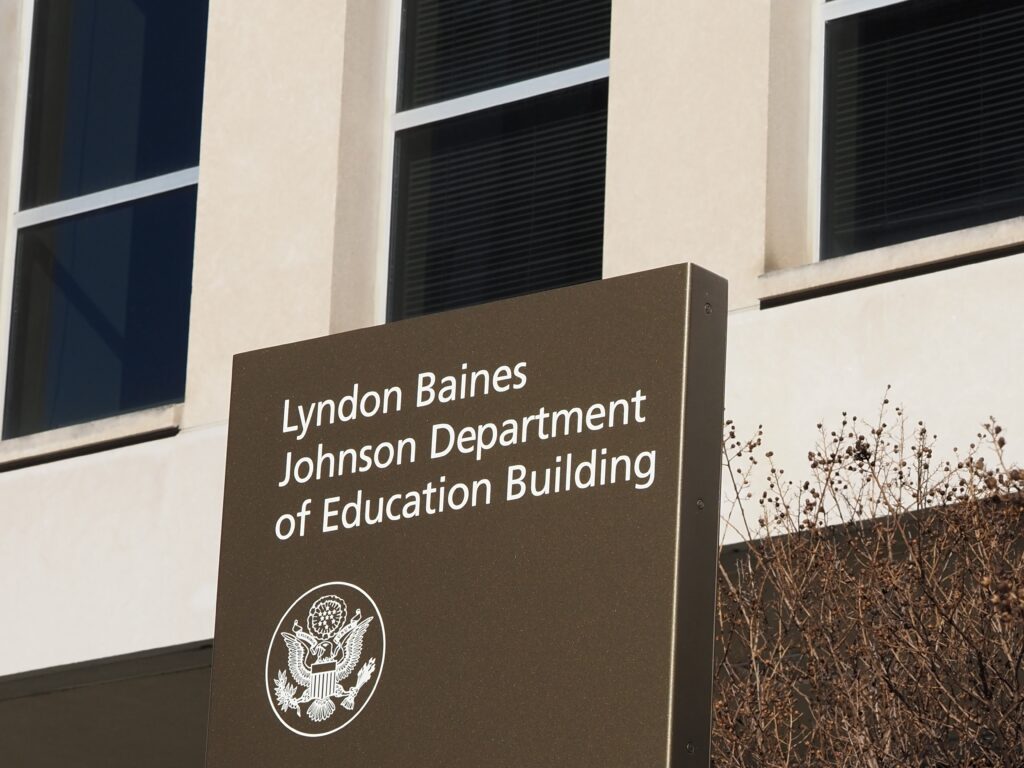
The Lyndon Baines Johnson Department of Education Building in Washington, D.C., in a file photo from November 2024. (Photo by Shauneen Miranda/States Newsroom)
WASHINGTON — The Trump administration said Friday it’ll soon release billions in Education Department funding that has been frozen for weeks, delaying disbursements to K-12 schools throughout the country.
The funding — which goes toward migrant education, English-language learning and other programs — was supposed to go out before July 1, but the administration informed schools just one day before that it was instead holding onto $6.8 billion while staff conducted a review. Members of both parties in Congress objected to the move.
The Education Department released $1.3 billion for before- and after-school programs as well as summer programs in mid-July, but the rest of the funding remained stalled.
Madi Biedermann, a Department of Education spokesperson, wrote in an email to States Newsroom that the White House budget office “has completed its review” of the remaining accounts and “has directed the Department to release all formula funds.”
The administration will begin sending that money to school districts next week, Biedermann wrote.
Appropriators cheer
Maine Republican Sen. Susan Collins, chairwoman of the Appropriations Committee, wrote in a statement the “funds are essential to the operation of Maine’s public schools, supporting everything from classroom instruction to adult education.”
“I am pleased that following outreach from my colleagues and me, the Administration has agreed to release these highly-anticipated resources,” Collins wrote. “I will continue working to ensure that education funds are delivered without delay so that schools have adequate time to plan their finances for the upcoming school year, allowing students to arrive back to class this fall to properly-funded schools.”
Collins and nine other Republican senators wrote a letter to Office of Management and Budget Director Russ Vought earlier this month asking him to “faithfully implement” the spending law Congress approved in March.
“The decision to withhold this funding is contrary to President (Donald) Trump’s goal of returning K-12 education to the states,” the GOP senators wrote. “This funding goes directly to states and local school districts, where local leaders decide how this funding is spent, because as we know, local communities know how to best serve students and families.
“Withholding this funding denies states and communities the opportunity to pursue localized initiatives to support students and their families.”
West Virginia Republican Sen. Shelley Moore Capito, chairwoman of the appropriations subcommittee that funds the Education Department, wrote in a statement released Friday she was glad to see the funding unfrozen.
“The programs are ones that enjoy longstanding, bipartisan support like after-school and summer programs that provide learning and enrichment opportunities for school aged children, which also enables their parents to work and contribute to local economies, and programs to support adult learners working to gain employment skills, earn workforce certifications, or transition into postsecondary education,” Capito wrote. “That’s why it’s important we continue to protect and support these programs.”
In preparation for a possible glacial lake outburst flood (GLOF) this summer, local, tribal, and state agencies have formed a joint communications initiative aimed at improving public safety and emergency response in Juneau.
The City and Borough of Juneau (CBJ), Central Council of the Tlingit & Haida Indian Tribes of Alaska (Tlingit & Haida), and the Alaska Department of Transportation & Public Facilities (DOT&PF) are coordinating with several federal and state partners to streamline flood messaging and improve community readiness.
The collaborative effort stems from increased awareness of the growing risks posed by the Mendenhall Glacier’s Suicide Basin and recent flood events that have affected homes, infrastructure, and traditional lands. With the basin approaching capacity, agencies are taking proactive steps to minimize confusion, provide timely updates, and improve response coordination in the event of a flood.
The new effort, called the Joint Information Center (JIC), was established under the Incident Command System and includes coordination from the National Weather Service, U.S. Coast Guard, Alaska Division of Homeland Security & Emergency Management, and the Alaska Department of Environmental Conservation.
“This partnership will allow us to pool our resources to make sure our residents receive accurate, timely information—especially during high-stress situations like a flood,” said CBJ City Manager Katie Koester.
The JIC will provide consistent emergency alerts, preparedness tips, and flood status updates through email, social media, media briefings, and partner websites. The group will release email updates twice a week and near-daily social media posts to help keep the public informed.
“Community emergencies such as flood events do not recognize jurisdictional boundaries,” said Tlingit & Haida President Chalyee Éesh Richard J. Peterson. “That’s why collaboration between tribal, municipal, state, and federal partners is critical as we prepare our community, pool our resources, knowledge and coordinate response. Together, we are building a framework that prioritizes public safety and ensures that no one is left behind when it matters most.”
Key Ways Residents Can Stay Informed:
Sign up for emergency alerts at bit.ly/CBJAlerts
Check in with the Juneau Flood Ready website at bit.ly/JuneauFloodReady
View road closure leading up to and during an event at 511.Alaska.gov
Stay tuned to the National Weather Service Suicide Basin monitoring page (link) 5 Review the interactive flood inundation maps available at JuneauFlood.com.
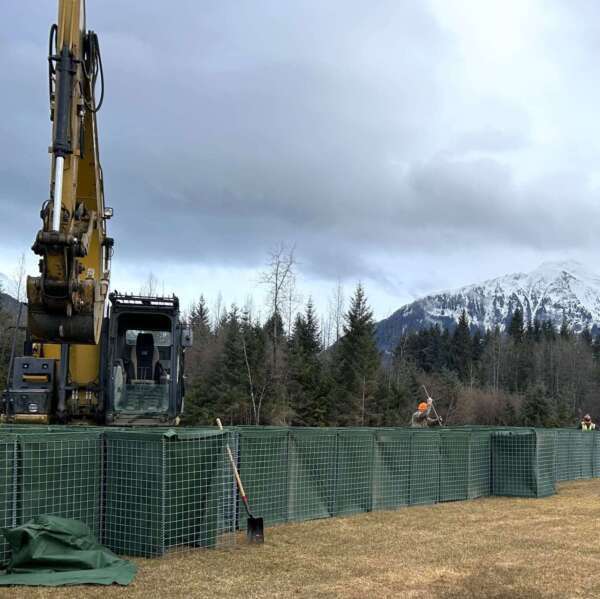
Photo provided by CBJ following the installation of the HESCO barrier project
Photo provided by CBJ following the installation of the HESCO barrier project
Representatives from the U.S. Army Corps of Engineers (USACE) Alaska District and the City and Borough of Juneau (CBJ) will host a public information session on Wednesday, July 30, to share updates on a technical study focused on long-term flood mitigation in the Mendenhall Valley.
The session will take place from 6 to 8 p.m. at Thunder Mountain Middle School in Juneau. The event is open to the public and intended for anyone interested in learning more about ongoing efforts to address the risk of glacial lake outburst flooding from the Mendenhall Glacier.
The evening will include a brief presentation by USACE’s Civil Works Branch, which is leading the technical study, followed by a public question-and-answer session. The Corps’ Emergency Management Program will not be in attendance.
Representatives from CBJ, Tlingit & Haida, the National Weather Service, the American Red Cross, and the University of Alaska Southeast will also be on hand to provide technical information and resources related to flood preparedness.
The $4.75 million study is fully funded by the federal government and aims to evaluate long-term options for reducing flood risks in the Mendenhall Valley.
The Mendenhall Valley is one of the city’s most densely populated residential areas, current water levels as of July 21 are sitting at 1,290 feet. That’s 81 feet below the basin’s overflow point, which experts expect to reach by mid-August if the current pace continues.
Water levels tend to rise more quickly during warm weather and rain events, and the USGS warns that large iceberg movement may cause data spikes.
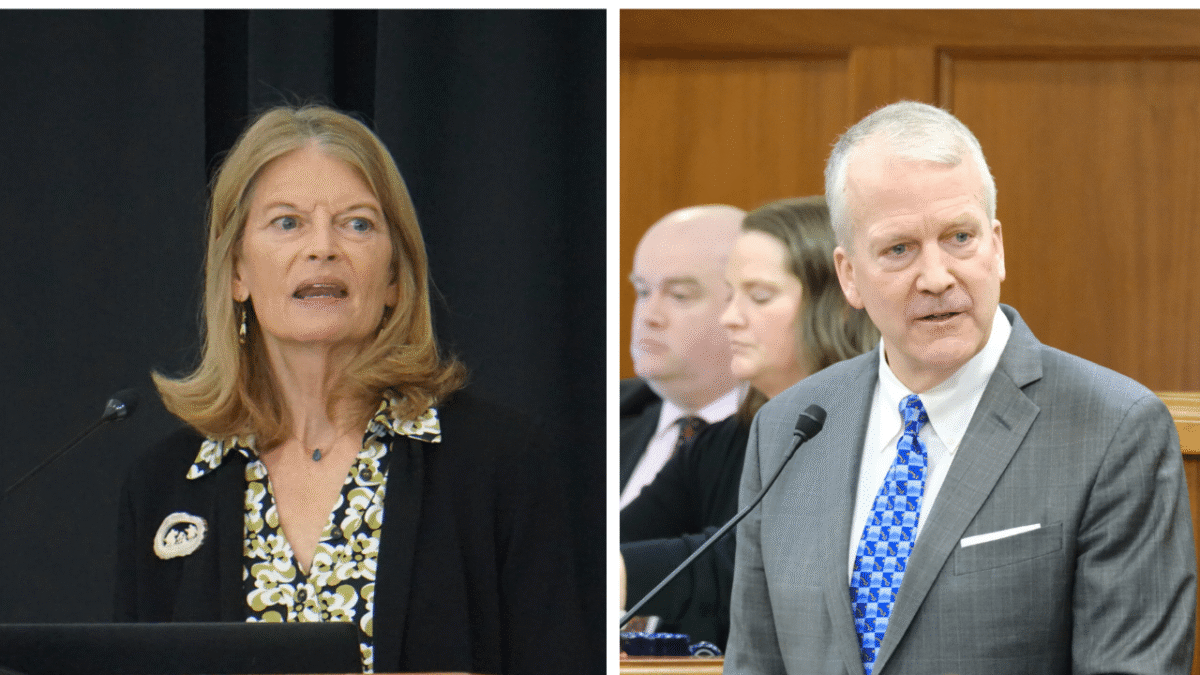
Alaska Republican U.S. Sens. Lisa Murkowski and Dan Sullivan (Alaska Beacon file photos)
Alaska’s two U.S. senators voted differently on a bill requested by President Donald Trump to block federal funding for foreign aid and public broadcasting.
The cuts include $1.1 billion for public broadcasting over two years, with more than $20 million in funding for Alaska’s 27 public radio and television stations. The measure is known as a rescission package, because it claws back funding that Congress had already approved earlier this year.
The overall bill includes $9 billion in cuts, with most in foreign aid.
The bill passed 51 to 48, with Alaska’s Republican senators voted differently: U.S. Sen. Dan Sullivan voted for the rescission, and U.S. Sen. Lisa Murkowski voted against.
Sullivan spokesperson Amanda Coyne sent a statement by email on Thursday repeating the senator’s position that he had warned public media, NPR and the Corporation for Public Broadcasting for years about their “biased reporting” that “would eventually jeopardize federal support for both national and local radio stations,” she said.
However, Coyne added, Sullivan has advocated for rural stations and has been working with other senators and White House officials on alternative sources of funding to keep rural stations on the air, particularly Native stations in Alaska.
“Currently, there is approximately $10 million available for tribal and Native stations in the country. Alaska has 11 Native stations. Going forward, Senator Sullivan will continue working to provide resources to support as many Alaska rural radio stations as possible. He was discussing this funding issue with a senior administration official this morning,” Coyne said.
Coyne did not respond to questions on how much would be available for Alaska stations, when, or what stations would be eligible.
Murkowski was outspoken and critical of the rescission bill, voting no.
In a statement on Thursday, she first cited a lack of clarity by the Trump administration for what programs and amounts would be rescinded, especially for global health programs. “We still lack necessary details, including which ones will be zeroed out. There is no way to determine the implications for lifesaving care and vital resources for women and children abroad,” she said.
“I also strongly oppose the rescission of funding for the Corporation for Public Broadcasting. My colleagues are targeting NPR but will wind up hurting – and, over time, closing down – local radio stations that provide essential news, alerts, and educational programming in Alaska and across the country,” she said.
Murkowski introduced an amendment on the Senate floor late Wednesday night to protect CPB funding, and it was voted down 51 to 47.
Murkowski told reporters on Thursday afternoon in an audio recording shared with the Alaska Beacon, when asked about the fate of rural stations in Alaska, that her office was also looking into funding for stations from federal tribal grants.
“Some of them, about a dozen, will be able to access these tribal grants,” she told the reporters.
“But that’s less than half of the Alaska stations. So what happens to KUCB going forward?” she said, referring to the public radio station in Unalaska that broadcast a tsunami warning and emergency evacuation order for remote Aleutian Island communities following a magnitude 7.3 earthquake the day before.
“So what we’re trying to do is kind of identify how perilously close are many of these small stations to being in a shut down mode. How much do they have to carry them forward?” she said.
In her statement, Murkowski emphasized her opposition to the rescission process, driven by the White House Office of Management and Budget, as undermining Congress’ authority.
“Finally, and most importantly, approving this package in this manner further shifts the balance of power over the federal budget to the executive branch. Congress, not OMB, holds the power of the purse under the Constitution. To the extent that certain appropriations are not necessary to comply with the laws passed by Congress, we can best address that through the annual budgeting process, where we routinely rescind funds every year.”
The rescission bill now advances back to the U.S. House, which passed an earlier version of the measure. As of Thursday evening it had not been taken up for a vote.
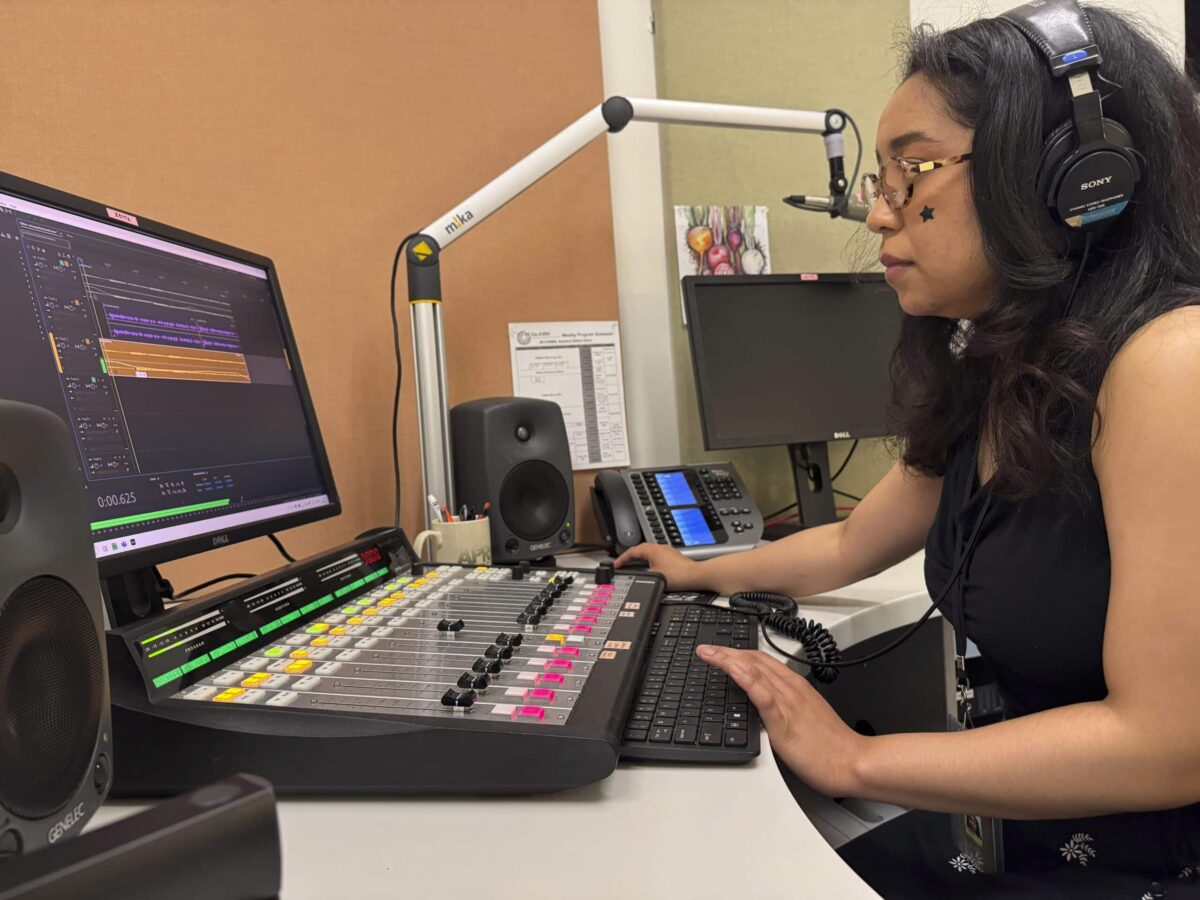
Elayna Cunningham, a college student interning at Koahnic Broadcast Corp., records a program on July 10, 2025, at the Anchorage, Alaska, studios of KNBA, the flagship station for National Native News. (AP Photo/Mark Thiessen)
Elayna Cunningham, a college student interning at Koahnic Broadcast Corp., records a program on July 10, 2025, at the Anchorage, Alaska, studios of KNBA, the flagship station for National Native News. (AP Photo/Mark Thiessen)
AP- Lauren Adams, general manager for KUCB public radio in Unalaska, Alaska, didn’t have much time to reflect on Congress, 4,000 miles away, stripping federal funding for public media this week. She’s been too busy working.
Sirens blared in the Aleutian Islands community Wednesday warning of a potential tsunami, with a voice over public loudspeakers urging the community’s 4,100 residents to seek higher ground immediately and tune into the radio — to Adams’ station.
At the same time in Washington, the Senate was voting on a measure that would eliminate nearly $1.1 billion that had already been appropriated for NPR and PBS — a process that didn’t end until early Thursday morning. The House is expected to complete the process in time for President Donald Trump to sign it before a Friday deadline.
Trump had called for the cuts, saying public media’s news programming was biased against him and fellow Republicans, and threatened GOP members of Congress with primary challenges if they didn’t fall in line.
Adams, her news director, a reporter and an intern kept broadcasting and updating KUCB’s social media feed until the danger passed. Then she made time for one more task — texting U.S. Sen. Lisa Murkowski and urging her to vote against the bill. Murkowski was one of two Republican senators, along with Susan Collins of Maine, to publicly dissent.
“I thought that it was such a telling story of why her constituents have a different relationship to public radio than maybe some other regions of the United States,” Adams said.
Hard decisions ahead for stations across the country
The federal money is appropriated to the Corporation for Public Broadcasting, which distributes it to NPR and PBS. Roughly 70% of the money goes directly to the 330 PBS and 246 NPR stations across the country, although that’s only a shorthand way to describe its potential impact.
The cuts are expected to weigh most heavily on smaller public media outlets away from big cities, and it’s likely some won’t survive. Katherine Maher, NPR’s president and CEO, estimated as many as 80 NPR stations may face closure in the next year. Some stations are already fielding offers from commercial entities to buy their broadcast licenses, she said.
“Many of our stations which provide access to free unique local programming and emergency alerts will now be forced to make hard decisions in the weeks and months ahead,” said Paula Kerger, PBS president and CEO. “There is nothing more American than PBS. Despite today’s setback, we are determined to keep fighting to preserve the essential services we provide to the American public.”
The measure will cost PBS and NPR stations in Mississippi roughly $2 million, about 15% of the budget, said Royal Aills, executive director of Mississippi Public Broadcasting.
Already, Mississippi Public Broadcasting has decided to eliminate a streaming channel that airs children’s programming like “Caillou” and “Daniel Tiger’s Neighborhood” to the state’s youngsters 24 hours a day, said Taiwo Gaynor, the system’s chief content officer.
“This is important for families, to have access to content that they don’t have to pay for,” Gaynor said. “That is a sad thought, to think that we … might not be able to provide that for a generation of children.”
Maine’s public media system is looking at a hit of $2.5 million, or about 12% of its budget, for the next fiscal year, said Rick Schneider, president and chief executive officer of Maine Public. He said he’s not ready to identify specific cuts, but the system is preparing to reinvent itself to make certain it continues serving the state’s residents.
Maine’s rural residents rely heavily on public media for weather updates and disaster alerts, said Molly Curren Rowles, executive director of ACLU of Maine. Rowles said public media was a “lifeline” to her growing up off the grid.
Bracing for trouble at stations that take pride in music discovery
NPR’s Maher fears what the cuts might mean for the system’s journalism, not just in rural areas where local news can be hard to come by, but in telling the rest of the country what is going on there. Less funding will also mean less support for popular television and radio programming, although it’s too soon to tell which programs will be affected.
NPR stations also use millions of dollars in federal money to pay music licensing fees. Now many will have to renegotiate these deals, which could mean less music, or a more limited variety of music, on outlets where music discovery is a big part of their identity. For example, Maher estimates that some 96% of all classical music broadcast in the United States is on NPR stations. “That is essentially taking an entire art form out of public access,” she said.
The affair transcends violins and piccolos. NPR received support Thursday from the heavy metal band Gwar, whose lead singer Blothar the Berserker posted a call on social media for fans to pay attention to what is going on with public media.
Already, public media is seeing an increase in donations from reader and viewers to support its mission, and stations are actively sounding the alarm. In a plea to listeners on its website Thursday, Philadelphia’s WXPN radio pointed to its legacy in helping people discover new music. “The most important thing you can do is support WXPN and the public media system in a way that is meaningful to you,” the station urged on its website.
But donations aren’t going to fill the hole left by the loss in federal funding, Maher said. The public media leaders have already turned to lobbying Congress to restore some of the funding through the appropriations process for next year’s budget. They don’t know how much time they have; Maher said it would be inordinately costly, and perhaps prohibitive, to reopen a radio station that is forced to close.
Public media isn’t getting any help from states, either. At least five states have reduced their own outlays for public media this year, either for budget or political reasons.
Gov. Ron DeSantis, for example, vetoed nearly $6 million that Florida lawmakers had set aside for public broadcasters the day before the state’s budget took effect on July 1. “Done in Florida,” DeSantis responded on social media to a Trump post calling public broadcasting a “monstrosity” that should be defunded.
Meanwhile, back in Alaska …
Back in Alaska, KMXT public radio station’s general manager, Jared Griffin, called the Senate vote a “devastating gut punch.” He estimated that the cuts would amount to 22% of KMXT’s budget. Griffin said the station’s board has already agreed on a plan to furlough staff members one day a month, and he’s taking a 50% pay cut.
The station covers Kodiak Island, home to one of the nation’s largest U.S. Coast Guard bases.
“We have to dip into our savings while we figure out what KMXT is going to look like over the next six months, Griffin said. ”At least for the next year we’ll be fine but we’re probably going to have to look at leasing space in our building to other organizations to help fill that gap.”
Unalaska resident Nikki Whittern said KUCB plays a vital role in the community during emergencies like the tsunami warning.
“They broadcast everything, and they make sure that everybody knows and everybody’s safe,” said Whittern, a bartender. She spoke while preparing to open the Norwegian Rat Saloon — known to local fishermen simply as “the Rat” — on Thursday morning.
Sen. Lisa Murkowski, R-Alaska, center, a member of the Senate Appropriations Committee, arrives for a closed-door Republican meeting to advance President Donald Trump's sweeping domestic policy bill, at the Capitol in Washington, Friday, June 27, 2025. (AP Photo/J. Scott Applewhite)
Sen. Lisa Murkowski, R-Alaska, center, a member of the Senate Appropriations Committee, arrives for a closed-door Republican meeting to advance President Donald Trump’s sweeping domestic policy bill, at the Capitol in Washington, Friday, June 27, 2025. (AP Photo/J. Scott Applewhite)
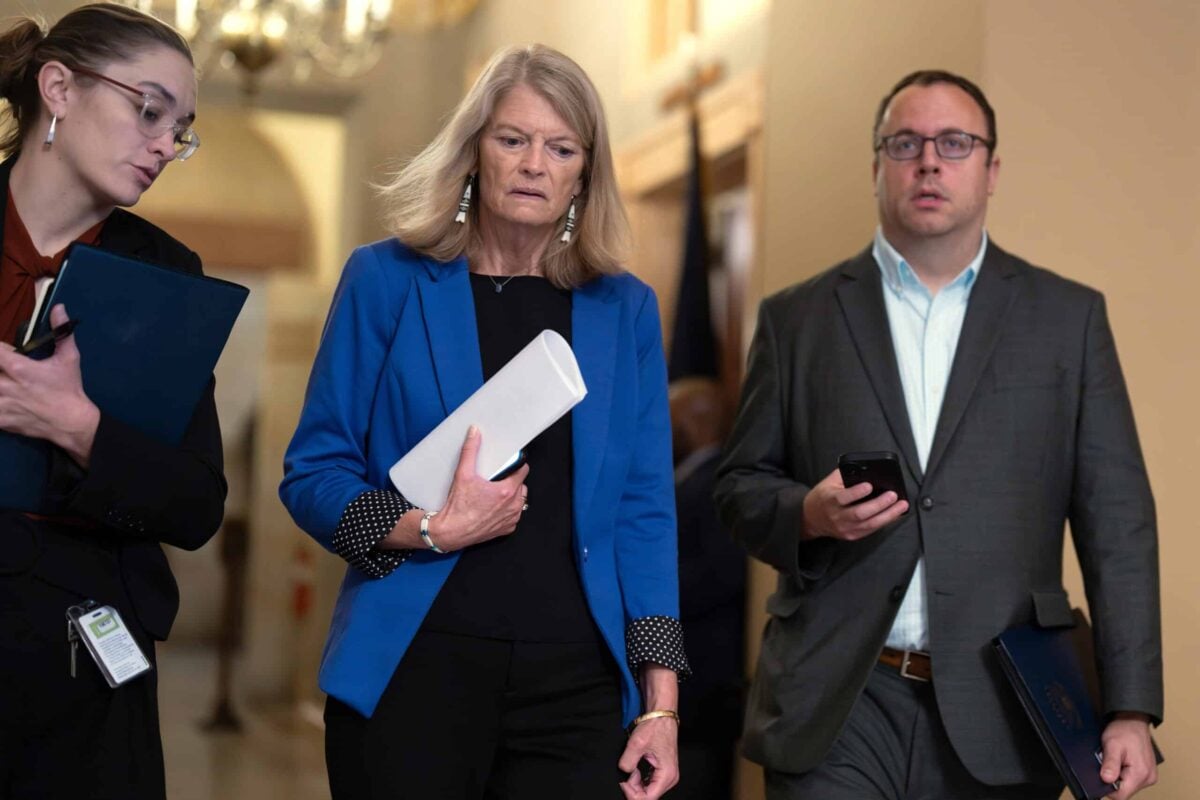
U.S. Sen. Lisa Murkowski, R-Alaska, has joined a group of Republican senators urging the Office of Management and Budget (OMB) to release federal education funds already approved by Congress for the 2025 fiscal year.
In a letter sent to OMB Director Russell Vought, the senators asked the agency to fully implement the Fiscal Year 2025 Full-Year Continuing Resolution Act, which includes funding for several education programs supporting students, educators and adult learners.
“The decision to withhold this funding is directly contrary to President Trump’s goal of returning K-12 education to the states,” the senators wrote. “This funding goes directly to states and local school districts, where local leaders decide how this funding is spent, because as we know, local communities know how to best serve students and families. Withholding this funding denies states and communities the opportunity to pursue localized initiatives to support students and their families.”
The funding in question includes grants for Supporting Effective Instruction, 21st Century Community Learning Centers, Student Support and Academic Enrichment, English Language Acquisition, Migrant Education, and Adult Basic and Literacy Education, including integrated civics and language programs.
Murkowski and her colleagues argue the funds are essential for local school districts and adult education providers, especially those that support English learners, workforce training, and after-school care. They also emphasized the bipartisan nature of these programs, writing, ” We share your concern about taxpayer money going to fund radical left-wing programs. However, we do not believe that is happening with these funds. These funds go to support programs that enjoy longstanding, bipartisan support like after-school and summer programs that provide learning and enrichment opportunities for school aged children which also enables their parents to work and contribute to local economies.”
The letter was also signed by Senators Shelley Moore Capito (R-WV), Susan Collins (R-ME), John Boozman (R-AR), Katie Boyd Britt (R-AL), Deb Fischer (R-NE), John Hoeven (R-ND), Jim Justice (R-WV), Mitch McConnell (R-KY), and M. Michael Rounds (R-SD).
The senators said they welcome further collaboration with OMB and Education Secretary Linda McMahon, writing, ” We want to see students in our states and across the country thrive, whether they are adult learners, students who speak English as a second language, or students who need after-school care so that their parents can work. We believe you share the same goal.” They urged Vought to reverse the decision and release the congressionally approved funding without further delay.
A full copy of the letter is available on Sen. Murkowski’s official website, or on her Facebook page.
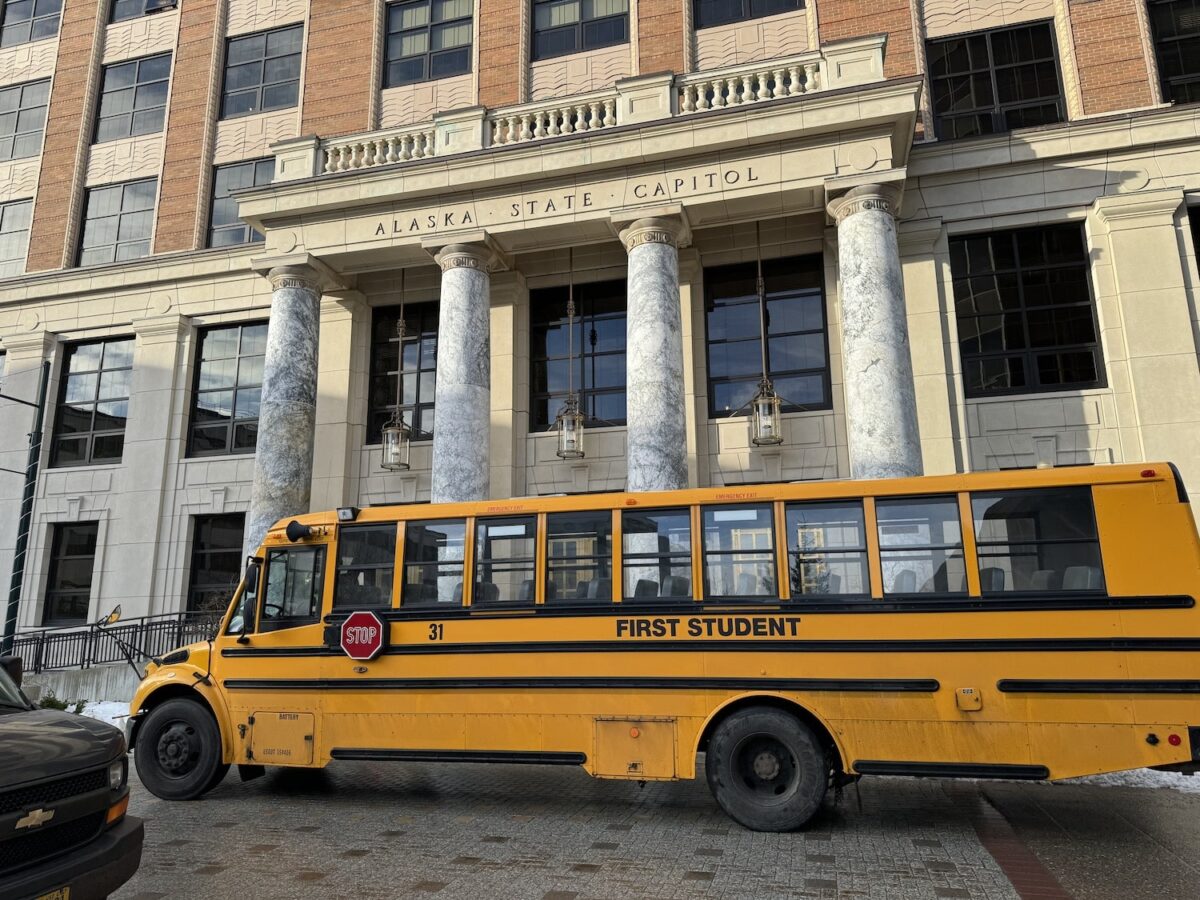
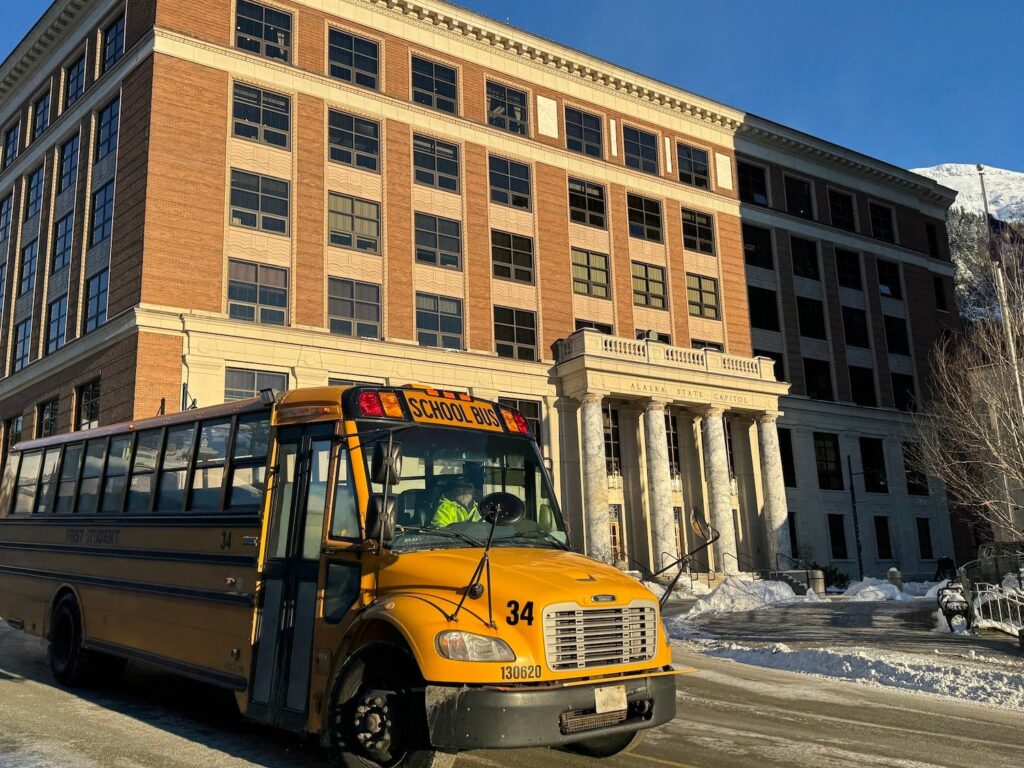
A school bus passes in front of the Alaska Capitol on Tuesday, Feb. 6, 2024. (Photo by James Brooks/Alaska Beacon)
A school bus passes in front of the Alaska Capitol on Tuesday, Feb. 6, 2024. (Photo by James Brooks/Alaska Beacon)
By: Shauneen Miranda, States Newsroom
Republican members of the U.S. Senate called on Office of Management and Budget Director Russ Vought in a letter Wednesday to release the $6.8 billion in funds for K-12 schools that the Trump administration is withholding.
The letter marked a major friction point between President Donald Trump and influential lawmakers in his own party as his administration tests the limits of the executive branch’s authority in clawing back federal dollars Congress has already appropriated. Every state has millions in school funding held up as a result of the freeze.
Wednesday’s letter came after the Supreme Court temporarily cleared the way earlier this week for the administration to carry out mass layoffs and a plan to dramatically downsize the Department of Education that Trump ordered earlier this year.
Just a day ahead of the July 1 date when these funds are typically disbursed as educators plan for the coming school year, the Education Department informed states that it would be withholding funding for several programs, including before- and after-school programs, migrant education and English-language learning, among other initiatives.
“Withholding these funds will harm students, families, and local economies,” wrote the 10 GOP senators, many of them members of committees that make decisions on spending. Sen. Shelley Moore Capito, a West Virginia Republican and chair of the Senate Appropriations Subcommittee on Labor, Health and Human Services, Education, and Related Agencies, led the letter.
Sen. Susan Collins of Maine, chair of the broader Senate Appropriations Committee, also signed onto the letter, along with: Sens. Katie Britt of Alabama, Lisa Murkowski of Alaska, John Boozman of Arkansas, Mitch McConnell of Kentucky, Deb Fischer of Nebraska, John Hoeven of North Dakota, Mike Rounds of South Dakota and Jim Justice of West Virginia.
“The decision to withhold this funding is contrary to President Trump’s goal of returning K-12 education to the states,” the senators wrote. “This funding goes directly to states and local school districts, where local leaders decide how this funding is spent, because as we know, local communities know how to best serve students and families.”
States Newsroom has asked the Office of Management and Budget for comment on the letter.
Meanwhile, a slew of congressional Democrats and one independent — 32 senators and 150 House Democrats — urged Vought and Education Secretary Linda McMahon in two letters sent last week to immediately release the funds they say are being withheld “illegally.”
Democratic attorneys general and governors also pushed back on these withheld funds when a coalition of 24 states and the District of Columbia sued the administration earlier this week.
Elayna Cunningham, a college student interning at Koahnic Broadcast Corp., records a program on July 10, 2025, at the Anchorage, Alaska, studios of KNBA, the flagship station for National Native News. (AP Photo/Mark Thiessen)
Elayna Cunningham, a college student interning at Koahnic Broadcast Corp., records a program on July 10, 2025, at the Anchorage, Alaska, studios of KNBA, the flagship station for National Native News. (AP Photo/Mark Thiessen)
AP- Dozens of Native American radio stations across the country vital to tribal communities will be at risk of going off the air if Congress cuts more than $1 billion from the Corporation for Public Broadcasting, according to industry leaders.
The U.S. Senate is set to vote this week on whether to approve the Department of Government Efficiency’s plan to rescind previously approved public broadcasting funding for 2026 and 2027. Fear is growing that most of the 59 tribal radio stations that receive the funding will go dark, depriving isolated populations of news, local events and critical weather alerts. The House already approved the cuts last month.
“For Indian Country in general, 80% of the communities are rural, and their only access to national news, native story sharing, community news, whatever it is, is through PBS stations or public radio,” said Francene Blythe-Lewis, CEO of the Lincoln, Nebraska-based Native American video programming producer Vision Maker Media. “If the claw back happens, I would say a good 90% of those stations will cease to exist.”
Native American communities rely on local radio stations
Local radio plays an outsized role in the lives of many who live in Indigenous communities, where cable television and broadband internet access are spotty, at best, and nonexistent for many. That leaves over-the-air TV stations — usually a PBS station — and more often local radio to provide local news, community event details and music by Indigenous artists. Sometimes the news is delivered in Indigenous languages.
“It means we’re not going to hear our language on the radio,” Blythe-Lewis said.
Flagstaff, Arizona-based Native Public Media, which supports the network of 59 radio stations and three television stations serving tribal nations across the country, said about three dozen of those radio stations that rely heavily on Corporation for Public Broadcasting funding will be the first to go dark if funding is cut for the coming fiscal year that starts Oct. 1.
Loris Taylor, CEO of Native Public Media, said in an op-ed that the tribal stations reach more than 1.5 million people and “may be the only source of locally relevant news, emergency alerts, public safety announcements, language preservation, health information and election coverage.”
Republicans face pressure to pass the cuts
GOP senators are under pressure from President Donald Trump, who promised last week on his Truth Social platform that any Republican who votes against the cuts “will not have my support or Endorsement.”
Many Republicans say the public media system is politically biased and an unnecessary expense. Sen. Eric Schmitt, a Republican from Missouri, recently defended the cuts as necessary to hack away at the nearly $37 trillion national debt, adding, “It is critical in restoring trust in government.”
But some Republicans have pushed back, such as Maine Sen. Susan Collins, who questioned the proposed cuts last month during a Senate committee hearing. She said that while some of the federal money is assigned to National Public Radio and the Public Broadcasting System, most of it goes to locally owned public radio and television stations.
Tribal stations provide lifesaving alerts
Jaclyn Sallee is president and CEO of Koahnic Broadcast Corporation and KNBA, its radio station in Anchorage, Alaska. Koahnic produces National Native News, a five-minute daily newscast that features headline news from across Indian Country, and Native America Calling, a daily hourlong call-in program, for about 190 stations across the nation. It also produces Indigefi, a music program in Indigenous languages.
KNBA is on Native Public Media’s list of those stations that would be most affected by the federal funding cuts — a concern Sallee confirmed, as 40% of the station’s funding comes from CPB.
“What we’re really worried about are the rural stations in Alaska where they may be the only station in the community,” she said. “The people that live there depend on the station for vital weather alerts, emergency alerts; it’s the local hub of the community where people share information. So that is very troublesome because people’s lives are at risk without this service.”
It’s currently fishing season in Alaska, she said, “which means getting out in the ocean or in rivers and going long distances to subsist, and so they really rely on weather reports.”
Having the news reported in a tribe’s language isn’t just about preserving that language, she said. Sallee spent summers in Nome with her mother’s family. Her grandmother, she said, spoke only Inupiaq.
Loss of small stations could hurt the larger system
New Mexico PBS’s signal reaches all but one of the more than 20 tribes and pueblos in the state. It also has signed an agreement with the Navajo Nation, which has the largest reservation of any tribe in the U.S., that allows the tribe to carry the PBS signal and programming on the Navajo Nation Television network, New Mexico PBS general manger Franz Joachim said.
“It’s no question in my mind that, you know, immediately some stations will pretty much go dark,” Joachim said.
When those first stations fail, it won’t take long for others to follow, Joachim said. And as they do, it will mean fewer and fewer stations left to pay membership dues that also help fund all of the stations.
“So now the whole system starts to fracture,” he said. “So for me, the federal funding is really about the system as a whole that keeps us in place.”
That funding also helps produce national content that groups like Vision Maker Media produce. Those include Native American documentaries shown on PBS like “Mankiller,” the story of Wilma Mankiller who became the first woman elected principal chief of the Cherokee Nation.
Blythe-Lewis compared the potential loss of tribal stations to the country’s past attempts to erase Native American cultures, such as through federal boarding schools where Indigenous children were sent for generations to assimilate them into white society and where systemic abuse of Indigenous children was carried out.
“We’re erased from public media and therefore invisible and therefore become unknown and unheard of,” she said.
A school bus drives in front of the Alaska State Capitol on Monday, Feb. 3, 2025. (Photo by James Brooks/Alaska Beacon)
A school bus drives in front of the Alaska State Capitol on Monday, Feb. 3, 2025. (Photo by James Brooks/Alaska Beacon)
Governor Mike Dunleavy has called a special legislative session beginning Saturday, August 2, in Juneau.
The session will focus on two issues, education reform and the creation of a new Alaska Department of Agriculture.
The Governor’s recent budget vetoes have been raising concerns, the Governor cut over $122 million from the state budget, including $50 million from per student funding and major school maintenance projects. Juneau Senator Jesse Kiehl spoke with News of the North about the Base Student Allocation and had this to say, “when we look at the budget issues and the Governor’s special session coming up, what that really has to do with is, are we going to fund the BSA that we passed? it took an override to get that $700 per kid increase, and of course, the Governor vetoed that down, actually below a level that he proposed at one point during the session.”
Senator Kiehl is also a part of an education task force created by House Bill 57 which will look at a wide range of financial challenges and school policies, It’s charged with making recommendations before the 35th Alaska State Legislature convenes in January 2027.
When asked if the governor’s vetoes would affect the Education Task Force, Senator Kiehl said “I think those are going to be pretty separate issues. The task force has a lot of work ahead of us, to look both at the adequacy of how much we’re putting into schools and whether we’re doing it as well as we can be- Are there better ways to fund? are there more fair ways to fund? And then some other education policy issues.”
The group will dig into rising costs in transportation, energy, insurance, and school maintenance, along with accountability and student outcomes. The task force will present recommendations in a report on the first day of the January 2027 session.
For the second consecutive year, student reading scores in Alaska have risen, a trend state officials attribute to the success of the Alaska Reads Act.
According to new data from the Department of Education and Early Development, the percentage of students reading at or above average increased from 41% at the beginning of the 2023–2024 school year to 57% by year’s end.
In the 2024–2025 school year, that percentage rose again, starting at 44% and climbing to 60% by the end of the year, an increase which outpaces the national average for growth.
“This is promising evidence for our Alaskan students and their teachers as all the hard work and focus they have put in is coming to fruition,” said Education Commissioner Deena Bishop. “This achievement shows that the Alaska Reads Act was the right policy direction for our state, and more importantly, for our youngest learners. Congratulations!”
The Alaska Reads Act was signed into law in 2022 by Governor Mike Dunleavy with the goal of ensuring all students can read at grade level by the end of third grade. The legislation focuses on evidence-based instruction, early intervention, and high teaching standards.
“These results show why it’s critical to tie clear goals and strong commitments to education policy,” said Governor Dunleavy. “The Alaska Reads Act proves that coupling funding with real reform works. We made the right decision, and students across Alaska are seeing the benefits.”
However, despite those gains, the governor has made deep cuts to education funding in the newly signed state budget.
Dunleavy vetoed more than $122 million from Alaska’s annual budget, including over $50 million from the state’s per-student education funding formula and tens of millions meant for major school maintenance projects. It marks the first time in state history that a governor has failed to fully fund the education formula.
While the rise in student reading scores is being celebrated, many educators and lawmakers warn that continued progress may be at risk without sustained investment.
The governor will hold a special legislative session on August 2, with one of the topics being education reform.