Alaska pollock, shown here from a harvest, make up the nation’s top-volume single-species commercial seafood catch. Alaska pollock, harvested mostly in the Bering Sea but also in the Gulf of Alaska, are processed into fish sticks, fish burgers, imitation crab meat and other common fish products. (Photo provided by NOAA)
For the organization that oversees commercial fisheries in federal waters off Alaska, the most significant impact of the federal government shutdown might materialize in December.
That is when the North Pacific Fishery Management Council is scheduled to issue harvest limits for Alaska pollock – the nation’s top-volume commercial harvested species – and other types of groundfish harvested in the Bering Sea and Gulf of Alaska, such as Pacific cod and sablefish.
The Bering Sea and Gulf of Alaska pollock harvests start in January.
To set the groundfish harvest levels, the council relies on federal scientists’ analysis of fish stocks in the ocean, work that is based in large part on scientific surveys conducted over the summer.
But during the shutdown, most National Marine Fisheries Service employees, including the scientists who analyze survey data to assess the conditions of commercially targeted fish stocks, are furloughed.
On Wednesday, the last day of the council’s October meeting, the members considered how to deal with scientific uncertainty if the government shutdown prevents completion of the detailed analysis that is usually provided in time for the December meeting.
Council member Nicole Kimball referred to a warning issued eight days prior by Bob Foy, director of the NMFS Alaska Fisheries Science Center, the organization that does the stock assessments. Foy said then that a shutdown lasting more than five days would compromise the ability to complete stock assessments and that a shutdown beyond 15 working days would “dramatically impact” those assessments.
The 15-day threshold is not too far away, Kimball said.
“How does the council and the public understand what to expect in December, in between the October and December meeting, relative to stock assessments?” she asked.
Diana Evans, the council’s deputy director, said impacts are yet to be determined, but the public will be notified of them as soon as possible.
“We don’t think we can answer that until we have a better sense of exactly where we land and how many days of work are remaining between the time that government workers are back and able to resume that work and the meeting,” she said.
Advocates with environmental organizations said they worry about shutdown effects on scientific information needed for harvest decisions, which would add to the effects of mass firings and retirements at NMFS and other agencies.
“I’m terrified at the prospect of flying blind into the next fishing season, especially as the Trump administration has decimated the ranks of scientists who monitor the health of our oceans,” Cooper Freeman, Alaska director of the Center for Biological DIversity, said by email. “I’m especially worried about fisheries like the massive pollock trawl fleet that has been harvesting millions of tons annually at the expense of the larger ecosystem.”
“The first challenge with this shutdown is the instant level of uncertainty it creates. Normal processes face delays that can easily impact or inhibit active fisheries. Potential staff losses will exacerbate that,” Michelle Stratton, executive director of the Alaska Marine Conservation Council, said by email.
“But beyond the concern for continuing day to day services, are those major efforts — like stock assessments and (total allowable catch) setting — that rely on substantial NMFS staff input, data processing and expert analysis. If this continues to the point where we are unable to set catch limits for the start of the 2026 seasons, we’ll be in seriously uncharted territory, and could well see massive economic impacts to our fishing communities and fleets,” she said.
The shutdown forced the council to rearrange its October meeting because federal representatives were unavailable to present information.
One major agenda item was postponed: review of a work plan for assessing essential fish habitat. Other items on the agenda were abbreviated.
The shutdown has already affected fishery management operations to some degree, said council member Jon Kurland. As Alaska regional director for NMFS, Kurland is one of a small group of agency employees remaining at work during the shutdown.
Kurland, in comments last week at the start of the meeting, said some services have been unavailable during the shutdown, such as the processing of harvest quota transfers.
NMFS is still doing basic management of ongoing fisheries, monitoring and closing them as needed, and is supported by contractors, he said. But that level of work has its limits, he said.
“If there are significant unforeseen problems, we will have limited ability to address those. Fingers crossed,” he said then.
“I voted” stickers are seen on display in the headquarters offices of the Alaska Division of Elections in Juneau on Tuesday, Nov. 12, 2024. (Photo by James Brooks/Alaska Beacon)
Election day is around the corner for most of Alaska’s local governments, and many communities are considering whether to raise local sales taxes to pay for the escalating cost of public services, including basic infrastructure like road repairs and landfills.
Alaska’s largest city, Anchorage, holds its elections in the spring, as do Valdez and Cordova, but most of the state’s 150-plus municipal governments will have their elections in the next week.
In the state capital, Juneau, where voting has been underway by mail since late September, voters are considering three ballot measures with major implications for the City and Borough of Juneau budget.
Measure No. 1 would tighten the cap on local property taxes below current rates, effectively cutting city revenue by about $1 million and eliminating the city’s ability to raise rates.
The second measure would exempt food and residential utilities from local sales taxes. That would eliminate between $10 million and $12 million per year from the city budget.
To compensate, there’s also Measure No. 3, which would raise the city’s sales tax from 5% to 7.5% in the summer and lower it to 3% in the winter. If that measure passes, it would roughly balance the lost money if Measure No. 2 passes.
If ballot measure No. 3 doesn’t pass, Juneau city officials expect to significantly cut local services in order to balance the budget.
Juneau is one of several communities deciding whether to pass sales tax hikes this month.
In Skagway, voters are considering a seasonal sales tax increase from 5% to 7% in the summer, with some of the proceeds earmarked for water, wastewater and garbage services in order to lower local rates.
In neighboring Haines, voters are deciding whether to raise the local sales tax from 5.5% to 7% in the summer within the Haines townsite, with a smaller increase in the rest of the borough. The sales tax would fall to 4.5% in the townsite during the winter, 3% in the rest of the borough, and groceries would be exempted.
In Ketchikan, borough residents are being asked whether they want to extend part of the local sales tax through 2032. The borough has a 2.5% sales tax, but half of a percent is dedicated to construction and renovation projects at local schools. That’s what voters will consider renewing.
Slightly north, in Petersburg, voters will decide whether to reduce a senior citizen sales tax exemption so it applies only to low-income residents.
Ketchikan city voters consider seven ballot measures
While voters in the Ketchikan borough contemplate a sales tax measure, voters within the city of Ketchikan itself will also have seven other ballot propositions to consider.
First is a $15 million bond to pay for sewer mains and upgrades to the city’s water treatment facility. Those upgrades are being mandated by the state and federal governments.
Voters in the First City also will decide six different amendments to the city charter. Proposition No. 2 would eliminate a 30-day waiting period for city ordinances to take effect. No. 3 would allow the city manager to live outside city limits, but only on the road system of Revillagigedo Island, where the city is located.
Proposition No. 4 would remove the requirement that voters approve the sale of any city property worth more than $30,000. Instead, the city council would have the authority to approve those sales.
The fifth proposition would allow the city to award large contracts to someone other than the lowest bidder, and the sixth would allow the city to approve sales or contracts with city employees and elected officials as long as there are at least three cost quotes and the chosen contract is “the most advantageous to the city.”
The last proposition, the seventh, would allow the city’s annual fiscal audit to take more than four months.
In addition to those ballot measures, three candidates are running for two seats on the Ketchikan City Council. There’s also a two-way race for borough mayor, two contested borough assembly races and two contested school board races.
Voters in Sitka will consider two ballot measures. The first would allow the city to use proceeds from the local tobacco tax and the sale of the local hospital for parks and recreation.
The second, if adopted, would require all ballot measures to include a comprehensive economic impact study report before reaching the signature-gathering phase.
Six people are running for two seats on the Borough Assembly in Sitka, and there are three candidates for two seats on the local school board.
In Petersburg, two candidates are running for mayor and five candidates are running for two seats on the borough assembly. There is one candidate and two open seats for the school board.
In Skagway, the one candidate for mayor is running uncontested, after the previous mayor resigned earlier this year. There are four candidates for two assembly seats, and one candidate for two open school board seats. In Haines, there are four candidates for two assembly seats, and two candidates for two school board seats.
North Slope voters contemplate big borrowing plan
In the North Slope Borough, two of four assembly races are contested, and only one of four school board races is contested. Borough voters also will consider eight different bond proposals. That’s more ballot propositions than any other municipal election taking place this month in Alaska.
The borough is proposing to borrow a combined $204 million for public facilities, including light, power, water, sewage, public safety, education and flood control.
At Utqiagvik, the borough’s largest town and the northernmost town in the United States, voters will choose between two candidates for mayor. There’s also two city council races, only one of which is contested.
Voters also are being asked to choose whether or not to extend Utqiagvik’s 20% wholesale tobacco tax to cover “alternative nicotine products and equipment,” such as vape and e-cigarette products.
Within the Northwest Arctic Borough, there are four borough assembly seats on this year’s ballot. Only one race is contested, and one seat — covering Ambler, Kobuk and Shungnak — has no candidates at all.
Similarly, among three races for school board, none are contested and one of the three seats has no candidates.
In the Kotzebue city election, two seats on the city council are on the ballot, and each race has two candidates. Another seat was vacated by the resignation of Ruth Moto in September, and someone will be appointed to fill that seat after the election, with the replacement being up for election in October 2026.
The Nome Nugget noted “meager interest to run for public office” in Nome this year, with two city council seats and two school board seats unopposed, but voters there will also be asked whether to raise the city’s sales tax from 5% to 6%.
This week, the Nugget reported that if the tax increase doesn’t pass, city officials will cut services.
In the Matanuska-Susitna Borough, Houston considers sales tax hike
The Matanuska-Susitna Borough holds its elections in November (as does Metlakatla in Southeast), but the cities within the Mat-Su borough vote in October.
Wasilla has no ballot measures; its city election includes three city council races, only one of which is contested.
In Palmer, five people are competing to become the city mayor, the most competitive single municipal race this fall. Three people are competing for two three-year seats on the city council. There also is a one-year seat on the council, and two people are vying for it.
Palmer voters are also being asked if they want to change the city charter so the city manager is no longer required to live within the city. The change would allow the manager to live within five miles of city limits.
Within Houston, six people are running for three spots on the city council. Houston also has four ballot measures. One asks whether voters support a city-owned airport. A second asks voters to approve a 2% sales tax increase (from 2% to 4%) in order to pay for road repairs. The third and fourth measures ask voters to approve the “Matanuska Thunder Festival” and “Founder’s Day” as city holidays.
Many ballot measures in the Kenai Peninsula Borough
Proposition No. 2 would create a special taxing district in Ninilchik to fund a new local swimming pool there. No. 3, if approved, would increase the property tax exemption in the borough so the first $75,000 of a homeowner’s residence would be exempted from local property taxes. The current exemption applies to the first $50,000.
The fourth proposition would raise the borough’s sales tax cap every five years. Currently, sales taxes only apply to the first $500 of a purchase.
Proposition No. 5 would shift borough elections to November, aligning them with state and federal elections, much as the Mat-Su borough has done.
Five seats on the Kenai borough assembly are up for election, and three of the races are contested. Three school board seats are on the ballot as well, with two races contested.
Among city elections on the Kenai Peninsula, only Soldotna has a ballot measure. That proposition asks voters to approve or reject the annexation of 2.63 square miles of nearby land into the city limits.
In the Interior, none of Fairbanks’ three local governments have ballot measures this year, but this year’s ballot will decide three seats on the borough assembly and two on the borough school board. There’s a two-person race to become Mayor of Fairbanks, and two seats on the city council are up for election.
Southeast of Fairbanks, in North Pole, four seats on the city council are up for election. There are only four candidates, but the order of the candidates will determine who gets a three-year term, a two-year term or a one-year term.
Kodiak will pick a new mayor
In Kodiak, voters will pick between two candidates for borough mayor, five candidates for two seats on the borough assembly, and they will vote on a variety of service area boards.
Within city limits on Kodiak, four people are running to replace longtime Mayor Pat Branson, and four candidates are running for two seats on the city council.
In southwest Alaska, Bethel has four open city council seats but only three registered candidates and one write-in candidate.
In Unalaska, Mayor Vince Tutiakoff Sr. is running unopposed for re-election, and three people are running for one of the two city council seats on the ballot. The other incumbent for city council is unopposed. On the local school board, three people are running for one of two school board seats; the other seat is held by the incumbent school board president, who is unopposed in his re-election bid.
Within the Aleutians East Borough, which includes Sand Point, King Cove and Cold Bay, two of three borough assembly seats have unopposed races, and the third has two candidates. All three school board seats on the ballot have candidates running unopposed.
Further north in Dillingham, two city council seats have two candidates apiece, and three people are running unopposed for three school board seats.
Within the Bristol Bay Borough, based in Naknek, three people are running for two seats on the borough assembly, and there are five candidates for the two school board seats on the ballot.
In the Lake and Peninsula Borough, two borough assembly members and two school board members are running unopposed. Those elections, like those in Juneau, are conducted by mail, and ballots must be postmarked by Oct. 7 and received by the borough clerk before Nov. 7.
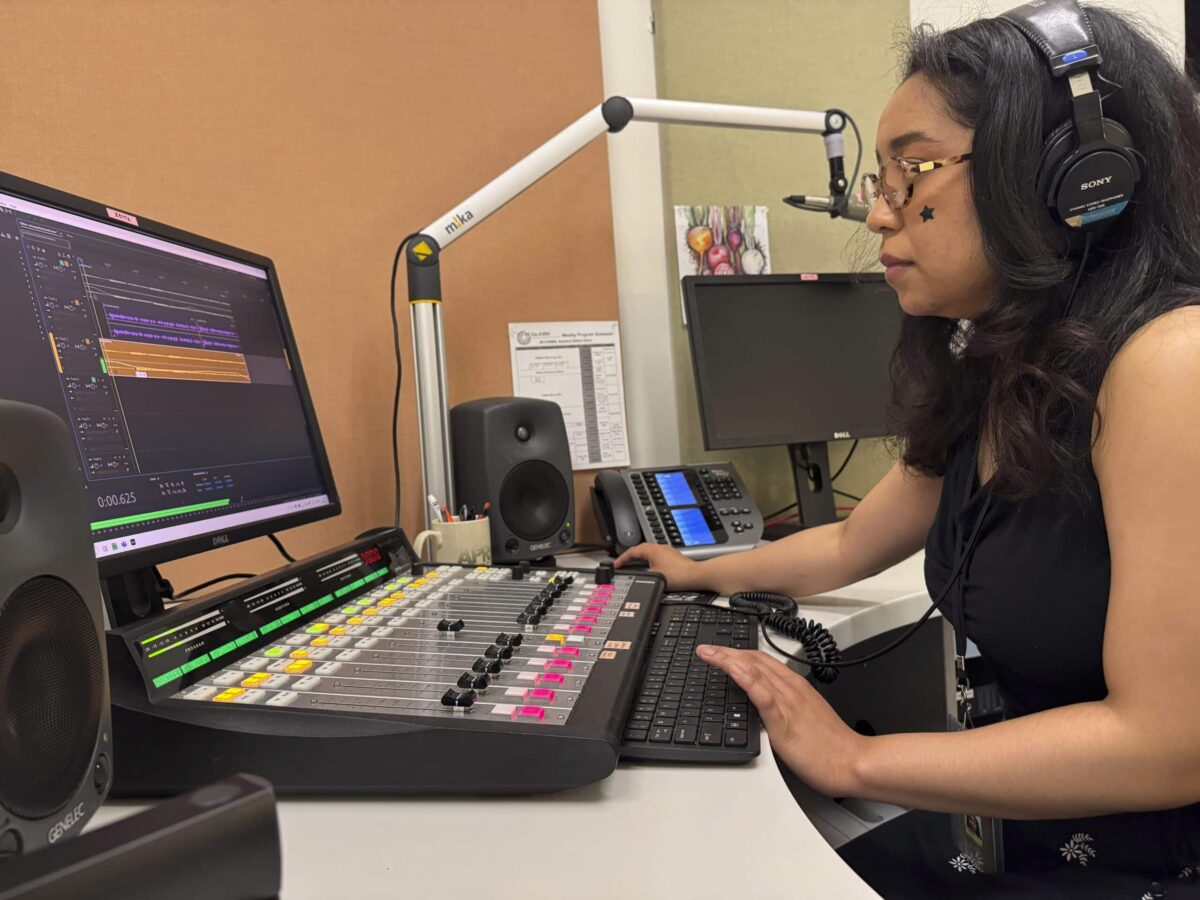
Elayna Cunningham, a college student interning at Koahnic Broadcast Corp., records a program on July 10, 2025, at the Anchorage, Alaska, studios of KNBA, the flagship station for National Native News. (AP Photo/Mark Thiessen)
Elayna Cunningham, a college student interning at Koahnic Broadcast Corp., records a program on July 10, 2025, at the Anchorage, Alaska, studios of KNBA, the flagship station for National Native News. (AP Photo/Mark Thiessen)
NOTN- Months after Congress eliminated federal funding for public broadcasting, 14 Alaska stations have been granted temporary relief.
Eligible stations were then presented with two potential funding options: they could partner with a Tribe, either through a 638 compact or 638 contract, or they could go through a grant process.
Stations will likely be funded through a program that supports tribal stations, but they won’t receive the temporary funding until after the federal government Shutdown.
In a press release, Senator Lisa Murkowski announced the funding, calling it a critical but short-term measure to keep rural stations operating after Congress rescinded $1.1 billion from the Corporation for Public Broadcasting.
“This funding will help some of Alaska’s most rural radio stations make ends meet for now.” Murkowski said, “But it is one-time funding, and the job isn’t done until every station in Alaska has stable, long-term support.”
Stations set to receive funding include KNBA in Anchorage, KBRW in Barrow, KYUK in Bethel, KDLG in Dillingham, KUCB in Unalaska, and others serving communities from the Aleutians to the Arctic.
A sign advertising the cashing of Alaska Permanent Fund Dividend, or PFD, checks hangs outside a business in Anchorage, Alaska, Tuesday, Sept. 23, 2025. (AP Photo/Mark Thiessen)
AP- The truck that arrived ahead of schedule at Allyssa Canoy’s home in Fairbanks brought enough heating fuel for the frigid winter months ahead — and a surprise bill for $2,600.
Canoy and her two sons have checks arriving that will cover that expense and leave some money for the boys, too. Starting Thursday, Alaska plans to begin distributing to residents their annual dividend derived from the state’s $83 billion oil wealth fund, a sort of bonus that Alaskans get for living in the state.
For some, it’s extra spending money for a new set of tires or a vacation to a sunnier clime during the long, dark winter. For others, it’s a vital supplement in a state where the cost for internet service, gas and groceries can be sky-high.
Here’s what to know about the Alaska Permanent Fund dividend:
This year’s payout is one of the lowest in 20 years
Alaskans are getting $1,000 per person — the lowest amount since 2020, when they each received $992. The payout has been below $1,000 only two other times since 2006.
There used to be a formula for calculating the amount, tied to the fund’s market performance. But lawmakers widely consider that formula unaffordable and within the last decade have abandoned it.
Politicians now set the amount. It’s often one of the last items settled during sensitive budget negotiations. Lawmakers must weigh the check’s size against other programs and public needs, including education, and in 2018 began using earnings from the fund — long used to pay dividends — to also help balance the budget.
This year, $1,000 is what lawmakers argued they could afford while also backing an increase in K-12 funding and trying to limit draws from savings.
Had the old formula been followed, residents would be getting about $3,800 each.
The Alaska Permanent Fund is nearly 50 years old
Voters created the fund in 1976, during the heady, early years of oil in the state. The goal was to save some of Alaska’s mineral wealth. The fund has grown through investments, and while the state constitution protects the fund’s principal, its earnings can be spent.
Dividends have been paid since 1982. Proponents saw them as a way to ensure Alaskans maintained a vested interest in the Alaska Permanent Fund.
More than 600,000 of Alaska’s roughly 740,000 residents are set to receive this year’s check. To qualify, one must meet residency and other requirements.
For some Alaskans, the check is a nice extra. Some put it into college funds or savings accounts or donate to charities. Others rely on it for necessities, such as heating oil, winter tires or snowmachines, which are critical modes of transportation in rural villages where residents rely on hunting or trapping.
Canoy, a single mom of two, is selling her home and downsizing. She had planned to fill her home’s fuel tank as a gift to the new buyers at closing, but the fuel truck came early while she was away. So instead of putting the $3,000 her family is receiving toward other projects, as she’d hoped, she’s using it to pay that bill. She plans to let her sons spend the remaining $400.
Canoy said she lives comfortably and sees the dividend as a blessing. Still, she wishes lawmakers would find a better way to set the amounts — “at least to just give Alaskans maybe a little peace of mind that, yeah, we’re actually doing everything that we can to make sure that you guys get the most out of the permanent fund dividend.”
NOTN- When Emma’s son, Cade, was just five months old, she noticed he was falling behind on developmental milestones. Doctors told her he was “just a late bloomer.” But after years of searching for answers, specialists diagnosed Cade with SPG50, an ultra-rare genetic disease that slowly robs children of the ability to control their bodies.
The Juneau community has rallied behind Cade’s cause, A daylong radiothon hosted by KINY on Saturday raised $35,000 to support 4-year-old Cade Jobsis.
The event, ran from 10 a.m. to 5 p.m. and featured prizes such as a helicopter ride from NorthStar Helicopters, an Eaglecrest ski pass, and a yearlong membership to the Rainforest Playzone.
Funds will support Cade, who was diagnosed at just 2 years old with SPG50, a rare form of hereditary spastic paraplegia that causes progressive loss of mobility. Fewer than 100 cases are known worldwide.
His mother, Emma, said her family spent years searching for answers before receiving Cade’s diagnosis. Doctors initially told them there was no treatment.
“There’s only around 100 cases in the world, and because of that, there really isn’t any interest in treating this disease or developing treatments for a disease that’s so rare.” Said Cade’s mom, Emma Jobsis, “So when we left the hospital after hearing his diagnosis, the doctors basically told us, there’s nothing we can do. Take him home, love him, he’s going to fade way in front of your eyes, basically. And we were distraught, as any parent would be.”
Because of the disease’s rarity, pharmaceutical companies and government agencies have shown little interest in funding development. Instead, families like Cade’s are leading grassroots efforts to raise millions for research.
“We decided we just have to do it by any means necessary, we have to raise the money and get this drug through clinical trials, because I can’t live with the fact that the next mom is going to be sitting in the office hearing what I heard when there’s a drug that exists, but you just can’t get access to it because it’s not approved.” Jobsis said.
Emma said the Juneau community’s response has been overwhelming.
“My town has pulled off something incredible that I never expected. This kind of showing up from my community.” Said Jobsis, “People that I’ve never met in my entire life are texting, emailing, calling, telling me they heard my story, they heard about Cade, and they want to help. And it’s just, it’s so surreal to feel like the community backs you in such a huge way.”
Listeners heard interviews with Cade’s family and others around the world affected by SPG50, as well as with the Canadian father who helped create the experimental gene therapy.
“I have found so much good in people through this process, through this fundraising and advocacy, I’ve felt so much compassion and generosity.” Jobsis said, “Leaning on each other, that’s what it means to be in a strong community. And I’m so grateful to be here and to all Juneau and beyond, supporting us in this way.”
Organizers say the true prize was seeing the community come together for Cade’s future. Donations can still be made at cureforcade.com.
Alaska Republican U.S. Sens. Lisa Murkowski and Dan Sullivan (Alaska Beacon file photos)
Alaska Republican U.S. Sens. Lisa Murkowski and Dan Sullivan signed on to a letter with 10 other U.S. senators, calling on the U.S. Department of Education to reverse the decision to cut millions in congressionally approved grant funding for Native American-serving colleges and universities nationwide.
The letter, addressed to U.S. Secretary of Education Linda McMahon, argues that an estimated $36.1 million in grant funding already allocated under the Higher Education Act should be distributed to colleges and universities serving Native students nationwide.
Senators wrote the funds are already authorized and appropriated by Congress and should go toward its intended colleges and universities nationwide, “including dollars that are part of ongoing grants – projects, programs, and services that are already in motion and that are serving currently enrolled students,” they said.
“These institutions are statutorily authorized to receive federal support from the Department to strengthen their capacity to serve American Indian, Alaska Native, and Native Hawaiian students, and rely on this federal support to adequately serve enrolled students,” they said.
“The Department’s decision to reprogram this critical source of funding for these colleges jeopardizes not just their continued existence, but also undermines the federal government’s trust and treaty obligations to provide Native students an education,” they wrote.
Earlier this month, Sec. McMahon announced that $350 million in congressionally approved funding for minority-serving institutions, a federal grant category that includes funding for Black, Hispanic, Asian-American and Native American students, would be reallocated. McMahon cited “racial quotas” as discriminatory and unconstitutional. “To further our commitment to ending discrimination in all forms across federally supported programs, the Department will no longer award Minority-Serving Institution grants that discriminate by restricting eligibility to institutions that meet government-mandated racial quotas,” McMahon said.
The group of three Republican and nine Democratic senators rejected the claims, saying “to be clear, these grants do not impose racial quotas or restrict admissions based on race, but support institutions that deliver on the federal trust responsibility to provide an education for American Indians, Alaska Natives, and Native Hawaiians because of their unique legal status and political relationship with the United States.”
In Alaska, University of Alaska officials say they are still reviewing the extent of the funding freeze, but University of Alaska Fairbanks officials report the grant elimination totals at least $8.8 million across campuses.
Senators argued that the funding cut contradicts the Trump administration’s expressed focus on career and technical education, and said the funds boost capacity for institutions serving not only Native students, but wider student populations.
“As such, we again urge you to reverse the decision,” the senators wrote, “to release these funds, as appropriated by Congress, so that the work these schools do to support the trust responsibility, as well as the next generation of leaders as part of our nation’s bright future, can continue.
The letter was signed by Murkowski, as the chair of the US Senate Committee on Indian Affairs, and committee co-chair U.S. Sen. Brian Shatz, D-Hawaii; along with Sens. Dan Sullivan, R-Alaska; Mazie Hirono, D-Hawaii; Thom Tillis, R-North Carolina; Ben Ray Luján, D-New Mexico; Ruben Gallego, D-Arizona; John Hickenlooper, D-Colorado; Michael Bennett, D-Colorado; Mark Kelly, D-Arizona; Tina Smith, D-Minnesota; and Amy Klobuchar, D-Minnesota.
A spokesperson for Murkowski said as of Wednesday they have not had a response from the department
NOTN- Jim Duncan, a former Alaska House Speaker and longtime labor leader, is looking back on more than four decades in public life in a new memoir he says shows how politics is a lot like making sausage.
Duncan, who served in the Legislature from the 1970s through the 1980s eventually becoming Speaker of the House. Over that time, he sponsored dozens of bills and says he learned that compromise was the only way to get things done.
Duncan also lead Alaska’s largest public employee union and said his book Making Sausage aims to put Alaska’s political issues into perspective, he says much of what was covered in the 70s and 80s is still applicable today.
“It was a long process, but it was worthwhile in my mind, because it really brought me back to how important the issues are that we were addressing and how those issues are still alive today.” Said Duncan, “The one thing I mentioned in the book is that it’s, about history, but it’s not ancient history, because what we did when I was serving in the legislature and after, are still alive today, those issues still need to be addressed. And I hope that there will be some encouragement given to some folks too, if they read this and say, Okay, let’s get busy and try to resolve these issues. They need to be done.”
Duncan recalled sifting through nearly 20 boxes of legislative files to piece together the book, which details his work on oil taxes, education, and labor negotiations.
He said one of his proudest achievements was securing finality in collective bargaining for school employees, a fight that spanned 15 years.
“Education funding has been at the top of the list for past legislators and legislators for a number of years.” Duncan said, “You know, we didn’t adequately address it when I was in the legislature. We tried to, and we put together a foundation, a formula program, but unfortunately, that hasn’t been kept up to date, and there hasn’t been adequate funding. And we complain about our schools and the fact that we don’t think that they’re providing a good education, but we’re asking our teachers to do more with less. There’s less teachers. The classroom sizes have increased. They’ve got to bring in their own supplies, so it’s very difficult.”
Locally, he pointed to helping secure funding for the University of Alaska Southeast library, which he argued cemented the campus’ future in Juneau.
Much of Duncan’s book also revisits Alaska’s battles over oil taxes, a debate he said shaped his career and even led to his removal as House Speaker.
“You know, the fact that the state doesn’t have a long-term fiscal plan, so we can really clearly set our goals and attain those, it’s got to be resolved.” Said Duncan, “And the one reason that hasn’t happened is because, so far, when they talk about creating fiscal plan, what they look at is decreasing spending and increasing the permanent fund dividend, but they forget about the fact they need more revenues, and unfortunately, revenues, the ones that we can get would come from oil companies.”
Duncan said that Alaska’s state issues like education and state funding are also federal issues.
“Education is being attacked with the current administration, the Department of Education is being decimated, and they’re reworking the way that the federal government helps provide education, health care is under attack, as we know, there’s talks about trying to repeal parts of Obamacare, doing away with Medicaid funding and or reducing it and Medicare, and that’s going to have a tremendous impact.” Duncan said “So the important thing I think here, is that the issues that we were addressing, trying to address years ago, are still alive today and need to be addressed. And I hope that this might spur some if folks read this.”
Duncan spoke on today’s political landscape and expressed concerns on partisanship, “I think Alaska, we do better working on a bipartisan nature than some other states do, and what they do on the federal level.” he said, “I think there’s good ideas on both sides, whether you’re Republican or Democrat. The goal you is to try to bring folks together, and you gotta be willing to accept their thoughts and views. Also, I think unfortunately, on the federal level, that’s not happening. It’s become very strident.”
Duncan also weighed in on the Alaska Permanent Fund Dividend, which he helped establish during his time in office. While he said he supports a larger dividend to benefit rural and low-income residents, he argued it must be paired with new revenue sources, including changes to oil production taxes.
“The challenge is, how do you maintain the dividend, provide government services and see the dividend grow? You know, the dividend has been going down in recent years. It’s going to be the lowest this year than it has been for some time. And in fact, it’s probably the lowest it’s ever been.” Duncan said “The reason is because so much of those earnings needs to be used to help support government services, I support that we should have a larger dividend, because it does a lot of good for people who really need it in rural Alaska and elsewhere, in order to do that, you need to find revenues outside of the permanent fund earnings and outside of the general fund money that’s just generated from other sources.”
Making Sausage is available online through Amazon and Google Books, with audio and additional formats expected soon.
A sign marking the east entrance of the The streetside east entrance of the James M. Fitzgerald United States Courthouse and Federal Building is seen on July 8, 2024. (Photo by Yereth Rosen/Alaska Beacon)
A trial underway in Anchorage this week is challenging the Alaska Office of Children’s Services and the foster care system, with plaintiffs claiming the system is failing Alaskan children and violating their rights.
“We hope that this trial will lead to significant reforms in Alaska’s foster care system. Alaska’s foster children deserve far better childhoods. It can be done,” Marcia Lowry, an attorney for the plaintiffs and with the nonprofit A Better Childhood, said in a written statement ahead of the trial.
There are about 2,500 children in Alaska foster care, a system that aims to provide a temporary placement environment after a child has been determined to be unsafe or at risk of maltreatment in their family home. Some placements are temporary, and families can seek reunification. If not possible or unsafe, OCS staff are tasked with finding other forms of permanent, safe placement for the child.
Alaska Native children make up a disproportionately high number of those in state custody – in July, the number was two thirds, or 68% of all children in custody, or 1,712 children.
The plaintiffs, who include five foster youths, are representing a class-action case that seeks wide-ranging changes to the system. The lawsuit, first filed in 2022, was brought on behalf of all Alaska children whom OCS has or will have in state custody.
The suit names Alaska’s Department of Family and Community Services (DFCS) and Office of Children’s Services (OCS) as defendants, as well as agency directors including OCS Director Kim Guay and DFCS Commissioner Kim Kovol.
The lawsuit, Mary B. et al. v. Kim Kovol, et al., alleges OCS is chronically understaffed and overburdens caseworkers, which poses a risk of harm to children. They argue the agency’s systemic failures include high vacancies and staff turnover, infrequent or poor quality caseworker visits, insufficient caseworker planning, and lack of adequate placements.
“Defendents knew and were aware of the serious harm to children, and ignored that harm,” said Julia Tebor, an attorney for the plaintiffs, during opening arguments on Monday, according to court transcripts. “Defendants have a policy and a practice of maintaining overburdened caseworkers. These caseworkers have 51 to 100 children, sometimes. They cannot do their job. They cannot keep children safe.”
Child welfare advocates, lawmakers, and foster youth themselves have raised alarm at inappropriate placements, including unnecessarily long stays at psychiatric facilities, homeless shelters, hotels with hired security guards and even overnights at OCS offices.
“Defendents fail to recruit and retain placements. They fail to connect children with services. And this places children at unnecessary risk of institutionalization,” Tebor said.
In defense of OCS, lawyers with the Alaska Department of Law are arguing that the child welfare system in Alaska is a complex network of government agencies and private partners, including Alaska Native tribes, working on children’s behalf — not just OCS.
They argue that superior court judges are routinely reviewing children’s cases and whether families are getting visitation, services and case planning, as required by law.
They say OCS is not ignoring the challenges presented by a shortage of caseworkers, caseplanning and access to services. But there are difficult logistics related to delivering services in Alaska, due to the vast geography, remote communities off the road system, and weather complications that can delay or complicate OCS staff’s work.
The lawsuit also alleges OCS overlooks or fails to seek out placements within an Alaska Native child’s family or community, instead placing them in non-Native households, violating their rights under the federal Indian Child Welfare Act.
Lawyers for the plaintiffs are arguing that “deliberate indifference” within OCS poses a substantial risk of harm to all foster children across the state.
The state rejects the claim, saying there is no deliberate indifference by OCS staff, and they are not violating children’s rights under federal child welfare laws, the Indian Child Welfare Act or the Americans with Disabilities Act.
Foster youth testify in court
A foster youth named Matthew was the first to take the stand on Monday. He entered OCS custody at 15 years old. In three years, he said, he was moved between 13 and 14 placements, including staying at an OCS office.
“Mentally, it took a toll on me because I couldn’t get schoolwork done,” he said. “There was a lot that I could have got done, that I never got done because I was moving around so much, and mentally took a toll on me.”
He described a placement called the “Ramen House” where kids only got two packs of ramen to eat for the entire day. “And if you ate the two ramen packs in the morning, then you’d have no food for the rest of the day,” he said. When he reported it to OCS, there was little response. “I told them multiple times, and they didn’t move me until I sat in the office and was like, I’m not moving until you guys put me in a new foster home, because I couldn’t do it anymore.”
Matthew said during his time in foster care he attended four or five schools in the Anchorage and Matanuska-Susitna Borough areas, and did not have regular access to medical care, like for a potential broken bone or to see a dentist. Now at 20, he’s still working on finishing high school.
In court on Monday, he recounted sleeping in OCS offices in Wasilla multiple times, where he was sometimes locked in. In one instance, he said “there was no couch — or there were no pillows or blankets or anything like that. They never gave me a pillow or blanket or anything like that.”
He said he had three or four caseworkers, some he never met in person.
Asked why he chose to testify, he said “so another kid doesn’t have to go through what I went through.”
Social workers’ caseload burden
OCS has five regional offices — Anchorage, Wasilla, Fairbanks, Bethel and Juneau — and 22 regional offices across the state.
Between January 2018 and January 2024, an average of 45% of OCS caseworkers had caseloads with more than 30 children, and an average of 25% of caseworkers had between 51 to 100 children, according to the lawsuit. At one point in 2023, the OCS Western Region had three caseworkers for the 309 out-of-home foster children in the region.
Kim Guay, director of OCS, took the stand on Monday and argued the state is working to make improvements to the system. She said caseworkers often work with partners, including tribal organizations and village public safety officers to make visits in remote locations. She said high caseload data requires context.
“They’re good things to look at, but it doesn’t tell the whole story. More needs to be looked into, what’s going on with the case, that office, the staff. There’s a whole context besides just the data and the numbers,” she said.
Guay herself began at OCS in 2000 as a caseworker.
“A one-kid case may sound easy, although that child may be extremely medically complex or have behavioral health problems or actively suicidal, and they will spend an enormous amount of time on a one-kid case as compared to maybe a family of six that are in a relative’s home,” Kovol said.
When asked if a caseworker having more than 100 children poses a “risk of substantial harm,” Kovol replied it depends on the situation. “Would I like to see caseloads lower than that? Sure. I think everyone would. But it, the cases are — you know I don’t like to use the words ‘it depends,’ but it does depend on the situation.”
Kovol also pointed to ongoing challenges with recruiting and hiring OCS caseworkers. “We need more workers,” she said.
Attorneys with the Department of Law and the plaintiffs were not immediately available to comment on Thursday.
“Defendents will try to argue that there are factors outside their control that affects the child welfare system,” Tebor said on Monday. “But that is not an excuse for failing children and failing to ensure their substantive due process rights and their statutory rights.”
Assembly member Ella Adkison is seeking re-election to the Juneau Assembly’s area-wide seat, hoping to continue her work on housing affordability, economic resilience, and education funding after finishing out the term of a previous member.
“This will be my first full term if I’m elected,” Adkison said in an interview. “I’ve really enjoyed the work, and I hope Juneau isn’t sick of me yet.”
Adkison, 25, first joined the assembly two years ago. A lifelong Juneau resident, she said her decision to run stemmed from seeing her peers and local businesses struggle during the pandemic.
A major focus of Adkison’s platform is housing. She supports efforts to increase density across Juneau, she discussed the city’s land constraints and high cost of living. “it’s just so important, in my opinion, to have density, because that’s one of the things that Juneau lacks right now.”
Adkison pointed to the city’s ongoing Title 49 rewrite, a comprehensive update to land use codes, as a long-term tool to ease development barriers and encourage growth.
“I want to make sure the Assembly keeps pushing for solutions that make it easier to build housing here,” she said.
She says projects like Telephone Hill are complicated but could potentially add 100-150 housing units, addressing housing needs for Juneauites across generations.
“Housing is one of those issues where it actually affects every demographic in Juneau, right? I mean for young people, I first think of all my friends and people I grew up with who have to leave Juneau because they can’t afford it.” She said, “but also with our seniors, if they’re in bigger houses and there are no smaller, friendly units for them to move into, then they have to stay in the larger houses that may not be comfortable for them, and then a young family maybe can’t have that big house because it’s not available.”
Education funding is also high on her list of priorities. Adkison emphasized the importance of maintaining support for local schools, especially while there is uncertainty over state-level contributions.
“Juneau is committed to supporting our schools, we’re doing our part, and the state has to do theirs.”
Adkison also noted the importance of collaboration within the assembly, “assembly members, they all want to work together to make a thing happen, even when people come to the assembly or send us an email and say we don’t like what you’re doing, it’s never just criticism. It’s always, we really appreciate your work, how can we help you get there? And I think that’s been the best part of the assembly is knowing that, even with all our disagreements, I know that everyone wants to get to the same end goal, which is a strong, healthy capital city.”
Adkison is gearing up this campaign season, she intends to go door-to-door, participate in candidate forums, and have direct conversations with voters, she says that’s her favorite part of the process.
“I really like knocking on doors, talking to people one on one, because when you’re on the assembly, you have a very high-level view of things, and just having the opportunity to go door to door and talk to individual Juneauites and have them tell you what matters to them is a really good public opinion reset in my brain.”
Election Day is October 7, with ballots expected to arrive by mail beforehand. Adkison encouraged voters to watch for candidate forums, attend events, and reach out directly with questions or concerns.
“I want to emphasize what a privilege it’s been to be on the assembly and represent such an amazing community.” she said, “Juneau is my home and has been, and it’s place I am so happy to work for.”
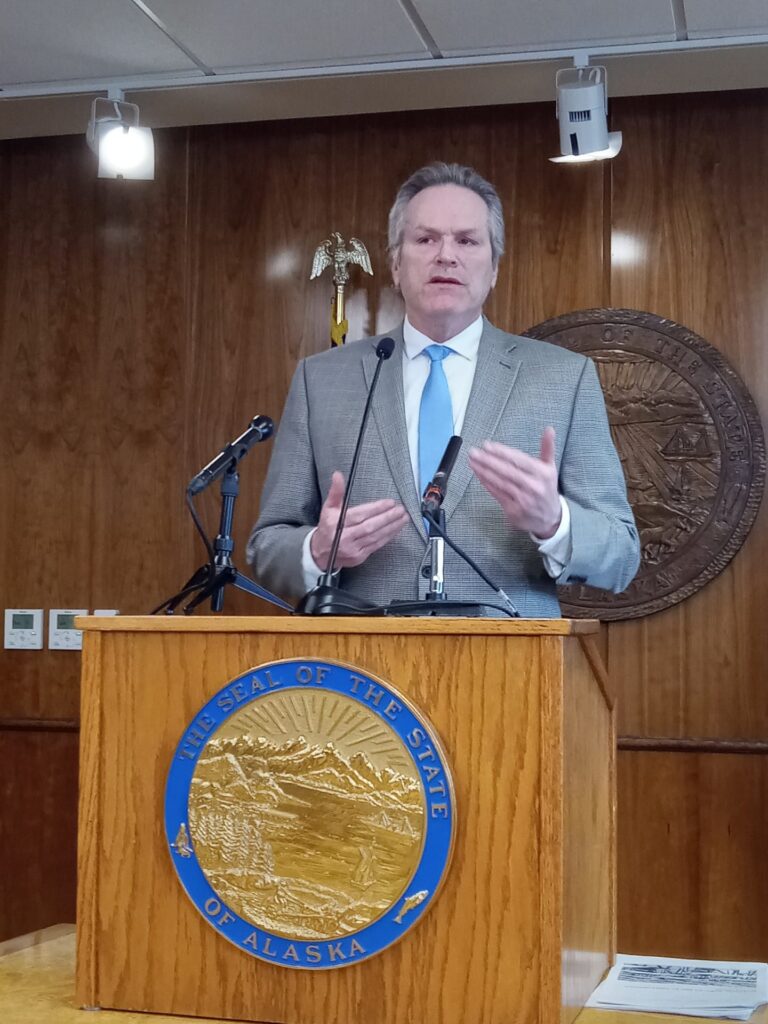
Governor Mike Dunleavy speaks during a press conference on Thursday, April 17 in Juneau. (Photo by Greg Knight/NOTN)
Governor Mike Dunleavy speaks during a press conference on Thursday, April 17 in Juneau. (Photo by Greg Knight/NOTN)
NOTN- Gov. Mike Dunleavy on Monday released the full policy agenda for a special session of the Alaska Legislature, scheduled to begin Saturday, Aug. 2. The session, first announced earlier this month, will focus on a sweeping package of education reforms the Governor says are aimed at improving student outcomes and securing long-term funding for public schools.
“This is an opportunity to address Alaska’s performance issues and funding issues in K-12 education well into the future.” Dunleavy said in the press release. “By addressing this now, school districts, students, parents, teachers, and policymakers will have certainty and will not have to debate this issue during the regular session that begins in January,”
The Governor’s office outlined their key priorities for the session, those include
Executive order creating a Department of Agriculture
Tribal Compacting between the state Department of education and select tribes
Expansion of corporate tax credit program for education.
Authorize the Department of Education as a charter school authorizer in addition to local districts
Open enrollment allowing public school students to enroll in any public school that has room including outside of a student’s resident district.
Grants for reading improvement and for a new after school reading tutoring program
Recruitment retention payments to classroom teachers to reduce turnover
Long-term certainty in funding for K-12 schools if agreement is reached on policy.
Education Commissioner Dr. Deena Bishop, a former teacher and superintendent, said the proposals are evidence-based and modeled after successful policies in other states.
Bill introductions are scheduled for the session’s opening day, with hearings requested to begin Sunday, Aug. 3.
However many lawmakers plan to override Gov. Mike Dunleavy’s decision to veto millions of dollars in public school funding from this year’s state operating budget.
according to the Alaska Beacon, It takes 45 votes to override an Alaska governor’s budget veto, and of the 46 legislators who voted this spring to override the governor’s veto of the education funding formula, all but a handful have committed to supporting a budget veto override as well.
That formula is subject to the state’s annual budget process, and Dunleavy chose to only partially fund it, causing a wave of cuts to services at public schools across the state. Dunleavy had said he would not agree to the full funding increase without the Legislature adopting other policies he’s proposed.