U.S. Forest Service workers clear a fallen tree from a trail in the Tongass National Forest. (U.S. Forest Service photo)
It was no surprise that everyone on the timber panel at this month’s Alaska Resource Development Council conference had the same message: The industry needs a larger supply of trees to cut.
And a steady, bankable supply, said Joe Young, of Tok, who started Young’s Timber in Alaska’s Interior more than 30 years ago.
Without long-term timber sales to supply a mill, “bankers will laugh you out of the room” when a mill owner asks for a business loan, Young said.
The Nov. 13 industry panel at the annual conference held in Anchorage also talked about demand for their product and the challenges in meeting that demand.
Juneau attorney Jim Clark, who has spent much of his life representing timber and wood pulp companies, said the Trump administration’s move to rescind the Roadless Rule, which has been around since 2001, could help open areas of the Tongass National Forest to logging.
The ban on road building has bounced between presidential administrations, like a ping pong ball, Clark said. “We’ll see if we can get this over with,” he said of the U.S. Department of Agriculture effort to rescind the rule, which will require an environmental impact statement.
In addition to the Tongass, the Roadless Rules affects tens of millions of acres of national forest lands in western states.
The lack of timber sales, financial pressures and opposition from conservation groups have knocked down Alaska timber industry jobs from almost 4,000 in 1990 to about 700 in 2015 and just 360 in 2024, according to Alaska Department of Labor statistics.
The timber industry in Southeast is getting only one-third of the log supply it needs, said Sarah Dahlstrom, public relations manager for Viking Lumber, which has operated a sawmill in Klawock for about 30 years.
Viking, the second-largest employer on Prince of Wales Island, needs more timber sales on federal, state and municipal lands, she said, contending that the U.S. Forest Service has failed to meet its commitment under a 2016 land management plan.
The mill cuts Sitka spruce, hemlock, red and yellow cedar, Dahlstrom said, and is a leading supplier of wood for piano soundboards and guitars.
“Steinway pianos would not exist if not for old-growth timber from the Tongass,” she said.
In addition to supplying the prized, tight-grain wood to Steinway & Sons’ factory in New York City, Viking supplies piano makers Kawai and Yamaha, and guitar manufacturers Gibson and Martin.
Steinway is worried enough about its wood supply that the company has written Alaska elected officials to advocate for the mill. “We use the top 1% of the top 1% of spruce,” company Chief Executive Ben Steiner told The Wall Street Journal this summer.
Dahlstrom said there are other small operators on Prince of Wales Island, cutting wood for pianos and musical instruments. And they all have the same problem of insufficient and unpredictable supply.
Viking also supplies manufacturers of doors, trim, fences, staircases, railing and window trim nationwide.
She complimented efforts by Wrangell Borough Manager Mason Villarma, who has been working to coordinate timber sales on the island between the state Department of Natural Resources, Alaska Mental Health Trust land office and the borough.
“I was born into a timber family,” she said of her dad and uncle, who built a mill in Hoquiam, Washington, more than 40 years ago, milling timber from the Olympic National Forest. She said she was not happy when her family moved to Klawock in 1994 and her dad and uncle took over the bankrupt mill.
In addition to lumber and boards, Viking sends wood chips south to be used in making corrugated boxes and supplies chips to the Craig School District which burns the wood waste to generate electricity and heat the swimming pool.
“Growing up, I didn’t know how cool it was,” she said of the industry she now calls home after resisting it when she was younger.
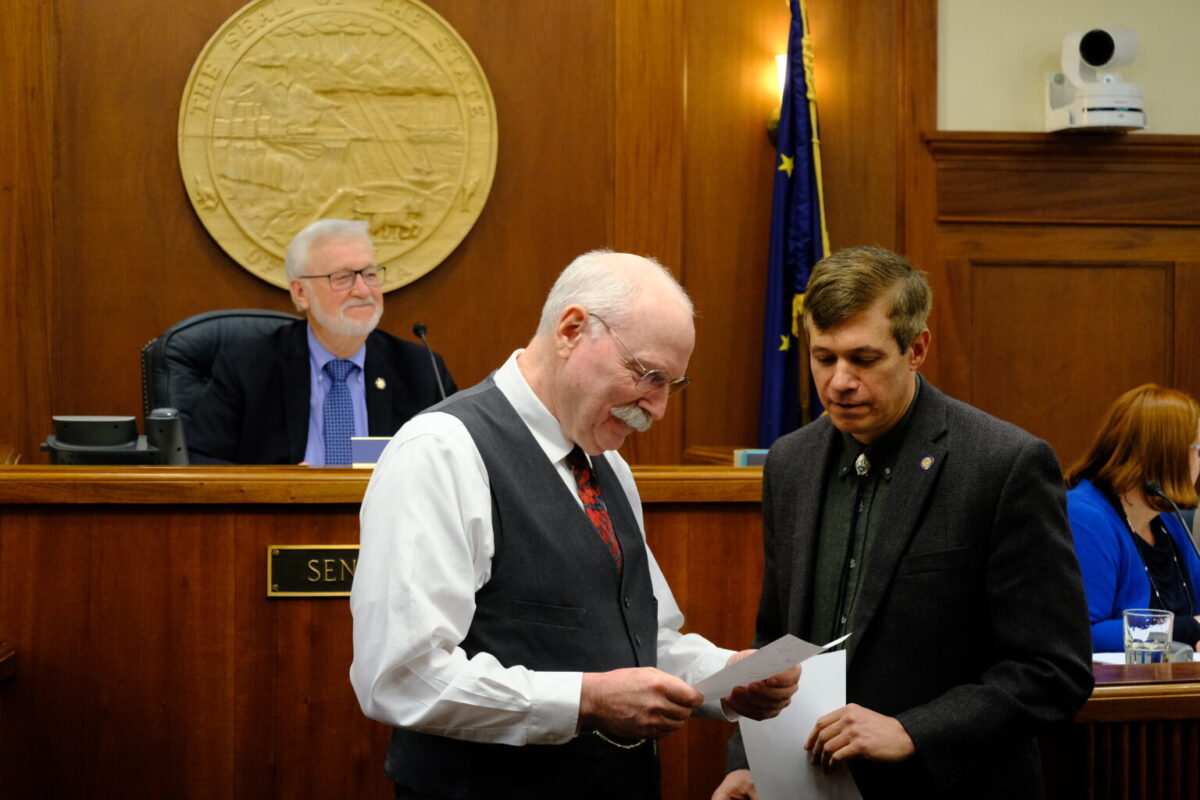
Speaker of the House Cathy Tilton, R-Wasilla, talks to fellow lawmakers about rules for debate on House Bill 183 on Saturday, May 11, 2024. (Photo by James Brooks/Alaska Beacon)
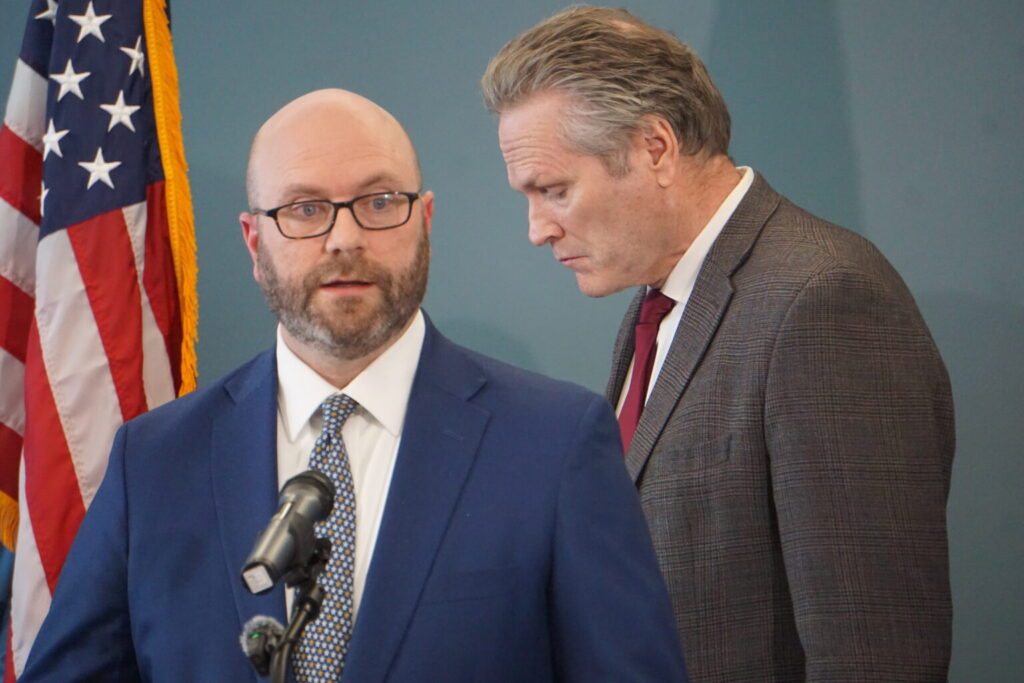
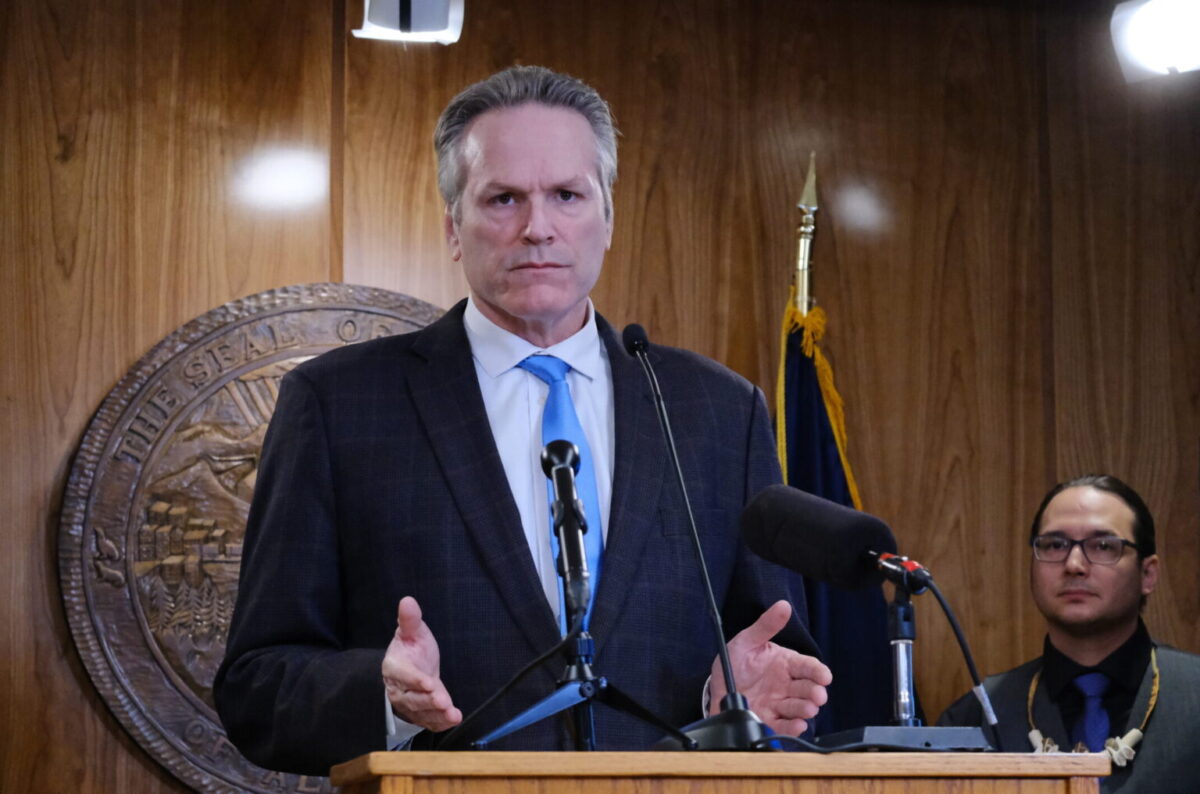
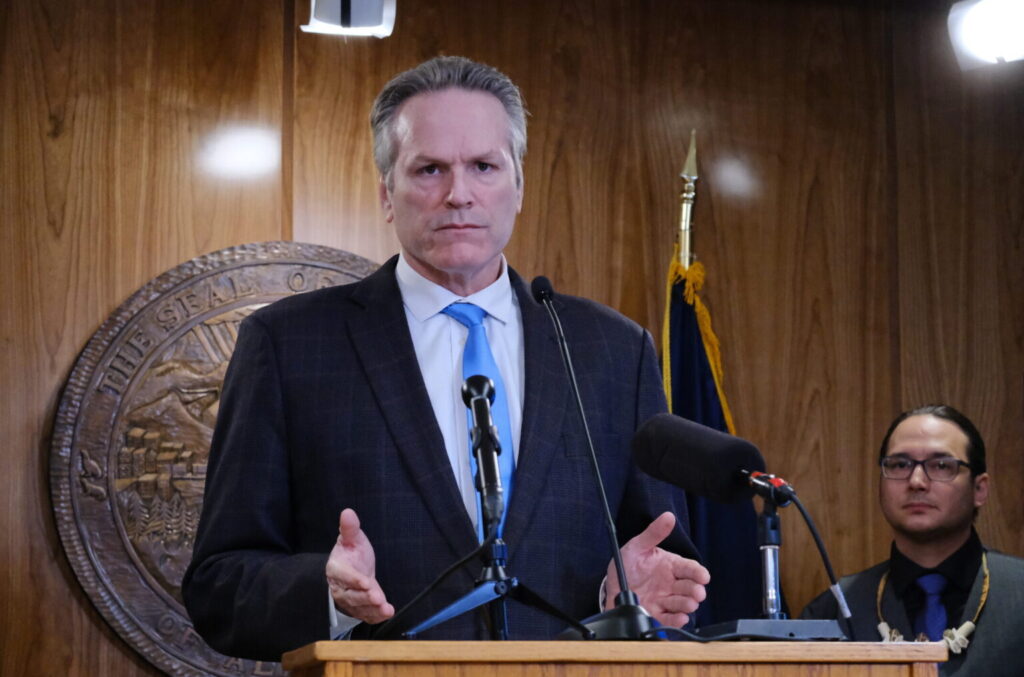
Gov. Mike Dunleavy has appointed state Reps. George Rauscher, R-Sutton, and Cathy Tilton, R-Wasilla, to two vacancies in the Alaska Senate.
Each nomination will become effective if at least five of the Senate’s nine other Republicans approve them. Senate President Gary Stevens, R-Kodiak, said the votes will take place by secret ballot at 10 a.m. Saturday in Anchorage.
“Honestly, I think both of them are excellent candidates,” Stevens said on Wednesday, adding that he expects both to be confirmed.
If Rauscher and Tilton are confirmed, their House seats would become vacant, and Dunleavy would be required to appoint replacements within 30 days of their resignations.
The office of former Sen. Mike Shower, R-Wasilla, is seen in the Alaska state Capitol on Tuesday, Nov. 25, 2025. Shower’s nameplate has been removed from beside the door, but a sticker commemorating Shower’s time as an F-22 fighter pilot remains on the door. (Photo by James Brooks/Alaska Beacon)
Dunleavy’s picks were due no more than 30 days after their resignations, but he acted earlier, which will allow the replacement legislators to take office before the regular legislative session convenes in January.
“I can’t think of two Alaskans more qualified and committed to public service to serve in the Alaska Senate than Representatives Rauscher and Tilton,” Dunleavy said in a statement announcing the selections. “I have known and worked with both for as long as I have been in public office and I look forward to working collaboratively with them as senators. I also want to thank the local Republican district committees for taking the time to meet, deliberate, and send forward names for these seats. This process works best when the people closest to the communities are involved.”
Tilton, first elected to the House in 2014, was Speaker of the House from 2023 through 2024. Reached by phone on Wednesday in the middle of Thanksgiving shopping, she referred to a statement on her Facebook page.
“I look forward to collaborating with my Senate colleagues to advance sensible policy solutions, foster an energy renaissance, and usher in an era of renewed prosperity for all Alaskans,” the statement said in part.
Rep. George Rauscher, R-Sutton, speaks in favor of the creation of an Alaska Department of Agriculture by executive order on Wednesday, March 19, 2025. (Photo by James Brooks/Alaska Beacon)
Rauscher said he’s already at work on a letter thanking Dunleavy for his appointment, but he declined to say what he thinks his confirmation chances are.
“It’s an honor,” Rauscher said of the appointment, “and I feel like it was quite the undertaking — the process — and to have it this close to seeing what the final outcome is, is always a relief in some ways, but it’s also very exciting that I am this close. So I appreciate the fact that the governor did consider me and thought highly enough of me to appoint me.”
Several senators said they expect Rauscher and Tilton to be confirmed, but each declined to say how he or she will vote, citing the need to work with them regardless.
Of the nine Republican senators who will be voting on this weekend’s confirmations, five are members of the Senate’s bipartisan majority caucus, and four are members of the Senate’s all-Republican minority.
Shower and Hughes were members of the House minority, and their replacements are expected to be as well.
Stevens said he’s conducting the confirmation vote by secret ballot in order to avoid the possibility of hurt feelings.
“I don’t want to have anybody have bad feelings when we start working together in January,” he said.
Stevens said he wants to give the House’s replacement process as much time as possible, since that will involve the appointment of two people new to the Legislature who will need to hire staff and uproot their lives in order to arrive in Juneau in January and be ready to work.
“I just want to make sure the House has all the time they need,” he said.
The U.S. Capitol on the evening of Tuesday, Sept. 30, 2025, just hours before a federal government shutdown. (Photo by Ashley Murray/States Newsroom)
Alaska Republican Sen. Lisa Murkowski denounced the Trump administration’s targeting of Arizona Democratic Sen. Mark Kelly on Tuesday, saying on social media that its actions are “reckless and flat-out wrong.”
“Senator Kelly valiantly served our country as an aviator in the U.S. Navy before later completing four space shuttle missions as a NASA astronaut,” Murkowski said. “To accuse him and other lawmakers of treason and sedition for rightfully pointing out that servicemembers can refuse illegal orders is reckless and flat-out wrong. The Department of Defense and FBI surely have more important priorities than this frivolous investigation.”
It has become unusual for elected Republican officials to speak in defense of elected Democrats, particularly when it places them at odds with President Donald Trump, who remains popular among Republican voters, even if his approval overall is low.
Alaska Republican Sen. Dan Sullivan previously expressed concerns about the possible politicization of the military during the presidency of Democrat Joe Biden.
Asked about the situation with Kelly, Sullivan criticized the Democratic video and the administration’s response to it.
“The Democrats in the video have offered no explanation of what they considered to be an illegal order, sowing confusion and politicizing the ranks in a way that risks undermining military discipline, lethality and readiness,” his office said in a written statement.
The statement went on to say that “he does not believe it is a good use of the Pentagon’s time to investigate Senator Kelly” because “such an investigation has the potential to turn into a major distraction for our military.”
The office of Rep. Nick Begich, R-Alaska, did not return a text message or email seeking comment.
Sullivan’s office requested that his statement be printed in full. Because it has not been published elsewhere, we think there is news value in reprinting it, so it is published below.
“Senator Sullivan strongly disagreed with many actions taken by the Pentagon under Presidents Obama and Biden — such as President Biden’s use of enlisted Marines as political props standing behind him in a very partisan speech in Philadelphia in 2022. But he would never have put out a video — like the one released by Senator Mark Kelly and five other Democratic lawmakers — implying that troops should question orders from their superiors. The Democrats in the video have offered no explanation of what they considered to be an illegal order, sowing confusion and politicizing the ranks in a way that risks undermining military discipline, lethality and readiness.
Instead of using our troops as political pawns, members of Congress should press top Pentagon officials directly on issues over which they have concerns. Senator Sullivan does this regularly in Senate Armed Services Committee hearings and in meetings and phone calls with top Pentagon leaders regardless of which party controls the White House.
While Senator Sullivan believes the message in the video was irresponsible and politically driven, he does not believe it is a good use of the Pentagon’s time to investigate Senator Kelly — who served honorably in the Navy — under the UCMJ, particularly given that the Constitution’s Speech or Debate Clause would likely take precedence over any UCMJ provision. Such an investigation has the potential to turn into a major distraction for our military. After four years of Biden’s woke military, the Department of War needs to stay laser focused on lethality and war fighting.”
NOTN- City and Borough of Juneau (CBJ) Utility Billing is applying sales tax exemptions passed in the October 2025 municipal election to CBJ’s December 2025 utility billing period. Residential, non-commercial customers of CBJ water and wastewater will not be charged sales tax starting this December. Residential, non-commercial customers with a current senior sales tax exemption will also receive a 100% sales tax exemption.
Juneau Mayor Beth Weldon said the changes are intended to remove sales tax from residential utility costs, though the city has instituted a 180-day grace period to correct any misclassifications.
“In order to do the intent the voters wanted, we just had to make a very high level residential versus commercial, and the exemptions are only supposed to be on residential. So we may end up putting some sales tax back on some things if we erroneously labelled them as residential and they were actually commercial. So if houses and that kind of stuff are used for commercial means, like offices or Airbnbs, then they wouldn’t be exempt, necessarily.”
Grocery stores are adapting to the food-tax exemptions as well with each store processing the adoption differently.
Weldon said some stores are automatically removing tax on eligible food items, while others may require customers to separate food from non-food items at checkout. Prepared or hot foods, such as deli fried chicken or macaroni salad, may not exempt under the measure.
Customers who believe they are incorrectly designated as commercial may need to apply for a sales tax exemption card to affirm residential and non-commercial status. Visit juneau.org/finance/sales-tax for more information about Proposition 2 implementation.
The chair of Alaska’s human rights commission has sued a political writer for defamation over his description of her work on a failed attempt to preserve a historic building in Seward.
Dorene Lorenz of Juneau filed the suit on Friday in Juneau Superior Court, seeking damages from Jeff Landfield and the other owners of the Alaska Landmine, a popular Alaska political website that publishes a mixture of news, commentary and parody.
Landfield, who backed Donald Trump in the 2024 presidential election, also publishes the Alaska Political Report, a sobersided news digest priced at $1,299 per year for lobbyists and others interested in activity at the state Capitol.
Lorenz’s suit stems from a social media post in which Landfield ridiculed a recent appearance by Lorenz at a United Nations event in Switzerland.
Landfield went beyond that appearance, which he labeled “bizarre,” and said, “This woman is an absolute nut. Remember when she got in trouble for using … state money for the Jesse Lee Home for herself?”
Lorenz asked for a retraction. Landfield refused, and reiterated his belief in a video posted on Facebook.
Lorenz filed her lawsuit in response, saying Landfield’s claim is false. She asked for financial damages for slander and defamation, a correction and retraction.
Lorenz, who has experience representing herself in court, filed the lawsuit on her own behalf.
“She’s a f***ing lunatic,” Landfield said of the lawsuit on Tuesday.
“Anyone who has themselves as a client is a fool, as the old saying goes,” he said, adding that he looks forward to the discovery process and showing what happened with the Jesse Lee Home.
That building was a former orphanage and the home of Alaska Flag designer Benny Benson in the early 20th century.
During the administration of Gov. Bill Walker, state lawmakers allocated almost $7 million to restore the building, but grants given to a Lorenz-chaired nonprofit called the Friends of the Jesse Lee Home were terminated after a series of “reporting issues and accountability issues.”
Lorenz said by text on Tuesday that most of the grant money was never disbursed to the nonprofit she administered.
In 2018, Fred Parady, then deputy commissioner of the Alaska Department of Commerce, Community and Economic Development, told Alaska Public Media that he didn’t think anyone involved with the project stole money.
In her legal complaint, Lorenz notes that Landfield was aware of that reporting and repeated his claim anyway.
Under Alaska law — which mirrors federal law — a public official filing a defamation claim needs to prove that someone knew what they were saying was a lie or that they willingly ignored evidence that their statement was a lie.
By text message, Lorenz said the 2018 reporting by Alaska Public Media shows that the state believed that the Friends of the Jesse Lee Home were spending too much money on classes within the school and not enough on the building itself.
“Landmine has asserted otherwise, with actual malice, and continues to do so,” she said. “Not cool.”
Salmon returning from the ocean attempt to jump Brooks Falls in Katmai National Park and Preserve’s Brooks River on July 12, 2018. Alaska’s commercial salmon harvest this year was nearly twice as big as last year’s small harvest. (Photo by Russ Taylor/National Park Service)
Alaska commercial fishers caught much more salmon in 2025 than they did last year, but the money they earned was modest, according to the statewide harvest report.
The state commercial salmon haul totaled 194.8 million fish, the 12th largest since 1985, according to the Alaska Department of Fish and Game’s preliminary annual summary, released this month.
Measured in pounds, the 2025 harvest was about average compared to the last 40 years the agency has been keeping an all-species record, the Fish and Game summary said.
But the amount of money paid to harvesters delivering their fish – known as ex-vessel value – was the 13th lowest since 1975, when adjusted for inflation. This year’s total was $541 million, the department said.
Copper River sockeye salmon fillets are displayed at New Sagaya Midtown Market in Anchorage on June 12, 2025. Sockeye salmon is also called red salmon. This year, sockeye salmon accounted for 58% of the value of Alaska’s total commercial salmon harvest, though it reprsented only about a quarter of the fish caught. (Photo by Yereth Rosen/Alaska Beacon)
This year’s totals represent a big improvement from last year, when only 101.2 million salmon were harvested. It was the third lowest haul since 1985 and the ex-vessel value was $304 million, the third lowest since 1975 when adjusted for inflation. In weight, the 2024 harvest totaled 450 million pounds, the lowest on record.
Alaska salmon, particularly Chinook, have been shrinking in size over the past decades, a trend that scientists attribute to a variety of factors, including climate change and ocean conditions.
This year, sockeye salmon accounted for the most value among Alaska’s five salmon species, continuing the long-term pattern in the industry. A little over a quarter of the landed fish were sockeye, but they made up 58% of the value, according to the Department of Fish and Game’s summary.
Pink salmon, the most plentiful and cheapest of the Alaska species, made up 61% of the total fish harvested and 21% of the total ex-value. The pink salmon harvest was about 14% less than expected at the start of the season, the department said.
At the other end of the volume spectrum, the statewide Chinook harvest, which accounted for only 181,892 of the 194.8 million total, was 26% higher than predicted in the preseason forecast, the department said.
Chum salmon accounted for 10% of the harvest and coho accounted for 1%, the department said.
The harvest totals are preliminary and subject to revision as more information is received, the department said.
The offices of the Alaska Permanent Fund Corp. are seen Monday, June 6, 2022 in Juneau, Alaska. (Photo by James Brooks/Alaska Beacon)
Craig Richards, a longtime member of the board in charge of the Alaska Permanent Fund Corporation, has been replaced.
On Monday afternoon, Gov. Mike Dunleavy announced he had selected Ralph Samuels, a former state legislator, businessman and tourism expert, to serve on the board in a public seat formerly occupied by Richards, whose term was slated to expire this year.
The board directs Alaska’s $85 billion Permanent Fund, whose investments are the source of more than 60% of the state’s general-purpose revenue. That money is used annually for services and the annual Permanent Fund dividend.
Richards had served on the board since 2015, first under then-Gov. Bill Walker, and then under Dunleavy, who appointed him to a four-year term as a public member of the board in 2021.
Richards did not immediately answer a message left on his cellphone. It was not immediately clear whether he had sought another term but was passed over by the governor.
Samuels also did not immediately answer a message left on his cellphone.
A statement announcing Samuels’ appointment did not include a comment from Richards or note his departure.
Of Samuels, the governor said, “He is a lifelong Alaskan with an innate understanding of our state’s business and political landscape. As a Trustee he will bring that experience and insight to managing Alaska’s sovereign wealth fund not only for today, but for future generations of Alaskans.”
Under Richards, who chaired the Board of Trustees from 2018 through 2022, the board launched a controversial in-state investment program that has yet to deliver positive results.
The board in recent years has also intensified its warnings about the threat that the fund may run out of spendable money in the coming years.
An analysis paper commissioned during Richards’ time on the board suggests that a constitutional amendment may be needed to change the Permanent Fund’s structure to firmly cap the amount of money that may be spent from the fund and to consolidate the fund’s current two-account structure.
Fresh produce is seen at the Alaska Commercial Company grocery store in Bethel on Oct 15, 2025. (Photo by Corinne Smith/Alaska Beacon)
U.S. Agriculture Secretary Brooke Rollins’ call for a close reexamination of the 42 million people who receive federal food aid has befuddled advocates and lawmakers, coming mere days after recipients began to see benefits that had been stalled during the government shutdown.
Details remain scant a week after Rollins during an interview on the right-wing Newsmax network first publicly broached the startling idea that every beneficiary would have to reapply for the Supplemental Nutrition Assistance Program, or SNAP, often called food stamps.
The U.S. Department of Agriculture, asked for an explanation, referenced existing requirements and suggested more changes in SNAP rules could be in store.
“Secretary Rollins wants to ensure the fraud, waste, and incessant abuse of SNAP ends,” a USDA spokesperson wrote Wednesday. “Rates of fraud were only previously assumed, and President Trump is doing something about it. Using standard recertification processes for households is a part of that work. As well as ongoing analysis of state data, further regulatory work, and improved collaboration with states.”
The 2008 law governing SNAP leaves states responsible for administration. Part of that role includes periodically making sure that the low-income people in the program meet the qualifications for inclusion, but the law allows states to determine how often that occurs.
“It’s not clear what she would be proposing that is different from what is already happening,” said Katie Bergh, a senior policy analyst for food assistance at the left-leaning think tank Center for Budget and Policy Priorities.
One interpretation of Rollins’ comments is that she would remove all 42 million individuals from SNAP’s rolls and ask them to resubmit applications. Bergh said that would lead to people losing money they need for groceries. About 40% of those enrolled in SNAP are children.
“If she’s suggesting that they’re going to somehow redo that process for more than 40 million people who already demonstrated their eligibility and who already have to periodically recertify their eligibility, that would be pretty duplicative and would likely create pretty significant paperwork backlogs that would cause people who are eligible to lose the food assistance that they need,” Bergh said.
Administration critics have suggested that, while the comments are unlikely to lead to policy changes, they introduce even more confusion for a program that was used as a political token during the record government shutdown that ended this month.
Making people reapply would underscore the Trump administration’s opposition to the nearly $100 billion program, which accounts for 70% of federal nutrition assistance. USDA says the average SNAP household in fiscal 2023 received a monthly benefit of $332, or $177 a person based on the average SNAP household size of 1.9 people.
“Secretary Rollins and the Trump administration have cut food assistance for 42 million Americans multiple times this year,” U.S. House Agriculture ranking member Angie Craig said in a Wednesday statement to States Newsroom. “Now, they’ve once again shown that they do not understand the program.”
What did Rollins say?
In the Nov. 13 interview on Newsmax, Rollins said SNAP was beset by widespread fraud, citing data that 29 mostly Republican-run states submitted to the department. Acquiring data from the 21 other states would give the department a way to wholly remake the program, she said.
“Can you imagine when we get our hands on the blue state data, what we’re going to find?” she said. “It’s going to give us a platform and a trajectory to fundamentally rebuild this program, have everyone reapply for their benefit, make sure that everyone that’s taking a taxpayer-funded benefit through SNAP or food stamps that they literally are vulnerable, and they can’t survive without it. And that’s the next step here.”
In an interview Monday on Fox News, host Maria Bartiromo asked Rollins about the move to have recipients “reapply.”
“Business as usual is over,” Rollins answered in part. “The status quo is no more. We know that the SNAP program is rife with fraud.”
She added that guarding against fraud would help those the program is meant to serve.
The comments touched off widespread confusion about what specifically Rollins meant.
Asked about the initiative during a Thursday press conference, Craig, a Minnesota Democrat, said she was unclear about how it would work and predicted that Rollins would take credit in the future for the existing low rate of fraud.
“We’re hearing off the record that, you know, maybe people don’t know what the hell they’re talking about,” she said. “In fact, I think they’re trying to take credit for the already very strict standards and the actual low fraud rate in the SNAP program … So we can find no real plan there. Not even sure there’s concepts of a plan there.”
In response to a States Newsroom request this week for details about the initiative, USDA provided the statement that did not answer how the department would proceed or under what authority, but said Rollins was seeking to reduce fraud in the program.
Spokespeople did not respond to follow-up questions, or a request to respond to Craig’s remarks Thursday.
Low fraud rate
Program experts say fraud is not a widespread problem for SNAP.
An April report from the nonpartisan Congressional Research Service found that retailers illegally trafficked about 1.6% of SNAP benefits from fiscal 2015 to 2017.
Fraud by households applying for SNAP, which appear to be the main target of Rollins’ proposal, is even lower.
According to a USDA report, about 26,000 applications were referred for an administrative review or prosecution on suspicion of fraud. That number accounts for about 0.1% of the 22.7 million households enrolled in the program, according to the Pew Research Center.
“Long-standing data sources indicate that intentional fraud by participants is rare,” Bergh said.
At Thursday’s press conference, Craig called Rollins’ comments “bullsh*t” and “propaganda.”
“Secretary Rollins goes on TV and talks about all the fraud,” she said. “This most effective anti-hunger program in our history has a fraud rate of 1.6%. It’s actually one of the most effective, well-run programs in the country … The bullsh*t this administration is peddling is egregious.”
More targeted reforms
Even experts who advocate for reforms to SNAP say eligibility fraud is not a major issue.
Romina Boccia, director of budget and entitlement policy at the libertarian Cato Institute, said high-net-worth individuals can receive SNAP benefits, but aren’t committing fraud by doing so.
“Some of the issues with SNAP … aren’t because of fraud or abuse, but they are because of bad program rules,” said Boccia.
Boccia also cited an “incentive misalignment” inherent in the state-federal program. States have little incentive to control payments because the federal government funds the program, she said.
Forcing all beneficiaries to reapply would likely reduce the cost of the program by reducing the number of its beneficiaries, including by forcing out higher earners who may not consider the benefits they don’t actually need to be worth the onerous reapplication process, Boccia said.
But it would also result in a percentage of low earners dropping off the program, as well as many who would be affected by the administrative backlog that would come with processing tens of millions of new applications, she said.
Shutdown, the big beautiful bill, and confusion
Bergh said Rollins’ comments “add insult to injury” because they come after congressional Republicans and President Donald Trump signed a major tax cuts and spending law that is expected to shrink federal SNAP spending by $187 billion over 10 years. The law added work requirements for many SNAP recipients and shifted some costs to states.
That was followed by the six-week shutdown that saw a dizzying back-and-forth over whether November SNAP benefits would be paid.
“There has been huge amounts of chaos and confusion and disruption for both states and participants in recent weeks, largely due to the shutdown, but also because simultaneously, the administration has required states to implement many of the reconciliation bill’s SNAP cuts,” Bergh said.
Craig, in her statement, also said Rollins’ comments would hurt the people who need the program.
“I am astounded by the secretary’s careless disregard for the hungry seniors and children who can afford to eat because of this program,” she said.
Sara Naomi Bleich, a public health policy professor at Harvard University, said in a phone interview the confusion from Rollins’ comments compounded hardships produced by the Republican reconciliation law, known as the One Big Beautiful Bill Act.
“Big picture with the One Big Beautiful Bill Act is that there’s basically this tidal wave coming to families that have low income,” Bleich, who worked at USDA during the Obama and Biden administrations, said. “They’re going to lose Medicaid. They’re going to lose SNAP. There could be collateral impacts on the school meals. This is going to be a really hard time for families to navigate.”
Homes are surrounded by debris in Kwigillingok, Alaska, Monday, Oct. 27, 2025, after being damaged earlier in the month by Typhoon Halong. (AP Photo/Lindsey Wasson)
AP- Storms that battered Alaska’s western coast this fall have brought renewed attention to low-lying Indigenous villages left increasingly vulnerable by climate change — and revived questions about their sustainability in a region being reshaped by frequent flooding, thawing permafrost and landscape-devouring erosion.
The onset of winter has slowed emergency repair and cleanup work after two October storms, including the remnants of Typhoon Halong, slammed dozens of communities. Some residents from the hardest-hit villages, Kipnuk and Kwigillingok, could be displaced for months and worry what their futures hold.
Kwigillingok already was pursuing relocation before the latest storm, but that can take decades, with no centralized coordination and little funding. Moves by the Trump administration to cut grants aimed at better protecting communities against climate threats have added another layer of uncertainty.
Still, the hope is to try to buy villages time to evaluate next steps by reinforcing rebuilt infrastructure or putting in place pilings so homes can be elevated, said Bryan Fisher, the state’s emergency management director.
“Where we can support that increased resilience to buy that time, we’re going to do that,” he said.
Many Alaska Native villages are threatened by climate change
Alaska is warming faster than the global average. A report released last year by the Alaska Native Tribal Health Consortium found 144 Native communities face threats from erosion, flooding, thawing permafrost or a combination.
Coastal populations are particularly vulnerable, climate scientist John Walsh said. Less Arctic sea ice means more open water, allowing storm-driven waves to do damage. Thawing permafrost invites more rapid coastal erosion. Waves hitting permafrost bounce like water off a concrete wall, he said, but when permafrost thaws, the loose soil washes away more easily.
Wind and storm surge from the remnants of Halong consumed dozens of feet of shoreline in Quinhagak, disturbing a culturally significant archaeological site. Quinhagak, like Kipnuk and Kwigillingok, is near the Bering Sea.
Just four times since 1970 has an ex-typhoon hit the Bering Sea coast north of the Pribilof Islands, said Rick Thoman, a climate specialist with the Alaska Center for Climate Assessment and Preparedness. Three of those have been since 2022, starting with the remnants of Merbok that year.
The damage caused by ex-typhoon Halong was the worst Fisher said he has seen in his roughly 30 years in emergency management. About 700 homes were destroyed or severely damaged, estimates suggest. Some washed away with people inside and were carried for miles. Kipnuk and Kwigillingok — no strangers to flooding and home to around 1,100 people — were devastated. One person died, and two remain missing.
Some homes and buildings that were torn off their foundations and floated away are seen near the village of Kwigillingok, Alaska, Monday, Oct. 27, 2025, after Typhoon Halong hit the region earlier in the month. (AP Photo/Lindsey Wasson)
Options are limited and expensive
At-risk communities can reinforce existing infrastructure or fortify shoreline; move infrastructure to higher ground in what is known as managed retreat; or relocate entirely. The needs are enormous — $4.3 billion over 50 years to protect infrastructure in Native communities from climate threats, according to the health consortium report, though that estimate dates to 2020. A lack of resources and coordination has impeded progress, the report found.
Simply announcing plans to relocate can leave a community ineligible for funding for new infrastructure at their existing site, and government policies can limit investments at a new site if people aren’t living there yet, the report said.
It took decades and an estimated $160 million for the roughly 300 residents of Newtok in western Alaska to move 9 miles (14.5 kilometers) to their new village of Mertarvik. Newtok was one of the first Alaska Native communities to fully relocate, but others are considering or pursuing it. In Washington and Louisiana, climate change has been a driving force behind relocation efforts by some tribes.
But many villages, including Kipnuk and Kwigillingok, “don’t have that kind of time,” said Sheryl Musgrove, director of the Alaska Climate Justice Program at the Alaska Institute for Justice. The two are among 10 tribal communities her group has been working with as they navigate climate-adaptation decisions.
Kipnuk before the last storm had been planning a protect-in-place strategy but hasn’t decided what to do now, she said.
Musgrove hopes that in the aftermath, there will be changes at the federal level to help communities in peril. There is no federal agency, for example, tasked with coordinating relocation. That leaves small communities trying to navigate myriad agencies and programs, Musgrove said.
“I guess I’m just really hopeful that this might be the beginning of a change because I think that there is a lot of attention to what happened here,” she said.
Federal support is in question
With money from the Infrastructure Investment and Jobs Act and Inflation Reduction Act, the U.S. Bureau of Indian Affairs in 2022 created the Voluntary Community-Driven Relocation Program and committed $115 million for 11 tribes’ relocation efforts, including $25 million each for Newtok and Napakiak. In Napakiak, most of the infrastructure is expected to be destroyed by 2030, and the community is moving away from the banks of the Kuskokwim River.
That is not enough to move a village, and additional funding opportunities are scattered across other agencies, including the U.S. Department of Agriculture and the National Oceanic and Atmospheric Association.
Sustained federal support is uncertain as the Trump administration cuts programs related to climate change and disaster resilience. Trump in May proposed cutting $617 million from the Bureau of Indian Affairs’ tribal self-governance and communities programs but did not specify which programs.
The Department of Interior said in an email that new grant funding is “under review as part of a broader effort to improve federal spending accountability,” but that the Bureau of Indian Affairs was “helping tribes lay the groundwork for future implementation when funding pathways are clarified.”
Other federal money that could help Alaska villages has already been cut. Federal Emergency Management Agency awards to Newtok and Kwigillingok for projects related to relocation didn’t arrive before the administration in April halted billions of dollars in unpaid grants.
Trump has also stopped approving state and tribal requests for hazard mitigation funding, a typical add-on that accompanies federal support after major disasters.
NOTN- The legal fight over the future of the historic Telephone Hill neighborhood will now proceed entirely in Superior Court, after district judge Kristen Swanson declined to rule on the city’s eviction cases tied to the planned redevelopment project.
City Attorney Emily Wright said Judge Swanson dismissed the eviction actions in District Court, to Superior Court Judge Daniel Browning of Sitka.
“Superior Court handles more complex matters than District Court, so Judge Swanson was only going to rule on the issue of, should we (CBJ) have possession of the houses, and should these tenants have to leave immediately?” Said Wright, “The tenants, plus a few others, have filed a civil lawsuit, and in that lawsuit are talking about the evictions, but they’re also talking about the larger questions of, what is the city doing on Telephone Hill? Should that continue? And so really, Judge Swanson’s not going to hear the small little piece. She’s going to send it over to the Superior Court to handle everything.”
The lawsuit alleges the city improperly evicted residents and violated state and federal historic preservation laws in its push to clear Telephone Hill for redevelopment.
Wright said the city accepts Swanson’s decision and plans to request an expedited hearing before Judge Browning.
“We are going to ask for expedited hearings on that case. Because even though, civil cases can take a very, very long time. The city is trying to move forward on the testing of the houses.” She said.
The city’s engineering department has already begun hazardous materials assessments on homes that are vacant. Three homes remain occupied.
“The city engineering department is working their way through doing the hazardous materials assessment, and we’re starting with the houses that are empty. We need to get to those other houses before this next step so we’re going to ask for expedited consideration in the Superior Court matter, which probably means a hearing, sometime after Thanksgiving.”
The city plans to redevelope Telephone Hill into higher-density housing and had issued Nov. 1 eviction notices.