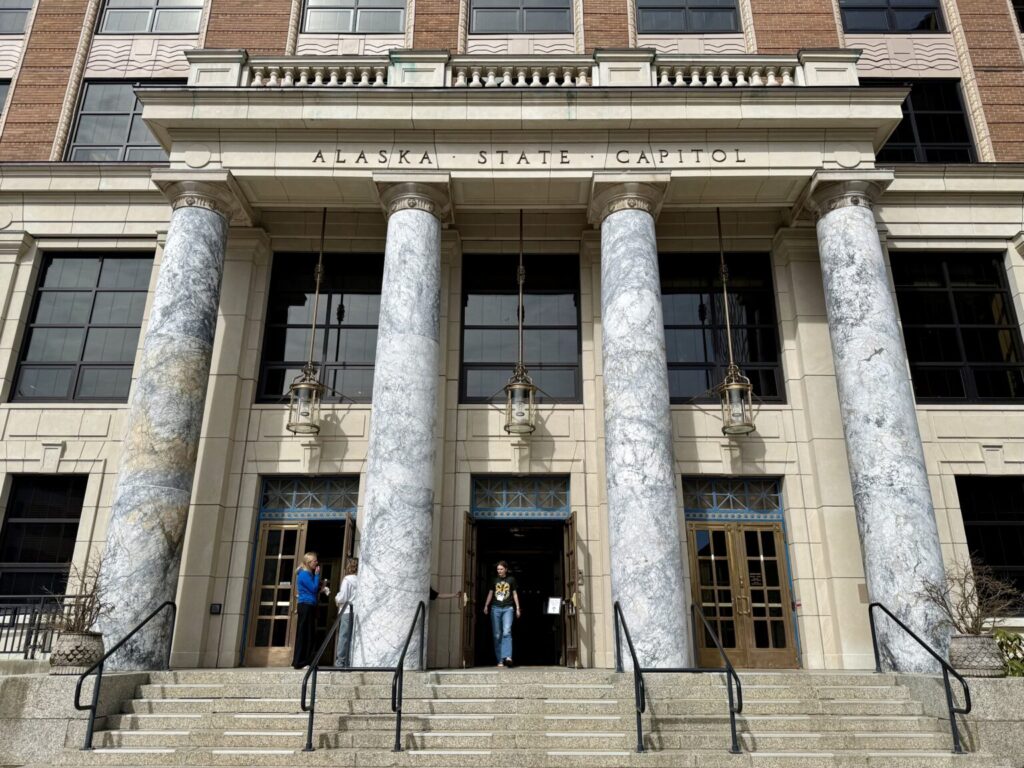
The Alaska State Capitol in Juneau is seen on Apr. 24, 2026. (Photo by Claire Stremple/Alaska Beacon)
NOTN- With just over a week left before Alaska lawmakers adjourn on May 20, the Legislature is entering its busiest stretch of the year as lawmakers scramble to pass budgets, major policy bills and a contentious natural gas tax proposal that lawmaker’s say has become the Governor’s biggest priority this session.
Alaska Public Media conjectured the final days of the session will likely center on three major areas: the state budget, the proposed Alaska LNG pipeline project and a flood of remaining legislation that must pass before the end of the two-year legislative cycle. Bills that don’t pass by adjournment will die and have to be reintroduced in a future session.
Negotiations are now underway between the House and Senate on the state operating budget. The House version includes a $1,500 Permanent Fund dividend, one-time school funding and expanded spending on child care and social programs. The Senate’s proposal is more conservative, with a $1,150 payment that includes an energy relief component and less education funding overall. Final negotiations may depend heavily on oil prices, which have recently remained above forecast levels.
Lawmakers are also debating how much tax relief should be offered to support the proposed Alaska LNG gasline project. Governor Mike Dunleavy has proposed replacing the state’s existing property tax on oil and gas infrastructure with a lower tax tied to pipeline throughput.
At the same time dozens of other bills are moving quickly through committees and floor votes, including a broad crime package, which includes bills targeting AI generated Child Sexual Abuse content, Sexual Assault kit tracking and raising the State’s age of consent.
There is a pension bill for state employees, a long time win for the legislature, that many expect Governor Dunleavy to veto before lawmakers leave Juneau.
But, the big question remains- will legislators pass these bills by the scheduled end of the session?
Juneau Senator Jesse Kiehl says it’s unclear pointing to that massive gas line bill that could push work into overtime.
“The Governor’s number one priority this year is the Gas line bill. He waited until two thirds of the way through the session to give us that.” He said, “The Resources Committees have been working like crazy, meeting multiple times a day. This is billions and billions of dollars worth of decisions, the kinds of things that will have impacts for 30 years to come. We’re working as hard and as fast as we can. Boy, it’s tough to see that passing before the end of the regular session. This time of year, it always looks like it’ll be overtime. Sometimes it is. Sometimes we can avoid it. But when I look at the issues that are pretty big, and may result in extra innings, we got that gas line bill on day 80 out of 121.”
The Alaska State Capitol is seen behind other buildings on Tuesday, Feb. 10, 2026, in downtown Juneau. (James Brooks photo/Alaska Beacon)
By: James Brooks, Alaska Beacon
The Alaska State Capitol is seen behind other buildings on Tuesday, Feb. 10, 2026, in downtown Juneau. (James Brooks photo/Alaska Beacon)
A late amendment to a bill nearing final passage in the Alaska Capitol would exempt some Alaska Native village corporations from public financial disclosures required by state law.
On Monday afternoon, the Alaska Senate’s labor and commerce committee voted to amend House Bill 126 with a new section that reduces and caps the number of Native corporations required to share information annually with the Alaska Division of Banking and Securities.
Sen. Jesse Bjorkman, R-Nikiski and chair of the labor and commerce committee, declined to answer questions when asked Tuesday about the change.
In Monday’s committee hearing, Bjorkman said, “I think members of the media might be interested in information therein, but at the end of the day, I don’t know that information is their business because it happens within the confines of a Native corporation.”
State law currently requires corporations with at least 500 shareholders and $1 million in assets to provide financial documents to the state, which treats them as public records.
Because Native corporations are exempted from federal disclosure requirements, existing state law provides the only free public avenue for non-shareholders to inspect their work.
Of the state’s 200-plus Native corporations, 59 are currently required to file reports with the division, and the number is growing over time because shareholders are splitting their shares and passing them to their descendants, pushing more corporations over the 500-shareholder limit.
The new definition would limit disclosures to corporations with 500 shareholders when they were created, regardless of how many they currently have.
That change would exempt at least seven village corporations — the division isn’t sure of the exact number and is reviewing another 30. None of the 12 regional corporations would be affected by the change because each had more than 500 shareholders when they were created.
Shareholders of each exempted corporation would still have access to financial information, but members of the public would not.
Curtis McQueen, executive director of the Alaska Native Village Corporation Association, is supporting the change and wrote to the committee, saying that the modification brings state law back to its original intent.
“The amendment will exempt, as was originally intended, smaller village corporations from the filing requirements. This amendment will allow their staff and leadership to focus their time and energy on improving the health of their communities and providing benefits to their shareholders, not filling out forms and complying with the complex requirements of the division of banking and securities,” he said.
Attorney Christopher Slottee, representing the Village Corporation Association, testified separately, writing that no other private corporation in the state is subject to the same reporting requirements as Alaska Native corporations.
“It means that an ANC’s non-Native competitor in the same federal contracting market … faces no public disclosure obligation, while the ANC must publicly expose the financial details that inform its pricing, overhead structure, profit margins, and executive compensation to the exact same competitors,” he wrote.
The original bill was from Rep. Neal Foster, D-Nome. On Monday, members of the labor and commerce committee asked a Foster aide if he was open to the change.
“It’s not core to what the bill itself does, but we are not opposed to it,” the aide said.
Alaska has more than 200 village corporations and 12 regional corporations, which were created as part of the Alaska Native Claims Settlement Act of 1971.
Since that act, many of these corporations — legally distinct from tribes, which are sovereign governments — have become a powerful force in Alaska, holding vast swaths of land and employing tens of thousands of Alaskans.
Many corporations have also become important nationally because they receive preferential treatment under federal contracting rules. Under the 8(a) program — named for the relevant section of federal law — some Native corporations have become successful behemoths with more than a billion dollars in annual revenue.
Most had humble beginnings, with just a few hundred initial shareholders. Federal law prohibits those shares from being publicly traded or sold, so Native corporations are not required to file documents with the federal Securities and Exchange Commission, as publicly traded corporations are.
On Monday, Sen. Forrest Dunbar, D-Anchorage, proposed an amendment with a different exemption criteria, but members of the committee rejected that proposal.
After Monday’s action, members of the committee voted to advance the bill to the Senate Rules Committee, the last stop before a vote of the full Senate.
Because the bill has already passed the House, Senate approval would trigger a single up-or-down vote in the House, which would be asked to agree or disagree with the change.
What are Native corporations required to disclose?
In the state-operated portal, you can find copies of all documents that qualifying Alaska Native corporations are required to disclose. As described by attorney Christopher Slottee, these include:
Named individual compensation — the total compensation of each of the five most highly compensated persons of the corporation and its subsidiaries, identified by name, including all deferred compensation, pension, and retirement plan contributions (3 AAC 08.345(b)(2));
Full audited consolidated financial statements — including balance sheet, income statement, statement of cash flows, and all footnotes (3 AAC 08.365);
Management’s Discussion and Analysis — a narrative analysis of financial condition, results of operations by segment, liquidity, and capital resources that reveals the internal financial architecture of the business (3 AAC 08.365);
Related-party transaction details — descriptions of all financial transactions exceeding $20,000 involving directors, executive officers, their family members, or entities in which they hold interests (3 AAC 08.345(b)(3)); and
A full description of the corporation’s business operations and subsidiary structure — including the principal products, services, markets, and significant subsidiaries through which operations are conducted (3 AAC 08.365).
Mary Peltola speaks to a crowd of supporters for her candidacy for U.S. Senate at a campaign kick off event in Juneau on Jan. 23, 2026 (Photo by Corinne Smith/Alaska Beacon)
The leading challenger to Republican incumbent U.S. Sen. Dan Sullivan is proposing to eliminate income taxes for Alaskans earning less than $92,000 per year, the state’s median household income.
Democratic candidate Mary Peltola introduced the idea Monday as part of a newly expanded platform of campaign ideas.
Among some of the other ideas: a federally subsidized “Essential Freight Service” for air cargo to small communities, a renewal of the federal Expanded Child Tax Credit, tax credits for renters and child care facilities, and price controls and limits on corporate mergers.
There are relatively few seats in the U.S. Senate that could be won by either a Republican or a Democrat this year. In a recent analysis, NPR dubbed Alaska’s seat the “majority maker.” National Democrats are hoping that Peltola can beat Sullivan and help them take control of the Senate, which currently has a 54-46 Republican edge.
Meanwhile, Sullivan has continued to strengthen a network of connections within the state. He’s already received endorsements from the United Fishermen of Alaska — the state’s largest commercial fishing organization — and last week was endorsed by the ANCSA Regional Association, a group representing the state’s largest Alaska Native corporations.
Both groups represent constituencies that have previously favored Peltola.
Statewide opinion polls have found economic issues are at the top of Alaskans’ minds, and many Alaskans have an extraordinarily pessimistic view of the state’s financial health and their own financial situation.
Many residents believe that any economic improvements won’t trickle down to them, said Matt Larkin, a leading pollster, in a recent interview.
That’s the environment in which Peltola is launching her new economic campaign.
“Affordability — it’s on everyone’s mind,” she said in an interview ahead of the launch.
Peltola, who lives part of the year in rural Alaska, said she believes the high cost of heating fuel and stove fuel has created a crisis.
“I feel like we’re in a dire situation that I have never experienced,” she said, explaining that her monthly fuel bill now exceeds her mortgage.
During a recent visit to St. Mary’s, on the Yukon River in southwest Alaska, she talked to people who are currently paying $10 per gallon for fuel. They’re expecting prices to go up by 40-50%, she said.
If they can’t afford fuel, “that means there’s no electricity, there’s no heat, there’s no gas for hunting and fishing. This is dire. And I, you know, I just think we’ve got to get really serious about how to bring down prices for everyday Alaskans, for everyday households.”
Peltola drew a direct line between the American war on Iran and those high prices. Sullivan has been a staunch supporter of the war. Peltola believes Congress needs to intervene, though she stopped short of outright opposing it.
“There is a need for the War Powers Act. I do not believe that any President should be making these kinds of substantive decisions unilaterally,” she said.
Peltola’s call for an “Essential Freight Service” mirrors her support for Bypass Mail and the Essential Air Service, two existing subsidy programs that support flights to rural Alaska and other parts of rural America.
She said the exact scope of the freight program still needs to be worked out. Alaska is essentially “six states within a state,” and “and every single region is so unique, and I think it would have to be unique approaches in every region and every community.”
Monday’s announcement is the second significant policy launch by Peltola since she announced in January that she would challenge Sullivan for Senate.
In late March, she announced her support for Congressional term limits, a ban on stock trading by members of Congress and her support for a Constitutional amendment to overturn the U.S. Supreme Court case known as Citizens United.
That case allows third-party groups to spend unlimited amounts of money on political campaigns as long as they do not coordinate with candidates.
Speaking Friday, Peltola said anti-corruption and affordability are complementary issues.
“I think we’re all going to be looking at where the price gouging is and where we can halt corporate greed and inflation,” she said.
This chart by Alaska Survey Research shows Alaskans’ views of the economy, as based on a 0-100 point scale, over the past 16 years. (Photo by Alaska Survey Research)
New statewide polling shows Alaskans have near-record negative views of the state’s economy, with opinions more pessimistic than they were during the 2020 COVID-19 pandemic emergency.
On a scale of 0-100, Alaskans give the state economy a score of 42.6, two-tenths of a point above a record low recorded in fall 2023.
Moore has been asking Alaskans the same six economic questions regularly since spring 2010.
“I wish that we were living up right now to the old adage that how the economy goes in the United States, we do the reverse,” he said on Thursday when asked about the results.
The survey’s score peaked in 2014, when Alaska oil prices were near record highs, government spending was up and the Permanent Fund dividend was large.
When oil prices plunged in 2014 and 2015, so did public opinion. Opinions rebounded in late 2017 and early 2018 but tumbled again during the COVID-19 pandemic emergency, then fell again when inflation spiked after the emergency ended.
“In the 3.5 years since, even though Covid is reasonably a thing of the past, and the inflation rate is back to normal, the index has not recovered,” Moore wrote in his latest analysis. “Alaskans are as pessimistic about economic conditions in Alaska today as they were in the depths of the worst winter Covid months.”
Speaking by phone, he said that “even though the inflation rate is back to normal, it doesn’t mean that things aren’t still shockingly expensive. The war in Iran is creating uncertainty. The price of gas has gone through the roof.”
National surveys report similar findings. Last month, the University of Michigan — which measures American consumer sentiment monthly — reported results on par with 2022, when opinions were at their lowest in decades.
Moore isn’t the only person who’s finding low opinions among Alaskans about the economy.
At Dittman Research, Matt Larkin regularly polls state residents on behalf of the Alaska Chamber of Commerce and other clients.
“I’ve been doing this 15 years,” Larkin said. “In my opinion, I’ve not seen the economic concern worse than it is now.”
This year’s survey, conducted in March, found 60% of respondents saying Alaska’s economy was either pretty bad or “not too good.”
That was an increase of eight percentage points from 2025.
Two-thirds of respondents said the state of Alaska is on the wrong track, continuing a streak that began in March 2016. The last time more Alaskans said the state was headed in the right direction than the wrong direction was in January 2015.
Larkin also said that his survey found that many Alaskans were likely to believe that even if economic conditions improve, the improvements would not benefit them personally.
While both Moore and Larkin said their polls are a good barometer to check on public opinion, they also said that the results may be an indicator for this fall’s election campaigns.
“It strikes me that, with all the political races this year, I think the candidates that can best understand and appear to be offering real solutions are going to likely do well in that environment,” Larkin said.
“I think that’s the challenge for all these campaigns: How do they speak to a voter base that’s very, very down right now about the economic prospects for their personal lives, but also the state in general?”
Senate President Gary Stevens, R-Kodiak, announces the final vote passing the operating budget of 17 to 3 on May 7, 2026. (Photo by Corinne Smith/Alaska Beacon)
The Alaska Senate has finalized its draft of the state’s operating budget for the upcoming fiscal year, moving lawmakers closer to the end of their last regular session before the 2026 election.
In a 17-3 vote, Senators approved a $13.1 billion proposal that includes a $1,000 Permanent Fund dividend for 2026, plus a $150 “energy rebate” for PFD recipients.
The Senate plan conflicts with a different version drafted by the House. Legislators are expected to convene a committee to negotiate a compromise plan that will be sent to Gov. Mike Dunleavy, following standard policy.
After the budget leaves the Legislature, the governor may veto individual line items but cannot add or increase items.
The operating budget is one of four budget bills that pass through the Capitol in a typical year. One, the supplemental budget, has already become law. A second, the $2.5 billion capital budget, is being considered in the House. The third, the state’s mental health budget, is advancing in the Senate as well.
With lawmakers’ attention focused on legislation addressing a possible trans-Alaska natural gas pipeline, this is the first time in several years that the budget isn’t the top unresolved item in the Capitol.
Senate Minority Leader Mike Cronk, R-Tok, said legislators entered the year anticipating a $500 million deficit. High oil prices caused by the Iran war erased that gap and left lawmakers with more than enough expected revenue to balance the books.
“I think the Senate did a really good job of trying to stay fiscally responsible and keeping a balanced budget at a certain level,” Cronk said.
“When you do that, there’s a lot less to argue about in the end,” he said.
Sen. Lyman Hoffman, D-Bethel and co-chair of the Senate Finance Committee, was the lead drafter of the operating budget.
He said the war may have made things easier for his committee, but it has made things much harder for the people of Alaska, because of the price of oil.
“That gave us more money to spend, but it provided additional hardships to the people and the organizations of the state of Alaska,” Hoffman said of the war. “That’s why we tried to concentrate on using that one-time money to give some more money to the individuals, through the dividend energy relief, helping school districts out … and to double the amount for community assistance so those communities can get some relief from the high prices of oil.”
On Wednesday, the Alaska Division of Elections made an unusual last-day request — a $4.75 million increase to cover spending for the 2026 election.
Senators instead approved $650,000 on Thursday, including $100,000 intended to cover the cost of prepaid envelopes for absentee ballots. Until now, the state has required absentee voters to pay for their own postage.
“It’s very unusual,” Hoffman said about the last-minute request, “but I felt we couldn’t ignore it. We don’t want to be blamed for a dysfunctional election, so we added the money at the last minute, so hopefully it will result in a better election.”
Senate Majority Leader Cathy Giessel, R-Anchorage, is seen during an at ease on the Senate floor on May 7, 2026. (Photo by Corinne Smith/Alaska Beacon)
After four years of effort, the Alaska Legislature has passed a bill offering additional support for the underfunded organization that offers free legal help to Alaskans facing civil lawsuits.
“We’re so excited,” said Maggie Humm, executive director of the Alaska Legal Services Corporation.
ALSC is the state’s largest provider of free legal assistance for survivors of domestic violence and abuse. It generally supports Alaskans who are unable to afford an attorney on their own.
Under state law, Alaska must provide criminal defendants with a defense attorney. No such mandate exists in civil cases, so the work falls to the ALSC, a nonprofit that lacks the budget to take on every request for help.
On Wednesday, the state Senate voted 17-3 to pass House Bill 48 and give the corporation 25% of all state court filing fees, up from 10%. The change is worth an extra $400,000 to the corporation.
The change does not affect funding for the Alaska Court System; the fees are otherwise used for general purposes, not the courts specifically.
Humm said earlier this year that ALSC provided legal help to roughly 6,200 Alaskans in 2024. By email on Wednesday, she said she expects another 800-850 people will be helped by the additional money.
Because the House passed HB 48 on a 27-13 vote in February, the Senate’s action on Wednesday will send the bill to Gov. Mike Dunleavy for final approval or veto.
Sen. Forrest Dunbar, D-Anchorage, proposed an identical bill in 2023, and while that bill passed the Senate, it never received a vote in the House before the 33rd Alaska Legislature expired in 2024.
That left Sara Hannan, D-Juneau, to reintroduce the bill last year and restart the legislative process.
By email, Humm said that if signed into law, the bill “helps to ensure that more low-income Alaskans facing issues such as domestic violence, elder fraud, and access to earned benefits receive the legal help they need to protect their safety, stability, and dignity. Investing in legal services benefits all Alaskans by helping resolve problems early, before they become more serious and costly challenges for both individuals and our communities.”
ALSC has been trying since 2011 to pass a bill that reserves 25% of the state’s court fees for the corporation. In 2018, the Legislature passed a measure allocating 10%.
Attorney General designee Stephen Cox answers questions from the House Judiciary Committee during a confirmation hearing on May 4, 2026. (Photo by Corinne Smith/Alaska Beacon)
As Alaska state lawmakers consider Gov. Mike Dunleavy’s pick for attorney general, several have questioned a potential conflict between his involvement with a private, religious school and his role in the state’s top legal office.
Stephen Cox currently leads the Alaska Department of Law, which is defending the state in a lawsuit that challenges the constitutionality of spending state homeschool funds on religious and private school tuition.
He is also the treasurer and a founding member of the Thomas More Classical School, a private Christian school for grades Kindergarten through sixth grade, slated to open in Anchorage in the fall, whose website invites the use of state homeschool funding for nonreligious courses.
Cox has served in the role since his appointment in August, and appeared before lawmakers in a series of legislative hearings last week and Monday, ahead of a confirmation vote for attorney general, expected in the next week.
Sen. Löki Tobin, D-Anchorage, who chairs the Senate Education Committee, noted the apparent conflict between the state constitution and the school’s financial plans at a May 1 hearing.
“Our constitution directly says ‘schools and institutions so established shall be free of sectarian control. No money shall be paid from public funds for the direct benefit of any religious or private education institution,’” she read.
She pointed to his role as treasurer as a direct conflict with the state constitution because the school’s “tuition assistance” web page said it anticipates accepting payment through state allotment funds for courses “that do not use religious-based publishers and/or content.”
The lawsuit that will decide whether that spending is constitutional is currently underway.
Cox said he was not aware of the school’s tuition information.
“I am on the board of that school. I am not involved in the day-to-day operations,” he said, adding that he was involved in hiring a headmaster and the formation of the school. “I am not aware of that part of the website and I’m also not aware of any decisions with respect to allotment programs.”
He declined to comment further saying the issue was in active litigation.
Each homeschooled student is eligible for up to $4,500 per year, to be spent on curriculum, supplies or other educational resources. But the question on whether that money can go toward religious or private institutions is currently being decided.
A group of parents brought the lawsuit to prohibit state money from going to such institutions against the state in 2023, and a judge ruled the allotment system unconstitutional in 2024, but that ruling was overturned by the Alaska Supreme Court. The case moved back to a lower court — four school districts were named as defendants — and last fall a judge denied a motion to dismiss the lawsuit, citing need for evidence of how allotments are actually spent. A discovery period for both sides to collect evidence is open until June 1.
At a Monday hearing before the House Judiciary Committee, Rep. Ted Eischeid, D-Anchorage, pressed the question.
“Does that mean that under Alaska ethics law, you would recuse yourself about decisions that might benefit your school, financially related to public money going to private schools?”
Cox answered a slightly different question. He told lawmakers, for background, he had already looked into the question of recusal given his three children are homeschooled through the Anchorage School District’s correspondence program, Family Partnership Correspondence School. He said that he was advised it wasn’t necessary.
“The advice that I received back from my ethics supervisor after an analysis was that it was not a reason for recusal, because I think there are, like, 25,000 Alaskan students that benefit from the allotment, and so the fact that my kids benefit in piano class and tutoring and whatnot wasn’t itself a reason to recuse,” he said.
Cox is Catholic, and is a parishioner at the Holy Family Catholic Church in Anchorage, according to the school’s website.
Cox said he learned that the Thomas More Classical School was anticipating receiving allotment funds during confirmation hearings last week. He said he was not directly involved with the state’s defense in the lawsuit and that he would seek ethics advice about recusing himself from the case.
“I will say that I’m not involved in any of the day-to-day litigation, or even really any of the supervision of the strategic litigation,” he added. “Recently, last week, I learned for the first time that on the website, there was a reference to the school anticipating becoming a vendor of the correspondent school allotment programs. So I have asked my staff to take another look at that from a recusal perspective.”
On Tuesday, the tuition information on the school’s website had been changed. It now says that it still anticipates taking allotment money, but only in accordance with state law.
At the hearing on Monday, Eischeid asked Cox if the school planned to receive public allotment funds.
Cox said the issue is being litigated in court now, and whether it’s constitutional has yet to be determined.
“I want to be very careful, because this is in active litigation, and these are the issues that the judge and the judges ultimately will have to grapple with,” he said. “But as I understand it, the school districts and their correspondence schools — so for example, ASD’s correspondent schools, Family Partnership — the school districts will decide whether or not and to what extent the allotment can be used for private educational or private institutions, and vendors.”
Cox said when a court rules on the question, the Thomas More Classical School will follow the law.
Rep. Andrew Gray, D-Anchorage, noted that the Thomas More Classical school board president is Charles Gartland, who is also working at the Alaska Department of Law as the civil division director.
“Would he need to recuse from any cases dealing with allotments and private schools?” Gray asked?
Cox said he has asked the department’s ethics lawyers to research the question.
“I would assume that the same analysis that existed for me would also apply with respect to Mr. Gartland,” he said. “But I do not have an answer on that question yet.”
Officials with Alaska Department of Law did not return a request for comment on Tuesday on how decisions on recusal are made.
Gray said Monday there appeared to be a conflict of interest.
“Even if it’s all above board, as a member of the public, I see that, and I think that I would be more comfortable if the chairman of the board of a private school and the treasurer of the board of the private school wouldn’t work on those particular cases,” he said.
Gov. Mike Dunleavy speaks about at a May 4, 2026, news conference about his property tax bill intended to help draw investment in a massive natural gas pipeline. The news conference was held in his Anchorage office. (Photo by Yereth Rosen/Alaska Beacon)
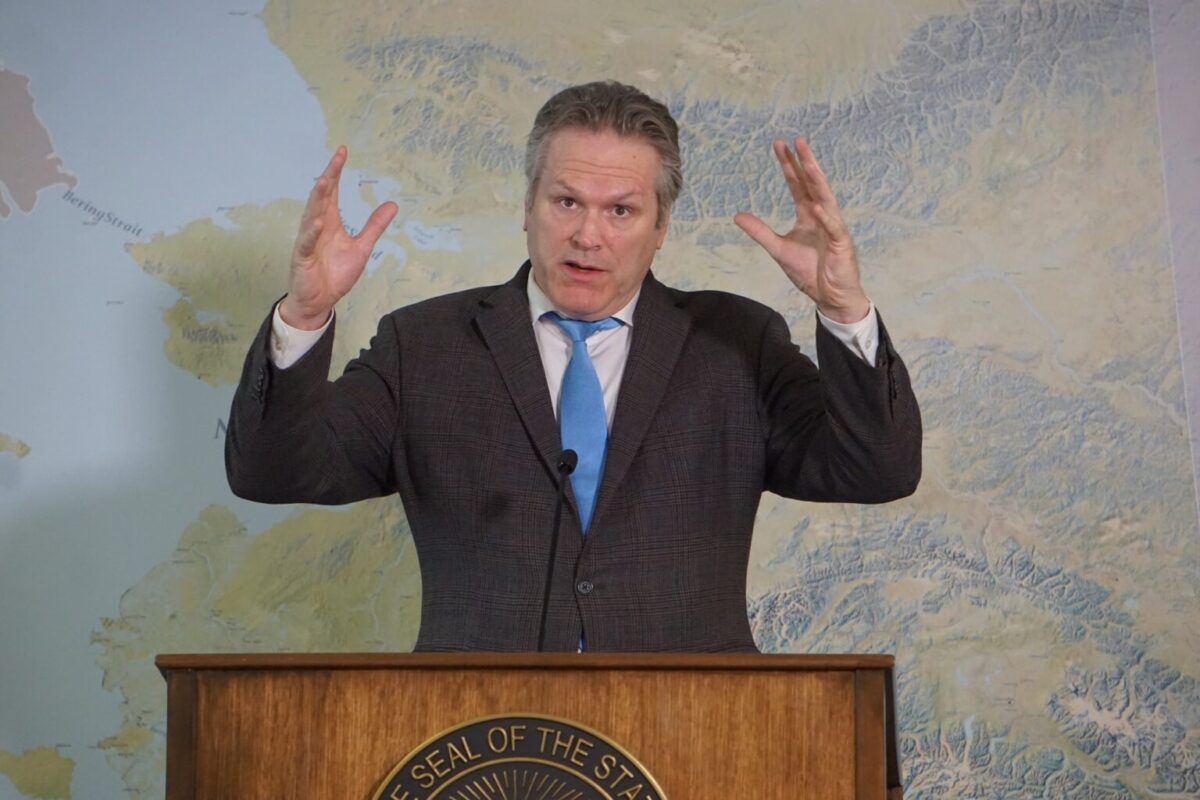
Alaska Gov. Mike Dunleavy is urging state lawmakers to act on his proposal to cut state taxes by $7.2 billion over the next 36 years to subsidize construction of the proposed trans-Alaska natural gas pipeline.
Failing to act, he said, could keep the pipeline from being built at all.
“This bill is too important. This concept is too important,” Dunleavy said. “This is not setting up a tax for the lemonade stand down here in the corner by the hot dog stand. This is the biggest (natural gas) project on the planet.”
But some state lawmakers are skeptical about the size of the governor’s proposed subsidy. Two alternatives — one in the House and the other in the Senate — are advancing through committees in the final weeks of the session.
Other legislators believe the pipeline already makes financial sense and no change is needed.
As a result, four different paths await state legislators in their last weeks, and it isn’t clear which one they’ll take — or whether the governor will call legislators into special session on the issue.
There’s also been no agreement with cities and boroughs affected by the proposed tax cut. There’s also no public agreement with North Slope gas producers or the state’s labor unions.
At the core of the problem facing lawmakers is how much — if any — subsidy is needed in order to attract investors who would pay for building the pipeline project in two stages.
The first stage would involve a pipeline from the North Slope to Cook Inlet for in-state use. The second stage would construct processing plants at the north and south ends of the pipeline, allowing larger volumes of gas to be exported overseas.
If both phases of the project are built, Department of Revenue economist Dan Stickel told legislators on Tuesday, the result would be cheaper natural gas than currently available from Cook Inlet.
“If the full project goes forward, it’s a significant reduction in cost to Alaskans,” he said.
Rep. Zack Fields, D-Anchorage, noted that Alaskans could be locked into high natural gas prices if the second phase is never built or if both phases are built but no exports take place.
For a hearing last week, the Department of Revenue estimated that under that scenario, prices in Anchorage would exceed $27 per thousand cubic feet by 2033, more than double current prices.
It’s unclear how likely that worst-case scenario is.
The larger the subsidy, the greater the chance that the project is built in full and the lower the price of gas for Alaskans, project proponents say.
“Our objective is to have the lowest cost gas for Alaskans and have certainty on the project,” said Adam Prestidge, president of Glenfarne Alaska, the project’s developer.
A problem, some legislators say, is that they’re working without information. Glenfarne, an international firm that last year bought 75% of the project and became its developer, has not shared its latest estimate for how much the pipeline will cost.
“I think it’s important for us to have starting points on what the actual numbers are, because if it needs tax relief, let’s figure out what the relief is,” said Sen. Bill Wielechowski, D-Anchorage.
Legislators also don’t know how much North Slope gas producers will charge for the gas, or what international buyers will pay for it.
Some of that information is impossible to know — legislators are trying to anticipate the price of natural gas in 2033 and beyond, once the pipeline is up and running.
Other information is being kept confidential until a final investment decision or when proposed prices are submitted to state regulators, something that’s months away at the earliest.
Legislators are being asked to take action within weeks.
“We’re not really competitive in the global market if the (cost) overrun is 40%,” said Rep. Julie Coulombe, R-Anchorage, on Tuesday.
The gas pipeline’s publicly stated cost on Tuesday was $46 billion, but most legislators believe the true figure is higher.
“I think it’s really $57 billion … if not higher,” said Sen. Bill Wielechowski, D-Anchorage, relying on a prior statement from former U.S. Sen. Mark Begich.
Begich, a Democrat, lost to Gov. Mike Dunleavy in the 2018 governor’s election. Now, Begich is a paid adviser, hired by Dunleavy’s administration on a $100,000 contract.
In a Tuesday hearing, Begich said lower taxes would not increase profits for investors or developers and would simply lower the end cost of gas for consumers.
“If you lower the tax, it does not go to the return or the profit or anything of this project,” he said.
“I am just telling you right now, every dollar you save consumers is a dollar in their pocket in an economy that is struggling,” Begich said.
Under his calculations, Wielechowski said, the average Southcentral Alaska family would save $55 per year if the pipeline is built and produces gas according to the latest available cost analysis from the Department of Revenue.
The subsidy needed to create that savings amounts to a loss of $500 per Alaskan per year, he said, money that could be used for the Permanent Fund dividend or state services.
“That’s not a good deal,” he said of the exchange.
The latest available version of the Senate proposal shows an increase in revenue to the state, rather than a subsidy. Instead of earning $27.9 billion through 2062, the state would earn $42.1 billion.
“I would describe that as very burdensome for the project and potentially prohibitively so,” Prestidge said.
“I will characterize that tax at that level as something that would require some real reconsideration of the drawing board of how the project is structured and taken forward,” he said.
In the House, discussions have been less acrimonious. The House Resources Committee on Tuesday morning discussed a proposed a subsidy of less than $5.9 billion, smaller than the governor’s concept but similar in other regards.
“It would be a tax reduction but a smaller tax reduction than proposed by the governor,” Stickel said of the House proposal.
On Tuesday afternoon, the committee worked methodically through a long series of amendments to its plan, frequently consulting Prestidge and Begich about how each might affect financial negotiations.
The House and Senate bills are each in an early stage of development. If passed by the resources committees, each would have to pass through their respective finance committee before advancing to a floor vote and on to the other half of the Legislature.
Alaska Organized Militia members from across the Alaska Army National Guard, and the Alaska State Defense Force, prepare for departure from Joint Base Elmendorf-Richardson as they travel to Bethel, Alaska, while supporting storm response operations, Oct. 13, 2025. (Alaska National Guard photo by Capt. Balinda O’Neal)
Alaska will deploy 25 National Guard soldiers and airmen to Washington D.C. this month, according to a Friday update from the Alaska Department of Military and Veteran Affairs.
The deployment is part of a response to President Trump’s August declaration of a “crime emergency” in the nation’s capital. In the nine months since, 2,500 troops remain, according to NBC4 Washington. Guard members have assisted with medical emergencies, arrests and beautification projects, as well as snow removal.
The division announcement said the Alaska service members will be focused on public safety: “Guard members provide support functions such as crowd management, perimeter security, and logistical and communications support.”
Alaska National Guard members will deploy for 60 days, according to the division, as part of a joint task force with the Metropolitan Police Department and federal law enforcement partners.
Gov. Mike Dunleavy approved a verbal request in November from the U.S. Secretary of the Army for Alaska to deploy 100 service members, following a national directive by the Pentagon to all 50 states to prepare National Guard service members to train for “civil disturbance operations.”
A spokesperson for Dunleavy’s office did not respond to a request for comment on the smaller deployment, the purpose and timing of the mission on Monday.
Lawmakers had raised concerns about the Pentagon’s national directive for an estimated 20,000 National Guard service members to be trained and prepared to deploy in U.S. cities within 24 hours. Alaska was initially charged with preparing 350 service members as part of a “quick reaction force” by Jan. 1.
Rep. Andrew Gray, D-Anchorage, co-chair of the Alaska Joint Armed Services Committee, and a veteran of the Alaska National Guard, was among those who had raised concerns.
On Monday, Gray said the smaller deployment for 60 days is less of an issue.
“I don’t think it’s in the best interest of the American taxpayer to be flying service members from Alaska to D.C. to do what I don’t believe is of grave consequence,” he said.
“At the end of the day, to me, it’s sort of a nothing burger. I do think that it shows that the Dunleavy administration and General (Torrence) Saxe are in alignment with Trump. They’re showing that they support Trump’s agenda. But again, this is just not that big of a deal, in my opinion.”
Speaker of the House Bryce Edgmon, I-Dillingham, and Senate President Gary Stevens, R-Kodiak (at rear) preside over Monday’s joint session of the Alaska Legislature on May 4, 2026. (Corinne Smith photo/Alaska Beacon)
After two southeast Alaska Republicans reversed themselves, the Alaska Legislature on Monday failed to override Gov. Mike Dunleavy’s veto of an elections bill intended to take effect this year.
Forty votes were needed to override the veto. Monday’s vote was 38-22, with Rep. Jeremy Bynum, R-Ketchikan, and Sen. Bert Stedman, R-Sitka, providing the critical votes to sustain the veto. Both previously voted to pass Senate Bill 64 and send it to the governor.
Each said after Monday’s vote that they did not believe state officials would be able to implement the bill in time for this year’s elections.
As written, SB 64 contained a swath of changes to state law that were intended to make it easier for Alaskans to vote and to improve the security of state elections.
Among the proposed modifications: Free postage for absentee ballots, a new system for absentee voters to track their ballots through the counting process, a 10-day period for absentee voters to fix problems that disqualified their ballots, updated procedures for auditing the state’s voter list to remove ineligible people, a requirement that the financial backers of ballot measures disclose their identities and a special liaison intended to fix widespread voting problems in rural Alaska.
Dunleavy vetoed the bill on Thursday. In his veto message to the Legislature, he wrote, “the Division of Elections warns such changes would be extremely difficult if not impossible, to implement securely and reliably in advance of the 2026 elections.”
Sen. Bill Wielechowski, D-Anchorage, supported the bill and the override. Speaking ahead of the vote, he said that in 2022, during a special election held after the death of Rep. Don Young, R-Alaska, the state was able to implement a ballot-tracking system within six weeks.
“I’m not prepared to tell Alaskans, ‘Sorry, it’ll have to wait another year. It’s just too hard,’” Wielechowski said.
Sen. Bill Wielechowski, D-Anchorage, speaks in support of overriding a veto by Gov. Dunleavy of an elections reform bill on May 4, 2026. (Photo by Corinne Smith/Alaska Beacon)
But Bynum said afterward that he was swayed by statements from the Division of Elections, which said it was uncertain about its ability to implement the system so quickly this year.
“I can’t speak to what they may or may not have done in 2022. I can only speak to what the Division of Elections is telling me today. And what they told me is that this timeline is too aggressive for them to effectively put this in the law,” he said.
Bynum said another factor in his vote was the use of tribal IDs by voters at the polls. SB 64 would have mandated the state to accept their use as voter ID. Bynum said that until the past week, he was unaware that tribal IDs could already be used as a matter of policy.
Bynum said the vote was a difficult one for him and that if the bill had taken effect Jan. 1, he would have voted for it.
Stedman was one of the last legislators to vote, and his opposition was significantly less important because Bynum’s decision had already sustained the veto.
“I think they need more time to implement it. That was it, pretty much. I think there’s a lot of good work in this bill and a lot of positive things, but it just needs a little more time,” he said while walking away from Monday’s joint session.
In a joint legislative session, lawmakers in the Alaska House and Senate failed to override Gov. Dunleavy’s veto of an elections reform bill, SB 64, by a vote of 38 to 22, sustaining the veto on May 4, 2026. (Photo by Corinne Smith/Alaska Beacon)
In March, the House voted 23-16 on March 23 to pass the bill. Rep. Ashley Carrick, D-Fairbanks, was excused absent from that vote but later expressed her support. Two days later, the Senate voted 16-4 to approve the House’s changes and send the bill to Dunleavy.
The veto of SB 64 was Dunleavy’s 10th in the two-year 34th Alaska State Legislature. While prior governors have vetoed more bills during a single Legislature, this Legislature has passed relatively few bills, and Dunleavy has vetoed bills at a higher rate than any previous governor.
Legislators overrode two of Dunleavy’s 10 vetoes. Two others, in addition to SB 64, saw override votes fail. The remaining five were never brought up for an override vote despite opportunities to do so.
The veto means a sixth consecutive year will pass without a significant update to the state’s election system. Bipartisan bills failed in 2022, 2024 and now 2026.
This year’s bill appeared to have the most likelihood of success — it was endorsed by Reps. Sarah Vance, R-Homer, and Kevin McCabe, R-Big Lake, two of the most politically conservative members of the state House, and it had support from House and Senate progressives.
The Alaska Federation of Natives issued a statement urging legislators to support an override, as did other groups.
But many Republicans opposed the changes because they wanted a more rigorous cull of the state’s voter list and oppose easier access to absentee voting.
Ahead of the final vote, Republican writer Suzanne Downing lambasted the bill, as did other socially conservative commentators.
Vance, speaking Monday to the Legislature, said she received “threats” and “bullying” because of her support of the bill and an override.
After the vote, she said “there has been slander and an all-out assault to discredit and, frankly, lie to the people about what this bill does.”
Asked whether she was referring to Downing and her website, which has published a series of articles against the bill, she said, “Very clearly — intentionally misleading the people about what’s actually in the bill, what it does, and claiming that I’m no longer a conservative.”
One of the articles was from Rep. Rebecca Schwanke, R-Glennallen, who urged Dunleavy to veto the bill and on Monday asked legislators to sustain the governor’s decision.
Speaking on the floor, she said rural voters in her district need more than 10 days to fix problems that might have disqualified their absentee ballot.
Sen. Mike Cronk, R-Tok, represents Schwanke’s district and another Fairbanks-area House district. He was in favor of the override.
“If I lose an election because a little old lady in Arctic Village had to cure her ballot and have that one ballot cost me my election, so be it,” he said. “Aren’t we here to make sure every vote counts?”