Categories
Featured Juneau News Juneau Local Ketchikan Local News Feeds Sitka Local

No US House vote to extend health care subsidies, Speaker Johnson says

By: Jennifer Shutt States Newsroom

U.S. House Speaker Mike Johnson, R-La., talks with reporters inside the U.S. Capitol on Tuesday, Oct. 21, 2025. (Photo by Jennifer Shutt/States Newsroom)

WASHINGTON — U.S. House Speaker Mike Johnson said Tuesday he will not allow a floor vote this week on a bipartisan amendment supported by moderate Republicans that would extend the Affordable Care Act enhanced tax credits. 

Johnson was confident that blocking the amendment would not lead centrist GOP lawmakers to oppose the Republican health care bill scheduled to get a vote Wednesday. 

“There’s about a dozen members in the conference that are in these swing districts who are fighting hard to make sure they reduce costs for all of their constituents. And many of them did want to vote on this Obamacare, COVID-era subsidy the Democrats created,” Johnson said. “We looked for a way to try to allow for that pressure release valve and it just was not to be.”

The enhanced ACA tax credits are set to expire at the end of the year, sharply increasing the cost of health insurance for the roughly 22 million Americans who purchase plans through the exchange and benefit from the subsidies. 

The House Republican health care bill wouldn’t extend those tax credits, frustrating GOP lawmakers in that chamber who are most at risk of losing their reelection bids during the November midterm elections. 

Johnson said he expects that GOP bill will pass, though he didn’t address its prospects in the Senate, where bipartisanship is needed for nearly all bills to advance under that chamber’s 60-vote legislative filibuster. 

‘Idiotic and shameful’

New York Republican Rep. Mike Lawler said in a speech on the House floor that GOP leaders’ decision to let the enhanced ACA tax credits expire was “idiotic and shameful,” especially after changes were added to address fraud and reduce costs. 

“So we have been forced to sign onto two discharge petitions,” he said. “And yet my Democratic colleagues will not join us, but for those that were at the negotiation table.”

Lawler then criticized House Minority Leader Hakeem Jeffries, of New York, for not encouraging Democrats to sign onto the bipartisan discharge petitions, noting that would likely get the 218 signatures needed to force a floor vote. He argued that’s because Jeffries “doesn’t actually want to solve the problem, he wants the issue.”

“This place is disgraceful,” Lawler said. “Everybody wants the upper hand.  Everybody wants the political advantage. They don’t actually want to do the damn work. This problem could be solved today if everybody who says they care about extending this signs the discharge.”

GOP-only bill in 2026?

When the House returns from its two-week holiday break next year, Johnson said, leaders may try to use the complex reconciliation process they used to enact the “one big, beautiful bill” to address health care. 

“What we anticipate going into the first quarter of next year is, possibly in a reconciliation package or in regular order a stand-alone, ideas just like this,” Johnson said after being asked a question about Health Savings Accounts. “We have a long list of things that we know will reduce premiums, increase access and quality of care.” 

President Donald Trump said Monday he wants Republicans to use the reconciliation process or to eliminate the Senate’s legislative filibuster to address health care and other policy priorities. 

“Republicans should knock out the filibuster and we should approve a lot of things,” Trump said. 

Senate Majority Leader John Thune, R-S.D., has said repeatedly he doesn’t intend to change or scrap the filibuster.

Direct payments or tax breaks

Trump also reiterated during the Oval Office event he would like to see Congress send direct payments to Americans to help them buy health insurance or afford health care. 

“I want all money going to the people and let the people buy their own health care. It’ll be unbelievable,” Trump said. “They’ll do a great job. They’ll get much better health care at a much lower cost.”

The Senate voted last week on two health care bills, one from Republicans and one from Democrats, but neither received the support needed to move toward a final passage vote. 

Republicans’ bill would have provided direct payments to some people enrolled in either bronze or catastrophic ACA marketplace plans with up to $1,500 in payments annually for 2026 and 2027. 

Democrats’ legislation would have extended the enhanced ACA marketplace tax credits for three years. 

Cost most urgent issue, poll finds

A bipartisan group of senators is trying to find solutions that bridge the political divide, though they are unlikely to achieve consensus on the details before the end of this week.

poll released Monday by the West Health-Gallup Center on Healthcare in America shows that cost is the “most urgent” health issue facing the country, followed by access and then obesity. 

Just 57% of those polled said they were satisfied with how much they pay for their own health care and only 16% were satisfied with the total cost of health care.

Nearly two-thirds of those in the survey said they believe it’s the federal government’s responsibility “to make sure all Americans have healthcare coverage,” while 33% said it’s not. 

Categories
Featured Juneau News Juneau Local Ketchikan Local News Feeds Sitka Local

Alaskans targeted by scammers posing as government officials, FBI warns

By: Corinne Smith, Alaska Beacon

Gift card displays, such as this one in a CVS in Harlem, N.Y., have been a source of concerns for lawmakers hoping to combat gift card fraud. “Card draining,” or stealing numbers from poorly packaged cards, is one of the costliest and most common consumer scams, and states are trying to combat it with consumer alerts, arrests and warning signs on store displays. (Photo by Robbie Sequeira/Stateline)

The Federal Bureau of Investigations’ office in Anchorage issued an alert warning Alaskans of scams impersonating law enforcement or government officials demanding payment. Alaskans lost an estimated $1.3 million due to this type of government impersonation scam in 2024 — more than five times the previous year’s losses.

Officials say Alaskans should not respond to calls claiming they have missed jury duty or have warrants out for their arrest. Officials say anyone targeted by such calls should not provide personal information or payment to the caller, but they should report scams to the agency.

“This scam isn’t new, but we are certainly seeing an uptick in this type of scam here in Alaska,” said Chloe Martin, a public affairs officer with the FBI Anchorage office.

In 2024, the bureau reported 6,670 fraud complaints from Alaskans, with over $26.2 million in losses. 

Scammers are calling residents and identifying themselves as an FBI official, a member of state or local law enforcement, or a government official. The scammer then claims the victim has missed jury duty or that a warrant has been issued for their arrest and demands payment from the victim, Martin said. 

Sometimes scammers will call using personalized information to appear official. “So when they look at their caller ID, it might actually look like it’s a caller from a legitimate law enforcement agency,” she said.

Martin said scammers use urgency, intimidation and fear to demand immediate payment in the form of cryptocurrency like Bitcoin, prepaid gift cards or wire transfers.

Martin urged Alaskans to pause, not give personal information or make payments and report the fraud to their bank and to the FBI’s Internet Crime Complaint Center, a reporting hub for cyber-crime. 

“If reported immediately, it’s actually not outside the realm of possibility to recover funds, so timely reporting is key,” she said. She added that victims should contact their bank to freeze funds if they have responded to a scam. 

Last year, the FBI recorded a more than five fold increase in losses from these scams, from nearly $250,000 lost in 2023 to more than $1.3 million in 2024.

Austin McDaniel, a spokesperson for the Alaska Department of Public Safety said it is common for scammers to impersonate Alaska State Troopers. 

“These scammers will go through and find the name of an Alaska law enforcement officer at that agency and call, pretending to be an actual state trooper, so that they’re sophisticated,” he said.

“This happens across the state. This targets every age demographic, and it’s something that we see a lot of,” he said. “I have personally received these types of scam calls demanding that I pay some type of exorbitant fee because I missed jury service. And thankfully, I know that’s definitely a scam, but not everyone does.”

McDaniel said it’s difficult to track, investigate and prosecute scammers because some of them are calling internationally, and are difficult to trace. He urged Alaskans to be cautious and not to make payments. 

“Law enforcement, the government, a utility, a bank, is never going to call you and demand money with a gift card or with Bitcoin,” he said. “If you get some type of suspicion that something’s wrong, it probably is.” 

Earlier this month, the Federal Emergency Management Agency issued an alert warning Alaskans of scammers posing as government officials, insurance agents or aid workers targeting residents impacted by Typhoon Halong receiving disaster assistance. 

Officials urged residents to contact FEMA to verify if a call is legitimate. 

McDaniel and Martin said their departments could not confirm cases of scammers specifically targeting residents impacted by the Western Alaska storm at this time, but McDaniel emphasized his department sees scammers victimize those who may already be more vulnerable. 

“We see it happen with missing persons,” McDaniel said. “Someone will call and try to defraud family members of missing people. Usually any type of situation where there’s some type of tragedy or emotional response to something, scammers will attempt to go through and exploit that.”

According to FBI data, Alaska ranked No. 1 in the nation in the number of internet crime complaints reported, at a rate of 914.7 complaints per 100,000 residents. Scammers target older residents because they can be more susceptible to scams The bureau estimates Alaskans in the age group of 60 or older lost more than $8.1 million to scams in 2024. 

Cryptocurrency scams are growing nationwide, as they are difficult to trace. In 2024, the FBI estimates 45% of Alaskans’ losses, approximately $11.7 million, were related to cryptocurrency related scams.

Such scams  have become a means to cheat investors, also known as “pig butchering,” according to the bureau. Scammers target victims, develop a relationship, and introduce a fraudulent investment opportunity in cryptocurrency.  Victims are coached to invest more and more money into the fraudulent investment, only to then be unable to withdraw their funds. 

Internet-based scams and fraud can range from emergency calls and extortion to identity theft and phishing or spoofing, where scammers identify as a trusted source and aim to gain login details or personal information to steal money or data. The FBI reports that complaints increased nationally by 33% in 2024, with $16.6 billion in losses.

Categories
Featured Juneau News Juneau Local Ketchikan Local News Feeds Sitka Local

Alaska revenue forecast predicts more oil, but its importance to the state budget is declining

By: James Brooks, Alaska Beacon
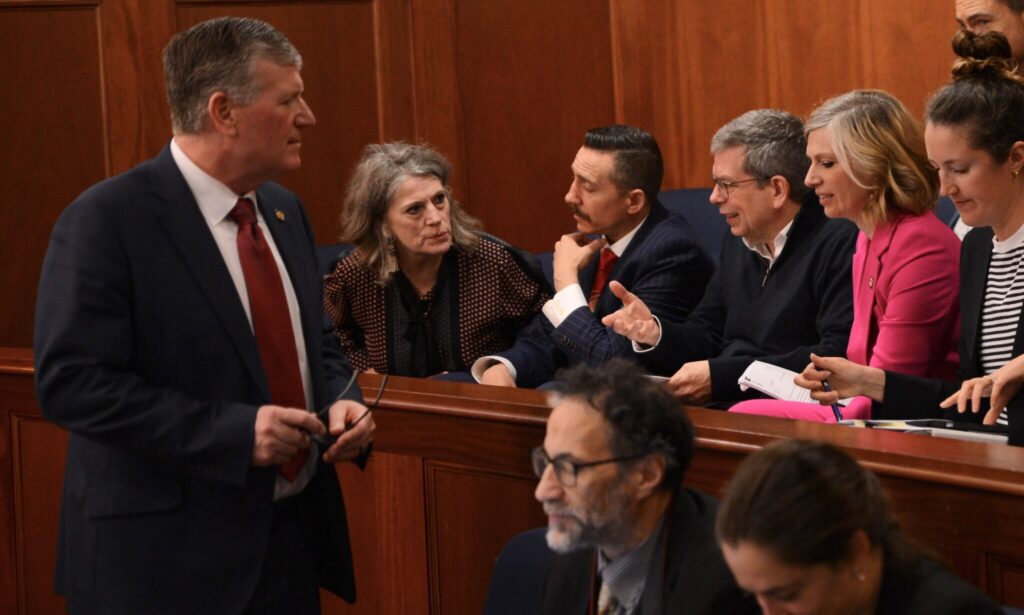
The trans-Alaska pipeline, seen on Oct. 8, 2008, threads over snow-covered terrain in the Brook Range foothills. A gryfalcon is perched on one of the pipeline’s thermosphyons in the lower center of the photo. (Photo by Craig McCaa/U.S. Bureau of Land Management)

Though the state of Alaska is anticipating more oil production in the fiscal year that starts July 1, money from oil continues to make up a dwindling share of general-purpose state revenue, according to a forecast published Wednesday by the Alaska Department of Revenue.

The projection, one of two per year published by the department, was released in conjunction with Gov. Mike Dunleavy’s draft budget for fiscal year 2027

Altogether, the state expects to earn $6.2 billion in general-purpose dollars between July 1, 2026 and June 30, 2027, the next fiscal year. Officially known as “unrestricted general fund revenue,” it’s the section of the budget where lawmakers and governors focus most of their attention. 

Federal money and money designated for specific programs can sometimes be shifted around to different priorities, but not easily. General-fund dollars can (and are) assigned to different priorities each year. 

The forecast for next year’s unrestricted general fund revenue is higher by almost $260 million than the current year’s expectation, but most of that increase isn’t coming from oil.

Since 2018, an annual transfer from the Alaska Permanent Fund to the state treasury has been the No. 1 source of general-purpose dollars for services and the Permanent Fund dividend. 

That’s more true than ever, according to the state forecast. 

In the next fiscal year, just 23% of the state’s general-purpose revenue is expected to come from petroleum revenue — royalties, property taxes and production taxes.

The Permanent Fund transfer would account for almost 66% of the general-purpose money. 

That difference comes despite an expectation that oil production will rise significantly between this fiscal year and next — from an average of 457,000 barrels of oil per day to 517,800 per day on average.

According to the Alaska Department of Natural Resources, that’s due to the startup of production in the Pikka oil field and other new production on the North Slope.

Despite that new production, oil revenue is expected to rise only slightly — from $1.43 billion to $1.44 billion.

That’s because the state is expecting North Slope oil prices to average just $62 per barrel during the next fiscal year, down from $65.48 in the current fiscal year.

At the same time, the Permanent Fund transfer is rising by almost $200 million, causing oil to become a still-smaller share of state revenue.

Even though revenue is expected to rise between the current fiscal year and the next one, the projected deficit in Dunleavy’s proposed spending plan stands at more than $1.8 billion.

If oil revenue alone were needed to fill that deficit, average North Slope prices would have to be near $100 per barrel, or the state would have to produce more than 1.2 million barrels of oil per day during the next fiscal year, an amount that is geologically, economically and mechanically unfeasible. The state hasn’t posted an annual average of over 1 million barrels of North Slope oil per day since the turn of the century.

Categories
Featured Juneau News Juneau Local Ketchikan Local News Feeds Sitka Local

Alaska Sens. Sullivan, Murkowski try unsuccessfully to prevent huge spike in health care costs

By: James Brooks, Alaska Beacon

Alaska U.S. Senators Lisa Murkowski and Dan Sullivan (Alaska Beacon file photos)

Alaska Republican Sens. Lisa Murkowski and Dan Sullivan joined Senate Democrats and a handful of other Republicans on Thursday in voting to extend federal subsidies that would have prevented a major spike in health care prices at the end of the year.

Sixty votes were needed to advance a bill containing the extension, but the vote failed 51-48. An alternative Republican-backed bill, which would have offered marginal help to offset the cost increases, also failed despite support from Murkowski and Sullivan.

Barring additional action before Jan. 1, thousands of Alaskans and millions of Americans who buy health insurance through the federal marketplace will pay significantly more for health care next year.

“I would just suggest that we have failed,” Murkowski said in a floor speech following the votes.

Sullivan, in a written statement, said in part that “there is little doubt that a lot of hard-working Alaskans, families, entrepreneurs and small business owners will be negatively impacted if these enhanced premium tax credits expire.”

Both Murkowski and Sullivan said they would continue working to try to find a compromise before the end of the year.

The failed Democratic proposal would have offered a flat three-year extension of subsidies that were put in place during the COVID-19 pandemic emergency and extended during the Biden administration.

Most Republican senators opposed a flat extension and emphasized instances of fraud and abuse, saying that further changes were needed to the program. 

Even with those changes, the Republican-backed proposal offered only a small cash payment and didn’t extend the subsidies; many Americans and Alaskans would still face large cost increases.

“Now that both the Republican and Democrat proposals failed to advance, I will redouble my efforts to develop a compromise solution. In the longer-term, we need to focus on getting federal government health care dollars out of the hands of insurance companies and into the hands of the people,” Sullivan said in his statement.

Categories
Featured Juneau News Juneau Local Ketchikan Local News Feeds Sitka Local

US Senate hits stalemate on solution to spiraling health insurance costs

By: Jennifer Shutt, States Newsroom

Health care costs. Stethoscope and calculator symbol for health care costs or medical insurance

WASHINGTON — The U.S. Senate in long-anticipated votes failed to advance legislation Thursday that would have addressed the rising cost of health insurance, leaving lawmakers deadlocked on how to curb a surge in premiums expected next year. 

Senators voted 51-48 on a Republican bill co-sponsored by Louisiana Sen. Bill Cassidy and Idaho Sen. Mike Crapo that would have provided funding through Health Savings Accounts for some ACA marketplace enrollees during 2026 and 2027. 

They then voted 51-48 on a measure from Democrats that would have extended enhanced tax credits for people who purchase their health insurance from the Affordable Care Act Marketplace for three years. A group of Senate Democrats in November agreed to end a government shutdown of historic length in exchange for a commitment by Republicans to hold a vote on extending the enhanced subsidies.

Republican Sens. Susan Collins of Maine, Lisa Murkowski and Dan Sullivan of Alaska and Rand Paul of Kentucky voted for the Democrats’ bill. Paul also voted against the GOP bill. 

Neither bill received the 60 votes needed to advance under the Senate’s legislative filibuster rule. 

Senate Majority Leader John Thune, R-S.D., criticized the ACA marketplace and the subsidies for leading to large increases in the costs of health insurance. 

“Under Democrats’ plan insurance premiums will continue to spiral, American taxpayers will find themselves on the hook for ever-increasing subsidy payments,” Thune said. “And don’t think that all those payments are going to go to vulnerable Americans.”

Thune argued Democrats’ bill was only an extension of the “status quo” of a “failed, flawed, fraud program that is increasing costs at three times the rate of inflation. 

Thune said the Republican bill from Cassidy and Crapo would “help individuals to meet their out-of-pocket costs and for many individuals who don’t use their insurance or who barely use it, it would allow them to save for health care expenses down the road.”

Schumer calls GOP plan ‘mean and cruel’

Senate Minority Leader Chuck Schumer, D-N.Y., said the three-year extension bill was the only option to avoid a spike in costs for people enrolled in ACA marketplace plans. 

“By my last count, Republicans are now at nine different health care proposals and counting. And none of them give the American people the one thing they most want — a clean, simple extension of these health care tax credits,” Schumer said. “But our bill does extend these credits cleanly and simply and it’s time for Republicans to join us.”

Senate Minority Leader Chuck Schumer, D-N.Y., speaks to House Minority Leader Hakeem Jeffries, D-N.Y.,  during a Hanukkah reception at the U.S. Capitol Building on Dec. 10, 2025 in Washington, D.C. (Photo by Anna Moneymaker/Getty Images)
Senate Minority Leader Chuck Schumer, D-N.Y., speaks to House Minority Leader Hakeem Jeffries, D-N.Y.,  during a Hanukkah reception at the U.S. Capitol Building on Dec. 10, 2025 in Washington, D.C. (Photo by Anna Moneymaker/Getty Images)

Schumer referred to the Cassidy-Crapo proposals as “stingy” as well as “mean and cruel.”

“Under the Republican plan, the big idea is essentially to hand people about $80 a month and wish them good luck,” Schumer said. “And even to qualify for that check, listen to how bad this is, Americans would be forced onto bare-bones bronze plans with sky-high deductibles; $7,000 or $10,000 for an individual, tens of thousands for a couple.”

After the votes failed, Schumer outlined some of the guardrails Democrats would put in place regarding negotiations with GOP colleagues.

“They want to talk about health care in general and how to improve it — we’re always open to that, but we do not want what they want — favoring the insurance companies, favoring the drug companies, favoring the special interests and turning their back on the American people,” he said. 

Health Savings Accounts in GOP plan

The Cassidy-Crapo bill would have the Department of Health and Human Services deposit money into Health Savings Accounts for people enrolled in bronze or catastrophic health insurance plans purchased on the ACA marketplace in 2026 or 2027, according to a summary of the bill. 

Health Savings Accounts are tax-advantaged savings accounts that consumers can use to pay for medical expenses that are not otherwise reimbursed. They are not health insurance products.

ACA marketplace enrollees who select a bronze or catastrophic plan and make up to 700% of the federal poverty level would receive $1,000 annually if they are between the ages of 18 and 49 and $1,500 per year if they are between the ages of 50 and 64. 

That would set a threshold of $109,550 in annual income for one person, or $225,050 for a family of four, according to the 2025 federal poverty guidelines. The numbers are somewhat higher for residents of Alaska and Hawaii.  

The funding could not go toward abortion access or gender transitions, according to the Republican bill summary. 

KFF analysis

Members of Congress have introduced several other health care proposals, including two bipartisan bills in the House that would extend the enhanced ACA marketplace tax credits for at least another year with some modifications. 

Speaker Mike Johnson, R-La., has been reluctant to bring either bipartisan bill up for a floor vote, though he may not have the option if a discharge petition filed earlier this week garners the 218 signatures needed. 

Pennsylvania Republican Rep. Brian Fitzpatrick wrote in a statement the legislation represents a “solution that can actually pass—not a political messaging exercise.”

KFF analysis

“This bill delivers the urgent help families need now, while giving Congress the runway to keep improving our healthcare system for the long term,” Fitzpatrick wrote. “Responsible governance means securing 80 percent of what families need today, rather than risking 100 percent of nothing tomorrow.”

But Johnson said Wednesday that he will put a package of bills on the House floor next week that he believes “​​will actually reduce premiums for 100% of Americans who are on health insurance.” Details of those bills have not been disclosed.

Thune told reporters that if “somebody is successful in getting a discharge petition and a bill out of the House, obviously we’ll take a look at it. But at the moment, you know, we’re focused on the action here in the Senate, which is the side-by-side vote we’re going to have later today.” 

Alaska’s Murkowski said lawmakers can find a compromise on health care by next week “if we believe it is possible.”

Political costs

The issue of affordability and rising health care costs is likely to be central to the November midterm elections, where Democrats hope to flip the House from red to blue and gain additional seats in the Senate. 

The Democratic National Committee isn’t waiting to begin those campaigns, placing digital ads in the hometown newspapers of several Republicans up for reelection next year, including Maine’s Collins and Ohio’s Jon Husted. 

“Today’s Senate vote to extend the ACA tax credits could be the difference between life and death for many Americans,” DNC Chair Ken Martin said in a press release. “Over 20 million Americans will see their health care premiums skyrocket next year if Susan Collins, John Cornyn, Jon Husted, and Dan Sullivan do not stand with working families and vote to extend these lifesaving credits.”

White House press secretary Karoline Leavitt blasted Senate Democrats’ proposal during Thursday’s press briefing, calling it a “political show vote” meant to provide cover for Democrats, whom she blamed for creating the problem. 

Trump and Republicans would “unveil creative ideas and solutions to the health care crisis that was created by Democrats,” she said. “Chuck Schumer is not sincerely interested in lowering health care costs for the American people. He’s putting this vote on the floor knowing that it will fail so he can have another talking point that he can throw around without any real plan or action.”

Shauneen Miranda and Jacob Fischler contributed to this report. 

Categories
Featured Juneau News Juneau Local Ketchikan Local News Feeds Sitka Local

Governor proposes FY 2027 Budget

Alaska Gov. Mike Dunleavy speaks during a news conference on Friday, March 15, 2024. (Photo by James Brooks/Alaska Beacon)

NOTN- Governor Mike Dunleavy on Thursday released his proposed Fiscal Year 2027 budget, a plan that would rely heavily on state savings to cover a substantial revenue gap.

The Office of Management and Budget projects the state will receive $15.3 billion in total revenue for the fiscal year beginning July 1, 2026, including $6.2 billion in unrestricted general funds available for lawmakers to appropriate, according to the statement release by Governor Dunleavy.

With declining revenue forecasts and rising costs attributed to inflation, Dunleavy’s proposal calls for withdrawing $1.5 billion from the Constitutional Budget Reserve, Alaska’s primary savings account, which currently holds about $3 billion.

Dunleavy said he plans to introduce a fiscal plan next session aimed at stabilizing state finances without raising taxes. He said the proposal will focus on expanding the private sector, controlling government growth and broadening the state’s economic base beyond oil.

Key elements of the governor’s FY 2027 budget include full statutory funding for K–12 public education, a full statutory Permanent Fund dividend of $3,650 per person and continued investment in public safety.

In an interview with KINY earlier this morning Juneau Senator Jessie Kiehl said, “The expectation is that it will be a budget that grapples with low oil prices. They’re closing below $64 a barrel, and that’s that’s really rough on the Treasury, and costs are going up for state services, just like they’re going up for Alaska. The governor has said that he’s submitting a fiscal plan, and that will be a very welcome change of pace, and if he is serious about that, it will give us a huge amount of work to do in this coming session, if we can get the state’s finances stabilized, not fat and happy, just stable, so we’re off the roller coaster. Alaska is poised for great things.”

Categories
Featured Juneau News Juneau Local Ketchikan Local News Feeds Sitka Local

Juneau’s Annual Holiday pet food drive expands as demand for help grows

By: Grace Dumas, News of the North

Pet food and supplies donations, Photo courtesy of Grateful Dogs of Juneau

Organizers of Juneau’s 16th annual Holiday Pet Food Drive say community support is more critical than ever for families struggling to afford pet food and supplies.

The drive, organized by Grateful Dogs of Juneau, began December 8, and runs through December 14, with donation boxes at Petco, Juneau Animal Rescue, and the main lobby of Bartlett Regional Hospital.

According to Pam Nelson of Grateful Dogs of Juneau, the organization distributes roughly 1,000 pounds of pet food to community food pantries every month.

“We’ve seen the need rise every month this year to the point that even in spring, our first spring pet food drive, we actually ran out of food.” She said, “This year has been an especially hard year for people.”

Pam said rising heating and utility costs leave many families forced to choose between paying bills and feeding their pets.

“If you have to choose between getting your heating oil, paying your electric bill, which is going to go up higher because it’s so cold, we can help offset having to make the choice between whether you can buy pet food.” Said Nelson.

Larger bags are broken down into smaller four- to five-pound portions to serve more families. A single 40-pound bag of dog food can help as many as 10 households, Pam said.

“I love Juneau.” She said, “I’ve lived here for almost 30 years, and just the amount that come out for their community members is just awesome.”

Donation bins will remain available at Petco and Juneau Animal Rescue during business hours, and at the Bartlett hospital lobby from 6 a.m. to 6 p.m. through Sunday. Grateful Dogs accepts donations year-round and will arrange pickup for those unable to deliver items.

Categories
Featured Juneau News Juneau Local Ketchikan Local News Feeds Sitka Local

Without completed 2025 reports, federal fishery managers use last year’s data to set Alaska harvests

By: Yereth Rosen, Alaska Beacon

Gulls hunting seeking scraps of fish swarm the docked fishing vessel Gold Rush, which harvests pollock and other groundfish, and Trident Seafood’s Kodiak plant on Oct. 3, 2022. The North Pacific Fishery Management Council set 2026 Bering Sea and Gulf of Alaska ccatch limits for pollock and other groundfish species, but the prolonged federal government shutdown interrupted the flow of information that would normally be used to set those harvests. (Photo by Yereth Rosen/Alaska Beacon)

Lacking the usual amount of data to guide them, federal fishery managers relied on last year’s reports to set the coming year’s harvests for the nation’s top-volume commercial fish species: Alaska pollock.

The North Pacific Fishery Management Council, the panel that sets harvest levels and other rules for fisheries conducted in federal waters off Alaska, voted on Sunday to keep 2026 pollock catch limits in the Bering Sea at about the same level as this year’s limits while paring back the pollock catch limit for the Gulf of Alaska.

Pollock, one of key species in the North Pacific Ocean, is widely sold as fish patties and fillets, fish sticks, imitation crab meat and other products.

The council, which sets the coming year’s groundfish harvest limits each December, typically bases those decisions on detailed annual Stock Assessment and Fishery Evaluation reports, known as SAFE reports. But this year, the prolonged federal government shutdown prevented National Oceanic and Atmospheric Administration scientists and their partners from completing SAFE reports for the Bering Sea and Gulf of Alaska.

Instead, the council used the 2024 SAFE reports, supplemented with some newer data about harvests completed this year and some preliminary information about ecosystem conditions. The newer information did not reveal any conservation concerns that would justify harvest reductions, the council determined.

Information that goes into SAFE documents comes from ocean surveys and analysis done by NOAA’s Alaska Fisheries Science Center, with cooperation from research partners. Like all years’ SAFE reports, the 2024 documents for the Bering Sea and Gulf of Alaska featured two-year projections, extending through 2026.

Bob Foy, the center’s director, said that while all of this year’s planned ocean surveys were completed, despite numerous challenges, information from them had not been fully reviewed or vetted.

However, last year’s reports are solid, Foy said.

“Those stock assessments are incredibly robust,” he told the council on Thursday. “What we put together last December was based on decades of information, decades of decisions, piles of information on biology, surveys and whatnot.”

Council members voted to set the Bering Sea and Aleutian Islands harvest of pollock at 1.375 million metric tons, slightly below the limit set for 2025. 

Counting all species of groundfish, a category that includes Pacific cod, sablefish, arrowtooth flounder and mackerel as well as pollock, the council set the total Bering Sea and Aleutian harvest limit at 2 million metric tons, unchanged from the 2025 limit.

The council set the Gulf of Alaska pollock harvest limit at 129,749 metric tons, considerably below the 2025 limit of 176,496 metric tons. The total Gulf of Alaska groundfish harvest limit was set at 464,336, compared to the 514,619 metric ton limit set for this year. Less than half of that 2025 limit has been harvested as of early November, according to council data.

Caitlin Yeager, representing owners of catcher-processor trawl vessels that harvest pollock, said the 2024 SAFE report held the “best scientific information available” to set 2026 harvests.

The North Pacific Fishery Management Council's December meeting, held at the William A. Egan Civic and Convention Center in Anchorage, is seen underway on Dec. 6, 2025. (Photo by Yereth Rosen/Alaska Beacon)
The North Pacific Fishery Management Council’s December meeting, held at the William A. Egan Civic and Convention Center in Anchorage, is seen underway on Dec. 6, 2025. (Photo by Yereth Rosen/Alaska Beacon)

Yeager, vice president for policy and engagement for the Seattle-based At-sea Processors Association, told the council that its plans for the 2026 pollock harvest were responsible.

“Maintaining these specifications ensures not only continuity but also legal defensibility and avoids the risk of a regulatory lapse that would otherwise halt our fishery operations” next spring, she said in testimony to the council on Saturday.

 Some industry representatives, citing positive indicators turned up by scientists’ surveys this year, argued for an increase in the allowable catch of Gulf of Alaska Pacific cod. The council did not take that step, but members agreed to revisit cod catch limits in the next few months if Alaska Fisheries Science Center scientists are able to provide enough information to warrant an adjustment.

While fishing industry representatives welcomed the council’s decisions, some environmental and community advocates expressed concern. 

Some testifying to the council or submitting written comments argued that catch limits for pollock and other groundfish should be reduced, citing information gaps and the ongoing and controversial incidental catches of river-bound salmon. Those accidental catches are called bycatch.

Megan Williams, fisheries scientist with Ocean Conservancy, was among those urging caution. She noted that this year, the annual ecosystem reports were not completed. That “represents another key data gap in 2026,” she said.

Abbreviated reports available in October contained some “red flags” that justified a more cautious approach to harvest limits, she said. “Data from 2024 and 2025 indicated a return to warm conditions with marine heatwaves occurring in all regions at given points, and reduced sea ice and cold-pool extent in the Bering Sea,” she said. The cold pool is an area of chilled deepwater that usually lingers in the Bering Sea in the summer, separating fish populations in the southern part of the sea from those in the north.

Francis Thompson, president of the Algaaciq Native Village in the Yukon River village of St. Marys, said the council was jumping too far ahead with its projections, not only for the coming year but for the year after that, given lack of information about salmon and other issues.

“It amazes me that you guys are already projecting 2026 and 2027 for allowable harvest of pollock,” he said in testimony on Saturday.

It is not fair that industrial fishing operators in the Bering Sea are allowed to continue their harvests at steady levels, he said, while subsistence users on the Yukon and elsewhere in Western Alaska have been forced to stop fishing because of low runs. The subsistence fishers account for only about 1 percent of the salmon catch, at most, but are bearing all the conservation burden, he said.

“We’re not going to be fishing for a while. And many of the folks in our area, the 1 percent that have put aside their fishing to save the resource for the escapement, are tired,” he said.

Escapement is the term used to describe salmon that reach their freshwater spawning grounds, allowing them to reproduce.

The council did not take action on salmon bycatch. Limits on Chinook bycatch already exist for the pollock fleet, and action on a chum salmon bycatch limit is scheduled to be taken at the council’s next meeting, to be held in February.

Council member Anne Vanderhoeven, during Sunday’s deliberations, said there is not yet any justification to reduce pollock harvests to conserve depressed runs of salmon in Western Alaska.

“The impacts of the salmon crisis are truly devastating to subsistence users and Alaska Native culture,” she said. “But the best scientific information available does not support the assertion that relatively small adjustments to the pollock (total allowable catch) will measurably or significantly increase salmon escapement to Western Alaska rivers.”

Categories
Featured Juneau News Juneau Local Ketchikan Local News Feeds Sitka Local

Alaska DOT is planning a new dock for one of Alaska’s most remote ferry terminals

By: James Brooks, Alaska Beacon

The Cold Bay dock is seen in 2021 during a visit by the ferry Tustumena. (Photo by Sean Maguire/contributed image)

The Alaska Department of Transportation and Public Facilities is planning a new dock at Cold Bay, one of the most remote stops on the state ferry system’s route map.

More than 600 miles southwest of Anchorage, on the Alaska Peninsula, the town of just 56 people is the gateway to the Izembek National Wildlife Refuge and home to a 10,000-foot runway used as an emergency stop for trans-Pacific flights. 

Cold Bay is a stop on the ferry route between Kodiak and Dutch Harbor, but the dock serves more than ferries — it connects the town with ships that supply groceries, water and almost everything else it needs.

State surveys have found that the existing dock “is nearing the end of its serviceable life and is at risk of failing.”

Most of the funding for the new dock is expected to come from the federal government; the Infrastructure Investment and Jobs Act passed by Congress during the Biden administration included $43.4 million for the dock, and the state will contribute another $8.7 million in matching funds.

The final cost of the dock may be higher than that; inflation has driven the cost of all construction projects higher than they were in 2023, when the federal government awarded a construction grant.

Under DOT’s timeline, the project will go out to bid in spring 2027, with construction beginning the following year, and projected to be completed in 2029.

The new dock is expected to be large enough to support the planned replacement for the ferry Tustumena.

One public meeting about the project has already taken place; a second is planned for Tuesday evening, Dec. 16, by Zoom.

Categories
Featured Juneau News Juneau Local Ketchikan Local News Feeds Sitka Local

State senators express skepticism about proposed Juneau ferry terminal backed by Dunleavy

By: James Brooks, Alaska Beacon

Sen. Jesse Bjorkman, R-Nikiski, speaks Wednesday, April 23, 2025, on the floor of the Alaska Senate. (Photo by James Brooks/Alaska Beacon)

In a Friday hearing, members of the Alaska Senate spoke critically about a proposed new ferry terminal in Juneau, questioning why the project would be worth its multimillion-dollar cost.

Earlier this year, state legislators planned to divert $62 million from a variety of transportation projects in order to pay for the state share of federal transportation grants worth between $500 million and $600 million.

Lawmakers included the diversion in their budget for the year, but Dunleavy vetoed the maneuversaying that the “funding is either still obligated in the original project or has been fully expended and is unavailable for reappropriation.”

That left legislators’ spending plan partially unfunded.

One of lawmakers’ biggest targets this past spring was DOT’s plan to build a new ferry terminal in Juneau, roughly 30 miles north of the existing terminal in Auke Bay, in Juneau at a place called Cascade Point, which would shorten ferry runs to Haines and Skagway.

Legislators sought to divert $37 million from an account intended to fund that new terminal, but Dunleavy vetoed the transfer and the Department of Transportation subsequently signed a $28.5 million contract for work on the terminal.

In October, the state’s ferry advisory board concluded that the project likely did not make economic sense. 

“Do you agree with that study?” asked Sen. Jesse Bjorkman, R-Nikiski, during Friday’s hearing of the Senate Transportation Committee.

“Can you please make the case to the Alaska people why you think investing this money … in the Cascade Point project makes fiscal sense for Alaskans?”

Anderson responded that “as a public agency, we’re more than economics. In this case, there’s this idea of saving people time with a much shorter run, saving money, the cost of operating that ship, we’re saving fuel. It’s less carbon emissions. I mean, there’s a lot of good benefits to shorter ferry runs.”

Lawmakers don’t have the votes to override the governor’s vetoes, which means that when they reconvene in January, they’ll have to come up with a new way to fund construction work this summer.

According to documents presented to the committee on Friday, the Alaska Department of Transportation has “deferred” about 25 projects 1-3 years “to remain within available match.”

Without new money, “fewer projects will move to contract award, limiting construction activity.”

Ryan Anderson, commissioner of the Alaska Department of Transportation and Public Facilities, told the transportation committee that his agency is prioritizing “shovel ready” projects, those that are about to go to construction.

“As we go and prioritize projects through this year, we’ll continue that action, and we’ll be ready. That’s really how we’re looking at this program,” he said.