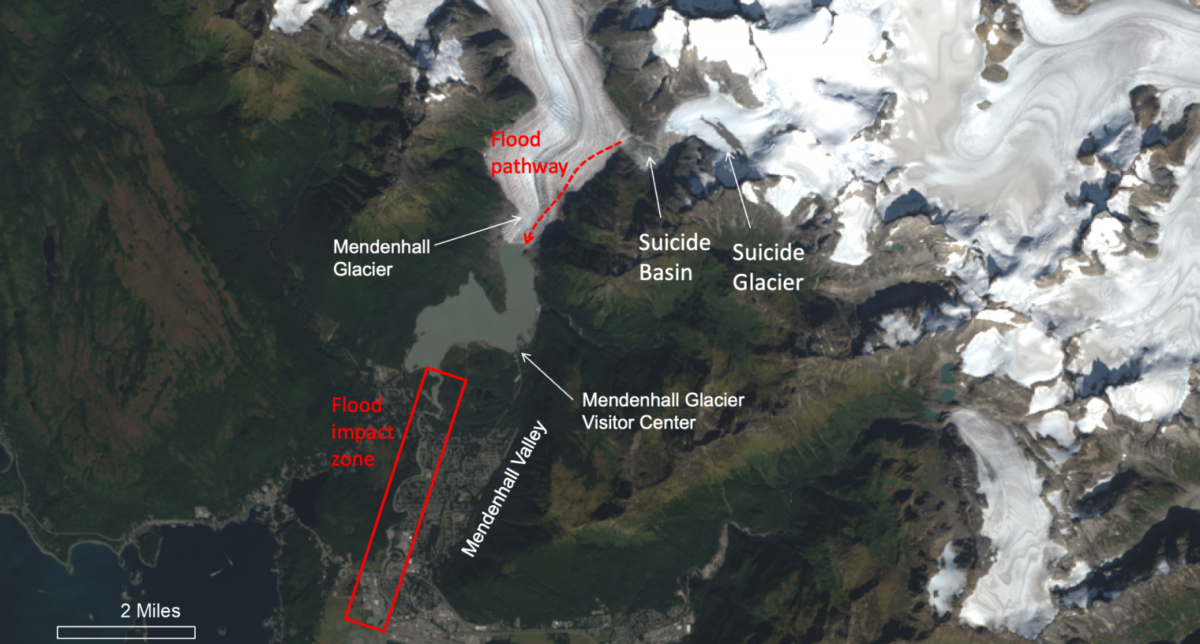
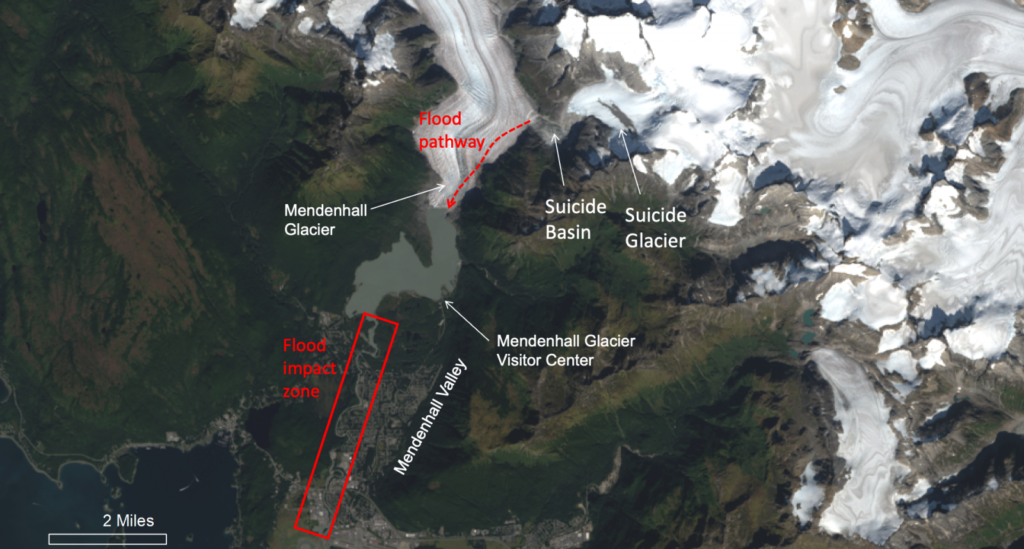
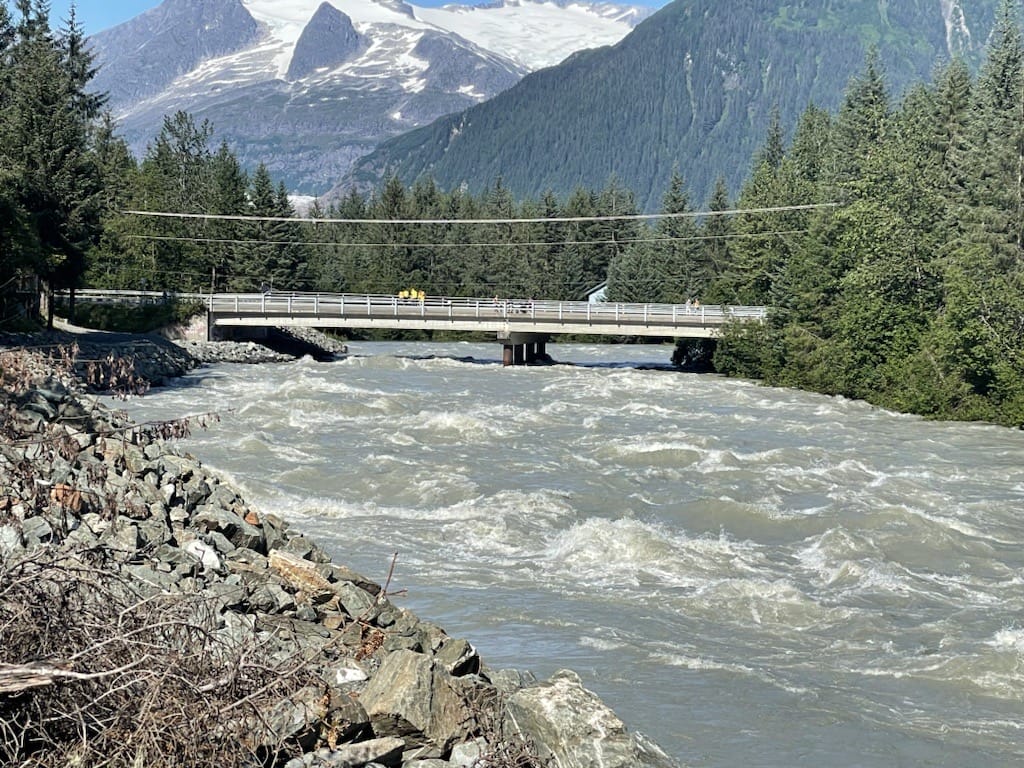
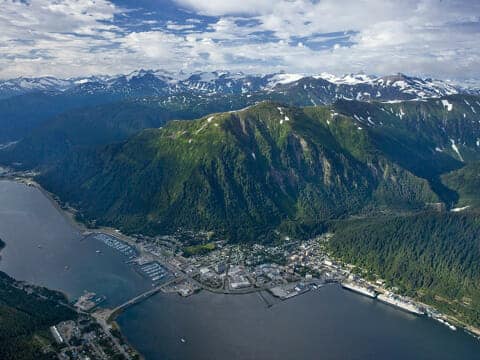
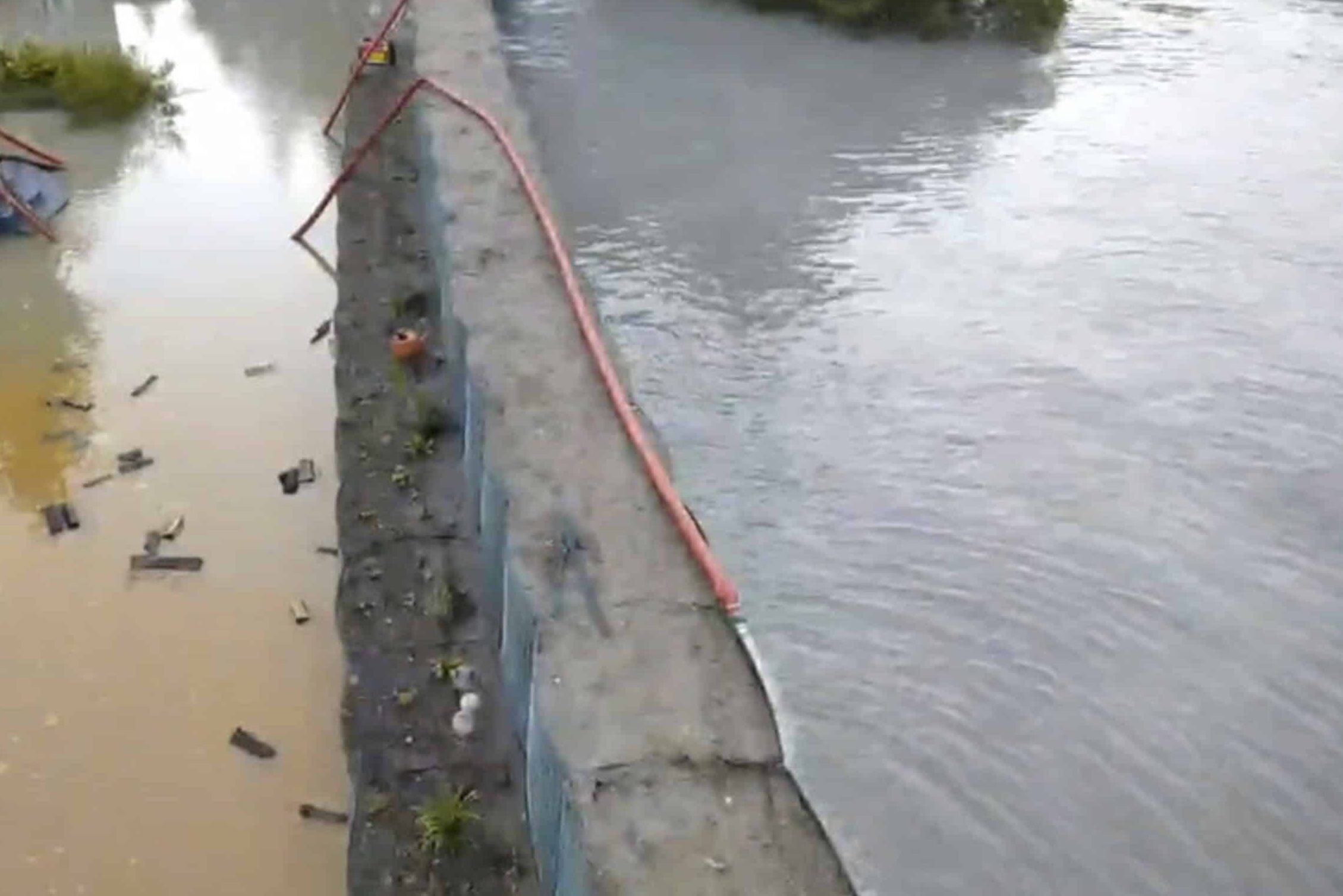
Mendenhall overview from the National Weather Service
NOTN- The city of Juneau has entered a heightened state of readiness after officials confirmed just this morning that Suicide Basin is full, meaning the anticipated Glacial Lake Outburst Flood in the Capitol city could happen at any time.
“We call this the set phase, where people should be prepared to evacuate.” Said Mayor Beth Weldon, “But it could still be days, if any. We’re all getting used to this. It could be within 24 hours, or even as much as five or six days until the basin releases.”
Weldon said the timing of any potential outburst flood remains uncertain. The City is in the “Set” phase of it’s ‘Ready, Set, Go’ framework, which means residents affected by the GLOF should stay vigilant and continue to check in with emergency officials, have a go bag packed and be ready to activate a plan of safety.
According to the National Weather Service, in the past it has taken up to 6 days for the main event to start after the basin is full.
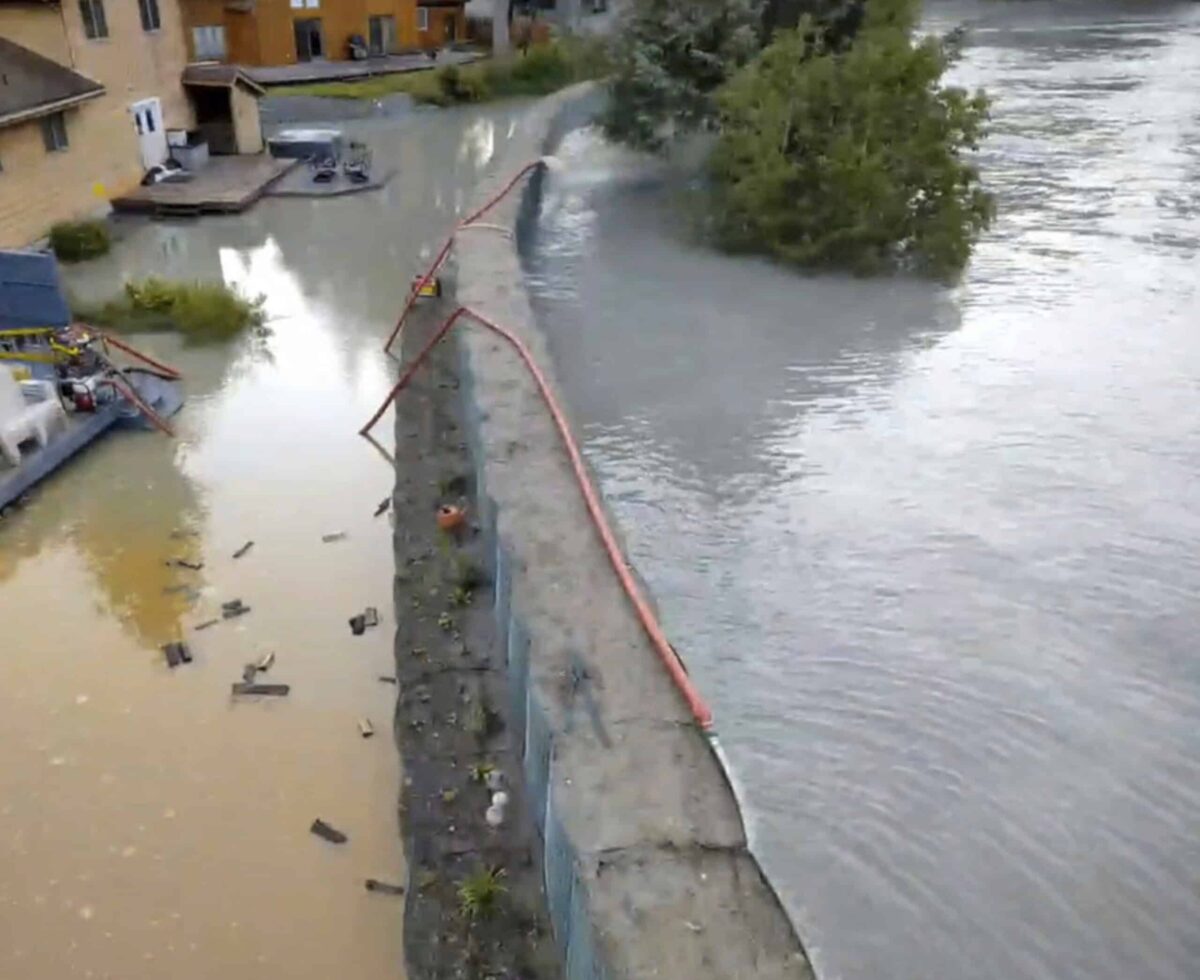
City officials urged residents to closely follow evacuation notices and stay away from flood control structures, particularly the Hesco barriers along vulnerable stretches of riverbank.
“Please do not climb up on the Hesco barriers,” Weldon said. “If they fail, it’s going to be catastrophic, and they could fail in a moment’s notice. You will not have time to run or move.”
if you have any questions, you can call the flood hotline at 907-500-0890 for information and updates.
“Everybody, try and be safe, and please abide by the evacuation notice,” Weldon said. “Again, everybody stay safe.”
NOTN- Federal officials say they are preparing both short- and long-term defenses as another glacial outburst flood is expected to hit Juneau’s Mendenhall River in the coming days, continuing a pattern of annual summer flooding that has put homes and lives at risk.
In a briefing Thursday, U.S. Sen. Dan Sullivan and Assistant Secretary of the Army for Civil Works Adam Telle said the U.S. Army Corps of Engineers has strengthened temporary protections ahead of the anticipated 2026 glacial outburst flood, and they’ve been gearing up to launch an unprecedented effort to drain water from Suicide Basin, the source of the destructive floods.
Sullivan said the Corps and local partners have invested about $45 million to make Hesco barrier floodwalls along the Mendenhall River taller and wider, and deployed roughly 40% of the Corps’ global pump inventory to Juneau as a backup if the river overtops or breaches the barriers.
“The fact that one of America’s capital cities in our country floods every summer at the risk of not only property but lives, you know, these floods are very risky for not just the safety of our own citizens, it’s a huge, unique challenge.” Sullivan said.” “The Corps of Engineers now has deployed 40% of all the pumps in the Corps of Engineers inventory for the world… in Juneau, just in case.”
Telle said the Corps will move quickly after this year’s flood to seek private-sector proposals for a faster, less costly way to evacuate water from Suicide Basin.
“We believe that evacuating water from Suicide Basin is fundamentally the best way to prevent this from happening in the future,” Telle said, ““We have a phenomenon here in Juneau that’s unlike any other in our entire portfolio.”
According to stories by both KTOO and the Juneau Independent, a local mining executive presented ideas that could cut the cost in half of teh proposed Lake Tap solution in half, groups like Juneau Flood Solutions have supported this effort.
Officials warned the public not to be complacent even with higher barriers in place, saying debris impacts remain a major threat and urging residents to treat the coming flood as a serious safety risk.
NOTN- As Suicide Basin nears capacity, the City and Borough of Juneau is urging residents in the flood evacuation zone to finalize their emergency plans.
In an interview with CBJ Emergency Programs Manager Ryan O’Shaughnessy, he said residents are encouraged to know where they’ll go if an evacuation is ordered.
“The basin is is almost full, once the basin becomes full and gets to 1350 ft, folks can expect to get an alert on their phones.” O’Shaughnessy said, “That’ll that loud, sort of jarring alert, a sort of siren that comes out of your phone for just a minute. And that’ll let people know that the basin has become full. And in our Ready, Set, Go framework, we’ve moved from Ready into Set. That means it’s time for folks to have a bag packed, it’s time to make sure your phone is charged, there’s gas in the car, and that you’re ready to go when the basin begins to release.”
We’ve put together the CBJ approved evacuation routes, take note of what’s nearest to you if you are in the evacuation zone.
Residents north of Division Street, please travel north on Riverside Drive, toward Mendenhall (Back) Loop Road and out of the inundation area.
Residents south of Division Street, travel south on Riverside Drive, turn left on Stephen Richards Memorial Drive, towards Mendenhall Loop Road.
On Rivercourt Way, travel south on Riverside Drive, toward Egan Drive
On the west side of the Mendenhall River, travel west on Mendenhall (Back) Loop Road toward Auke Bay (avoid Back Loop Bridge).
West of Brotherhood Bridge, travel west on Glacier Highway toward Auke Bay
An emergency shelter will be available at Floyd Dryden Middle School, and limited space is available there for pets. Juneau Animal Rescue can also help coordinate temporary pet sheltering.
People in the evacuation zone are also being asked to register their vehicles in advance if they plan to use the city’s temporary flood parking areas, which are located at St. Brendan’s Episcopal Church 4207 Mendenhall Loop Road, Shepherd of the Valley Lutheran Church 8198 Keegan Street, Christ Lutheran Church 10300 Glacier Hwy, Juneau Christian Center 8001 Glacier Hwy.
“We’re optimistic, and we have a tremendous amount of confidence in the HESCO barriers, but it’s not something to bet your life on. That’s why we’re really encouraging folks who live in the hazard area to evacuate and go ahead and heed that evacuation advisory when that’s issued.” O’Shaughnessy said.
Officials recommend preparing homes now by moving valuables, as well as items such as oils, paints and cleaning products, into secure waterproof containers at higher elevations.
Residents should also have a go-bag packed and ready in case an evacuation order is issued.
Officials remind residents not to drive or walk through floodwaters and to wait for an official all-clear before returning home after the event. The City and Borough of Juneau has also activated a flood information hotline for non-emergency questions. The hotline currently operates weekdays, with expanded weekend and around-the-clock hours planned once the basin fills and, if necessary, when a flood begins. United Way of Southeast Alaska is also coordinating volunteers and assistance for residents who may need help before or after the flood.
Flood waters are rising at a rate of about 3 feet per day but more information about flood preparedness is available through the City and Borough of Juneau’s flood readiness resources, the National Weather Service or by calling the flood hotline.
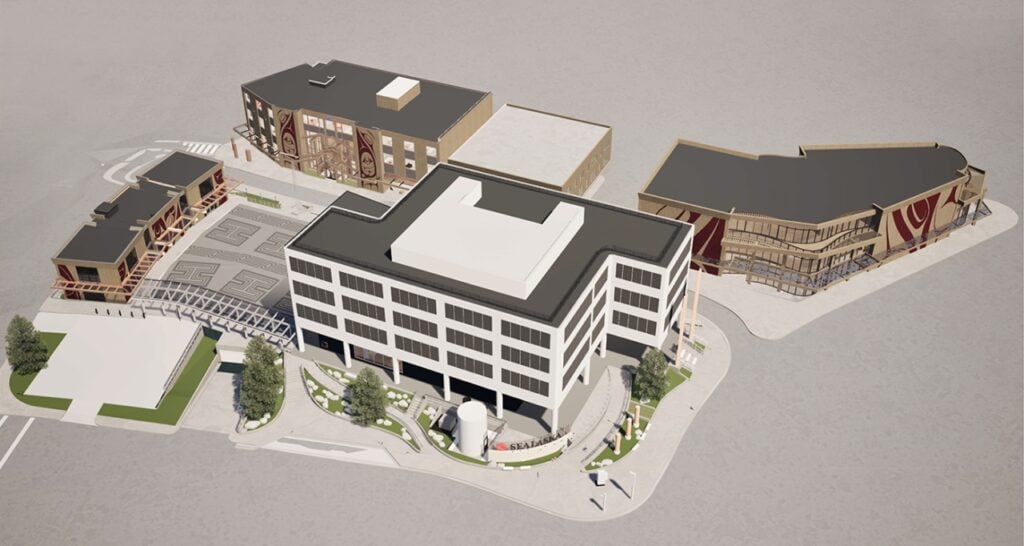
NOTN- Sealaska Heritage Institute has released new renderings of a proposed $40 million mixed-use arts and cultural center planned for the current Juneau City Hall site.
The three-story facility would feature Northwest Coast art and cultural experiences, a glass-blowing studio, gallery space, community programming and a possible new home for the Juneau-Douglas City Museum, though no agreement has happened between SHI and the city as of now.
Institute officials say the project would strengthen downtown year-round, create jobs and expand Juneau’s cultural tourism economy. The proposal depends on the City and Borough of Juneau approving the sale of the City Hall property to Sealaska Heritage for $1.5 million.
The Juneau Assembly is scheduled to hold a public hearing on the proposal Aug. 17.
The full press release by SHI can be found below;
Sealaska Heritage Institute (SHI) has released schematics of its proposed arts building envisioned for the site of Juneau’s old city hall.
The crown-jewel, mixed-use facility would encompass multi-levels, feature stunning glass walls and be adorned in monumental red formline design — elements that mirror SHI’s Walter Soboleff Building, Atnané Hít (Sealaska Heritage Arts Campus) and its Indigenous Science Building in the city’s designated Heritage Square.
The space would provide authentic educational, cultural and art experiences for locals and visitors, include a Northwest Coast art glass studio and offer space to house the Juneau-Douglas City Museum.
The project is part of SHIs efforts to make Juneau the Northwest Coast arts capital of the world, said SHI President Rosita Worl.
“We are thrilled to unveil our latest proposal to bring more Northwest Coast arts, cultural experiences and economic diversity to Juneau and to further enhance the downtown corridor,” Worl said.
The project hinges on whether the city elects to put the project out to the highest bidder or sell to SHI for $1.5 million. If the institute did purchase the land, SHI would have to raze city hall because it’s contaminated with asbestos and other toxins inside and below the dilapidated facility. The city also has delayed maintenance on the building that would cost $13 million to address.
Demolishing the building and decontaminating the site would come with a steep price tag, said SHI Chief of Operations Lee Kadinger.
“The project would require demolition and removal at considerable cost to SHI. The demolition and highly regulated removal and disposal process is estimated to cost in excess of $1 million before construction of a new facility would be possible,” Kadinger said.
The new structure would span roughly 30,000 square feet and encompass three floors. If it were built using today’s prices, it would cost approximately $32 million. Assuming it will take four years to raise capital funds, the price would be closer to $40 million, as costs rise over time, Kadinger said.
SHI would install a nicely landscaped space onsite for locals and visitors while it’s raising capital funds to build the facility, similar to when it filled in the so-called “pit” downtown while the institute raised money to construct the Walter Soboleff Building.
The institute would give the city first right of refusal to relocate the Juneau-Douglas City Museum to the second floor of the building. This would move the museum closer to cruise ship docks.
Through community oriented year-round activities, the facility will help draw locals to the downtown corridor in off-tourism months — and help to revitalize downtown, which is a priority of the City and Borough of Juneau. The institute is also considering setting aside some space for apartments in recognition of the community’s housing needs, as well as its own employees.
Cultural Tourism
The new facility would launch SHI’s planned cultural tourism programming, where visitors and locals would get hands-on experiences in Northwest Coast arts.
The structure would include a glass studio, where the famed Tlingit glass artist Preston Singletary would help to establish the program and secure partners who would create an educational structure around glass blowing. This would become a creative space for the community of Juneau — one that could grow to create opportunities for visitors and locals to make their own glass pieces. Singletary would also help create a tiered program to develop skills from beginner to advanced, teaching students to create limited production pieces that could become a cottage industry over time.
The glass studio is based on the wildly successful model created by the Museum of Glass in Tacoma, Washington, which draws nearly 100,000 visitors annually, includes a Hot Shop that hosts more than 50 visiting artists each year and has engaged more than 250,000 students through educational programs to date.
The new facility would be across from the Juneau Seawalk and Marine Park and attract more tourists to the core of downtown. The glass studio and a retail gallery for high end art would add to SHI’s monumental art and cultural tours currently offered at the Arts Campus and Walter Soboleff Building.
Community Benefits
While SHI projects and services are structured for tribal members, many of the programs benefit or are available to the entire community. Teacher trainings, lectures, art classes, summer camps, visiting scholars, concerts, academic publications, live streams, traditional ceremonies, First Fridays, Totem Pole Trail tours and Indigenous science workshops are commonly available to the public.
As the glass program grows, the facility would be open to residents who want to learn about the art of making glass and glass blowing.
SHI’s three other buildings also have transformed and beautified Juneau, adding to the visual appeal of downtown, and the plaza has been open to the public for art performances and other activities. The institute’s hope is to retain the city hall site for additional community space.
Economic Benefits
The successful completion of previous SHI capital campaigns has led to significant benefits for Juneau. In addition to its construction projects and their associated employment and economic activity, SHI has provided direct monetary contributions to the Juneau School District and University of Alaska Southeast totaling more than $13,000,000 since 2015, according to a 2025 study by McKenley Research Group, and it plans to continue the educational investments.
Today, SHI employs more than 100 staff in Juneau. An economic impact study by the same firm in 2023 demonstrated that SHI generates more than $30,100,000 in direct and induced economic activity annually in Juneau.
Because SHI’s buildings are staffed and open year-round, they support area businesses as employees patronize nearby establishments. The new building’s employees would help offset the loss of city workers who will move to the area by the Juneau-Douglas Bridge.
As with SHI’s other buildings, the new facility is expected to provide an economic boon during construction, provide new jobs, boost labor income and generate millions of dollars in direct expenditures.
The city will hold a public hearing on Monday, Aug. 17, to take public testimony on the terms of the sale.
Sealaska Heritage Institute is a non-profit tribal organization founded in 1980 to perpetuate and enhance Tlingit, Haida and Tsimshian cultures of Southeast Alaska. Its goals are to promote cross-cultural understanding by educating the general public about the Indigenous cultures of Alaska. SHI also conducts scientific and public policy research that promotes Alaska Native arts, cultures, history and education statewide. The institute is governed by a Board of Trustees and guided by a Council of Traditional Scholars, a Native Artist Committee, a Southeast Regional Language Committee and an Education Committee.
CONTACT: Kathy Dye, SHI Communications and Publications Deputy Director, 907.321.4636, kathy.dye@sealaska.com. Captions from top: The facade of the arts building. The structure as seen from Marine Way. Heritage Square, which currently includes SHI’s Atnané Hít (Sealaska Heritage Arts Campus), Walter Soboleff Building, its Indigenous Science Building and the Sealaska building. Schematics by MRV Architects, courtesy of Sealaska Heritage Institute. Note: Media outlets are welcome to use these photos for coverage of this story. For higher resolution images, contact kathy.dye@sealaskaheritage.com.
NOTN- State transportation officials say that the Back Loop Bridge will be closed to all traffic during the anticipated Glacier Lake outburst flood also known as GLOF, while Brotherhood Bridge will remain open to vehicles but closed to pedestrians for safety.
“Much like last year, we’re going to close the bridge that’s on Back Loop when the gauge level on Mendenhall Lake hits 12 feet, or at 8:30 at night if it’s predicted to go over 12 feet overnight.” Said Department of Transportation Incident Commander Travis Eckhoff, “Folks will remember last year during the flood we had some damage to an approach that totally washed the approach out on the east side of the bridge. And so, just for everyone’s safety, we’re going to go ahead and close that bridge once it hits 12 feet, and we’ll open it back up once our engineers have had a chance to go and inspect the bridge to make sure everything’s okay.”
Engineers will inspect the bridge before reopening it once water levels subside.
Eckhoff urged residents to heed evacuation boundaries, avoid driving through floodwater and sign up for alerts at 511alaska.gov and with the City and Borough of Juneau.
Drone flights will also monitor infrastructure during the event.
“When the basin releases we’ll be putting out a temporary flight restriction for a specific area. So we advise you don’t fly your drones in that area. We’ll be posting that on our socials. There will be drones in the sky, monitoring important infrastructure and HESCO barriers.” Echkoff said.
NOTN- Juneau voters will again decide whether to extend the city’s 3% temporary sales tax for another five years, which city staff say is critical to funding basic services.
The Assembly approved Ordinance 2026-13 Monday night, which places the question on the October 2026 ballot. The measure would continue a 3% tax from July 1, 2027, through July 1, 2032.
City Manager Katie Koester told Assembly members that Juneau’s total 5% sales tax is built from a 1% permanent base tax, a 1% temporary capital projects tax, and this 3% temporary levy that has been in place since 1983.
“The temporary 3% tax is used to fund really the bread and butter of city services. 1% is spent on operations, including police and fire, 1% is spent on streets and drainage projects and we’ve added some utility projects to that list as of late to again keep up with those utility projects. Then the other 1% goes to other needed CIP projects, often parks and playground maintenance, there’s some Eaglecrest funding in there.” Said Koester, “The 3% has been around for decades and really is part of how we’re able to provide basic city services. This ordinance puts 3% on the ballot this fall and I recommend the assembly take public testimony and adopt this ordinance.”
The ordinance passed without objection, sending the renewal to voters this fall.
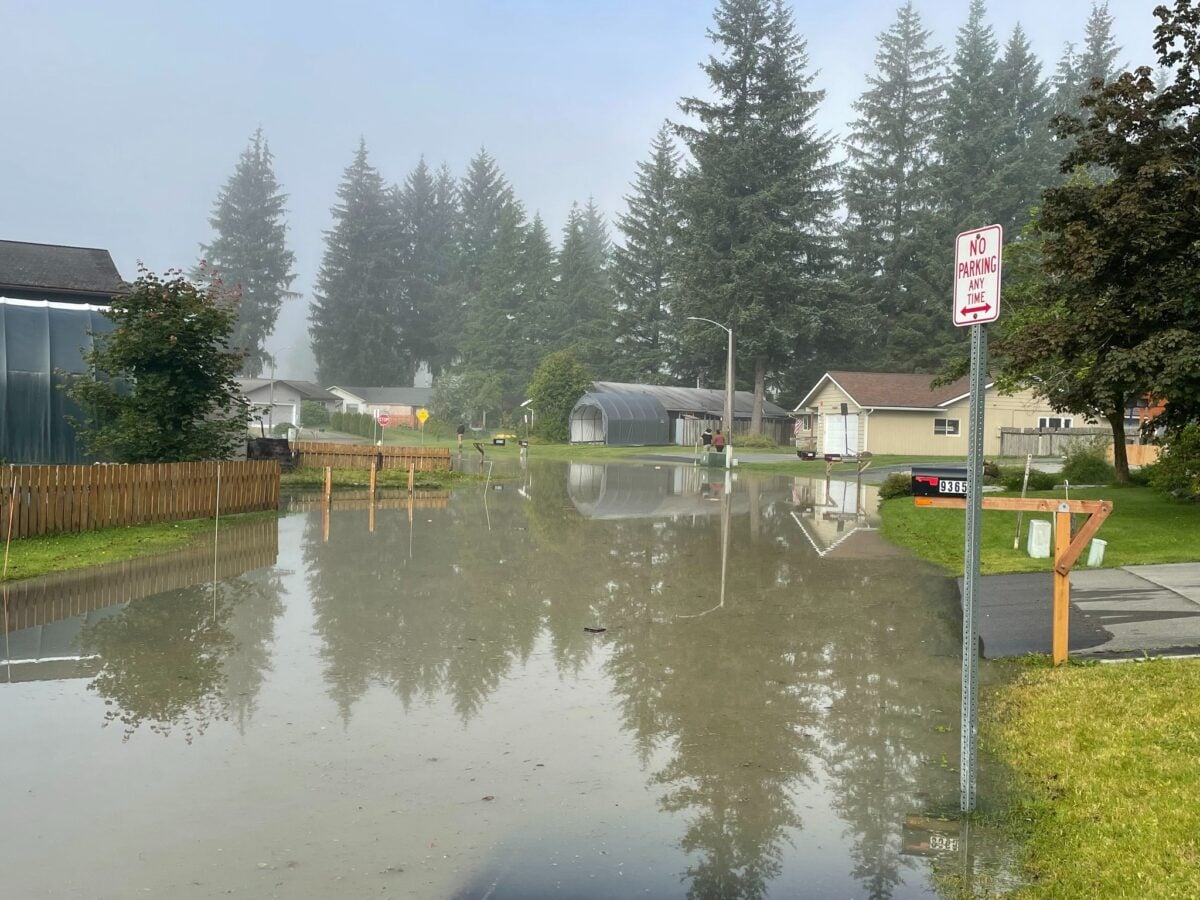
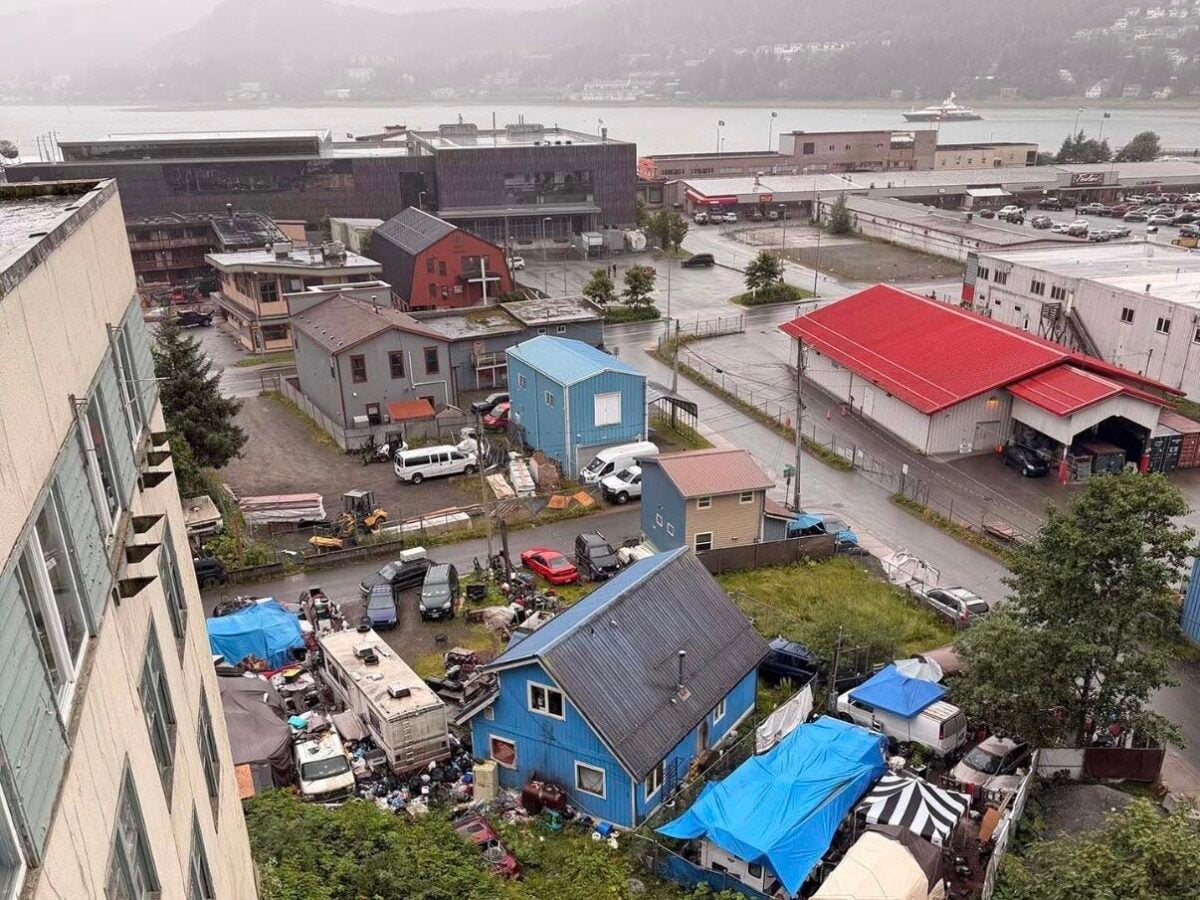
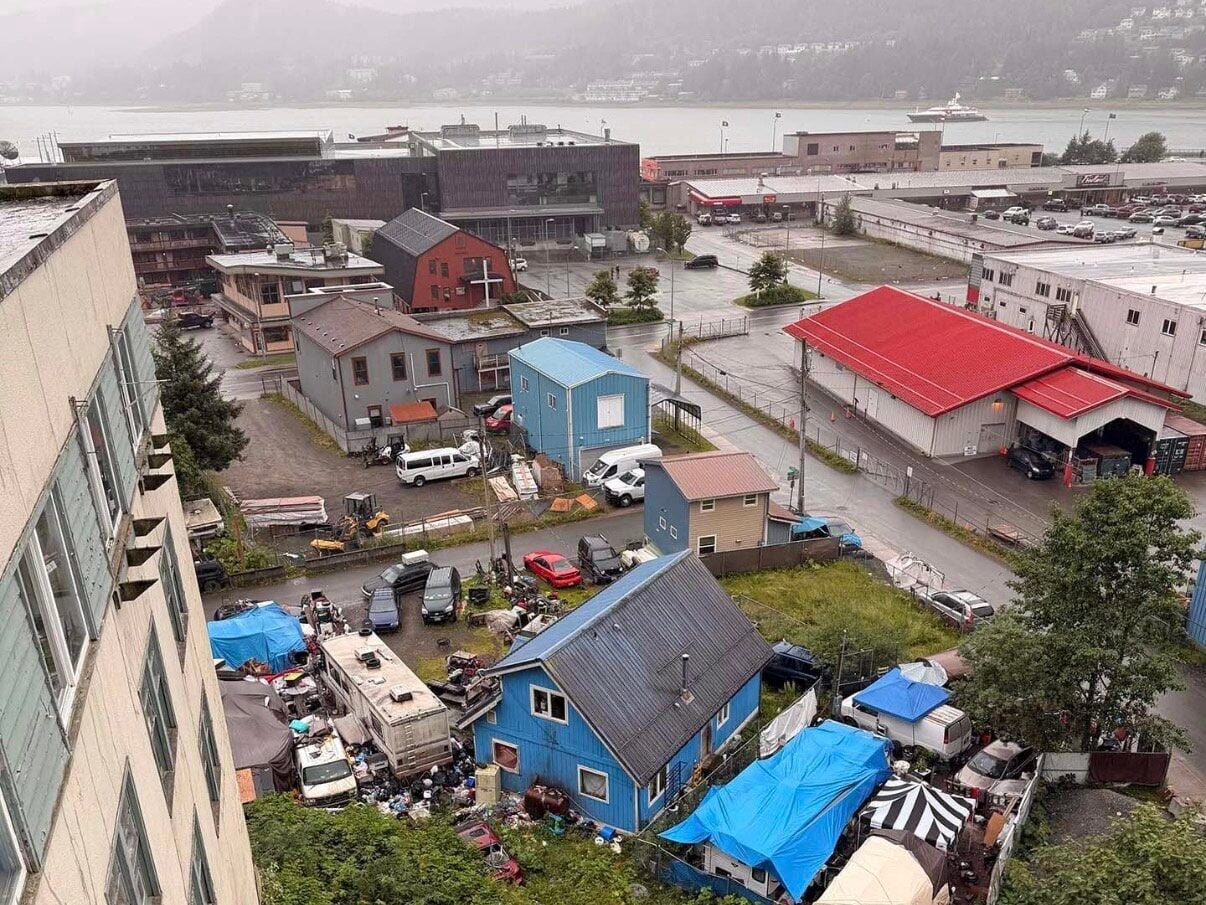
Photo courtesy of Peter Metcalfe via his Facebook post
NOTN- Residents living near the Governor’s Mansion are calling on city officials to address their safety concerns surrounding an “armed encampment” following an incident earlier this month where a young black bear was shot and later euthanized by the Department of Fish and Game due to its fatal injuries.
According to a post on the Juneau Community Collective, concerned residents living above Capital Avenue have sent a letter to the City and Borough of Juneau and nearby property owners saying the July 9 incident has prompted renewed concerns about conditions at the encampment.
The post described the site as an “armed encampment” and said residents are seeking a long-term solution to what they say are ongoing public safety issues and “outrages’ in the neighborhood.
Residents are asking others who have witnessed incidents associated with the encampment to come forward.
Below is the full letter written by Peter Metcalfe with the exclusion of addresses and personal information for resident’s privacy.
To the officials and offices named above:
The encampment on Capital Avenue, a longtime obnoxious nuisance, has become a threat to public safety.
Earlier this month, a person living in that camp shot a young black bear that was up a tree at the edge of the encampment. The animal was grievously wounded, and a Fish and Game officer had to track it down to put the young bear out of its misery.
The shots that wounded the bear were fired upward, likely toward the Fosbee, a 30-unit apartment building directly above the site. The apartment building is in our densely populated Governor’s Mansion neighborhood.
We live directly across from the Fosbee Apartments. We ask that the squatter camp on Capital Ave. be removed before someone is seriously hurt.
According to the CBJ Parcel Viewer, this encampment is on city land and shares boundaries with property owned by AEL&P, the Central Council, and a privately owned parcel (701 Capital Ave). All these properties are adversely affected by the encampment and its widely scattered piles of garbage, which are irresistible to bears.
This did not come out of nowhere. For years, the camp has created conditions no neighborhood should have to endure: clouds of toxic smoke, garbage piles measured by the truckload, and human and household waste left directly on the ground. Discarded hypodermic needles litter the area around the camp and have been dragged with other refuse by bears into the surrounding neighborhood, presenting hazards to people, pets, and wildlife.
When one of us stopped by to ask two of the occupants about the toxic smoke, their twitchy behavior was consistent with heavy methamphetamine or similar stimulant use.
Frequently, in the pre-dawn hours, residents are woken by disturbances from the site, where drugs are used openly and what appear to be drug sales occur. Now that we know the people in this camp are armed and willing to fire weapons with no regard for who is nearby, we have reason to fear for our safety.
Since the encampment is on city-owned property, CBJ clearly has the authority and responsibility to act, and its ownership removes any question of deferring to another party. The city’s own guidance calls for intervention once an encampment repeatedly harms the surrounding community, with trash accumulation and open drug use named as the triggers. This camp crossed that line years ago and has now escalated to gunfire toward occupied homes. Recent court decisions have also made clear that CBJ may enforce limits on camping on public land, so this is well within its authority.
Clearing the camp by itself will not fix this. The city has collaborated with AEL&P to remove encampments like this that have crossed the line, and with the Central Council to clean up this site.
We are now asking the city, through the Division of Lands & Resources and the Police Department, to clear the Capital Avenue camp, clean up the site, and then secure the area against re-encampment so that this stops being a recurring hazard, and to coordinate any support services the occupants may need as part of that process.
Photographs documenting current conditions at the site are attached to this letter.
We would appreciate a written response identifying who is handling this matter and what will be done. Thank you for your attention to a serious hazard in the heart of our community.
Respectfully,
Sandra and Peter Metcalfe, and on behalf of the following residents of the Governor’s Mansion neighborhood.
CBJ- The City and Borough of Juneau Flood Information Hotline is now available during weekdays. Residents can call the hotline with non-emergency questions and concerns related to the 2026 glacial lake outburst flood. The hotline is available at 907-500-0890 on Mondays through Fridays from 9 a.m. to 4 p.m.
Once Suicide Basin is filled, the hotline will extend operating hours to include Saturdays and Sundays from 9 a.m. to 4 p.m. Once release has begun – and a wireless emergency alert text message goes out – the hotline will move to 24/7 operations through the event.
Juneau police are investigating after human remains were discovered Sunday evening at a residence in the 6500 block of Glacier Highway. Officers responded after someone cleaning out the property of a deceased family member reported finding what appeared to be human remains inside a chest freezer in a locked outbuilding.
Below is the full press release.
JPD/CBJ- On Sunday, July 19, 2026, at approximately 7:59 p.m., the Juneau Police Department responded to a residence in the 6500 block of Glacier Highway following a report of possible human remains discovered on the property.
The reporting party advised officers they had been cleaning out the residence following the death of a family member when they located what appeared to be human remains inside a chest freezer in a locked outbuilding on the property.
Officers responded and confirmed the presence of deceased human remains. A preliminary identification has been made, and investigators believe the remains may be those of an adult male family member. Next of kin has been notified. Positive identification is pending confirmation by the State Medical Examiner’s Office.
The length of time the remains have been in the freezer is unknown. Investigators have determined that no missing person’s report related to the deceased was ever filed with the Juneau Police Department.
The remains have been transported to the State Medical Examiner’s Office, where an autopsy will be conducted to confirm the identity of the deceased and determine the cause and manner of death.
At this stage of the investigation, there is no known threat to the public. The investigation remains active and ongoing.
Anyone with information that may assist investigators is encouraged to contact the Juneau Police Department at (907) 586-0600. Those wishing to remain anonymous may submit tips through Juneau Crime Line at www.juneaucrimeline.com.
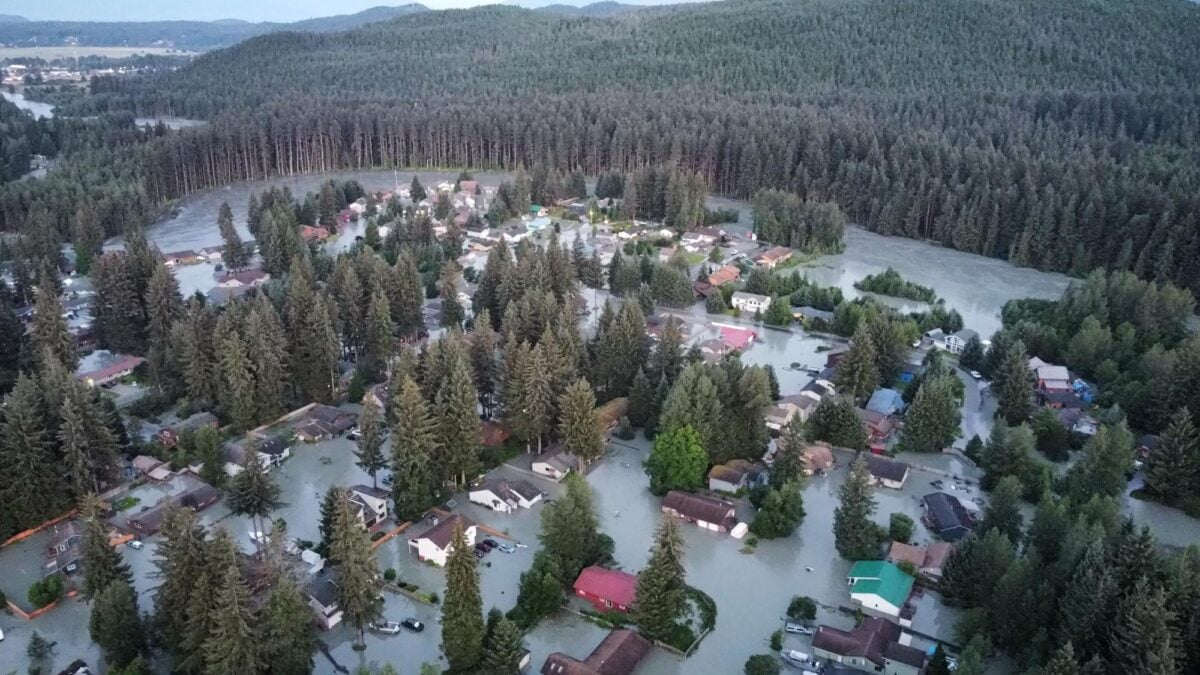
This drone image provided by the City and Borough of Juneau shows flooding from a release of water and snowmelt at Mendenhall Glacier covered some roads and threatened homes along the Mendenhall River in Juneau, Alaska on Wednesday, Aug. 13, 2025. (City and Borough of Juneau via AP)
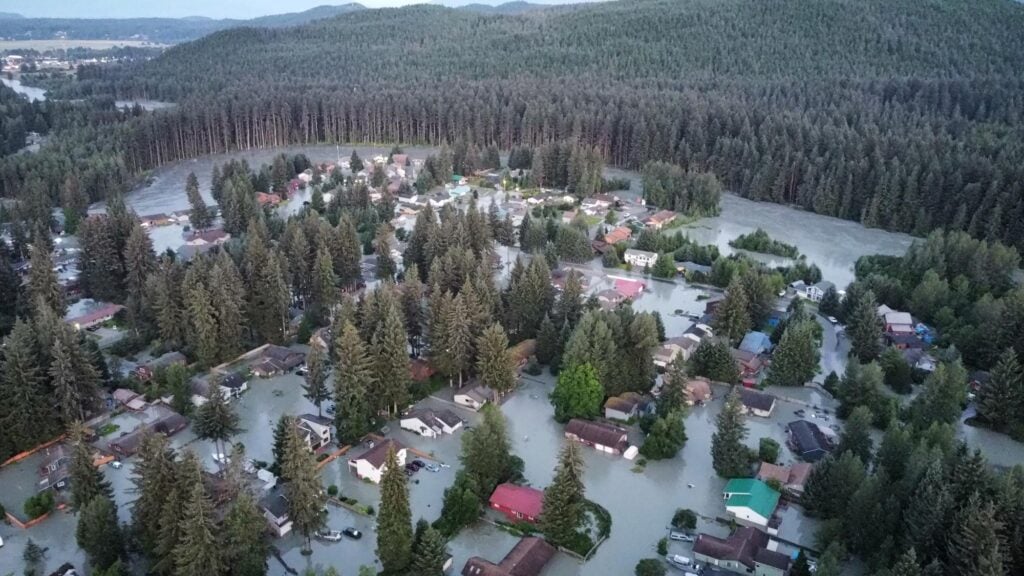
This drone image provided by the City and Borough of Juneau shows flooding from a release of water and snowmelt at Mendenhall Glacier covered some roads and threatened homes along the Mendenhall River in Juneau, Alaska on Wednesday, Aug. 13, 2025. (City and Borough of Juneau via AP)
CBJ- The City and Borough of Juneau (CBJ) Assembly Committee of the Whole (COW) Worksession scheduled for Monday, July 20 at the Andrew Hope Building has been cancelled for both topical and timing reasons. CBJ will move the planned agenda topics to a future COW worksession after the 2026 glacial lake outburst flood (GLOF).
The Special COW meeting was originally scheduled to provide updates and allow for assembly discussion on topics related to the annual threat of glacial lake outburst flooding events. The meeting included an update from the U.S. Army Corps of Engineers, a discussion of flood protection costs and potential funding mechanisms, and flood preparedness updates from the CBJ Emergency Management and Tlingit & Haida Public Safety offices.
“With a 2026 GLOF just days to weeks away, all three of our agencies (USACE, Tlingit & Haida and CBJ) are talking with residents daily about mitigation, preparation and how they can stay safe,” shared City Manager, Katie Koester. “We understand that our flood vulnerable neighbors are dedicating their focus and time to the flood just ahead of us, and realized there was nothing in the planned meeting agenda that couldn’t wait until after the waters have receded and residents have more capacity to tune in and share their input.”
The July 20 COW was scheduled to take place in the Council Chambers of the Central Council of the Tlingit & Haida Indian Tribes of Alaska in the Andrew Hope Building.
“We are honored that President Peterson and the Central Council invited the Assembly to conduct our meeting in their Executive Council Chambers showcasing the strong spirit of collaboration between our two governments,” said CBJ Deputy Mayor Greg Smith. “We are already looking for the next opportunity to meet and discuss these critical issues that impact Juneau’s residents, including tribal citizens in their Chambers.”
Updates regarding GLOF mitigation solutions and flood preparedness are regularly shared on the CBJ, USACE and Tlingit & Haida social media pages. Flood planning resources, including evacuation maps, are available at bit.ly/juneaufloodready. CBJ is also hosting sandbag distribution events tomorrow (July 18) and on all subsequent Saturdays until the 2026 GLOF.