By: Corinne Smith, Alaska Beacon
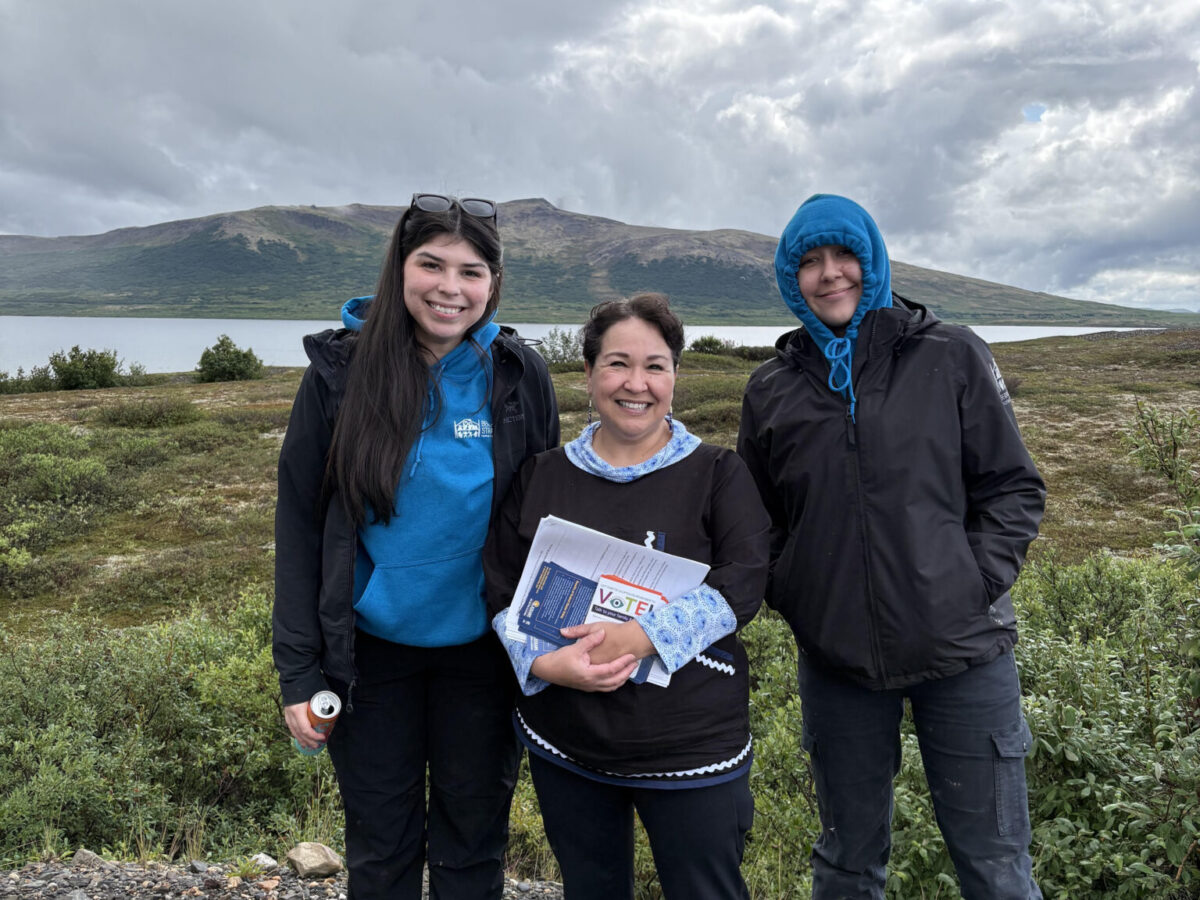
A Native-led voter mobilization group is working to boost Alaska Native voter education and turnout this election season.
Get Out the Native Vote is a non-partisan effort now underway to reach voters across the state’s vast and varied geography and get them to cast ballots in the primary elections on August 18 and the midterm elections on November 3.
Alaska Native voters make up roughly one in four Alaskan voters, said Michelle Sparck, director of the initiative, who is Cup’ik from the Southwest village of Chevak. She said part of voter education is raising awareness of when Alaska Native voters came out in force and reached a peak voter turnout of 66% in 1982. Some regions had nearly 80% voter turnout, Sparck said. That’s when decisions on subsistence policy, abortion and moving the Alaska State Capitol from Juneau were on the ballot.
“I call it the birth of the Alaska Native super voter. That generation made it a cultural value,” she said. “With that political capital that the 1980s generation built, they were able to own their sovereignty and self-determination tools.”

But voter turnout has declined significantly in the decades since. In the last election in 2024, 30% of Alaska Native voters cast their ballots. That meant Alaska Native voters made up 11% of state voters, according to data compiled by Sparck.
The mission of the campaign is to turn that decline around and reach historic highs again.
“This is what we’re capable of, and this is what this is our potential, and and I’m so excited to hold the mirror up to the communities because a lot of them really just had no idea what their performance is over the last, you know, 40-some years,” Sparck said.
“The challenge to the community is to say: own our power. We need to get out and vote,” she said. “Not should we go out and vote, we should make informed decisions.”
Get Out the Native Vote is supported by a partnership between the Alaska Federation of Natives, First Nations Institute and Cook Inlet Tribal Council with some funding from private foundations and the Carter Center, which was founded by former President Jimmy Carter. The campaign is collaborating with local, state and Tribal governments; regional Native corporations, organizations and service providers; schools; prisons and community groups to host voter education and outreach events around the state. Sparck spoke on a video call on Tuesday after returning from a voter outreach visit in Nome, and before heading to visit Utqiagvik, then the coastal community of Wainwright.
The August 18 primary falls within the summer subsistence fishing season, which is challenging for many people to find time to vote, Sparck said, but she’s found a helpful analogy.
“We’ve realized that if we describe primaries like basketball regionals, light bulbs go off their heads,” she said, smiling. “You have to win at regionals in order to make it to state. So a lot of people now know what primaries mean.”
Spark said 131 voting precincts in the state, more than a quarter, rely entirely on the U.S. Postal Service and air carriers to receive and mail their ballots.
Get Out the Native Vote working to make sure post offices are staffed, and helping the Alaska Division of Elections to recruit staff and volunteers so that each precinct has elections workers, bilingual poll workers and outreach workers to help with Native language translations. Sparck is also finding youth volunteers for a “Youth at the Booth” program, whose goal is to have two 17 and 18 year old volunteers assist at polling places and learn about elections in the process.
Particularly in the Arctic, the initiative is partnering with the North Slope Borough and local community leaders to make sure all precincts are staffed and open, in hopes of avoiding repeats of past election years where rural residents could not vote due to issues with staffing poll workers. In 2024, polling stations in rural villages of Wales and Kaktovik never opened. In Northwest and Western Alaska, voting hours were reduced in Marshall, Shaktoolik,Diomede and Kobuk. Primary ballots arrived late in at least 14 other Native villages.
“I get a lot of (precinct) chairs calling me before an election saying, ‘I don’t think I can do this.’ And we’re like, ‘You can do this. Your community can’t vote without you,’” she said. The organization’s goal is to have a well-staffed polling station in each village.
Alaska Native communities have also had the highest rates of rejected ballots, according to the Alaska Federation of Natives. One of the main issues is an incomplete witness signature on the ballot. In 2022, one in eight rural mail-in ballots were rejected, totalling more than 7,500 ballots rejected from rural Alaska.
A bipartisan elections bill that would have removed the witness signature requirement, among many other measures aimed at improving voting access, passed the Alaska State Legislature this year, but Gov. Mike Dunleavy vetoed it.

Between now and November, the campaign is working to distribute voter information, with guides on how to register, cast a ballot and find more information on state and federal candidates.
“So we’re trying to make things easier, but we’re building the plane as we’re flying it,” Sparck said. “You know, it’s still a work in progress, and we’re glad to have the alliances we have.”
This year, the annual Alaska Federation of Natives convention, where thousands of people from across the state convene in Anchorage, will be held one week later than usual to accommodate early voting at City Hall across the street. “So we’re excited that we’re going to have an ability to send people across the street to go vote or drop off their absentee ballots,” Sparck said.
The campaign is planning to hold voter outreach events in Alaska Department of Corrections facilities where roughly 40% of incarcerated people awaiting trial and sentencing are eligible to vote. Organizers are also working with service provider organizations to reach people who are unhoused or housing insecure, as well as foster youth who are turning 18, and inform them about their voting rights.
“We try to recognize every avenue to access voters, and especially those that are low propensity or disenfranchised. We try to meet their needs in every way, so it doesn’t mean we’re doing it 24/7, but it means we are trying to dedicate time and create the allyship and coordination with organizations that are more intimate with those groups to to best deliver that,” she said.
Get Out The Native Vote shares outreach events and regional voting updates on their Facebook page, and website at aknativevote.com.