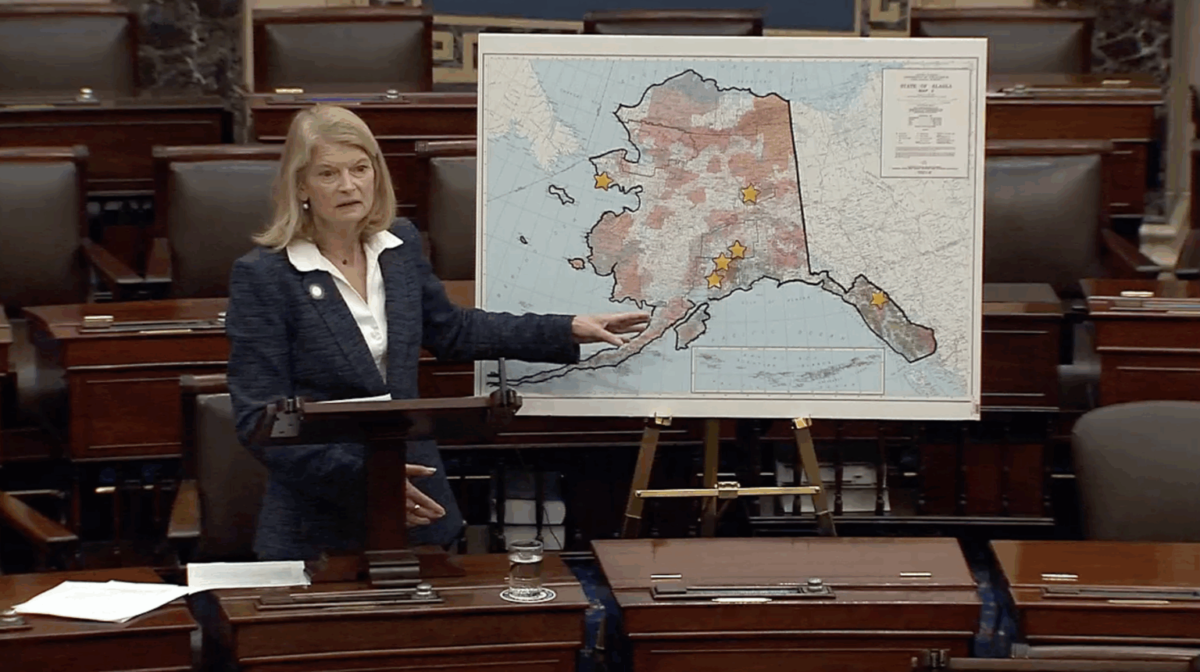
U.S. Sen. Lisa Murkowski, R-Alaska, speaks Thursday, March 19, 2026, on the floor of the U.S. Senate, in this screenshot of a video broadcast by the Senate. (Screenshot)
An elections bill being debated by the U.S. Senate could cost thousands of Alaskans the ability to vote in this year’s elections, Sen. Lisa Murkowski said Thursday in a lengthy speech on Capitol Hill.
The SAVE America Act, supported by President Donald Trump and most congressional Republicans, is ostensibly intended to prevent noncitizens from voting in American elections, but its implementation could prevent many Americans from being able to vote.
“While disenfranchisement may not be the intent of the SAVE America Act … I think that we will see that. In fact, I fully expect it to be an outcome of this,” Murkowski said.
The act would require that voters present photo ID when they vote, and that people present documentary proof of citizenship when they register to vote. That would mean presenting proof of citizenship in person at an elections office or other specially licensed state license.
“This would be a major, major departure from how most Alaskans currently register to vote,” Murkowski said.
In 2024, about 29,000 Alaskans registered to vote. Most of those — 25,000 or so — would have run into problems if the current bill had been law at that time, she said.
Most of Alaska’s voter registrations are done online or through the state’s motor-voter or PFD voter process. The bill could allow citizenship verification, but it’s not clear how that would happen, Murkowski.
Mandating in-person registration would have big effects in Alaska.
Some other state agencies might also be able to accept that proof, but the bill’s requirements take effect immediately, and it contains no funding for states to make changes that would allow remote offices to verify ID.
In practice, that means the bill would require rural residents to fly to urban Alaska, Murkowski said.
In addition, anyone seeking to register would have to have either a passport — roughly 50% of Alaskans don’t have one, Murkowski said — or some other form of appropriate ID.
Alaska driver’s licenses wouldn’t be good enough to register to vote, nor would most tribal IDs, because they don’t specifically label someone as a citizen or not.
The bill allows someone to self-certify their citizenship if they sign an affidavit, but that clause only applies if the person has already made “reasonable efforts” to obtain a copy of a valid ID.
It isn’t clear what that means, Murkowski said.
The bill also would end Alaska’s practice of allowing anyone to cast an absentee ballot for any reason. It would restrict absentee voting to a subset of specifically identified voters, including people living out of the state where they are registered to vote.
Murkowski said she hasn’t seen evidence that these kinds of measures are needed to address a small-scale problem.
Voting by noncitizens is rare in Alaska. A report obtained by the Alaska Beacon through a public records request showed 70 possible cases since 2015. At least 11 people on that list have been charged in state court.
“That’s basically seven a year,” Murkowski said.
“You look at what we’re trying to chase here with this balance — with disenfranchising so many who would be faced with almost insurmountable challenges in order to register or vote — I look at this and on balance, it doesn’t weigh,” she said.
Earlier this year, Rep. Nick Begich III, R-Alaska, voted in support of the bill as it passed out of the House, saying afterward that he doesn’t think it will be hard to comply with the bill.
Sen. Dan Sullivan, R-Alaska, has said he supports the act despite its ramifications for the state.
“I do think that having the ability to show an ID and proof of citizenship to keep elections safe is important, and it’s supported by the vast majority of Americans,” he said in response to a question during a February forum hosted by the Juneau Chamber of Commerce.
At that forum, he was confronted by an angry attendee who questioned how he could speak on Elizabeth Peratrovich Day, a state holiday honoring an Alaska Native civil rights leader, and support a bill that would have detrimental effects on Alaska Native voters.
“I have a very, very, very strong record as it relates to the franchise for our people, in particular, the Alaska Native community,” he said, referring to actions he took during the 2010 Alaska election, when he served as attorney general.
“I think voting, in my view, should be easy, but cheating on voting should not be,” Sullivan said.
While Sullivan has said he supports the bill, he also told reporters last month that he doesn’t support overriding the Senate’s filibuster to pass it.
In practice, the filibuster means that the bill would require 60 votes, not 50 and the vice president, to advance through the Senate.
With all of the Senate’s Democrats and Murkowski opposed to the SAVE Act, the bill — at least as of Friday — lacks the support it needs to become law.
Judy and Eric Edwards pose for a photo at a ribbon cutting ceremony for a new universal changing station installed on the first floor of the Alaska State Capitol on Mar. 19, 2026. (Photo by Corinne Smith/Alaska Beacon)
Judy Edwards and her son Eric traveled from Palmer to advocate for people with disabilities at the Alaska State Capitol in Juneau this week, and now one part of that process is a bit easier.
A newly installed universal changing station on the first floor of the Capitol is a clean, safe space for people who need assistance when using the restroom. The changing station is adult-size and adjustable, for people who use adult diapers and need help changing them. This is an upgrade for Eric, who is 18-years-old and has quadriplegic cerebral palsy with dystonia and uses a power wheelchair.
Previously he and his mother would have had to use the floor.
“This will make life easier for everybody,” Judy said. “Parents, especially younger parents, they just deal with things, but they shouldn’t have to. You know, parents hurt themselves because they’re trying to lift from the floor.”
At a ribbon cutting ceremony on Thursday, lawmakers and advocates with the Key Coalition — a group of people with disabilities, their caregivers, service providers and supporters — gathered to applaud the new installation.
Judy and Eric Edwards gather with Reps. Sara Hannan, D-Juneau and Ashley Carrick, D-Fairbanks, and Capitol facilities manager Serge Lesh for a ribbon cutting ceremony for the installation of a new universal changing station at the Alaska State Capitol on Mar. 20, 2026. (Photo by Corinne Smith/Alaska Beacon)
“I am so sorry that you’ve had to advocate for this and that those of us who are able bodied don’t automatically think about it,” said Rep. Sara Hannan, D-Juneau, who oversees a committee that runs maintenance in the Capitol.
Hannan said the universal changing station cost the state less than $20,000 total, including the cost of the device, shipping and electrical costs for installation. She said the committee is in the process of reviewing and making accessibility upgrades around the Capitol, including plans to widen the door frame and install an automatic door opener for the first floor accessible restrooms.
The Edwards family travel often for medical care. They are among the advocates who have been raising concern and pushing for more changing stations around the state. A new bill now introduced in the legislature, House Bill 141, would require at least one universal changing station be included in construction or renovation of all state or local government owned public buildings.
Rep. Ashley Carrick, D-Fairbanks, sponsored the bill.
“We’re looking at different ways to approach the issue, whether just on a funding level or policy, but ultimately, the goal is to just have types of changing facilities across the state,” Carrick said in an interview. “As legislators, the more we can do to just help all Alaskans have their basic needs met — that’s really where the motivation for this bill came from, and the awareness around this being a major challenge is so important.”
Advocates and lawmakers are focusing first on Alaska airports. The Edwards family was involved in raising awareness around access, resulting in a new universal changing station being installed at the Ted Stevens Anchorage International Airport in 2024.
There is also a changing station at the Mat Su Health Foundation, and a temporary station was installed last summer at the fairgrounds of the Alaska State Fair. Edwards said she also wants to see one installed at Providence Alaska Medical Center hospital in Anchorage.
Advocates with the Key Coalition flew to Juneau for an advocacy day on Wednesday, when they held a march and rally in front of the Capitol and met with lawmakers urging policy changes to increase access and services.
Demonstrators with the Key Coalition march through downtown Juneau to rally at the Alaska State Capitol for disability rights and increased services on Mar. 18, 2026. (Photo by Corinne Smith/Alaska Beacon)Demonstrators with the Key Coalition rally at the Alaska State Capitol calling for disability rights and increased services on Mar. 18, 2026. (Photo by Corinne Smith/Alaska Beacon)
“Having a disability could happen to any one of us,” said Michele Girault, board president for the Key Coalition. “So we’re creating communities where accessibility is at the top of the leaderboard, access to housing and good workforce and all the things that you might need to be supported, are available when you need it.”
Advocates are pushing for the state to eliminate the waitlist for people with disabilities applying for Medicaid services. Girault said they also want to reduce wait times for reimbursements for service providers.
“So that people who provide the service to people with disabilities and elders across the state are reimbursed at a rate that keeps them in business,” Girault said. “Some people have left the state because they were tired of waiting for services, and some families are opting not to even put their names on the wait list.”
Girault said the Key Coalition is continuing to support increased funding and expanded access for infant learning programs and early intervention services for youth experiencing developmental delays, which support families and children from infancy to age three.
Last year, Gov. Mike Dunleavy vetoed a bill to provide $5.7 million to increase funding for the state’s 17 infant learning programs. But lawmakers are trying again this year, with Senate Bill 178, sponsored by the Senate Health and Social Services Committee, to expand eligibility for the programs and increase funding.
A bill to update the state’s guardianship statutes is also supported by the Key Coalition. Girault said Senate Bill 190 would strengthen protections for people involved in the state guardianship system, including for medical guardians, partial guardians and in conservatorship. They’re also pushing for improvements to access to public transportation.
Sara Kveum speaks to the crowd rallying at the Alaska State Capital for disability rights and increased services on Mar 18, 2026. She is beside Michele Girault, director of the Key Coalition of Alaska, which organized the rally as part of an annual legislative fly-in, and includes people with disabilities, their families, service providers, educators and advocates. (Photo by Corinne Smith/Alaska Beacon)
“Transportation is in the top five barriers for people with disabilities. When you think about all the snow we’ve had this winter, how do you get to the bus stop? Once you’re at the bus stop, is the bus stop cleared?” Girault said. The Key Coalition is supporting House Bill 26, which would require a new state transportation plan to include access for people with disabilities.
“This transportation bill requires the state to create a plan that actually thinks about all of the points of access for people across the state of Alaska, not just in major cities, but in rural areas as well,” Girault said.
More than 1 in 4 adults in the U.S. have some type of disability, including mobility, hearing, vision or cognition disabilities, and advocates say they want to see improvements across Alaska to expand access, care and dignity for all.
For the Edwards family, and many advocates and families with disabilities, flying to Juneau isn’t easy, but Judy Edwards said it’s worthwhile — and she wants to see more changes to increase access across Alaska.
“I’m 67, but when I was a kid, you didn’t see people with disabilities out in public, really, much,” Edwards said. “And so today, it’s like, why not? I mean, we’ve come such a far way. Why not? We need to keep going.”
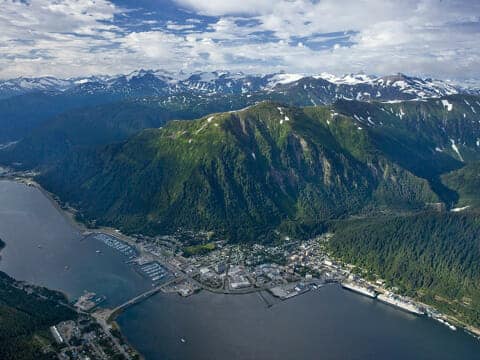
NOTN-The results are in, residents in Juneau have been helping shape the capital city’s long-term future at “Juneau Futures” workshops and with a community survey.
“Juneau’s had Comprehensive Plans on the books for decades, since the 1900s, so it’s basically a big picture guide that helps us decide where and how to develop, usually, over the next 20 to 30 years.” Said Senior Planner Minta Montalbo, “I think it’s important to keep in mind that the Comprehensive Plan reflects community priorities, and it connects our values and goals with CBJ decision makers, with policies and actions. It’s like a reference point for decisions on how to best use our land and where to focus our resources.”
The effort is part of the “Our Juneau, Our Future” comprehensive plan update, which gathered input through 14 in-person workshops and an online survey aimed at guiding development in Juneau over the next 20 years.
The workshops asked residents 3 major questions, Where should Juneau grow? What does Juneau need to do to prepare for the future? And how should Juneau grow?
According to findings released by CBJ, participants outlined several approaches for where that growth should happen. Many supported investing in central areas like downtown Juneau and Lemon Creek.
Quotes in italics will be pulled directly from CBJ’s results.
Downtown Juneau and Lemon Creek were popular development areas with many participants expressing interest in building activity in and around central Juneau.
Others prioritized established neighborhoods such as the Mendenhall Valley, emphasizing investment near current residents.
Investments should focus on infill and areas with existing infrastructure.
Additional support emerged for developing multiple hubs, including Auke Bay, seen by some as an alternative community center, others pointed to North Douglas as a next step for expansion due to its available land.
North Douglas is the next logical step for development in the next 20 years, and then we can focus on West Douglas.
Across all responses, one issue stood out: housing.
Participants consistently identified it as the community’s top priority, even noting that “everything connects to housing.”
Housing was the most important issue for many participants. While approaches differed, it is clear that Juneau needs more housing solutions.
Respondents also stressed the importance of protecting neighborhoods from natural hazards like flooding and avalanches, and called for diversifying Juneau’s economy beyond tourism.
“Folks are focused mainly on flooding and protecting the homes in the valley, but we’re also hearing renewed discussion about landslide dangers and avalanches, so we’re going to want to be looking at that in the new comp plan.” Montalbo said, “Not surprisingly, housing for all definitely remains a huge priority, and when we’re talking about housing, housing options that suit a variety of needs. And then I think the third biggest category is economic diversification. Again, not a new topic, but we’re hearing a lot of concern about trying to strengthen year round industries, and find a balanced approach to tourism. We want to recognize the economic contribution, but people are also asking that we care for Juneau’s unique small town characteristics at the same time.”
Once participants had decided how Juneau should grow, they were asked to see how their scenario would hold up against future conditions, such as potential increase or decrease in tourism, funding, and natural hazards.
Participants said they expect tourism to increase, while state and federal funding may decline and natural hazards may become more severe.
In workshop scenarios, residents adjusted their priorities accordingly, shifting resources toward housing, hazard mitigation, and economic resilience when faced with those challenges, notably when faced with a decrease in federal funds, participants primarily divested from Remote Area Infrastructure and Waterfront Development, viewing them as non-essential “luxuries” without federal support.
According to the findings particpants felt, “no matter the strategy, growth should consider existing investment, current residents, housing needs, and hazard risk.”
Two animals in the Teshekpuk Caribou Herd are seen on June 27, 2014, in the National Petroleum Reserve in Alaska. A right-of-way agreement reinstated through a federal court order protects the Teshekpuk Lake area and the habitat used by the caribou herd named for the lake. But in an oil and gas lease sale, the Trump administration auctioned off tracts in that right-of-way area nonetheless. (Photo by Bob Wick/U.S. Bureau of Land Management)
A controversial oil and gas federal lease sale in the National Petroleum Reserve in Alaska generated a new bidding record, according to results released on Wednesday. It was the first auction held in that Arctic Alaska territory since 2019.
The lease sale produced $163 million in high bids, beating the $104 million mark set during the first competitive oil and gas lease sale in the Indiana-sized reserve, which was held in 1999 during the Clinton administration.
Eleven companies submitted bids for more than 1.3 million acres of the nearly 5.5 million acres offered in the auction.
Kevin Pendergast, Alaska state director for the U.S. Bureau of Land Management, called the results “historic.”
“This is the strongest sale we have ever had in the National Petroleum Reserve in Alaska by nearly every measure. It makes clear that for the NPR-A, despite all the successes to date, the best days are still ahead,” Pendergast said at the conclusion of the bid opening, which lasted about two hours.
In statements issued after the bid reading, federal and state officials hailed the results.
“Today’s lease sale underscores the National Petroleum Reserve in Alaska’s vital role in strengthening America’s energy security while fueling economic growth across Alaska,” Secretary of the Interior Doug Burgum said in a statement. “The Reserve was created to support our nation’s energy needs, and this successful sale demonstrates what’s possible when we align responsible development with that original purpose.”
Gov. Mike Dunleavy celebrated the results in a Facebook post that thanked President Donald Trump “for believing in the great State of Alaska.”
“Today’s record setting NPR-A lease sale is a major win for our state and our country. It reinforces Alaska’s role as a reliable energy producer, supports high-paying jobs for our families, generates additional revenue for the state, and strengthens American energy security at a time when energy security is more important than ever,” he said in the post. “Alaskans have demonstrated that we know how to unlock our vast resources while protecting the land for future generations. This is exactly the kind of balanced, commonsense progress Alaskans have been calling for.”
The lease sale was one of five mandated in the reserve over the next 10 years by the sweeping budget and tax bill called the “One Big Beautiful Bill Act.” That mandate calls for lease sales to be conducted under a Trump administration management plan that opened 82% of the reserve to oil development. Previously, the Obama administration held annual lease sales in the petroleum reserve, but that administration’s management plan protected about half of the land through the designation of “special areas” considered important to wildlife and to Native cultural practices.
Prominent bidders were energy giants ConocoPhillips and Repsol, which are already active in the area. ConocoPhillips is developing a huge project within the reserve, the Willow Ppoject, that is expected to produce up to 180,000 barrels a day after its expected startup in late 2029. Repsol is a partner in another huge oil field, Pikka, which is on state land bordering the reserve and is set to start production this year.
Late-afternoon sunlight bathes the ConocoPhillips building in downtown Anchorage on March 10, 2026. ConocoPhillips, long active in the National Petroleum Reserve in Alaska, was a major bidder in the lease sale held Wednesday. (Photo by Yereth Rosen/Alaska Beacon)
The petroleum reserve and adjacent state and Native-owned lands along its eastern border are considered highly prospective for new oil finds because of a geological feature called the Nanushuk Formation that underlies it.
Federal officials auctioned tracts of protected land
Much of the bidding in Wednesday’s sale was for territory that was previously off-limits to oil development under protections that date as far back as the Reagan administration.
The inclusion of long-protected land in the sale, predominantly the area around ecologically sensitive Teshekpuk Lake, made the lease sale contentious. It is the subject of two lawsuits filed by Native and environmental groups.
Bids were accepted even for tracts within an area encircling Teshekpuk Lake, the North Slope’s largest lake, despite a federal court order issued Monday that reinstated development prohibitions there.
U.S. District Court Judge Sharon Gleason on Monday issued an injunction reinstating a right-of-way agreement with Nuiqsut Trilateral Inc., a partnership of Nuiqsut’s city and tribal governments and Kuukpik Corp., the village for-profit Native corporation.
Nuiqsut, an Inupiat village of about 500, is the community closest to oil development occurring in the reserve, including the Willow project. Under the agreement, oil development is banned within the right-of-way territory, though the Nuiqsut Trilateral Inc. has the right to waive that ban.
The court ruling was not mentioned Wednesday when BLM officials in Alaska opened the bids.
But in a statement issued later in the day, the U.S. Department of the Interior acknowledged that BLM did sell tracts that lie within the Nuiqsut right of way and that legal issues concerning those tracts remain.
“We can confirm that lease offerings within the right of way are included in today’s sale. Any lease issuance for tracts within the right of way will be consistent with the court’s order,” the statement said.
DOI officials did not elaborate on how they would follow the court order.
Criticism of expanded lease offerings, but praise as well
The Trump administration’s decision to auction off long-protected land, and especially its decision to press forward with leasing of tracts within the Nuiqsut right of way, dismayed critics.
A map shows the tracts within the National Petroleum Reserve in Alaska that are at issue in two lawsuits targeting the Trump administration’s management of the land unit. The orange tracts are in previously protected areas that were off-limits to leasing. Some tracts are within the Nuisuit Trialateral Inc. right of way and the subject of that organization’s lawsuit. A lawsuit filed by the Native organization Grandmothers Growing Goodness and The Wilderness Society is seeking to prevent development in all of the tracts colored orange. (Map provided by Layla Hughes, one of the plaintiff attorneys)
Among them was Rosemary Ahtuangaruak, leader of one of the plaintiff groups suing the Department of the Interior over its management of the petroleum reserve. She criticized the Trump administration for abandoning protections deemed important for several generations of Indigenous North Slope residents.
She cited in particular a narrow corridor of land northeast of the lake that is important to migration of the Teshekpuk Caribou Herd. The BLM accepted a $2 million bid from a company called Epoch Oil and Gas LLC for a large block within that migration corridor.
“It’s very concerning that they’re not putting a better foot forward in protecting what’s important about this area,” said Ahtuangaruak, a resident of Nuiqsut and leader of the group Grandmothers Growing Goodness. “For me, it’s really important that we push back on the activities that are encroaching around us.”
She said it was hard for her to watch the latest lease sale unfold because it added to a pattern of development encroaching on the village and resulting problems like air pollution and the January accident that overturned a huge drill rig intended for ConocoPhillips work in the area.
“It’s painful every time I watch these because these are important traditional land use areas. And the further they get into the Teshekpuk Lake area, the more traditional land use areas are going to be impacted,” Ahtuangaruak said.
The Trump administration’s decision to press ahead with auctioning land within the area protected by the Nuiqsut Trilateral right-of-way agreement drew particular ire from critics.
A plain reading of the right-of-way agreement shows that leasing in that area is not allowed without a waiver from the Nuiqsut group, said Andy Moderow of the Alaska Wilderness League.
“For the administration to not even acknowledge that is absurd,” he said.
In contrast, a different organization representing Indigenous people of the North Slope, Voice of the Arctic Iñupiat, praised the Trump administration’s management of the lease sale and celebrated its results.
“Today’s lease sale proves what we have been saying for years: when there is meaningful policy in place supporting responsible onshore development, industry interest will follow,” Nagruk Harcharek, Voice of the Arctic Iñupiat’s president and chief executive, said in a statement. “Over the past year, we have supported the Trump-Vance administration and Congress’s efforts to build more durable policies affecting our homelands. This successful NPR-A lease sale is a gratifying reminder (of) our work that will strengthen our self-determination for generations to come.”
Half of the royalties derived from oil production in the National Petroleum Reserve are designated for North Slope communities through a grant program established in federal law.
A competitive auction
Lease sale bidding was competitive, with some tracts receiving as many as six different offers. ConocoPhillips focused much of its bidding on tracts near the eastern border of the lease sale area and closest to its Willow project.
A pair of tundra swans swim on a lake on June 25, 2014, in the northeastern part of the National Petroleum Reserve in Alaska. The northeastern part of the reserve is highly prospective for oil, But it also has wetlands, including Teshekpuk Lake and various smaller lakes, that are important to birds that migrate from as far away as Antarctica. (Photo by Bob Wick/U.S. Bureau of Land Management)
ConocoPhillips did not bid for any tracts within the Nuiqsut Trilateral right of way, however,
Exxon Mobil was among the companies that bid for tracts within the right-of-way area, emerging as the apparent winner of tracts along the southern shore of the lake.
The lease sale marks a return to Alaska of sorts for Exxon.
While it maintains part ownership of the Prudhoe Bay field and the trans-Alaska oil pipeline, Exxon pared down its Alaska presence in recent years. In 2021, it transferred the operator position at the Point Thomson field to Hilcorp. Earlier that year, the company dropped its longtime corporate sponsorship of the Iditarod Trail Sled Dog Race.
Also returning to Alaska through the lease sale is Royal Dutch Shell. The bids submitted by Repsol were in partnership with Shell Frontier Oil and Gas Inc., a company subsidiary. Several of those Repsol-Shell winning bids were for over $2 million per tract.
Shell engaged in an expensive Arctic offshore exploration program in past years that turned out to be a failure. After spending at least $7 billion and wrecking a drill ship, Shell in 2015 abandoned its Arctic offshore program and eventually dropped its leases in the Chukchi and Beaufort Seas. The company in 2024 relinquished leases in state offshore territory.
Another active bidder was North Slope Exploration LLC, which is a unit of Denver-based Armstrong Oil and Gas. The company was the high bidder on over 70 tracts, according to preliminary results, adding to acreage in the reserve acquired during the 2019 lease sale.
The debate continues
While there is excitement among development supporters about the big sale, legal questions about the lease sale and the management plan under which it was conducted persist.
While Gleason on Monday issued the preliminary injunction reinstating the Nuiqsut Trilateral right of way, thus erecting a roadblock to any oil development in that approximately 1-million-acre area, on Wednesday she rejected the request from Ahtuangaruak’s group for a broader injunction that would have barred leasing in a wider region around Teshekpuk Lake.
Gleason, in her Wednesday ruling, said the Grandmothers Growing Goodness-Wilderness Society plaintiffs could try for another injunction should the BLM authorize any surface-disturbing activities in the formerly protected area.
That lawsuit remains active, as does the lawsuit filed by Nuiqsut Trilateral Inc., which is seeking a permanent reinstatement of the right-of-way agreement.
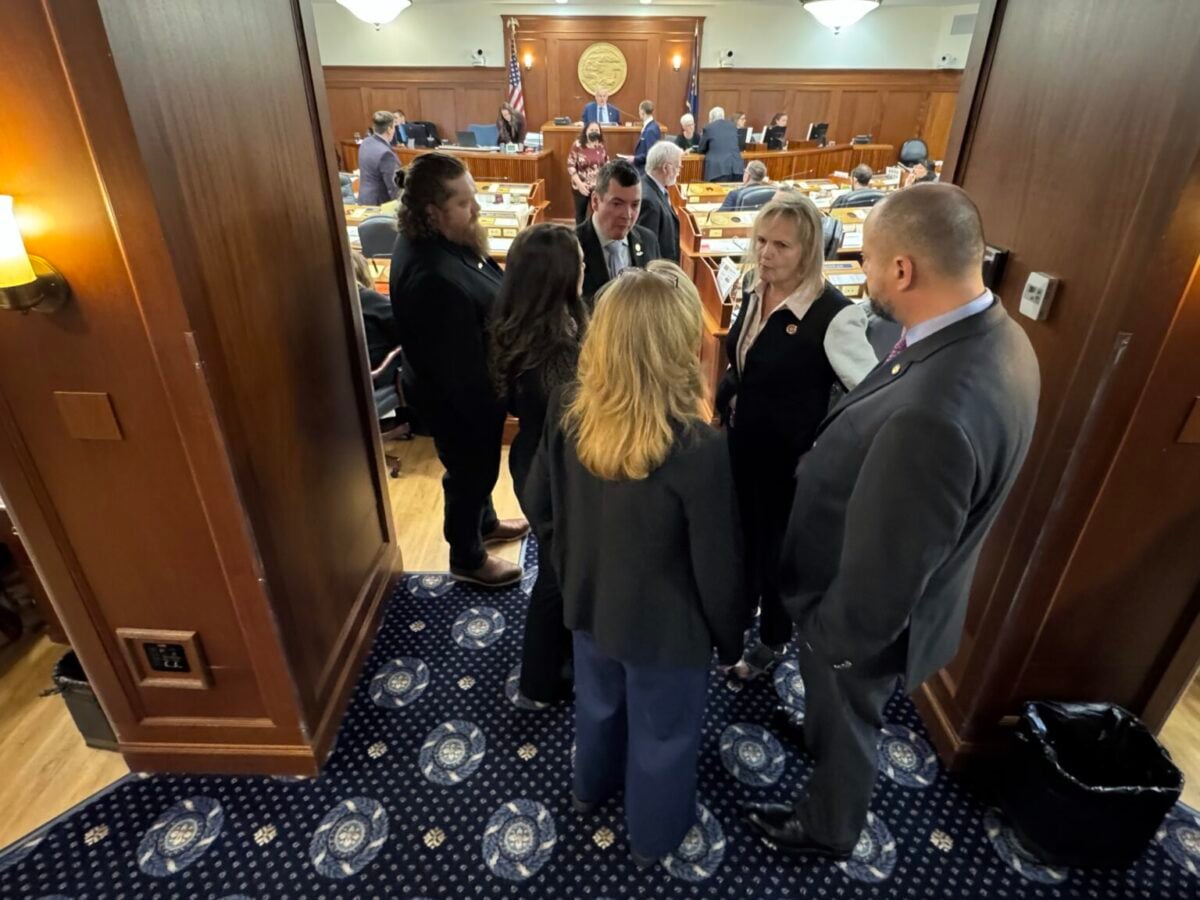
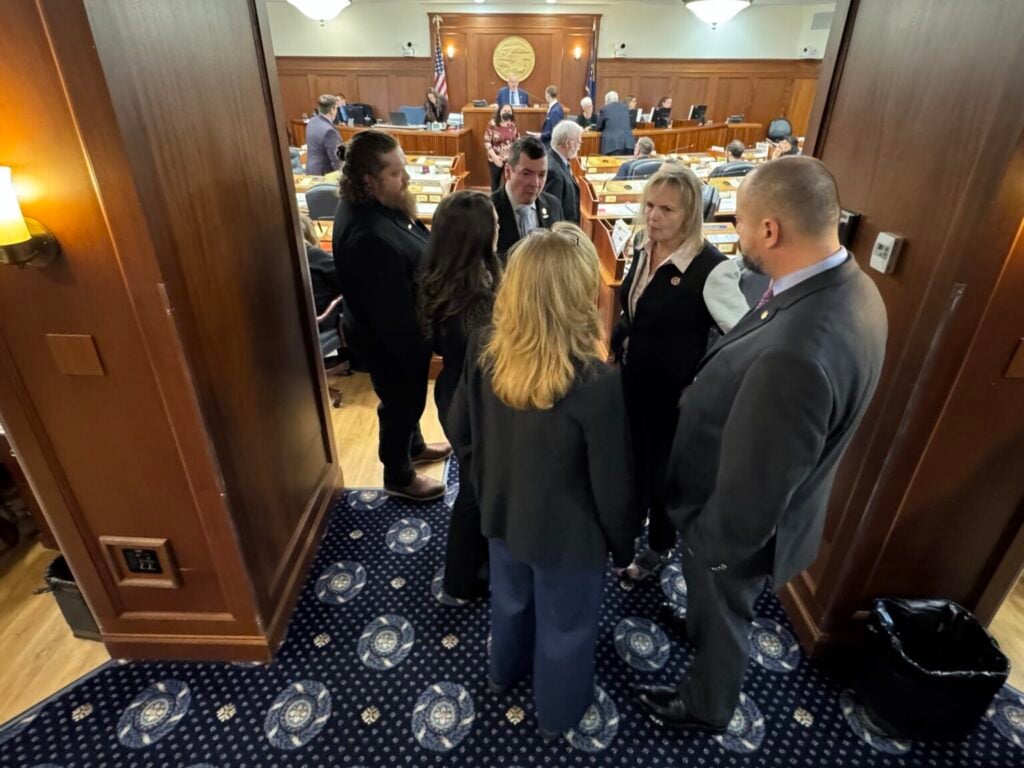
Members of the Alaska House minority talk strategy during a break in the Wednesday, March 18, 2026, session of the Alaska House of Representatives. (James Brooks photo/Alaska Beacon)
By: James Brooks, Alaska Beacon
Members of the Alaska House minority talk strategy during a break in the Wednesday, March 18, 2026, session of the Alaska House of Representatives. (James Brooks photo/Alaska Beacon)
Alaska legislators have sidetracked a bill originally intended for the legislative fast track.
In a pair of votes Wednesday, the Alaska House and Senate voted to send House Bill 289, the state’s supplemental budget bill, to a conference committee empowered to iron out differences between two different versions respectively enacted by the House and Senate.
Lawmakers took that unusual action after the House failed to approve a Senate-passed plan to pay for the bill with more than $373 million from the state’s principal savings account, the Constitutional Budget Reserve.
The committee is scheduled to hold its first meeting at 3:45 p.m. Thursday.
HB 289 is intended to fund expenses in the current state fiscal year that were incurred after lawmakers adjourned last year’s legislative session.
That includes money needed to respond to last summer’s wildfires and ex-Typhoon Halong, which devastated Western Alaska in the fall.
One key item in the bill — $70.2 million intended to unlock federal construction grants — is time sensitive. For months, the state’s construction industry has been lobbying for fast action on that money, saying that without surety on federal grants, they cannot make hiring and purchasing decisions for this summer’s construction season.
In February, the House passed a version of HB 289 with more than $500 million in expenses and proposed to pay for it by spending from the reserve.
It takes 30 votes in the House and 15 votes in the Senate to unlock the reserve. This month, in order to meet the threshold in the Senate, lawmakers there cut the bill to slightly over $373 million.
For more than a week, that caucus has been united in opposition to spending from savings, saying that a forecast boon to state finances — caused by higher oil prices amid the Iran war — should be enough to pay for the extra spending.
Members of the House majority, meanwhile, have been just as adamant in their position that it is unwise to rely on war-driven oil prices.
Sens. Lyman Hoffman, D-Bethel; Bert Stedman, R-Sitka; and Mike Cronk, R-Tok, were appointed to represent the Senate on the committee. Reps. Andy Josephson, D-Anchorage; Calvin Schrage, I-Anchorage; and Will Stapp, R-Fairbanks; will represent the House.
Cronk and Stapp are members of their respective minority caucuses; the other four lawmakers are representing their respective majority caucuses.
Additional meetings are expected after Thursday’s initial organizational hearing.
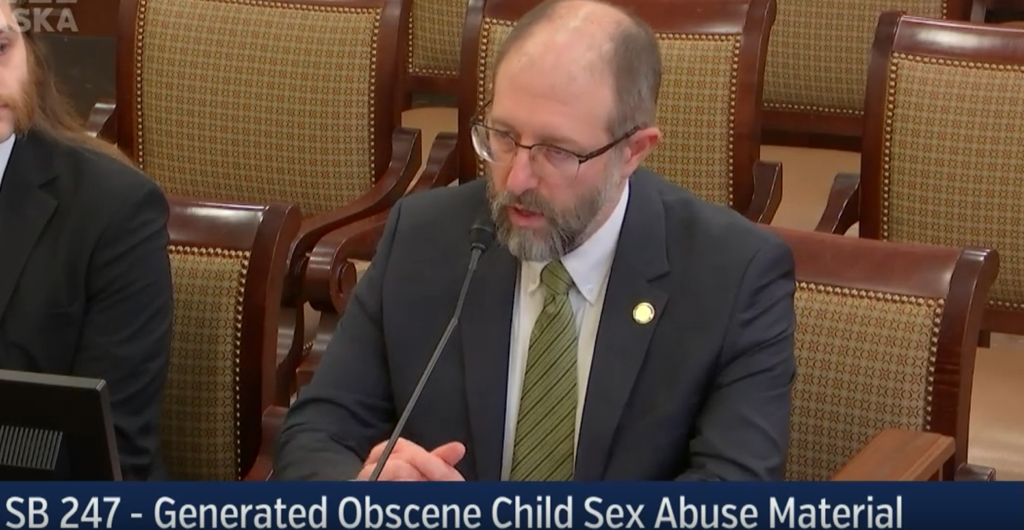
Senator Jesse Kiehl presenting SB 247 to the Senate Community and Regional Affairs Committee on Tuesday March 17, Photo courtesy of Gavel Alaska
Lawmakers are considering legislation that would expand criminal penalties for child sexual abuse material to include images generated using artificial intelligence and other digital tools.
Senate Bill 247, Sponsored by Juneau Sen. Jesse Kiehl, would create new crimes for the possession and distribution of “generated” child sexual abuse material, also known as CSAM, including images that appear to depict minors but may not involve real children.
Under the bill, distributing such material would be a felony, with harsher penalties for repeat offenders. Possession of generated CSAM would also be a felony offense.
Distribution under this bill is relatively broad and includes sharing or posting such content online.
United Nations, just this January released a warning on escalating AI threats to children.
The staggering amount of harmful AI-generated online content has prompted an urgent call from across the UN system for a raft of measures to protect children from abuse, exploitation and mental trauma.
This is a new form of sexual exploitation, the rapid progression of AI means lawmakers are struggling to craft legislation to prevent such harm from happening.
“Artificial intelligence is leading to the ability to generate images, generate videos, generate vast amounts of content, and that ability is growing fast, unfortunately, along with the ability to modify or create your own cute cat videos, some people use these technologies to terrible effect.” Said Kiehl, ” Senate Bill 247 addresses computer generated or otherwise generated Child Sexual Abuse materials. It amends Alaska law to create parity between generated Child Sexual Abuse materials and non generated Child Sexual Abuse materials, what we think of as photos or videos that have not been modified of real children. We know that artificial intelligence is, when it comes to images, a highly sophisticated collage machine, and that those images are made ultimately from things that are real, those are the data sources of millions, often billions, of real images on which these large language models, these artificial intelligences, are trained. The bill sets the punishments for generated Child Sexual Abuse materials on par with, and equal to non-generated CSAM that avoids overburdening bogging down law enforcement resources, court system resources, with the difficulty of proving that an amalgamated image has a real child under the age of 18 in it.”
The proposal also updates existing laws to include manipulated or altered images of real minors, even if the material was digitally created or modified.
In addition to criminal penalties, the bill would require the permanent revocation of teaching certificates for individuals convicted of certain sex offenses involving minors, including those tied to generated materials. It would also prohibit people convicted of those crimes from obtaining school bus driver licenses.
“The real prevalence of child sexual abuse is not known because so many victims do not disclose or report their abuse. However, adult representative or retrospective studies by the CDC has shown that one in four women and one in six men were sexually abused before the age of 18, and we know Alaska has one of the highest rates per capita of child sexual abuse in the nation.” Said Trevor Storrs, the President and CEO of the Alaska Children’s Trust, “Ai generated CSAM represents one of the most urgent and fast moving threats facing children today. In 2023 the National Center for Missing Exploited Children, received 4700 reports of AI related CSAM, by 2024 that number had grown to 67,000 and in the first half of 2025 alone, they received more than 400,000 such reports, an average of over 2000 every single day. At the same time, extortion, where offenders use real or AI generated images to blackmail children, continues to surge.”
Lawmakers say the bill is part of a broader effort to modernize Alaska law while technology continues to evolve, it’s one of several bills currently making their way through the legislature meant to strengthen protections for children.
SB 247 is set to be heard again in the legislature on Thursday.
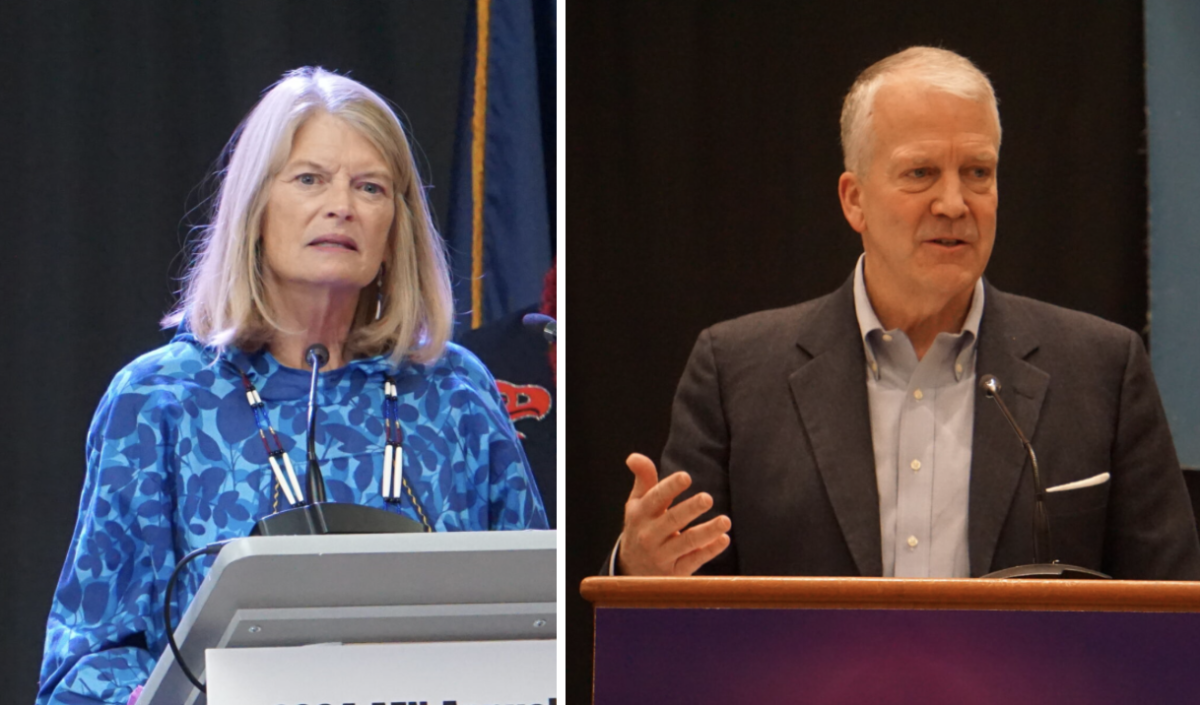
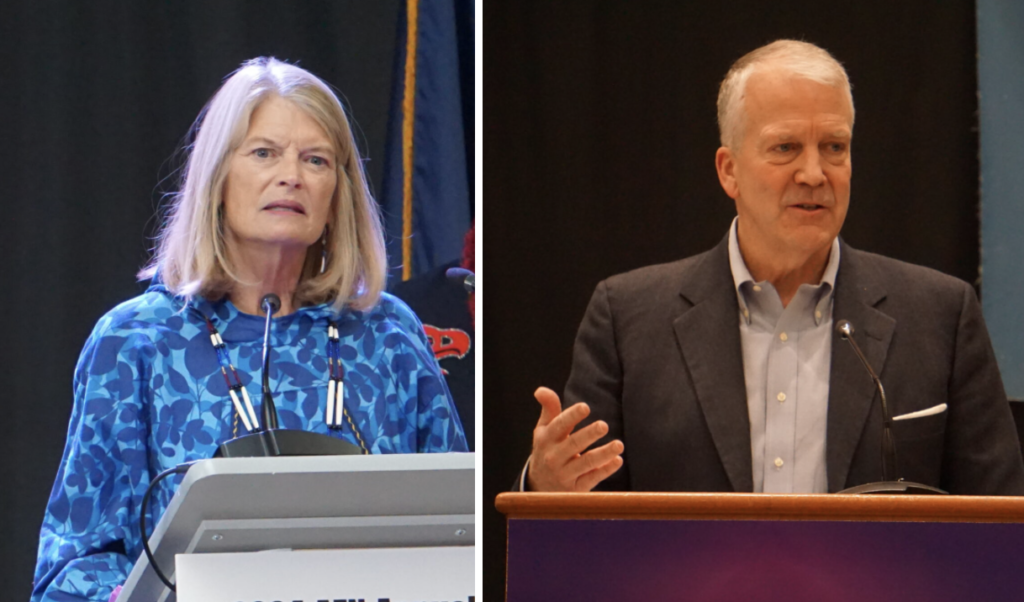
Alaska U.S. Senators Lisa Murkowski and Dan Sullivan (Alaska Beacon file photos)
Alaska’s Republican U.S. senators are pushing the Trump administration to waive a recently hiked visa fee for all public school employees.
The Trump administration raised the fee for highly skilled workers visas, known as the H-1B visa program, from $5,000 to $100,000 per visa in September. That has consequences for Alaska school districts, which have grown to rely on international hiring to fill teaching and staff positions.
“As soon as this proclamation was released last year, I have been sounding the alarm with the administration about the importance of the H-1B visa program to Alaska’s school districts,” U.S. Sen. Lisa Murkowski said in a prepared statement announcing the bill.
Murkowski introduced legislation in the U.S. Senate on Mar. 12, saying it would help alleviate financial strain for Alaska’s school districts. U.S. Sen. Dan Sullivan signed on as a cosponsor of the bill on Tuesday.
The H-1B visa program provides non-immigrant visas for U.S. employers to recruit highly skilled workers, with at least a bachelor’s degree, in fields such as healthcare, technology or education. The visa is valid for up to six years.
“Our public school classrooms have been facing a staffing crisis for years, but teachers in Alaska on H-B visas have been instrumental in bridging that shortage and serving our students with talent and care,” Murkowski wrote. “This legislation offers a commonsense exemption that will ensure Alaska’s schoolchildren have access to more high-quality educators while keeping class sizes reasonable.”
The Alaska House of Representatives introduced a resolution this month urging the visa waiver for teachers.
There are close to 600 international teachers working in Alaska and 341 of them use H-1B visas, according to data provided by the Alaska Council of School Administrators, which assists districts in recruitment and hiring.
“In some rural districts, visa teachers make up 50% to nearly 80% of the teaching staff,” said Lisa Parady, the council’s director, in a statement with the bill’s announcement. “School districts already invest $6,000 to $12,000 per teacher to recruit and sponsor educators through the H-1B visa process. Adding a $100,000 federal visa fee has made it financially impossible for many districts to continue hiring the teachers their students depend on.”
Alaska districts are also in the process of hiring teachers for next year, and officials say the fee imposes an impossible financial barrier.
Cyndy Mika, superintendent of the Kodiak Island Borough School District, said in a written statement with the bill’s announcement that nearly 20% of teachers district wide — and 75% of village teachers — are international hires through visa programs.
“These educators are not replacing American teachers—we simply do not have applicants for these positions,” she said. “Without access to international educators, districts like Kodiak will struggle to fill classrooms and provide consistent learning environments for students.”
The situation is exacerbated in Alaska’s rural districts by recent additional restrictions on the J-1 visa program, which requires visa-holding teachers to be placed in areas with access to health care services, transportation and other public services.
Tammy Dodd, superintendent of the Bering Strait School District, said in a statement the new J-1 visa restrictions put rural districts at a unique disadvantage.
“So the H-1B visa is the only choice,” she said. “The Bering Strait School District employs 86 international teachers, which is roughly 40% of certified staffing. With the new fee in place, the district would be unable to replace those positions with international hires.”
Murkowski sent a letter of concern to the former U.S. Sec. Kristi Noem with the Department Homeland Security, which administers the visa program. Noem responded in a letter on Dec. 15 shared by the senator’s office. Noem wrote that some exemptions are possible.
“Exceptions to the $100,000 payment are extremely rare and are granted only in extraordinarily compelling circumstances. Petitioning employers may seek an exception by sending their request,” Noem wrote.
“Evidence should support the alien worker’s presence in the United States as an H-1B worker is in the national interest, no American worker is available for fill the role, the alien worker does not pose a threat to security or welfare of the United States, and requiring the petitioning employer to pay the $100,000 payment would significantly undermine the interests of the United States,” she wrote.
Jennifer Schmitz, director of the Alaska Educator Retention and Recruitment Center, a division of the Alaska Council of School Administrators, said by email Monday that some districts have sought individual exemptions from DHS for teachers with pending H-1B visa applications, but have received no response and no timeline from the department.
Economist Dan Stickel talks to the Alaska House Finance Committee on Monday, March 16, 2026. (James Brooks photo/Alaska Beacon)
By: James Brooks, Alaska Beacon
Economist Dan Stickel talks to the Alaska House Finance Committee on Monday, March 16, 2026. (James Brooks photo/Alaska Beacon)
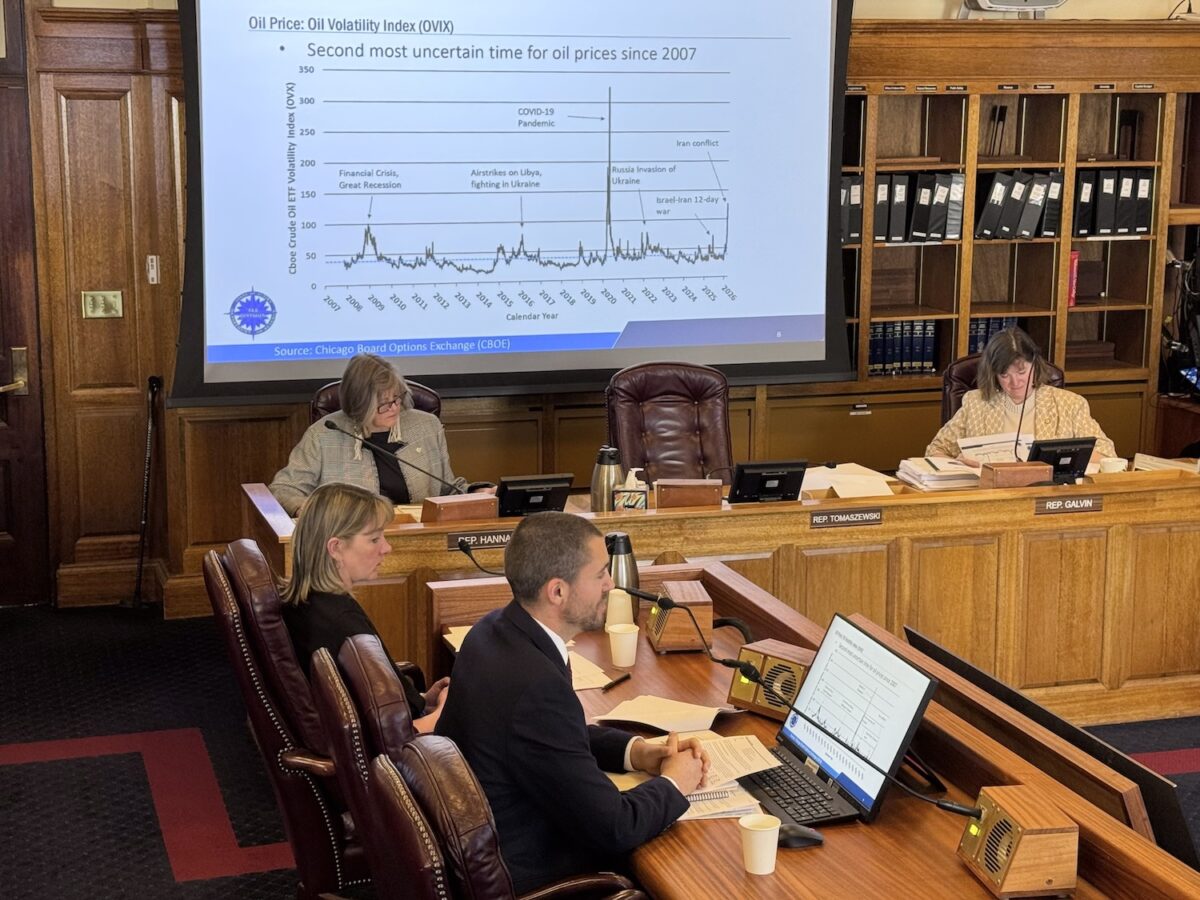
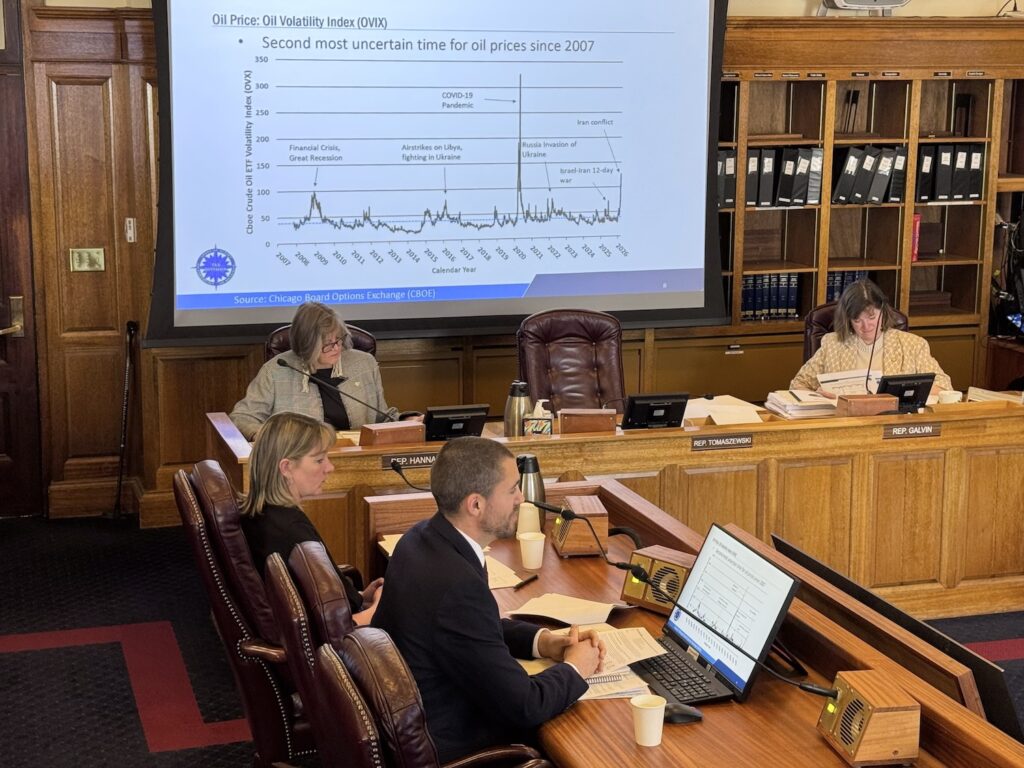
The U.S.-Israeli war against Iran has left oil markets more uncertain than they were during the Great Recession, a state expert told the Alaska Legislature on Monday.
In a pair of hearings, Alaska Department of Revenue economist Dan Stickel told state legislators that the volatility of global oil markets is the second-highest on record, leaving future forecasts particularly unreliable.
“The level of uncertainty around future prices in the oil markets now is higher than during the peaks of the Great Recession in 2008-2009 and it’s higher than the Russian invasion of Ukraine, and it’s higher than any of the COVID spikes other than the initial April 2020 spike,” he said during a Monday morning hearing of the Senate Finance Committee.
“The message here is to plan for the possibility that revenue doesn’t come in exactly at what we forecast for the next couple of years,” Stickel said.
Oil is the second-largest source of general-purpose revenue for the Alaska state budget, and Stickel’s testimony came days after the department released a new Alaska revenue forecast showing $545 million more in current-year revenue than projected in the fall. Most of that higher prediction is due to the price of oil.
That forecast has snarled relations in the Alaska House of Representatives, which has repeatedly postponed discussion of a bill that would fund a variety of amendments to the fiscal year 2026 budget passed by lawmakers and Gov. Mike Dunleavy last spring.
On Monday, after more than two hours of acrimonious debate, House legislators again declined to take up the bill.
Soon after the House adjourned its floor session, Stickel testified in front of the House Finance Committee, and told lawmakers that “the level of certainty that we will hit our exact forecast is low.”
As he spoke, on the other end of the Capitol’s fifth floor, the Senate Finance Committee was simultaneously hearing from Office of Management and Budget director Lacey Sanders, who said the governor’s office was requesting another $18 million in spending for the current fiscal year.
Altogether, the governor has requested almost $427 million in additions to the budget. Add in additional spending proposed by lawmakers, and there’s only about a $30 million difference between the new revenue forecast and the additions proposed by the governor and legislators.
At the latest forecast prices, said Rep. Calvin Schrage, I-Anchorage, a $2 change in the average price of a barrel of North Slope oil is worth $30 million.
He asked Stickel what the odds were that the forecast misses low by more than $2.
“Roughly a slightly less than 50% chance that we come in more than $2 below the forecast,” Stickel said, then alluded to the fact that there’s a similar chance of coming in above the forecast.
“The level of certainty that we will hit our exact forecast is low in either direction,” he said.
Currently, members of the House majority are advocating that legislators unlock the state’s principal savings account to provide surety for some of those budget additions.
Doing so would avoid problems if oil prices turn out to be lower than forecast.
But spending from the Constitutional Budget Reserve, the state’s principal savings account, requires 30 votes in the House and 15 votes in the Senate.
The House’s multipartisan coalition majority has 21 members, which means they need support from the all-Republican House minority caucus.
Members of that group have been arguing against unlocking the budget reserve right now, saying that the new forecast and the current balance of the state’s general-purpose accounts demonstrate it isn’t needed.
In addition, as currently written, the supplemental budget bill in the House would allow spending from savings regardless of the price of oil. That could allow the majority to dictate extra spending even if prices stay high.
The Senate has already approved spending from the Constitutional Budget Reserve, and on Monday morning, Sen. Bert Stedman, R-Sitka and co-chair of the Senate Finance Committee, said a draw from the reserve would act as a “safety net.”
Sen. Lyman Hoffman, D-Bethel, said senators don’t intend to spend dollars from savings unless it is needed.
“If they are not needed, they will stay in the CBR,” he said, adding that without permission to spend from savings, there’s a chance that lawmakers would need to return in August to fix budget problems in a special session.
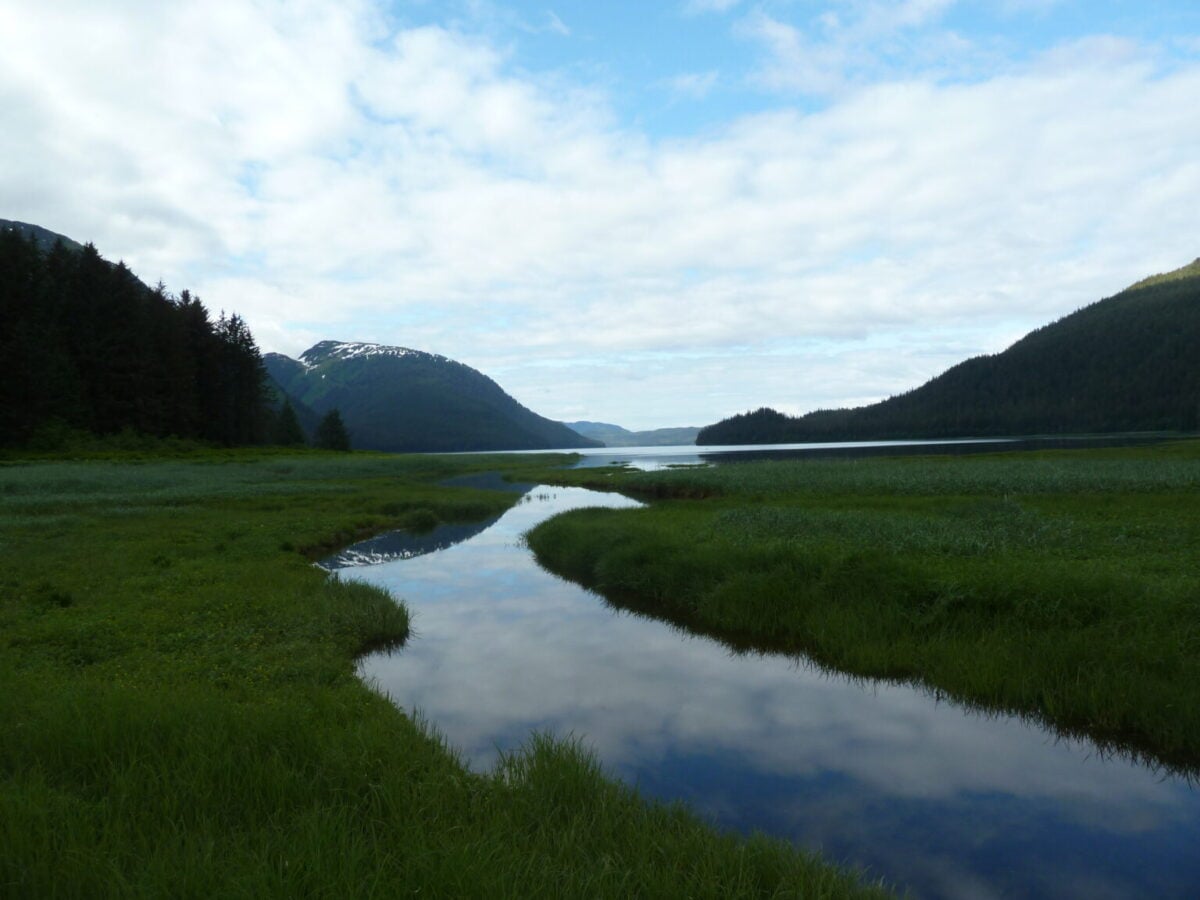
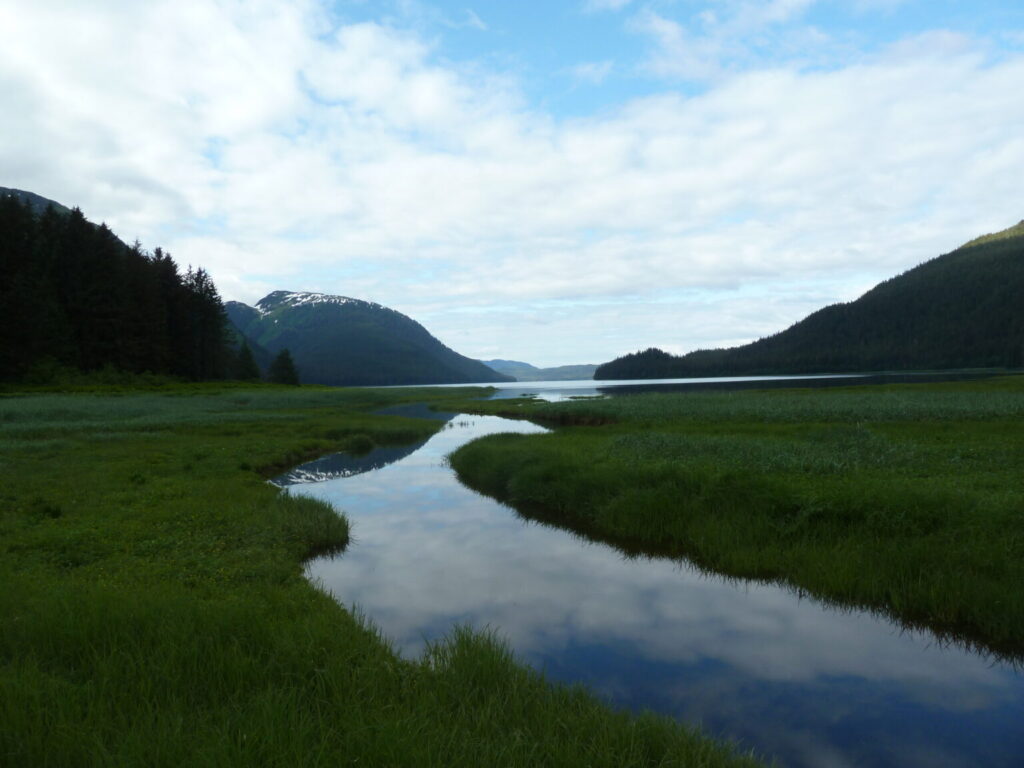
A stream reflects the clouds on June 20, 2011, in Kootznoowoo Wilderness, Admiralty Island National Monument, Tongass National Forest, Alaska. (Forest Service photo by Don MacDougall)
A federal judge in Alaska has rejected a lawsuit that sought to reinstate a management plan that would allow heavier logging in the world’s largest temperate old-growth rainforest.
The result leaves an Obama-era management plan in place, but it could be short-lived: The administration of President Donald Trump is already at work on a new plan that could allow more logging in Alaska’s Tongass National Forest.
In an order published Friday, Judge Sharon Gleason dismissed the lawsuit filed by Viking Lumber, Alcan Timber and the Alaska Forest Association.
The three groups sued the U.S. Department of Agriculture — the parent organization of the U.S. Forest Service — last year, alleging in part that the federal Tongass Timber Reform Act of 1990 required the Forest Service to offer enough timber sales to meet market demand.
Gleason ruled otherwise, finding that TTRA does not impose “a mandatory duty” on the Forest Service to ensure that market demand is met by Tongass timber sales.
“Whether the harvest levels are designed to actually meet market demand is a discretionary agency action, not a mandatory requirement imposed by the TTRA on the Forest Service,” she wrote.
Gleason also declined to take up plaintiffs’ argument about whether the Forest Service violated the Administrative Procedures Act, and she ruled that a 2021 announcement about Tongass strategy did not amount to formal rulemaking under law. She did not analyze whether it would have met legal standards if it had been a formal rulemaking process.
Plaintiffs were represented by Pacific Legal Foundation, which on Friday said that the Forest Service’s approach has been devastating to plaintiffs.
Kyle Griesinger, a spokesperson for the foundation, said that even with a new management plan in the works, the case isn’t moot because the old plan remains in effect until superceded.
“And, moreover, the Forest Service has not lived up to the 2016 plan so any new plan they may not live up to is no guarantee for our clients,” he said.
Marlee Goska, an attorney for the Center for Biological Diversity, agreed that last week’s ruling still has merit.
Goska was one of several attorneys who represented tribal, tourism, fishing and environmental groups that intervened on the side of the Department of Agriculture.
“I don’t think we have enough information yet to say the Forest Service is going to implement what the plaintiffs want. And certainly we’ll fight tooth and nail to stop that from happening,” she said of the upcoming plan change.
Goska added that last week’s ruling is important because it shows that the Forest Service does not have to meet market demand under existing law, and it shows that federal law doesn’t draw a distinction between old-growth harvests and new-growth ones.
“To the extent this administration and the Forest Service might be thinking about saying the TTRA mandates large old-growth timber sales to meet market demand, the court has already said that is incorrect,” she said.
Gleason published a final judgment on Friday. Plaintiffs have 30 days to file an appeal.
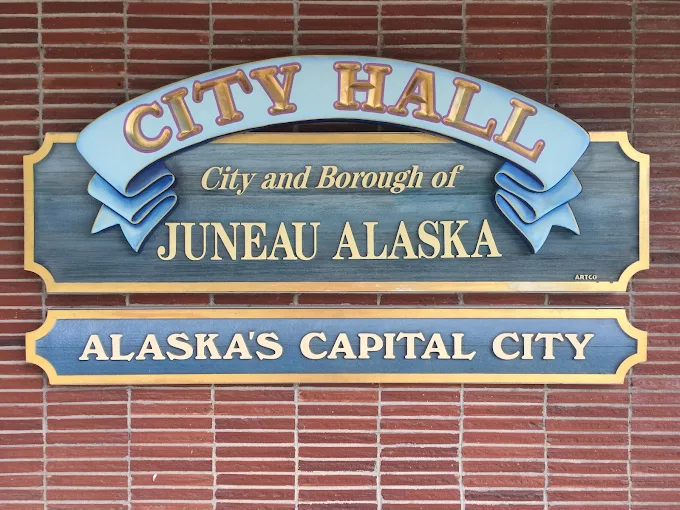
NOTN- The Assembly debated the future of 155 Heritage Way, the city’s current City Hall, and voted last night to send the ordinance to the full Assembly for public hearing and back to committee for further refinement.
City staff recommended selling the building by sealed bid with a $2.5 million minimum.
“The intent of bringing the disposal of City Hall to you well in advance of moving into the (new) municipal building or the Burns building, is we acknowledge that this conversation could take some time and even a sealed bid process, which is relatively straightforward, will take about nine months.” Said City Manager Katie Koester.
Members were split over whether to require an appraisal before sale, with some arguing an appraisal would provide necessary valuation confidence.
“To me, we have a duty. This project to move City Hall has been very expensive, more expensive than we would have ever wanted, and the public is not happy about it.” Said Christine Woll, “I do feel like we have a responsibility to get at least fair market value for this property. That being said, I don’t think we need to get the highest amount that we could get out of this, because I think that will come at an expense to our other goals. This is our downtown core and our waterfront, and we hear all the time from people who want to make sure this space stays year round in nature. So I think if we don’t design a process that allows us some control, not all the control in the world, but a bit more control to make sure that it goes somewhere that supports other community goals and is more year round in orientation.”
Others said it would add cost and delay.
“I would disagree with getting an appraiser, I think that’s spending money we don’t have to. If Huna Totem dock goes in, this is going to be a really valuable piece of property, and I think 2.5 will be nothing to what we can get for it.” Said Mayor Beth Weldon, “I probably have a couple minor little conditions to put on it, but not major ones. And my minor would be, just to give people food for thought, no jewelry stores, and a portion of the building would have to be year round. But everybody has to keep in mind that we can sell it like this, and then that person who bought it could turn around and sell it and have no conditions on it. So we just want to be careful. And I, like Ms. Woll, would like to get as much money as we can from the building.”
Several members urged sale conditions to protect downtown character, which is most commonly a requirement for year‑round occupancy of some portion of the site.
“Thank you, Mr. Chair. I also would resonate that I’m not particularly interested in doing the assessment, but it’s for a different reason.” said Nano Brooks, “Just a few years ago, we spent a lot of taxpayer money doing a campaign on why we need the new building, and plenty of data and figures came out from that campaign that this building was worth around $3 to $5 million and needed 14 million in deferred maintenance, therefore rendering it worthless. We all know that the land is extremely valuable, extremely desirable, but to say we’re selling a building I think, isn’t the most transparent and upfront, and we already did spend a lot of money figuring that information out that we put out there to the public. We need to find money where it can be found. But doing what’s right by the public takes the precedence too. So as far as the stipulations or requirements, I think, like the others were saying, having a preference for someone interested in year round operations, and then, if possible, having preference for a local purchase or two.”
Staff told the committee the $2.5 million minimum was set after consulting the assessor, and estimated a commercial appraisal would cost roughly $15,000–$20,000 if the Assembly opted for one.
Officials said the city will return with options on sale method, minimums and possible conditions at the next assembly meeting where the issue of City Hall will be brought to the public.