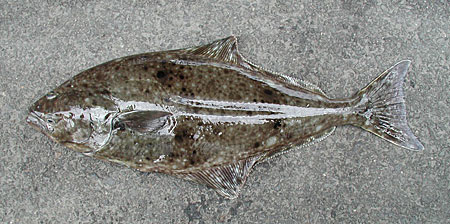
Pacific Halibut out of water, photo courtesy of Alaska Fish and Game
Five commercial fishermen from Alaska and Washington have been indicted by a federal grand jury, accused of conspiring to illegally harvest more than 10,000 pounds of halibut over a four-year period near Yakutat.
According to the U.S. Attorney’s Office, the fishermen, Jonathan Pavlik, 43, of Yakutat; Vincent Jacobson, 51, of Yakutat; Kyle Dierick, 36, of Yakutat; Michael Babic, 42, of Cordova; and Timothy Ross, 58, of Washington, each face federal charges under the Lacey Act, a law that prohibits illegal wildlife trafficking.
Prosecutors say the five men, all experienced commercial fishermen, took part in a conspiracy between 2019 and 2023 to violate halibut fishing rules tied to Individual Fishing Quotas, a system designed to sustainably manage halibut harvests in Alaskan waters.
The indictment alleges that Pavlik conspired separately with each of the other defendants to land halibut without being on board their vessels for the full duration of the fishing trips, a violation of federal regulations.
The indictment alleges that Pavlik, Jacobson, Dierick, Babic, and Ross intentionally falsely reported that the halibut caught was creditable to their respective Individual Fishing Quota (IFQ) permit balances, which is a permit any individual commercially fishing for halibut in the waters off Alaska is required to have. Pavlik and the three co-conspirators are responsible for over 10,700 pounds of illegally harvested halibut.
In a separate incident last fall, Pavlik allegedly sold over 9,600 pounds of illegally caught halibut that was fished aboard a vessel called the Bad Intentions and then transferred to another vessel, New Era, in an effort to conceal its origin before landing it for sale.
Pavlik faces 14 felony charges, including four counts of conspiracy, five counts of unlawful sale, and five counts of false labeling under the Lacey Act. Jacobson, Dierick, Babic, and Ross each face one count of conspiracy.
If convicted, each defendant could face up to five years in prison and fines of up to $250,000 per count. Court appearances are scheduled in the coming weeks before U.S. Magistrate Judge Matthew M. Scoble in Anchorage.
The investigation was led by NOAA Fisheries’ Office of Law Enforcement, Alaska Division, with support from the Alaska Wildlife Troopers. Assistant U.S. Attorneys Seth Brickey and Mac Caille Petursson are prosecuting the case.
An indictment is a formal accusation and not evidence of guilt. All defendants are presumed innocent unless proven otherwise in a court of law.
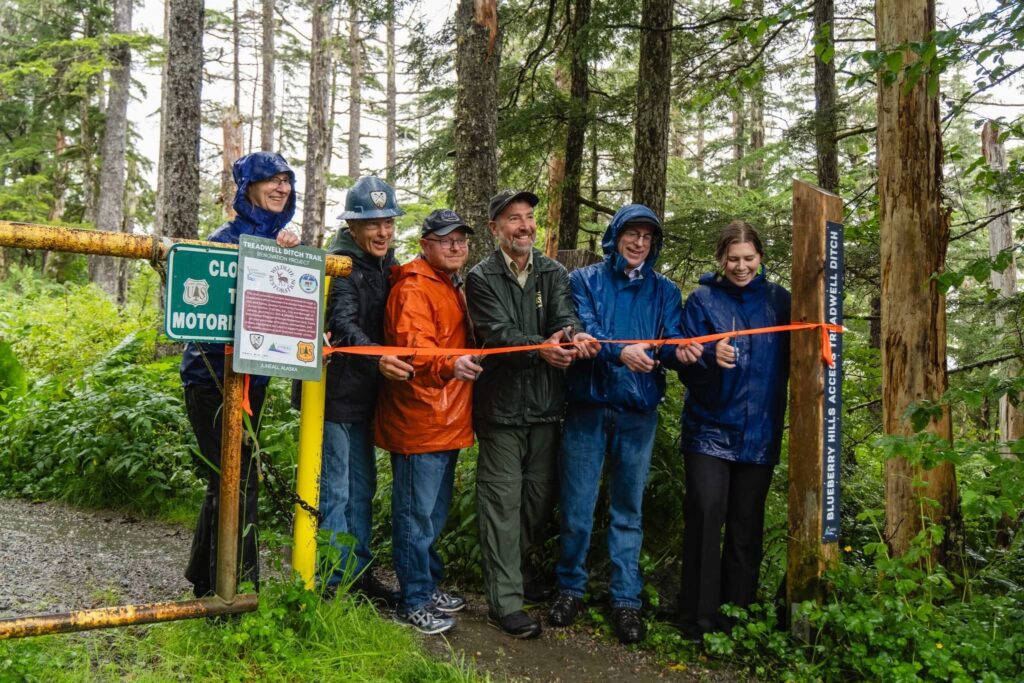
Treadwell Ditch Trail Saturday Ceremony, photo courtesy of Juneau Parks and recreation.
Trail Mix, the nonprofit trail stewardship organization based in Juneau, celebrated the long-awaited reconnection of the historic Treadwell Ditch Trail over the weekend.
The 13.3-mile trail now stretches continuously from Eaglecrest to South Douglas, featuring 65 bridges and 25 culverts.
A ribbon-cutting ceremony was held Friday from noon to 1 p.m. at the Blueberry Hills Dan Moller Trail parking lot, featuring remarks from agency partners and Trail Mix staff.
A larger public celebration happened Saturday at Savikko Park’s log shelter, with exhibits discussing the trail’s history and the work that led to its restoration.
“Last year, we installed the final bridge as part of this grant that we have through Alaska Department and fish and game, and it reconnected the Treadwell ditch for the first time in over 100 years.” said Trail Mix’s executive director Meghan Tabacek “it’s, it’s really a huge milestone, and the community loves the ditch. It feels really good to build a trail that we know people in Juneau love”
The Treadwell Ditch Trail was originally used to divert water for mining operations.
Trail Mix manages over 250 miles of trail in the region, with only three crews to maintain them.
“One of the biggest challenges, is logistics.” Said Tabacek “You know, you can’t drive a truck with all the pieces you need onto a trail.”
Volunteers play a crucial role in supporting Trail Mix’s mission. The organization has hosted near-weekly volunteer events throughout the summer and recently surpassed 1,200 volunteer hours. Their goal is 2,000 hours by season’s end.
“We are just so blown away with our volunteers, it’s just been really, really incredible watching people in Juneau show up.” Tabacek said.
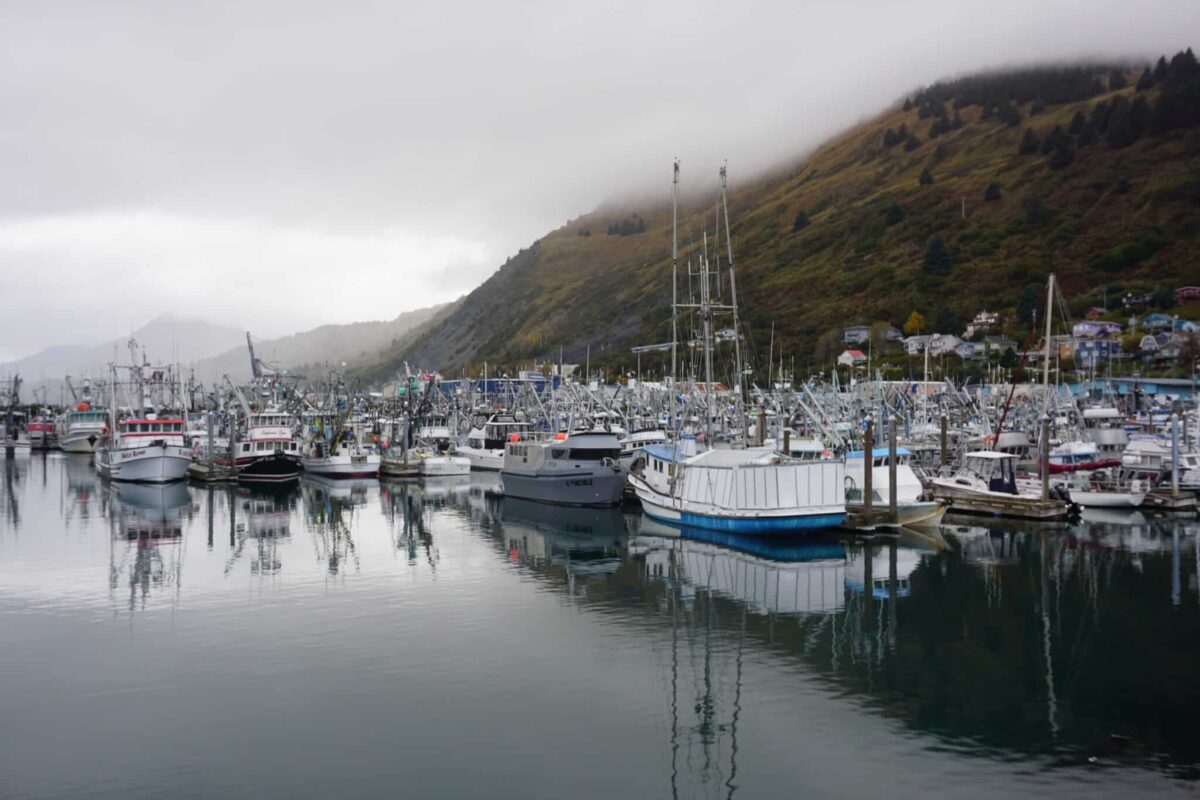
Low clouds hang over Kodiak’s St. Paul Harbor on Oct. 3, 2022. A Coast Guard response to a distress call from a fish tender sinking in the Kodiak harbor led to the discovery that oily bilge water was being discharged from the vessel, in violation of the Clean Water Act. (Photo by Yereth Rosen/Alaska Beacon)
A longtime Alaska fisher who was sentenced in May to a year in jail for illegally exporting crab, much of it disease infected, has now been ordered to pay $1.18 million in penalties for unrelated water pollution charges.
Corey Potter and the companies he managed — the vessel Knot EZ, Aleutian Tendering LLC and the Alaska Tendering Company LLC — were ordered to pay the combined penalty in a default judgment issued on Thursday by U.S. District Court Judge Sharon Gleason.
The penalty was for repeated discharges of oily bilge water, which violated the Clean Water Act, according to court documents.
Potter had not responded to the charges, which were detailed in a complaint filed on Oct. 24, or appeared in court on the case, according to the U.S. Coast Guard and federal prosecutors. That triggered the default judgment by Gleason.
Potter’s previous case concerned thousands of pounds of king crab he and his partners harvested in Southeast Alaska and took directly to Washington state. Alaska law requires that all crabs commercially harvested in waters off Alaska be landed and processed within the state. Part of the reason for that is to ensure quality and marketability.
The Knot EZ, seen in this undated photo, had been illegally discharging oily bilge water over multiple fishing seasons, federal prosecutors said. The vessel operated as a tender, delivering harvested fish from catcher vessels to processors. It was owned by Corey Potter, a longtime Alaska fisher sentenced in May to jail time for illegal out-of-state shipment of king crab, much of which was infected with bitter crab syndrome. (Photo provided by the U.S. Coast Guard)
Instead, a significant percentage of the catch that Potter and his associate brought to Washington state was infected with bitter crab syndrome. The parasitic disease, which is linked to warming waters, kills crabs and makes their meat unpalatable, though not toxic to humans.
The water pollution case against Potter is separate. It stems from a Coast Guard rescue of the Knot EZ, which was sinking in Kodiak Harbor in July of 2022. The Knot EZ operated as a tender, a vessel that delivered fish from harvesters to processors, according to court documents.
Guardsmen who responded to the Knot EZ’s distress call discovered that the vessel had an illegal discharge system that was pumping oily bilge water directly into the sea, according to the complaint. Crew members hired by Potter admitted that the illegal bypass system was used daily, according to the complaint.
The vessel was declared to be unfit for service, and subsequent investigation discovered a long-running pattern of such violations in past fishing seasons as well, according to the complaint.
While neither Potter nor his companies responded to the Clean Water Act charges, a public defender representing him in the crab case asked for leniency, based on his age and on the financial hardships he has already endured. Potter, 64, “has been reduced to relying upon family for assistance and has no viable means to support himself,” said the defense presentencing memorandum in that case, which was filed on May 6.
NOTN- The last two defendants in a six-person drug trafficking conspiracy pleaded guilty last week to charges stemming from a multi-state operation that funneled fentanyl and heroin into Alaska, federal prosecutors said..
According to court documents, Semaj Brown, 34, and Brandon Garrett, 46, both of Anchorage, pleaded guilty to conspiring with Julio Juarez, 32, of Anchorage, Marcelino Juarez, 30, of Anchorage, Shane Murphy, 43, of Wasilla, and Gustavo Sebastian Lopez-Chavez, 24, a Mexican national illegally residing in the U.S., to purchase fentanyl and heroin in California and transport the substances to Alaska through the mail or in checked airline baggage.
According to officials, the group trafficked at least 36 kilograms of fentanyl and about 10 kilograms of heroin.
The investigation culminated on Aug. 22, 2024, when U.S. Postal Inspection Service agents intercepted a suspicious parcel in Anchorage. A search warrant revealed more than two kilograms of fentanyl powder inside.
Days later, law enforcement conducted a controlled delivery, ultimately arresting Marcelino Juarez and Brown after observing them collect and transport the package. Garrett was detained in a separate vehicle nearby.
Authorities later linked Brown and Murphy to a July 2024 trip to Los Angeles, where they allegedly sourced additional fentanyl and heroin, including from Lopez-Chavez.
On July 6, airport security at Los Angeles International Airport seized a suitcase bound for Anchorage containing about one kilogram of heroin and two kilograms of fentanyl, when Murphy and Brown arrived in Alaska, they noted that the suitcase did not arrive.
Lopez-Chavez was arrested in Los Angeles on Nov. 14, 2024. At the time, he was carrying roughly 23 kilograms of fentanyl, along with cash and counterfeit immigration documents.
The Juarez brothers and Brown were identified as known gang members by the Stockton, California, Police Department.
All six defendants have now pleaded guilty. Marcelino and Julio Juarez entered pleas in July; Murphy pleaded guilty in April; Lopez-Chavez pleaded guilty in June; and Garrett was indicted in March before pleading last week.
The defendants are scheduled to be sentenced within the next three months. Marcelino Juarez, Brown, Murphy, Lopez-Chavez and Garrett face between 10 years to life in prison. Julio Juarez faces between 15 years to life in prison due to a prior conviction in California for attempted murder, for which he served 11 years in prison.
The case was investigated by the FBI Anchorage Field Office and the Alaska High Intensity Drug Trafficking Area (HIDTA) task forces, with assistance from multiple agencies across Alaska and California.
U.S. Attorneys Tom Bradley, Jack Schmidt, and Bill Reed are prosecuting the case.
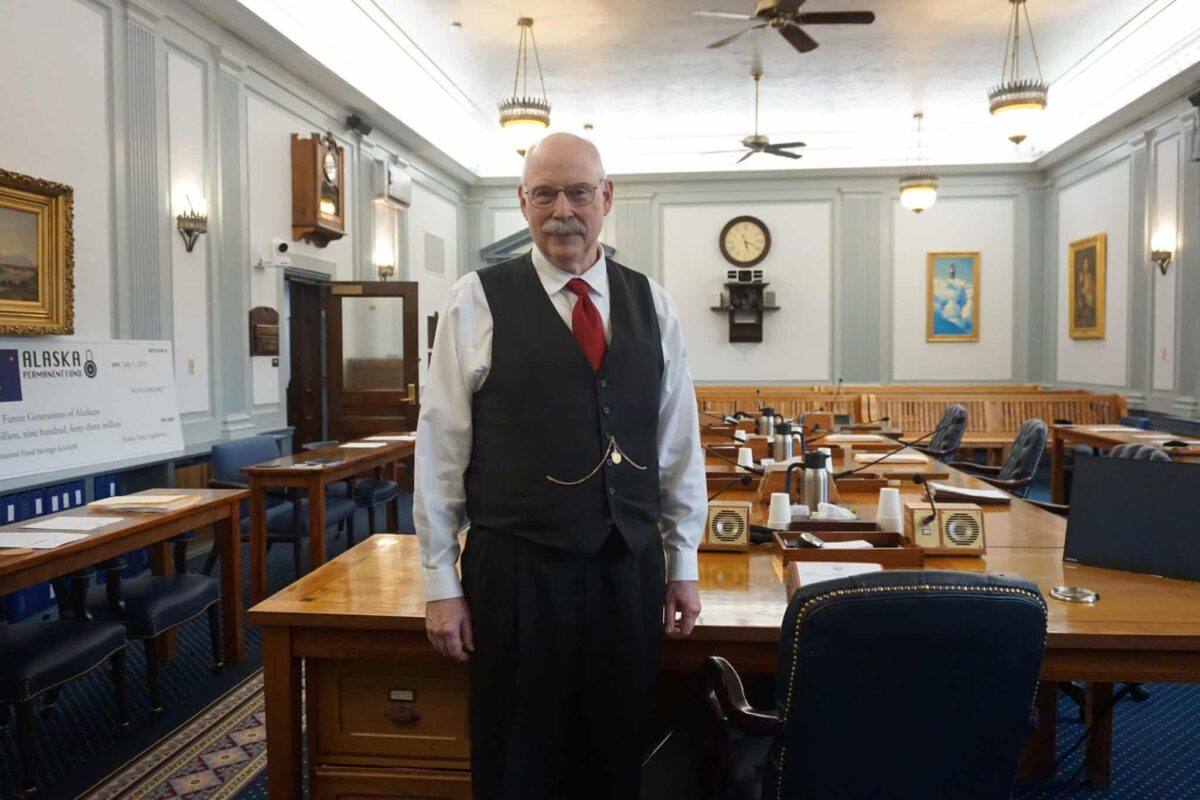
Sen. Bert Stedman, R-Sitka, stands in the Senate Finance Committee room on April 24, 2025. Stedman is sponsoring a bill that would create an Alaska flood insurance system that would be an alternate to the Federal Emergency Management Agency’s national insurance program. (Photo by Yereth Rosen/Alaska Beacon)
As the Trump administration shrinks and even considers eliminating the Federal Emergency Management Agency, the Alaska Legislature is considering a substitute for one of the agency’s key functions.
A bill introduced by Sen. Bert Stedman, a Republican from the Southeast city of Sitka, would establish an Alaska flood authority and an Alaska flood insurance fund. As far as he knows, it would make Alaska the only state with its own flood insurance, Stedman said.
The veteran state lawmaker said his measure, Senate Bill 11, stems from his dissatisfaction with FEMA and its flood policies, feelings that predated the agency’s possible demise in the Trump era.
The federal agency is, for now, the only source of flood insurance in Alaska, as private carriers that offer policies elsewhere in the country do not operate in the state’s small market, Stedman said.
But Alaskans overall pay much more into the FEMA insurance pool that they receive, he said.
“There’s a cost factor involved here, with Alaska residents subsidizing the Mississippi Delta and the Gulf Coast and East Coast and all that compared to our losses,” Stedman said.
FEMA’s rules about insurance and assistance, which are aimed at flood-prone flat Lower 48 areas, are another source of irritation for Stedman. In Lower 48 areas, FEMA encourages communities to avoid building along coastlines, but in Southeast Alaska, where steep mountains rise from the water’s edge, there are few options for moving inland, he said. An only-in-Alaska flood program could consider local conditions and local governments’ zoning rules rather than FEMA national guidelines, he said.
The Trump administration’s antipathy toward FEMA and its mission has given his bill more urgency, he said.
“It’s reasonably likely that there’ll be significant changes to FEMA coming out of Washington, from restructuring to possibly elimination, so the timing of this bill might be, by happenstance, timely,” he said.
The bill moved through committees this year and is due for more work next year’s session, including an examination of funding options. If a system is established, Stedman said, it could potentially be expanded to another type of disaster that is occurring with increasing frequency in warming Alaska: landslides. There is no specific landslide insurance available in Alaska, Stedman noted.
That may be of interest to Jason Amundson and Eran Hood, University of Alaska Southeast scientists who are focused on glacial outburst flood risks. Though immersed in their project at Mendenhall Glacier, they do not live in the path of the meltwater. Rather, both live in the city’s downtown area, which clings to the lower slopes of steep mountains. There, avalanches and landslides pose the most serious risks.
“There’s hazards everywhere in Juneau,” Hood said.
This story has been supported by the Solutions Journalism Network, a nonprofit organization dedicated to rigorous and compelling reporting about responses to social problems, http://solutionsjournalism.org.
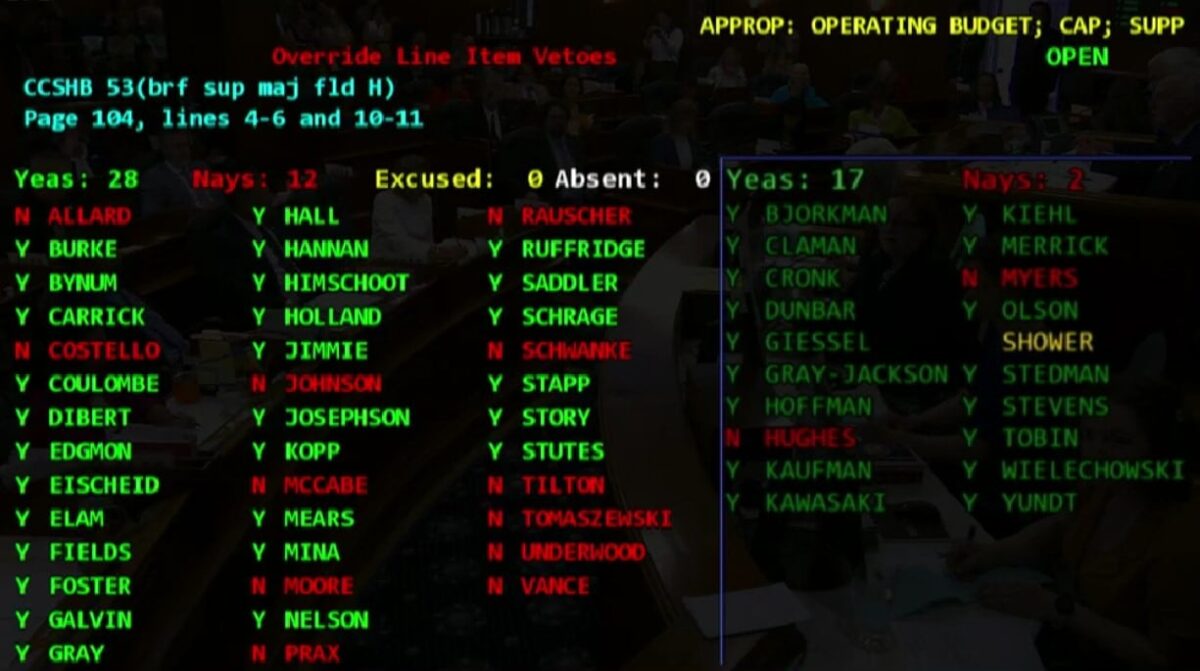
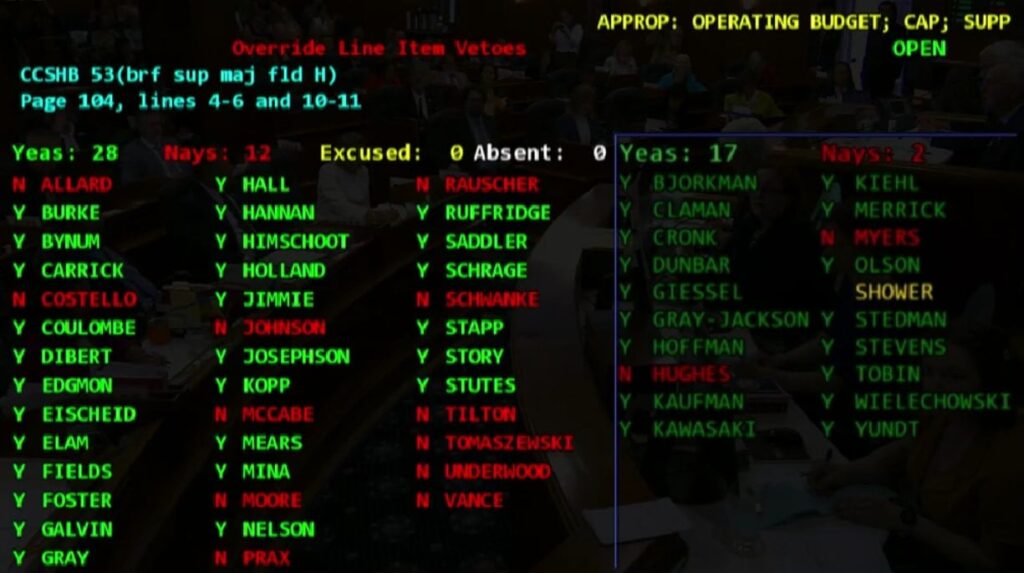
The joint session voted 45-14 in favor of overriding Gov. Mike Dunleavy’s veto of public school funding. (Image courtesy Gavel Alaska)
Meeting in special session, Alaska lawmakers have overridden Governor Mike Dunleavy’s veto of more than $50 million in public school funding.
The 45–14 vote hit the exact threshold needed to override a budget veto, restoring what would have been a 5.6% cut to school districts and providing a modest funding boost.
In Juneau, the veto would have had the effect of a $1.4 million loss.
Lawmakers also overrode Dunleavy’s veto of Senate Bill 183, a measure requiring the Department of Revenue to share details of oil tax settlements with legislative auditors.
The special session was originally called by the governor to press for education reform and create a statewide Department of Agriculture, two ideas lawmakers have already rejected.
Instead, legislative leaders focused solely on the veto overrides and adjourned until August 19.
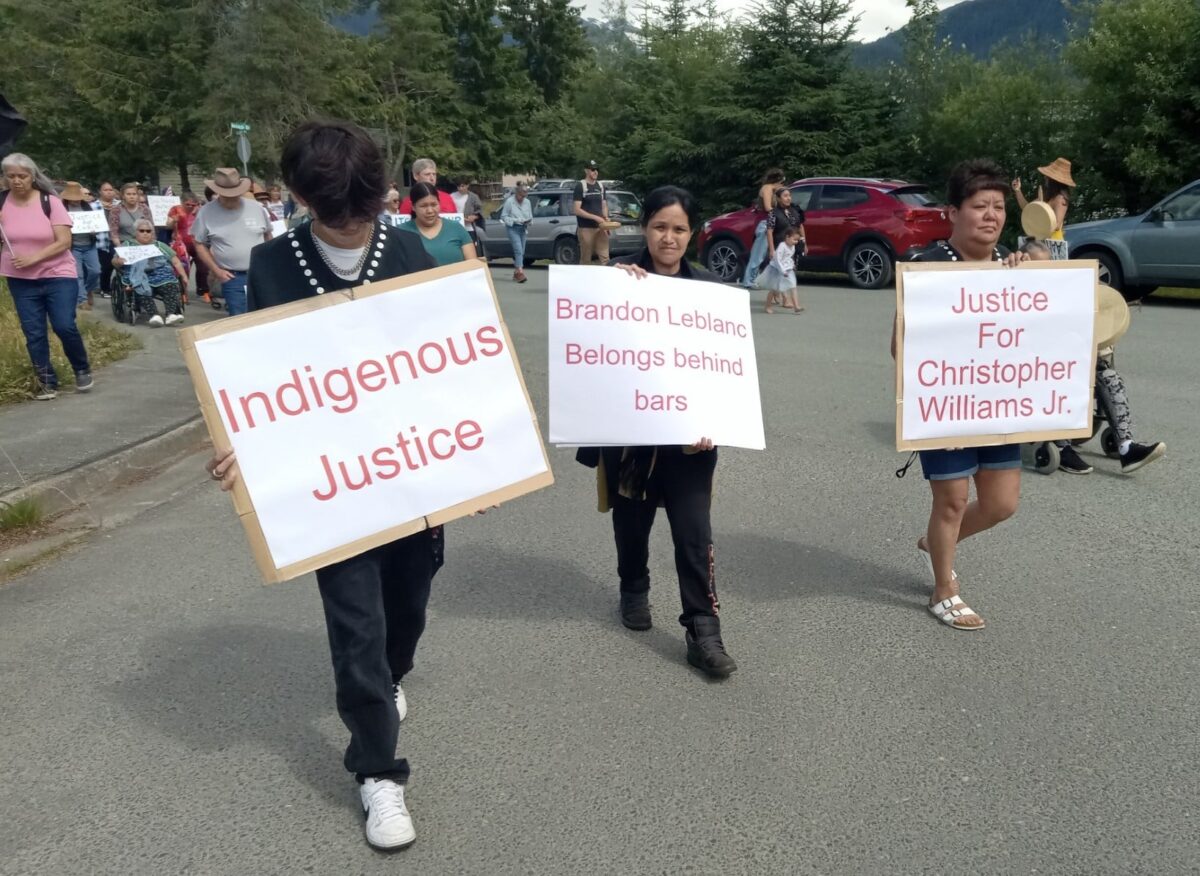
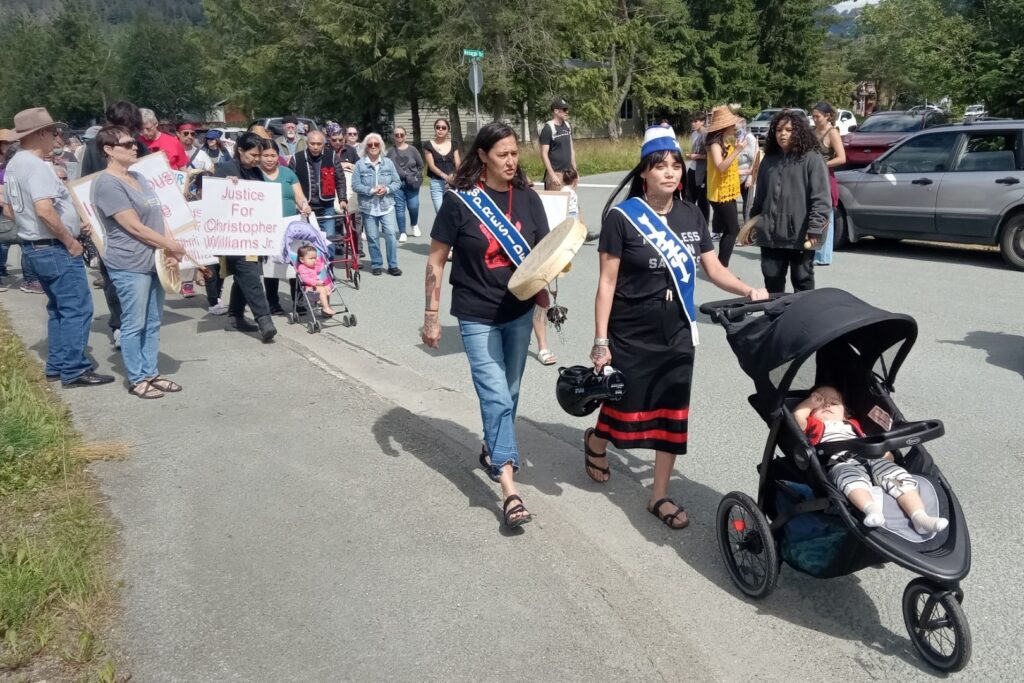
A peaceful protest was held Saturday outside Juneau Police Department headquarters, following the arrest last week of 49-year-old Chris Williams, Jr.
Williams was medevaced to Anchorage after being taken to the ground by JPD Officer Brandon LeBlanc outside the Douglas Library. Video posted on social media shows LeBlanc taking Williams down during what police say was an arrest after Williams allegedly approached officers aggressively.
Nearly 100 protesters peacefully called for accountability and systemic police reform.
Organizer Jamiann S’eiltin said the incident reflects a broader pattern of violence against Indigenous people.
“This isn’t something new,” S’eiltin said. “This has been going on since almost time immemorial, since the arrival of Western European settlers. So, just want to put that out there that we are brutally attacked 10 times more than the national average, and that’s something to bring forward here today.”
LeBlanc is on administrative leave and an outside agency is conducting an investigation into the incident.
The Central Council of Tlingit and Haida, which confirmed Williams is a tribal citizen, is demanding transparency and a full inquiry.
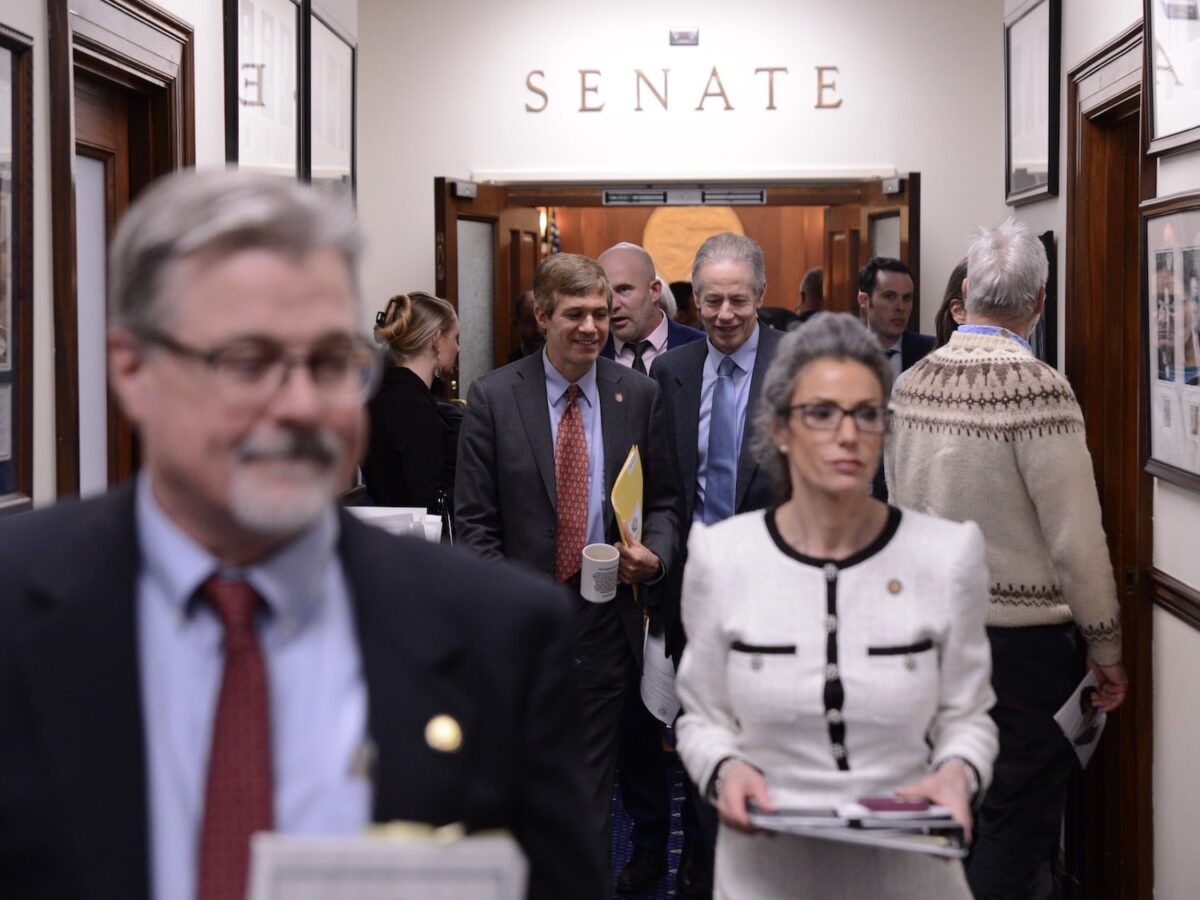
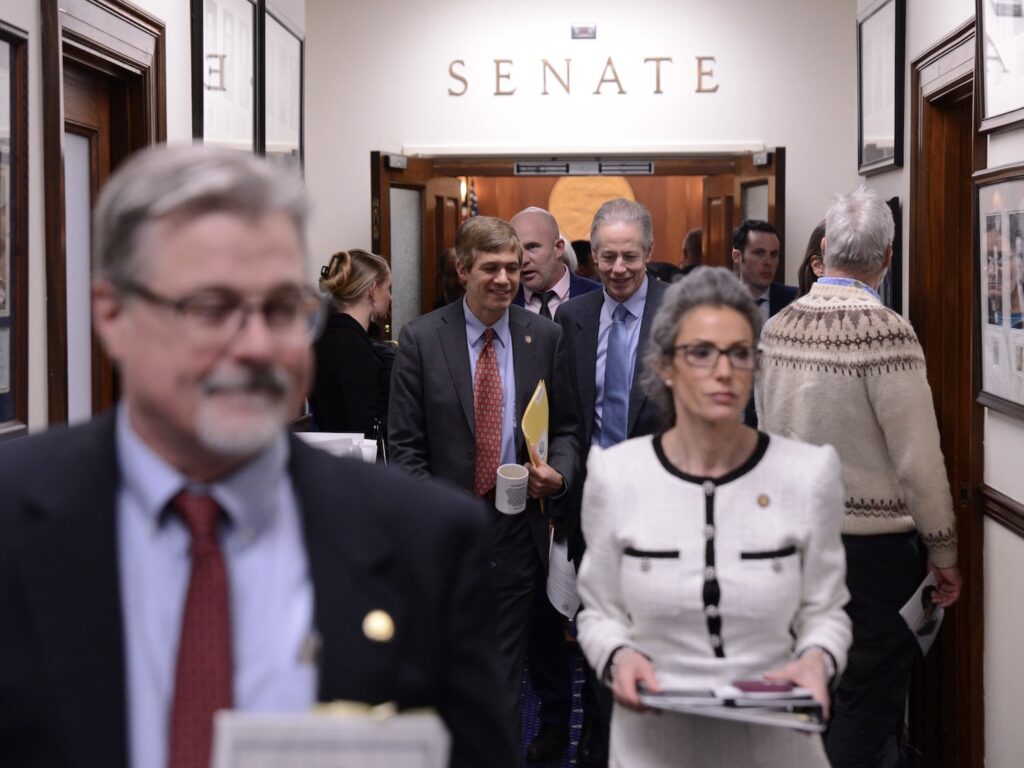
Members of the Alaska Senate leave the Senate chambers on Monday, April 28, 2025. (Photo by James Brooks/Alaska Beacon)
By: James Brooks and Corinne Smith, Alaska Beacon
Members of the Alaska Senate leave the Senate chambers on Monday, April 28, 2025. (Photo by James Brooks/Alaska Beacon)
Alaska lawmakers are scheduled to meet at 10 a.m. in Juneau for a special session of the Alaska Legislature. You can watch live online on Gavel Alaska.
Why is the Legislature meeting in a special session?
Gov. Mike Dunleavy called the special session. The official agenda says that it will involve legislation about education policy and a proposed Alaska Department of Agriculture.
Will legislators actually do that?
No.
What are they doing instead?
They’re going to vote on overriding at least some of the vetoes the governor has made since the regular legislative session ended in May.
No. 1 on the list is the governor’s decision to veto about $51 million in funding for public schools. The No. 2 item is the bill that would require the Alaska Department of Revenue to provide lawmakers with additional information about tax settlements between oil companies and the state. Lawmakers believe the state may be settling tax disputes for far less than they’re worth, costing the state millions.
Some legislators are interested in taking up other vetoes as well, including the governor’s decision to cancel a ban on payday loan lending, his decision to veto money for transportation projects, and his vetoes of bills affecting police dogs and teacher housing, among others.
Will those overrides succeed?
It’s too close to call. The Alaska Constitution says votes from 45 of 60 legislators are needed to override a budget veto. In May, 46 legislators voted in favor of overriding the governor’s decision to veto a bill that increases the state’s public school funding formula.
That was the first time since 2002 that legislators voted to override the veto of a sitting governor.
It isn’t clear whether everyone who voted in favor of that first override will vote in favor of the second.
Overriding a policy bill veto, like the one dealing with the tax settlements, takes 40 votes.
Will everyone be there?
Probably not. Some conservative Republicans had said they would stay away from the session in a show of support for the governor’s vetoes. Immediately after calling the special session, Dunleavy asked them to be absent for the first five days because an absence is as good as a “no” vote when it comes to a veto override.
He later changed his position, asking lawmakers to begin meetings about his stated agenda on Sunday, and some Republicans changed course and said they will attend the session, after all. It wasn’t clear whether all have done so, but it isn’t likely to affect the vote total on the potential override.
Sen. Forrest Dunbar, D-Anchorage, is in favor of an override and had been expected to be unavailable because of military service overseas. He ended up getting a special leave of absence and is flying back from Europe. Sen. James Kaufman, R-Anchorage, is flying back from Vietnam to attend. Other legislators have canceled family plans and postponed business trips.
How long will this take?
On the low end, a few hours. On the high end, a few days. Officially, the special session can last for up to 30 days, but legislators have said they won’t use all that time.
In some previous special sessions, legislators have left Juneau without formally closing the special session, just in case they need to come back. Those special sessions ended after the 30th day.
How much will this special session cost?
Based on historical costs, the estimated cost for a special session is $30,000 per day, according to the Legislative Affairs Agency, the Legislature’s nonpartisan support agency. But that cost depends on the duration and scope of the special session, said Jessica Geary, the agency’s executive director, by email on Tuesday.
“Many legislators had to change summer travel plans to attend the special session, and many of them purchase their own travel and submit for reimbursement. At this point we don’t have any concrete cost estimates and won’t know until the special session concludes,” she said.
Geary said legislators have up to 60 days to submit reimbursements for expenses like hotel lodging, transportation and airfare, staffing, expenses, and so the agency will have a total cost by October.
Legislators receive an annual salary of $84,000 per year. The 57 members that live outside of Juneau are entitled to receive a “per diem” amount of $332 per day to cover expenses.
If lawmakers don’t take up the governor’s ideas, are they dead?
No. Legislators have created a task force to consider education policy changes, including those from the governor. One idea supported by the governor is open enrollment — allowing a student to move between different schools and school districts, regardless of where they live. That will be considered by the task force, which meets Aug. 25.
Legislators are also considering a bill that would create the Alaska Department of Agriculture. That bill is broader than the governor’s initial plans; for example, it would include sea farms (formally known as aquaculture), which are the fastest-growing agricultural sector in Alaska.
NOTN- Human remains discovered more than two decades ago in the Gastineau Channel have been identified as those of Darryl Bruce Fawcett, reported missing in 1999, authorities said Wednesday.
The Juneau Police Department, in coordination with the Alaska Department of Public Safety and the State Medical Examiner’s Office, confirmed the identification using new DNA analysis techniques made available this month.
Fawcett, who was said to be experiencing homelessness at the time, had not been in contact with family since September 1999. He was reported missing in December of that year after relatives became concerned when mailed checks were returned uncashed. Authorities said Fawcett may have briefly traveled to Yakutat, where local police confirmed he was seen before disappearing.
On March 13, 2004, a diver discovered human remains approximately 83 feet underwater in the Gastineau Channel near Merchant’s Wharf. The remains were recovered and submitted to the State Medical Examiner’s Office, but could not be identified with the forensic tools available at the time.
On July 21, 2025, the Alaska Scientific Crime Detection Laboratory implemented a new DNA extraction method capable of generating profiles from bones and teeth. Less than two weeks later, on July 31, officials confirmed the remains as those of Fawcett.
The Alaska State Troopers have notified Fawcett’s next of kin.
According to the proposed ordinance, when an officer-involved shooting occurs that causes death or serious injury to an officer or someone else, Juneau Police Department would release body-worn camera footage no later than 30 days after the incident. (Photo courtesy City & Borough of Juneau website)
A Juneau Police Department vehicle(Photo courtesy City & Borough of Juneau website)
A woman was arrested and a man was hospitalized following an altercation outside the Douglas Library on Wednesday evening, according to the Juneau Police Department.
Police responded to a report of a woman fighting with a man near the library at approximately 7:32 p.m. on July 30. Officers identified the woman as Marisa Didrickson, 47, of Juneau, and the man as a 52-year-old Juneau resident.
According to police, Didrickson allegedly threw water in the man’s face and made racially charged remarks, including comments suggesting the man, who is black, did not belong in Juneau. She was arrested on a charge of disorderly conduct.
As officers attempted to place Didrickson into a patrol vehicle, she continued to shout at the 52-year-old man and directed a 49-year-old male friend to “take care of him,” while nodding toward the man, police said.
The 49-year-old, also a Juneau resident, then approached officers in what police described as an aggressive manner. the man was taken to the ground during arrest and sustained a head injury.
He was transported by Capital City Fire/Rescue to Bartlett Regional Hospital and later medevacked to Anchorage for further treatment.
Didrickson was transported to Lemon Creek Correctional Center. The incident remains under investigation, police said.
The press release comes after a video was circulated by a civilian on social media.
The arrest has sparked controversy in comments, with some saying the officer used unnecessary force.
The Juneau Police Department has requested and was granted assistance from an outside law enforcement agency to lead an investigation into the officer’s use of force in this incident.
Once the agency concludes its investigation, the State of Alaska Office of Special Prosecutions will review the case to determine whether the use of force was consistent with AS.11.81.370. The Officer involved has been placed on administrative leave per department policy. Their name will be released following the investigating agency’s review. In accordance with CBJ code, body-worn camera footage related to this incident will be released and posted on the JPD website 30 days from the date of the incident.