Categories
Featured Juneau News juneau Juneau Local Juneau Local Ketchikan Local News Feeds Sitka Local

Alaska Supreme Court considers limits of executive and legislative power, including on abortion

By: James Brooks, Alaska Beacon

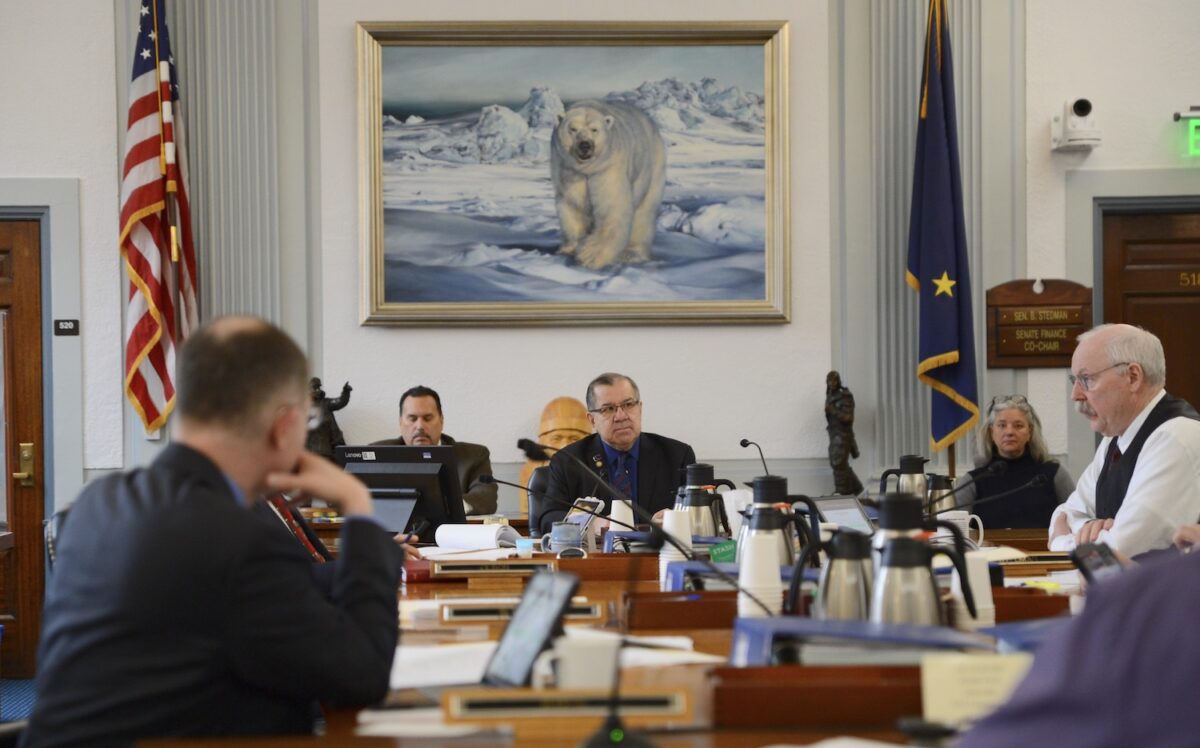
In this screenshot from Gavel Alaska, Alaska Supreme Court Justice Aimee Oravec speaks during a hearing on Wednesday, March 4, 2026. (Screenshot)

For years, politically conservative members of the Alaska Legislature have attempted to restrict state-paid abortion care via language in the annual state budget.

That maneuver and similar actions could be ruled unconstitutional by the Alaska Supreme Court, which on Wednesday heard oral arguments in a lawsuit that may determine the limits of the Alaska Constitution’s confinement clause, which requires that budget bills be limited to spending and not include policy changes.

At issue in the case is a budgetary maneuver twice adopted by the Legislature in an attempt to partially de-fund a contract for a Washington, D.C.-based law firm that Gov. Mike Dunleavy’s administration used to defend his controversial restructuring of public employee unions’ dues payments

GET MORE

If you’re interested in the technical details of this case, the Alaska Legislature’s opening brief can be found here. The state’s response can be found here, and the Legislature’s reply brief is here.

Legislators said the contract, at more than $600,000, was too expensive, and in 2020 and 2021, they carved the budget for the Alaska Department of Law into two segments in an attempt to limit the contract.

Two of the governor’s attorneys general said they believed the Legislature was actually targeting the union dues plan, and its actions thus represented an unconstitutional infringement of the executive branch’s power.

Dunleavy vetoed the contract-specific language, technically eliminating all funding for the defense, and his administration kept on spending.

The Legislature’s auditor concluded in 2023 that the Dunleavy administration likely violated state law and the Alaska Constitution by continuing to spend money that had been eliminated from the budget. 

Lawmakers sued in January 2024.

By that time, the Alaska Supreme Court had ruled that the union-dues changes had been enacted illegally. Four days after the Legislature filed its lawsuit, the U.S. Supreme Court said it would not hear an appeal requested by the administration, an act that leaves the state supreme court’s ruling in place.

In 2025, over the Legislature’s objections, Anchorage District Court judge Dani Crosby ruled that lawmakers’ lawsuit was moot because the money had already been spent, and she dismissed it. 

Legislators appealed to the Supreme Court, arguing that there is a public interest in having the issue resolved, because it is likely to return again.

Attorney Kevin Cuddy, representing the Legislature, noted that last year — as in past years — the Alaska Legislature authorized a budget that included a provision stating that the Alaska Department of Health may not spend Medicaid money on certain abortions.

“That idea of no funding for this, some funding for that, these conditions are a regular feature of the budgeting process,” he said in Wednesday’s oral argument, arguing that the issue is not moot.

Deputy Solicitor General Jessie Alloway represented the state in Wednesday’s hearing and said the abortion issue is an example of why the court should decline to take up the Legislature’s arguments.

“This is exactly why the court should say this is moot and not take a more abstract view … because there is an unlimited number of hypotheticals that we could come up with that would be problematic,” she said.

If the court does overrule Crosby, both sides asked the justices to give them a firm answer rather than having Crosby take up the issue again.

The justices would then have to decide whether legislators overreached by attempting to restrict the executive branch, whether the executive branch overreached by continuing to spend, and where exactly the line rests between legislative and executive power.

“That’s what we keep coming back to: Who gets to decide this, whether these contracts are necessary?” asked Justice Aimee Oravec.

One prior Supreme Court case discussed Wednesday may offer some clues. In 2001, the court ruled on a legislative lawsuit against then-Gov. Tony Knowles over a series of budget vetoes.

One of those vetoes involved a dispute over bed space bought by the state prison system in private facilities. Legislators wrote in the budget that the space had to be bought from private contractors. 

The supreme court upheld that language in its ruling.

“Conditions are permissible, as this court held in the Knowles case,” said Cuddy, the Legislature’s attorney, “including saying what types of services, public versus private, or private versus public, the money can be spent upon.”

But Alloway, arguing for the state, said legislators were attempting to define purchases that had already happened. That’s different from Knowles. 

“What was happening was the (attorney general) had already retained outside counsel via his statutory authority. The Legislature knew about it, and then the appropriation targeted that decision by eliminating the amount the AG could spend on the contract,” she said.

During Wednesday’s argument, chief justice Susan Carney was absent. Staff for the court said she was recovering from surgery and out on medical leave.

Justice Dario Borghesan, a former Department of Law attorney, recused himself from the case, leaving three justices, all Dunleavy appointees, for Wednesday’s hearing.  Justice Jennifer Henderson, presiding over oral arguments, said Carney may be involved in deliberations before a final decision is published at a later date.

Categories
Featured Juneau News juneau Juneau Local Juneau Local Ketchikan Local News Feeds Sitka Local

Alaska House OKs bill to crack down on AI-generated child sexual abuse material

By: Corinne Smith, Alaska Beacon
Rep. Sarah Vance, R-Homer, speaks in support of a bill she sponsored, HB 47, that would add state criminal penalties for AI-generated child sexual abuse material, on the House floor on Feb. 27, 2026. (Photo by Corinne Smith/Alaska Beacon)

Anyone that possesses, creates or shares child sexual abuse material created with artificial intelligence in Alaska would face new state felony charges under legislation advanced by the Alaska House of Representatives on Friday — plus AI companies and social media companies could face state penalties too. 

House members passed House Bill 47 almost unanimously by a 39 to 0 vote, with Rep. Neal Foster, D-Nome, absent. The bill is sponsored by Rep. Sarah Vance, R-Homer, and would enact new state felony charges for creating AI-generated images or videos that visually depicts sexually explicit or obscene content involving anyone under the age of 18. Previously known as child pornography, it’s now referred to as child sexual abuse material or CSAM.

“A decade ago, we couldn’t even imagine what it is that the vulnerable and our children are facing, and tools that are being used to exploit them,” Vance said Friday on the House floor ahead of the vote. “But here we are in a fast-paced technological environment, and our prosecutors are left with very few tools,” she said. 

Vance lauded the bill as closing a gap in state criminal law. Currently there are no state laws directly addressing AI-generated CSAM, though there are statutes that prohibit the viewing, possession and distribution of child sexual abuse materials. Vance emphasized that the bill would update Alaska law to penalize AI-generated CSAM, and noted it would apply regardless of whether images depict a victim or AI-generated material.  

“Currently in statute, you have to prove the harm of an actual child. And what this bill does is says that anything that is generated obscene material of minors will be criminalized to the same level as if it were a real child,” Vance said. 

Vance and others pointed to the recent arrest of an Alaska senator’s chief of staff for soliciting minors for CSAM on Snapchat, and the need to increase state penalties. Other lawmakers said the case demonstrates the need for more parental controls on minors’ social media. 

Legislators added on and approved significant parental controls and penalties for tech companies too, through an amendment process on Wednesday. 

Under the revised bill, social media companies will require age verification and parental or guardian consent for minors to create or maintain social media accounts. Parents would have full access to minors’ social media, including all minors’ messages and interactions on the platform. The bill enacts a social media curfew for minors from 10:30 p.m. to 6:30 a.m., unless modified by a parent. 

Rep. Zack Fields, D-Anchorage, sponsored the amendments and said with increased parental control measures, parents and guardians will be able to intervene on potentially predatory behavior or victimization of children. 

“The fundamental question is: Do parental rights supersede the rights of predators?” Fields said on the House floor Wednesday. “And do parental rights supersede the rights of multi-national corporations, which we have heard knowingly target children with addictive, destructive algorithms. We know that.”

Targeted advertising to minors on social media would also be prohibited, as would content targeting minors, addictive design or features that “encourages or rewards a minor user’s excessive or compulsive use of the platform or that exploits the psychological vulnerabilities of a minor user,” according to the bill. 

Families or the state would be able to bring civil legal action against social media companies for harm due to such violations under the bill, and companies could face a penalty of up to $10,000 for each violation. 

“I don’t care how hard it is. We should not back down from Big Tech when it comes to protecting our children,” Fields said. 

The amendment passed with a 28 to 12 vote, with supporters and opponents spanning party lines.

Rep. Genevieve Mina, D-Anchorage, the youngest member of the House, opposed the provision. 

“I absolutely agree that social media can be harmful for youth, especially given the vast environment, where there are a lot of different strangers and people on the internet. I also know I’m probably one of the only people in the body who very much grew up online,” she said Wednesday on the House floor.  

“I’ve wrestled back and forth with these types of policies, especially as it relates to age verification or requiring consent from a minor,” she said, and added that she shared concerns about first amendment and privacy rights. “But I just don’t believe that age verification through government regulation is the right way.” 

Vance, the sponsor of the bill, also opposed the increased parental controls provision citing First Amendment concerns. 

Lawmakers also voted to approve a provision levying civil penalties on any AI organization that facilitates users creating AI-generated CSAM of up to $1 million for each instance. 

Rep. Calvin Schrage, D-Anchorage, sponsored the amendment which was passed unanimously. 

“I think this is something that creates an incentive for these large companies to curtail or at least put some controls and protections around what I think can be a very powerful and useful tool, but is so often used today for really malicious, nefarious and, I would say, disgusting purposes,” Schrage said. 

The bill would also prohibit the distribution of generated sexual depiction of adults without their consent or participation. It would also prohibit distribution of a “forged digital likeness,” known as “deep fakes” often used as misinformation, revenge pornography, scams or blackmail. 

The bill now advances to the Senate.

Categories
Featured Juneau News juneau Juneau Local Juneau Local Ketchikan Local News Feeds Sitka Local

Alaska House advances bill intended to boost workforce housing

By: Sean Maguire, Alaska Beacon

Rep. Andi Story, D-Juneau, speaks Wednesday, May 8, 2024, on the floor of the Alaska House of Representatives. (Photo by James Brooks/Alaska Beacon)

The Alaska House on Friday advanced legislation intended to increase construction of workforce housing.

Alaska has long had a severe and persistent housing shortage. House Bill 184 attempts to address that by allowing the Alaska Industrial Development and Export Authority, the state’s economic development agency, to finance construction of commercial housing with more than five units.

The House approved the bill on a 23-15 vote with two lawmakers absent.

Juneau Democratic Rep. Andi Story, the bill’s prime sponsor, said that Alaska’s housing shortage is “at crisis levels,” which is contributing to workforce challenges. 

“This shortage is very discouraging to Alaskans and businesses, and it is a persistent barrier to economic growth,” she said before Friday’s final vote.

In 2023, Agnew::Beck Consulting estimated that Alaska would need to build 27,500 new units over the next decade to meet demand. However, actual construction numbers have fallen far below those targets.

HB 184 was supported by all present members of the Democrat-dominated House majority and three minority Republicans.

Supporters said the legislation would help with resource development projects and to address workforce shortages more generally. Story cited examples of health care workers who had turned down jobs in Juneau due to a lack of housing. 

Rep. Jeremy Bynum, a Ketchikan Republican in the minority, voted for the bill. He said shipyard projects and fish processors in Ketchikan and Wrangell were exciting developments for Southeast Alaska, but a shortage of housing remained a concern.

“We have a tremendous need for workforce housing,” he said on Friday.

Opponents of the bill noted that AIDEA already has the authority to invest in multi-unit housing for workers. 

Mark Davis, special counsel for the agency, told lawmakers last year that AIDEA does have that authority and it has invested in workforce housing in the past. He cited examples of the agency financing construction of work camps in Prudhoe Bay.

“However, we have also said that this provides clarification that we would have that power,” he said, later adding that it would be a “positive bill.”

Some opposition to the bill centered on whether new housing units would actually serve workers in critical industries or if it would direct construction of affordable housing. 

A previous version of HB 184 used the U.S. Department of Housing and Urban Development definition of workforce housing: “(as) residential housing that costs the occupants less than 30 percent of the income of a household with 120 percent of the median family income.”

But that definition was removed from the bill in committee. Instead, the bill states that AIDEA should facilitate the financing of “new workforce housing facilities containing five or more dwelling units.”

Big Lake Republican Rep. Kevin McCabe on Friday suggested the legislation was a “thinly-veiled attempt” to direct AIDEA into the construction of “community housing.” He said the agency, which was established in 1967, should be focused on “job creation.” He said that HB 184 would change AIDEA’s basic structure.

McCabe attempted to amend the bill on Wednesday to limit its scope, but he was unsuccessful. 

HB 184 now heads to the Senate for its consideration. A similar bill in that legislative chamber has advanced to the Senate Finance Committee.

Categories
Featured Juneau News juneau Juneau Local Juneau Local Ketchikan Local News Feeds Sitka Local

Anchorage lawmaker pushes legislation to protect sibling ties for Alaska foster youth

By: Corinne Smith, Alaska Beacon

Kxlo Stone (left) and Trinity Beltz (right) testify to the importance of protecting sibling relationships in foster care to the House Judiciary Committee on Feb. 26, 2026. Stone’s sister Tali Stone sits behind her. (Photo by Corinne Smith/Alaska Beacon)

Alaska foster youth could see their ties to siblings legally protected through the adoption process, under legislation proposed last year in the Alaska House of Representatives.

House Bill 157 would maintain the legal relationship between siblings through the process of adoption, and also encourage adoptive families to support sibling relationships. It is sponsored by Rep. Andrew Gray, an Anchorage Democrat, who is a foster parent himself.

“Sibling relationships are among the most powerful and enduring connections a person can have,” Gray said, in opening remarks of a hearing on the issue on Wednesday. “For children in foster care, siblings are often a remaining link to their past, their identity and their family. These bonds provide emotional stability, comfort and a sense of belonging during an experience that is confusing and traumatic.”

Currently, under Alaska law, adoption ends the legal relationship between adopted children and their birth family, including siblings. The bill preserves the legal relationship between siblings, despite adoption and termination of parental rights. Siblings would continue to be legally recognized, including for siblings by blood, marriage or adoption by one or both parents.

Deko Harbi (left) and Lotus Nickoli (right) testify in support of HB 157 and the importance of preserving sibling relationships in foster care on Feb. 25, 2026. (Photo by Corinne Smith/Alaska Beacon)

Gray introduced the bill last year but it has not yet been scheduled for committee hearings. This week, he invited a group of current and former foster youth with Facing Foster Care in Alaska, a non-profit advocacy organization, to testify on the issue to the House Judiciary Committee on Wednesday. In an emotional hearing, youth shared personal stories of separation from siblings, and urged legal protections for maintaining sibling relationships as vital.

“When my siblings and I were separated, daily things became harder to do and life was harder to get through,” said Tali Stone, who was separated from her five siblings when they entered state custody. “I went from laughing, sharing bed with my older sister, and playing with my younger siblings, to not knowing where they lived, who they lived with, and missing huge milestones and moments in their lives.” 

Lotus Nickoli of Fairbanks testified to the fear and uncertainty he felt when he was separated from his eight siblings.

“It’s just more scary, like knowing that they’re going to be going through different situations, different foster homes and whatnot, different foster parents, like you don’t know who they’re with and what these foster parents are capable of,” he said, breaking down into tears. 

“Siblings should not be separated,” he said. 

In Alaska, the Office of Children’s Services, which runs the state’s foster care system, is required to “make reasonable efforts” to place siblings together in a foster placement if siblings are living in the same home when taken into state custody. If siblings are not placed together, case workers must document how reasonable efforts were made. The case worker is also charged with connecting siblings and providing opportunities for contact, “if it is in the best interest of the child to maintain contact.” 

Amanda Metivier, director of Facing Foster Care, said the foster youth have called for legislation to prevent sibling separation because the reality is often youth are having great difficulties in maintaining contact when taken into state custody and after adoption.

Amanda Metivier (right) director of Facing Foster Care Alaska, and Amanda Redmon (right) a former foster youth testify to the House Judiciary Committee on the importance of maintaining sibling relationships among foster youth on Feb. 25, 2026. (Photo by Corinne Smith/Alaska Beacon)

“So as a state, we’ve been experiencing a decline in the number of foster homes in recent years, and so it becomes harder and harder for OCS to keep children together,” she said.

“The unfortunate truth is that if you have a young person that moves into a foster family or a relative, and the permanent goal is going to be adoption, and their siblings are in another place, they become legal strangers,” she said.

Trinity Beltz said when OCS intervened and took her, her eight siblings and two stepsisters into state care, they were all separated in foster placements. While she could see some of her siblings, she OCS barred her from seeing her stepsisters because the agency claimed they were not related.

“Nobody updated me on where they were, and that really broke me,” she said. “I haven’t seen them since they were at least four years old, and looking at them now, they’re already almost seven to eight.”

“But I do want to still be their sister, and not be like a stranger to them,” she added. “To me, that would break my heart completely.”

The bill was introduced last year and was referred to the House Health and Social Services Committee.

Categories
Featured Juneau News juneau Juneau Local Juneau Local Ketchikan Local News Feeds Sitka Local

House Bill 101 would raise Alaska’s Age of Consent to 18

Representative Andrew Gray at a Senate Judiciary hearing for HB 101 on February 9, 2026, Photo Courtesy of Gavel Alaska.

This article mentions sensitive topics such as sexual assault and child sexual assault, resources for victims in Alaska can be found here.

NOTN- Alaska lawmakers are considering legislation that would raise the state’s age of consent from 16 to 18, a change the sponsor statement says would strengthen protections for teenagers and make it easier to prosecute sexual assault and exploitation.

House Bill 101, sponsored by Rep. Andrew Gray, was introduced as Alaska continues to report some of the highest rates of sexual violence in the country.

“Alaska has the highest rate of rape in the country, which is over 3 times the national average.” Gray said at a Senate Judiciary hearing, “We also have one of the highest rates of child sexual assault in the country, over 6 times the national average, according to the UAA Justice Centers’ Alaska Victimization Survey.”

Under current law, 16- and 17-year-olds can legally consent to sex with adults, which supporters say creates a loophole that complicates prosecutions. Survivors often must prove they did not consent, even when there is a clear power imbalance between adults and teens, which Gray says makes the successful prosecution of cases difficult.

HB 101 would close that gap by establishing that minors under 18 cannot legally consent to sexual activity with adults. The bill includes a four-year “close-in-age” exemption so consensual relationships between peers are not criminalized.

The Anchorage Police Department has formally endorsed the bill. In a letter to lawmakers, Police Chief Sean Case said officers regularly see the harm caused by sexual abuse and exploitation and that the bill would give law enforcement clearer authority to protect minors and hold offenders accountable.

“On behalf of the Anchorage Police Department, I express our strong support for House Bill 101. This legislation strengthens protections for Alaska’s youth by aligning our criminal statutes with the realities of adolescent development and the responsibility of adults to safeguard minors from exploitation and harm.” The letter said.

Categories
Featured Juneau News juneau Juneau Local Juneau Local Ketchikan Local News Feeds Sitka Local

Alaska lawmakers probe state detention policies following ICE arrest of Soldotna family

By: Corinne Smith, Alaska Beacon

Rep. Andrew Gray, D-Anchorage, speaks Friday, April 26, 2024, on the floor of the Alaska House of Representatives. (Photo by James Brooks/Alaska Beacon)

The arrest of a Soldotna family by U.S. Immigration and Customs Enforcement, including two teens and a 5-year-old, has prompted a wave of concern and lawmakers to hold an investigatory hearing on Monday on the arrest and detention of minors in Alaska.

“As far as I am aware, the detention of children by ICE in Alaska is unprecedented,” said Rep. Andrew Gray, D-Anchorage, who chairs the House Judiciary Committee. In opening remarks, he questioned if federal agents provided full due process to the family and honored legal protections for children. 

“Is Alaska about to see more children detained?” he asked.

ICE agents arrested Sonia Espinoza Arriaga at her home in Soldotna on Feb. 17, and apprehended her three children — ages 18, 16 and 5. Arriaga is married to an Alaskan U.S. citizen and was in court proceedings to gain asylum after fleeing violence in Mexico, according to news reports. The next day, Arriaga and her two younger children were deported to Jalisco, where they remain. The 18-year-old was transported and detained at the Anchorage Correctional Complex and transferred on Feb. 20 to a privately-run ICE detention facility in Tacoma, Washington, according to news reports

The arrest comes as ICE operations are ramping up in Alaska and nationwide, amid the Trump administration’s immigration crackdown. Gray noted the agency saw a historic funding increase last year and now has a budget of roughly $85 billion.

Clergy members, immigration attorneys, advocates and concerned community members testified to the House Judiciary Committee on Feb. 23, 2026 on the recent ICE arrest of a Soldotna family and detention of minors in Alaska. (Screenshot of Gavel)
Anna Taylor with the Alaska Institute for Justice (top left), Rev. Michael Burke with St Mary’s Episcopal Church of Anchorage (top middle), Elora Mukherjee, a clinical professor of law at Columbia and director of the Immigrant Rights Clinic (top right), Rev. Meredith Harbor with the Christ Lutheran Church in Soldotna (bottom left), Rev. Lisa Adam Sherry with the Anchorage Unitarian Universalist Fellowship (bottom center), and Soldotna parent Alison Flack (bottom right) testified to the House Judiciary Committee on Feb. 23, 2026 on the recent ICE arrest of a Soldotna family and detention of minors in Alaska. (Screenshot of Gavel)

Members of the House Judiciary Committee put questions to officials with the Alaska Department of Corrections and Department of Public Safety on the extent of the state’s involvement in ICE operations and detention of minors. They also heard testimony from community members, attorneys and clergy expressing outrage and concern at ICE operations. 

Gray said the committee had invited representatives from ICE and the U.S. Department of Homeland Security to testify about the arrest and issues raised, but they declined to appear. He said his office has submitted a list of questions to the agencies, including questions about due process, and have not yet heard back.

Gray said his office will be drafting a committee resolution urging a change in federal policy, and said if ICE fails to answer the committee’s questions, the committee will “look at other options for compelling their testimony.”

State agencies questioned on policy around detaining minors and cooperation with ICE

Jen Winkelman, commissioner of DOC, said the department has an agreement with federal authorities to detain people arrested under federal charges, including with ICE for civil immigration charges.

“Does DOC detain minors?” Gray asked. Winkelman said no.

Winkelman did not say in the committee meeting whether DOC would hold children detained by ICE.

“We have the contract for the federal government to hold individuals that may come in in a non-criminal capacity,” Winkelman said. “When the ICE agents detain somebody, they will bring them to us, the individual and a piece of paper that essentially authorizes us to hold them.”

In the case of Arriaga, her husband, Alexander Sanchez-Ramos, told reporters that initially she and her two youngest children would be held in a hotel in Anchorage and guarded by federal agents, but then he learned they were flown to San Diego the same evening of their arrest, then driven to the Mexico border and deported.

ICE did not immediately respond to questions on Tuesday about  the expedited deportation of the Arriaga family and plans and protocols for detaining minors and families in Alaska.

Gray said the committee had invited representatives from ICE and the U.S. Department of Homeland Security to testify about the arrest and issues raised, but they declined to appear. He said his office has submitted a list of questions to the agencies, including questions about due process, and have not yet heard back.

Zane Nighswonger, director of institutions for DOC, told lawmakers that ICE detainees are held in state prisons, but are held separately.

“They’re basically subject to the same security measures we have for our prisoners. We do keep them separate from the prisoner population, as they’re non-criminally charged,” he said Monday. “They recreate separately from other prisoners, have access to their telephone calls separately from other prisoners, and then showers and things like that.”

Nighswonger said individuals arrested by ICE are typically held in Alaska jails and then transferred to federal detention facilities within 72 hours. 

The Alaska State Troopers do not participate in ICE enforcement, Leon Morgan, deputy commissioner for the Alaska Department of Public Safety, told lawmakers on Monday. “We don’t coordinate with ICE for immigration enforcement,” he said. 

Morgan said for criminal cases Troopers will work with federal partners, but not cases related to immigration enforcement. He said Troopers have a policy to mitigate effects of law enforcement actions when children are involved. “In terms of how ICE does their job, or what they do, that is just beyond or outside the scope of how we operate,” he said. 

Rep. Chuck Kopp, R-Anchorage asked what state legislators can do to constrain ICE action in Alaska given federal authority outweighs state law. 

Elora Mukherjee, a clinical professor of law at Columbia Law School and director of the Immigrant Rights Clinic, testified that lawmakers can not only speak out, raise concerns and demand answers from federal authorities, but states are also taking action to block ICE enforcement actions and developing new detention centers. 

“I think your committee is doing exactly the right thing by inviting officials from the federal government, from ICE, from DHS, to testify about what is happening in Alaska,” she said. “Right now, it seems that in Alaska, as in many states across the country, the federal government does not want local and state legislators to know what they are doing.”

Advocates call arrests and detainments a ‘grave concern’

Attorneys and immigration advocates testified that the avenues for legal immigration are being cut back by the Trump administration at every level — from travel bans, to canceling visa and refugee programs, to petitioning to end birthright citizenship — resulting in more and more people being arrested and deported.

Arriaga had reportedly applied for and was in the process of obtaining asylum for her family. A spokesperson for ICE said she had failed to appear for a court hearing in January, prompting deportation, according to news reports. 

Mukherjee testified that ICE is increasingly arresting and detaining children and families.

“From January to October 2025, at least 3,800 children under the age of 18, including 20 infants, were detained by US immigration authorities,” she said, and many are held beyond the legal limit of 20 days. 

She spoke about her experience representing children and families held at the privately-run South Texas Family Detention Center in Dilley, Texas, and the traumatizing conditions of detention there. 

“Among my other clients at Dilley have been a two year old boy who was breastfeeding in detention. A six year old boy had a leukemia diagnosis. An eight year old girl began wetting the bed. An 11 year old girl lost hearing in one year. A 14 year old girl engaged in self harm. All of these children and their parents were detained despite being eligible for release,” she said. 

“ICE has the authority to release these families who are not flight risks on parole as they seek asylum and other forms of humanitarian protections in the United States,” she noted. “None of these children or their parents had a criminal history anywhere in the world.” 

A Soldotna mother, Alison Flack, whose daughter attended kindergarten with Arriaga’s five-year-old, testified he was flourishing in school and learning English, and that the community is shaken by his arrest.

“We’re all now faced with the decision of what to tell our children,” she said. “Should I tell her that he moved and just hope and pray that she doesn’t find out the truth? Our state is better than this. 

“I don’t want to tell my daughter that the grown-ups have done something so terrible, the ones she’s supposed to be able to trust,” she said. 

Clergy members in Anchorage and Soldotna testified that the incident and actions from federal immigration authorities raise grave moral concerns. 

“We believe there’s been a serious breach of what we as clergy leaders would consider basic sacred family values,” said Rev. Michael Burke, pastor of St. Mary’s Episcopal Church of Anchorage and speaking on behalf of a multi-faith group. 

“We tore a family from their community rootedness in this recent event, and this harm that was done, potential harm to children that will have a lifetime memory of trauma was not caused by any bad actors other than those of the federal government themselves,” he said. “This raises grave concerns as a matter of policy, the rule of law and our fundamental ethical commitments to one another as members of the community.”

Categories
Featured Juneau News juneau Juneau Local Juneau Local Ketchikan Local News Feeds Sitka Local

UA Board of Regents to continue anti-DEI policy, despite federal court ruling

By: Corinne Smith, Alaska Beacon

 Student walks along West Ridge at the University of Alaska Fairbanks campus on Oct. 10, 2024. (Photo by Yereth Rosen/Alaska Beacon)

The University of Alaska Board of Regents says the university will continue the policy to ban references to “DEI,” or “diversity, equity and inclusion,” enacted last year, despite a federal court ruling that struck down the policy and the U.S. Department of Education agreeing to drop an appeal.

Jonathon Taylor, a spokesperson for the university, said even though the policy was struck down, “the direction of enforcement and potential risk has not gone away.”

Last year, the Trump administration issued a “Dear Colleague” letter to all pre-K through 12 schools, colleges and universities who receive federal funding outlining its opposition to diversity initiatives it called discriminatory, and threatened to withhold federal funds from schools if they had diversity or equity programs.

As a result, the board moved quickly to comply, approving a policy on Feb. 21, 2025 to scrub references to DEI and affirmative action from all university programs and operations, job titles and office names. At the time, Ralph Seekins, chair of the Board of Regents, defended the policy, saying the action to remove DEI language as committing to “equal opportunity” for everyone. 

Several education and civil rights groups filed lawsuits and a federal court blocked the directive in April. This week, a New Hampshire federal judge dismissed the case, following a January agreement by both parties and the Department of Education to drop its appeal. The ruling invalidates the directive, and prevents the government from enforcing it. Plaintiffs celebrated the court’s move, with some saying it was a victory for free speech and academic freedom.

Taylor confirmed that the UA Board of Regents had no immediate plans to change or rescind the policy for the University of Alaska.

“The Dear Colleague Letter from February 2025 has indeed been struck down by the courts, and the Department of Education has declined to appeal,” Taylor said by email. 

“However, the federal administration’s policy goals and concerns that led to the letter – including what they see as discriminatory DEI practices, and attempts to tie enforcement to federal funding – have not changed. Federal agencies can still pursue similar goals through other legal or regulatory means and have demonstrated an intent to focus oversight or investigations on what they see as DEI-related policies and programs using mechanisms other than agency guidance (the original Dear Colleague letter),” he wrote.

Taylor said the board enacted the policy to mitigate risks of federal funding being withheld. He said the board has had to “balance their concern about the potential medium- and long-term regulatory and funding risks to which UA may be exposed with the University’s unchanging and unwavering commitment to equal access, equal opportunity, and no discrimination, as well as free speech, academic freedom, and freedom of expression.”

Taylor added that overall, UA has so far been effectively able to “weather the storm” of federal funding cuts, grant freezes and terminations. As of September, and most recently available data, UA had roughly $530 million in active federal grants. There has been $24.6 million, or 4.6% that have been delayed, frozen or terminated.

The item was not on the Board of Regents’ February meeting agenda, scheduled for two days this week in Dillingham, at the University of Fairbanks’ Bristol Bay campus.

But several university faculty weighed in during public comment to the board on Monday.

Jill Dumesnil, a professor of mathematics at the University of Southeast and president of the largest faculty union, United Academics, called on board members to create updated guidance following the ruling. 

“Many faculty are still experiencing a chilling effect on our campuses. Some fear retaliation or punishment for teaching or discussing DEI-related subject matter, others just feel uncomfortable, unsupported and unwelcome,” she said. 

“Teaching about race, racism, inequality and related issues, continues to be lawful, supporting students in a way that acknowledges racial or ethnic identities continues to be lawful,” she added. “Schools may continue operating programs that encourage diversity, equity and inclusion in accordance with existing law, and the Dear Colleague letter and the certification requirement cannot be enforced against educators or schools.” 

Michael Navarro, a professor of marine fisheries at the University of Alaska Southeast, and co-chair of the Belonging, Empowerment, Access, Representation and Safety Committee, known as UAS BEARS, made a plea to the board to rescind the anti-DEI motion. 

“As a direct result of this board decision, UAS has lost faculty and staff and some students question the university’s commitment to their success and safety on campus,” he said. 

“Despite the anti-DEI motions, reaffirmation towards maintaining a welcoming environment and honoring Alaska Native culture and heritage, after this motion, many people now feel less welcome or even unwelcome, and are not testifying today because they don’t feel safe to do so.”

Taylor, with the university, said as of now the board does not have plans to take up the issue but continually accepts written comments from the public. “The Board continues to receive testimony both in support of and in opposition to last year’s motion, and takes that feedback into consideration when setting meeting agendas,” he said.

To date, the University of Alaska Fairbanks has taken the hardest hit with federal funding cutbacks — of the $24.6 million in grants delayed, frozen or terminated, approximately $20 million has been at UAF, including $8.8 million terminated for funded programs for Alaska Native and Native Hawaiian students last year. The Trump administration has terminated $4 million in grant funding at the University of Alaska Anchorage, Taylor confirmed, and no federal grant funding has been frozen at the University of Alaska Southeast.

Categories
Featured Juneau News juneau Juneau Local Juneau Local Ketchikan Local News Feeds Sitka Local

Alaska to replace Black Veterans Memorial Bridge, saving part as tribute to Alaska Highway builders

FILE – This Oct. 25, 1942, photo provided by the U.S. Army Corps of Engineers Office of History, shows Corporal Refines Slims, Jr., left, and Private Alfred Jalufka shaking hands at the, “Meeting of Bulldozers,” for the ALCAN Highway in the Yukon Territory in Beaver Creek, Alaska. (U.S. Army Corps of Engineers Office of History via AP, File)

AP-Thousands of Black soldiers performed the backbreaking work of transforming rough-hewn wilderness in extreme weather swings during World War II to help build the first road link between Alaska and the Lower 48.

The work of the segregated Black soldiers is credited with bringing changes to military discrimination policies. The state of Alaska honored them by naming a bridge for them near the end point of the famed Alaska Highway.

Now, eight decades later, the aging bridge needs to be replaced. Instead of tearing it down, the state of Alaska intends to keep two of the bridge’s nine trestles in place as a refashioned memorial. The others will be given away.

Two spans will become the memorial

The state of Alaska will replace the 1,885-foot (575-meter) bridge that spans the Gerstle River near Delta Junction, the end point of the Alaska Highway about 100 miles (161 kilometers) south of Fairbanks.

Seven of the bridge’s trestles are being offered for free to states, local governments or private entities who will maintain them for their historical features and public use.

The two remaining spans from the old bridge, renamed the Black Veterans Memorial Bridge in 1993, will honor the 4,000 or so Black soldiers who built the first wooden bridge over the river while completing the Alaska Highway.

These two sections, the first trestles on either end, will retain the name of the memorial bridge. The new Gerstle River Bridge will unofficially carry the memorial name unless the Legislature also makes it official. The old bridge will remain in place until the new one opens in 2031.

Former mayor wants proper memorial

Mary Leith, a former Delta Junction mayor and member of the historical society, said she’s pleased some of the history will be saved, but she wants the state to have proper signage and a highway pullout area near the historic bridge to allow people to walk on it.

“I would hope that if they’re going to save it, then they save it properly,” she said.

The Black Veterans Memorial Bridge sign will remain and the two sections will be visible from the new bridge, but both will be blocked off to prevent people from climbing or vandalizing them, said Angelica Stabs, a spokesperson for the state transportation department. No pullout is planned.

The new bridge will parallel the existing bridge to the east, leaving about 50 feet of space between it and the old bridge’s location, Stab said.

Soldiers’ work helped integrate the U.S. Army

The project to build a supply route between Alaska and Canada used 11,000 troops from the U.S. Army Corps of Engineers divided by race, working under a backdrop of segregation and discrimination. Besides transforming the rugged terrain, the soldiers had to deal with mosquitoes, boggy land, permafrost and temperatures ranging from 90 degrees F (32 degrees C) to minus 70 F (minus 56 C).

“Though conditions were harsh for all, they were nearly unbearable for black soldiers. From the Deep South, most of these soldiers had never encountered anything approaching the severe conditions of the far north. Moreover, since black troops were not typically permitted to use heavy machinery, they made do with picks, shovels, and axes. In addition, they were prohibited from entering towns and were confined to wilderness assignments,” according to a historical account by the National Park Service.

It took Black soldiers working from the north just over eight months to meet up with white soldiers coming from the south to connect the 1,500-mile (2,400-kilometer) gravel road, then called the Alcan Highway, from Dawson Creek, British Columbia, to Delta Junction Oct. 25, 1942.

“In light of their impressive performance, many of the black soldiers who worked on the Alcan were subsequently decorated and sometimes deployed in combat. Indeed, the U.S. Army eventually became the first government agency to integrate in 1948, a move that is largely credited in part to the laudable work of the soldiers who built the Alcan,” the National Park Service says.

Road expedited after Japanese attacks

Alaska was still a territory, and officials long wanted such a road to the Lower 48. However, battles over routes and its necessity led to delays.

Japanese attacks on Pearl Harbor in Hawaii and Dutch Harbor in Alaska, along with the Japanese invasions of the Alaska islands Kiska and Attu signaled urgency for the road since the ocean shipping lanes to the West Coast could be vulnerable.

Black soldiers working near Delta Junction built a temporary bridge over the Gerstle River in 1942. Contractors finished the steel structure two years later.

Free bridge comes with caveats

The Alaska transportation department is accepting proposals until March 6 for the seven trestles, but you don’t have to take them all. The state will consider all proposals, even those seeking one or two trestles for uses such as a walkway over a creek in a public park.

Winners will have to abide by certain restrictions including not allowing vehicular traffic, paying for removal, transportation and lead abatement, and maintaining the features that make the bridge historically significant.

Categories
Featured Juneau News juneau Juneau Local Juneau Local Ketchikan Local News Feeds Sitka Local

Anchorage Republican spending lots of his own money in governor’s race, early campaign records show

By: James Brooks, Alaska Beacon

Matanuska-Susitna Borough Mayor Edna DeVries looks up at fellow Alaska Republican governor candidate Matt Heilala during a candidate forum on Feb. 11, 2026, in Juneau. (James Brooks photo/Alaska Beacon)

An Anchorage doctor and his wife have put almost $1.3 million of their own money into his campaign for Alaska governor, an extraordinary act that puts him atop early fundraising totals in figures published this week by the Alaska Public Offices Commission.

With more than $1 million remaining in the bank after early spending, Republican candidate Matt Heilala stands out among a field of candidates that expanded to 17 this week with the entry of community organizer Meda DeWitt. 

State law requires political candidates to disclose their financial support on an irregular basis; the next report isn’t due until July, so this week’s figures represent an early look at who might be a competitive candidate. 

Campaign fundraising doesn’t guarantee success at the polls, experts say, but it can act like  gas in a car’s tank: Even a campaign with a high-powered engine can fall short if it doesn’t have enough gas in the tank. 

‘Zero chance’ of getting elected without money

“Money is the mother’s milk of politics,” said Jim Lottsfeldt, an experienced Alaska campaign consultant. “I didn’t coin that phrase, but it is true. If you’re not raising sufficient money to float an organization, you have zero chance of getting elected.”

Lottsfeldt hasn’t signed a contract with any candidate in the race but was planning to personally host a fundraiser for Democratic candidate Jonathan Kreiss-Tomkins. 

Former Alaska attorney general Treg Taylor, another Republican candidate, reported having more than $724,000 in his campaign accounts as of Feb. 1, the reporting deadline for the information published this week. He also made a significant contribution to his own campaign — records show a $250,000 donation from Taylor to his campaign.

Both he and Kreiss-Tomkins stood out from the field in terms of dollars available to spend: The only other candidates who reported having more than $226,201 available were Heilala and Democratic candidate and current state Sen. Matt Claman.

Kreiss-Tomkins said in a news release that his campaign had raised more than $750,000 since entering the race this month; because he entered the race after Feb. 1, those figures were not included in this week’s APOC reports. 

It also wasn’t clear how much of that total he has already spent. Several candidates reported that they had already spent much of the money they raised since starting their campaigns.

Republican businesswoman Bernadette Wilson has raised almost $306,000 since becoming the third candidate to enter the governor’s race, but she has spent more than two-thirds of that total. Similarly, former state Sen. Click Bishop has spent more than half of the $283,605 he reported raising since he started his campaign last summer.

Anchorage doctor seeks to fill a niche

Heilala, the self-funded candidate, spent more than any other candidate in the early going but still has the largest stockpile of campaign cash.

By phone on Wednesday, he said he hopes to fill a niche on the ballot.

“A lot of people claim they want a non-politician, non-bureaucrat, but how do you raise funds if nobody knows who you are?” he asked. 

He said he and his wife have “worked our tail off” in their lives and have enough financial freedom to afford their spending. 

He said that while he is a podiatrist, he also is “a fairly diverse business guy.”

“And that’s where my success has come from — investing and property developing and a lot of other things,” he said.

Self-funding the campaign to such a large degree means they can’t be swayed as much by donors, he said.

Heilala is a member of the state medical board but hasn’t served in public office before. At a candidate forum in Juneau, he praised President Donald Trump and said that he and his wife are golfing buddies with the president. 

That they’re willing to spend so much of their own money shows they’re serious about their campaign, he said.

“From this point forward, it will be a little easier to get larger donors,” he predicted. 

Matt Larkin is president of Dittman Research, which conducts polls and advises candidates in Alaska. Early fundraising figures can “serve sort of the same function as a primary” election, he said.

“When you have this many candidates … it’s really hard for donors to make a decision on who they’re going to support. And what you’ll typically see is donors will kind of support maybe multiple candidates at this stage in small amounts, but they’re really kind of waiting to see who emerges,” he said. “And so, this first fundraising update, I think will probably narrow the field some.”

Among well-known candidates, incumbent Lt. Gov. Nancy Dahlstrom, a Republican, reported having just $4,880 in cash on hand, less than Matanuska-Susitna Borough Mayor Edna DeVries, another Republican candidate.

Former state Sen. Click Bishop reported $130,258 in cash on hand, putting him in the bottom half of candidates, but his list of donors was an unusually multipartisan list that included former state Sen. John Coghill, a conservative Republican from Nenana, and current state Sen. Jesse Kiehl, a progressive Democrat from Juneau, among others. 

Former state Rep. Joe Hayes, a Democrat, was a donor, as was Leslie Hajdukovich, a Republican who unsuccessfully challenged Hayes’ current employer — Democratic state Sen. Scott Kawasaki — in a 2024 Fairbanks Senate race. 

In Alaska, there are no limits on donations — for now

Alaska has no limits on the amount of money an individual can donate to a political campaign. The state’s prior limits were eliminated by the U.S. 9th Circuit of Appeals in 2021, and the state declined to appeal the decision.

The Alaska Legislature has not passed a bill to reimpose limits, but voters will be asked in August whether they want to approve a ballot measure that reimposes them

Those new limits would take effect after the November general election.

Several third-party groups registered with the public offices commission last month to support various candidates, but none have reported significant spending or donations.

In the 2022 race for governor, Republican Mike Dunleavy’s campaign spent more than $2 million. A supporting campaign backed by the Republican Governors Association, added almost $3 million in a parallel effort.

Independent Bill Walker’s campaign spent more than $2.4 million, and Democratic candidate Les Gara’s campaign spent almost $1.6 million. Republican Charlie Pierce, the fourth candidate, spent less than $150,000

Gara said that with early fundraising numbers, “you can get a sense for how hard somebody’s working, and I think that’s the most important thing.”

In general, Lottsfeldt said, “the reason you want this money is you need to spend it mostly when people are paying attention and are going to cast a ballot. And so that is really, mid-July through the third week in August.”

“Unfortunately for all the guys and women running for governor,” he said, “there’s this U.S. Senate iceberg floating in the middle of the channel.”

Lottsfeldt expects that the U.S. Senate race between Democrat Mary Peltola and Republican incumbent Dan Sullivan will take up most of the available TV and radio ad slots because those candidates will have more money and be able to outbid governor candidates. 

For that reason, he thinks a successful governor candidate will invest in things like yard signs, supporters going door-to-door, and other parts of a “field game.”

“It’s funny: Yard signs don’t win campaigns, but it is a marker of, ‘oh, that campaign is active. There’s people behind that. There’s enthusiasm. … Whether it’s a door stop, a yard sign, word of mouth, that is going to be huge when we have 16 people who are running.”

Even as Lottsfeldt talked, that number had already increased by one.

The deadline to sign up as a candidate is June 1. Candidates may drop out of the race as late as June 27. 

In Alaska, the top four finishers in the August primary, regardless of political affiliation, advance to the November general election, where voters use ranked choice voting to sort the candidates in order of preference and pick a winner.

Larkin, of Dittman Research, doesn’t have a contract with any candidate but has done polling on the governor’s race. While money is important, he said, “how you use that money is more important.”

“Increasingly, it’s the message that these candidates will go with will end up being the difference,” he said. “… I think the candidate with the best ideas is going to win this race, bottom line.”

Categories
Featured Juneau News juneau Juneau Local Juneau Local Ketchikan Local News Feeds Sitka Local

In legislative speech, Dan Sullivan reiterates support for Trump administration, denounces Democrats

By: James Brooks, Alaska Beacon

U.S. Sen. Dan Sullivan, R-Alaska, leaves the Alaska Legislature on Wednesday, Feb. 18, 2026, after his annual address to state legislators. (James Brooks photo/Alaska Beacon)

Facing a potentially difficult re-election campaign, U.S. Sen. Dan Sullivan came to the Alaska Legislature with praise for President Donald Trump’s administration and damnation for Democrats.

The Republican senator endured a gauntlet of protesters before he delivered his annual address to state lawmakers, saying his theme was an “Alaska comeback” brought about by the change between the Democratic presidency of Joe Biden and Trump’s Republican administration.

“We’re now beginning to see the beginnings of a real comeback and real progress on goals we’ve dreamed about collectively for decades,” he said, referring to the way the Trump administration has opened more parts of the North Slope to oil and gas drilling, and its stated support for a trans-Alaska natural gas pipeline.

Sen. Lyman Hoffman, D-Bethel, leads U.S. Sen. Dan Sullivan, R-Alaska, through a group of protesters in the Alaska Capitol on Wednesday, Feb. 18, 2026. Hoffman has endorsed Sullivan in this year’s U.S. Senate elections. (James Brooks photo/Alaska Beacon)

He reiterated his support for the Republican-drafted budget plan known as the Big, Beautiful Bill Act. It’s since been rebranded the “Working Families Tax Cuts Act.”

That plan calls for multiple oil and gas lease sales in Alaska, new military and Coast Guard construction in the state, and large personal tax cuts.

It also offered large one-time health care funding grants to compensate for a cut to Medicaid, cut federal food stamps and imposed work requirements for both programs. 

More Alaska-specific benefits in the Big Beautiful Bill were objected to by Senate Democrats and removed before the bill’s final passage, including a Medicaid increase that Sullivan had sought.

In his speech, Sullivan repeatedly criticized Democrats in the U.S. Senate.

“Alaskans should know who wants to help us and who wants to hurt us,” Sullivan said.

One of the legislators listening in the audience was state Sen. Forrest Dunbar, D-Anchorage.

“That was the most partisan speech I’ve ever heard a member of the congressional delegation give in the Alaska Legislature,” he said afterward.

“There was no critique of what the Trump administration has done in canceling projects in Alaska. There was no critique of what Trump has done, whether it comes to rule of law or democracy,” Dunbar said.

U.S. Sen. Dan Sullivan, R-Alaska, receives applause from the Alaska Legislature on Wednesday, Feb. 18, 2026, during his annual address to state legislators. (James Brooks photo/Alaska Beacon)

Also listening was state Sen. George Rauscher, R-Sutton. Afterward, Rauscher said he always appreciates the volume of Sullivan’s speeches and the range of subjects.

Did it feel like a campaign speech to him?

“If it felt like that, there’s probably a reason,” Rauscher said.

Until Sullivan was prompted by reporters and lawmakers, he didn’t address some of the nation’s most inflammatory issues, including the actions of Immigration and Customs Enforcement officers nationwide.

The day before Sullivan’s speech, ICE agents detained a Soldotna family, including a mother, two teenagers and a five-year-old.

Rep. Alyse Galvin, I-Anchorage, asked Sullivan about the incident. He responded that he hadn’t heard about it.

Answering reporters’ questions after his speech, Sullivan voiced soft disagreement with ICE policies nationwide, saying he supports deporting illegal immigrants with violent criminal records.

“I think that should be the focus of the administration’s efforts,” he said.

About ICE’s violent tactics in Minnesota, Sullivan said, “I put out statements, but also, importantly, weighed in with senior folks in the administration, saying, look, it’s really important to bring the temperature down on both sides — which ended up happening — and then very much that ICE needs to refine its techniques and tactics.”

Sullivan said he doesn’t believe protesters killed by ICE agents are “domestic terrorists,” as the White House has claimed.

“American citizens have the right to their Second and First Amendment rights, and I don’t think they should be targeted for that reason,” he said.