This satellite image provided by NASA Earth Observatory shows the retreat of Alsek Glacier in Glacier Bay National Park and Preserve in Alaska, as it loses contact with a land mass known as Prow Knob, center right, revealing an island, Aug. 6, 2025. (NASA Earth Observatory via AP)
AP- A retreating glacier revealed a new island in Alaska this summer, as lake water filled in to surround a land mass once hugged by ice.
Mauri S. Pelto, a glaciologist at Nichols College in Massachusetts, had anticipated for some time that the Alsek Glacier in southeast Alaska’s Glacier Bay National Park and Preserve would detach from the land mass referred to as Prow Knob. As the glacier has retreated, it has eroded a basin now filled by Alsek Lake, which is fed by the nearby Alsek River, glacier melt and icebergs, he said.
Pelto for years has used satellite imagery as part of his work chronicling changes in glaciers, and he had been checking images of the area at least once a month as he watched for the separation to occur, he said. It appears to have happened sometime between late July and early August.
Glacier Bay has over 1,000 glaciers, according to the park. While many glaciers in Alaska are retreating, not many new islands of size are revealed by their retreat, Pelto said. Prow Knob is roughly 2 square miles (5 square kilometers), and its highest point is just over 1,000 feet (304.8 meters), he said.
Imagery from the early 1980s, shared by NASA Earth Observatory, shows the Alsek Glacier largely surrounding Prow Knob, with Alsek Lake on one side. The glacier at that time shared a connection with Grand Plateau Glacier, the images show.
Over time, the lake has expanded as the glaciers have retreated. Alsek Lake is one of three lakes next to glaciers in the region that has seen marked growth since the 1980s, Pelto said.
The campus of the University of Alaska Fairbanks is seen from the air on Sept. 20, 2022. (Photo by James Brooks/Alaska Beacon)
Officials at the University of Alaska said this week that previously announced cuts to federally funded programs for Alaska Native and Native Hawaiian students will be worse than initially thought.
At the University of Alaska Fairbanks, the canceled funding will amount to an estimated $8.8 million, and University of Alaska Southeast programs will also be affected but to a lesser degree.
“It was quite a shock, because there was no forewarning to this,” said Bryan Uher, interim vice chancellor for rural, community and Native education at UAF in a phone interview Wednesday.
Uher said the elimination of the grant funding for the University of Alaska Fairbanks affects programs at the Bristol Bay campus in Dillingham and in Fairbanks at the Community and Technical College focused on career training and workforce development, as well as student services.
In total, for the five-year grant programs, Uher said the cancellation is estimated at $8.8 million of $12.9 million in grant funding previously awarded.
“This award funding is unique in that it funds faculty for new program development, and then it also funds staff for student support — so advisors, outreach, individual wellness coordinators, admissions, graduation – student services, essentially,” he said.
Uher said new programs in development that will be impacted — for students in person or through distance education — include American Sign Language, information technology technician training and private pilot ground school, helping students train for their pilot’s license.
Uher said those programs will continue through this academic year, and then the university will evaluate whether or how to continue them. University officials say they were given one year to close out grant-funded programs.
UAF includes campuses in Fairbanks, Dillingham, Bethel, Nome and Kotzebue. Uher said while these programs must have at least 20% Native students to be eligible for the funding, they serve a wider student population, especially student services at rural campuses that serve wider regions of rural Alaska.
“They provide follow-ups, financial aid support like, how do you apply for financial aid? Are there scholarships out there?” Uher said. “They provide financial literacy to students. So it really is a comprehensive service that we provide to these students who are not living in or located in urban centers like Fairbanks or Anchorage.”
An estimated 17% of the University of Alaska student population identified as Alaska Native in 2024, or 3,254 students statewide, and roughly 1.3% or 266 students identified as Native Hawaiian.
UAA and UAS expect less impact
University of Alaska Anchorage has grant-funded programs for Native students, but officials say they are not expecting them to be affected.
University of Alaska Southeast Chancellor Aparna Palmer said in a university-wide email Monday that a grant-funded program on its Sitka campus to support student services is already set to end this month, and the university is authorized to continue to spend remaining funds for another year.
“I want to assure you that we will continue to support the many ways in which we are rooted in Alaska Native culture, history, language, and arts,” Palmer said, adding emphasis by underlining her statement.
Palmer said programs and courses in Indigenous studies, as well as support for Indigenous students, will continue. “Our programs and courses in Indigenous Studies at UAS are strong and will continue to thrive and grow. The UA President, Pat Pitney, and I are fully aligned on this,” she said. “Our Native and Rural Student Center will continue to be a space that provides support for Alaska Native students while welcoming all students.”
Faculty union president Jill Dumesnill, professor of mathematics at UAS, said by email on Monday that the announcement also disrupts future programs, faculty positions and student services.
“Writing these grant applications takes an enormous amount of faculty time and effort, and the Sitka proposal would have provided two additional faculty on the Sitka campus. That loss is significant because there are currently no Alaskan Native faculty members on the Sitka campus,” she said. “You don’t make campuses welcoming simply by calling them welcoming.”
Alaska’s U.S. Senators say they’re working to fund higher education
U.S. Sen Lisa Murkowski, R-Alaska, said in a statement Wednesday that the funds are already legally authorized by Congress, and support students as well as address workforce shortages in the state.
Alaska Republican U.S. Sens. Lisa Murkowski and Dan Sullivan (Alaska Beacon file photos)
“I am working with my colleagues to reinforce to the administration that these are statutory grant programs authorized and appropriated by Congress that align with the President’s goal of providing career technical education to the next generation for high-impact workforce needs such as fisheries, healthcare, skilled trades, and energy,” Murksowski said.
“As Alaska partners with this administration on several large-scale and exciting projects that can help transform our state, we need a local workforce trained to meet this moment,” she said. “Cancelling these funds takes us further away from that objective.”
A spokesperson for U.S. Sen. Dan Sullivan, R-Alaska, also repeated the impact on career training and workforce development education.
“Senator Sullivan and his team are in touch with the Department of Education regarding these grants. The University of Alaska serves thousands of students across the state, including Alaska Natives, and provides critical programs, such as job training and technical education, that build up Alaska’s trained workforce. President Trump’s Day 1 executive order to ‘Unleash Alaska’s Extraordinary Resource Potential’ makes it clear we must be training the next generation to power projects like the Alaska LNG pipeline and keep these good-paying jobs in Alaska,” said spokesperson Amanda Coyne by email on Tuesday.
“Senator Sullivan will continue to work with the administration to fund secondary education and job training to continue building up Alaska’s economy and workforce,” she said.
Alaska’s U.S. House Representative Nick Begich did not respond to a request for comment on Wednesday.
The announcement follows the Trump administration’s move to cancel $350 million in congressionally approved grant funding for minority-serving institutions last week, saying the funds will be allocated elsewhere.
There are an estimated 5 million students enrolled in 800 minority-serving institutions nationwide. The grant funding is aimed at supporting students of color and from low-income backgrounds to pursue and complete higher education.
A copy of the Alaska Constitution is seen on Thursday, July 28, 2022. (Photo by James Brooks/Alaska Beacon)
In Anchorage Superior Court on Wednesday, attorneys for the state of Alaska defended Gov. Mike Dunleavy’s decision to name a former attorney to a public seat on Alaska’s judge-picking board, saying the choice was within the governor’s powers under the Alaska Constitution.
The governor’s choice of John W. Wood has been challenged by lawsuits filed by Juneau resident James Forrer and Alaskans for Fair Courts, a group devoted to the defense of the court system as an independent, apolitical branch of government.
They argue that if Wood’s appointment stands, it would give attorneys four of the six seats on the Alaska Judicial Council, the state board that accepts applications for judicial vacancies, selects nominees and forwards them to the governor for final selection.
Under the Alaska Constitution, the council consists of three attorneys picked by the Alaska Bar Association and three non-lawyer members of the public appointed by the governor and confirmed by the Legislature. In ties, the chief justice of the Alaska Supreme Court may cast a seventh vote.
The state contends that Wood is no longer an attorney and that he was a valid pick for an open seat. Both sides have asked for summary judgment, allowing Judge Yvonne Lamoureux to decide the case short of trial.
Wood’s appointment has been challenged on three main points. First, was the governor’s choice a valid recess appointment? Second, is Wood an attorney? Third, was he employed by the state at the time of the appointment?
Dunleavy appointed Wood in a letter dated May 29, filling a position that had been vacant since March, when a prior appointment expired. That was after the Legislature had adjourned for the year.
Under the Alaska Constitution and state law, a governor may fill vacant positions on boards and commissions when the Legislature is out of session, but the appointee will be subject to confirmation during the next regular legislative session.
Attorney James Reeves, arguing on behalf of Alaskans for Fair Courts, said his group contends that because a position on the Judicial Council became vacant during the legislative session, Wood may not begin serving until a confirmation vote takes place.
That contradicts existing practice, and Alaska Department of Law attorney Claire C. Keneally said in court on Wednesday that “it’s also not supported by the history of the (Alaska) Constitution” or the clause of the constitution that deals with appointments that take place when the Legislature is out of session.
“This is not a new or novel practice,” Keneally said of Dunleavy’s decision to not fill a March vacancy until May.
In 2015, then-Gov. Bill Walker filled a public seat on the Alaska Judicial Council in October; that seat had also been vacant since March, when the Legislature was in session.
Because of that timing issue, Keneally argued both in court and in writing, the case should be dismissed. Other arguments would be ripe for discussion only if the Legislature approves Wood’s appointment.
Wood was granted a law license in 1972, but it was suspended in 2000 because of a failure to pay dues to the Alaska Bar Association. Under a sworn affidavit, Wood said he has not practiced law since 2000 and has no intention of practicing law.
But in court on Wednesday, Reeves with Alaskans for Fair Courts said, “the Constitutional Convention history, which both sides have cited, indicates that the framers who discussed this understood the word non-attorney to mean layman or lay member. Is a lawyer who chooses not to practice law a layman?”
Reeves and attorney Joseph Geldhof, who was representing James Forrer in a separate but combined lawsuit also challenging Wood’s appointment, argued that because Wood held a state consulting contract at the time of his appointment, he was ineligible to serve on the Judicial Council.
The contract calls for Wood to advise the Alaska Department of Law on labor relations matters and to provide advice to the governor’s office when needed.
The Alaska Constitution states that no member of the Judicial Council may hold “any other office or position of profit under the United States or the state.”
But Keneally noted that the Alaska Supreme Court has previously interpreted that phrase to mean “salaried, non-temporary employment” with the state, and that other members of the Alaska Judicial Council, including some current members, have also held state contracts while serving on the council.
Lamoureux, who heard Wednesday’s arguments, said she intends to issue a written order within 30 days, the timeline requested by both sides of the case in order to allow a speedy appeal.
NBC Sports will spotlight Juneau as part of a documentary on what football means to communities, Juneau-Douglas High School football coach Rich Sjoroos announced on Facebook.
The network has chosen a handful of cities nationwide to feature.
Juneau, home to the Crimson Bears, was selected from among more than 15,000 high school football programs in the United States.
A production crew will travel to the capital city this weekend to film Saturday’s game against Anchorage’s Dimond High School, scheduled for 3 p.m.
According to Sjoroos’ post, NBC will also interview players, parents and fans.
The footage is set to air as part of NBC’s Super Bowl pregame programming on Feb. 8, 2026.
Sjoroos encouraged residents to attend and “show all of America how much football means to Juneau.”
NOTN- Ketchikan police shut down the Visitor’s Bureau on Front Street Wednesday morning after a suspicious device was discovered on a wooden bench outside the building.
Officers responded around 8:12 a.m. and worked with Port Security to establish a perimeter. Video footage from inside the building was reviewed while the area remained closed to the public. A Carnival cruise ship was docked nearby at the time, but passengers had not yet disembarked. They were instructed to stay onboard and avoid the port side of the vessel closest to the device.
Police photographed the device and consulted with an Explosive Ordnance Disposal technician, who determined it was safe to move. Officers then removed it and secured it off-site.
The area reopened and operations returned to normal at 9:47 a.m. The Ketchikan Police Department says it maintained communication with the U.S. Coast Guard during the incident. The case remains under active investigation until the device can be fully examined by an EOD specialist
This article will contain mentions of suicide. If you or someone you know is struggling please call or text 988 to reach the Suicide and Crisis Lifeline.
NOTN- September is Suicide Prevention Awareness Month, and advocates in Juneau say the observance is an important chance to break stigma and share resources.
Jessica Gray, of NAMI Juneau, said Alaska continues to face persistently high rates of suicide, with nearly 200 deaths each year.
‘In Alaska, suicide is the second leading cause of death for ages 10 to 24,” Said Gray, “Young people don’t want to feel like a burden. There’s so much stigma surrounding the topic as well. We don’t talk about mental health the same way that we talk about physical health.”
Gray noted that free resources are available statewide, including the Alaska Careline and the national suicide prevention hotline. Both are available 24/7 for people in crisis.
NAMI events throughout September have been aimed at creating open dialogue and community support.
A Wall of Remembrance launched during First Friday at the Juneau Arts and Culture Center.
Gray said building community connections is one of the most powerful protective factors against suicide.
“That’s why Suicide Prevention Awareness Month is so important, because it opens up the conversation, and it gives people a chance to know that they’re not alone, that it is okay to ask for help,” Gray Said “It is okay to have these conversations about such a hard topic. It’s really powerful in that sense, because it builds connection. And we know that connection is one of the primary protective factors for suicide.”
Support group meetings will be taking place for the rest of the month, visit NAMI’s calendar, available at NAMI Juneau’s website for more details.
Gov. Mike Dunleavy discusses proposed education legislation at a news conference on Jan. 31, 2025. (Photo by Corinne Smith/Alaska Beacon)
NOTN- Alaska’s governor will not withdraw an executive order proposing to create a new state Department of Agriculture, he said in a letter sent Monday to the leaders of the state House and Senate.
Gov. Mike Dunleavy’s letter comes days after a joint House-Senate panel voted to spend up to $100,000 on a lawsuit against the governor if he goes ahead with his proposal to create the department unilaterally.
Alaska is one of only two states without a cabinet-level state Department of Agriculture, and legislators have spoken favorably about the idea of creating one, but a majority of the House and Senate want to authorize that new department through law, not by the governor’s executive order.
In March, the Legislature voted 32-28 to reject an administrative order that would have created the Department of Agriculture by splitting off part of the Department of Natural Resources, the agency that currently oversees agriculture.
Shortly before the vote, lawmakers in the House and Senate introduced new legislation to create the department. Neither the House bill nor the Senate bill advanced to a final vote, and either could be taken up during the next regular legislative session, which begins in January.
When Dunleavy called lawmakers into special session in August, he reissued the executive order, but the leaders of the state House and Senate declined to accept the order as valid, saying that the Alaska Constitution does not grant the governor the power to issue an order during a special session.
Lawmakers also say they believe that it isn’t legal to reintroduce a previously rejected order.
“There clearly exists a disagreement between the executive and legislative branch as to the governor’s ability to introduce an executive order in a special session,” the governor wrote in Monday’s letter. “When such a dispute exists, it is appropriate to seek clarification from the courts.”
The governor’s letter notes that lawmakers could have met during the special session to vote down his executive order. Legislators have previously said they did not wish to do so, because taking the vote would have been the equivalent of acknowledging that the governor has the power to issue an executive order during a special session.
Rep. Sara Hannan, D-Juneau, is chair of the Legislative Council, the joint House-Senate committee that authorized the lawsuit against the governor.
By phone on Tuesday, she said she isn’t sure when the suit will be filed, but she expects it to move quickly.
The executive branch is preparing to launch the new department by Jan. 1, and legislators want to stop it before then.
“We have two prime legal issues that we think need to be addressed by a court, because the executive branch is interpreting them completely different,” she said.
Hannan said she expects that once a trial judge decides the issue, the losing party in the case will rapidly appeal to the Alaska Supreme Court for a final determination.
Regardless of who wins the case, Hannan said the state may still end up with a Department of Agriculture by June because legislators are advancing bills that would create the department.
“The 34th Legislature still may create a Department of Agriculture, but the executive order action of creating that and attempting to do it in a special session and after an executive order has been rejected, those are the legal questions that we need addressed,” she said.
NOTN- A High Wind Warning in Southeast Alaska is disrupting cruise ship schedules in Juneau for tomorrow.
The National Weather Service says winds of 25 to 35 miles per hour with gusts up to 60 are expected through Wednesday evening for the outer coast and islands, including Prince of Wales, Annette, Baranof, Chichagof and Western Kupreanof.
“Over the next 24 hours we are going to see storm-force low along our coast. For the inner channels, we are going to see gale-force to strong gales push up through the inner channels overnight Tuesday into Wednesday.” Said Andrew Park from the National Weather Service Juneau in a social media post.
The Caribbean Princess has extended its stay in Juneau, while the Ruby Princess and Sapphire Princess canceled Wednesday port calls due to the weather.
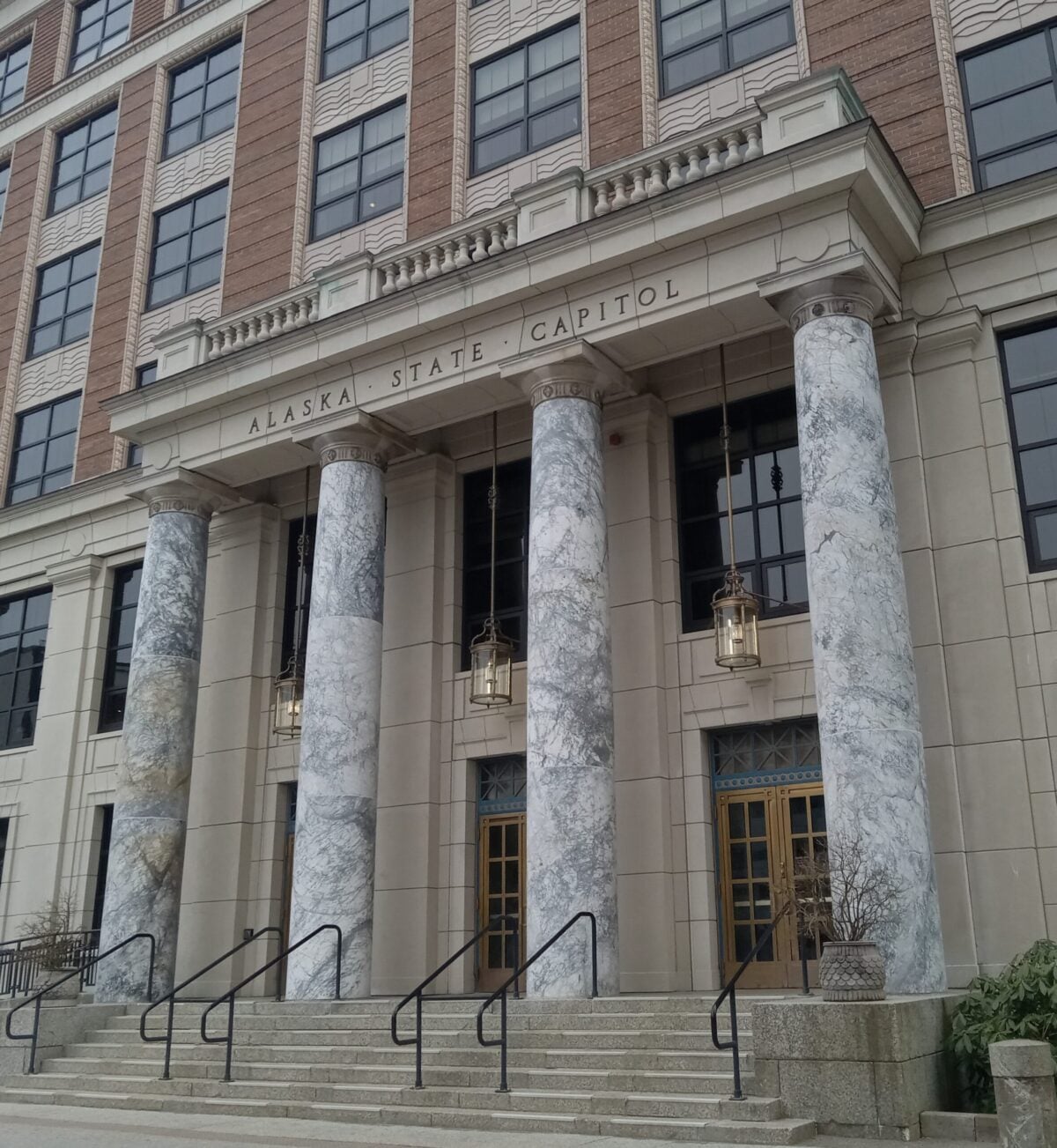
The Alaska State Capitol in downtown Juneau.
(Photo by Greg Knight/News of the North)
By: James Brooks, Alaska Beacon
The Alaska State Capitol in downtown Juneau.
(Photo by Greg Knight/News of the North)
A panel of state lawmakers voted 9-2 on Wednesday to approve spending up to $100,000 on a lawsuit against Gov. Mike Dunleavy.
The lawsuit, if filed, would challenge the governor’s decision to press ahead with plans to create a cabinet-level Alaska Department of Agriculture via executive order.
The governor issued an executive order in January, but lawmakers rejected it in a 32-28 vote in March, saying they preferred to create it through legislation instead. Creating the department through legislation, legislative leaders said, would allow lawmakers to debate and structure the department how they wish, instead of relying on the governor’s plans alone.
Dunleavy disagrees with that approach and in August filed a new executive order during a 30-day special session.
The leaders of the House and Senate refused to accept the filing, saying that it was not within the governor’s power to issue an executive order during a special session, or to reintroduce an already-rejected order.
The governor’s office has said that lawmakers’ failure to vote down the new order means that it will take effect and allow the executive branch to create the cabinet-level department at the start of 2026.
Why does the Legislature’s failure to vote on the executive order matter?
Article III, section 23 of the Alaska Constitution says that executive orders automatically take effect “unless disapproved by resolution concurred in by a majority of the members in joint session.”
The question that could be decided in court is whether lawmakers need to take that vote if an order is issued during a special session. Is issuing an order in a special session even legal? And does it matter if the order is identical to one that’s already been issued and voted upon?
Under Article III, section 23 of the Alaska Constitution, the “legislature shall have sixty days of a regular session, or a full session if of shorter duration, to disapprove” executive orders that would make a change to the functions of the executive branch.
For almost two hours on Wednesday, members of the joint House-Senate Legislative Council — a committee that makes decisions for the Legislature when it is out of session — heard about the dispute behind closed doors, then debated it briefly in open session before voting.
“It’s a disagreement between the Legislature and the governor about whether or not the governor has the authority under the Alaska Constitution to introduce an executive order during a special session,” said Emily Nauman, director of Legislative Legal Services, the legal department for Alaska’s legislative branch.
Because the House and Senate’s presiding officers returned the order to the governor without taking action, “the governor is asserting that he will give effect to the executive order because it was not specifically rejected or disapproved by the legislature, thus causing a conflict in the interpretation of the Constitution between the Legislature and executive branch.”
Rep. Louise Stutes, R-Kodiak, voted in favor of authorizing the Legislature to prepare and, if necessary, file a pre-emptive lawsuit to keep the governor from enacting the executive order.
“It’s just a question, to me, of, we said, ‘No. Don’t you understand what no means?’”
Rep. Calvin Schrage, I-Anchorage, also voted in favor of moving forward with a lawsuit. He said that while there is still time for the governor to back away from his position, “I really see it as our prerogative to protect ourselves procedurally, and for us to do that, I believe we need to file litigation.”
The two votes against Wednesday’s proposal came from Reps. Chuck Kopp, R-Anchorage, and Mike Prax, R-North Pole.
Prax said he feels as if it could set a precedent that could allow lawmakers to disapprove of a future governor’s actions in a “more urgent” situation by simply not taking action.
“We would establish a precedent that the Legislature can do something by doing nothing, and that just does not seem like a very good practice to have established for any organization,” Prax said.
Sen. Jesse Kiehl, D-Juneau, said he doesn’t think that’s a correct interpretation of the lawsuit.
“With great respect to Representative Prax, no one is asserting here that the Legislature may act by inaction. What is before us is the question of whether the second shot at an executive order came in a way that the Constitution allows. I am convinced it did not.”
Kopp said he believes the governor may be prepared to change course on his executive action, and he’s reluctant to approve a lawsuit unless the governor attempts to take action and actually create the department.
“I would like to see us not initiate this until there’s some overt action by the administration that clearly indicates their intent to move unilaterally on this issue outside of the legislative process,” he said.
As of Friday, there was no estimate as to when a lawsuit might be filed.
Under the Alaska Constitution, the executive branch may not sue the legislative branch. Lawsuits by the Legislature against the governor are rare; this would be the fourth against Dunleavy during his two terms in office beginning in 2018.
In 2019, lawmakers sued the governor over a school funding issue. The governor won that case in the Alaska Supreme Court. The following year, legislators sued Dunleavy over their failure to consider some of his appointees during the COVID-19 pandemic emergency. The Alaska Supreme Court again ruled in Dunleavy’s favor.
In 2022, lawmakers filed a ‘friendly’ lawsuit against the governor in a dispute over the proper handling of oil and gas tax settlements. That dispute, which dates to the administration of Gov. Bill Walker, has yet to be decided by the Alaska Supreme Court.
The sign at the entrance to the University of Alaska Fairbanks campus welcomes students on Sept. 20, 2023. (Photo by Yereth Rosen/Alaska Beacon)
The U.S. Department of Education has terminated grant funding for universities’ Alaska Native and Native-Hawaiian-serving programs and support services, an act that University of Alaska Fairbanks Chancellor Mike Sfraga said “will have a substantial and negative impact on a large number of Alaskans, including our Alaska Native students.”
Sfraga announced the federal decision in a campus-wide email on Thursday.
Mike Sfraga spoke at an Alaska Senate hearing in April 2025. (Photo by James Brooks/Alaska Beacon)
Sfraga said the funding cut for UAF is estimated at $2.9 million, and the full effects are still under review. More than 20%, or an estimated 1,450 students at UAF are Indigenous, Sfraga noted.
The full extent of the grant funding freeze across the University of Alaska system is still being analyzed, said Jonathon Taylor, UA director of public affairs, by email on Friday.
UA President Pat Pitney said in an emailed statement on Friday that the university will continue to create a welcoming environment for all students.
“We are evaluating the impact these changes will have on our services to Alaska Native students, and are communicating directly with students, staff, and faculty who may be affected,” Pitney said. “A significant part of UA’s identity is our commitment to Alaska Native culture, language, art, heritage, business, and tribal management and governance; that remains unchanged. We proudly embrace our global leadership in Alaska Native and Indigenous studies, and will continue to sustain a welcoming environment where all – including our Alaska Native and Indigenous students – can thrive and succeed.”
Taylor said the University of Alaska Southeast has at least one grant-funded program on the Sitka campus aimed at improving student services, and university officials are waiting to hear whether it will be eliminated. Taylor said the University of Alaska Anchorage does not have any programs funded by this federal grant.
As of fall 2024, there were 3,254 students enrolled at the University of Alaska that identified as Alaska Native or American Indian, and 266 that identified as Hawaiian Native or Pacific Islander, according to the university, and 19,629 students total across the UA system.
The University of Alaska announcements came after the Trump administration said Wednesday it will withhold an estimated $350 million of congressionally-approved funding for minority serving colleges and universities, saying the money will be allocated elsewhere. The measure continues President Donald Trump’s initiative to eliminate programs that focus on diversity, equity and inclusion.
Sfraga said the federal government is allowing up to a year to close out the programs. UAF has multiple grants which fall under the program, Sfraga said, and most are under the College of Indigenous Studies and the UAF Community and Technical College.
Sfraga said the grant program does not fund student aid, but it does support degree programs and support services like student advising and recruiting, workforce development and student success initiatives across campuses.
University officials report that to date, the Trump administration has cancelled $6.6 million in research grants and almost $45 million has been frozen.
Each year, the university receives an estimated $250 million in federal research funds, Taylor said, adding that “95% of the university’s broad research portfolio remains intact. UA has experienced only minor disruptions as a result of the rapidly shifting policy picture in Washington, D.C., and we are closely monitoring developments as they evolve.”