Categories
Featured Juneau News Juneau Local Ketchikan Local News Feeds Sitka Local

Trump plans to nominate state fish and game attorney for Alaska federal judgeship

By: James Brooks, Alaska Beacon

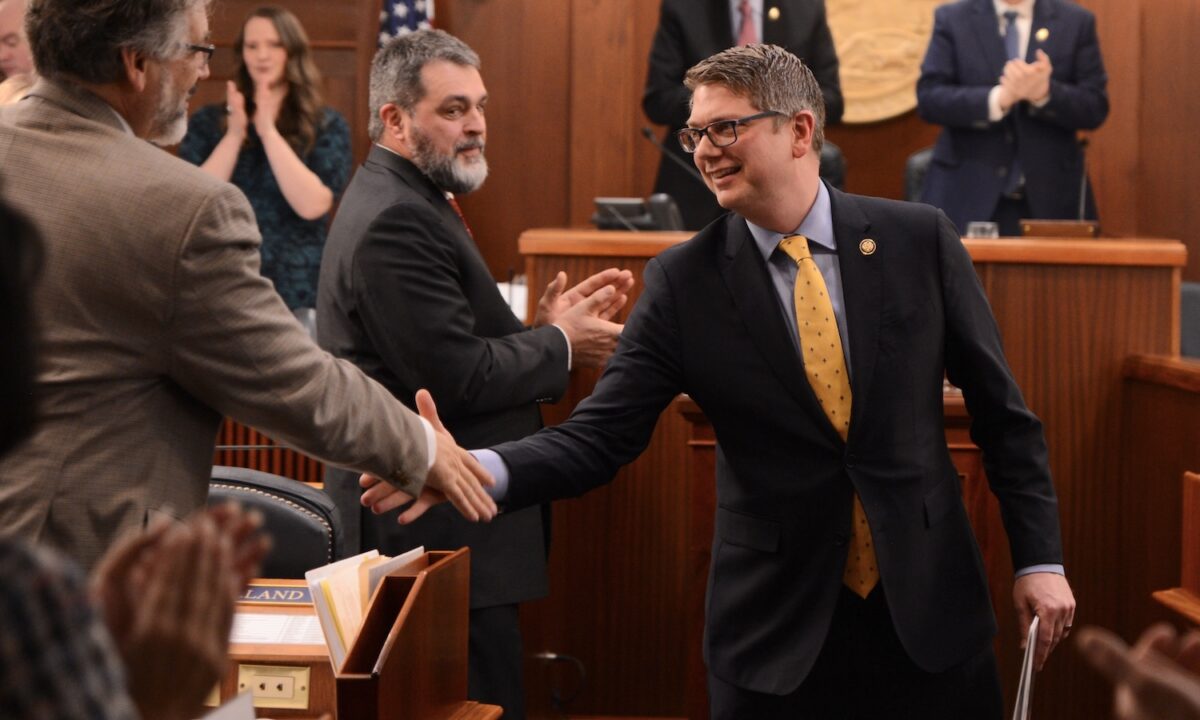
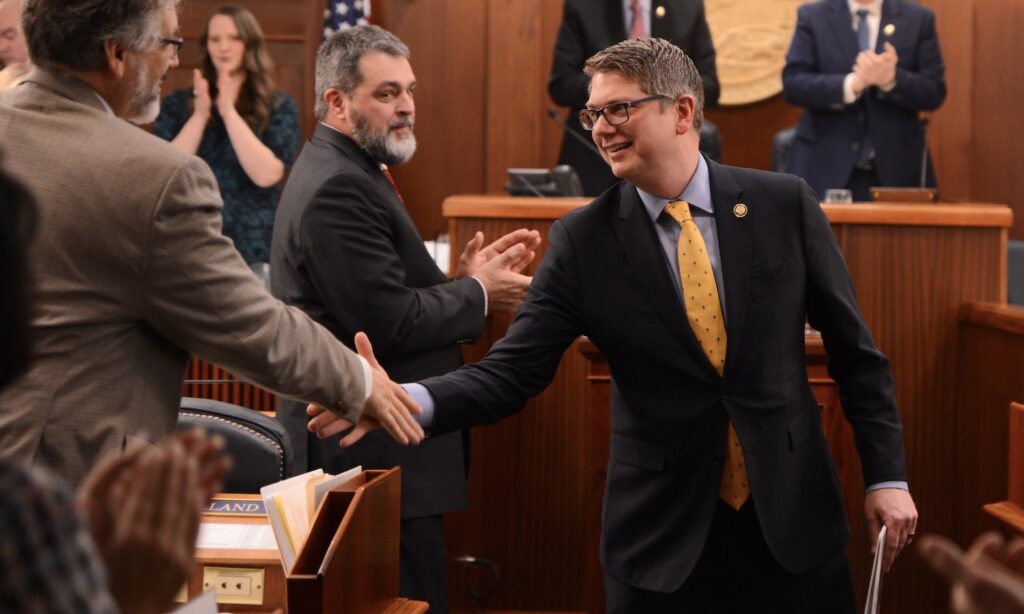
Alaska attorney Aaron Peterson, seen here in a February 2024 photo, is expected to be nominated by President Trump to one of two vacancies on Alaska’s federal court bench. (Alaska Division of Forestry photo)

President Donald Trump plans to nominate Aaron Peterson, an attorney with the Alaska Department of Law’s natural resources division, for one of two open federal judgeships on the bench of the U.S. District Court for the District of Alaska.

The president’s plans were confirmed by the news organization Reuters, which published a copy of a questionnaire Peterson submitted to the U.S. Senate’s judiciary committee. 

Trump himself has not formally announced Peterson’s nomination, but state and federal officials confirmed the president’s plans with the Beacon.

Reuters reported that Trump is preparing to nominate two federal judges in other states as well as Peterson.

A message left on Peterson’s work phone was not returned Tuesday afternoon. 

According to a copy of Peterson’s questionnaire, a member of Gov. Mike Dunleavy’s federal transition team encouraged him to apply to a committee formed by Sen. Dan Sullivan, R-Alaska, to vet possible candidates for the federal judiciary. 

According to state voter records, Peterson is a Republican. He identified himself in the questionnaire as a member of the Federalist Society, whose members generally follow Republican legal principles and support President Donald Trump.

Records published by the Federal Elections Commission and the Alaska Public Offices Commission do not list any political contributions by Peterson. 

Attorney General-designee Stephen Cox served on the Sullivan committee. By email, he called Peterson an “outstanding choice.”

“He’s demonstrated a remarkable ability to navigate complex issues with fairness and integrity, including during his representation of the Board of Fisheries. His extensive understanding of both civil and criminal law, honed through his experience as a prosecutor, makes him uniquely qualified for this position. Alaska needs judges who are equipped to handle the complex cases before them and the realities of our state, and I am confident that Aaron will be an excellent addition to the bench,” Cox wrote.

Alaska has three federal judgeships but only one sitting federal judge. Judge Timothy Burgess retired at the end of 2021, and Judge Joshua Kindred resigned in disgrace in 2024 amid a sexual scandal.

Since then, Alaska’s two U.S. senators have been divided about who to pick as replacements and how to pick those replacements. Under longstanding Senate tradition, judge picks normally advance only with the assent of both home state senators.

As a result of the senators’ disagreements and Sullivan’s decision to not attempt to fill a vacancy under President Joe Biden, the judgeship vacated by Burgess is now the fifth-oldest vacancy among 50 in the federal court system.

Sullivan has not disclosed the names of judicial candidates that he examined through a special committee designed to serve as an alternative to the Alaska Bar Association’s traditional review process. 

Sen. Lisa Murkowski, R-Alaska, disclosed the names of applicants she received and solicited opinions from the Bar Association. Peterson’s application was not among those initially received by Murkowski.

Through a spokesperson, Murkowski said she learned about Peterson’s nomination from the White House.

“After speaking extensively with him last week about his many qualifications, I informed the White House that I would support his nomination. Alaska’s District Court has had two vacancies for far too long, and I hope the White House will soon announce a second qualified nominee whom I can support to fill out the bench,” Murkowski said. 

According to Peterson’s questionnaire, he met with Murkowski on Oct. 23, seven months after being interviewed by Sullivan and four months after his initial interview by the White House Counsel’s Office. Since September, according to the questionnaire, he has been in regular contact with White House and Department of Justice officials.

By email, Sullivan said Peterson has “extensive legal experience.”

“Throughout his career, which includes military service, Aaron has demonstrated a commitment to the rule of law and federalism. He also understands the principle that the job of a federal judge is to interpret the law, not to make policy,” Sullivan said. “I’d like to thank each of the members of the Alaska Federal Judiciary Council, who worked with me to fully vet a number of well-qualified Alaska nominees, including Aaron. The council’s diligent work and input are invaluable in ensuring Alaskans are represented by jurists and citizens of the highest caliber. I also want to thank President Trump and his team for working closely with my office on identifying outstanding judges who will serve Alaska and our country well.”

According to the information Peterson submitted to the U.S. Senate’s judiciary committee, he was born in Anchorage in 1981 and served in the U.S. Air Force from 2000 to 2003 before attending the University of Alaska Anchorage, graduating in 2007. He attended Gonzaga University School of Law and graduated in 2010.

After graduation, he returned to Alaska, serving first as a clerk to Justice Michael Spaan of the Alaska Supreme Court, then as a prosecutor with the Municipality of Anchorage.

The Alaska Bar Association’s directory says he was admitted to the state bar on Nov. 16, 2010.

Peterson worked in the Anchorage District Attorney’s office starting in 2012, including on violent felonies, such as murder and sexual assault. He moved to the Department of Law’s office of special prosecutions in 2015 before beginning work with the Department of Law’s natural resources section in 2019.

Since joining that section, he’s prosecuted high-profile criminal cases, including a 2018 incident in which two Matanuska-Susitna Borough men illegally killed a black bear and her two squealing cubs within their den.

More recently, Peterson has represented the state in an ongoing case that challenges the state’s current two-tier system of subsistence fishing management. He also represented the state in a lawsuit that challenged salmon fishery management in Cook Inlet.

“If confirmed,” Peterson said in his questionnaire, “I will recuse myself from any case where I have ever played a role. Further, I will evaluate any potential conflict or issue that could give rise to the appearance of a conflict, on a case-by-case basis and determine appropriate action, including recusal where necessary.”

Categories
Featured Juneau News Juneau Local Ketchikan Local News Feeds Sitka Local

Discrepancies and voter roll questions addressed Monday night

City Hall, downtown Juneau / File

NOTN- City Municipal Clerk Breckan Hendricks presented the official election certification report, at Monday evenings eventful meeting, and City officials are addressing questions voters had about voter number discrepancies.

Juneau has about 28,000 registered voters despite a population of roughly 31,000.

Weldon said the difference comes from using the state voter roll, which can take up to eight years to remove inactive voters.

“So that’s why, when everybody looks at that, when the election results says only 20% of the vote, that’s not a true number, because that’s 20% of the 28,000.” Said Mayor Beth Weldon.

Only 117 ballots were rejected this year, a small number that Weldon said reflects voters’ growing familiarity with the city’s voting process.

CBJ Municipal Clerk Breckan Hendricks says that election integrity is taken seriously by the borough.

“We need to make sure that we’re transparent, that everybody has faith in our system,” Hendricks said. “A lot of people don’t understand it. We have our election rules and procedures online now, on our juneau.org elections page, and we’re trying to get more PSAs out there, trying to make people hopefully understand the process a little better to give them more faith in our system. I know that there’s a lot of hesitancy with by-mail ballots, and we really are following all the rules and regulations to make sure that there’s no gaps.”

Categories
Featured Juneau News Juneau Local Ketchikan Local News Feeds Sitka Local

City holds reorganization meeting, police are called on man accused of threatening City officials

NOTN- Juneau Mayor Beth Weldon said city officials are taking new safety precautions after a man previously banned from City Hall returned during Monday night’s Assembly meeting and caused alarm among members as well as an hour delay preceding this month’s reorganization meeting.

Weldon said the man, who has a history of making threatening remarks toward the city, appeared wearing a mask and goggles, carrying a backpack, and taking photos while standing close to Assembly members.

“He’s been trespassed from City Hall and showed up yesterday and
was menacing to the assembly, looming over them and taking pictures of us.” Said Weldon “It just was very uncomfortable for all of us, because we knew his history.”

Police escorted the man out peacefully, and Weldon said he will now be trespassed from all city meeting spaces, including Centennial Hall and City Hall.

She emphasized that the incident was not connected to ongoing public testimony about the controversial Telephone Hill redevelopment project, which has drawn strong emotional responses but no threats.

“The testimony from Telephone Hill residents has been very heartfelt,” Weldon said. “At no time have we felt threatened by them.”

The meeting did however, mark the close of the 2025 municipal election cycle as newly elected members were officially sworn into office.

Ella Adkison began her first full term as Areawide Assemblymember, Greg Smith started his final three-year term representing District 1, and Nathaniel “Nano” Brooks took office for his first term in District 2. On the School Board, Steve Whitney and Melissa Cullum each began three-year terms, while Jenny Thomas will serve two years to complete an unexpired seat.

Voters approved two citizen-led propositions, one lowering the property tax cap from 12 to 9 mills, and another creating sales tax exemptions for food and essential utilities, both tax measures will be in place November 20.

A third measure, proposing a seasonal sales tax, failed.

Categories
Featured Juneau News Juneau Local Ketchikan Local News Feeds Sitka Local

Pressure builds on Congress to end the shutdown due to SNAP funding uncertainty, but a quick breakthrough appears unlikely

Sen. Lisa Murkowski, R-Alaska, center, a member of the Senate Appropriations Committee, Friday, June 27, 2025. (AP Photo/J. Scott Applewhite)

AP- The pressure to end the second-longest federal government shutdown is gaining new urgency this week as millions of Americans face the prospect of losing food assistance, more federal workers miss their first full paycheck and recurring delays at airports snarl travel plans.

The building strain on lawmakers to end the impasse was magnified by the nation’s largest federal employee union, which called on Congress to immediately pass a funding bill and ensure workers receive full pay. Everett Kelley, president of the American Federation of Government Employees, said the two political parties have made their point.

“It’s time to pass a clean continuing resolution and end this shutdown today. No half measures, and no gamesmanship,” said Kelley, whose union carries considerable political weight with Democratic lawmakers.

Still, Democratic senators, including those representing states with many federal workers, did not appear ready to back down. Virginia Sen. Tim Kaine said he was insisting on commitments from the White House to prevent the administration from mass firing more workers. Democrats also want Congress to extend subsidies for health plans under the Affordable Care Act.

“We’ve got to get a deal with Donald Trump,” Kaine said.

But shutdowns grow more painful the longer they go. Soon, with closures lasting a fourth full week as of Tuesday, millions of Americans are likely to experience the difficulties firsthand.

“This week, more than any other week, the consequences become impossible to ignore,” said Rep. Lisa McClain, chair of the House Republican Conference.

Shutdown’s impact is set to grow dramatically

The nation’s 1.3 million active-duty service members are at risk of missing a paycheck on Friday. Earlier this month, the Trump administration ensured they were paid by shifting $8 billion from military research and development funds to make payroll. But it is unclear if the Trump administration is willing — or able — to shift money again.

Larger still, the Trump administration says funding will run out Friday for the food assistance program that is relied upon by 42 million Americans to supplement their grocery bills. The administration has rejected the use of more than $5 billion in contingency funds to keep benefits flowing into November. And it says states won’t be reimbursed if they temporarily cover the cost of benefits next month.

The Department of Agriculture says the contingency fund is intended to help respond to emergencies such as natural disasters. Democrats say the decision concerning the Supplemental Nutrition Assistance Program, known as SNAP, goes against the department’s previous guidance concerning its operations during a shutdown.

Senate Democratic leader Chuck Schumer of New York said the administration made an intentional choice not to the fund SNAP in November, calling it an “act of cruelty.”

Will lawmakers find a solution?

At the Capitol, congressional leaders mostly highlighted the challenges many Americans are facing as a result of the shutdown. But there was no movement toward negotiations as they attempted to lay blame on the other side of the political aisle.

“Now government workers and every other American affected by this shutdown have become nothing more than pawns in the Democrats’ political games,” said Senate Majority Leader John Thune, R-S.D.

The House passed a short-term continuing resolution on Sept. 19 to keep federal agencies funded. Speaker Mike Johnson, R-La., has kept the House out of legislative session ever since, saying the solution is for Democrats to simply accept that bill.

But the Senate has consistently fallen short of the 60 votes needed to advance that spending measure. Democrats insist that any bill to fund the government also address health care costs, namely the soaring health insurance premiums that millions of Americans will face next year under plans offered through the Affordable Care Act marketplace.

Window-shopping for health plans delayed

The window for enrolling in ACA health plans begins Saturday. In past years, the Centers for Medicare and Medicaid Services has allowed Americans to preview their health coverage options about a week before open enrollment.

As of Monday, Healthcare.gov appeared to show 2025 health insurance plans and estimated prices, instead of next year’s options. CMS was expected to temporarily bring back all its workers furloughed during the shutdown, in part to manage the ACA open enrollment period.

Twenty-eight senators, mostly Democrats, signed a letter urging Trump’s administration to let ACA enrollees start previewing next year’s health insurance options on its marketplace website.

Republicans insist they will not entertain negotiations on health care until the government reopens.

“I’m particularly worried about premiums going up for working families,” said Sen. David McCormick, R-Pa. “So we’re going to have that conversation, but we’re not going to have it until the government opens.”

Congressional leaders dig in deeper

Schumer said Republicans would prefer to shut the government down than work with Democrats in preventing massive spikes in their health insurance costs. He said the average American doesn’t want to pay an extra $20,000 a year to cover their health insurance.

“And we Democrats want to solve this crisis right away,” Schumer said. “So lowering health care is not a crazy demand.”

Vice President JD Vance planned to attend a Republican luncheon on Capitol Hill Tuesday. But with President Donald Trump traveling in Asia and congressional leaders dug into their positions, a quick deal appeared unlikely.

Meanwhile, some rank-and-file lawmakers urged colleagues to consider the impact of their standoff on the lives of federal employees and Capitol police officers who have not been paid for weeks.

“We have got to come together, which means we’ve got to talk to one another,” Sen. Lisa Murkowski, an Alaska Republican, said in a floor speech urging leaders to stop focusing on who was winning the political fight. “Right now, those that are losing are the American people.”

Categories
Featured Juneau News Juneau Local Ketchikan Local News Feeds Sitka Local

Alaska DNR commissioner resigns, deputy takes over agency

By: James Brooks, Alaska Beacon

John Boyle, commissioner of the Alaska Department of Natural Resources, speaks on Nov. 15, 2023, at the Resource Development for Alaska annual conference in Anchorage. (Photo by Yereth Rosen/Alaska Beacon)

John Boyle, commissioner of the Alaska Department of Natural Resources, abruptly resigned his position on Friday. 

Gov. Mike Dunleavy announced the appointment of his deputy, John Crowther, as acting head of the agency that regulates Alaska’s agriculture, mining, oil and gas.

The governor’s office declined Monday to answer questions about the resignation, which had not been previously announced.

Dunleavy is term-limited and will leave office in December 2026. Boyle’s departure follows those of Revenue Commissioner Adam Crum and Attorney General Treg Taylor.

The resignations of both of those men — who are now Republican candidates for governor in next year’s elections — were announced in advance, unlike Boyle’s departure.

Boyle could not be reached for comment on Monday.

The departing commissioner has extensive experience in the oil industry. Before joining Dunleavy’s cabinet in 2023, he was a lobbyist for BP and Oil Search.

Crowther, who will replace Boyle on an interim basis, has been with the Department of Natural Resources since 2012, the governor’s office said.

He previously worked as director of the governor’s Washington, D.C. office and served on the staff of the U.S. Senate’s Energy and Natural Resources Committee. He holds a law degree from Georgetown University.

“The Department of Natural Resources is at the forefront of protecting and developing Alaska’s precious land and waters. Mr. Crowther’s legal background and experience as a deputy commissioner make him a great choice to advance the responsible development, and maximum use, of Alaska’s natural resources consistent with the public interest as mandated by Alaska’s Constitution,” the governor said in a prepared statement released on Friday.

Categories
Featured Juneau News Juneau Local Ketchikan Local News Feeds Sitka Local

Congressional Dems, Alaska’s Murkowski tell high court to nix emergency tariffs

Ashley Murray, States Newsroom

U.S. President Donald Trump speaks during an executive order signing in the Oval Office at the White House on Feb. 11, 2025, in Washington, D.C.   (Photo by Andrew Harnik/Getty Images)
U.S. President Donald Trump speaks during an executive order signing.

WASHINGTON — More than 200 Democratic lawmakers and one Republican are urging the U.S. Supreme Court to strike down President Donald Trump’s sweeping global emergency tariffs.

The 207 members of the U.S. House and Senate argued in an amicus brief late Friday that the International Emergency Economic Powers Act, or IEEPA, does not authorize the president to unilaterally impose tariffs. The lawmakers urged the justices to agree with a lower court finding that Trump’s wide reaching import taxes triggered under IEEPA violate the Constitution, which grants duty powers to Congress.

“IEEPA contains none of the hallmarks of legislation delegating tariff power to the executive, such as limitations tied to specific products or countries, caps on the amount of tariff increases, procedural safeguards, public input, collaboration with Congress, or time limitations,” the lawmakers wrote. 

“In the five decades since IEEPA’s enactment, no President from either party, until now, has ever invoked IEEPA to impose tariffs.” 

Sens. Jeanne Shaheen, D-N.H., and Ron Wyden, D-Ore., ranking members of the Senate committees on Foreign Relations and Finance, led the signatures of 36 members of the upper chamber. Sen. Lisa Murkowski, an Alaska Republican, was the single GOP co-signer on the brief. A majority of House Democrats, 171 in total, also joined.

The lawmakers filed the friend-of-the-court brief ahead of oral arguments scheduled before the Supreme Court next week on the question of whether Trump’s emergency tariffs are legal. 

The U.S. Court of Appeals for the Federal Circuit in late August upheld a lower court ruling striking down the administration’s IEEPA tariffs.

The Senate is expected to vote on three bills this week that aim to terminate Trump’s import taxes on products from Canada, Brazil and any other country subject to emergency duties.

Fentanyl, trade deficits as emergencies

Trump began imposing tariffs under IEEPA in February and March on China, Canada and Mexico, declaring these countries responsible for illegal fentanyl smuggling into the U.S. 

The president escalated the emergency tariffs over the following months on goods from around the globe, declaring trade deficits a national emergency. A trade deficit means the U.S. imports more goods from a country than that nation purchases from U.S. suppliers.

Domestic businesses and purchasers now pay the U.S. government anywhere from 10% to 50% in tariffs on most imported products. The government had collected $195 billion this year in customs duties at the end of September, according to a U.S. Treasury monthly statement.

State AGs and businesses launched court challenge

Several private businesses and a dozen states sued Trump over the use of the emergency statute to trigger the steep import taxes.

Arizona, Colorado, Maine, Minnesota, Nevada, New Mexico and Oregon were among states, led by Democratic state attorneys general, that brought the suit.

Businesses that sued the Trump administration include the lead plaintiff, V.O.S. Selections, a New York-based company that imports wine and spirits from 16 countries, according to its website. 

Other plaintiffs include a Utah-based plastics producer, a Virginia-based children’s electricity learning kit maker, a Pennsylvania-based fishing gear company, and a Vermont-based women’s cycling apparel company.

The U.S. Court of International Trade ruled Trump’s tariffs under IEEPA illegal in late May.

Categories
Featured Juneau News Juneau Local Ketchikan Local News Feeds Sitka Local

Billionaire seeks controlling interest in GCI, regulatory filings show

By: James Brooks, Alaska Beacon

Alaska’s largest residential internet provider may soon come under the control of billionaire businessman John Malone, one of America’s biggest private landowners and wealthiest people

On Oct. 3, Malone filed paperwork with the Regulatory Commission of Alaska asking for permission to take majority ownership of GCI Liberty Inc., the parent company of GCI Communications, Alaska’s largest internet company.

Malone already owns a majority of GCI Liberty’s voting shares, according to RCA filings, but until now has been limited by agreements that hold his voting power below 50%.

According to the filings, Malone is asking for authority to increase his voting power to “a level that would constitute control of GCI Liberty and its certificated subsidiary GCICC.”

The filings also state that both GCI Liberty and Malone have asked for a waiver that would allow them to keep their financial documents confidential.

Under state law and regulation, those documents would ordinarily be available for public inspection as part of regulators’ approval process.

Public comments on the request for secrecy are due to RCA by Tuesday, Oct. 28, and the state regulator is expected to review the takeover request after that date.

The takeover would also affect United Utilities, which provides telephone and internet service in rural Alaska, including much of the Yukon-Kuskokwim river delta region, filings show.

Categories
Featured Juneau News Juneau Local Ketchikan Local News Feeds Sitka Local

New online art directory seeks to promote, connect Alaska Native artists across the state

By: Yereth Rosen, Alaska Beacon

Britt’Nee Brower of Utqiagvik peers through hanging jewelry at her table at the Alaska Federation of Natives convention on Oct. 16, 2025. Brower creates works of art out of a variety of media. Among her skills is carving, sewing, beading, etching, fashion design and poetry. She is among the artists listed in the Alaska Native Arts Directory. (Photo by Yereth Rosen/Alaska Beacon)

A new online statewide directory has been launched to showcase and connect Alaska Native artists across disciplines.

The Alaska Native Arts Directory is the work of the nonprofit Alaska Native Arts Foundation. Listing is free. The directory went live last week, timing that coincided with the Alaska Federation of Natives annual convention in Anchorage.

As of Monday, about 200 artists were listed, most of them with photos and biographical information. The Alaska Native Arts Foundation said it is seeking to expand that number to more than 1,000 by next year.

The Anchorage-based foundation said it also has a goal of holding a first-ever Alaska Native Arts Economic Summit next year, bringing together artists, policymakers and other partners to work on building the Indigenous creative economy.

There are other artists’ directories in Alaska, some of them with a focus on Indigenous artists. One, the Collective49 Marketplace, enables member artists to promote and sell their work online. And there are numerous local artists directories, such as those in Ketchikan and Homer.

The Alaska Natives Art Directory, however, is intended to be more comprehensive. Along with being statewide, the directory includes writers, musicians and other performing artists along with those who create carvings, paintings and other physical works of art. It includes contemporary art forms as well as traditional Indigenous arts.

“The Alaska Native Arts Directory celebrates the full spectrum of Alaska Native creativity, visual and written arts, performance, design, and traditional practices, reflecting the diversity and vitality of Alaska’s Indigenous cultures,” Gail Schubert, chair of the Alaska Native Arts Foundation, said in a statement.

Launch of the Alaska Native Arts Directory represents a renaissance of sorts for the Alaska Native Arts Foundation.

The foundation was created in 2002 and for several years operated an ecommerce site and a gallery in Anchorage. But it shut down those operatioons in 2016 after losing state funding and encountering other financial problems.

The directory project and other new activities now have a variety of funding sources, according to the foundation’s statement. The effort is backed by grants and other support from organizations that include the Rasmuson Foundation, the U.S. Small Business Administration, the office of U.S. Sen. Lisa Murkowski, R-Alaska, the Alaska State Council on the Arts and the Municipality of Anchorage, among others, according to the statement.

Britt'Nee Brower of Utqiagvik helps a custmoer at her table at the Alaska Federation of Natives convention on Oct. 16, 2025. Some of her earrings and prints are in the foreground. Brower creates works of art out of a variety of media. She is among the artists listed in the Alaska Native Arts directory. (Photo by Yereth Rosen/Alaska Beacon)
Britt’Nee Brower of Utqiagvik helps a custmoer at her table at the Alaska Federation of Natives convention on Oct. 16, 2025. Some of her earrings and prints are in the foreground. Brower creates works of art out of a variety of media. She is among the artists listed in the Alaska Native Arts directory. (Photo by Yereth Rosen/Alaska Beacon)
Categories
Featured Juneau News Juneau Local Ketchikan Local News Feeds Sitka Local

Interior Dept. advances Ambler mining road, King Cove road and ANWR drilling in signing ceremony

By: James Brooks and Corinne Smith, Alaska Beacon

US Department of Interior Sec. Doug Burgum at a news conference with Gov. Mike Dunleavy, Alaska’s congressional delegation US Sen. Lisa Murkowski, Rep. Nick Begich, and Sen. Dan Sullivan, announcing several actions advancing resource development projects in Alaska on Oct. 23, 2025 (Screenshot)

The federal government is proceeding with efforts to expand drilling in the Arctic National Wildlife Refuge, mining in northwest Alaska, and construction of a road between King Cove and Cold Bay on the Alaska Peninsula, US Interior Secretary Doug Burgum announced Thursday.

At an event in Washington, D.C. that was dubbed “Alaska Day” by the federal department, Burgum signed a series of documents pertaining to all three projects as well as an ongoing effort by the federal government to give land to the families of Alaska Native Vietnam War veterans.

“This is our first, this won’t be our last, Alaska Day. We have a lot more things to accomplish, a lot more things to celebrate going forward,” said Burgum, flanked by Gov. Mike Dunleavy and all three members of the state’s congressional delegation.

“I told the president, it’s like Christmas every morning,” said Dunleavy. “I wake up, I go to look at what’s under the proverbial Christmas tree to see what’s happening. And here’s another example of more presents for not just Alaska, but for this country.”

Tribal and environmental groups opposed to the three development projects saw Thursday’s action differently, with Defenders of Wildlife, a national group, dubbing the event “Alaska Sellout Day.”

“Today’s announcements are the latest step in Donald Trump’s plan to sell out our wildest landscape and natural heritage to corporate polluters,” said Dan Ritzman, director of conservation for the Sierra Club. 

What was done on Thursday

Burgum signed previously announced permits for the 211-mile Ambler Road, which is intended to connect the Dalton Highway with a series of potential mine sites in the Brooks Range of northern Alaska.

He also signed a record of decision for the federal government’s oil and gas drilling program in the coastal plain of the Arctic National Wildlife Refuge of northeast Alaska. 

That re-establishes a program that had been in place during the first term of President Donald Trump but which was subsequently reversed by President Joe Biden.

Burgum also reversed the Biden administration’s decision to suspend oil and gas leases issued by the federal government in 2020 to the Alaska Industrial Development and Export Authority.

Barring further litigation, that move clears the way for AIDEA — Alaska’s state-owned development bank — to begin seismic surveys that could reveal the amount of oil available within parts of the Arctic refuge’s coastal plain.

While the Ambler and ANWR actions effectively took the projects back to where they stood in 2020, the King Cove road is now closer to construction at any point in its decades-long development process.

Envisioned as a gravel road between King Cove and an all-weather airport at Cold Bay, the road would pass through the Izembek National Wildlife Refuge, a nationally important bird sanctuary.

Eleven miles of new road are needed to link existing roads to the two towns, but those 11 miles would pass through a wilderness area. 

On Thursday, Burgum signed documents that complete a land exchange between King Cove Corp., the local Alaska Native corporation, and the federal government. King Cove Corp. gives up about 31,200 acres to expand the refuge, and in return, it receives the 490 acres of refuge land needed to complete the road.

In a move with more limited statewide impact, Burgum signed paperwork awarding three Alaska Native Vietnam War veterans with 160-acre plots of land under a federal allotment program. As of March, 453 veterans and their families had requested plots authorized under legislation authored by Alaska Sens. Lisa Murkowski and Dan Sullivan.

For King Cove, a medevac-avoiding road moves forward

King Cove’s airport is frequently closed by bad weather, and since 2014, there have been more than 100 Coast Guard medevacs from the community because regular air ambulance service was unavailable. 

Murkowski, who has previously vowed to complete the road, noted that this is the third time that the federal government has embarked on a land exchange for the road, with the prior two attempts blocked and reversed by litigation.

“We’ve reached a point with the King Cove exchange that we haven’t yet before, and that’s actually the official patent being issued to KCC, so we’re one step further. I think that’s important,” she said.

The road, though supported by local residents, is opposed by some Yukon-Kuskokwim river delta tribal leaders and subsistence bird hunters who fear its effects on wildlife.

“Surely, the people of King Cove can see the value of leaving the habitat for so many species intact would be far more valuable than any road could be,” said  Angutekaraq Estelle Thomson, Traditional Council President of the Native Village of Paimiut, one of several communities that have supported lawsuits seeking to prevent road construction.

Rebecca Noblin, an attorney with the Center for Biological Diversity who has fought the road on behalf of several area villages, said Thursday that “we have significant questions about the legality of the exchange. We, along with the Native Villages of Hooper Bay and Paimiut, expect to bring those issues to court soon. Road construction will also require additional permits, including an Army Corps 404 permit and Endangered Species Act consultation, so this is far from a done deal.”

With Ambler and ANWR, a triumph of economics over environment

On the first day of his second term in office, Trump issued an executive order seeking to encourage oil and gas development, mining and logging in Alaska.

US Rep. Nick Begich, R-Alaska, US Dept. of Interior Sec. Doug Burgum, and Alaska Gov. Mike Dunleavy pose for a photo at a news conference announcing advancements to several resource projects, including oil drilling in the Arctic National Wildlife Refuge on Oct. 23, 2025 (Screenshot)

Elected officials said they see Thursday’s actions in line with that decision. 

Alaska Republican Rep. Nick Begich said projects like the Ambler Road and ANWR drilling matter because they create jobs.

“We need the jobs. We need high-paying, good jobs, and these resource industry jobs fit that bill completely. And so whether it’s mining, timber, oil and gas development or other resources, these are necessary for the functioning of Alaska’s economy,” he said.

The coastal plain of the Arctic National Wildlife Refuge is believed to contain billions of barrels of recoverable oil that could be sold on global markets. 

Sullivan noted that previous North Slope oil development has been good for the region’s residents. 

“The life expectancy, mostly of the Native people in our state, has increased in the North Slope and the Northwest Arctic Borough and by dramatic numbers … and a lot of that is due to the benefits that come from responsible resource development: jobs, revenues, water and sewer, gymnasiums, health clinics. So it’s a real life and death issue,” he said.

The predominantly Alaska Native town of Kaktovik is located on Barter Island, within the refuge.

“Developing ANWR’s Coastal Plain is vital for Kaktovik’s future,” said the town’s mayor, Nathan Gordon Jr., in a written statement. “Taxation of development infrastructure in our region funds essential services across the North Slope, including water and sewer systems to clinics, roads, and first responders. Today’s actions by the federal government create the conditions for these services to remain available and for continued progress for our communities.”

To date, no oil companies have shown interest in drilling within the refuge, leaving only Alaska’s state-owned development bank, which won leases in a 2020 sale, to work there.

So far, no actual work has taken place because of repeated lawsuits seeking to overturn the sale.

The bank, which has filed several lawsuits over federal restrictions on drilling within the refuge, did not respond to a request for comment on Thursday.

Several legal challenges to the 2020 ANWR plan of development — which was restored Thursday — are still pending in federal court. 

Some of those challenges revolve around the possible effects that ANWR development and the burning of those fossil fuels will have on climate change.

Thursday’s announcement came just a week after the remnants of Typhoon Halong devastated coastal communities in southwestern Alaska. Experts say that storm was worsened by climate change.

Murkowski said she does not shy away “from the fact that the impact of that typhoon was made more fierce and more destructive because it was able to travel over a large body of what is now warmer, open ocean with lack of ice. I get that, and I call it climate change.”

At the same time, people worldwide are continuing to consume fossil fuels. Murkowski said that for her, the choice is straightforward: Will they get those fossil fuels from Alaska or some place with worse environmental standards?

“I’d much rather be producing in Alaska, than just across the Bering Strait there, over in Russia, where I don’t think that they respect the same level of environmental standards and safeguards,” she said. “So is it complicated? Yes. But am I proud of how Alaska has led in terms of meeting environmental standards that are amongst the highest in the world? I am.” 

What comes next for Ambler, King Cove and ANWR?

All three development projects boosted by the federal government on Thursday are a long way from construction, both supporters and detractors say.

In all three cases, proponents need to obtain additional federal permits and will have to cope with lawsuits brought by opponents.

The environmental law firm Earthjustice has repeatedly been involved in lawsuits against the federal government over the issue of arctic refuge drilling.

“Interior has re-adopted the maximally destructive plan from President Trump’s first term,” said Earthjustice attorney Erik Grafe, by email on Thursday. “That plan was unlawful in 2020 and is still unlawful today. The bedrock environmental laws that protect the Arctic Refuge’s irreplaceable natural resources remain despite Congress passing reconciliation bills on leasing in the refuge.” 

The Gwich’in Steering Committee, represented by attorneys from Trustees for Alaska, is among the organizations that have repeatedly sued to block drilling in ANWR. 

The committee is concerned about the effect that refuge development would have on local caribou herds used by subsistence hunters. In a statement, the committee’s executive director, Kristen Moreland, implied that further litigation will come.

“This action by the Trump administration is a direct attack on the Gwich’in, who have for decades been a voice for the caribou and stood against the destruction of the Arctic Refuge. A leasing program that would open the entire Coastal Plain completely ignores the impacts that oil and gas development would have on the land, on wildlife, and on our communities,” she said.

“We condemn these efforts by the Trump administration to exploit the calving grounds of the Porcupine Caribou herd for short-term gain, and we know that we are not alone. We will continue to raise our voices and fight for the protection of this sacred land and for our way of life.”

The Arctic National WIldlife Refuge coastal plain at the outflow of the Hulahula River, is seen on July 8, 2019. (Photo by Danielle Brigida/U.S. Fish and Wildlife Service)
Categories
Featured Juneau News Juneau Local Ketchikan Local News Feeds Sitka Local

Advocates work on cleaner cruise ship fuels following record tourism year

A cruise ship emerges from a fog bank Monday, Aug. 28, 2023, in Juneau. (Photo by James Brooks/Alaska Beacon)

NOTN- As Alaska wraps up another strong cruise season with over 3 million visitors to the state, Juneau Sen. Jesse Kiehl says work is ongoing to reduce environmental impacts from visiting ships, including discussions about transitioning to cleaner fuels.

Kiehl said Juneau’s port saw about 1.7 million cruise visitors this year, a slight increase from 2024, according to industry data presented at the Alaska Travel Industry Association conference.

Kiehl, who has long advocated for environmental safety in the visitor industry, said he’s in talks about transitioning from scrubber systems, which trap air pollutants but can discharge waste into the ocean, to cleaner-burning fuels.

“It’s got a price tag, and some of the lines are talking to me about what that costs and what the impact would be, and some are keeping that a trade secret, which makes it a little harder to make a good, rational policy decision.” Said Kiehl.

Kiehl said he has no new policies, proposals or bills to announce, but attended a panel hosted by the Southeast Conservation Council, and says, “The best outcome, is to have a visitor industry that’s good for the economy but doesn’t have those impacts on the environment. We’re trying to find the best pathway to get there.”

According to SEACC, discharge from scrubber systems can be toxic to marine life even at very low concentrations.

Aaron Brakel of SEACC writes, “While scrubbers may seem beneficial — removing pollution from the air —  they allow ships to continue burning dirty fuel, transferring those pollutants to the millions of gallons of acidic, polluted wastewater discharged into our living marine waters daily.”