NBC Sports will spotlight Juneau as part of a documentary on what football means to communities, Juneau-Douglas High School football coach Rich Sjoroos announced on Facebook.
The network has chosen a handful of cities nationwide to feature.
Juneau, home to the Crimson Bears, was selected from among more than 15,000 high school football programs in the United States.
A production crew will travel to the capital city this weekend to film Saturday’s game against Anchorage’s Dimond High School, scheduled for 3 p.m.
According to Sjoroos’ post, NBC will also interview players, parents and fans.
The footage is set to air as part of NBC’s Super Bowl pregame programming on Feb. 8, 2026.
Sjoroos encouraged residents to attend and “show all of America how much football means to Juneau.”
NOTN- Ketchikan police shut down the Visitor’s Bureau on Front Street Wednesday morning after a suspicious device was discovered on a wooden bench outside the building.
Officers responded around 8:12 a.m. and worked with Port Security to establish a perimeter. Video footage from inside the building was reviewed while the area remained closed to the public. A Carnival cruise ship was docked nearby at the time, but passengers had not yet disembarked. They were instructed to stay onboard and avoid the port side of the vessel closest to the device.
Police photographed the device and consulted with an Explosive Ordnance Disposal technician, who determined it was safe to move. Officers then removed it and secured it off-site.
The area reopened and operations returned to normal at 9:47 a.m. The Ketchikan Police Department says it maintained communication with the U.S. Coast Guard during the incident. The case remains under active investigation until the device can be fully examined by an EOD specialist
This article will contain mentions of suicide. If you or someone you know is struggling please call or text 988 to reach the Suicide and Crisis Lifeline.
NOTN- September is Suicide Prevention Awareness Month, and advocates in Juneau say the observance is an important chance to break stigma and share resources.
Jessica Gray, of NAMI Juneau, said Alaska continues to face persistently high rates of suicide, with nearly 200 deaths each year.
‘In Alaska, suicide is the second leading cause of death for ages 10 to 24,” Said Gray, “Young people don’t want to feel like a burden. There’s so much stigma surrounding the topic as well. We don’t talk about mental health the same way that we talk about physical health.”
Gray noted that free resources are available statewide, including the Alaska Careline and the national suicide prevention hotline. Both are available 24/7 for people in crisis.
NAMI events throughout September have been aimed at creating open dialogue and community support.
A Wall of Remembrance launched during First Friday at the Juneau Arts and Culture Center.
Gray said building community connections is one of the most powerful protective factors against suicide.
“That’s why Suicide Prevention Awareness Month is so important, because it opens up the conversation, and it gives people a chance to know that they’re not alone, that it is okay to ask for help,” Gray Said “It is okay to have these conversations about such a hard topic. It’s really powerful in that sense, because it builds connection. And we know that connection is one of the primary protective factors for suicide.”
Support group meetings will be taking place for the rest of the month, visit NAMI’s calendar, available at NAMI Juneau’s website for more details.
Gov. Mike Dunleavy discusses proposed education legislation at a news conference on Jan. 31, 2025. (Photo by Corinne Smith/Alaska Beacon)
NOTN- Alaska’s governor will not withdraw an executive order proposing to create a new state Department of Agriculture, he said in a letter sent Monday to the leaders of the state House and Senate.
Gov. Mike Dunleavy’s letter comes days after a joint House-Senate panel voted to spend up to $100,000 on a lawsuit against the governor if he goes ahead with his proposal to create the department unilaterally.
Alaska is one of only two states without a cabinet-level state Department of Agriculture, and legislators have spoken favorably about the idea of creating one, but a majority of the House and Senate want to authorize that new department through law, not by the governor’s executive order.
In March, the Legislature voted 32-28 to reject an administrative order that would have created the Department of Agriculture by splitting off part of the Department of Natural Resources, the agency that currently oversees agriculture.
Shortly before the vote, lawmakers in the House and Senate introduced new legislation to create the department. Neither the House bill nor the Senate bill advanced to a final vote, and either could be taken up during the next regular legislative session, which begins in January.
When Dunleavy called lawmakers into special session in August, he reissued the executive order, but the leaders of the state House and Senate declined to accept the order as valid, saying that the Alaska Constitution does not grant the governor the power to issue an order during a special session.
Lawmakers also say they believe that it isn’t legal to reintroduce a previously rejected order.
“There clearly exists a disagreement between the executive and legislative branch as to the governor’s ability to introduce an executive order in a special session,” the governor wrote in Monday’s letter. “When such a dispute exists, it is appropriate to seek clarification from the courts.”
The governor’s letter notes that lawmakers could have met during the special session to vote down his executive order. Legislators have previously said they did not wish to do so, because taking the vote would have been the equivalent of acknowledging that the governor has the power to issue an executive order during a special session.
Rep. Sara Hannan, D-Juneau, is chair of the Legislative Council, the joint House-Senate committee that authorized the lawsuit against the governor.
By phone on Tuesday, she said she isn’t sure when the suit will be filed, but she expects it to move quickly.
The executive branch is preparing to launch the new department by Jan. 1, and legislators want to stop it before then.
“We have two prime legal issues that we think need to be addressed by a court, because the executive branch is interpreting them completely different,” she said.
Hannan said she expects that once a trial judge decides the issue, the losing party in the case will rapidly appeal to the Alaska Supreme Court for a final determination.
Regardless of who wins the case, Hannan said the state may still end up with a Department of Agriculture by June because legislators are advancing bills that would create the department.
“The 34th Legislature still may create a Department of Agriculture, but the executive order action of creating that and attempting to do it in a special session and after an executive order has been rejected, those are the legal questions that we need addressed,” she said.
NOTN- A High Wind Warning in Southeast Alaska is disrupting cruise ship schedules in Juneau for tomorrow.
The National Weather Service says winds of 25 to 35 miles per hour with gusts up to 60 are expected through Wednesday evening for the outer coast and islands, including Prince of Wales, Annette, Baranof, Chichagof and Western Kupreanof.
“Over the next 24 hours we are going to see storm-force low along our coast. For the inner channels, we are going to see gale-force to strong gales push up through the inner channels overnight Tuesday into Wednesday.” Said Andrew Park from the National Weather Service Juneau in a social media post.
The Caribbean Princess has extended its stay in Juneau, while the Ruby Princess and Sapphire Princess canceled Wednesday port calls due to the weather.
The Kuskokwim River is seen in this image captured by scientists working on NASA’s Arctic Boreal Vulnerability Experiment, or ABoVE, which measured the elevation of rivers and lakes in Alaska and Canada to study how thawing permafrost affects hydrology. (Photo by Peter Griffith/NASA)
On Monday, the Alaska Department of Law asked the Supreme Court to reconsider a ruling from a three-judge panel from the 9th U.S. Circuit Court of Appeals, which upheld the state’s existing two-tiered subsistence fishing system last month.
State attorneys have argued unsuccessfully since 2021 that federal law, as interpreted by recent rulings from the Supreme Court, means the state, not the federal government, has the power to regulate fishing in navigable waters on federal land.
A federal law, the Alaska National Interest Lands Conservation Act, requires that rural Alaskans be given preferential treatment when hunting and fishing are regulated in Alaska. Simultaneously, the Alaska Constitution forbids that kind of preference.
For decades, the result has been a two-tiered system under which the federal government regulates hunting and fishing on federal land and water, and the state regulates it everywhere else.
Under the state framework, someone from Anchorage would have the same fishing rights on the Kuskokwim River as someone who lives a mile away. Under the current system, the local resident gets priority in parts of the river within federal land.
In 2021, a regulatory dispute on the Kuskokwim River during a salmon shortage resulted in the federal government filing a lawsuit against the state. The Alaska Federation of Natives, Association of Village Council Presidents and other Native groups from across the state joined the lawsuit on the side of the federal government.
In 2024, a U.S. District Court judge in Alaska ruled in favor of the federal government, but the state appealed that decision. Last month, three judges from the 9th Circuit again ruled in favor of the federal government. Rather than appeal the issue to the full 9th Circuit, the state is going directly to the Supreme Court.
The state’s filing on Monday was formally known as a “cert petition,” which asks the court to take up the case.
The court takes only about 1% of the cases it receives, though the acceptance rate is higher (about 5%) if the large number of cases involving prisoners representing themselves in court are excluded.
In a written statement announcing the filing, Alaska Gov. Mike Dunleavy and Attorney General designee Stephen Cox said the state believes that federal law gives Alaska control of its navigable waters when it comes to fishing.
“Alaska is asking the Supreme Court to hold fast to the text, because fidelity to the law as written is the foundation of the rule of law,” Cox said in his statement.
Doug Vincent-Lang, commissioner of the Alaska Department of Fish and Game, said he believes the 9th Circuit decision “deepens a fractured system that undermines conservation, creates confusion, and threatens equitable access for all Alaskans. Salmon don’t recognize federal and state boundaries — our management shouldn’t either. We remain committed to sustainable management and will continue fighting for a system that works for every Alaskan. The Court should decide this case and reverse the Ninth Circuit.”
Attorneys representing Alaska Native groups said on Monday that they expected an appeal to the Supreme Court, even if they didn’t know the exact timing.
Nathaniel Amdur-Clark, who has represented the Kuskokwim River Intertribal Fish Commission in the lawsuit to date, said by text message on Monday that his clients “are disappointed, but not surprised, to see the state’s cert petition. It is just a continuation of the state’s push to undermine subsistence protections for Alaska Natives and rural Alaskans.”
The Supreme Court does not have a set timeline for considering the state’s petition, which will be taken up in a closed-door judicial conference after both sides of the argument file written briefs on the issue.
NOTN- Officials issued a flood warning today for the Mendenhall Lake and River after gauges showed that Suicide basin had begun releasing water.
The National Weather Service said flooding is imminent or already occurring near the glacier visitor center, Mendenhall Campground, Skaters Cabin Road, View Drive and possibly downstream of the Back Loop bridge. The warning remains in effect until around 8:00 am to 12:00 pm tomorrow.
Officials from the National Weather Service in Juneau said in an interview that the flood is expected to crest at around 11.5 to 11.9 feet, it’s not expected to be on the same scale as the flood that struck in August.
“This one’s going to come out significantly lower,” said Jeff Garmon with National Weather Service Juneau, “That doesn’t mean there won’t be impacts, but it’s not the same situation we were facing in August.”
Garmon advised residents to monitor updates from the City and Borough of Juneau for any evacuation guidance but said no immediate evacuations were being recommended.
He added that forecasters are continuing to refine projections as new data becomes available.
“We’re working with CBJ right now. We’ll have more information going out on social media.” He said.
This story has been updated as of Tuesday morning to reflect the National Weather Service had warned water from Suicide Basin could crest near 12 feet overnight, but the river actually peaked lower about 9.6 feet around 7:30 p.m. Monday, just shy of the moderate flood stage.
The Flood Warning for the Mendenhall Lake and River has since been cancelled. Levels have been steadily dropping and were already below minor flood stage by 10 p.m.
NOTN- Capital City Fire Rescue Chief Rich Etheridge will retire this fall after more than 15 years leading the department and 34 years in public service.
Etheridge told News of the North the time felt right to “hang up the helmet and put away the ax.”
“It’s just been a roller coaster of a ride,” Etheridge said. “I’ve got to do some amazing stuff, work with some fantastic people, and I’ve thoroughly enjoyed it, and it’s always a new challenge. Prior to this, I used to get bored of jobs after just a couple of years. But every day is something different, something new. there’s challenges at every turn, so it’s been fun. If you like problem solving, it’s definitely a good career.”
Etheridge said he plans to remain in Juneau, spending more time with family and focusing on his woodworking business, Fairweather Woodworks, which started as a hobby for stress relief.
“It went from doing a lot of stuff for friends and neighbors to Hey, can you make this for me?” Etheridge said, “It’s just kind of naturally started growing, and so I’ll probably be doing that a little more full-time in retirement.”
Assistant Chief Sam Russell praised Etheridge’s leadership, saying the chief’s guidance made it easy for others to do their jobs.
“He’s fantastic to work with,” Russell said. “He’s always sort of looking forward to the next thing that needs to be done, and then lets us go to work trying to solve the problems.”
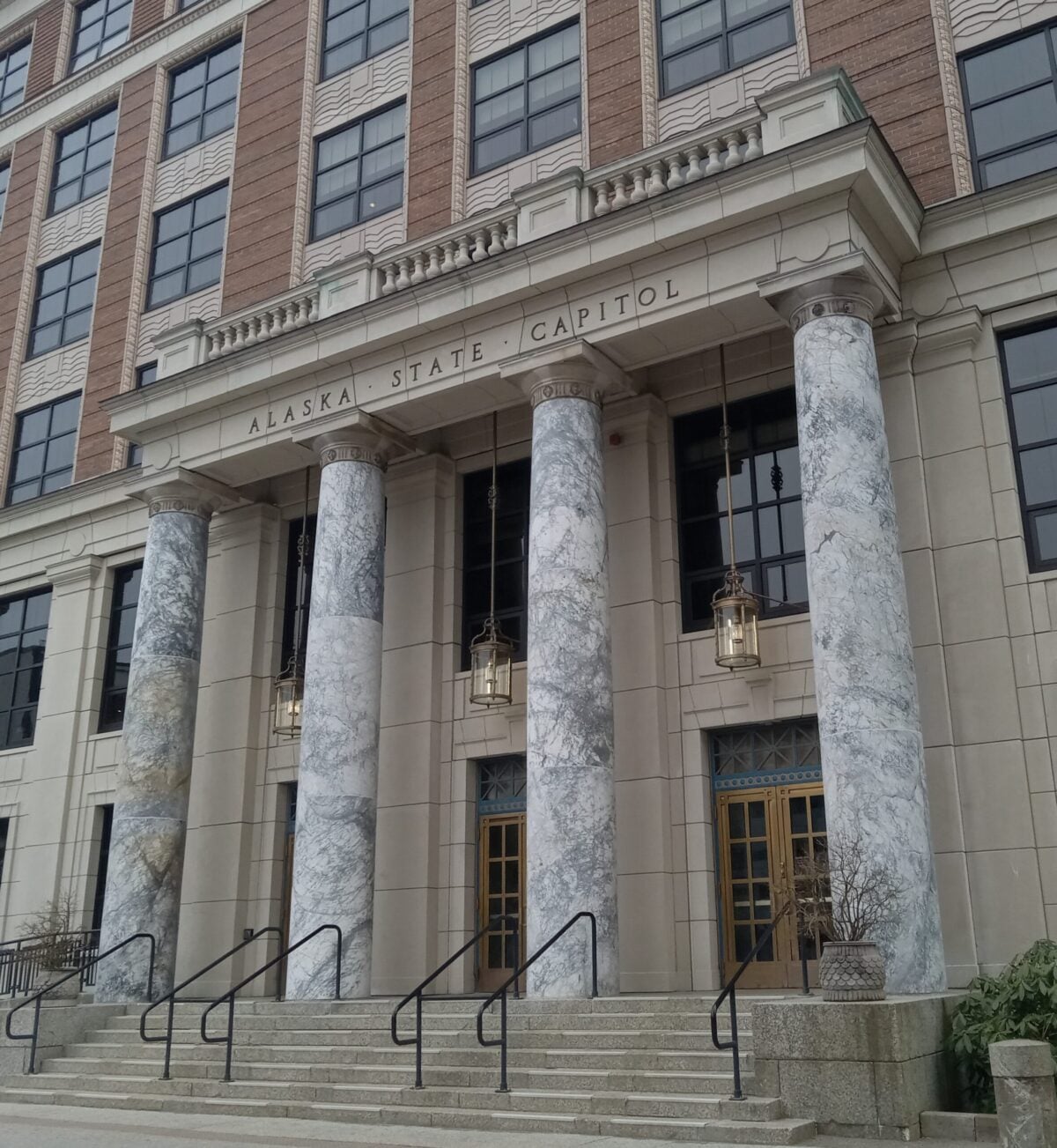
The Alaska State Capitol in downtown Juneau.
(Photo by Greg Knight/News of the North)
By: James Brooks, Alaska Beacon
The Alaska State Capitol in downtown Juneau.
(Photo by Greg Knight/News of the North)
A panel of state lawmakers voted 9-2 on Wednesday to approve spending up to $100,000 on a lawsuit against Gov. Mike Dunleavy.
The lawsuit, if filed, would challenge the governor’s decision to press ahead with plans to create a cabinet-level Alaska Department of Agriculture via executive order.
The governor issued an executive order in January, but lawmakers rejected it in a 32-28 vote in March, saying they preferred to create it through legislation instead. Creating the department through legislation, legislative leaders said, would allow lawmakers to debate and structure the department how they wish, instead of relying on the governor’s plans alone.
Dunleavy disagrees with that approach and in August filed a new executive order during a 30-day special session.
The leaders of the House and Senate refused to accept the filing, saying that it was not within the governor’s power to issue an executive order during a special session, or to reintroduce an already-rejected order.
The governor’s office has said that lawmakers’ failure to vote down the new order means that it will take effect and allow the executive branch to create the cabinet-level department at the start of 2026.
Why does the Legislature’s failure to vote on the executive order matter?
Article III, section 23 of the Alaska Constitution says that executive orders automatically take effect “unless disapproved by resolution concurred in by a majority of the members in joint session.”
The question that could be decided in court is whether lawmakers need to take that vote if an order is issued during a special session. Is issuing an order in a special session even legal? And does it matter if the order is identical to one that’s already been issued and voted upon?
Under Article III, section 23 of the Alaska Constitution, the “legislature shall have sixty days of a regular session, or a full session if of shorter duration, to disapprove” executive orders that would make a change to the functions of the executive branch.
For almost two hours on Wednesday, members of the joint House-Senate Legislative Council — a committee that makes decisions for the Legislature when it is out of session — heard about the dispute behind closed doors, then debated it briefly in open session before voting.
“It’s a disagreement between the Legislature and the governor about whether or not the governor has the authority under the Alaska Constitution to introduce an executive order during a special session,” said Emily Nauman, director of Legislative Legal Services, the legal department for Alaska’s legislative branch.
Because the House and Senate’s presiding officers returned the order to the governor without taking action, “the governor is asserting that he will give effect to the executive order because it was not specifically rejected or disapproved by the legislature, thus causing a conflict in the interpretation of the Constitution between the Legislature and executive branch.”
Rep. Louise Stutes, R-Kodiak, voted in favor of authorizing the Legislature to prepare and, if necessary, file a pre-emptive lawsuit to keep the governor from enacting the executive order.
“It’s just a question, to me, of, we said, ‘No. Don’t you understand what no means?’”
Rep. Calvin Schrage, I-Anchorage, also voted in favor of moving forward with a lawsuit. He said that while there is still time for the governor to back away from his position, “I really see it as our prerogative to protect ourselves procedurally, and for us to do that, I believe we need to file litigation.”
The two votes against Wednesday’s proposal came from Reps. Chuck Kopp, R-Anchorage, and Mike Prax, R-North Pole.
Prax said he feels as if it could set a precedent that could allow lawmakers to disapprove of a future governor’s actions in a “more urgent” situation by simply not taking action.
“We would establish a precedent that the Legislature can do something by doing nothing, and that just does not seem like a very good practice to have established for any organization,” Prax said.
Sen. Jesse Kiehl, D-Juneau, said he doesn’t think that’s a correct interpretation of the lawsuit.
“With great respect to Representative Prax, no one is asserting here that the Legislature may act by inaction. What is before us is the question of whether the second shot at an executive order came in a way that the Constitution allows. I am convinced it did not.”
Kopp said he believes the governor may be prepared to change course on his executive action, and he’s reluctant to approve a lawsuit unless the governor attempts to take action and actually create the department.
“I would like to see us not initiate this until there’s some overt action by the administration that clearly indicates their intent to move unilaterally on this issue outside of the legislative process,” he said.
As of Friday, there was no estimate as to when a lawsuit might be filed.
Under the Alaska Constitution, the executive branch may not sue the legislative branch. Lawsuits by the Legislature against the governor are rare; this would be the fourth against Dunleavy during his two terms in office beginning in 2018.
In 2019, lawmakers sued the governor over a school funding issue. The governor won that case in the Alaska Supreme Court. The following year, legislators sued Dunleavy over their failure to consider some of his appointees during the COVID-19 pandemic emergency. The Alaska Supreme Court again ruled in Dunleavy’s favor.
In 2022, lawmakers filed a ‘friendly’ lawsuit against the governor in a dispute over the proper handling of oil and gas tax settlements. That dispute, which dates to the administration of Gov. Bill Walker, has yet to be decided by the Alaska Supreme Court.
The sign at the entrance to the University of Alaska Fairbanks campus welcomes students on Sept. 20, 2023. (Photo by Yereth Rosen/Alaska Beacon)
The U.S. Department of Education has terminated grant funding for universities’ Alaska Native and Native-Hawaiian-serving programs and support services, an act that University of Alaska Fairbanks Chancellor Mike Sfraga said “will have a substantial and negative impact on a large number of Alaskans, including our Alaska Native students.”
Sfraga announced the federal decision in a campus-wide email on Thursday.
Mike Sfraga spoke at an Alaska Senate hearing in April 2025. (Photo by James Brooks/Alaska Beacon)
Sfraga said the funding cut for UAF is estimated at $2.9 million, and the full effects are still under review. More than 20%, or an estimated 1,450 students at UAF are Indigenous, Sfraga noted.
The full extent of the grant funding freeze across the University of Alaska system is still being analyzed, said Jonathon Taylor, UA director of public affairs, by email on Friday.
UA President Pat Pitney said in an emailed statement on Friday that the university will continue to create a welcoming environment for all students.
“We are evaluating the impact these changes will have on our services to Alaska Native students, and are communicating directly with students, staff, and faculty who may be affected,” Pitney said. “A significant part of UA’s identity is our commitment to Alaska Native culture, language, art, heritage, business, and tribal management and governance; that remains unchanged. We proudly embrace our global leadership in Alaska Native and Indigenous studies, and will continue to sustain a welcoming environment where all – including our Alaska Native and Indigenous students – can thrive and succeed.”
Taylor said the University of Alaska Southeast has at least one grant-funded program on the Sitka campus aimed at improving student services, and university officials are waiting to hear whether it will be eliminated. Taylor said the University of Alaska Anchorage does not have any programs funded by this federal grant.
As of fall 2024, there were 3,254 students enrolled at the University of Alaska that identified as Alaska Native or American Indian, and 266 that identified as Hawaiian Native or Pacific Islander, according to the university, and 19,629 students total across the UA system.
The University of Alaska announcements came after the Trump administration said Wednesday it will withhold an estimated $350 million of congressionally-approved funding for minority serving colleges and universities, saying the money will be allocated elsewhere. The measure continues President Donald Trump’s initiative to eliminate programs that focus on diversity, equity and inclusion.
Sfraga said the federal government is allowing up to a year to close out the programs. UAF has multiple grants which fall under the program, Sfraga said, and most are under the College of Indigenous Studies and the UAF Community and Technical College.
Sfraga said the grant program does not fund student aid, but it does support degree programs and support services like student advising and recruiting, workforce development and student success initiatives across campuses.
University officials report that to date, the Trump administration has cancelled $6.6 million in research grants and almost $45 million has been frozen.
Each year, the university receives an estimated $250 million in federal research funds, Taylor said, adding that “95% of the university’s broad research portfolio remains intact. UA has experienced only minor disruptions as a result of the rapidly shifting policy picture in Washington, D.C., and we are closely monitoring developments as they evolve.”