The ConocoPhillips Alaska Inc. building in Anchorage is seen on June 28, 2023. (Photo by Yereth Rosen/Alaska Beacon)
The top oil-producing company in Alaska is planning significant layoffs, it announced last week.
In a series of statements, the oil giant ConocoPhillips said it will be firing between 20% and 25% of its global workforce of about 13,000 people. That would mean between 2,600 and 3,250 layoffs worldwide.
“We are always looking at how we can be more efficient with the resources we have. As part of this process, we have informed employees that a 20% to 25% reduction in our global workforce, which includes employees and contractors, is anticipated. The majority of these reductions will take place in 2025,” said Rebecca Boys, director of external affairs for ConocoPhillips Alaska, on Thursday.
Boys declined to say how many people the company employs in Alaska, but prior documents published by the company say that it has “about 1,000 people in Alaska,” and of those, about 80% live in the state.
Altogether, the oil and gas industry employed 8,800 people in Alaska as of July, according to state statistics. If ConocoPhillips were to lay off a quarter of its Alaska workforce, it likely would reverse an upward trend for the oil and gas industry here.
Since bottoming out at 6,100 people in November 2020, during the COVID-19 pandemic emergency, the number of people employed by the oil and gas industry rose throughout President Joe Biden’s administration.
ConocoPhillips produces the most oil of any company operating on the North Slope and holds the second-most oil and gas lease area in the state.
According to state data, ConocoPhillips leases about 490,000 acres of Alaska land and water for oil and gas drilling. That’s behind only privately owned Hilcorp, whose holdings exceed 500,000 acres.
ConocoPhillips is developing the large Willow project in the National Petroleum Reserve-Alaska, which is expected to begin producing oil in 2029.
According to the Alaska Division of Oil and Gas, ConocoPhillips is also planning to drill four exploration wells in other parts of the reserve this winter.
On its production side, ConocoPhillips was planning to drill 12 new production wells this year and next from the Kuparuk oilfield west of Prudhoe Bay.
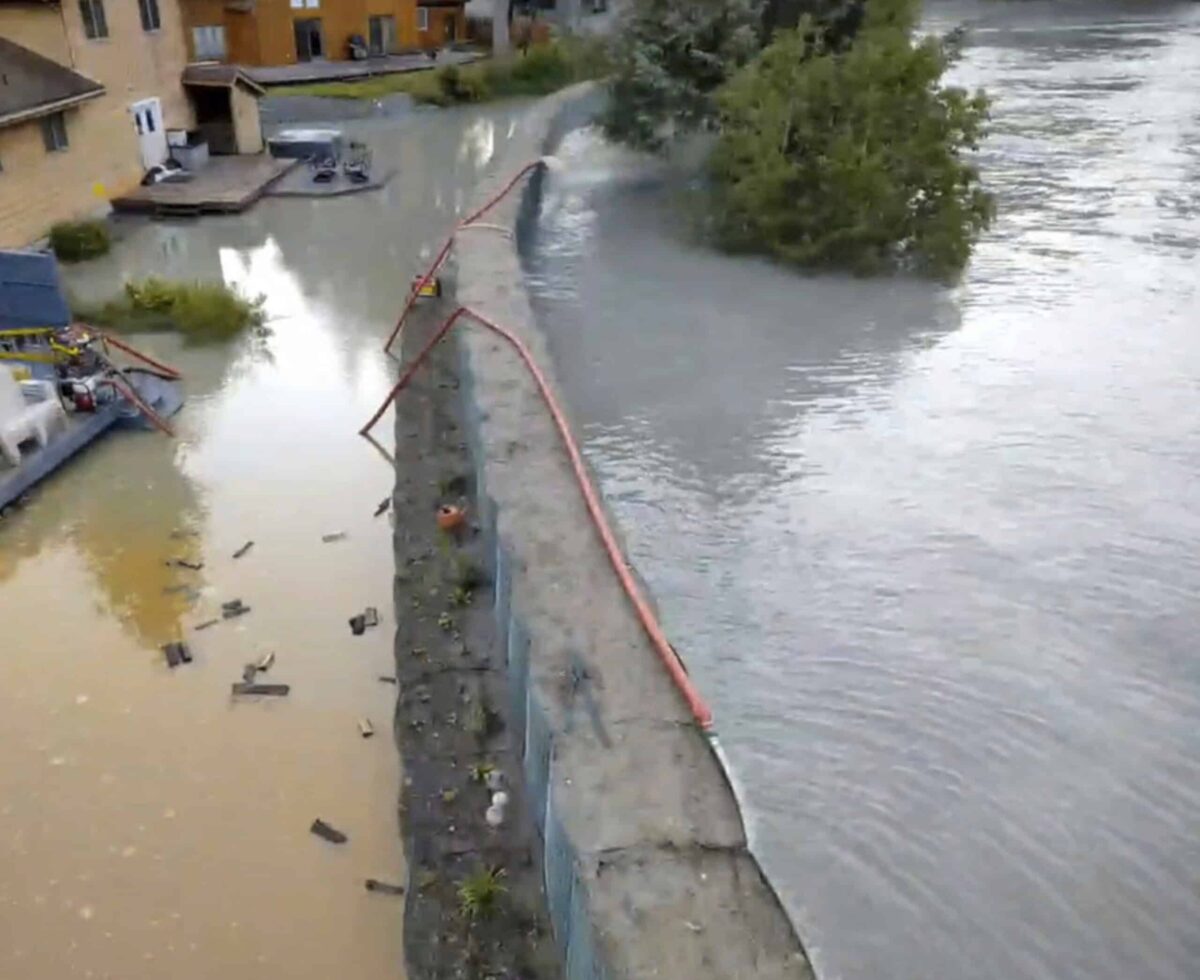
This drone image provided by the City and Borough of Juneau shows flooding from a release of water and snowmelt at Mendenhall Glacier covered some roads and threatened homes along the Mendenhall River in Juneau, Alaska on Wednesday, Aug. 13, 2025. (City and Borough of Juneau via AP)
This drone image provided by the City and Borough of Juneau shows flooding from a release of water and snowmelt at Mendenhall Glacier covered some roads and threatened homes along the Mendenhall River in Juneau, Alaska on Wednesday, Aug. 13, 2025. (City and Borough of Juneau via AP)
NOTN- Juneau officials say repairing damaged flood barriers and planning for long-term protection along the Mendenhall River will be a top priority in the wake of August’s glacier outburst flood.
At a Monday night work session, the Assembly said that Phase One of the HESCO barrier project, temporary flood walls installed to protect neighborhoods, sustained an estimated $1 million in damage.
“We are still gathering a lot of information on what happened this year, so folks are looking at, how did the basin change? How did the river change? So we still need a lot of information from our scientists before we’re ready to make any decisions.” Said Christine Woll head of the Finance Committee, “Essentially, last night, we started talking abou are we going to extend the barriers? Last year, we prioritized protecting the areas that had flooded in 2024, but as we think about the potential for this flood to increase in size, we start thinking about, do we want to extend the barriers to essentially the rest of the river? What’s the cost for that going to be and how are we going to pay for it? It starts to get kind of increasingly more expensive for the other areas of the river just because they’re trickier, and those areas are less likely to flood. So it makes for interesting policy decisions about how much the city can afford.”
The Assembly discussed whether to build barriers to a 17-foot or 18-foot model, this carries implications for construction depth, bank armoring, and overall cost. Expanding protection both north and south of the current installation could require substantial outside funding.
Members also considered long-term options for the View Drive neighborhood, where flood protection is difficult to build.
“There’s lots of challenges, but one of them is definitely View Drive, which meets the criteria of being significantly impacted every year by this flood, and yet, you know, has engineering challenges to put HESCOs up” said Woll.
Deputy City Manager Robert Barr said a potential buyout program could be pursued, but cost is the leading question.
“There’s some unanswered questions there that we need to resolve. Specifically, how much is going to cost and how many of the folks in the View Drive area need to participate for that to be a program that the federal government will participate in.” Barr said.
Last nights meeting was a Work Session however the Assembly took one actionable step, voting unanimously to shift $5 million from the Capital Civic Center project into flood mitigation. That money will help repair existing HESCO barriers and support the next phases of protection planning.
“These are decisions we’re going to have to tackle in the coming months,” he said. “We’ll keep looking for federal and state help, but ultimately we have to prepare for what may come next summer.”
The August flood, caused by an outburst from Suicide Basin above the Mendenhall Glacier, inundated neighborhoods and left behind millions in property damage.
NOTN- A trial is scheduled to begin this week for a man accused of fatally shooting another man in the Mendenhall Valley in 2023.
Court records show 46-year-old Andre P. Lawrence is set to appear before Juneau Superior Court Judge Amy Mead on Wednesday.
He is charged with first- and second-degree murder in the death of 23-year-old James T. Newman.
Newman was found dead from a gunshot wound on Cinema Drive on the night of July 20, 2023.
Investigators said video surveillance showed him approaching a black Dodge pickup before collapsing. A witness later identified Lawrence as the driver.
Police said the truck linked to the shooting had blood on the driver’s side door.
Lawrence was arrested the next morning at a residence on Riverwood Drive after what police described as an overnight investigation.
If convicted, Lawrence could face up to 99 years in prison.
Attorneys general (from left to right) Treg Taylor of Alaska, Marty Jackley of South Dakota, Kris Kobach of Kansas, J.B. McCuskey of West Virginia, and Liz Murrill of Louisiana participate in a panel discussion on Thursday, Aug. 28, 2025, at the Alaska Oil and Gas Association conference in Anchorage. (Photo by James Brooks/Alaska Beacon)
During a pair of public panel discussions during the last week of August, attorneys general from five conservative Republican states said they see climate ‘superfund laws’ passed by Democratic states as major threats to the fossil fuel industries of their state.
“I think that the group of people that are on this panel are all united in making sure that all of the expertise in all of our offices are being utilized to make sure that this doesn’t keep going, because it’s very, very dangerous,” said J.B. McCuskey, attorney general of West Virginia, at the annual meeting of the Alaska Oil and Gas Association.
Alongside him were attorneys general Kris Kobach of Kansas, Liz Murrill of Louisiana, Marty Jackley of South Dakota, and then-attorney general of Alaska, Treg Taylor.
The attorneys general said they are also concerned by lawsuits from states and local governments that could result in financial penalties against fossil fuel companies for disasters attributed to climate change.
Vermont made history in 2024 when it enacted a law that allows the state to hold fossil fuel companies financially liable for the negative impacts of climate change on that state. New York followed suit with a similar law later in the year.
Under both laws, fines levied by the states and paid by fossil fuel companies would go into a large fund that would be spent on projects that could mitigate natural disasters or subsidize clean energy projects.
“Now that we have a friendly EPA and a friendly administration, the blue states are deciding that they’re now going to be the EPA,” McCuskey said, speaking at a different panel hosted by the Republican Women of Anchorage.
The attorneys general, plus Ken Paxton of Texas, who was not present at the industry panel, nodded along as McCuskey spoke.
“Their argument is that every single permitted operation that happened in Alaska caused $75 billion worth of damage to the people of New York. It’s completely outrageous. And the problem isn’t just that it’s New York, it’s that Illinois has one. California is going to have one. Vermont’s going to have one. Massachusetts is going to have one. You name a place that has radical environmentalists running their government, and then it becomes an amount of money that’s not withstandable,” McCuskey said.
Taylor, who has since resigned as Alaska’s attorney general and is expected to run for governor, said he believes that in states with budget holes, “it’s pretty convenient just to raise taxes on oil and gas, right? And those states that don’t have oil and gas, that’s their way of dealing with their budget shortfalls, is to take it out of oil and gas through these types of acts.”
Republican attorneys general from five states speak at an event hosted by the Anchorage Republican Women on Thursday, Aug. 28, 2025, in Anchorage. (Photo by James Brooks/Alaska Beacon)
Fossil fuel businesses and trade groups, including the American Petroleum Institute and the U.S. Chamber of Commerce, filed suit last year against the Vermont law.
A group of Republican attorneys general, led by McCuskey, sued New York in February. Another McCuskey-led suit, filed in May, targets Vermont.
Those suits say companies should be financially liable for harm caused by climate change.
Speaking at the Alaska oil panel, Kobach said he’s concerned about climate lawsuits filed by cities and counties and believes they’re being encouraged by national environmental law firms and groups.
“The reason I’m so energized about fighting back against that is Ford County, Kansas, which you probably never heard of, where Dodge City is — little tiny county, rural county, very low population — somehow, they were convinced by some very well-heeled attorneys in California to be a plaintiff in one of these lawsuits. And so we’re chasing them around. My office is chasing them around, trying to get them kicked out of court because they don’t speak for the people of Kansas,” he said.
Taylor said he sees the same issue.
“We’re seeing those opportunistic plaintiffs’ attorneys convince municipalities and boroughs and cities to take on litigation that’s really not in their best interest and really puts money into their own pockets,” he said during the panel discussion.
McCuskey, of West Virginia, said his state is considering a law that would restrict the ability of local governments to sue.
Nationally, the fossil fuel industry is lobbying Congress to pass a liability shield law akin to the one passed in 2005 to protect the gun industry against lawsuits attempting to hold gun manufacturers responsible for gun crimes.
In June, McCuskey and other attorneys general wrote a letter to the U.S. Attorney General to offer support for a national liability shield to protect fossil fuel companies.
McCuskey, speaking at the oil panel, got a laugh from the audience when he asked attendees what they thought West Virginians would say if New York tried to collect a fine from the state of West Virginia.
“Our big joke is that the people in New York are literally looking down on us from the skyscrapers that were built with coal from West Virginia,” McCuskey said at the oil and gas association panel. “So they’re not just looking down on us figuratively, but both literally and figuratively, and they just have no contemplation of why their economies were built by the people who do the work that’s happening here.”
NOTN- Jim Duncan, a former Alaska House Speaker and longtime labor leader, is looking back on more than four decades in public life in a new memoir he says shows how politics is a lot like making sausage.
Duncan, who served in the Legislature from the 1970s through the 1980s eventually becoming Speaker of the House. Over that time, he sponsored dozens of bills and says he learned that compromise was the only way to get things done.
Duncan also lead Alaska’s largest public employee union and said his book Making Sausage aims to put Alaska’s political issues into perspective, he says much of what was covered in the 70s and 80s is still applicable today.
“It was a long process, but it was worthwhile in my mind, because it really brought me back to how important the issues are that we were addressing and how those issues are still alive today.” Said Duncan, “The one thing I mentioned in the book is that it’s, about history, but it’s not ancient history, because what we did when I was serving in the legislature and after, are still alive today, those issues still need to be addressed. And I hope that there will be some encouragement given to some folks too, if they read this and say, Okay, let’s get busy and try to resolve these issues. They need to be done.”
Duncan recalled sifting through nearly 20 boxes of legislative files to piece together the book, which details his work on oil taxes, education, and labor negotiations.
He said one of his proudest achievements was securing finality in collective bargaining for school employees, a fight that spanned 15 years.
“Education funding has been at the top of the list for past legislators and legislators for a number of years.” Duncan said, “You know, we didn’t adequately address it when I was in the legislature. We tried to, and we put together a foundation, a formula program, but unfortunately, that hasn’t been kept up to date, and there hasn’t been adequate funding. And we complain about our schools and the fact that we don’t think that they’re providing a good education, but we’re asking our teachers to do more with less. There’s less teachers. The classroom sizes have increased. They’ve got to bring in their own supplies, so it’s very difficult.”
Locally, he pointed to helping secure funding for the University of Alaska Southeast library, which he argued cemented the campus’ future in Juneau.
Much of Duncan’s book also revisits Alaska’s battles over oil taxes, a debate he said shaped his career and even led to his removal as House Speaker.
“You know, the fact that the state doesn’t have a long-term fiscal plan, so we can really clearly set our goals and attain those, it’s got to be resolved.” Said Duncan, “And the one reason that hasn’t happened is because, so far, when they talk about creating fiscal plan, what they look at is decreasing spending and increasing the permanent fund dividend, but they forget about the fact they need more revenues, and unfortunately, revenues, the ones that we can get would come from oil companies.”
Duncan said that Alaska’s state issues like education and state funding are also federal issues.
“Education is being attacked with the current administration, the Department of Education is being decimated, and they’re reworking the way that the federal government helps provide education, health care is under attack, as we know, there’s talks about trying to repeal parts of Obamacare, doing away with Medicaid funding and or reducing it and Medicare, and that’s going to have a tremendous impact.” Duncan said “So the important thing I think here, is that the issues that we were addressing, trying to address years ago, are still alive today and need to be addressed. And I hope that this might spur some if folks read this.”
Duncan spoke on today’s political landscape and expressed concerns on partisanship, “I think Alaska, we do better working on a bipartisan nature than some other states do, and what they do on the federal level.” he said, “I think there’s good ideas on both sides, whether you’re Republican or Democrat. The goal you is to try to bring folks together, and you gotta be willing to accept their thoughts and views. Also, I think unfortunately, on the federal level, that’s not happening. It’s become very strident.”
Duncan also weighed in on the Alaska Permanent Fund Dividend, which he helped establish during his time in office. While he said he supports a larger dividend to benefit rural and low-income residents, he argued it must be paired with new revenue sources, including changes to oil production taxes.
“The challenge is, how do you maintain the dividend, provide government services and see the dividend grow? You know, the dividend has been going down in recent years. It’s going to be the lowest this year than it has been for some time. And in fact, it’s probably the lowest it’s ever been.” Duncan said “The reason is because so much of those earnings needs to be used to help support government services, I support that we should have a larger dividend, because it does a lot of good for people who really need it in rural Alaska and elsewhere, in order to do that, you need to find revenues outside of the permanent fund earnings and outside of the general fund money that’s just generated from other sources.”
Making Sausage is available online through Amazon and Google Books, with audio and additional formats expected soon.
The China-flagged research vessel JIDI operates approximately 265 miles northwest of Utqiagvik, Alaska, September 2, 2025. The Coast Guard Arctic District deployed USCGC Healy (WAGB-20) to monitor and query the vessel. (U.S. Coast Guard Courtesy Photo)
The U.S. Coast Guard shadowed two Chinese research ships operating in disputed waters within the Arctic Ocean this week, the Coast Guard announced Wednesday.
The icebreakers Ji Di and Zhong Shan Da Xue Ji Di were traveling more than 200 miles offshore of Utqiagvik, America’s northernmost town, in what’s known as the “extended continental shelf” under the International Law of the Sea Treaty.
Ordinarily, international law restricts a nation’s fishing, oil drilling and scientific exploration to within 200 nautical miles of its coast, in what’s known as its “exclusive economic zone.” Under the United Nations Convention on the Law of the Sea, a nation can extend that exclusive limit if the continental shelf — a place of generally shallower water — stretches beyond 200 miles.
More than 160 countries and the European Union have ratified the Law of the Sea agreement, but the United States has not, despite the urging of members of Alaska’s congressional delegation.
The agreement says foreign vessels may pass through extended continental shelf waters, but they must have the owner’s consent in order to perform scientific studies or seafloor mapping there.
The United States claims the extended continental shelf near its shorelines and in 2023 began the international process to have its claims recognized, but the United Nations committee that regulates the agreement has not finalized the American claims, a process that could take decades because the United States is not a party to the agreement.
Meanwhile, despite the lack of international recognition, the United States has continued to claim sovereignty over the extended continental shelf in the Arctic Ocean.
China, which operates more Arctic icebreakers than does the United States, has contended that the Arctic Ocean should remain open to free navigation.
This week, when the two Chinese research icebreakers crossed into the disputed area, the Coast Guard dispatched the icebreaker Healy, which was already operating in the Arctic Ocean under a different mission.
“They were pretty close to the standard 200 nautical mile EEZ boundary. They were outside of that by a few miles, which is directly over that portion that is being claimed right now … by the United States,” said Troy Bouffard, director of the Center for Arctic Security and Resilience at the University of Alaska Fairbanks.
“It’s deliberate in several ways,” he said of the Chinese action. “It’s meant to get attention but not go over the line.”
He said some of China’s actions in the Arctic have been to “promote it as a global commons that belongs to everybody, and to minimize sovereign rights as much as possible. So that’s a pretty obvious reason why they would have done this at the location they did.”
Chief Petty Officer Travis Magee, assistant public affairs officer for the U.S. Coast Guard’s Arctic District, said that in cases like the ones that occurred this week, the typical response is to “monitor, and query the vessels” over the radio, frequently using a pre-prepared script.
The script he said, often goes like this:
“You are currently operating over the United States Extended Continental Shelf (ECS). Under international law, the United States has rights to conserve and manage the living and non-living natural resources of its ECS as well as to regulate marine scientific research by foreign scientists relating to its ECS. In all cases where marine scientific research is pursued on the Extended Continental Shelf, appropriate official channels must be used to obtain U.S. consent.”
The Coast Guard also flew a long-range patrol aircraft from Kodiak to shadow the two ships.
Rear Adm. Bob Little, commander of the Arctic District, said in a prepared statement that “the U.S. Coast Guard is controlling, securing and defending the northern U.S. border and maritime approaches in the Arctic to protect U.S. sovereignty, and Healy’s operations demonstrate the critical need for more Coast Guard icebreakers to achieve that.”
While the U.S. Navy frequently operates submarines in the Arctic Ocean, it does not have any icebreakers; the Coast Guard operates the federal government’s only icebreaking ships.
The recently approved Republican budget package known as the “Big Beautiful Bill Act” included billions of dollars for the Coast Guard to construct new heavy icebreakers.
The first of those ships is expected to enter service in 2030, though some medium-weight icebreakers are being planned and could arrive sooner.
NOTN- A 57-year-old woman visiting Alaska on a cruise was killed Thursday morning when a car accelerated through a guard rail, struck her and plunged into Ketchikan Creek, city officials said.
The woman, from Auburn, Indiana, was pronounced dead at the scene. Her husband, also a cruise passenger, was with her on her trip.
The city said the family has been notified.
Three other people, including the driver, were taken to the island’s hospital. One remained in critical condition Thursday afternoon, while the other two were released with minor injuries.
The crash happened around 8:40 a.m. at the Centennial parking lot near Historic Creek Street, a popular downtown destination for tourists. The vehicle went through a wooden fence and dropped about 10 feet into the creek below, damaging a nearby walkway.
The cause of the crash remains under investigation.
An early voting station is set up in the atrium of the State Office Building in Juneau, Alaska on Monday, Aug. 5, 2024, the first day of early voting for the 2024 Alaska primary election. (Photo by James Brooks/Alaska Beacon)
By: James Brooks, Alaska Beacon
An early voting station is set up in the atrium of the State Office Building in Juneau, Alaska on Monday, Aug. 5, 2024, the first day of early voting for the 2024 Alaska primary election. (Photo by James Brooks/Alaska Beacon)
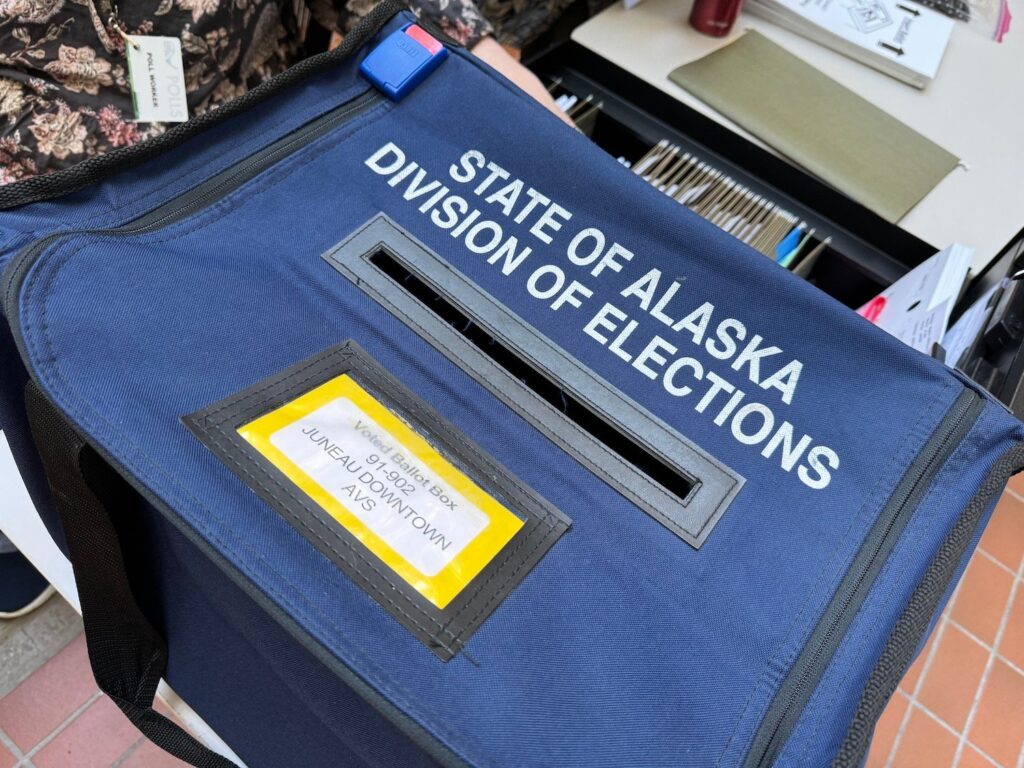
A document submitted by the Alaska Division of Elections to the U.S. Department of Justice in response to a nationwide data request names 70 possible noncitizens who voted or attempted to vote in state or local Alaska elections since 2015.
Noncitizen voting remains extraordinarily rare, nationwide figures show, and Carol Beecher, director of the Alaska Division of Elections, said there is no evidence that noncitizen voting changed the result of last year’s elections here.
Ahead of last year’s elections, Donald Trump and other Republican politicians said they believed large numbers of non-U.S. citizens would seek to vote and influence the result of elections.
Since becoming president, Trump has asked Congress to impose citizenship checks on all potential voters. His Department of Justice has asked all 50 states for copies of their voter lists in order to create a national government database.
Alaska turned over its voter list and other documents to the U.S. Department of Justice last month.
In response to a public records request filed by the Alaska Beacon, the Alaska Division of Elections provided copies of documents it delivered to federal authorities.
Most of the documents, including a copy of the state’s official voter list, were already public. The voter list, for example, is available for purchase from any state elections office and doesn’t include sensitive information beyond a voter’s name, how often they’ve voted, and where they live.
The state’s inactive voter list — showing people whose voter registrations have been flagged for review and possible removal — is also a public record, but it isn’t commonly circulated. Inactive voters can’t cast a ballot without additional ID checks.
WHERE’S THE LIST?
Ordinarily, the Alaska Beacon publishes copies of the documents it obtains via public records requests, but in this case, we’re not publishing the list.
The inactive voter list contains the names and addresses of tens of thousands of Alaskans who have committed no wrongdoing, and we believe the potential harm outweighs the benefit of publishing it.
The list may become available from other sources or news outlets, but because people may be listed as “noncitizens” due to paperwork errors or other innocent mistakes, and because we aren’t able to verify the citizenship of all 541 people, we’re not publishing it.
The inactive voter list provided to the DOJ and to the Beacon is from August. It includes 541 people whose voter records were tagged “NC” for non-citizen.
But it’s not clear whether these Alaskans are noncitizens or were on the list because of mistakes.
Carol Beecher, director of the Alaska Division of Elections, said some people may have been erroneously labeled, so it isn’t correct to say that there were 541 noncitizens registered to vote.
“As we get more information, things change. So what I’m telling you today on a number may change tomorrow because of new information that we got,” Beecher said in an extended interview on Wednesday.
Stephen Kirch, the division’s spokesperson, said by email that “the DOE cannot say with any degree of certainty whether the current number of NC-coded entries is ‘abnormal’ or ‘unusual’ in a historical context. This is because the number is a moving target and not a static one; it is not tracked.”
The inactive voter list shows only people whose records have been flagged for additional attention and isn’t confirmation that they are not citizens. It may include people who filled out paperwork incorrectly or registered to vote shortly before becoming a citizen.
“It’s really hard to say whether this particular number (541) is a problem, because there’s so many questions behind even that particular number,” said Mara Kimmel, a former immigration attorney who now works as executive director of the Alaska chapter of the American Civil Liberties Union.
That total also might miss noncitizens who are on the active voter list but haven’t yet been identified.
Carol Beecher, the new director of the Alaska Division of Elections, answers questions from reporters on Thursday, Feb. 16, 2023. (Photo by James Brooks/Alaska Beacon)
Beecher said she considers the “NC” tag to be “kind of like a file drawer. You put things into that file based on the status when you put it in there. But that could change.”
Kimmel said that the issue is “never as easy as it seems or as it would be framed. … Noncitizens voting has become a real political hot-button issue.”
In her experience, “there’s so much confusion and misinformation that is born out of a benign desire to participate in your new home.”
In Alaska, residents can register to vote by contacting the Alaska Division of Elections. Residents are also asked if they want to register when they update their driver’s license, get a new driver’s license, and apply for the annual Permanent Fund dividend.
As Beecher explained, if someone attests that they’re not a citizen through one method but says they are a citizen via a different method, that gets the attention of authorities.
“When we have gone in there and looked and contacted them, we have found that usually it was a mistake,” she said.
In other cases, particularly with the state’s “motor-voter” program, the mistake might come from a typo or someone’s misunderstanding of the rules, particularly if they don’t speak fluent English, as might be the case with new immigrants.
The Division of Elections doesn’t have investigative powers, which means voting officials rely on an applicant’s sworn oath about their citizenship. There’s no automatic double-checking, and it’s federally unconstitutional for the division to ask for proof of citizenship.
“All we get is the affirmation, and however frustrating that can be for everyone out there to say, ‘Well, why can’t you make sure?’ Well, we are not given that authority. So essentially, the division takes people at their word is really what it comes down to,” Beecher said.
If someone’s registration is flagged by a complaint or because of a discrepancy in the records, the division forwards the case to the Alaska Department of Law for investigation.
“We provide them with documents if they request that, as pursuant to an investigation, but if not, we may never hear from them,” Beecher said of the investigation.
Smith was born in American Samoa, an island territory in the South Pacific. Its residents are U.S. nationals — having some of the same legal rights as other Americans — but aren’t citizens.
During the subsequent investigation, Alaska State Troopers learned of 10 other American Samoans who had voted in Alaska. The state charged them with civil crimes in April, and this week, they were indicted.
All 10 are labeled noncitizens on the inactive voter list supplied to the Beacon and Department of Justice. They, and another 60 other people, are shown as having voted or attempted to vote at least once during the past 10 years.
It isn’t clear whether all of those ballots were actually counted. Many are labeled as “questioned,” meaning that they were subject to additional ID verification. Beecher said “it’s possible” that some were counted but that she didn’t have numbers.
She believes “very few” noncitizens have voted.
“I’m speaking very anecdotally, because I don’t have those kinds of numbers for you, but our sense is that it’s very small. And I think the underlying reason for that is because there is no nefarious intent out there to try to sway an election. It’s people who either — and this is my personal opinion — they’re confused about the rules or somehow ended up marking something that they didn’t understand,” Beecher said.
If the noncitizen-tagged voters on the inactive list had still been active, they would have represented just 0.09% of Alaska voters.
Last year, 340,981 Alaskans voted in the state’s November general election. The division’s inactive list shows six noncitizens either voted or attempted to vote in that election.
In Michigan, officials announced in April that they had found 16 credible cases of noncitizen voting out of about 5.7 million votes cast overall, or one per every 360,000 votes.
Sen. Bill Wielechowski, D-Anchorage and a supporter of election reform legislation in Alaska, noted that the rate of noncitizen voting in Alaska is likely well below the rate at which legitimate voters are being disqualified because of problems with the state’s absentee voting system.
“Any time you have people who are voting that shouldn’t be voting, that’s cause for concern,” Wielechowski said in an interview Wednesday.
“But at the same time, we’ve got hundreds of people that we know of, actually thousands of people who were disenfranchised,” he said, referring to the state’s regular practice of disqualifying absentee ballots because of submittal errors.
“In rural Alaska, we had 10% or 15% of the population in rural Alaska that was disenfranchised a couple of years ago, legitimate voters who were disenfranchised because of a bureaucratic technicality that’s not even checked. So I think there’s bigger problems,” Wielechowski said.
In 2023, Rep. Sarah Vance, R-Homer, proposed legislation that would have required the Division of Elections to cross-check the state’s voter rolls with a national citizenship database.
“I always like to presume innocence, but we have to put the safeguards in place, and by having the division use those databases as a check and balance, I think that’s a very simple way to make sure that we’re crossing our T’s and dotting I’s,” Vance said Wednesday.
She noted that current Speaker of the House Bryce Edgmon, I-Dillingham, won his 2006 primary election via a coin toss that followed a tied election.
“When you look at how slim some of our elections are, how tight races can be, these numbers matter,” she said.
The Alaska Senate stripped out Vance’s citizenship provision and passed a revised bill, but the Republican-led House failed by a single vote to take up the legislation on the last day of the regular session in 2024. The bill died at the end of the session, and lawmakers started anew this spring.
In recent years, the Alaska Department of Law has requested funding for a part-time elections investigator. The Legislature has not approved that request.
“We shouldn’t have anyone voting in our elections on any level who shouldn’t be,” Vance said.
“This is important and significant because we want to make sure that we protect the sovereignty of every individual’s vote,” she said.
U.S. Coast Guard Cutter Polar Star (WAGB 10) (left) sits moored next to U.S. Coast Guard Cutter Healy (WAGB 20) at Coast Guard Base Seattle, Aug. 25, 2024. The Polar Star and Healy are routinely deployed to Arctic and Antarctic locations to support science research or help resupply remote stations. (U.S. Coast Guard photo by Lt. Chris Butters)
The U.S. Coast Guard announced Tuesday that it has awarded a $137 million contract for the first phase of a project intended to allow its Seattle base to host two new heavy icebreakers.
The contract, awarded to The Whiting-Turner Contracting Company, covers dredging of the Coast Guard’s Slip 36 and construction of two ship berths capable of hosting the new icebreakers, formally known as Polar Security Cutters.
The first of those ships, the Polar Sentinel, is expected to be complete in 2030. When accepted into the Coast Guard, it will be the service’s first new heavy icebreaker since the Polar Star was commissioned in 1977.
The Coast Guard operates the federal government’s icebreaker fleet, and the Polar Star is key to supplying American research bases in Antarctica from its Seattle home port.
A second and third heavy icebreaker were fully funded with $4.3 billion included as part of the Republican budget package approved by Congress and President Donald Trump earlier this year.
The budget package also included $300 million for port construction in Juneau to support the newly commissioned Coast Guard icebreaker Storis, a converted oilfield services ship. Until that work is complete, the Storis will be homeported in Seattle.
The Republican budget package, known as the “Big Beautiful Bill Act,” includes billions of dollars for shoreside port facilities like those in Juneau and Seattle.
Additional phases of work are expected in Seattle, which is expected to be the home port of four new major Coast Guard cutters, the service said in a written statement.
Photo of Mendenhall glacier in autumn, taken by Rosary Lombardo
NOTN- After two recent deaths on trails near the Mendenhall Glacier, Juneau police are urging hikers to take precautions and understand the challenges search-and-rescue teams face in southeast Alaska.
Juneau Police Chief Derek Bos said such cases fall into one of two categories, people who vanish in the wilderness, often requiring search-and-rescue efforts, and those whose disappearances are suspicious or criminal in nature.
“Alaska State Troopers actually have jurisdiction over search and rescues in all of Alaska.” said Bos, “When we get those calls in, initially, it’s deferred to AST for them to conduct search and rescue operations and begin the initial stages of that investigation, we also are privileged in Juneau to have Juneau mountain rescue, which is a very professional, wonderful entity that does a great job of search and rescues. And so they work in collaboration with AST on those initial stages of a missing person who’s gone hiking and just not come back.”
JPD supports both groups and shadows their work in case the missing person case later becomes a criminal investigation.
Bos also noted that southeast Alaska poses difficulties for search teams. Dense vegetation, steep mountainsides and shifting winds complicate efforts by ground crews and even trained search dogs.
“It doesn’t take much to look around and see that we are in a very densely vegetated area, and it’s very vertical. So it’s not like looking for somebody in the plains of Kansas.” Bos said, “There’s a lot of visual obstructions, there’s altitude challenges, there are different wind patterns. So even using search and rescue dogs, if you’re above a scent and the scent is below you, it might blow up on the wind, but if the dog is below the scent and the scent is going up, you might miss it. There’s significant challenges through every aspect of a search and rescue in Southeast Alaska.”
Community members often play an important role, he added, since hikers can help narrow down search areas if they remember where they saw someone.
“A huge thing for us with the public is, if you see this individual on a trail, call us and tell us, let us know where you saw them and when you saw them, that helps us narrow down the search area, and gives a better point of where that person was last seen, so that we can start search efforts in a more specific location.”
Police are urging residents and visitors to share their plans before heading out on local trails.
“If you don’t communicate that, it could be days before anybody identifies that you’re missing, and it just delays search efforts.” Bos said, “And if you’re hurt in the woods or have an illness in the woods, you want help as quickly as possible, self induced accountability is pivotal for any kind of hiking or adventures in Southeast Alaska.”