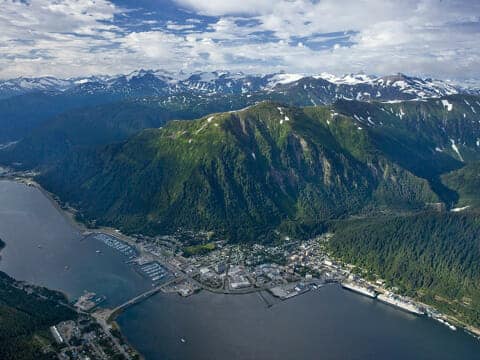
Photo provided by CBJ following the installation of the HESCO barrier project
With the summer heat rising and water levels climbing in Suicide Basin, emergency officials, city officials and the National Weather Service are closely monitoring the threat of another glacial lake outburst flood (GLOF) in the Mendenhall River Valley. This threat follows a record flood event on August 6, 2024, which swept through neighborhoods, damaged property, and reshaped how Juneau prepares for these recurring flooding events.
Suicide Basin, located above the Mendenhall Glacier, has released floodwaters nearly every year since 2011. These events occur when meltwater trapped behind the glacier breaks through ice dams, sending torrents into Mendenhall Lake and River below.
As of Monday, July 7, the U.S. Geological Survey (USGS) reports that the basin’s laser-monitored water elevation is approximately 1,224 feet, well below the 1,247 feet recorded on the same date last year, and more than 100 feet below 2023 levels. The current elevation is about 147 feet below the overflow channel, which begins spilling at 1,371 feet.
If the rate of rise in the basin remains around 4 feet per/day, this would result in a full basin in 37 days, though the rate of the rise could change.
These differences in water levels from 2024 and 2023 to current levels are due to the cold spring/early summer time temperatures. Freezing levels remained 3000 to 4000 feet through the spring and early summer time but are now around 7000 feet, meaning rapid melt could accelerate water accumulation.
Monitoring equipment, including two daily cameras and a USGS laser sensor, remains active. Officials caution that water level data may show occasional jumps or drops due to icebergs disrupting sensor readings.
City and Borough of Juneau (CBJ) officials, in partnership with state, federal, and tribal agencies, have implemented Phase 1 and Phase 1A of a near-term flood mitigation strategy. With guidance from the U.S. Army Corps of Engineers, CBJ has installed HESCO barriers along vulnerable stretches of the Mendenhall River. These modular barriers are designed to protect against floodwaters as high as 18 feet.
Given the growing threat and lack of a permanent solution, officials urge Juneau residents, especially those in the Mendenhall Valley, to take stay informed and prepared.
This map from the U.S. Geological Survey shows the former Nazi Creek on Little Kiska Island. (U.S. Geological Survey photo)
By: James Brooks, Alaska Beacon
A small creek on Alaska’s Little Kiska Island has been renamed, more than 80 years after it was named after Germany’s Nazi Party by World War II soldiers fighting in the Aleutians.
Nazi Creek was the last landmark in the United States to bear the Nazi name. Its new name is “Kaxchim Chiĝanaa,” meaning either “gizzard creek” or “creek or river belonging to gizzard island” in Unangam Tunuu, the language of the Indigenous Unangax̂ people.
On Thursday, the Domestic Names Committee of the U.S. Board on Geographic Names voted 17-0 to approve the new name, without discussion.
The board’s decision allows the federal government to officially change the creek’s name in federal databases that are the official repository of geographic names. That repository is used by federal agencies and commercial companies that provide maps to the general public.
The board also approved the renaming of nearby “Nip Hill,” named by soldiers using a derogatory term for Japanese people. That hill was renamed “Kaxchim Qayaa,” or “gizzard hill,” again using the traditional name for Little Kiska Island, which is not far from Kiska Island, site of a World War II battle.
Michael Livingston, an employee of the Aleutian Pribilof Islands Association, has been working for almost two years to have the names changed. Moses Dirks, an expert on Unangam Tunuu, recommended the new names.
“I think that’s pretty awesome. I think elders … and others are happy about it. It really should have never been there in the first place,” Livingston said of Thursday’s vote.
“Like one of my teachers … used to say, if you know something that can make our community better, our villages better, be brave and stand up and say something about it, do something about it,” Livingston said.
The new names were previously recommended by the Alaska Historical Commission, which considered them in April. The changes were endorsed by local Native tribes and Native corporations, the Museum of the Aleutians, the manager of the Alaska Maritime National Wildlife Refuge, Congregation Beth Sholom of Anchorage, and the Alaska Chapter of the Japanese American Citizens League, among others.
Kiska Island is located 242 miles west of Adak, at the far end of the Aleutian Islands. The area has been mostly uninhabited since World War II, when invading Japanese forces took 42 people on Attu Island prisoner. More than half died in Japanese internment camps.
The United States forcibly relocated almost 900 Unangax̂ residents of the Aleutian Islands, housing them in unsuitable internment camps in Southeast Alaska and elsewhere. Many became sick and died from the conditions imposed by the government.
Aleutian Islands residents subsequently received reparations from the federal government under legislation that also paid reparations to Japanese Americans also interned during the war.
Livingston’s work isn’t yet complete. He’s also seeking to rename Quisling Cove, a small body of water named after the Norwegian Nazi collaborator Vidkun Quisling. That name change remains pending.
For the second consecutive year, student reading scores in Alaska have risen, a trend state officials attribute to the success of the Alaska Reads Act.
According to new data from the Department of Education and Early Development, the percentage of students reading at or above average increased from 41% at the beginning of the 2023–2024 school year to 57% by year’s end.
In the 2024–2025 school year, that percentage rose again, starting at 44% and climbing to 60% by the end of the year, an increase which outpaces the national average for growth.
“This is promising evidence for our Alaskan students and their teachers as all the hard work and focus they have put in is coming to fruition,” said Education Commissioner Deena Bishop. “This achievement shows that the Alaska Reads Act was the right policy direction for our state, and more importantly, for our youngest learners. Congratulations!”
The Alaska Reads Act was signed into law in 2022 by Governor Mike Dunleavy with the goal of ensuring all students can read at grade level by the end of third grade. The legislation focuses on evidence-based instruction, early intervention, and high teaching standards.
“These results show why it’s critical to tie clear goals and strong commitments to education policy,” said Governor Dunleavy. “The Alaska Reads Act proves that coupling funding with real reform works. We made the right decision, and students across Alaska are seeing the benefits.”
However, despite those gains, the governor has made deep cuts to education funding in the newly signed state budget.
Dunleavy vetoed more than $122 million from Alaska’s annual budget, including over $50 million from the state’s per-student education funding formula and tens of millions meant for major school maintenance projects. It marks the first time in state history that a governor has failed to fully fund the education formula.
While the rise in student reading scores is being celebrated, many educators and lawmakers warn that continued progress may be at risk without sustained investment.
The governor will hold a special legislative session on August 2, with one of the topics being education reform.
Harlequin Beach on Amchitka Island is seen in this undated photo. The island, now part of the Alaska Maritime National Wildlife Refuge, was the site of atomic weapons tests in 1965, 1969 and 1971. (Photo provided by the U.S. Fish and Wildlife Service)
By: Yereth Rosen, Alaska Beacon
People who might have been exposed to radiation from atomic weapons tests conducted in the Aleutians half a century ago have extra time to apply for compensation from a federal program, under the sweeping tax and budget bill passed by Congress and signed into law last week.
The bill, which was signed by President Donald Trump on July 4, includes a provision reviving the Radiation Compensation Exposure Act, which was enacted in 1990.
The act’s compensation system distributed one-time payments to people who were exposed to radiation from the weapons tests and who later were diagnosed with certain types of cancer. The program has distributed about $2.7 billion to date, according to the U.S. Department of Justice.
While most of the tests covered by the act were conducted in Nevada, the program also covers health damages from underground weapons tests conducted on Alaska’s Amchitka Island in 1965, 1969 and 1971.
The program covers former uranium mine workers, as well, many of whom were Navajo Nation members.
The compensation program had been on track to expire, with a previous deadline of June 10, 2024, for any new claims.
The budget bill extends the deadline for new claims to Dec. 31, 2027, and it sets a Dec. 31, 2028, sunset date for the trust fund that administers the claims.
The bill also raises compensation amounts. For “downwinders,” people who were not on site at the time of the tests but may have been exposed to radiation carried by the wind, the compensation is hiked from $50,000 to $100,000. For on-site workers, the compensation is raised from $75,000 to $100,000.
Of the Alaska weapons tests, the third — called Cannikin — was the most controversial.
It was the biggest underground nuclear test ever conducted by the United States. The tested bomb was 5 megatons, about 250 times as powerful as the bomb dropped on Hiroshima, Japan, in 1945. There was widespread opposition to the project, including from environmentalists who later founded the organization Greenpeace.
Legal opposition to the test went all the way to the U.S. Supreme Court, which ultimately allowed the project to proceed.
The test created what was the equivalent of a magnitude 7 earthquake, killing up to 2,000 sea otters and thousands of fish.
Stock photo by Jose A. Bernat Bacete, Courtesy of Alaska Beacon
By: Corinne Smith, Alaska Beacon
After a Fox News interview raised the possibility of Alaska building a “Bear Alcatraz” Immigration and Customs Enforcement detention facility, the office of Gov. Mike Dunleavy said on Tuesday that the state has no such plans.
The Dunleavy administration statement was prompted by an inaccurate story by Newsweek that summarized the interview, asserting that the state had suggested the idea.
“The story is false,” said Jeff Turner, Dunleavy’s director of communications by email. He said that he had demanded a correction from the Newsweek reporter.
The Newsweek story referred to a July 1 interview on Fox News by host Laura Ingraham of Stephen Miller, the White House deputy chief of staff for pPolicy and homeland security adviser. Miller is known as the architect of the Trump administration’s immigration policies, and a vocal proponent of ramping up ICE arrests, detention and mass deportations.
In the interview, Ingraham and Miller praised Florida for building a new ICE detention facility in the Everglades, dubbed “Alligator Alcatraz,” for its isolation and being surrounded by wildlife in the Big Cypress Natural Preserve in Ochopee, Florida. It was constructed in just eight days, and can hold up to 3,000 detainees before deportation, and opened last week.
Miller said he had pitched all Republican governors to build similar ICE detention facilities. “We want every governor of a red state, and if you’re watching tonight, pick up the phone call, DHS, work with us to build facilities in your state,” Miller said.
Ingraham said Fox reached out to states, including Alaska, for comment. “Alaska told us that ‘we don’t have alligators, but we have lots of bears.’ However, they aren’t aware of any plans for an Alaska version,” she said.
“Of, I said, ‘Bear Alcatraz,’” Ingraham added, chuckling.
When asked to comment on Alaska’s response to Fox News, Turner repeated there were no state plans to build such a facility.
“I am not aware of any response from the state to Mr. Miller for a facility like the one in Florida,” Turner said. “The governor’s office was asked by Fox News if there were any such plans and the answer was no.”
Last week, President Donald Trump signed his signature domestic policy bill, dubbed the “One Big Beautiful Bill,” which allocates a historic increase of $165 billion to the U.S. Department of Homeland Security, which administers ICE, through 2029. ICE’s budget is currently $10 billion.
The Department of Homeland Security said $165 billion includes $45 billion for new ICE detention facilities, $46 billion for border wall construction along the U.S.-Mexico border, $14 billion for deportation operations, and billions for hiring 6,000 new Customs and Border Patrol agents, and 10,000 new ICE agents.
The first-ever Bitcoin Alaska Conference was held July 5–6 at Centennial Hall in Juneau.
The conference brought together policymakers, energy experts, and Bitcoin enthusiasts to examine the role of cryptocurrency in shaping Alaska’s economy and energy future.
One of those experts was Alex Gladstein, chief strategy officer at the Human Rights Foundation.
Alex Gladstein offers an argument for technology as a critical tool for individual empowerment and freedom in an increasingly complex global landscape.
“So the organization that I worked for, the Human Rights Foundation, was founded with a very specific mission, which was to address authoritarianism.” Said Gladstein , “5.7 billion people live under an authoritarian regime in nearly 100 countries around the world, where they don’t have free speech, rule of law, separation of powers, or property rights. So while our country is not perfect, it is something that you know, billions of people aspire to, and we focus on helping human rights activists, journalists, labor leaders and environmentalists, who live under authoritarian regimes. And that often brings us to look at what the tools are that they’re using.”
Gladstein, working with the Human Rights Foundation since 2007, has witnessed firsthand the power of technology in some of the world’s most restrictive environments. His journey began with underground internet efforts in Cuba, where he and his team would smuggle contraband media and help citizens access information forbidden by authoritarian regimes.
The conversation centers on two primary technological innovations: Bitcoin and open-source AI tools. Bitcoin he says, emerges as a powerful instrument of financial sovereignty.
“even the most hardened skeptic admits that it’s got some sort of speculative investment quality to it, given that it’s been the best performing financial asset in the world since it was created, I think there’s a risk in ending the story there. I mean, that’s really what a lot of people see. They see an investment, and that’s about it.” Said Gladstein “I think what they don’t see is the freedom money part of it, which is that it doesn’t require paperwork to use. You don’t need an account. You can be any gender, any faith, any religion, any nationality, and you can use it and connect to it and trade and commerce and transact with other people. The second part of it is the censorship resistance. You know, it’s unstoppable.”
In Alaska, particularly in the North Slope, where abundant “stranded” natural gas from oil production could power cryptocurrency data centers, Stax Capital Partners, a Wasilla-based startup, recently proposed building a 50 MW Bitcoin mining facility south of Prudhoe Bay, about the same amount of electricity used as Alaska’s largest coal plant, according to the Alaska Beacon.
A New York Times investigation found that U.S. Bitcoin mining operations can require power comparable to small cities, and during crises like Texas’ 2021 Winter Storm Uri, some operations were actually paid to shut down to protect vulnerable power grids, Critics warn that large-scale installations, like those proposed in Alaska, risk similar grid strain and could push fossil fuel consumption higher.
On the technology front, according to Gladstein, it’s a double-edged sword. “there’s the centralizing force of the state, and they are using AI tools to better understand their population, map their population, surveil their population. But at the same time, these open AI tools that are available to anybody, are allowing individuals to have, essentially, a fortune 500 company in their pocket.”
Gladstein acknowledges the risks of digital intrusion and recommends people spend more time offline to reduce their digital surface area as these same technologies can pose a threat to individual privacy.
Yet, he remains fundamentally optimistic about technology’s potential to expand human freedom. “It’s going to be super empowering for individuals and small businesses that don’t have a lot of resources. I’m excited about that.”
Students swing on a playground at Meadow Lakes Head Start in Wasilla, Alaska. It closed in 2024 due to funding and staffing challenges. (Image by Lela Seiler, courtesy of CCS Early Learning)
By: Corinne Smith, Alaska Beacon
The budget vetoes that Alaska Gov. Mike Dunleavy issued last month included millions of dollars proposed by the Legislature to bolster child care and early intervention services for children with disabilities or developmental delays.
Dunleavy vetoed a proposed $1.86 million in additional funding for child care grant programs and place-based and home-based child care centers, citing declining state revenues. The budget retains $5.87 million for those programs for next year.
For early education and infant learning, the Legislature proposed a significant boost — $5.7 million more — for the state’s 17 programs that provide intervention services for families with children from infancy to 3 years old experiencing disabilities or developmental delays. Dunleavy rejected the increase, and allocated $10 million for the statewide programs.
“Governor Dunleavy’s goal is for Alaska to be the best place in the country to raise a family,” said Grant Robinson, a deputy press secretary for the governor in an email on Monday responding to a request for comment. “The budgeting process requires the Governor to consider all line items in view of the State’s fiscal situation. The budget the Governor signed still provides more than $5.8 million of funding for childcare benefits. Given the State’s revenue outlook, the Governor made the difficult yet fiscally responsible decision to veto increasing and expanding infant learning programs.”
The governor vetoed more than $127 million from the Legislature’s proposed budget, including $50 million for public schools. In a prerecorded video released with the veto announcement in June, Dunleavy cited lower state revenues due to falling oil prices.
“Basically, we don’t have enough money to pay for all of our obligations. So as a result of that, you’re going to see some reductions in this year’s budget. It’s not an easy thing to do. It’s certainly not a fun thing to do, but it’s necessary,” he said.
Anchorage Republican Sen. Cathy Giessel, who also serves as the Senate majority leader, agreed that the state is facing fiscal challenges, but said child care and early education programs should be prioritized, as the Legislature had proposed.
Senate Majority Leader Cathy Giessel, R-Anchorage, listens to a presentation about natural gas during a March 12, 2025, hearing of the Senate Resources Committee, which she chairs. (Photo by Yereth Rosen/Alaska Beacon)
“We had a balanced budget. It is true, it was very difficult to arrive at that balanced budget,” she said in a phone interview. “We searched all the couch cushions for one-time funding to fund this balanced budget, but we achieved it. The governor’s vetoes of these two critical services are just going to mean future costs, because these services were not provided for kids in their earliest development stages. So I was very disappointed.”
An estimated 1,800 Alaskan families are currently served each year by the state’s infant learning programs, funded by the state and federal Medicaid, at no cost to families. Children and families work with developmental specialists, and can receive speech, physical and occupational therapies. In addition, parents receive training and education on child development.
For example, in the Northwest Arctic region, an early learning and family program is administered by the Northwest Arctic Borough School District. It is based in Kotzebue and serves all the Northwest Arctic villages, as well as Point Hope in the North Slope Borough.
“We’re spread very thin,” said Tracey Schaeffer, one of the program’s three staff members. “And we definitely could use another staff person to help with traveling and seeing families and spending time in the villages.”
There is only one air carrier, Bering Air, serving the region, down from four companies operating a few years ago, she said, so with weather events and disruptions, it’s increasingly challenging.
“We have to change reservations a lot because of the weather,” she said, estimating the total cost for travel and flights at up to $25,000 per year, plus significant time. “As it gets warmer, we have a lot more days that are not very safe to fly here.”
Schaeffer said they work as much as possible by phone, but intervention services are very personal. “And all the while, you’re trying to kind of build a relationship with this family, because it’s a really intimate, sensitive situation when you’re working with a family who has a child that experienced, you know, something that wasn’t expected, a disability, or something, a medical issue, that has put their development at risk,” she said.
The proposed state funding increase would have been welcome, she said. “That would have been a huge relief, because there’s a lot of pressure. I mean, (with) early intervention, three years is a short period of time, you know, and we lose so much time because of weather, flight cancellations or something,” she said. “So there’s a lot of pressure there. We’ve done this job for a long time, and we know the time goes fast, and we want to provide as much intervention as we can. And it’s just hard to do that.”
Schaeffer also runs a small child care center in Kotzebue, serving eight children, the first licensed provider to open in the community in over a decade. She said more local and state support is needed to address the lack of child care and rippling impacts for the community. “We lose people all the time because of a lack of child care. You know, we have educators or providers that come and they start a family, and then they realize, like, ‘Wow, I can’t find a child care provider,’ and we lose them because of that.”
Shaeffer and her daughter opened the child care center in 2023, a challenging process documented in a short film by Laura Norton-Cruz, a social worker, public health advocate and film producer. She and filmmaker Joshua Albeza Branstetter created a documentary film series focused on the challenges of child care and early education programs called the “Early Childhood in Alaska” series.
Yulia Smith, a developmental specialist with the Mat-Su Valley infant learning program, is seen in a playroom with a young participant. The program is the subject of a short documentary film produced by Laura Norton-Cruz and Joshua Albeza Branstetter, part of the ‘Early Childhood in Alaska’ series. (Photo courtesy of Joshua Albeza Branstetter)
“Child care is just not a profitable business model. It’s an investment in child brain development and family well-being, and the economy,” Norton-Cruz said, emphasizing the need for increasing state and federal funding support. “Staffing is the majority of the costs. But also, if you run a home-based child care center, you have to pay your mortgage or you have to pay rent, you have to pay utilities: Those things cost money. And we need support from the government to be able to offer this essential service, to have a workforce, and to have children who are kindergarten ready.”
In April, Anchorage’s largest child care provider, Bright Beginnings Early Learning Center, closed, displacing 125 children. Norton-Cruz said while some progress has been made, like raising awareness around Alaska’s child care crisis, families and providers are still struggling.
“Others have cut back on hours or cut back on the number of rooms, or the number of kids they can take, in order to have this essential service for parents to be able to go to work, which we need them to do,” she said. “Because we have major workforce shortages, and parents need income to pay for, you know, rent and everything else, we have to do a better job of funding and supporting the sector.”
In 2023, Dunleavy launched a child care task force with the stated goal to develop a plan to improve availability and affordability of quality child care throughout Alaska. Norton-Cruz said the work of the task force was positive, and would like to see the governor put more state funding toward its recommendations.
“When we don’t have policy that supports child care and early childhood, we basically just rely on the unpaid labor of women,” Norton-Cruz said. “Whether that’s moms, or whether that’s grandmothers, or aunties, you can’t just say, ‘Oh, but grandmas and aunties can step in.’ That’s not policy. That relies on something that may not always be there for everyone, and isn’t fair. … People need to be able to make that choice, rather than have that choice made for them.”
Giessel also said there is a need for state funding for the governor’s own task force recommendations. She pointed to new state revenue measures that Dunleavy has opposed —like oil taxes — that leaders in the Alaska House multipartisan and Senate bipartisan majority caucuses want to pursue to bring in more state dollars.
“First of all, we have a huge gap in our tax structure on our oil resources,” Giessel said, referring to the difference between taxes paid by traditional corporations and by those corporations that report their income through their owners, known as “S corporations.”
“The S corporations pay no corporate tax to the state,” Giessel said. “There is legislation that would institute a requirement for S corporations to pay a corporate tax to the state, conservatively estimated, that would be $100 million per year.”
A bill to tax these corporations is in the Senate Rules Committee.
“That would pay for a huge amount of these child care and early education funding requirements,” Giessel said.
“For him to say that these cuts are because of declining revenue and ignoring his responsibility in this, is just amazing to me,” Giessel added.
The Legislature will meet for a special session on Aug. 2, when they will consider whether to override the budget vetoes.
Trail Mix, the Juneau-based nonprofit is an organization dedicated to stewarding local trails, by bringing together people and resources for trail improvements and activities.
With a dedicated team of 15-20 seasonal workers and 4 year-round employees, they collaborate closely with the Forest Service, City and Borough of Juneau, Alaska State Parks, and indigenous organizations to maintain and enhance Juneau’s extensive trail network.
“I think something people maybe don’t realize, is how many years, and hours that it takes to complete a small section of trail, and oftentimes, like some of the trails that we’re working on this summer, are projects that have been in the works, you know, for maybe three or four years.” Said Trail Mix’s executive director Meghan Tabacek “You kind of just have to play the timing right and wait for the perfect grant, or the perfect crew lead or the perfect conditions in order to actually make the trail work. So we always have a very, very long list of trails that we want to work on.”
The organization recently faced challenges with potential Forest Service funding cuts, which forced them to reduce their trail crews from four to three for the season. In response, they launched a successful community fundraiser, raising nearly $55,000.
“it was really, really cool to see the community come together and support.” Said Tabacek, “Since February, it’s really just been touch and go. We have been working to kind of, diversify our project streams, so like working more with the city, more with state parks, and just trying to make sure we have other work guaranteed outside of the Forest Service.”
As of right now Trail Mix’s agreements with the Forest Service still stand and they are able to continue work as normal, but Tabacek said with increasing levels of uncertainty, they just dont know if – or when the cap is going to stop on those projects.
Volunteers play a critical role in Trail Mix’s operations, with the organization currently tracking over 700 volunteer hours this summer.
“Volunteers are huge to trail mix. I mean, the heart of trail mix is volunteerism.” said Tabacek “Trail Mix was started in 1993 by a group of volunteers and in our first years, Trail Mix was actually all volunteer run.”
This community involvement is essential, as only 30-35 people are responsible for maintaining Juneau’s 250 trails. Volunteers help meet grant requirements, supplement staff efforts, and support additional organizational work not covered by standard agency agreements.
“A lot of what we do is build the trails, but, also a lot of what we do is work with people who build the trails. And I think that’s the cooler part about Trail Mix.” Said Tabacek.
Volunteer waivers are available on the Trail Mix website, as well as their schedule of upcoming events.
The offices of the Alaska Department of Labor and Workforce Development in Juneau are seen on Thursday, Oct. 26, 2023. (Photo by James Brooks/Alaska Beacon)
Approved by voters in November, it states that someone working at a business with 15 or more employees will earn one hour of paid sick leave for every 30 hours worked, up to a maximum of 56 per year, unless the employer voluntarily increases that limit.
Someone working at a business with fewer than 15 employees earns sick leave at the same rate, but the maximum per year is 40 hours.
The law also raised the state’s minimum wage to $13 per hour. The minimum wage rises to $14 per hour next year and $15 per hour in 2027. It will rise with the rate of inflation for each year after that.
The law also forbids bosses from forcing their employees to attend meetings about religious or political issues, including whether or not to join a labor union, political group or church.
There are exemptions for religious organizations.
Under the law, sick leave can be used for an employee’s illness or to take care of a family member who needs care. It can also be used in cases of domestic violence, sexual assault or stalking.
While workers can access the benefits now, it will be a few weeks before the state formalizes some of the details of how employers must implement the law. On June 25, the Alaska Department of Labor and Workforce Development proposed new regulations. Those won’t take effect until August at the earliest, but they would add some new rules to the sick leave law.
Under those regulations, all of the state’s employers “shall notify each employee in writing” about its sick leave policy.
Those policies may include the amount of advance notice required when using sick leave for a prescheduled medical appointment or “other forseeable absence.”
An employer can’t require more than 10 days’ notice in that case.
If someone is unexpectedly sick, the proposed regulations would require the sick employee to “notify the employer before the start of the employee’s shift or as soon as is possible.”
If someone uses sick leave for more than three consecutive days, their boss may require them to show proof of their need for sick leave, if that requirement is included in the written policy.
Someone who needs to take sick leave because of domestic violence, sexual assault, harassment or stalking, cannot be required to verify that explanation.
Under the law, someone can carry over unused sick leave from one year to the next, but they can’t exceed the maximum, unless their employer voluntarily allows them to do so.
Employers are forbidden from retaliating against employees who use their sick leave, and nothing prevents an employer from “front-loading” sick leave by giving them the hours in advance instead of accruing them over time.
The Department of Labor’s new regulations are subject to public comment through July 31. Anyone with questions may email dol.lss.regulations@alaska.gov.
Photographs of injured humpback whale #2583. Left: Whale #2583 on June 16th, prior to being injured. Right: June 27th with a deep gash behind the dorsal fin. Photos taken under the authority of Scientific Research Permit #27027 issued by NOAA Fisheries. (Janet Neilson photos/National Park Service)
By: James Brooks, Alaska Beacon
Officials with the National Park Service are asking for the public’s help as they try to figure out how a humpback whale was injured by a boat in June.
Pictures published by the park on July 1 show a humpback whale with a large gash behind its dorsal fin. The whale was photographed uninjured on June 16, and the injury took place sometime between then and June 27, when a photo of the injury was taken by a biologist near Willoughby Island.
“They swim around all over the place. We don’t know exactly where it would have been. We do know that it had been spotted in a similar area to where it was seen only seven days before that. So we’re quite sure it’s been feeding in this area and then it had that fresh injury on the 27th, so we are expecting that someone quite close was in this area and interacted with that whale and ran into it,” said Matthew Cahill, public information officer for Glacier Bay National Park.
Two cruise ships and 25 private vessels are allowed per day into Glacier Bay.
Last year, several whales were struck by boats and ships in nearby waters, and at least two whales died as a result.
“We do know that whales are getting hit by boats in the area. I can’t tell you how many, though,” Cahill said, explaining that not all injuries are seen or reported, and data is anecdotal.
From his perspective, “we have a couple of identified photos of individual (whales) with fresh prop marks this year.”
Whale injuries are notable because humpbacks, gray whales and other species are protected by federal law. All vessels in the park are prohibited from coming within one quarter of a nautical mile of a humpback, and if they come inside that radius by accident, they must immediately reduce speed to 10 knots.
Cahill said that the Glacier Bay area is one of the more protected parts of Southeast Alaska for humpback whales, and staff at the park want to protect the marine environment while still providing a good visitor experience.
Anyone with information about the stricken whale has been asked to contact the park at 907-697-2230.