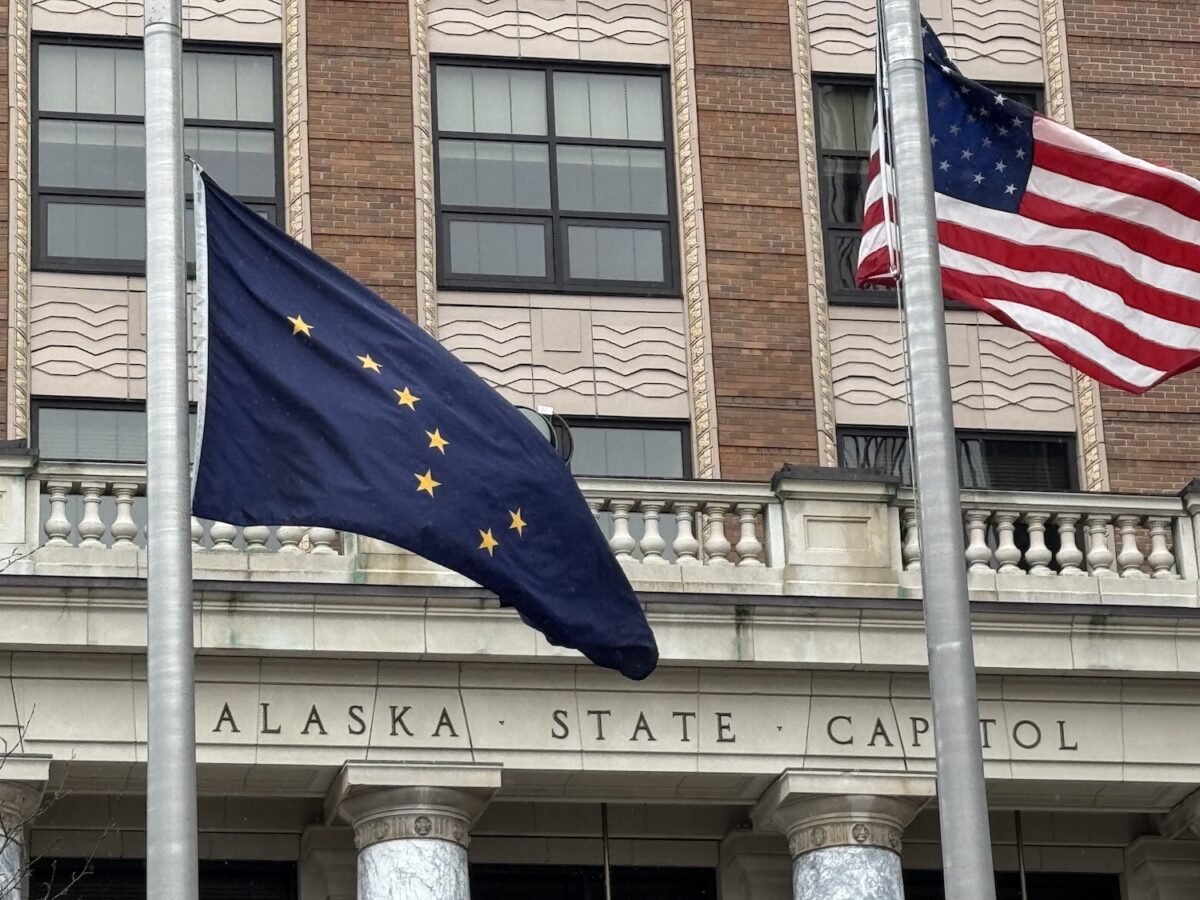
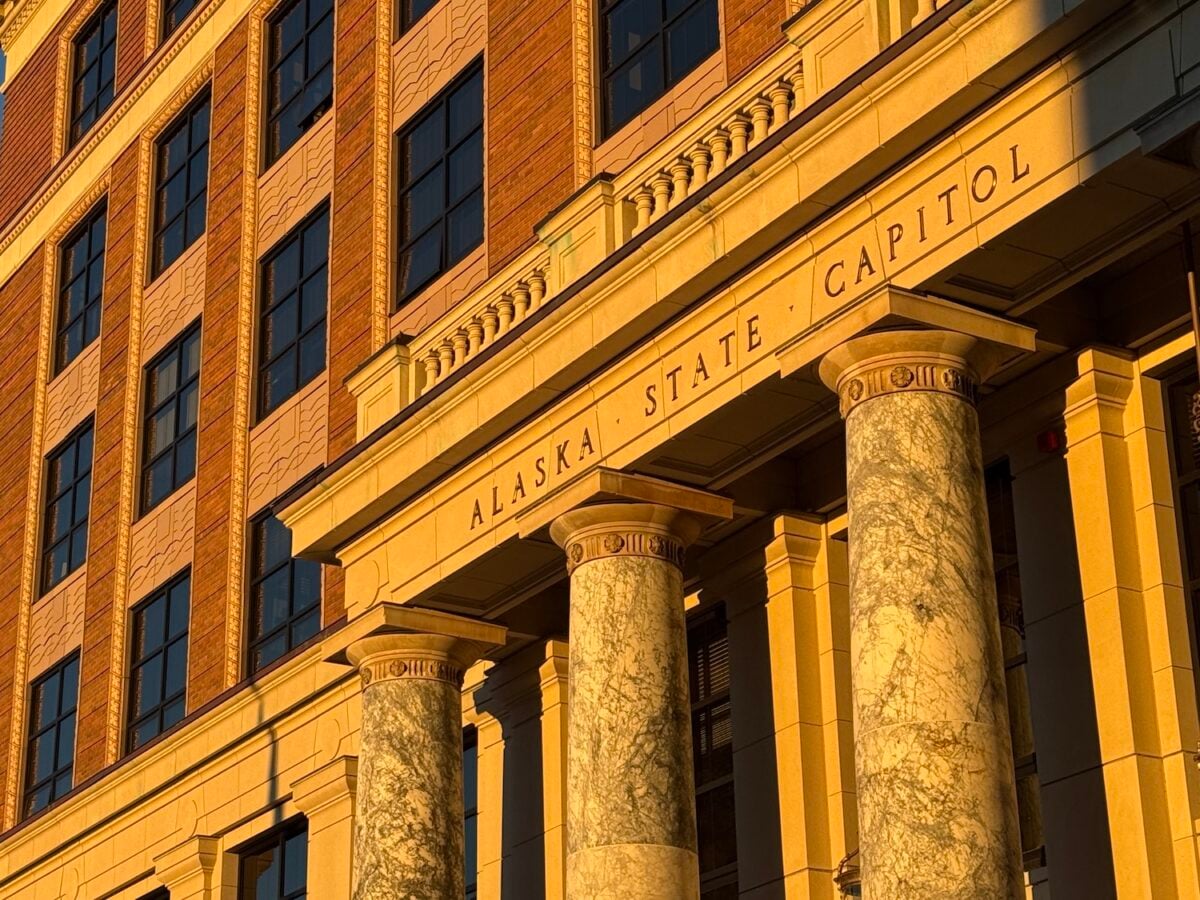
The Alaska and American flags fly in front of the Alaska State Capitol on Tuesday, April 22, 2025. (Photo by James Brooks/Alaska Beacon)
Corinne Smith, Alaska Beacon
The Alaska and American flags fly in front of the Alaska State Capitol on Tuesday, April 22, 2025. (Photo by James Brooks/Alaska Beacon)
The Alaska House of Representatives voted to approve a revised bill to reinstate a pension system for all Alaska public sector employees, following passage by the Senate on Tuesday. The bill now heads to Gov. Mike Dunleavy’s desk for consideration.
With just 21 days to go in the second year of the 34th Legislature, the governor has 15 days, excluding Sundays, to approve or veto the bill, or allow it to become law without his signature.
A spokesperson with Dunleavy’s office declined to comment on the governor’s position on lawmakers’ pension plan on Wednesday.
If enacted, the bill would revive the state’s defined benefit retirement system that was eliminated in 2006, a top priority of both the multipartisan Senate Majority and House Majority caucuses.
The proposed defined benefit system would be open to all state employees, including teachers, public safety workers and public employees of cities and boroughs statewide. Those municipal employers have six months to decide whether to participate in the program or opt out beginning in January, and the new program would be launched in July 2027.
Within the new plan, retirement for teachers and public employees would be possible at age 60 or any age after 30 years of service. For public safety officers, including police and firefighters, it would be age 50 with 25 years of service, or age 55 with 20 years of service.
The House narrowly passed the bill along caucus lines by a vote of 21 to 19 on Wednesday. The Senate passed the bill with significant revisions the day before, by a vote of 12 to 8.
Sen. Cathy Giessel, R-Anchorage, a longtime proponent of reviving the plan, said it took two decades of work in the Legislature and praised the House vote at a news conference on Wednesday.
Sen. Cathy Giessel, R-Anchorage, smiles at the news that the House concurred with the Senate’s bill and approved a new state pension plan at a news conference on Apr. 29, 2026. (Photo by Corinne Smith/Alaska Beacon)
“We are pleased that it was successful. And it was designed to be a modest, and yet secure, pension for retirement. And it had some amendments made on the floor that kind of made it a little bit more moderated. Choice was put in for employers, which is a big deal,” she said.
But she pointed out that the governor has yet to weigh in: “We still have one more stop, though. We have the big red pen potentially. So we’ll see what happens.”
House Majority Leader Rep. Chuck Kopp, R-Anchorage, carried House Bill 78, and told the Anchorage Daily News that he’s discussed the proposed plan with Dunleavy and members of his staff and is “encouraged” by those conversations.
House Majority Leader Rep. Chuck Kopp, R-Anchorage, speaks in support of a state pension plan on Apr. 29, 2026. (Photo by Corinne Smith/Alaska Beacon)
Kopp, speaking on the House floor Wednesday, said the new plan is entirely separate from the old plan, and has been revised with safeguards to prevent future unfunded liabilities.
“Do we want to continue down this path, with high turnover, constant vacancies and a growing strain on public services?” he added. “Or do we want to move forward with the plan that’s been vetted, improved and supported by both chambers, a plan that’s involved a lot of collaboration and compromise, and a plan that reflects Alaska’s long term interests.”
State lawmakers voted to axe the state’s defined benefit contribution plan in 2006, after the system accrued a multi-billion dollar shortfall that was misreported by a state actuary. Alaska sued the actuary, Mercer, for $1.8 billion in damages for miscalculating liabilities and settled in 2010 for $500 million. But, opponents of the bill noted, the state still owes billions of dollars on the old system and is on track to pay it off in 2039.
Proponents of the bill say the new pension system is structured differently to avoid repeating the same mistakes — it includes mechanisms to adjust contributions up and down, safeguards in the form of three actuaries checking each other’s work and no healthcare insurance benefits — to prevent the pension system from going underfunded.
Health insurance benefits, a major driver of ballooning costs of the old pension system, isn’t included in the new proposal. Under the new plan, employers would pay into a health reimbursement fund of up to 3% of teachers salaries and 4% of public sector workers’ salaries to supplement Medicare for those over age 65.
On Wednesday, members of the all-Republican House minority put up a potential technical hurdle by voting against the effective date clause of the bill, which needed a two-thirds majority vote to pass. That sets up a potential conflict between the effective date written in the bill and the Alaska Constitution, which says that the bill would be enacted within 90 days after the governor’s signature without a two-thirds majority vote to do otherwise.
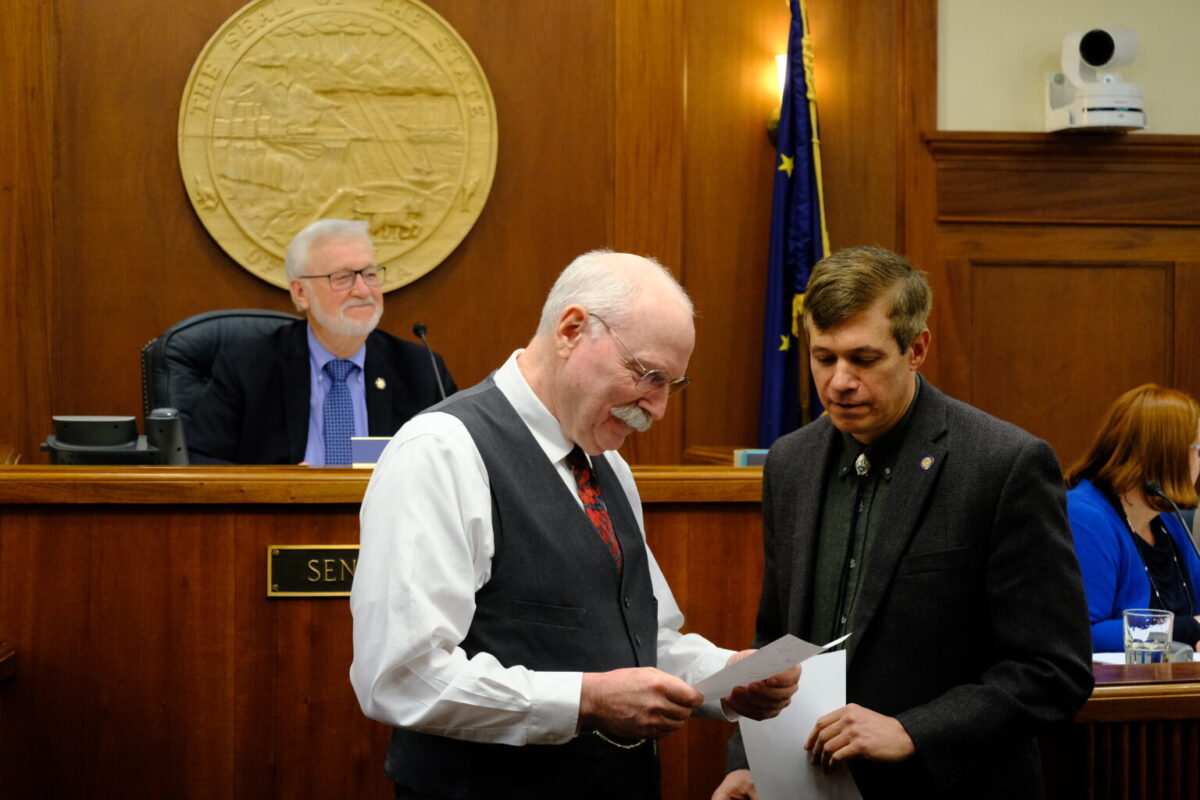
Sens. Bert Stedman, R-Sitka, Bill Wielechowski, D-Anchorage, discuss a proposed pension bill, with Sen. President Gary Stevens, R-Kodiak, seen in the background on Apr. 28, 2026. (Photo by Corinne Smith/Alaska Beacon)
Members of the Alaska Senate voted to approve a long-awaited pension bill on Tuesday, amid debate on the cost of the new public retirement benefits system and responsibilities of the state and local community employers.
The Senate passed a revised version of a pension plan approved by the House last year. The vote was 12 to 8. Twenty years after lawmakers eliminated a public pension system, the vote marks the closest lawmakers have come to restoring a defined retirement benefit for thousands of Alaska’s public sector employees.
Sen. Cathy Giessel, R-Anchorage, speaks about Senate Bill 88, the Senate majority’s public employee pension proposal, on Wednesday, March 1, 2023. (Photo by James Brooks/Alaska Beacon)
“It strikes me as a historic day,” said Sen. Cathy Giessel, R-Anchorage, after the vote. She has been working on the issue for several years. “When you figure 33 different offerings to correct this over the years — yeah, we’ve been trying for a long time.”
If enacted, the bill would reinstate a defined benefit retirement system for Alaska state employees, as well as teachers, public safety workers and municipal employees statewide.
Supporters said the retirement benefit is crucial for hiring and retaining a skilled public sector workforce in Alaska for the long-term, while detractors say the uncertainty around the cost to the state and local municipalities isn’t worth the risk.
Sen. Mike Cronk, R-Tok, is seen at a Senate Finance Committee meeting on Apr. 24, 2026. (Photo by Corinne Smith/Alaska Beacon)
Senate Minority Leader Sen. Mike Cronk, R-Tok, said he opposes increasing state spending.
“We look at our federal government, we’re going to be $40 trillion upside down. That’s totally unacceptable,” he added. “And for adding this kind of burden for the future, generated cost is something that I just can’t be a part of. I know we have a problem. I think there are other solutions out there that can help this problem.”
The move was applauded by the state’s largest public employees union, the Alaska State Employees Association, which represents roughly 8,500 public employees.
“The impact is almost difficult to overstate,” said Heidi Drygas, its executive director, by phone on Tuesday. “Our membership overwhelmingly supports a defined benefit pension. And I think this will mean security for them, so that they can feel comfortable staying in their state jobs. It will attract more employees to work for the state.”
The bill passed the House last May, and the revised version now goes back to the House for a concurrence vote, before heading to Gov. Dunleavy’s desk for consideration.
The governor has been critical of previous pension proposals. Dunleavy receives a state pension for his previous employment as an educator and superintendent.
If the bill becomes law, current state employees would be allowed to switch from a defined contribution or a 401(k) style retirement plan to the new system. Retirement for teachers and public employees would be possible at age 60 or any age after 30 years of service. For public safety officers, including police and firefighters, it would be age 50 with 25 years of service, or age 55 with 20 years of service.
“Every other state offers a pension for at least some of the public servants. We do not,” Giessel said on the Senate floor. “And we are seeing the results. We ask our public employees to do difficult work, often in the hardest conditions. The question is whether we will give them a reason to build a career here.”
After several hours of debate, the Senate approved several amendments, including a change to allow cities and boroughs to choose whether to opt out of the new defined benefit retirement plan, instead of opt in.
“It’s better policy for local governments to follow the state’s lead,” said Sen. Matt Claman, D-Anchorage, who sponsored the provision. “If they don’t like our choice, they’re certainly allowed to make their own choice and opt out, but if they don’t take any action, they’re in.”
That means local cities and boroughs can choose whether to opt out of the plan, if enacted, between January and June of 2027, and then the new system would begin July 1 next year.
Under the revised bill, employees would contribute 8% of their pay to the pension plan. Employers would pay up to 22.5% for public sector employees, and up to 12.5% for teachers. Senators debated the cap and arrived at 22.5%, noting municipality officials public testimony and concern about cost.
Employers would also pay into a health reimbursement fund of up to 4% of workers’ salaries to supplement Medicare for those over age 65. Disability and death benefits would be included.
If passed, the bill would revive Alaska’s state pension that was eliminated in 2006, after the state ran into a multi-billion dollar shortfall and unfunded liabilities in the retirement system.
Sen. Bert Stedman, R-Sitka, a co-chair of the Senate Finance Committee, opposed the bill, citing the risk that the state will repeat the mistakes of the early 2000s.
Sen. Bert Stedman, R-Sitka, speaks against a bill to revive the state’s pension system on the Senate floor on Apr. 28, 2026. (Photo by Corinne Smith/Alaska Beacon)
“This proposal in front of us today diminished the benefit to the retired employee when it goes underfunded. Yeah, it won’t go unfunded until people retire. Normally, it takes about 30 years, but we’ve got 20 years already with the current defined contribution. So about 10 years out,” he said.
A recent estimate by the state’s actuary, Gallagher, projected state costs to total $467 million for the first 13 years, until FY 2039.
Stedman said the state is also still on the hook to pay billions to account for the old pension system. But Giessel said the new pension system has built in safeguards to prevent it from going underfunded, according to the actuary’s analysis.
“Even with a never before seen ‘black swan’ event of three consecutive years with zero investment returns, even then this pension holds up,” she said.
Giessel and other lawmakers cited the state’s current ballooning costs paying state employee overtime to cover vacancies and essential public services, called “premium pay.”
“It is costing us over $200 million a year in premium pay,” she said. “Just to keep basic services running — that number has grown nearly 80% in the past five years. We have, in effect, turned Alaska into a training ground, a place where people come, gain experience and then leave.”
Sen. Bill Wielechowski, D-Anchorage, described a crisis of families leaving the state, in part due to a lack of stable retirement. Alaska has seen more than a decade of consistent outmigration, according to state data.
“There has been a quiet, heavy crisis unfolding all across Alaska, in our schools, in our state office buildings, in our courts, in our communities all across Alaska, it’s the sound of a door slamming shut. Another family packs up to leave,” Wielechowski said on the Senate floor.
“We talk a lot about fiscal responsibility in this chamber, but I ask you, what is responsible about watching our most precious resource, our people walk out the door?”
Supporters of the pension plan also pointed to the state’s struggle with high turnover rates, including up to 30% of teachers in urban and rural districts alike each year.
Sen. Löki Tobin, D-Anchorage, and chair of the Senate Education Committee, said the high unseen costs of turnover of educators is magnified throughout the state.
Sen. Löki Tobin, D-Anchorage, speaks in support of a new state pension plan on Apr. 28, 2026. (Photo by Corinne Smith/Alaska Beacon)
“Because of high teacher turnover, we’re already paying $20 to $30 million a year,” she said. “We can either continue to pay that in turnover costs, or we can fund a quality retirement program that retains our quality educators, attracts new quality educators, and ensures that our kids get the best education they deserve.”
Senators in support of the pension plan noted a recent state audit of Alaska state government that reported hundreds of millions lost in federal reimbursements or incorrectly accounted for due to a variety of factors, including “staff turnover,” “competing priorities” or “inadequate supervisory review.”
Wielechowski pointed to one example of the Alaska Department of Military and Veterans Affairs underreported disaster spending for federal reimbursement by $297 million. The error was corrected once identified by auditors, according to the report.
“Dozens of projects incorrectly reported. And that’s just that’s just a fraction of the inaccuracies and the mistakes,” Wielechowski said.
Opponents of the pension bill pointed to other factors contributing to high turnover like work environment, leadership and a need to raise salaries.
That included Cronk who said he receives a pension after teaching for 25 years. “I would say focus should be on our pay,” he said.
Drygas, with the state’s public employees union, said while the pension plan is one important part of Alaska’s workforce issues, she sees it as crucial for stemming the tide of outmigration from the state.
“I cannot tell you how many people, just personal, friends and acquaintances that I know, that are leaving state service in particular because they can’t retire here. They can’t live on the retirement that our state offers,” she said. “So I think a lot of us are hopeful that, you know, five or 10 years in the future, if this legislation should pass and become law, we’ll see a turnaround in our state workforce again.”
An invasive northern pike is shown to have its stomach stuffed with tiny juvenile salmon. Invasive northern pike are well-established on the Deshka River, where they are eating their way through the supply of salmon and other fish. As tempertures have risen, pike are eating more, a new study found. (Photo provided by the Alaska Department of Fish and Game)
Invasive northern pike have wreaked havoc in Southcentral Alaska rivers and lakes. Introduced illegally in the 1950s, they have been devouring juvenile salmon and other native species.
Now a University of Alaska Fairbanks study warns that matters could get even worse.
As temperatures rise in waterways, invasive pike eat more, said the study, published in the journal Biological Invasions. And as temperatures continue to rise, that trend will continue, the study said. Based on expected temperature trends, invasive northern pike will eat 6% to 12% more by the end of the century, the study said.
“We expect there will be significant warming in the future, and the amount of fish that pike consume is going to increase with it,” Benjamin Rich, who led the study while earning a master’s degree at UAF’s College of Fisheries and Ocean Sciences, said in a statement released by the university.
The UAF study found that over the past decade, northern pike of all age classes ate more as waters warmed. The increase was most dramatic in year-old pike, which upped their intake by about 63% over the period.
The study site was the Deshka River, a Matanuska-Susitna Borough waterway that is an important feeder to Cook Inlet and commercial fisheries there. The 44-mile river, a tributary of the Susitna River, is also a cherished destination for Southcentral Alaska sport anglers.
It is famous for its abundance of salmon — or it has been. Salmon in the Deshka is a lot less abundant now than in the past.
The decline is a decades-long problem that affects king salmon in particular. State and federal biologists have cited numerous reasons for the decline.
The presence of invasive pike is one of them; pike have eaten a lot of juvenile king salmon, also known as Chinook, and coho salmon, also known as silver salmon.
A pair of juvenile Chinook salmon emerge from the stomach of a northern pike caught on the Deshka River in Southcentral Alaska. (Photo by Benjamin Rich/U.S. Fish and Wildlife Service)
Heat stress is also among the myriad causes of declines. The Deshka is particularly vulnerable to heat. It is in a flat area and not glacier-fed, and it is known to be one of the warmest river systems in the Matanuska-Susitna Borough.
It is the subject of ongoing temperature monitoring and studies by the U.S. Fish and Wildlife Service, the conservation group Cook Inletkeeper and others.
In 2019, a record-hot year in Alaska, waters in the Deshka were particularly warm — exceeding 81 degrees Fahrenheit that July, according to readings by Cook Inletkeeper.
Warmer temperatures, along with speeding pike metabolism and spurring more food consumption, appear to be sharpening the northern pikes’ predation skills, said Erik Schoen, a UAF fisheries biologist and a study co-author.
Fish, which are cold-blooded animals, have varying physiological responses to heat, Schoen said. Compared to salmon, which get sluggish in warm temperatures, northern pike thrive and become speedier swimmers, he said.
“If it keeps getting warmer, they get much better at catching salmon,” he said. “They’re amazing ambush predators.”
Deshka pike are actually eating less salmon than they did in past years, analysis of stomach content shows. But that is not because they are turning away from salmon; rather, it is evidence of salmon declines in the river.
The abundance of adult king salmon in the Deshka dropped by 42% over the past decade. At about the same time, the biomass of juvenile salmon eaten by northern pike decreased by 30% to 74%, depending on age class.
Do not expect the pike to go away if they deplete all the salmon, warned Schoen, who grew up in Anchorage and spent a lot of time fishing in the Deshka.
Rather, they will turn to other fish, as they appear to have done in the Deshka, such as whitefish and rainbow trout. If they can’t eat fish, they eat flies, he said. Northern pike are even known to eat birds, such as eagle chicks and ducklings, small mammals like voles and shrews — and, on occasion, each other.
“Once they wipe out the salmon, the pike don’t die off because they run out of food,” Schoen said.
Two Chinook salmon, also known as king salmon, migrate up the Deshka River in this undated photo. The Matanuska-Susitna Borough river is a popular spot for sport anglers, but its salmon runs, especially its runs of Chinook salmon, have dwindled. (Photo by Katrina Liebich/U.S. Fish and Wildlife Service)
Northern pike are native to the Interior and northern parts of Alaska, but they are not part of the natural ecosystem south of the Alaska Range. The first introduction was about seven decades ago, prior to statehood, and traced to the Bulchitna Lake, which is part of the Susitna River drainage. Through the following years, flooding and reproduction spread the fish to new places. And they have proved persistent, showing up not just around the Matanuska-Susitna Borough but also in Anchorage and, to biologists’ dismay, on the Kenai Peninsula.
As entrenched as the pike infestation is in the Matanuska-Susitna Borough, the salmon picture there is not beyond hope, Schoen said.
Pike prefer areas with slow-moving waters and lots of plants. That means areas with swift-flowing waters and gravelly banks are much less likely to be invaded by pike, and there are several such pike-resistant spots in the borough.
Even though it can’t get rid of all the pike, the Alaska Department of Fish and Game has had some success suppressing the invaders in certain important Matanuska-Susitna spots, Schoen said.
One is Alexander Creek, a 40-mile waterway that was one of the most important Northern Cook Inlet freshwater sites for king and silver salmon.
A multiyear program launched by the department resulted in removal of more than 25,000 Northern pike from Alexander Creek by 2021, according to a department report. Salmon numbers have improved. But pike remain a persistent problem, and suppression should continue, the report concluded.
Through its activities as part of the Alaska Invasive Species Partnership, a multiagency organization, the department is pursuing a long-term plan to control northern pike.
NOTN- The City and Borough of Juneau Assembly will hold a public hearing tomorrow on its proposed fiscal year 2027 budget, including property taxes, school funding, a multi-year capital improvement plan, Eaglecrest and the Gondola Project.
The special Assembly meeting is scheduled for 5:30 p.m. and it will be followed by the Assembly Finance Committee. Residents may testify in person or via Zoom.
At the hearing, Assembly members will take testimony on several key ordinances, including a measure setting the 2026 property tax rate to fund the FY27 budget.
According to the agenda, officials will also consider a $551.2 million operating budget for city and borough services, along with a separate $97.2 million budget for the Juneau School District.
In addition, the Assembly will review a resolution adopting the city’s capital improvement program for fiscal years 2027 through 2032, which outlines infrastructure priorities and planned project spending.
Another resolution would set aside up to $2.3 million from the city’s restricted budget reserve to cover an anticipated operating deficit at Eaglecrest Ski Area.
Separately, the Assembly is expected to introduce an ordinance to begin terminating a revenue-sharing agreement with Goldbelt Inc. tied to the proposed gondola project at Eaglecrest. City officials say the project is no longer financially feasible after cost estimates rose to more than $37 million, up from initial projections of about $10 million.
This is still up in the air, but under this agreement Juneau would be required to repay Goldbelt’s $10 million investment plus interest if the deal is terminated. Repayment would include general funds and previously allocated project money.
A school bus drives in front of the Alaska State Capitol on Monday, Feb. 3, 2025. (Photo by James Brooks/Alaska Beacon)
By: Corinne Smith, Alaska Beacon
A school bus drives in front of the Alaska State Capitol on Monday, Feb. 3, 2025. (Photo by James Brooks/Alaska Beacon)
While many school districts across Alaska are facing severe budget shortfalls, several bills to provide a sustained increase to education funding appear to have stalled in the Legislature. But a bill to add nearly $82 million one-time funding and education policy changes is moving forward with bipartisan support.
On Monday, the Senate Education Committee introduced a revised version of House Bill 28, that adds one-time funds for energy relief, transportation, reading and vocational training, to a bill that would establish a loan forgiveness program for Alaska teachers. It also includes a variety of policy changes related to home school programs and others.
Chair Sen. Löki Tobin, D-Anchorage, described it as a “mini-bus” bill on Wednesday, saying the new omnibus bill includes specific education funding to areas sought by the governor and lawmakers on both sides of the aisle.
“We heard that there is a deep concern about education reform still being left on the table, and so in those discussions we focused the new version of House Bill 28 on codifying some of the best practices that we know are going to improve education outcomes across the state,” Tobin said.
The underlying bill establishes a new three-year student loan forgiveness program to incentivize teachers to stay in Alaska. It’s focused on teachers specializing in special education, English as a second language, science, technology, engineering and math. It would provide up to $15,000 to pay off student loans for those who go out of state and return to work in Alaska. The House passed the bill last May.
“We need to incentivize teachers to stay here,” said Rep. Andi Story, D-Juneau, who sponsored the bill. “We’ve had such tremendous turnover, and we’ve got this tremendous shortage. And so I think the bill will help.”
The bill moved to the Senate this year, and education committee members tagged on a variety of items on Apr. 21. According to data provided by Tobin’s office, it contains an additional $21.8 million for reading proficiency grants, $9.7 million for career and technical education, $7.3 million for transportation, and $43 million to offset rising energy costs for school districts.
“We do not want to divert operating costs, dollars that should be in the classroom, to just keeping the lights on and buildings warm,” Tobin said.
Meanwhile many Alaska school districts are in the midst of budget negotiations and grappling with cuts to staff and programs to address large budget shortfalls.
Tobin said at a Senate Majority caucus news conference on Wednesday the goal of the education policy bill is to garner enough support on both sides of the aisle to be able to override a potential veto by the governor.
“It is obviously the hope for all of us that we will continue to increase stable and predictable funding for our schools and ensure that they have the resources they need,” she said. “However, at the end of the day, our goal is to get dollars into the classroom and to get support into our schools, and I will work diligently to do that with the number of people that I can guarantee will be there to get that bill across the finish line.”
Gov. Mike Dunleavy has been a staunch opponent of increasing funding for schools, saying that education policy changes are needed to improve student outcomes. Last year, he issued three vetoes of additional funding for K-12 schools sustained through the state’s funding formula, the base student allocation, and the last was narrowly overridden by the Legislature last summer.
This year, legislators introduced bills to again provide a sustained increase per student funding statewide. Rep. Rebecca Himschoot, I-Sitka, introduced a bill to add $158 million to boost the per student formula, but so far it hasn’t moved out of the House Education Committee.
Earlier in the session, Tobin introduced a bill that would add nearly $100 million in education funding. A portion of that money would go to per student funding through the BSA, and additional reading proficiency grants and transportation funding. But her bill proposed policy changes to enact reporting and testing requirements for homeschool programs that drew public criticism from homeschool proponents, so the Senate Education Committee stripped the provision and held the bill.
The new draft Senate bill also institutes more reporting requirements from school districts to the state on their homeschool programs, including how many students are enrolled by grade, where they live across the state and how their annual allotment is spent, among others.
The draft bill would commission a state audit to evaluate Alaska’s funding for schools, and make recommendations for changes or for alternative methods of education funding. There is no cost estimate yet for the study, or the entire bill.
Tobin said the funding adequacy study is a top priority of the joint Task Force on Education Funding. “We know that our foundation formula needs some reform, and it also needs some additional attention on particular components that have changed significantly in the last few years, the pandemic really showcased that,” she said.
Story said she supports the changes to the bill. “There’s some really good things that got put in there,” she said. “It’s the end of the session, lots of things are happening, so we’ll just see. But I’m hoping good things happen for teachers and families and for our kids to get more attention next year.”
The draft “mini-bus” bill was approved by the Senate Education Committee and now moves to the Senate Finance Committee for consideration.
Meanwhile, senators are debating the draft operating budget for next year that includes up to $100 million in additional funding for schools, but only if oil prices remain high. The House passed a draft operating budget with nearly $158 million in one-time funding for K-12 schools earlier this month.
A select group of lawmakers from both chambers will negotiate and reconcile a compromise between the two budget bills — and a final allocation for Alaska schools next year — in a conference committee in the last days of the legislative session, by May 20.
Two spawning pink salmon head upstream in shallow water in Cove Creek in Whittier on Aug. 5, 2024. Pink salmon have two-year life cycles, the shortest of all of Alaska’s five salmon species, and in recent years big pink salmon runs have alternated with smaller runs. A smaller run is expected this year, leading to a forecast of a smaller statewide commercial salmon harvest compared to last year’s total harvest of over 197 million fish. (Photo by Yereth Rosen/Alaska Beacon)
Alaska’s statewide commercial salmon harvest this year is expected to total 125.5 million fish, less than two thirds of the total landed by commercial harvesters in 2025, according to the annual forecast released last week by state biologists.
The anticipated 2026 total, detailed in Alaska Department of Fish and Game 2026 forecast and 2025 review, is lower than annual statewide harvests in all but four years since 2000, according to department records.
The lowered expectations for the statewide salmon harvest are driven mostly by anticipated declines in runs of pink salmon, also known as humpback salmon, according to the forecast.
Pink salmon are the most plentiful, smallest and cheapest of Alaska’s five salmon species. They have two-year life cycles, the shortest of all of Alaska’s salmon species. Although there are regional variations, the general pattern for the recent past is alternating big-run and smaller-run years, with 2025 as one of the big-run years.
The year-to-year difference has been significant, said Forrest Bowers, who heads the department’s commercial fishing division.
“We have been seeing a pronounced even-odd year difference in pink salmon returns, with much larger returns in odd-numbered years,” Bowers said by email.
In all, about 197.4 million salmon were harvested commercially last year, 120 million of which were pink salmon, the forecast said. This year, about 60 million pink salmon are expected to be harvested commercially, according to the forecast.
For Alaska’s other four salmon species, the forecast is for a lower total catches as well, with a combined reduction of 11% below the 2025 non-pink salmon total harvest, Bowers siad..
That is not considered a precise prediction. There are estimate ranges for different species and locations, which put the anticipated 2026 harvest in the general ballpark of last year’s harvest, except for pink salmon.
Alaska commercial salmon harvest totals from 1975 to 2024 are shown on a graph. In recent years, totals have fluctuated widely from year to year, reflecting the pattern in pink salmon returns. The 2025 total, not shown on the graph, was over 197 million fish, putting it among the top years in the past five decades for salmon numbers. (Graph provided by the Alaska Department of Fish and Game)
“When we consider forecast uncertainty and the distribution of harvests across the state, the forecast for non-pink salmon is fairly similar to the 2025 actual harvest,” Bowers said.
Sockeye salmon, also known as red salmon, is the second-most plentiful of Alaska’s five species, and the statewide harvest is dominated by Southwestern Alaska’s Bristol Bay, site of the world’s largest sockeye salmon runs.
That status will continue this year, according to the forest. Bristol Bay’s estimated 2026 harvest for this year is 33.5 million fish, a little over the average over the last 20 years — but smaller than in some recent years, when harvests in that region hit or approached records. Last year’s Bristol Bay sockeye harvest was about 41.2 million fish, a little more than three quarters of the statewide sockeye harvest.
This year, the statewide sockeye salmon harvest is forecasted to total 49.7 million fish, of which about two thirds are expected to come from Bristol Bay.
The forecasted chum salmon commercial harvest this year is 17.2 million fish, compared to 21.7 million last year. This year’s forecasted harvest of coho salmon, also known as silver salmon, is 2.4 million fish, compared to 2.7 million harvested last year. This year’s forecasted harvest of Chinook salmon, also known as king salmon, is 197,000 fish, compared to last year’s total harvest of 201,000 fish.
The department’s forecast details regional differences along with species differences.
In the Yukon and Kuskokwim river systems, salmon runs are expected to continue to be weak, as they have been for the past several years, according to the forecast. There is no commercial fishing anticipated on either of those river systems. The only commercial fishing in the Arctic-Yukon-Kuskokwim region is expected to be in Norton Sound and in the Kotzebue area, as was the case last year and in other recent years.
The newly released forecast is for commercial harvesting alone. It does not include subsistence or sports harvests. Reports detailing last year’s subsistence harvests are expected to be released in the future, the forecast said.
Pink salmon are seen in an undated photo. Male pink salmon develop humps on their backs, and the fish are also known as humpback salmon or “humpies.”(Photo provided by the National Oceanic and Atrmospheric Administration Fisheries Service)
Hacker using laptop. Lots of digits on the computer screen.
By: Haley Lehman, Alaska Beacon
Hacker using laptop. Lots of digits on the computer screen.
The Federal Bureau of Investigation released a report Thursday that showed Alaskans lost nearly $40 million in cyber crime in 2025.
Special Agent in Charge Matthew Schlegel of the FBI Anchorage Field Office said it is the highest financial loss ever reported in Alaska for such crimes.
“Behind these numbers are real people – Alaskan families who lost hard-earned savings, retirement funds, and financial security,” he said in a news release.
Americans lost nearly $21 billion in cyber crimes in 2025, according to the FBI Internet Crime Report issued by the Internet Crime Complaint Center.
This chart outlines IC3 loss trends over a 10-year period for Alaska, with reported losses exceeding $158 million. (FBI graph)
Alaskans reported the 2025 losses in 3,202 complaints to the Internet Crime Complaint Center, making it the highest financial losses ever reported in Alaska in one year. Losses went up by $13.6 million since 2024.
The FBI encouraged people to identify red flags of a potential scam to protect themselves from cyber threats and crime.
“To combat this ever-evolving threat, it has never been more important for residents and businesses to be diligent with cybersecurity, electronic interactions, and safeguarding personal and financial information,” Schlegel said.
The greatest losses in Alaska were from investments-related fraud, confidence or romance fraud, compromised business emails and tech support scans. Approximately 482 Alaskans lost more than $18 million to cryptocurrency crimes.
According to the report, 20% of Alaskans who reported losses from internet crimes were 60-years-old and older who lost $16.2 million.
President Donald Trump issued an executive order on March 6 directing officials to develop a plan to prevent, disrupt, investigate and dismantle Transnational Criminal Organizations in order to stop cyber-enabled criminal activity.
“Cybercrime, fraud, and predatory schemes are draining American families of their life savings, stealing the benefits of years of work, and destroying the lives of our youth,” Trump wrote in the order.
An Alaska State Trooper's shoulder patch is seen on Thursday, Jan. 25, 2024. (Photo by James Brooks/Alaska Beacon)
Corinne Smith, Alaska Beacon
An Alaska State Trooper’s shoulder patch is seen on Thursday, Jan. 25, 2024. (Photo by James Brooks/Alaska Beacon)
Members of the Senate Judiciary committee put questions to a governor’s nominee for the Alaska Police Standards Council about her social media posts during a confirmation hearing Wednesday.
Veronica Lambertsen defended conspiracy theories around the Holocaust, blood-harvesting from children and the Jan. 6 insurrection at the U.S. Capitol.
Lambertsen has been nominated by Gov. Mike Dunleavy to serve a three-year term representing one of four public seats on the 13-member Alaska Police Standards Council, which oversees law enforcement standards across the state.
Lambertsen has served on the council since being nominated in August, but her name was removed from the council’s website Thursday afternoon, following the hearing and media coverage of the posts.
Dunleavy’s office did not respond to a request for comment about her nomination, her social media posts and the removal of her name from the website on Thursday.
Lambertsen is the owner and operator of a motel in Birch Creek, a small neighborhood in Turnagain Arm that is part of the municipality of Anchorage. She also serves as a voluntary member of the local Turnagain Arm Community Council, according to her resume.
Lawmakers in the House expressed skepticism in a hearing earlier this month and questioned Lambertsen’s experience, connections with law enforcement and eligibility for the seat.
Sens. Matt Claman, D-Anchorage, and Löki Tobin, D-Achorage, are seen in a Senate Judiciary Committee hearing on Apr. 20, 2026. (Photo by Corinne Smith/Alaska Beacon)
In a second confirmation hearing on Wednesday, following questions about her background, chair Sen. Matt Claman, D-Anchorage, asked about several social media posts going back many years.
“One of the postings that I saw was a posting that you didn’t believe the Holocaust was real,” Claman said. “Do you believe the Holocaust occurred during World War II?”
Lambertsen said it was a tragedy, but that she has questions. “Do I believe something happened at the Holocaust, and a tragedy and a lot of people died?” she said. “Yes, I believe that actually happened. Are we being told the true story about it all? No, I don’t believe we’re being told the true story about it all.”
“What do you believe is the true story?” Claman asked.
“That I don’t know yet,” she replied.
The Alaska Police Standards Council is charged with setting and enforcing standards for law enforcement, including police, probation, parole and correctional officers. They’re also tasked with reviewing regulation and investigating misconduct, like officer discipline and use of force.
A zip drive of selected posts from Lambertsen’s public Facebook page compiled by legislative staff and reviewed by the Alaska Beacon includes posts going back to 2021 related to a variety of conspiracy theories — questioning the shape of the Earth, the moon landing, the 2020 election results and the Jan. 6 insurrection, as well as posts related to the far-right internet conspiracy theory movement QAnon.
Claman asked about a QAnon claim that children are being harvested for a chemical called adrenochrome from their blood.
After a long pause, Lambertsen responded similarly that she had questions. “From information I have seen and documentation that was provided the question that should be asked,” she said.
Claman said in an interview Thursday that he found the hearing troubling. “For this position, which really means you’re providing some degree of supervision and regulation of our public safety officers, I just have a lot of concerns, given her perspective,” he said.
Lambertsen did not respond to a request for comment on Thursday. She told the Juneau Independent that what she posts on social media is separate from what’s involved in serving on the council.
Sen. Löki Tobin, D-Anchorage, raised the issue that Lambertsen may not be eligible to serve on a seat reserved for a member of the public from a rural district. Two of the four public seats are reserved for members representing communities with a population of 2,500 people or less.
“I think this is unfortunately a situation of where Ms. Lambertsen has been put into a seat that she is not qualified to hold based on statute and practice,” she said. “I would encourage Ms. Lambertsen to consider withdrawing her own name, as she is, in my estimation and read of the statute, not legal to sit in the seat.”
The Senate Judiciary Committee forwarded Lambertsen’s nomination on Wednesday to a vote by a joint session of the Legislature. But whether she will be considered is uncertain, as her name is no longer listed on the state website describing the council.
A joint session for state appointments to boards and commissions, including for Attorney General Stephen Cox, is scheduled for May 7.
The Alaska State Capitol is illuminated by the rising sun on the morning of Friday, Jan. 23, 2026. (James Brooks photo/Alaska Beacon)
By: Corinne Smith, Alaska Beacon
The Alaska State Capitol is illuminated by the rising sun on the morning of Friday, Jan. 23, 2026. (James Brooks photo/Alaska Beacon)
The Senate Finance Committee on Wednesday proposed an operating budget for the next fiscal year, with a $1,000 Alaska Permanent Fund dividend plus $150 energy relief payment per eligible Alaskan.
The committee’s draft budget takes a more conservative approach to uncertainty around the state’s revenue forecast for next year — driven by rising oil prices due to the Iran war – than the proposed budget passed by the Alaska House passed earlier this month, and eliminates the deficit.
State forecasters have projected a $500 million boost in state revenues, and senators have expressed caution around state spending and a willingness to focus funds to tackle aging infrastructure and deferred maintenance, particularly upgrading school facilities.
“The most fundamental thing we have to remember is that the state doesn’t have the resources to do all the things we need to do and that Alaskans need us to do,” said Sen. Jesse Kiehl, D-Juneau, a member of the finance committee on Thursday. He said the greatest challenge for the Legislature is prioritizing.
“And so I think we did that effectively,” Kiehl said. “I think it makes a few really crucial, really targeted investments.”
The Senate’s draft budget removed the House’s proposed $158 million one-time education funding boost, and instead appropriates up to $100 million for K-12 schools subject to oil revenues averaging $95 per barrel for the rest of this fiscal year ending on June 30.
Alaska has no personal income or state sales tax, and so roughly 60% of state funds for the general purpose budget comes from the Alaska Permanent Fund, the state’s sovereign wealth fund currently valued at $86.3 billion, and roughly 30% comes from state oil revenues.
The draft Senate operating budget is based on an average of $73 per barrel for the next fiscal year starting in July, whereas the House draft budget is based on an average $75 per barrel projection.
The draft budget contains some changes to the House version and additions across departments. It would double funding for disaster relief to $48 million, and increase fire suppression funding from $47.5 million to nearly $61 million. It funds an additional $29 million for school districts and $20 million for communities to offset rising fuel and energy costs; $30 million for community assistance programs; $5.3 million toward a renewable energy fund; $3.5 million for the Alaska Marine Highway system’s ferry maintenance and staff salary increases. It also boosts funds for public employees retirement from $75 million to $106 million, and increases funds for teachers’ retirement system from $157 million to $164 million, among others.
The budget also contains $650,000 for a state audit of the Alaska Department of Corrections to evaluate cost drivers, as the department’s budget has ballooned in recent years.
Kiehl said while he’d like to see more investment in services like in the state’s foster care system, homelessness programs, energy and schools, he said the state can’t bank on unknown revenues.
“We have to be careful not to treat a temporary boost in the price of oil, which will probably last more than a year as though it were permanent, increase. That’s not responsible,” he said.
Senate Minority Leader Sen. Mike Cronk, R-Tok and a member of the finance committee, said he’d like to see a more conservative budget, but he also wants to avoid a large supplemental budget as seen this year. He said he supports the budget based on an average $73 per barrel estimate.
“I’m pretty comfortable with that number. I just don’t want to be back in that same position as we have this year, where we are $500 million upside down for supplemental,” he said.
Cronk said he supports targeted funding for renewable energy projects, education and deferred maintenance for schools, rather than expanding state department budgets. “I just think we should focus on making sure we have a fiscally responsible budget all around and not adding money to programs that continue in future budgets.”
The budget also includes a number of supplemental items, or costs incurred this year outside the budget. Those include $5.2 million for Alaska Pioneer Homes, $1.25 million for Village Public Safety Officer operations, $1.5 million for the Department of Law’s criminal division, $543,000 for court settlements and $4 million to defend a lawsuit challenging the state’s health care system for inmates in the corrections system.
Cronk said while he would like to see a maximum Permanent Fund dividend, it’s not possible within the state’s current financial picture.
“The whole PFD issue is very controversial, no matter which way we go on it,” he said. “We should be paying a full PFD, but the budget, the numbers, don’t allow that right now.”
The Senate’s draft budget overall cuts nearly $450 million from the operating budget, compared to the House draft version. However, the Senate’s proposal leaves $50 million of headroom for additional expenses next year, but that’s after accounting for a $360 million capital budget for state infrastructure projects. The Senate passed a nearly $250 million capital budget on Tuesday, which is now being debated in the House where likely additional projects will be added.
The proposed budget, unveiled as amendments to House Bill 263 will continue to be debated in the Senate Finance Committee and further amendments are due by Friday, before going before the full Senate for a vote.
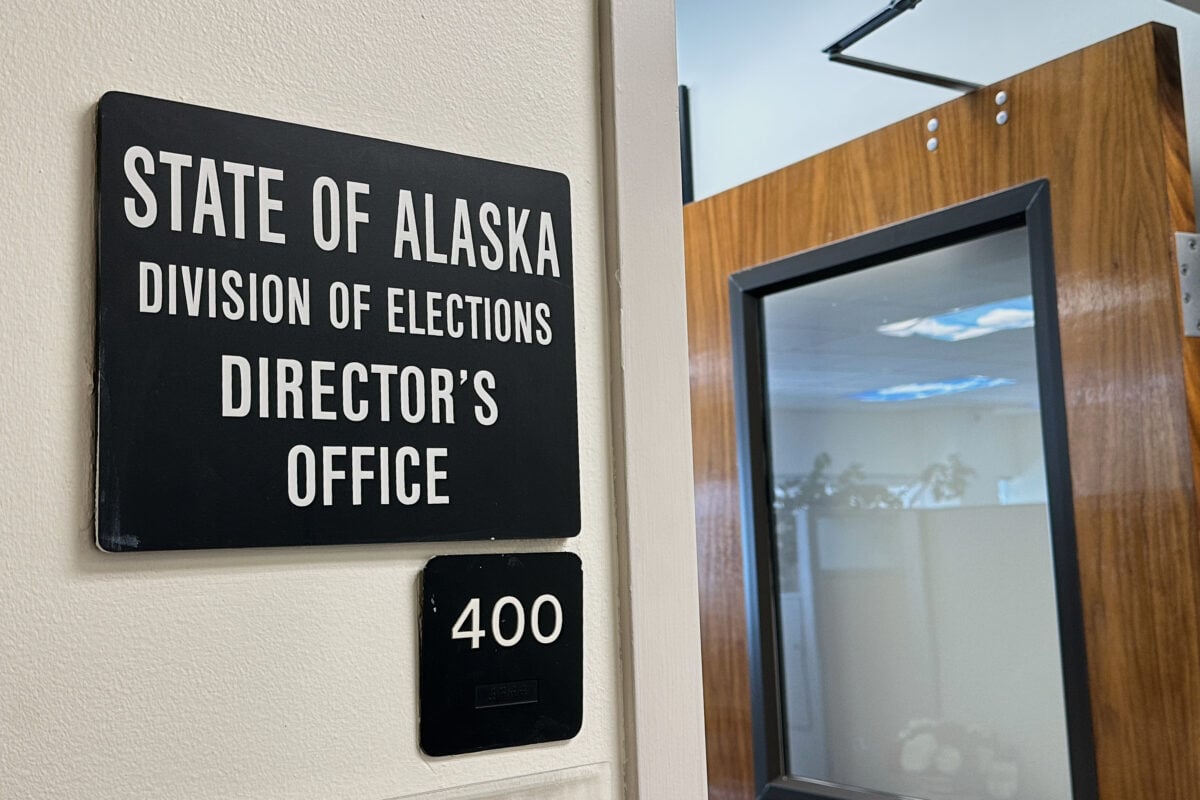
FILE - A sign hangs outside the director's office of the Alaska Division of Elections, March 19. 2026, in Juneau, Alaska. (AP Photo/Becky Bohrer, File)
FILE – A sign hangs outside the director’s office of the Alaska Division of Elections, March 19. 2026, in Juneau, Alaska. (AP Photo/Becky Bohrer, File)
AP-Voting and civil rights groups sued Alaska elections officials Wednesday, alleging that their sharing of the state’s full voter registration list with the U.S. Department of Justice violates the state constitution.
Alaska is one of at least 12 states that has provided or said it would provide detailed information about its voters — including date of birth, driver’s license number or partial Social Security number — to the Trump administration, according to the Brennan Center. Alaska and Texas also signed agreements when they shared data in which the department outlined plans for its own analysis of voter files, its plans to flag voter list issues and directions for removing voters deemed ineligible.
Several other states provided the data, but refused those agreements, as part of a wide-ranging effort by the Justice Department to obtain detailed voter data from every state. Some elections officials have expressed concern the information being sought could be used by the Trump administration to search for possible noncitizens.
The Alaska lawsuit was filed in state court against state Division of Elections officials by the League of Women Voters of Alaska and Alaska Black Caucus. It alleges the handing over of personal data on the voter list violates the right to privacy under the state constitution. It also says the memorandum of understanding violates due process by allowing the Justice Department to flag voters for removal “without any apparent notice or process for impacted voters to challenge those decisions.”
The lawsuit names as defendants Republican Lt. Gov. Nancy Dahlstrom, who oversees the division, and division Director Carol Beecher.
Sam Curtis, a spokesperson with the state Department of Law, said by email that it would be premature to comment on specific claims raised in the lawsuit. But Curtis said the department has previously explained in public hearings that state law “expressly permits the sharing of this information for authorized governmental purposes. That statute is on the books, and we will defend it.”
“Alaska statutes contain numerous provisions that allow the sharing of otherwise non-public or confidential information with law enforcement,” Curtis said.
The plaintiffs are represented by the American Civil Liberties Union of Alaska, ACLU Voting Rights Project and the Electronic Privacy Information Center.
The Justice Department has sued at least 30 states and the District of Columbia to try to force the release of the data, according to a tally by the Brennan Center. Judges have rejected those efforts in California, Massachusetts, Michigan, Oregon and most recently, Rhode Island. A judge in Georgia dismissed a Justice Department lawsuit after ruling it had been filed in the wrong city. It was subsequently refiled.
In the Rhode Island case, Justice Department attorneys acknowledged the department was seeking unredacted voter information so it could be shared with the Department of Homeland Security to check citizenship status.
In addition to the state court lawsuit in Alaska, at least four federal lawsuits have been filed around the U.S. seeking to stop the Justice Department from collecting information from unredacted voter registration files or to prevent states from taking steps to cancel or suspend people’s voter registrations based on the federal project.
During a legislative hearing in Alaska last month, Rachel Witty, an attorney with the state Department of Law, told lawmakers the state had a “compelling interest” to comply with the federal request.
“To ensure the integrity of elections, there was a mutual interest in maintaining voters rolls that were accurate and current,” she said.
The Alaska lawsuit describes the process under state law for maintaining voter rolls and states that there are only limited circumstances under which a voter’s registration can be promptly canceled — “upon death or conviction of a felony involving moral turpitude.” It says that while elections officials have said they will only remove voters “to the extent allowed by state and federal law,” that interpretation is “irreconcilable with the plain language” of the agreement signed with the Justice Department.
The plaintiffs are asking a judge to void the agreement and require the elections division to make “reasonable efforts” to ensure the immediate destruction by the Justice Department of any hard copies and electronic versions of the list that was shared.
“Rather than fiercely defending the rights of Alaska’s voters, our Division of Elections acceded to federal overreach,” Eric Glatt, legal director for the ACLU of Alaska, said in a statement. “Now, we are asking the court to step in and ensure that DOE upholds its constitutional and legal obligations to Alaskans.”