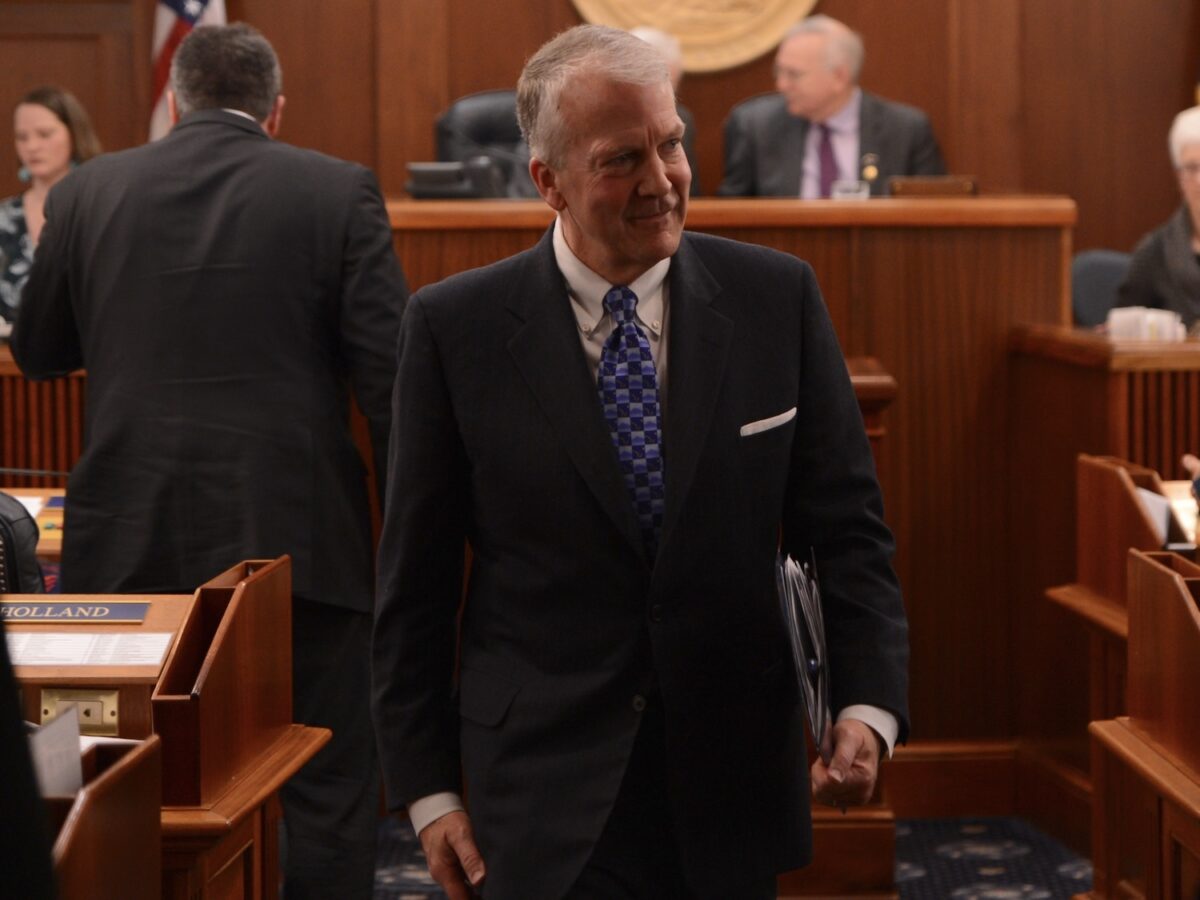
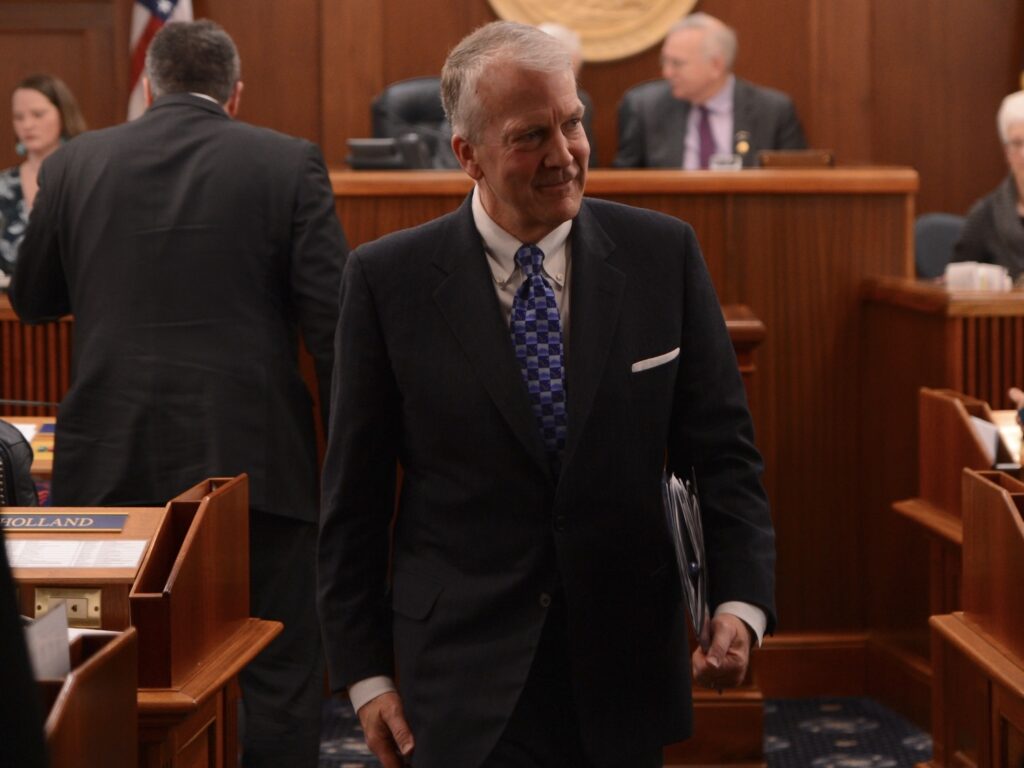
U.S. Sen. Dan Sullivan, R-Alaska, leaves the Alaska Legislature on Wednesday, Feb. 18, 2026, after his annual address to state legislators. (James Brooks photo/Alaska Beacon)
By: James Brooks, Alaska Beacon
U.S. Sen. Dan Sullivan, R-Alaska, leaves the Alaska Legislature on Wednesday, Feb. 18, 2026, after his annual address to state legislators. (James Brooks photo/Alaska Beacon)
Facing a potentially difficult re-election campaign, U.S. Sen. Dan Sullivan came to the Alaska Legislature with praise for President Donald Trump’s administration and damnation for Democrats.
The Republican senator endured a gauntlet of protesters before he delivered his annual address to state lawmakers, saying his theme was an “Alaska comeback” brought about by the change between the Democratic presidency of Joe Biden and Trump’s Republican administration.
“We’re now beginning to see the beginnings of a real comeback and real progress on goals we’ve dreamed about collectively for decades,” he said, referring to the way the Trump administration has opened more parts of the North Slope to oil and gas drilling, and its stated support for a trans-Alaska natural gas pipeline.
Sen. Lyman Hoffman, D-Bethel, leads U.S. Sen. Dan Sullivan, R-Alaska, through a group of protesters in the Alaska Capitol on Wednesday, Feb. 18, 2026. Hoffman has endorsed Sullivan in this year’s U.S. Senate elections. (James Brooks photo/Alaska Beacon)
That plan calls for multiple oil and gas lease sales in Alaska, new military and Coast Guard construction in the state, and large personal tax cuts.
It also offered large one-time health care funding grants to compensate for a cut to Medicaid, cut federal food stamps and imposed work requirements for both programs.
More Alaska-specific benefits in the Big Beautiful Bill were objected to by Senate Democrats and removed before the bill’s final passage, including a Medicaid increase that Sullivan had sought.
In his speech, Sullivan repeatedly criticized Democrats in the U.S. Senate.
“Alaskans should know who wants to help us and who wants to hurt us,” Sullivan said.
One of the legislators listening in the audience was state Sen. Forrest Dunbar, D-Anchorage.
“That was the most partisan speech I’ve ever heard a member of the congressional delegation give in the Alaska Legislature,” he said afterward.
“There was no critique of what the Trump administration has done in canceling projects in Alaska. There was no critique of what Trump has done, whether it comes to rule of law or democracy,” Dunbar said.
U.S. Sen. Dan Sullivan, R-Alaska, receives applause from the Alaska Legislature on Wednesday, Feb. 18, 2026, during his annual address to state legislators. (James Brooks photo/Alaska Beacon)
Also listening was state Sen. George Rauscher, R-Sutton. Afterward, Rauscher said he always appreciates the volume of Sullivan’s speeches and the range of subjects.
Did it feel like a campaign speech to him?
“If it felt like that, there’s probably a reason,” Rauscher said.
Until Sullivan was prompted by reporters and lawmakers, he didn’t address some of the nation’s most inflammatory issues, including the actions of Immigration and Customs Enforcement officers nationwide.
Rep. Alyse Galvin, I-Anchorage, asked Sullivan about the incident. He responded that he hadn’t heard about it.
Answering reporters’ questions after his speech, Sullivan voiced soft disagreement with ICE policies nationwide, saying he supports deporting illegal immigrants with violent criminal records.
“I think that should be the focus of the administration’s efforts,” he said.
About ICE’s violent tactics in Minnesota, Sullivan said, “I put out statements, but also, importantly, weighed in with senior folks in the administration, saying, look, it’s really important to bring the temperature down on both sides — which ended up happening — and then very much that ICE needs to refine its techniques and tactics.”
Sullivan said he doesn’t believe protesters killed by ICE agents are “domestic terrorists,” as the White House has claimed.
“American citizens have the right to their Second and First Amendment rights, and I don’t think they should be targeted for that reason,” he said.
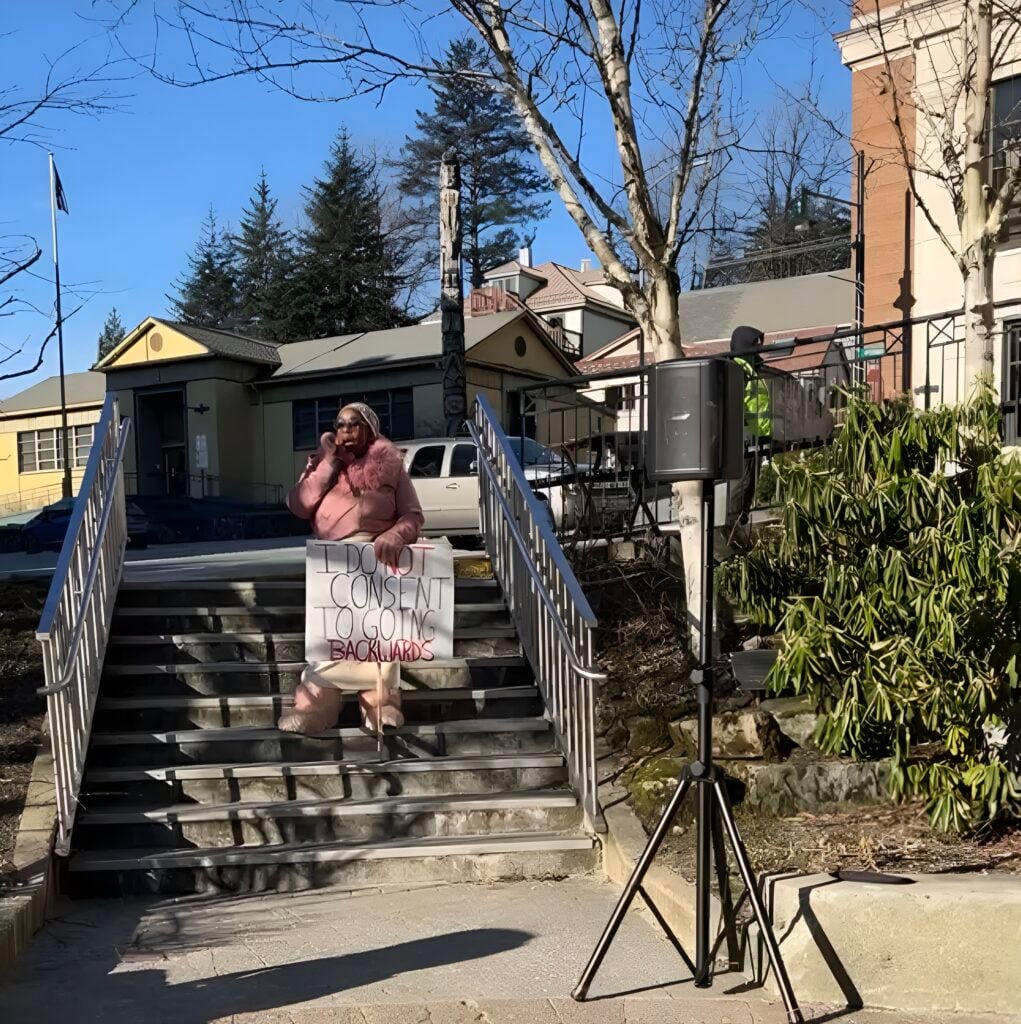
Erin Jackson-Hill outside the Capitol, speaking to a group of protestors
Protesters gathered outside the Alaska State Capitol this morning, calling on U.S. Sen. Dan Sullivan to oppose what organizers described as growing authoritarianism at the federal level.
“Juneau for Democracy is a group of Juneau residents who get together in care and resistance.” Said Volunteer Anjali Grantham, “We really are a network of people trying to live our democracy and protect our democracy.”
The rally’s theme was “We the People Do Not Consent.” Participants held signs and delivered speeches criticizing Sullivan’s positions on immigration enforcement, federal spending and voting requirements.
“We are finished with the silence, we are finished with complicity, we demand a leader who will fight for us, we demand courage.” Said Erin Jackson-Hill of Stand up Alaska.
Grantham said protesters were urging Sullivan to support additional congressional oversight of immigration enforcement agencies and to oppose policies they believe undermine constitutional rights, such as the deployment of federal officers in U.S. cities, and increased funding for the Department of Homeland Security.
“We’re going to make sure that Sullivan knows it’s despicable that he has voiced support for the SAVE act.” Grantham said, this is federal legislation that would require voters to provide proof of citizenship, like a passport or birth certificate, to cast a ballot.
“Can you imagine what that would mean for Rural Alaskans? In addition to many women who have changed their name after getting married.” She said.
Voting by noncitizens has been found to be exceedingly rare nationwide and in Alaska.
“He’s an attorney, and he has not only watched but actually facilitated the erosion of our First Amendment rights, our Fourth Amendment rights, our Fifth Amendment rights and our Eighth Amendment rights. He’s a military officer, but he’s also justified the deployment of troops to U.S. cities. He’s a senator, and he’s totally abandoned the role of the legislative branch. He’s had the audacity to tell Alaskans that we should be grateful to the regime, meanwhile, the federal government has become predatory on its own people.” Grantham said.
The rally was held before Dan Sullivan delivered his annual speech to the Alaska Legislature.
“We want him to be someone who is standing against authoritarianism and not paving the way for authoritarianism.” she said.
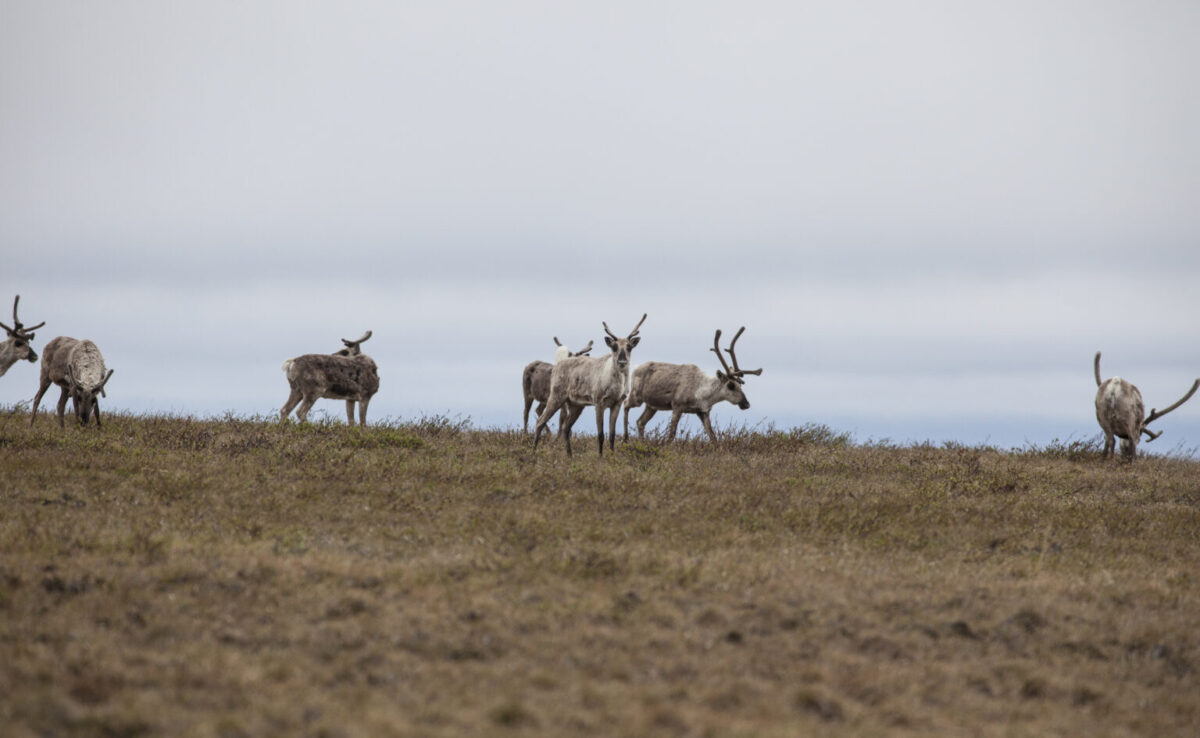
Teshekpuk Caribou Herd animals graze in June of 2014 in the northeastern part of the National Petroleum Reserve in Alaska. (Photo by Bob Wick/Bureau of Land Management)
A newly filed lawsuit and a revived six-year-old case from environmental groups and an Alaska Native organization are challenging the Trump administration’s proposal to open more parts of the National Petroleum Reserve-Alaska to oil and gas drilling.
On Tuesday, Grandmothers Growing Goodness and The Wilderness Society filed suit against the U.S. Department of the Interior, alleging that the department’s development plan for the reserve violates proper procedure and federal law.
That suit was filed in the U.S. District Court for the District of Columbia.
Thousands of miles away, in the U.S. District Court for the District of Alaska, the Center for Biological Diversity and Friends of the Earth updated a six-year-old challenge dating from the first Trump administration.
Despite the difference in time and distance, both lawsuits are seeking the same goal: A stop to new plans for oil and gas drilling in the reserve.
The Audubon Society, which had been participating in the older lawsuit, withdrew from the case shortly before the new complaint was filed.
That sale, which will open up to 5.5 million acres of North Slope land to oil and gas drilling, would be the first in the National Petroleum Reserve-Alaska since 2019.
The reserve, located to the west of Prudhoe Bay, has been eyed for possible development for decades, and — unlike the Arctic National Wildlife Refuge to the east of Prudhoe Bay — has been the subject of interest by major drillers.
The sale is one of five mandated in the next 10 years by the budget and policy legislation known as the “Big Beautiful Bill Act.”
During the first Trump administration and again this year, the federal government attempted to lease parts of the reserve that are near Teshekpuk Lake, an area that had been protected under previous agreements with local residents.
The lake is the largest on the North Slope and is considered important habitat for caribou and migrating birds.
Since taking office earlier this year, Trump has emphasized his desire for increased oil production from the North Slope and other federal land nationwide, part of a strategy intended to wean America off imported oil.
If a lease sale takes place in the reserve, exploratory drilling would likely take years, and production would take years more.
Oil company ConocoPhillips acquired some NPR-A leases in 1999; its Willow Project, located in the reserve, is expected to reach full production by the end of this decade.
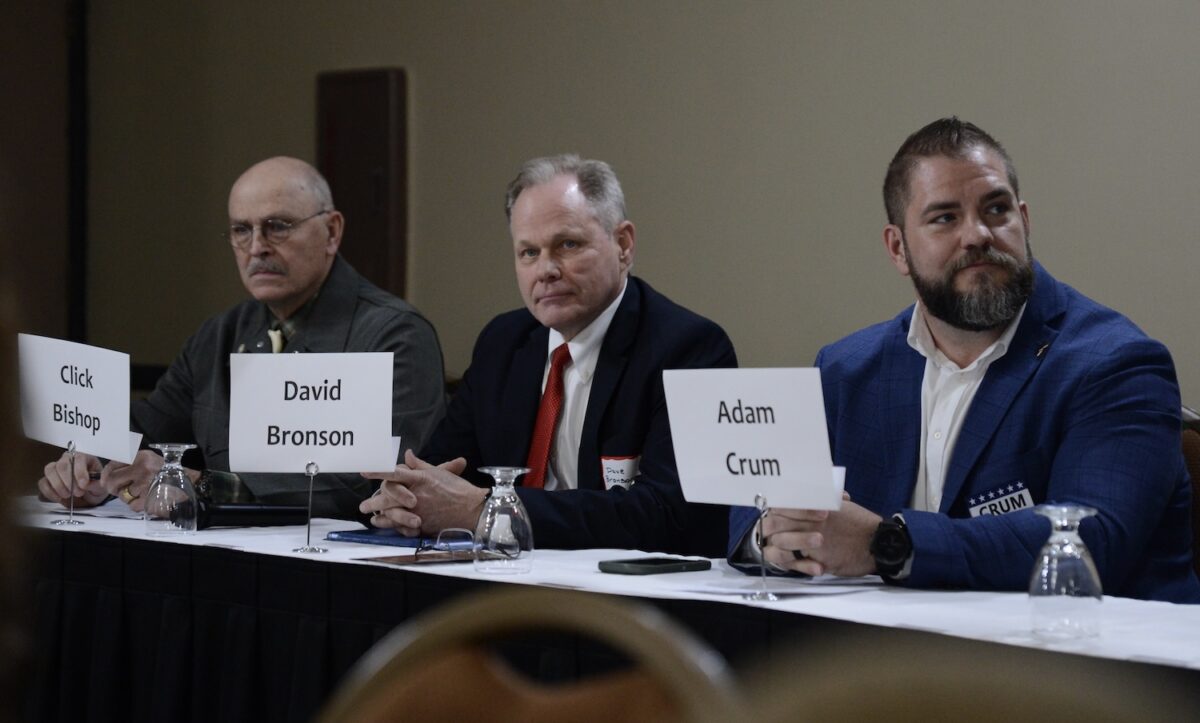
From left to right, Click Bishop, Dave Bronson and Adam Crum, three of the 10 candidates at the Capital City Republican governor candidate forum, are seen on Wednesday, Feb. 11, 2026, at the Baranof Hotel in Juneau. (James Brooks photo/Alaska Beacon)
By: James Brooks, Alaska Beacon
From left to right, Click Bishop, Dave Bronson and Adam Crum, three of the 10 candidates at the Capital City Republican governor candidate forum, are seen on Wednesday, Feb. 11, 2026, at the Baranof Hotel in Juneau. (James Brooks photo/Alaska Beacon)
A fast-moving forum in Juneau on Wednesday hosted 10 of Alaska’s 12 Republican candidates for governor, but the size of the field in the hourlong event meant there was more flavor than meat in the soup du jour.
All but two of the candidates effusively praised incumbent President Donald Trump, but despite that support, most said they disagree with his attempt to acquire Greenland and make it part of the United States.
As of Wednesday, 16 people have signed up to run for governor in this year’s election: 12 Republicans, 3 Democrats and an independent.
The top four candidates in the August primary election will advance to the November general election, where voters will sort their choices using ranked choice voting.
Incumbent Gov. Mike Dunleavy is term-limited and unable to run for a third term, leaving the seat open.
Current Lt. Gov. Nancy Dahlstrom and author Hank Kroll were the only Republicans to not participate in Wednesday’s event, which was hosted by the Capital City Republicans on the night of their annual Lincoln Day dinner. Dahlstrom had a prior commitment and was unable to attend, organizers said. Kroll was not mentioned.
Asked to name their favorite Republican president other than Reagan and Lincoln, most of the 10 candidates said Trump, and some said they put him above Reagan and Lincoln.
“He’s the best president Alaska’s ever had,” said former attorney general Treg Taylor.
“I’d have taken a bullet for him,” said Bruce Walden, a former paratrooper.
“Trump has done more for Alaska than every president in our entire American history,” said former state Sen. Shelley Hughes.
Anchorage podiatrist and state medical board member Matt Heilala said he had to choose Trump because Heilala and his wife play golf with Trump.
Former state Sen. Click Bishop was an exception, naming Teddy Roosevelt, Dwight Eisenhower and Ronald Reagan as his favorite presidents. James William Parkin IV of Angoon said he doesn’t choose favorites and didn’t name a pick.
Asked whether Alaska should support the American acquisition of Greenland, Bishop was quick to say “no,” and most of the other candidates followed suit.
“I think we have enough problems here, and I’d like to see the federal government give us more support to develop our resources here,” said former state revenue commissioner Adam Crum.
Taylor said that “when my friend, the governor of Louisiana, Jeff Landry, was tapped to be the US envoy (to Greenland), I texted him and said, ‘What the heck? You don’t even know what it’s like to be cold.’ Ultimately, it’s a question for Greenland and self determination, but I’d be happy to talk to (Trump) about how we fit into the United States and the importance that we play in our economy and our strategic location.”
Matanuska-Susitna Borough Mayor Edna DeVries was the sole candidate who offered a different answer, saying, “Well, if I want President Trump to continue to love Alaska, I’m going to say yes.”
All but Bishop and Parkin said they intend to support the repeal of Alaska’s 2020 ballot measure, which installed open primary elections and a ranked-choice general election, as well as tougher disclosure requirements for political donations.
The candidates split when asked whether they think Alaska’s judges should be required to run for office or whether judges should be appointed, as in the existing system.
Bishop, Heilala and Hughes each said they think judges should be appointed, though Hughes called for more public members on the Alaska Judicial Council, which examines applicants and nominates candidates to the governor for appointment.
Former Anchorage Mayor Dave Bronson, Crum, DeVries, Parkin, Taylor, Walden and Wilson each said they think judges should be elected.
When asked which Alaska politician each candidate admires, most said either Ted Stevens or Don Young, longtime Republicans who served in the Senate and House, respectively.
“I don’t think hardly any of them,” Wilson said. “I think you have to get back to my great-uncle Wally (Hickel). … Nick Begich is also doing a hell of a job.”
Wilson served as a senior adviser to Begich’s 2024 election campaign.
Walden also chose Nick Begich.
Asked whether Alaska should regulate artificial intelligence software, the candidates gave a variety of answers.
AI is sort of like a hammer, Walden said. “You can build a house with a hammer. You can also murder somebody with a hammer. If it’s used properly, it’s probably going to be all right, but yeah, we better regulate it big time,” he said.
Wilson said that if anyone on her campaign team is using AI, “they better not be.”
While it is a powerful tool and can be harnessed, she said there are serious concerns. “We have seen AI used to manipulate photos, especially against people running for office. We’ve seen it used to create comments that were never said. I think that we really need to pay attention to the damage that can be done for AI,” she said.
DeVries, at 83, is the oldest candidate in the field.
“I can remember when TV came in and how horrible that was going to be, right? It ended up — it can either be a blessing or a curse, and that’s the way I feel about AI,” she said.
Taylor, who said he used AI to help prepare his closing speech, said “Alaska is AI’s best friend” because the state is the source for critical minerals used in high-tech electronics.
“On the other side, AI is Alaska’s best friend,” because it could be used to make government functions more efficient, Taylor said.
“We have to responsibly deploy AI in state government to create those efficiencies, to create those savings, or we’re going to get left behind.”
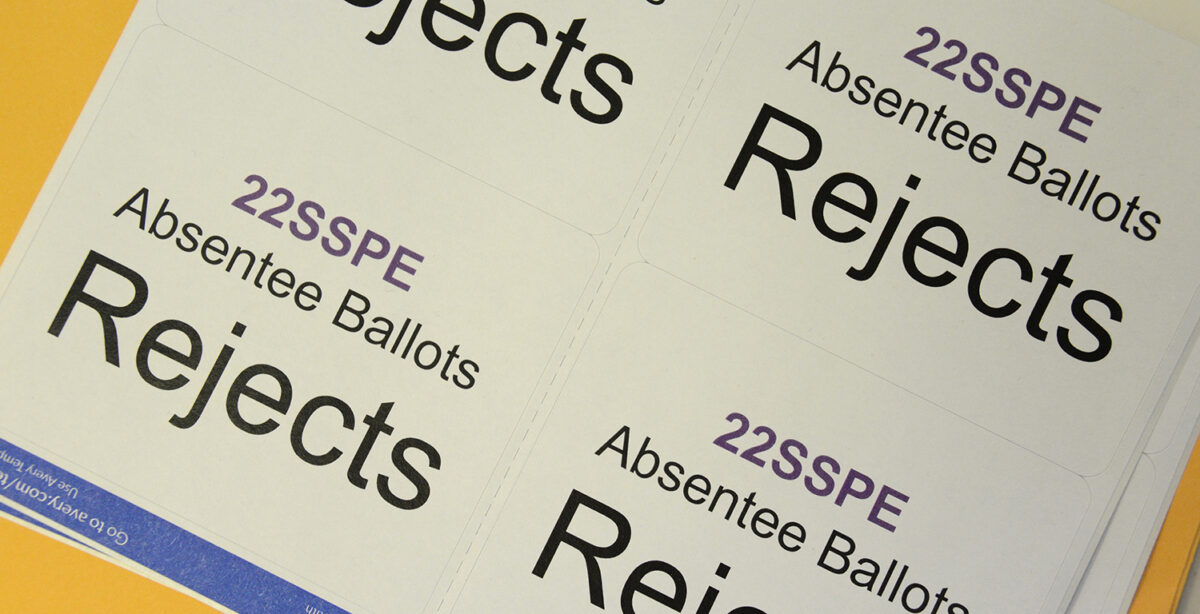
Reject stickers await ballot envelopes Wednesday, June 15, 2022 at the Division 1 office of the Alaska Division of Elections in Juneau, Alaska during counting for Alaska's special U.S. House primary election. (Photo by James Brooks/Alaska Beacon)
By: James Brooks, Alaska Beacon
Reject stickers await ballot envelopes Wednesday, June 15, 2022 at the Division 1 office of the Alaska Division of Elections in Juneau, Alaska during counting for Alaska’s special U.S. House primary election. (Photo by James Brooks/Alaska Beacon)
When the state of Alaska turned over a copy of the state’s voter rolls to the Department of Justice in December, it also signed an agreement that allows the DOJ to ask the state to put individual Alaskans on track for removal from the state’s voter list.
Officially labeled a “confidential memorandum of understanding,” the document was signed Dec. 19 by Carol Beecher, director of the Alaska Division of Elections, and U.S. Assistant Attorney General Harmeet Dhillon.
Alaska is one of at least a dozen states that have signed similar documents, even as more states continue to fight the requests in court.
In part, the document says “the Justice Department will securely notify you or your state of any voter list maintenance issues … i.e., that your state’s (list) only includes eligible voters.”
It goes on to state “that within forty-five (45) days of receiving that notice from the Justice Department of any issues … your state will clean its (list) by removing ineligible voters and resubmit the updated (list) to the Civil Rights Division of the Justice Department” to confirm that the state is following federal law.
Alaska’s signed agreement was obtained by the Alaska Beacon on Tuesday via a public records request.
Beecher and Kelly Howell, chief of staff to Lt. Gov. Nancy Dahlstrom, said the agreement does not allow DOJ to purge voters — a term that means removing them from the voter roll altogether.
Instead, the DOJ’s picks, if any, would be placed on the state’s inactive voter list. Anyone on that list must provide ID and have their identity verified if they wish to vote.
The agreement says in part that it was “entered into at your state’s request,” but by email, Dahlstrom’s office said that isn’t correct and that the Department of Justice provided the agreement.
The lieutenant governor is in charge of Alaska’s elections, and in a cover letter dated Dec. 19, she said the memo was “entered at the request of the Department of Justice” and state law.
That law, Dahlstrom said, “allows the Division of Elections to share voters’ confidential information with a federal government agency, such as the Department of Justice, provided it uses ‘the information only for governmental purposes authorized under law.’”
If the Department of Justice were to seek faster removal of Alaskans from the voter rolls, it could violate that clause.
Responding to questions from the Beacon, the lieutenant governor’s chief of staff said the state has not received any notices from the Justice Department about problems with its voter list, that no “ineligible voters” have been removed and that the state isn’t aware of any times when Alaska’s rolls were used for “pre-litigation or litigation purposes,” as defined in the agreement.
Concerns about states’ rights being overridden
The U.S. Supreme Court has repeatedly upheld the right of states to set the rules for local and state elections; changing voter rolls would represent a new expansion of powers by the Department of Justice.
Former Democratic state Sen. Tom Begich, posting about the issue on social media, said he is “outraged” by the agreement between the state and the federal government.
“That kind of federal interference threatens our constitutional right to run our own elections,” he said.
He later issued a statement calling on the Alaska Legislature to investigate the issue.
Dahlstrom, a Republican, is also a candidate for governor.
Writing in an opinion column published by the Juneau Independent on Friday, former Alaska Attorney General Bruce Botelho, a Democrat, said “it is alarming that the federal government has demanded” the copy of the voter roll with personally identifying information.
Nationally, at least 11 other states have signed agreements similar to the one signed by Alaska, according to federal court testimony in December over a lawsuit that challenged the state of California’s refusal to turn over its voter rolls to the federal government.
The text of Alaska’s agreement is almost identical to ones previously disclosed in court and by the American Civil Liberties Union in a lawsuit by the federal government against the state of Colorado.
“We will not comply with the Trump Department of Justice’s request for Coloradans’ sensitive voting information,” said Colorado Secretary of State Jena Griswold, a Democrat, in December. “The DOJ can take a hike; it does not have a legal right to the information. Colorado will not help Donald Trump undermine our elections and hurt the American people.”
Nationally, the federal government has sued more than two dozen states, including Colorado, that refused to send voter rolls to the federal government.
Those states generally have provided copies of publicly available rolls, but the federal government is seeking more detailed information, including lists of personally identifying information that may include birth dates, driver’s license numbers and Social Security numbers in part or whole.
“The manner in which the Department of Justice has acted makes clear that what is at stake is not voter integrity, but voter privacy,” Botelho said.
The Justice Department has said that its requests are necessary to make sure that states are following federal laws that require them to regularly maintain their lists and keep noncitizens from voting.
As of this week, federal judges had ruled against the Department of Justice in lawsuits covering Oregon, California and Michigan. The department has not prevailed in any case so far.
In the Oregon ruling, published on Feb. 5, Judge Mustafa Kashubhai wrote that the federal government cannot be trusted about its true motives.
“When Plaintiff, in this case, conveys assurances that any private and sensitive data will remain private and used only for a declared and limited purpose, it must be thoroughly scrutinized and squared with its open and public statements to the contrary,” he wrote.
Alaska-specific implications may be broad
The national ACLU has opposed the federal government’s requests in general. When contacted Friday about the Alaska memo, the Alaska chapter of the organization said it did not have immediate comment and was still researching the issue.
The agreement between the state of Alaska and the Department of Justice could have broad consequences here.
Days before signing the agreement, the Alaska Division of Elections disclosed that dozens of noncitizens had accidentally been registered to vote by the Alaska Department of Motor Vehicles.
Under guidelines imposed by the Trump administration, those noncitizens could be deported, because federal law strictly prohibits noncitizens from registering to vote, and appearing on a voter list prompts special review when someone is attempting to become a citizen.
Correction: The initial version of this article incorrectly stated that the memo would allow the Department of Justice to direct the purge of individual voters. It only permits DOJ to identify Alaskans for eventual removal and does not immediately prevent them from voting.
Augustine Volcano looms on Oct. 22, 2025, behind mist hanging over Lower Cook Inlet. The U.S. Bureau of Ocean Energy Management is soliciting bids for exploration rights in federal waters of Cook Inlet in the first of six scheduled federal lease sales to be held through 2032. (Photo by Yereth Rosen/Alaska Beacon)
The Trump administration is soliciting bids for what it intends to be the first in an annual series of oil and gas lease sales in federal waters of Southcentral Alaska’s Cook Inlet.
The upcoming sale will offer about 1 million acres in Cook Inlet, with bids to be opened on March 4, the U.S. Bureau of Ocean Energy Management said on Friday.
The auction has been named the “One Big Beautiful Bill Act Lease Sale 1” because it is the first of six lease sales mandated under the sweeping tax and budget bill passed by Congress and signed by President Donald Trump last summer. The six sales are to be held by 2032, under the bill.
“Regular and predictable federal leasing is the minimum standard for maintaining domestic energy production,” BOEM Acting Director Matt Giacona said in a statement. “Energy security is national security, and this sale reflects a clear, congressionally mandated path forward for Cook Inlet leasing. By offering predictable terms and a transparent process, we are supporting Alaska’s role in meeting America’s energy needs, strengthening national readiness and creating opportunities for investment and jobs.”
Environmentalists criticized the planned sales.
“The relentless push for more oil drilling in Cook Inlet won’t solve Alaska’s energy problems but it will bring a massive risk to this already stressed and polluted waterway,” Cooper Freeman, Alaska director at the Center for Biological Diversity, said in a statement. “The federal government is required to protect our oceans and the fish and wildlife that call them home, but Trump is ignoring that responsibility. From critically endangered Cook Inlet belugas to salmon and razor clams, this sale puts so many species in the crosshairs of a devastating oil spill,” the statement said.
The federal lease sale coincides with the Alaska Division of Oil and Gas’ scheduled annual lease sale for state territory in the Cook Inlet basin. Results of the state lease sale, which is offering 2.9 million offshore and onshore acres, will also be released on March 4.
The planned “One Big Beautiful Bill Act” Cook Inlet lease sales are in addition to several sales that the administration has proposed for nearly all areas of federal waters off Alaska, from the High Arctic to the Gulf of Alaska waters south of the Kodiak Archipelago and the Aleutian chain. The proposed lease sales are listed in a new five-year draft plan released by BOEM in November.
Cook Inlet oil and gas lease sales, whether conducted by the state or federal government, have drawn little interest in recent years. The state’s 2025 lease sale drew five bids, and the most recent federal sale, held at the end of 2022, drew only one bid.
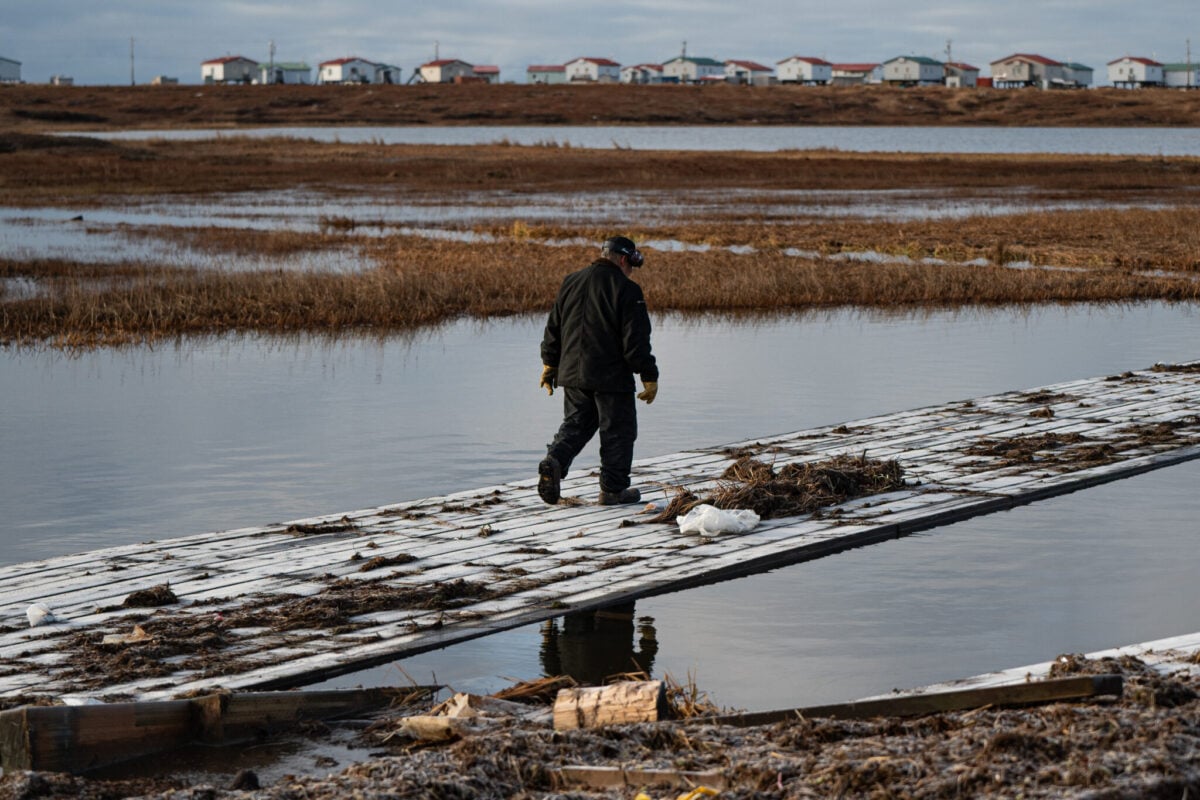
Eric Phillip, the boardwalk foreman for Kongiganak, Alaska, surveys infrastructure damage caused by Typhoon Halong, Oct. 18, 2025. The Alaska Organized Militia continues coordinated response operations in support of the State Emergency Operation Center following the 2025 West Coast Storm as the mission focus, pursuant to Governor Dunleavy’s declaration of disaster, shifts from lifesaving to life sustainment and stabilization of communities and survivors. (Alaska National Guard photo by Staff Sgt. Joseph Moon)
By: Corinne Smith, Alaska Beacon
Eric Phillip, the boardwalk foreman for Kongiganak, Alaska, surveys infrastructure damage caused by Typhoon Halong, Oct. 18, 2025. The Alaska Organized Militia continues coordinated response operations in support of the State Emergency Operation Center following the 2025 West Coast Storm as the mission focus, pursuant to Governor Dunleavy’s declaration of disaster, shifts from lifesaving to life sustainment and stabilization of communities and survivors. (Alaska National Guard photo by Staff Sgt. Joseph Moon)
The Trump administration has denied Alaska’s request for full reimbursement for disaster relief efforts immediately following last October’s devastating Western Alaska storms, despite the Dunleavy administration’s claim that the federal disaster declaration meant the state would be fully reimbursed.
Gov. Mike Dunleavy arrives in Bethel after visiting the storm-damaged villages of Kipnuk and Kwigillingok on Oct. 17, 2025. (Photo by Eric Stone/Alaska Public Media)
That leaves the state on the hook for millions of dollars for disaster recovery, however the full amount is still unknown.
The state’s request for federal support for 100% of disaster relief efforts in the first 90 days after the storms hit was denied on Dec. 20, according to a spokesperson for the Alaska Division of Homeland Security and Emergency Management on Thursday.
The state appealed the denial on Jan. 15, and asked for a 90% federal cost reimbursement, but has not yet gotten a response from the Federal Emergency Management Agency.
“We have not heard back from FEMA on approval or denial and there is no timeframe requirement,” said Jeremy Zidek, public information officer for the division, by email.
A spokesperson for Dunleavy’s office did not respond to a list of questions, but confirmed the appeal on Friday. “An appeal has been filed and the administration will await the federal government’s decision,” said Jeff Turner, Dunleavy’s communications director.
In the meantime, the federal government is reimbursing Alaska’s disaster recovery efforts at roughly 75%, leaving the state to cover 25% of its costs, with some exceptions for certain relief programs, Zidek said.
Following the West Coast storm disaster in October, Dunleavy quickly declared a state disaster emergency. On Oct. 22, his office announced that the Trump administration approved the state’s request for a federal disaster declaration, and the state’s full costs would be covered immediately following the storms.
“President Trump was deeply concerned with the wellbeing of Alaskans who lost their homes and livelihoods to this historic storm,” Dunleavy said in a statement along with the announcement. “I want to thank him and his administration for approving the disaster declaration because now Alaskan families have local, state and federal support for rebuilding their lives in the months ahead.”
“The federal disaster declaration authorizes a 100 percent federal cost share for all categories of relief assistance for the next 90 days,” the statement said.
Dunleavy’s office did not respond to questions about his previous statement or whether his office had communication from the Trump administration about why the request was denied.
Alaska’s Republican U.S. congressional delegation applauded the federal disaster declaration and Trump’s support for the Western Alaska disaster response last year. All three members said through spokespeople Friday that they support the state’s appeal.
U.S. Sen. Lisa Murkowski has been actively engaged with FEMA and state officials throughout the disaster relief efforts, said her communications director, Joe Plesha, in a statement on Friday. “Alaska’s vast geography and many rural communities make disaster response more challenging and recovery efforts significantly more costly,” he said. “She supports the state’s appeal and will work to secure the maximum amount of federal support available to Alaskans who have suffered so much from this devastating storm.”
A spokesperson for U.S. Sen. Dan Sullivan, Amanda Coyne, said the senator has advocated for the 100% federal cost share, as well as organized a delegation of FEMA and other Trump administration officials to visit Western Alaska.
“Given the severity of the storm and its devastating impacts on communities in Western Alaska, Senator Sullivan believes an increased federal cost share is warranted,” Coyne said. “He will continue strongly advocating with FEMA and other senior officials in the Trump Administration for an increased federal cost share as the state’s appeal goes through the process.”
A spokesperson for Alaska’s lone U.S. Representative, Nick Begich III, said on Friday that he supports the appeal and will continue to advocate for those impacted by Typhoon Halong at the Congressional level. “Our office is in communication with the Administration to ensure recovery efforts in Western Alaska remain a priority,” spokesperson Silver Prout wrote.
Western Alaska storm recovery is ongoing
The Western Alaska storms and particularly ex-Typhoon Halong brought record-breaking winds and flooding — damaging thousands of structures, roads, boardwalks, airports and other critical infrastructure. It prompted the state’s largest mass evacuation of residents from their homes to other villages, Bethel and Anchorage.
Evacuees of Kipnuk and Kwigillingok wait to board an evacuation flight from Bethel to Anchorage on Oct. 15, 2025 (Photo by Corinne Smith/Alaska Beacon)
While some Western Alaska residents are continuing to rebuild through the winter, other residents who evacuated to Anchorage are living in temporary housing. As of Thursday, the Alaska Division of Homeland Security and Emergency Management reports that 471 residents are still sheltering in hotels in Anchorage.
The state is administering public assistance programs, which reimburse costs of repairing public infrastructure and utilities, as well as provide individual disaster assistance, in partnership with other agencies, including FEMA.
FEMA has awarded $31.2 million in individual assistance to date, Zidek said.
More than 2,000 residents have been awarded state individual assistance, and 1,794 households have registered for federal assistance from FEMA.
Those applications for state and federal assistance are still open until Feb. 20.
State disaster relief funding under debate
The state’s disaster relief funding is a point of ongoing debate among lawmakers and the governor, as they kick off discussion of Dunleavy’s proposed $7.75 million budget and its $1.5 billion deficit.
Last year, legislators approved $23.3 million in state disaster relief funds, but Dunleavy vetoed $10.3 million of that sum last summer, leaving $13 million in the budget. In November, following the federal government shutdown, Dunleavy announced a state disaster to help provide food aid, transferring $10 million to the state’s disaster relief funding from the Department of Environmental Conservation’s Village Safe Water and Wastewater Infrastructure program.
This year, the governor has requested an additional $40 million in the state’s supplemental budget, which is a routine ask for additional money to pay the state’s bills for the previous year.
Sen. Bert Stedman, R-Sitka, a co-chair of the Senate Finance Committee, didn’t mince words about the governor’s back and forth with disaster spending. “Ill-advised and foolish,” he said. “It makes no sense what he did to me, frankly, and it’s embarrassing for him, his veto.”
But Stedman said he hopes the state’s federal appeal is approved, and expects legislators to pass the governor’s request for the additional $40 million. “Obviously, 100% is better than 90 and 90 is better than 75,” Stedman said of the federal cost share. “So that’s pretty much a given there. But we will fund the disaster request as the governor puts it on the table, through next week’s amendments.”
Sen. Jesse Kiehl, D-Juneau, also a member of the Senate Finance Committee, commended the governor for his record on disaster response, and echoed hope for the appeal to move forward. “There’s no question in my mind that this is exactly what the federal disaster relief programs exist for. So I think the governor’s request was the right thing, and if it came back at less than full funding from the feds, that’s the wrong call,” Kiehl said.
Kiehl described the state’s fiscal picture, with rising costs and ongoing debates on how to raise more revenues, as “bleak.” “So there isn’t cash just sitting around for disaster assistance,” he said. “We have to step up for western Alaska financially. That’s going to stink, but we have to do it, as far as I’m concerned.”
A typical cost share between the federal government and a state for disaster relief efforts is a 75% federal and 25% state cost split.
“We have dozens of federal declared disasters we are currently working on that have the 75/25 cost share structure,” said Zidek, with agency. “Large disasters are occasionally given a modified cost share structure adjustment, but it is not guaranteed. When we have a large disaster, we ask for modification to reduce the amount of state funding needed because as managers of state funds it is the responsible thing to do.”
Department of Homeland Security Secretary Kristi Noem at a Nashville press conference on July 18, 2025, to discuss arrests of immigrants during recent Immigration and Customs Enforcement sweeps. (Photo by John Partipilo/Tennessee Lookout)
Alaska’s senior Senator, Republican Lisa Murkowski, told reporters on Tuesday that Department of Homeland Security Kristi Noem should “probably” step down. Murkowski is one of a handful of Senate Republicans calling for further investigation into the killing of U.S. citizens by Immigrations and Customs Enforcement personnel and ICE conduct in Minneapolis.
She is the second Republican in the U.S. Senate, after Thom Tillis of North Carolina, to call for Noem’s resignation.
“She has, through her words — and I think in her actions — she’s taken a direction that has not been helpful to the situation, and I don’t think that it helps the country,” Murkowski said.
“Accountability goes all the way to the top, and I think you have a secretary right now that needs to be accountable to the chaos and in some of the tragedy that we have seen,” she added.
Her comments come after a massive surge of federal agents has been operating in Minneapolis as part of the Trump administration’s immigration crackdown. Their actions include an unknown number of arrests and two fatal shootings in three weeks, prompting widespread protests.
Murkowski voted to confirm Noem’s appointment last January. Noem faces mounting bipartisan criticism after House Democrats co-sponsored articles of impeachment against her.
Republican Sen. Dan Sullivan and Rep. Nick Begich III did not immediately respond to questions about Noem’s leadership from the Alaska Beacon on Tuesday.
Murkowski has not supported calls from a faction of progressive Democrats in Congress to defund the agency. She voted in support of the Republican-drafted budget package earlier this year that sent almost $85 billion to the agency, giving it a larger budget than the U.S. Marine Corps.
“You’ve got all these cries to say, ‘We can’t give another penny to ICE.’ Well, the fact of the matter is ICE has the resources that they will need. What it comes down to is: What are they doing with the money? And that’s where it comes to the management, that’s when it comes to who is controlling it, that’s when it comes to who is ultimately in charge and accountable,” she said.
Congressional response to ICE action in Minneapolis
Alaska’s congressional delegation is split in its response to the ICE action and the killing of Alex Pretti in Minneapolis over the weekend.
In a Sunday statement, Murkowski called for a “comprehensive, independent investigation” of the killing, which she said is necessary to build back public trust. Her statement called on Congressional committees to fulfill their oversight duties in hearings.
“ICE agents do not have carte blanche in carrying out their duties,” she said in the statement.
“The tragedy and chaos the country is witnessing in Minneapolis is shocking,” Murkowski’s statement said, and added that the killing of another U.S. citizen “should raise serious questions within the administration about the adequacy of immigration-enforcement training and the instructions officers are given on carrying out their mission.”
Sullivan’s office is closely monitoring reports out of Minneapolis following the fatal shooting, according to a statement through spokesperson Devyn Shea. Sullivan stopped short of calling for an independent investigation of ICE actions.
“He believes we should gather all the facts and investigate the incident before drawing conclusions — to ensure accountability, restore public trust, and prevent future confrontations that result in loss of life,” his spokesperson wrote.
“Senator Sullivan strongly supports our law enforcement and their ability to do their jobs. He also believes that any loss of life is tragic and hopes that the temperature in Minnesota on both sides can be lowered and that the situation between protestors and law enforcement deescalates and the violence dissipates,” the statement said.
Silver Prout, a spokesperson for Begich’s office, said he will not speculate, but “allow facts to be established through appropriate investigative processes.”
“Congressman Begich supports law enforcement’s ability to carry out their duties safely and without interference from agitators,” Prout wrote on Tuesday. “This includes a responsibility to ensure transparency and accountability in the commission of those duties.”
Prout said Begich supports “appropriate” Congressional oversight of federal law enforcement and that safe communities are a top priority of Begich’s.
“If anything, recent events have underscored the need for additional funding to ensure law enforcement has the tools, personnel, and training needed to complete their job,” she wrote.
Congressional candidates speak out
Some congressional candidates have issued statements in response to the violence and unrest in Minneapolis. Former U.S. Rep. Mary Peltola, a Democrat challenging Sullivan, called for an independent investigation into the death of Alex Pretti, as well as increased Congressional oversight for ICE and funding for local law enforcement in Alaska.
“Nothing is more important than the safety of our communities,” she wrote on social media on Monday.
“What’s happening right now in the Lower 48 does nothing to make us safer here in Alaska. In Alaska, we respect the rule of law and lawfully carrying a firearm never justifies deadly force by federal agents,” the post said.
On Monday, the campaign of Democratic candidate Matt Schultz, who is challenging Rep. Begich for Alaska’s sole House seat, called on Congress to respond to the killings of U.S. citizens by ICE.
The statement urged that ICE be withdrawn from Minnesota and for its personnel to be better trained. It accused the Trump administration of deploying them “as a cudgel for settling petty partisan grudges.”
“I’m troubled by the silence and inaction of too many of our leaders here in Alaska,” the statement said, specifically attacking Begich and another candidate, independent Bill Hill. “It is time to speak up and show up for our fellow Americans, immigrants, and the Bill of Rights.”
Hill gave a statement on social media on Monday, saying that Americans should be able to exercise their 1st and 2nd Amendment rights without “being killed by their government.”
“Our congressman needs to stand up and fight for an independent investigation into the shooting of Alex Pretti. Until that happens, ICE should get the hell out of Minneapolis,” the statement said.
Corinne Smith and James Brooks contributed reporting to this story. This story has been updated.
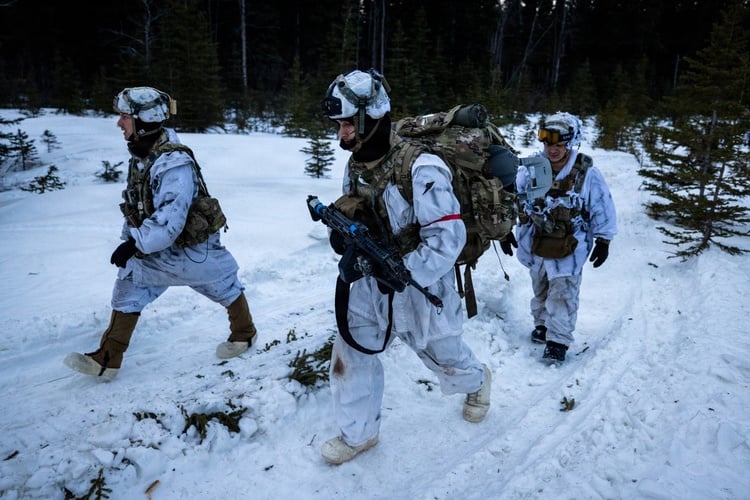
U.S. Army Soldiers with the 11th Airborne Division, load Air Force C-130 Hercules aircraft in preparation for deployment into the Joint Pacific Multinational Readiness Center’s 25-02 training exercise, Fairbanks, Alaska, Jan. 23, 2025. (U.S. Army Photo by Master Sgt. Justin P. Morelli)
A Democratic state lawmaker from Anchorage loudly denounced the actions of U.S. Immigration and Customs Enforcement’s surge in Minnesota while speaking on the Alaska House floor on Friday.
Rep. Andrew Gray, D-Anchorage, is a military veteran and co-chair of the Legislature’s Joint Armed Services Committee.
“The facts are that our government is out of control. Norms have been broken at an alarming rate, and the world is watching us in shock,” he said.
Gray’s remarks were met by loud desk-thumping — a form of applause — and came on a day when thousands of Minnesotans marched in subzero weather and held a general strike to show their opposition to ICE efforts in their state.
Tensions are particularly high after several shootings by federal officers, including one in which an officer killed a mother of three.
The remarks came one day before federal agents fatally shot another Minneapolis resident on Saturday, prompting nationwide protests throughout the weekend.
Up to 1,500 active-duty troops of the U.S. Army’s 11th Airborne Division, based in Anchorage, have been ordered to stand by for possible deployment to Minneapolis — Minnesota’s largest city — according to National Public Radio.
In those letters, Gray and Kawasaki say they are receiving “enquiries … from the Alaskan people” and pose a series of questions.
How long will the 11th Airborne be in Minnesota? How does a deployment fit in the division’s mission to defend the United States against foreign threats? Could soldiers be detaining suspected undocumented people? Would the 11th Airborne fight the Minnesota National Guard if Gov. Tim Walz activates it to defend protesters?
“Fifteen hundred active-duty soldiers may be sent from Alaska to Minnesota to protect ICE agents as they continue their efforts to arrest and detain suspected undocumented immigrants,” Gray said, “But who really needs the protection? Is it the ICE agents, or is it the folks who are terrified to leave their homes, to go to work, to pick their kids up from school or to actually show up at their immigration appointments?”
While Gray’s comments appeared to have the support of many legislators in the chamber — judging by the desk-pounding applause — there was at least one dissenting voice.
Rep. Jamie Allard, R-Eagle River, is a veteran, the spouse of a veteran, and a Latina, she said, explaining that she had also sent a letter to Gen. Cogbill, but her letter was to remind him that he is not legally obligated to answer the Legislature’s questions or testify in the Capitol.
Allard said she has been deployed overseas with the military and with the U.S. State Department.
“I experienced things when I worked for the US State Department, of women being abused, hit — watched them get their teeth knocked in, where I had to stand by and couldn’t do anything,” she said.
“We have a lot going on in our country, dividing, saying we’re this or we’re that. We’re all Americans, but it doesn’t mean that it’s okay to have riots across our country. If the military and the federal government and the Department of War and the 11th Airborne Division decide that it’s best to go to Minnesota, that’s what we need to do,” she said.
Allard’s comments were met by quieter but noticeable desk-pounding, with the loudest coming from Rep. Kevin McCabe, R-Big Lake.
He said afterward that he thinks Gray incorrectly described some aspects of ICE’s work in Minnesota. For example, Gray said ICE detained a five-year-old in Minnesota.
“There’s a little bit more to the story, McCabe said.
“We shouldn’t be messing around in another branch of the government in their bailiwick,” he said. “The worst people in Alaska to manage the National Guard is probably the state Legislature.”
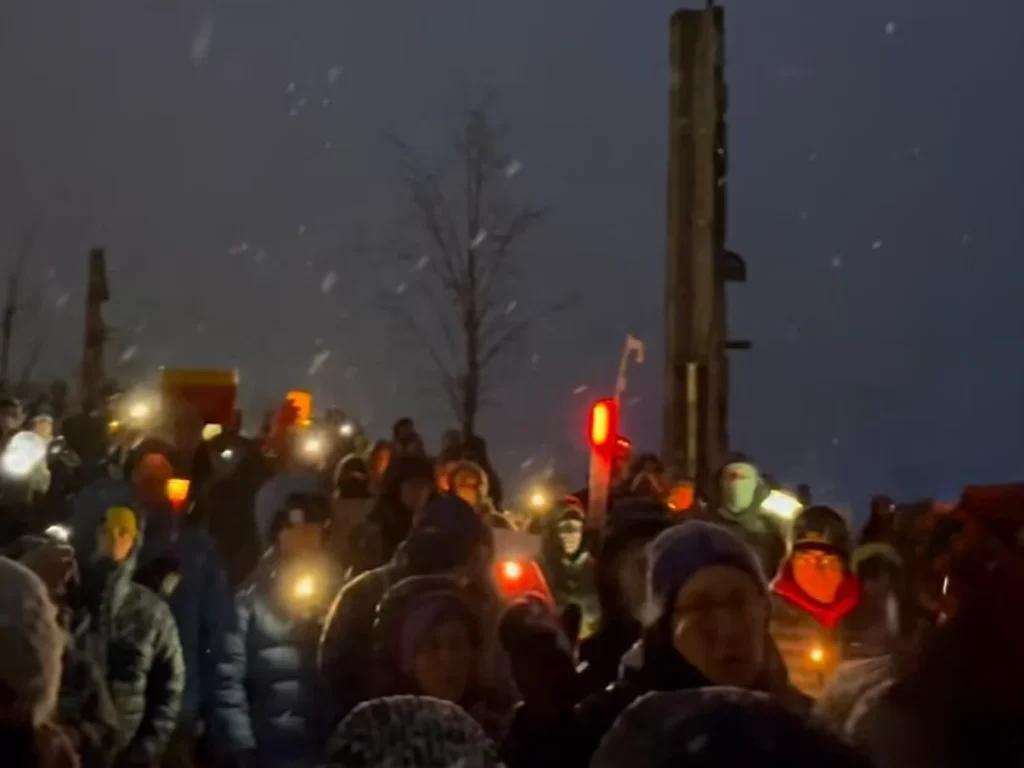
NOTN- Juneau for Democracy and the ReSisters held a peaceful pop-up protest in Juneau yesterday evening in solidarity with nationwide demonstrations which are being held due to recent federal immigration enforcement actions.
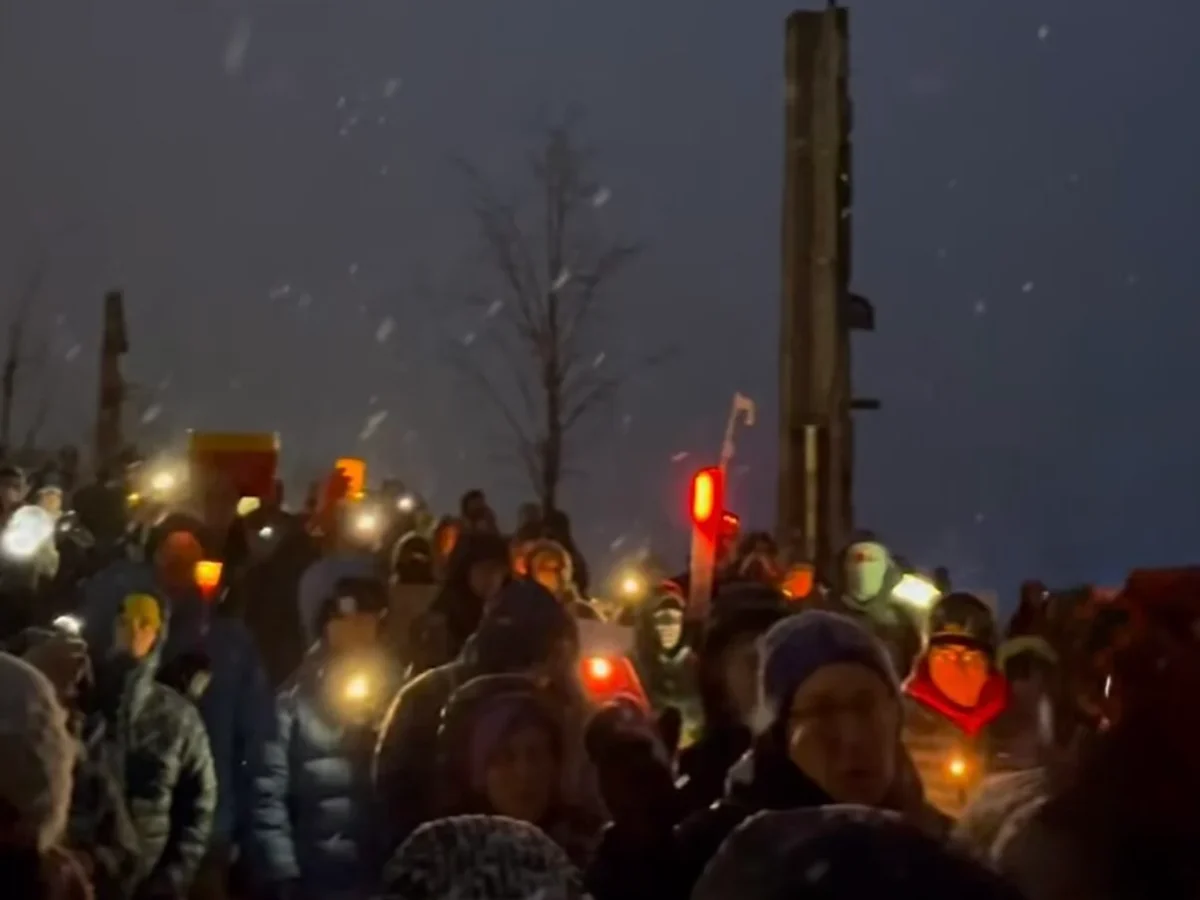
Juneau for Democracy invited residents to gather at The Whale for what the group called a candlelight vigil, to show support for people protesting Immigration and Customs Enforcement (ICE) agents across the country.
The event is part of a wave of protests that have followed several shootings and lethal confrontations with ICE agents, particularly in Minneapolis.
Protestors sang “This Little Light of Mine” in the lightly falling snow, posting on their social media to bring songs, poems, love and determination to share.