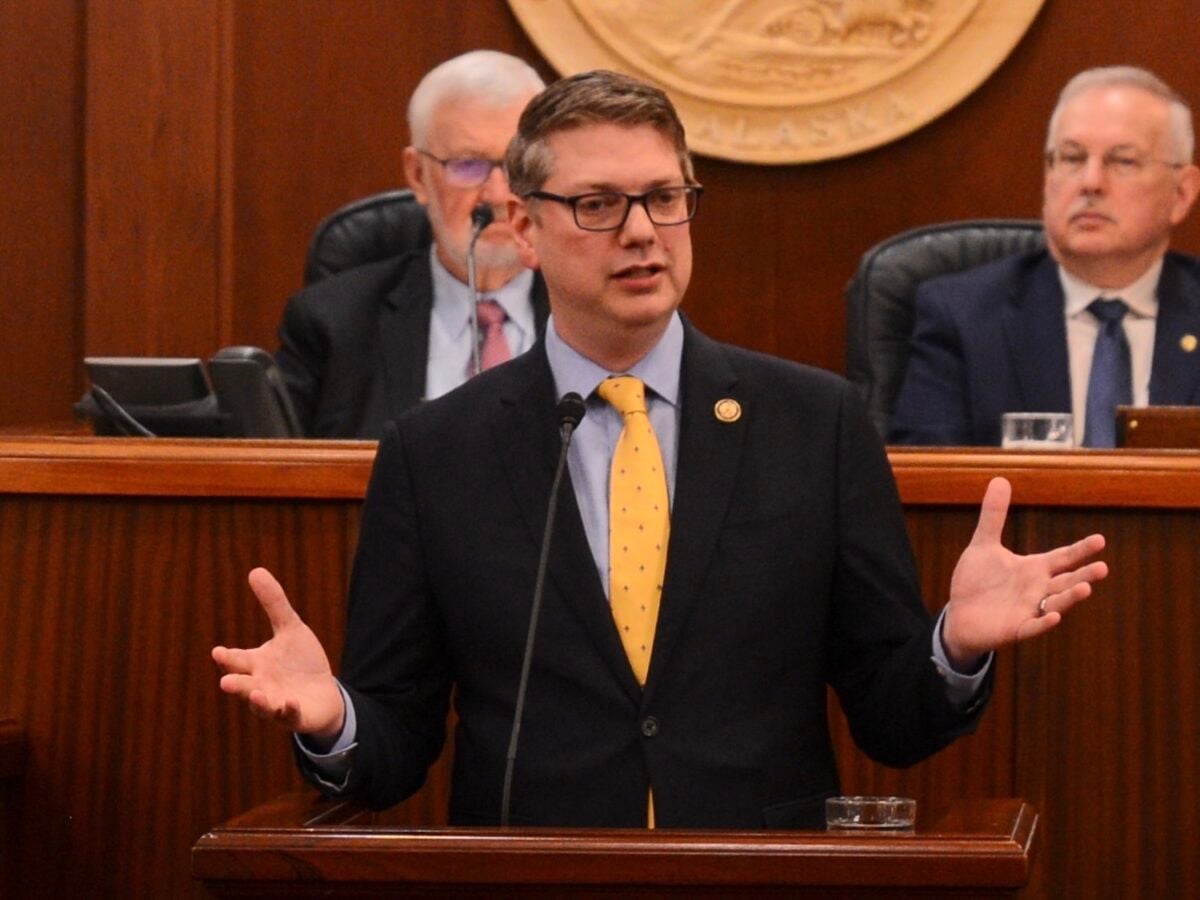
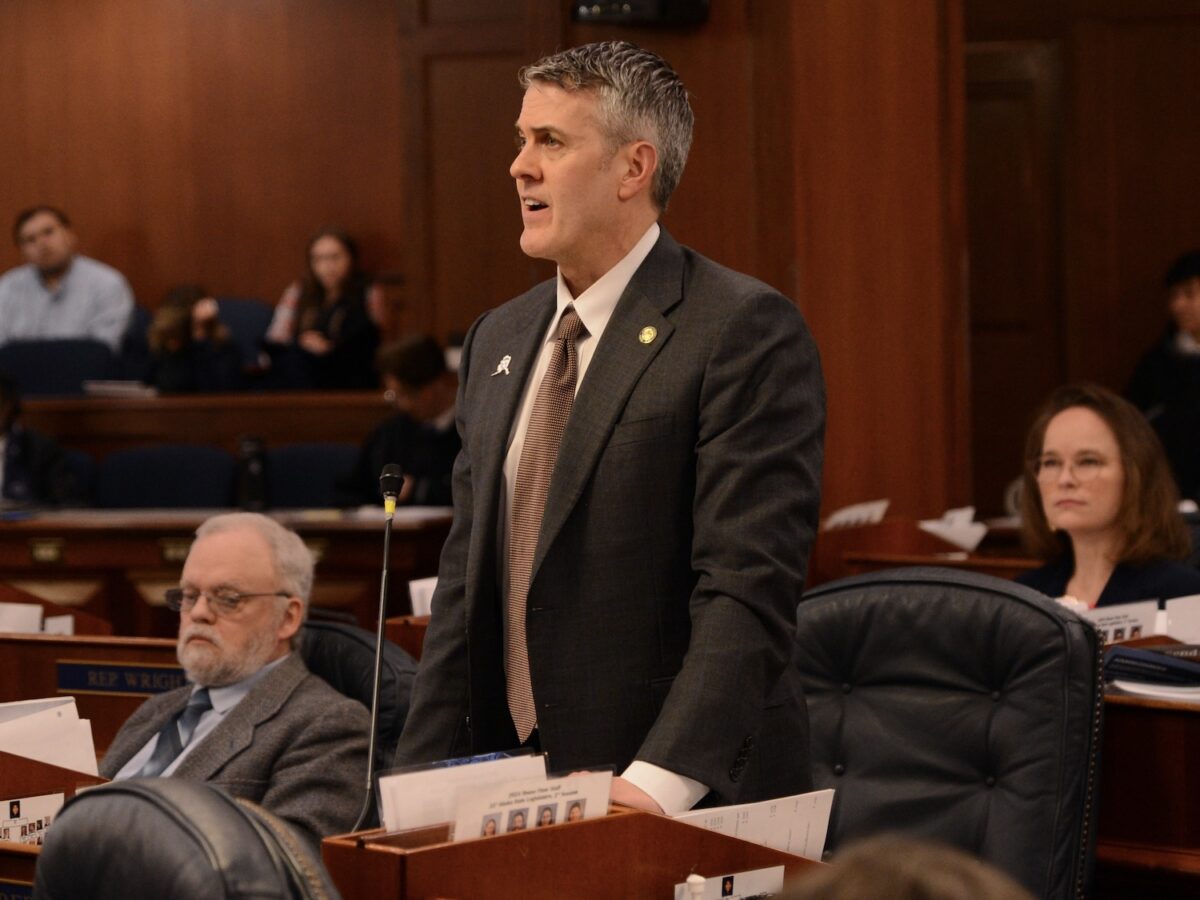
U.S. Rep. Nick Begich III, R-Alaska, speaks to a joint session of the Alaska Legislature on Tuesday, March 10, 2026. (James Brooks photo/Alaska Beacon)
By: James Brooks, Alaska Beacon
U.S. Rep. Nick Begich III, R-Alaska, speaks to a joint session of the Alaska Legislature on Tuesday, March 10, 2026. (James Brooks photo/Alaska Beacon)
The filing deadline for this year’s Alaska Permanent Fund dividend is March 31, and if Rep. Nick Begich III has his way, this year’s dividend will be tax free.
On March 3, Alaska’s lone member of the U.S. House introduced a bill that would exempt the dividend from federal taxes.
When Begich mentioned it during his address to state lawmakers this week, it garnered a standing ovation in the state Capitol.
Begich said afterward that passing the bill into law “is going to be a lift,” but in his first year as a Representative, Begich has found an unusual amount of success. On the day he introduced the tax-free dividend measure, he had a sixth prime-sponsored bill pass the U.S. Senate and advance to President Donald Trump.
Those six bills include two Congressional Review Act resolutions that repealed regulations adopted by the administration of President Joe Biden.
When members of Alaska’s Congressional delegation speak to the Legislature, it’s usually a platform to talk about their recent accomplishments, and Begich had plenty to talk about this year.
The number of bills he passed through Congress in his first year is a record, his office said.
According to the Center for Effective Lawmaking, when Begich’s sixth bill becomes law, he will tie former Rep. Rick Renzi, R-Arizona, for the most bills that became law in a freshman term.
The 119th Congress still has several months to run, and if Begich manages a seventh, he would set the record.
“No other House freshman in our data (going back to 1973) had six or more,” said Colin Achilles, the center’s associate director, by email.
At least some of Begich’s success is attributable to groundwork laid by his immediate predecessors, Democratic Rep. Mary Peltola and Republican Rep. Don Young.
He’s also received help from Alaska’s two senators, Republicans Lisa Murkowski and Dan Sullivan, who have been able to guide his legislation through the Senate after passing the House.
Begich’s House-and-Senate passed bills to date include:
A legal change making it easier for disabled Alaska Natives to qualify for some federal aid programs;
A measure repealing Biden-era limits on oil and gas leasing within the Arctic National Wildlife Refuge;
A law that distributes extra land to Alaska Native village corporations by eliminating an inactive trust;
A bill granting land to the Alaska Native village corporation for Saxman, in Southeast Alaska;
And a bill extending the amount of time that Alaska Native Vietnam War veterans or their families have to pick grants of federal land.
While the measures repealing Biden-era actions advanced along party lines, taking advantage of Republican control of the House, Senate and Presidency, Begich’s other bills have gotten unanimous support in the House, from Democrats and Republicans alike.
Speaking to the Alaska Legislature, Begich said that “not every bill is a touchdown pass, but every bill puts (points) on the board. We are getting points on the board for the state of Alaska, and we will continue to look for opportunities to do that.”
After his speech, he acknowledged that the dividend bill is something closer to a deep pass than a short run down the middle, but it helps to be ready for an opportunity.
“You have to have these bills in existence in order for them to have an opportunity to pass. And sometimes a must-pass piece of legislation will show up, and you’ll have an opportunity to attach a priority for your district,” he said. “In our case … we wanted to make sure that we had this in the clip ready to go. When that opportunity arrives, sometimes it happens faster than you think it will. Sometimes it takes a while, but you have to have the legislative text ready to go for the moment that arrives, and that’s what we’re doing on that bill.”
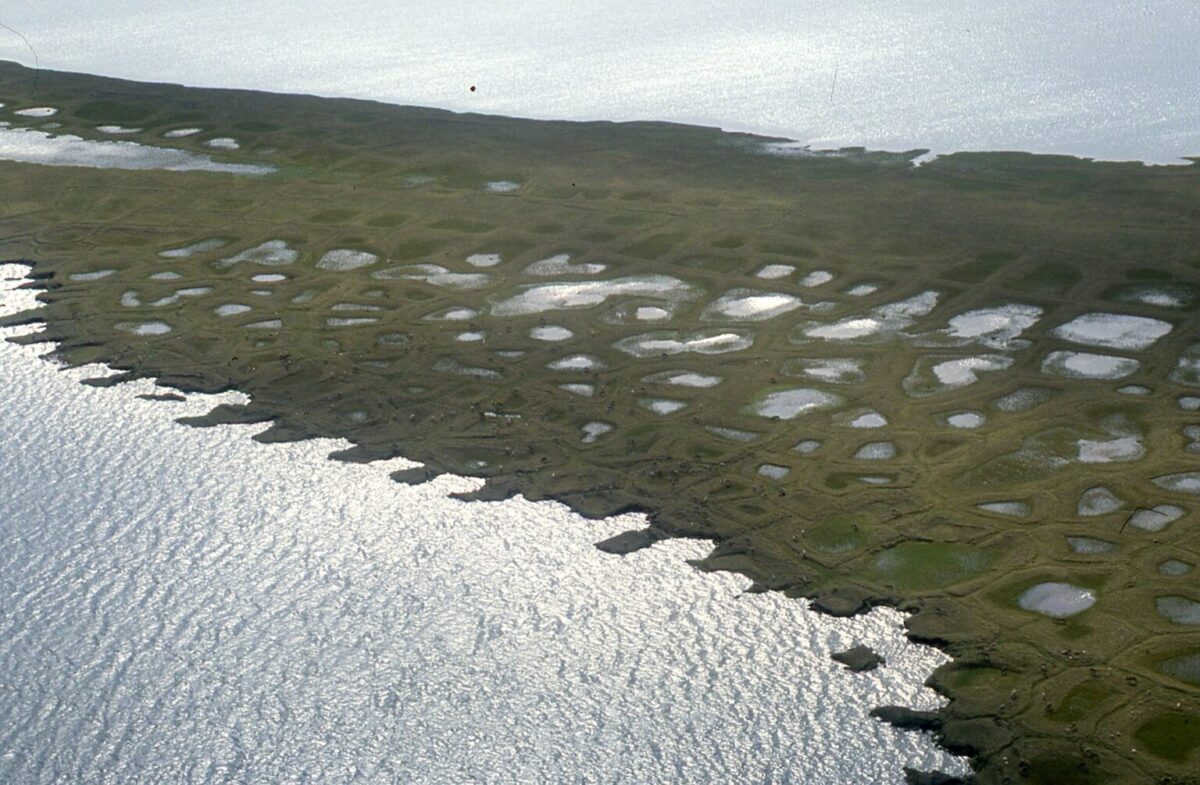
Surface pools on the edge of West Long Lake in the Teshekpuk Lake Special Use Area of the National Petroleum Reserve in Alaska are seen in this undated photo. The pools are formed by permafrost. Summer melt creates pools of water on the surface, creating thousands of sites that support wildlife. The Teshekpuk Lake area is important to subsistence harvests and had been protected from development for decades, but the Trump admininistration is now trying to sell oil leases there. (Photo by Laura McDuffie/U.S. Geological Survey Alaska Science Center)
Just six days before the Trump administration is set to open bids in the first of several oil and gas lease sales for federal territory in Arctic Alaska, critics were in court on Thursday trying to win injunctions to temporarily block some or all of the sale.
In one case, a Native organization called Grandmothers Growing Goodness and an environmental organization, The Wilderness Society, are seeking to fully prevent the scheduled March 18 sale in the National Petroleum Reserve in Alaska, a federal land unit stretching across Alaska’s western North Slope. The sale is offering 5.5 million acres, a larger geographic scope than most of the NPR-A lease sales held since 1999.
The Grandmothers Growing Goodness-Wilderness Society lawsuit is also seeking to overturn a new Trump administration management plan that opens 82% of the Indiana-sized reserve to oil development. Previously, only about half of the reserve was available for leasing, and several areas had protective status. Among those areas was Teshekpuk Lake and its adjacent wetlands and tundra, which provide key habitat for a caribou herd, numerous species of migratory birds, fish and other Arctic animals.
The other case, filed by an organization representing residents of Nuiqsut, is narrower.
Nuiqsut is the North Slope Inupiat village closest to existing NPR-A development. The Nuiqsut lawsuit is seeking to reinstate a program that protects an environmentally sensitive portion of the reserve that had been off-limits to oil development until the Trump administration jettisoned those protections.
The Nuiqsut lawsuit concerns a right-of-way agreement struck with the Biden administration and Nuiqsut Trilateral Inc., an organization formed by Nuiqsut’s city and tribal governments and its village for-profit Native corporation. The agreement, made final in 2024, protects about 1 million acres in the area of Teshekpuk Lake by barring leasing and other development not approved by Nuiqsut Trilateral.
In December, the Trump administration abruptly canceled that agreement, citing the potential for oil in the right-of-way area.
That cancellation, which was announced without any consultation or advance warning to the villagers, caused immediate harm, said Travis Annatoyn, an attorney for the Nuiqsut plaintiffs.
“From the moment Interior canceled the right of way, it advertised its intent to grant competing property rights on top of the subject acreage. That is an invitation to administrative and judicial chaos down the road,” Annatoyn told U.S. District Court Judge Sharon Gleason during the day’s second hearing. “This court should foreclose that chaos by issuing a narrow injunction and stay for just the area of the right of way. We are not seeking relief across the reserve. We are not seeking relief sale-wide.”
Gleason stated her intention to issue rulings before bids are unsealed on Wednesday, Mar. 18.
She said Nuiqsut plaintiffs presented a more compelling case for a temporary injunction. That case concerns property rights, not just “more esoteric” environmental and subsistence protections.
A caribou from the Teshekpuk herd grazes on June 27, 2014, in the National Petroleum Reserve in Alaska. The herd is named for the lake, the largest on the North Slope. The herd uses the tundra adjacent to the lake for calving. (Photo by Bob Wick/U.S. Bureau of Land Management)
“I do see that there are far greater reasons for injunction as to this preliminarily, until the merits can be fully fleshed out,” she told U.S. Justice Department attorney Paul Turcke, who argued on behalf of the Department of the Interior at both hearings.
If the Teshekpuk-area leases are sold and the case is later decided in Nuiqsut Trilateral Inc.’s favor, that could create challenges for numerous parties, Gleason said.
The right-of-way agreement stemmed from environmental and subsistence stipulations in the Biden administration’s 2023 approval of ConocoPhillips’ giant Willow project, and it was a condition of Nuiqsut residents’ endorsement of that project. Willow is set to become the North Slope’s westernmost producing oil field. Conoco Phillips expects production to start in 2029, with an eventual peak of 180,000 barrels per day.
The right-of-way agreement focused on the Teshekpuk Lake area because it is important to Inupiat subsistence food-gatherers.
Under Trump administration terms, Teshekpuk-area protections that had been in place for decades no longer exist. That auction offers some areas at Teshekpuk Lake that have never previously been open to leasing, including parts of the lake itself.
Turcke argued at Thursday’s hearing that the federal government already protects subsistence rights diligently and does not need the right-of-way agreement to do so.
He also argued that Congress has already effectively struck down the restrictions imposed by the right-of-way agreement.
That happened last year, when Congress passed the sweeping budget and tax bill called the “One Big Beautiful Bill Act,” he said. The bill mandated a series of at least five NPR-A lease sales to be conducted over 10 years under terms of management plan proposed by the first Trump administration.
Turcke also disputed the idea that including the Teshekpuk area in the lease sale would cause irreparable harm to the Nuiqsut plaintiffs.
“It sounds concerning when they say that their property rights could be impacted, but again, the whole property right that they’re really talking about is the ability to just leave it the way it is right now. And that’s not going to change whether leases are issued or not,” he said.
But Annatoyn said Nuiqsut residents are already suffering impacts from the administration’s actions.
“They wake up every day. They see and smell and hear the trucks going to Willow,” he said.
Both lawsuits were originally filed in U.S. District Court in the District of Columbia but transferred last month to federal court in Alaska.
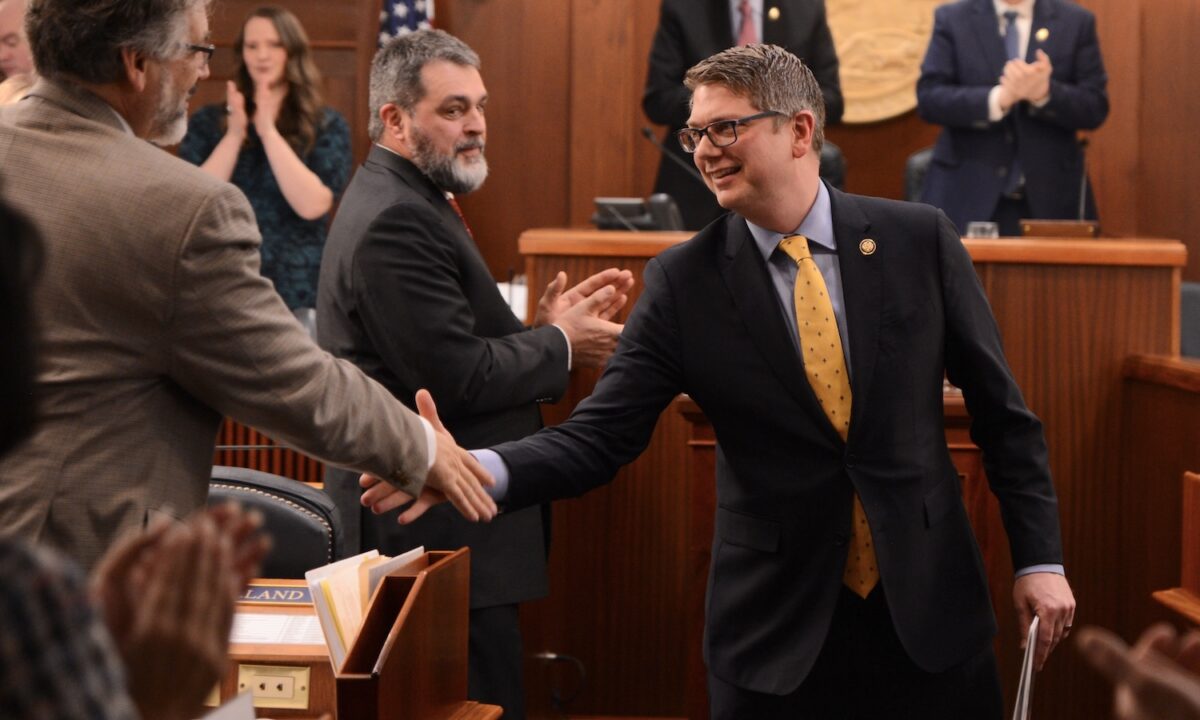
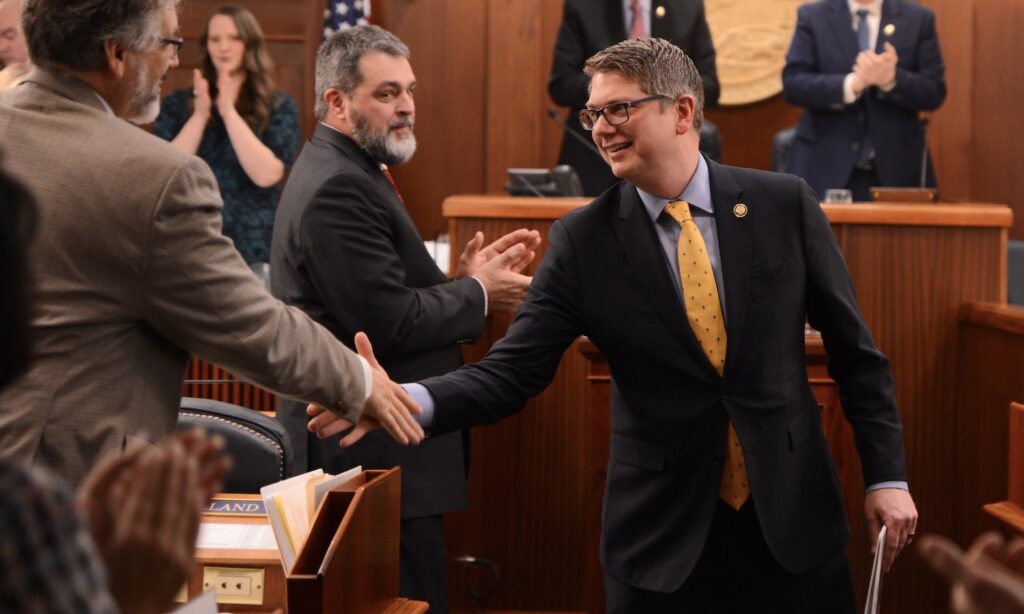
Rep. Nick Begich III, R-Alaska, shakes hands with state Rep. Ky Holland, I-Anchorage, as he leaves a joint session of the Alaska Legislature on Tuesday, March 10, 2026. (James Brooks photo/Alaska Beacon)
By: James Brooks, Alaska Beacon
Rep. Nick Begich III, R-Alaska, shakes hands with state Rep. Ky Holland, I-Anchorage, as he leaves a joint session of the Alaska Legislature on Tuesday, March 10, 2026. (James Brooks photo/Alaska Beacon)
In a speech to the Alaska Legislature this week, Alaska Rep. Nick Begich III urged state lawmakers to boost the development of a proposed trans-Alaska natural gas pipeline.
“The federal path is largely cleared, but investors also need state level clarity, fiscal predictability and simplicity,” Begich said. “Scrutinize it carefully, model it thoroughly. But my request to you is not to become a roadblock.”
But legislators who are dealing with the pipeline on a daily basis say they don’t have answers to basic questions, including how much the pipeline will cost and whether the gas it carries will be affordable to Alaskans.
“I have not seen any figures,” said Sen. Cathy Giessel, R-Anchorage and chair of the Senate Resources Committee.
Senate President Gary Stevens, R-Kodiak, said legislators are not going to be a roadblock.
“We’re not going to throw sand in the works. Everybody wants a pipeline. We all hope that it comes about, but it’s got to be done properly and make sure that we know what’s going on.”
Sen. Bill Wielechowski, D-Anchorage, said he has heard “from very credible sources” that the price of gas through the pipeline could be $50 per million cubic feet by 2046.
The current cost of gas from Cook Inlet for Southcentral Alaska is about $10 per MCF.
“Just imagine if you have utilities locked into 30-year contracts for gas at $50 an MCF. That would be catastrophic,” Wielechowski said. “That’s the sort of thing that we’re trying to protect Alaskan consumers all up and down the Railbelt from — an absolute catastrophe to our economic system.”
As currently proposed, the pipeline project consists of two phases. The first phase includes an 807-mile pipeline from the North Slope to the west side of Cook Inlet, with a tie-in to existing natural gas infrastructure around Anchorage.
The second phase would extend the pipeline to the Kenai Peninsula, where an export terminal would be built. The second phase would also include a processing plant on the North Slope.
Since the acquisition, Glenfarne has signed a number of nonbinding agreements with potential gas purchasers and gas sellers, but it has not disclosed estimates for the project’s cost, and it hasn’t disclosed what it expects the cost of gas to be.
Last year, company officials said they expected to make an investment decision by the end of 2025. In a subsequent filing with the Federal Energy Regulatory Commission, they said they would make the decision in February. A new timeline hasn’t been made public.
The lack of data is particularly problematic because legislators are considering whether to offer a property tax break to pipeline developers.
Those taxes are significant. Because Alaska does not have a statewide income tax or sales tax, its state budget suffers when people move into the state. More people means more demand for things like schools, parks and roads, but no increased revenue to pay for those things.
“That bill should be next week,” Dunleavy said during a Thursday news conference with U.S. Interior Secretary Doug Burgum, confirming the 0.2% rate will be part of the new legislation.
“Last couple weeks, we’ve been working with municipalities, getting their input as to what this should look like before (we) put the bill out,” he said. “So look forward to probably next week on that PILT bill, so that we can look at the economics of this line and also ways to ensure that municipalities benefit from this directly.”
This week, Begich expressed some support for a lower property tax rate, saying it could encourage people to invest in the pipeline.
“The classic 2% tax burden that would apply, say, to a $50 billion asset, would be a billion dollars in cash flow early in the project’s life cycle,” Begich said. “If that cash flow coming out of the project lowers the rate of return for investors, they’re not going to show up and invest. And so we need to make sure that our tax policy is A, doing what’s right for Alaskans. B, is not impeding the ability for the project to move forward. And I think we can do both of those things with some creative thinking and conversations with the industry.”
While a lower tax rate would benefit pipeline developers, it has the potential to harm residents who live near the pipeline.
If pipeline construction and operation mean more people moving to Alaska and municipalities are unable to raise revenue to meet the resulting demand for services, local governments could be forced to raise taxes or cut basic services in order to pay for the pipeline subsidy.
Last week, the Senate Resources Committee introduced Senate Bill 275, which imposes some transparency requirements on the pipeline project, eliminates a tax exemption relevant to the project, and imposes a new surcharge on gas processing plants.
That bill was introduced just days before Begich urged lawmakers not to be a “roadblock.”
Giessel, who chairs the resources committee, said she didn’t think Begich’s comments were directed at her or her committee’s bill.
“We’re not being a roadblock. We’re doing exactly what we’re supposed to do according to our constitution,” she said.
Asked whether he was thinking of Giessel’s bill during his speech, Begich said, “It was not my direct intention. No, I think it’s always worth having the conversation about the tax structure, about the incentive structure, though that’s an ongoing discussion that happens at the state legislature in Alaska. I think it’s important that when we have those conversations, they’re done in a way that is going to encourage, rather than discourage, industry from coming in and saying, ‘Yes, this is a good place for us to invest in.’”
Speaking to reporters after his speech, Begich said the state would benefit by getting more information from Glenfarne.
“I welcome more information,” Begich said. “I recognize that they’ve got certain restraints on what they can share. But look, I’d like to see more information shared. I’d like to see more of the economics of the project shared so we can understand what the full potential is and what’s on the table. I believe that’s going to come with time, but more information is better.”
Members of the Alaska Organized Militia board an Alaska Army National Guard CH-47 Chinook helicopter, assigned to the 207th Aviation Troop Command, while traveling from Bethel to Tuntutuliak, Alaska, during storm response operations after Typhoon Halong on Oct. 23, 2025. (Courtesy photo)
Officials with the Alaska National Guard said plans to deploy a trained rapid response force this month to support federal authorities in Washington D.C. has been pushed back to May.
Gov. Mike Dunleavy in November approved the U.S. Secretary of the Army’s request for 100 service members to deploy to the nation’s capital as part of a joint federal task force this month. The effort is part of a national directive by the Pentagon to all 50 states to prepare National Guard service members to train for “civil disturbance operations.”
By email on Tuesday, a spokesperson for the Alaska National Guard said the timeline has been extended.
“The Alaska National Guard remains in contact with the Pentagon, through the National Guard Bureau, and continues to move through the established processes to support Joint Task Force-District of Columbia,” said Dana Rosso, a public affairs officer with the Alaska Department of Military and Veterans Affairs, which houses the Army and Air National Guard divisions.
“The current activation timeline has been refined to May 2026,” he wrote.
As of January, there were roughly 2,700 National Guard members stationed in Washington D.C., which the Trump administration has said is to help drive down crime. Service members are expected to be stationed there through the end of the year. On Tuesday, an additional District of Columbia Army National Guard brigade was activated “to coordinate military support to civil authorities and protect critical infrastructure in the nation’s capital.”
A spokesperson for Dunleavy’s office declined to comment on the extended timeline on Wednesday.
Torrence Saxe, commissioner of the Alaska Department of Military and Veterans Affairs, speaks at an Oct. 13, 2015, news conference about the impacts of Typhoon Halong’s to Western Alaska and the response there. Behind him and also speaking at the news conference, which was held at Gov. Mike Dunleavy’s Anchorage office, is National Weather Service meterologist David Kramer, U.S. Coast Guard Sector Western Alaska and U.S. Arctic Commanding Officer Captain Christopher Culpepper and Ryan Anderson, commissioner of the Alaska Department of Transportation and Public Facilities. (Photo by Yereth Rosen/Alaska Beacon)
At the time the request was announced, Maj. Gen. Torrence Saxe, Adjutant General of the Alaska National Guard and Commissioner of the Alaska Department of Military and Veterans Affairs, said in a letter to lawmakers that 100 service members were in training for the mission to be “aligned with nation-level requirements.”
“The team will consist of Alaska Army and Air National Guard personnel trained in mission sets that may include site security, roadblocks and checkpoints, civil disturbance control, critical infrastructure protection, and personnel security,” Saxe wrote.
But the process for how the deployment was requested and approved still isn’t clear.
Dunleavy’s office could not find a copy of the U.S. Secretary of Defense that requested the deployment, a spokesperson for the governor’s office said Wednesday. When asked if the request was made verbally, Jeff Turner, Dunleavy’s director of communications, referred the question back to the Alaska Department of Military and Veterans Affairs.
The division did not answer a request for comment on Wednesday.
Rep. Andrew Gray, D-Anchorage and co-chair of the Joint Armed Services Committee, is a veteran of the Alaska National Guard and was among lawmakers that raised concerns in November when the announcement was made. He questioned the legality of the directive in an interview on Wednesday.
“Until they get something in writing, then there’s no actual deployment to prepare for,” Gray said.
“I think it’s a big misuse of the American taxpayer dollar to fly any soldiers from Alaska to D.C. for what we know is a trash pickup mission in many ways, and it’s a waste,” he added. “It’s just a waste of taxpayer dollars. So I hope that it continues to get pushed off indefinitely and that it never happens.”
A plume of smoke rises after an explosion on Feb. 28, 2026 in Tehran, Iran. (Getty photo)
All three members of Alaska’s delegation to Congress showed their support for the new war with Iran last week, voting against resolutions intended to restrain President Donald Trump.
The Alaska legislators’ votes were in line with their past actions. Last year, when Trump ordered a bombing campaign against Iranian nuclear facilities, all three said they supported the strikes.
The current war is significantly larger than last year’s attacks, and Trump has said he is seeking Iran’s “unconditional surrender” and wants to have a role in picking its next leader.
Neither he nor senior administration officials have given firm long-term plans, and they have not ruled out the deployment of soldiers on the ground in Iran.
Begich issued a statement on Feb. 28 calling the war “a necessary and targeted response” and said he supports regime change in the country.
“The path forward cannot be centered on further appeasement but the removal of this corrupt, fanatical leadership that has brought suffering to the Iranian people and threatens our peace at home. In so doing, we can provide the people of Iran the opportunity to change leadership, reclaim their sovereignty, and chart a new course,” the statement said in part.
Begich is in the middle of a re-election campaign, and his two leading challengers issued statements opposing the war.
By email, Democratic U.S. House candidate Matt Schultz criticized Begich’s vote and suggested he would have chosen differently.
“Our tax dollars should build schools and hospitals here at home, not bankroll endless foreign wars. But Washington always seems to find billions for war while Alaskans pay the price with sky-high costs and watch investments in our future get delayed, downsized, or ignored,” he said.
“The cost of war isn’t just dollars and cents, it’s measured in human lives and suffering. As a pastor, I believe every life is sacred. That’s why the Constitution requires Congress to approve war: so no president can send Americans into conflict without a real plan and the support of the American people.”
A spokesperson for independent U.S. House candidate Bill Hill referenced that candidate’s posts on social media when asked about his position.
“Our leaders should be investing in lowering costs and making life better for working Americans, not putting American lives at risk in foreign wars without congressional approval,” Hill wrote in a Wednesday post on Facebook.
“Six U.S. service members have died and billions of dollars have been spent in a matter of days. Meanwhile here at home, our schools are in crisis, healthcare costs keep rising, veterans are at risk of losing benefits, and everyday costs are just too damn high,” he wrote. “We can’t afford a costly war with no end in sight.”
On the Senate side, Murkowski said the resolution presented to her this week would have required the removal of soldiers from hostilities, stopping military operations immediately.
“The abrupt cessation of all offensive operations would not leave any Americans — soldiers, diplomats, or civilians — in the Middle East in a safer position,” her statement said in part.
Murkowski said Trump has “committed U.S. troops to active engagement in combat with an enemy that has targeted and killed Americans for decades. We have lost six soldiers in this fight with the potential for more casualties. What our troops need now is for our Congress, and this country, to know that they are supported. It is for this reason that I oppose Senator Kaine’s War Powers Resolution — based on the practical implications of its passage.”
Sullivan has supported military action against Iran for years and told reporters on Feb. 28, “I’m not someone that, in general, would support kind of taking out world leaders,” he said. “But I think these guys, … my belief is that they’re less world leaders than terrorists, right?”
“This country’s been at war with us for almost a half century,” he said, referring to Iran, “and they’ve killed thousands and wounded thousands of our best and brightest.”
Sullivan is also facing a re-election campaign this year, but unlike on the House side, there isn’t a bright line between the incumbent and his leading opponent on this issue.
Democratic U.S. Senate candidate Mary Peltola hasn’t made any public statements about the Iran war, and her campaign social media accounts have been silent on the subject.
When contacted Thursday, her campaign spokesperson said she had no comment.
That makes it unclear whether she supports or opposes the war.
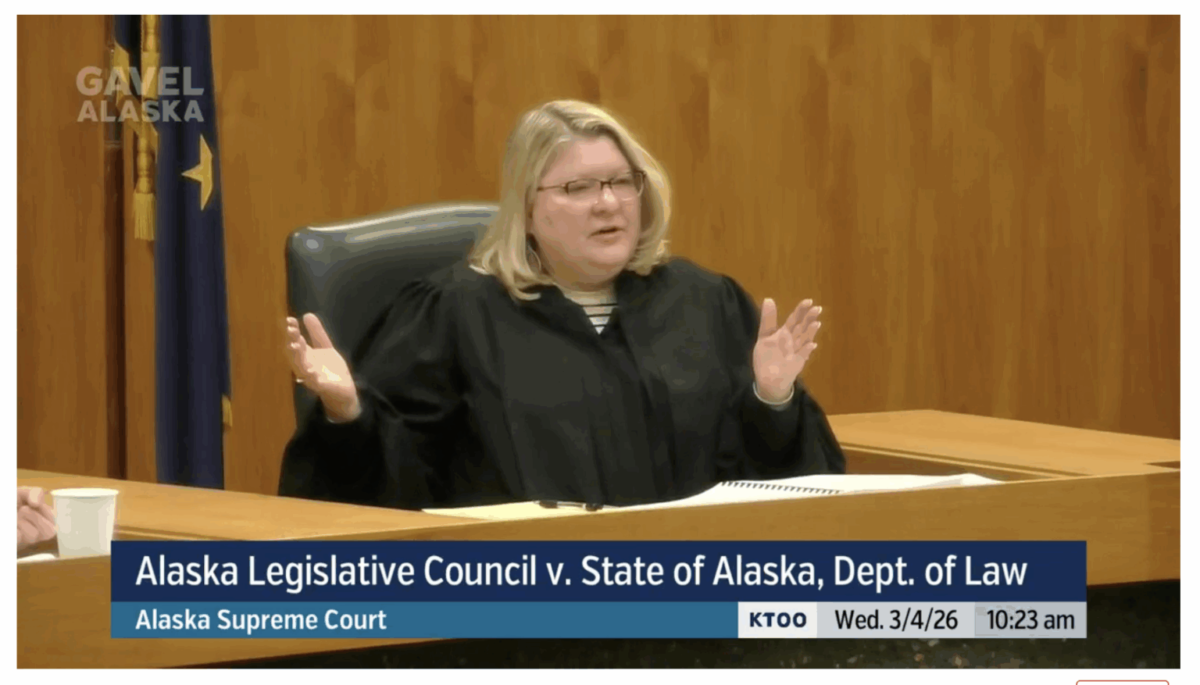
In this screenshot from Gavel Alaska, Alaska Supreme Court Justice Aimee Oravec speaks during a hearing on Wednesday, March 4, 2026. (Screenshot)
For years, politically conservative members of the Alaska Legislature have attempted to restrict state-paid abortion care via language in the annual state budget.
That maneuver and similar actions could be ruled unconstitutional by the Alaska Supreme Court, which on Wednesday heard oral arguments in a lawsuit that may determine the limits of the Alaska Constitution’s confinement clause, which requires that budget bills be limited to spending and not include policy changes.
Legislators said the contract, at more than $600,000, was too expensive, and in 2020 and 2021, they carved the budget for the Alaska Department of Law into two segments in an attempt to limit the contract.
Two of the governor’s attorneys general said they believed the Legislature was actually targeting the union dues plan, and its actions thus represented an unconstitutional infringement of the executive branch’s power.
Dunleavy vetoed the contract-specific language, technically eliminating all funding for the defense, and his administration kept on spending.
The Legislature’s auditor concluded in 2023 that the Dunleavy administration likely violated state law and the Alaska Constitution by continuing to spend money that had been eliminated from the budget.
Lawmakers sued in January 2024.
By that time, the Alaska Supreme Court had ruled that the union-dues changes had been enacted illegally. Four days after the Legislature filed its lawsuit, the U.S. Supreme Court said it would not hear an appeal requested by the administration, an act that leaves the state supreme court’s ruling in place.
In 2025, over the Legislature’s objections, Anchorage District Court judge Dani Crosby ruled that lawmakers’ lawsuit was moot because the money had already been spent, and she dismissed it.
Legislators appealed to the Supreme Court, arguing that there is a public interest in having the issue resolved, because it is likely to return again.
“That idea of no funding for this, some funding for that, these conditions are a regular feature of the budgeting process,” he said in Wednesday’s oral argument, arguing that the issue is not moot.
Deputy Solicitor General Jessie Alloway represented the state in Wednesday’s hearing and said the abortion issue is an example of why the court should decline to take up the Legislature’s arguments.
“This is exactly why the court should say this is moot and not take a more abstract view … because there is an unlimited number of hypotheticals that we could come up with that would be problematic,” she said.
If the court does overrule Crosby, both sides asked the justices to give them a firm answer rather than having Crosby take up the issue again.
The justices would then have to decide whether legislators overreached by attempting to restrict the executive branch, whether the executive branch overreached by continuing to spend, and where exactly the line rests between legislative and executive power.
“That’s what we keep coming back to: Who gets to decide this, whether these contracts are necessary?” asked Justice Aimee Oravec.
One prior Supreme Court case discussed Wednesday may offer some clues. In 2001, the court ruled on a legislative lawsuit against then-Gov. Tony Knowles over a series of budget vetoes.
One of those vetoes involved a dispute over bed space bought by the state prison system in private facilities. Legislators wrote in the budget that the space had to be bought from private contractors.
The supreme court upheld that language in its ruling.
“Conditions are permissible, as this court held in the Knowles case,” said Cuddy, the Legislature’s attorney, “including saying what types of services, public versus private, or private versus public, the money can be spent upon.”
But Alloway, arguing for the state, said legislators were attempting to define purchases that had already happened. That’s different from Knowles.
“What was happening was the (attorney general) had already retained outside counsel via his statutory authority. The Legislature knew about it, and then the appropriation targeted that decision by eliminating the amount the AG could spend on the contract,” she said.
During Wednesday’s argument, chief justice Susan Carney was absent. Staff for the court said she was recovering from surgery and out on medical leave.
Justice Dario Borghesan, a former Department of Law attorney, recused himself from the case, leaving three justices, all Dunleavy appointees, for Wednesday’s hearing. Justice Jennifer Henderson, presiding over oral arguments, said Carney may be involved in deliberations before a final decision is published at a later date.
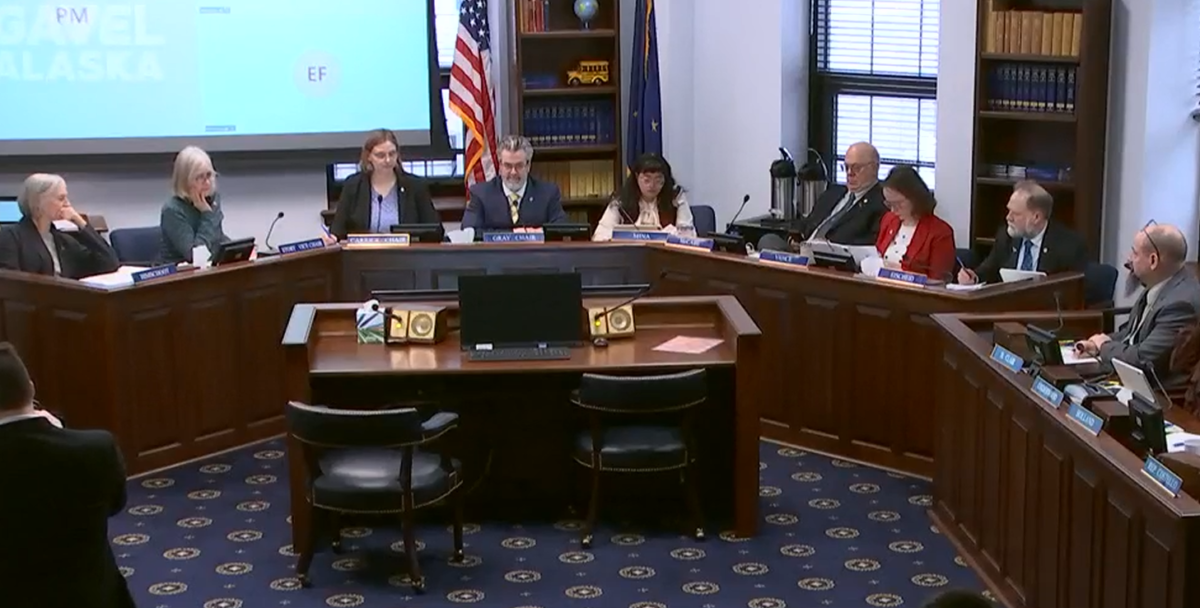
Judiciary presentation on March 2 on voter data sharing, photo courtesy of KTOO
NOTN- Alaska lawmakers are examining why the state turned over confidential voter information, including birth dates and parts of Social Security and driver’s license numbers to the U.S. Department of Justice.
In a joint hearing Monday of the House Judiciary and House State Affairs committees, Rep. Andrew Gray said the U.S. Justice Department’s 2025 request for complete voter registration lists from every state was unprecedented.
“This request by DOJ has never happened before, the Department of Justice has never asked for the confidential information of voters at any point in our history.” Gray said.
Alaska first sent only public voter information, but in December agreed to transmit a full electronic file with all data fields visible.
“On December 19, under the authority of Lieutenant Governor Nancy Dahlstrom, the state agreed to transmit an electronic voter file with all data fields visible, records were provided that included voter’s full names, dates of birth, residential addresses and either driver’s license numbers or the last four digits of social security numbers. Not every single state responded the way Alaska did.” Said Gray.
Attorney Libby Bakalar, who formerly represented Alaska’s Division of Elections, told lawmakers the disclosure likely conflicts with state law and Alaska’s constitutional right to privacy.
“Before I get into why this data transfer is problematic, if not unconstitutional, I just want to offer some context on the relationship between the state and federal government when it comes to running elections, the administration of elections in this country is the purview of the states. Those of you on the committee who support states’ rights would be pleased to know that states, including Alaska, maintain a lot of leeway and control over how their elections are run, issues like voter identification and voter list maintenance have historically fallen within the state’s remit. There is good reason for this.” She said, “For example, Alaska’s voter ID law allows for tribal IDs and confirmation of identity by a poll worker’s personal knowledge of the voter which aids voting in rural Alaska, where voters may not hold driver’s licenses or passports. We also have our own very detailed voter list maintenance statute that governs the way the division of elections adds and removes voters from the rolls and is supposed to determine who is eligible to vote in our state. The Alaska constitution, which affords greater protections of individual liberty than its federal counterpart, establishes a state based constitutional system of suffrage that includes provisions on the qualifications and disqualifications of voters. Perhaps most significantly, Alaska also has a specific constitutional provision that explicitly protects our citizens right to privacy.” She said.
Bakalar read from the federal agreement Alaska signed, under which the state pledged that within 45 days of receiving notice from DOJ about any “issues, insufficiencies, inadequacies, deficiencies, anomalies or concerns,” it would “clean its voter registration list by removing ineligible voters and resubmit the updated data.
“This process effectively turns Alaska’s independent voter list maintenance process into an audit and referendum by the federal government, in which the DOJ in Washington, has the final say over which Alaskans are allowed to vote here or not.” Bakalar said, “This has the potential to disenfranchise huge numbers of Alaskans at the whim of the DOJ, a whim which the DOJ may not necessarily be inclined to explain to the public’s satisfaction. And to what use will the DOJ put this data beyond just elections? We don’t know. We have seen aggressive immigration enforcement and unprecedented citizen surveillance under this administration. I think it’s fair to say that we cannot necessarily trust the federal government to use this data in good faith and for the purposes it claims.”
Election researcher Dr. Paul Manson of Portland State University warned that federal databases used to check voter eligibility are imperfect and often return non-matches that may still be U.S. citizens due to data inconsistencies.
He said that federal law bars large-scale voter removals in the 90 days before federal elections.
Lawmakers plan further questioning of state officials and experts about whether the Dunleavy administration’s cooperation was legally required and what protections now exist for Alaskans’ personal data.
Rep. Alyse Galvin at the Alaska House Education Committee presenting HJR39, photo courtesy of Gavel Alaska
NOTN- Alaska lawmakers are urging the federal government to waive steep new fees on H-1B visas for international teachers, warning that hundreds of classrooms could be left without educators if school districts are forced to absorb the added costs.
On Monday, the Alaska House Education Committee heard testimony on House Joint Resolution 39, which calls on the state’s congressional delegation to seek an exception to a recent presidential proclamation that imposes a $100,000 annual fee per H‑1B visa holder.
Many Alaska districts, particularly in rural and remote communities, rely heavily on international teachers to fill longstanding vacancies.
Rep. Alyse Galvin, the sponsor of HJR 39, told the committee the resolution is meant to give U.S. Sen. Dan Sullivan and the rest of Alaska’s delegation a stronger hand in Washington, D.C.
“We are unfortunately without enough educators before students, and so we are facing a really tough time in recruitment and retention of teachers, especially in rural and remote communities. Many school districts across Alaska use international recruitment to fill our school vacancies, with cases of international hires filling 60% of the total teaching staff in western Alaska.” Said Galvin, “We heard last week about how hard they’re working to grow our own teachers, we are still facing this gap. Our H-1B teachers are very important to us, and with the most recent proclamation by the President, we now have an imposition of a $100,000 fee for any employer who is hiring H-1B, so any new ones coming in will be having to face that cost, at least our school districts will and this is insurmountable.”
Galvin said some districts also face deep budget holes, including an estimated $90 million deficit for the Anchorage School District alone and more than $200 million in combined shortfalls across the state. Many districts have already exhausted their reserves, she said.
The committee also heard from Dr. Lisa Parady, executive director of the Alaska Council of School Administrators, who said Alaska employs 573 international teachers, including 341 on H‑1B visas.
“Alaska is already facing a severe teacher shortage, at the start of the school year, we had at last report, 345, first day teacher vacancies, which equates to thousands of Alaska students beginning school without a teacher. Many Alaska districts, especially rural and remote communities, struggle annually to fill critical positions. International educators are not a luxury, without these educators, class sizes increase, course offerings shrink, student services are reduced, student outcomes suffer.” Said Parady.
Some lawmakers used the hearing to argue that while HJR 39 may help in the short term, it does not solve deeper problems with Alaska’s teacher workforce.
Rep. Andi Story, who co-chaired the committee Monday, heard concerns about pay and retirement. Galvin noted that unlike other states, Alaska does not have a single statewide pension system for all educators, and cited research that found Alaska’s average teacher salaries are roughly 30% lower than those in Washington state.
HJR 39 would not change the law, but would formally express the Legislature’s support for waiving or exempting Alaska school districts from the new visa fees.
Rep. Andrew Gray, D-Anchorage, speaks Friday, April 26, 2024, on the floor of the Alaska House of Representatives. (Photo by James Brooks/Alaska Beacon)
By: Corinne Smith, Alaska Beacon
Rep. Andrew Gray, D-Anchorage, speaks Friday, April 26, 2024, on the floor of the Alaska House of Representatives. (Photo by James Brooks/Alaska Beacon)
The arrest of a Soldotna family by U.S. Immigration and Customs Enforcement, including two teens and a 5-year-old, has prompted a wave of concern and lawmakers to hold an investigatory hearing on Monday on the arrest and detention of minors in Alaska.
“As far as I am aware, the detention of children by ICE in Alaska is unprecedented,” said Rep. Andrew Gray, D-Anchorage, who chairs the House Judiciary Committee. In opening remarks, he questioned if federal agents provided full due process to the family and honored legal protections for children.
“Is Alaska about to see more children detained?” he asked.
ICE agents arrested Sonia Espinoza Arriaga at her home in Soldotna on Feb. 17, and apprehended her three children — ages 18, 16 and 5. Arriaga is married to an Alaskan U.S. citizen and was in court proceedings to gain asylum after fleeing violence in Mexico, according to news reports. The next day, Arriaga and her two younger children were deported to Jalisco, where they remain. The 18-year-old was transported and detained at the Anchorage Correctional Complex and transferred on Feb. 20 to a privately-run ICE detention facility in Tacoma, Washington, according to news reports.
The arrest comes as ICE operations are ramping up in Alaska and nationwide, amid the Trump administration’s immigration crackdown. Gray noted the agency saw a historic funding increase last year and now has a budget of roughly $85 billion.
Anna Taylor with the Alaska Institute for Justice (top left), Rev. Michael Burke with St Mary’s Episcopal Church of Anchorage (top middle), Elora Mukherjee, a clinical professor of law at Columbia and director of the Immigrant Rights Clinic (top right), Rev. Meredith Harbor with the Christ Lutheran Church in Soldotna (bottom left), Rev. Lisa Adam Sherry with the Anchorage Unitarian Universalist Fellowship (bottom center), and Soldotna parent Alison Flack (bottom right) testified to the House Judiciary Committee on Feb. 23, 2026 on the recent ICE arrest of a Soldotna family and detention of minors in Alaska. (Screenshot of Gavel)
Members of the House Judiciary Committee put questions to officials with the Alaska Department of Corrections and Department of Public Safety on the extent of the state’s involvement in ICE operations and detention of minors. They also heard testimony from community members, attorneys and clergy expressing outrage and concern at ICE operations.
Gray said the committee had invited representatives from ICE and the U.S. Department of Homeland Security to testify about the arrest and issues raised, but they declined to appear. He said his office has submitted a list of questions to the agencies, including questions about due process, and have not yet heard back.
Gray said his office will be drafting a committee resolution urging a change in federal policy, and said if ICE fails to answer the committee’s questions, the committee will “look at other options for compelling their testimony.”
State agencies questioned on policy around detaining minors and cooperation with ICE
Jen Winkelman, commissioner of DOC, said the department has an agreement with federal authorities to detain people arrested under federal charges, including with ICE for civil immigration charges.
“Does DOC detain minors?” Gray asked. Winkelman said no.
Winkelman did not say in the committee meeting whether DOC would hold children detained by ICE.
“We have the contract for the federal government to hold individuals that may come in in a non-criminal capacity,” Winkelman said. “When the ICE agents detain somebody, they will bring them to us, the individual and a piece of paper that essentially authorizes us to hold them.”
In the case of Arriaga, her husband, Alexander Sanchez-Ramos, told reporters that initially she and her two youngest children would be held in a hotel in Anchorage and guarded by federal agents, but then he learned they were flown to San Diego the same evening of their arrest, then driven to the Mexico border and deported.
ICE did not immediately respond to questions on Tuesday about the expedited deportation of the Arriaga family and plans and protocols for detaining minors and families in Alaska.
Gray said the committee had invited representatives from ICE and the U.S. Department of Homeland Security to testify about the arrest and issues raised, but they declined to appear. He said his office has submitted a list of questions to the agencies, including questions about due process, and have not yet heard back.
Zane Nighswonger, director of institutions for DOC, told lawmakers that ICE detainees are held in state prisons, but are held separately.
“They’re basically subject to the same security measures we have for our prisoners. We do keep them separate from the prisoner population, as they’re non-criminally charged,” he said Monday. “They recreate separately from other prisoners, have access to their telephone calls separately from other prisoners, and then showers and things like that.”
Nighswonger said individuals arrested by ICE are typically held in Alaska jails and then transferred to federal detention facilities within 72 hours.
The Alaska State Troopers do not participate in ICE enforcement, Leon Morgan, deputy commissioner for the Alaska Department of Public Safety, told lawmakers on Monday. “We don’t coordinate with ICE for immigration enforcement,” he said.
Morgan said for criminal cases Troopers will work with federal partners, but not cases related to immigration enforcement. He said Troopers have a policy to mitigate effects of law enforcement actions when children are involved. “In terms of how ICE does their job, or what they do, that is just beyond or outside the scope of how we operate,” he said.
Rep. Chuck Kopp, R-Anchorage asked what state legislators can do to constrain ICE action in Alaska given federal authority outweighs state law.
Elora Mukherjee, a clinical professor of law at Columbia Law School and director of the Immigrant Rights Clinic, testified that lawmakers can not only speak out, raise concerns and demand answers from federal authorities, but states are also taking action to block ICE enforcement actions and developing new detention centers.
“I think your committee is doing exactly the right thing by inviting officials from the federal government, from ICE, from DHS, to testify about what is happening in Alaska,” she said. “Right now, it seems that in Alaska, as in many states across the country, the federal government does not want local and state legislators to know what they are doing.”
Advocates call arrests and detainments a ‘grave concern’
Attorneys and immigration advocates testified that the avenues for legal immigration are being cut back by the Trump administration at every level — from travel bans, to canceling visa and refugee programs, to petitioning to end birthright citizenship — resulting in more and more people being arrested and deported.
Arriaga had reportedly applied for and was in the process of obtaining asylum for her family. A spokesperson for ICE said she had failed to appear for a court hearing in January, prompting deportation, according to news reports.
Mukherjee testified that ICE is increasingly arresting and detaining children and families.
“From January to October 2025, at least 3,800 children under the age of 18, including 20 infants, were detained by US immigration authorities,” she said, and many are held beyond the legal limit of 20 days.
She spoke about her experience representing children and families held at the privately-run South Texas Family Detention Center in Dilley, Texas, and the traumatizing conditions of detention there.
“Among my other clients at Dilley have been a two year old boy who was breastfeeding in detention. A six year old boy had a leukemia diagnosis. An eight year old girl began wetting the bed. An 11 year old girl lost hearing in one year. A 14 year old girl engaged in self harm. All of these children and their parents were detained despite being eligible for release,” she said.
“ICE has the authority to release these families who are not flight risks on parole as they seek asylum and other forms of humanitarian protections in the United States,” she noted. “None of these children or their parents had a criminal history anywhere in the world.”
A Soldotna mother, Alison Flack, whose daughter attended kindergarten with Arriaga’s five-year-old, testified he was flourishing in school and learning English, and that the community is shaken by his arrest.
“We’re all now faced with the decision of what to tell our children,” she said. “Should I tell her that he moved and just hope and pray that she doesn’t find out the truth? Our state is better than this.
“I don’t want to tell my daughter that the grown-ups have done something so terrible, the ones she’s supposed to be able to trust,” she said.
Clergy members in Anchorage and Soldotna testified that the incident and actions from federal immigration authorities raise grave moral concerns.
“We believe there’s been a serious breach of what we as clergy leaders would consider basic sacred family values,” said Rev. Michael Burke, pastor of St. Mary’s Episcopal Church of Anchorage and speaking on behalf of a multi-faith group.
“We tore a family from their community rootedness in this recent event, and this harm that was done, potential harm to children that will have a lifetime memory of trauma was not caused by any bad actors other than those of the federal government themselves,” he said. “This raises grave concerns as a matter of policy, the rule of law and our fundamental ethical commitments to one another as members of the community.”
Student walks along West Ridge at the University of Alaska Fairbanks campus on Oct. 10, 2024. (Photo by Yereth Rosen/Alaska Beacon)
The University of Alaska Board of Regents says the university will continue the policy to ban references to “DEI,” or “diversity, equity and inclusion,” enacted last year, despite a federal court ruling that struck down the policy and the U.S. Department of Education agreeing to drop an appeal.
Jonathon Taylor, a spokesperson for the university, said even though the policy was struck down, “the direction of enforcement and potential risk has not gone away.”
Last year, the Trump administration issued a “Dear Colleague” letter to all pre-K through 12 schools, colleges and universities who receive federal funding outlining its opposition to diversity initiatives it called discriminatory, and threatened to withhold federal funds from schools if they had diversity or equity programs.
As a result, the board moved quickly to comply, approving a policy on Feb. 21, 2025 to scrub references to DEI and affirmative action from all university programs and operations, job titles and office names. At the time, Ralph Seekins, chair of the Board of Regents, defended the policy, saying the action to remove DEI language as committing to “equal opportunity” for everyone.
Several education and civil rights groups filed lawsuits and a federal court blocked the directive in April. This week, a New Hampshire federal judge dismissed the case, following a January agreement by both parties and the Department of Education to drop its appeal. The ruling invalidates the directive, and prevents the government from enforcing it. Plaintiffs celebrated the court’s move, with some saying it was a victory for free speech and academic freedom.
Taylor confirmed that the UA Board of Regents had no immediate plans to change or rescind the policy for the University of Alaska.
“The Dear Colleague Letter from February 2025 has indeed been struck down by the courts, and the Department of Education has declined to appeal,” Taylor said by email.
“However, the federal administration’s policy goals and concerns that led to the letter – including what they see as discriminatory DEI practices, and attempts to tie enforcement to federal funding – have not changed. Federal agencies can still pursue similar goals through other legal or regulatory means and have demonstrated an intent to focus oversight or investigations on what they see as DEI-related policies and programs using mechanisms other than agency guidance (the original Dear Colleague letter),” he wrote.
Taylor said the board enacted the policy to mitigate risks of federal funding being withheld. He said the board has had to “balance their concern about the potential medium- and long-term regulatory and funding risks to which UA may be exposed with the University’s unchanging and unwavering commitment to equal access, equal opportunity, and no discrimination, as well as free speech, academic freedom, and freedom of expression.”
Taylor added that overall, UA has so far been effectively able to “weather the storm” of federal funding cuts, grant freezes and terminations. As of September, and most recently available data, UA had roughly $530 million in active federal grants. There has been $24.6 million, or 4.6% that have been delayed, frozen or terminated.
The item was not on the Board of Regents’ February meeting agenda, scheduled for two days this week in Dillingham, at the University of Fairbanks’ Bristol Bay campus.
But several university faculty weighed in during public comment to the board on Monday.
Jill Dumesnil, a professor of mathematics at the University of Southeast and president of the largest faculty union, United Academics, called on board members to create updated guidance following the ruling.
“Many faculty are still experiencing a chilling effect on our campuses. Some fear retaliation or punishment for teaching or discussing DEI-related subject matter, others just feel uncomfortable, unsupported and unwelcome,” she said.
“Teaching about race, racism, inequality and related issues, continues to be lawful, supporting students in a way that acknowledges racial or ethnic identities continues to be lawful,” she added. “Schools may continue operating programs that encourage diversity, equity and inclusion in accordance with existing law, and the Dear Colleague letter and the certification requirement cannot be enforced against educators or schools.”
Michael Navarro, a professor of marine fisheries at the University of Alaska Southeast, and co-chair of the Belonging, Empowerment, Access, Representation and Safety Committee, known as UAS BEARS, made a plea to the board to rescind the anti-DEI motion.
“As a direct result of this board decision, UAS has lost faculty and staff and some students question the university’s commitment to their success and safety on campus,” he said.
“Despite the anti-DEI motions, reaffirmation towards maintaining a welcoming environment and honoring Alaska Native culture and heritage, after this motion, many people now feel less welcome or even unwelcome, and are not testifying today because they don’t feel safe to do so.”
Taylor, with the university, said as of now the board does not have plans to take up the issue but continually accepts written comments from the public. “The Board continues to receive testimony both in support of and in opposition to last year’s motion, and takes that feedback into consideration when setting meeting agendas,” he said.
To date, the University of Alaska Fairbanks has taken the hardest hit with federal funding cutbacks — of the $24.6 million in grants delayed, frozen or terminated, approximately $20 million has been at UAF, including $8.8 million terminated for funded programs for Alaska Native and Native Hawaiian students last year. The Trump administration has terminated $4 million in grant funding at the University of Alaska Anchorage, Taylor confirmed, and no federal grant funding has been frozen at the University of Alaska Southeast.