President Donald Trump speaks to the media in the Oval Office at the White House on Sept. 2, 2025 in Washington, D.C.
President Donald Trump on Friday called on Alaska voters to repeal ranked choice voting at the November election.
“The Wonderful People of Alaska desperately want to restore Free, Fair, and Honest Elections in their Great State, and get rid of their disastrous, and very fraudulent, “Ranked-Choice Voting,” Trump said on Truth Social.
An effort to repeal ranked choice voting in 2024 failed by just 737 votes. A separate repeal initiative, sponsored by figures aligned with the Alaska Republican Party, is set to appear on the 2026 general election ballot.
Trump gave his “complete and total support” to supporters of the repeal effort, including U.S. Sen. Dan Sullivan and Congressman Nick Begich, both Alaska Republicans running for reelection in November.
The president’s post was seized on by Republican candidates for Alaska statewide office who echoed his calls to strike down the voting system.
Alaska voters narrowly approved a ballot measure in 2020 that implemented ranked choice voting for state and congressional elections, alongside open primary elections and tougher campaign finance disclosure requirements.
Ranked-choice voting in Alaska lets voters pick candidates in order of preference rather than choosing just one. If no candidate wins a majority of first-choice votes, the lowest-ranked candidate is eliminated and those votes are redistributed until someone surpasses 50% of votes.
However, the new election system has been controversial. Opponents argue that ranked choice voting is unnecessarily complicated, while supporters say it has led to more moderate and consensus candidates elected.
Ranked voting, open primaries and the tougher campaign finance disclosure requirements would all be struck down if the 2026 ballot measure is approved by a majority of voters.
Alaska for Better Elections is a group running voter education campaigns in support of retaining ranked choice voting and open primaries. Executive Director Juli Lucky said Alaska’s election system has allowed policymakers across the political spectrum to work together without fear of challengers in partisan primaries.
“I think Alaskans will reflect on the results we’ve seen to decide whether our system of open primaries, ranked choice voting, and the strictest campaign finance laws in the country works for them,” Lucky said by text message after Trump’s post. “Ultimately, Alaskans created and enacted this system, and Alaskans will decide whether we keep it.”
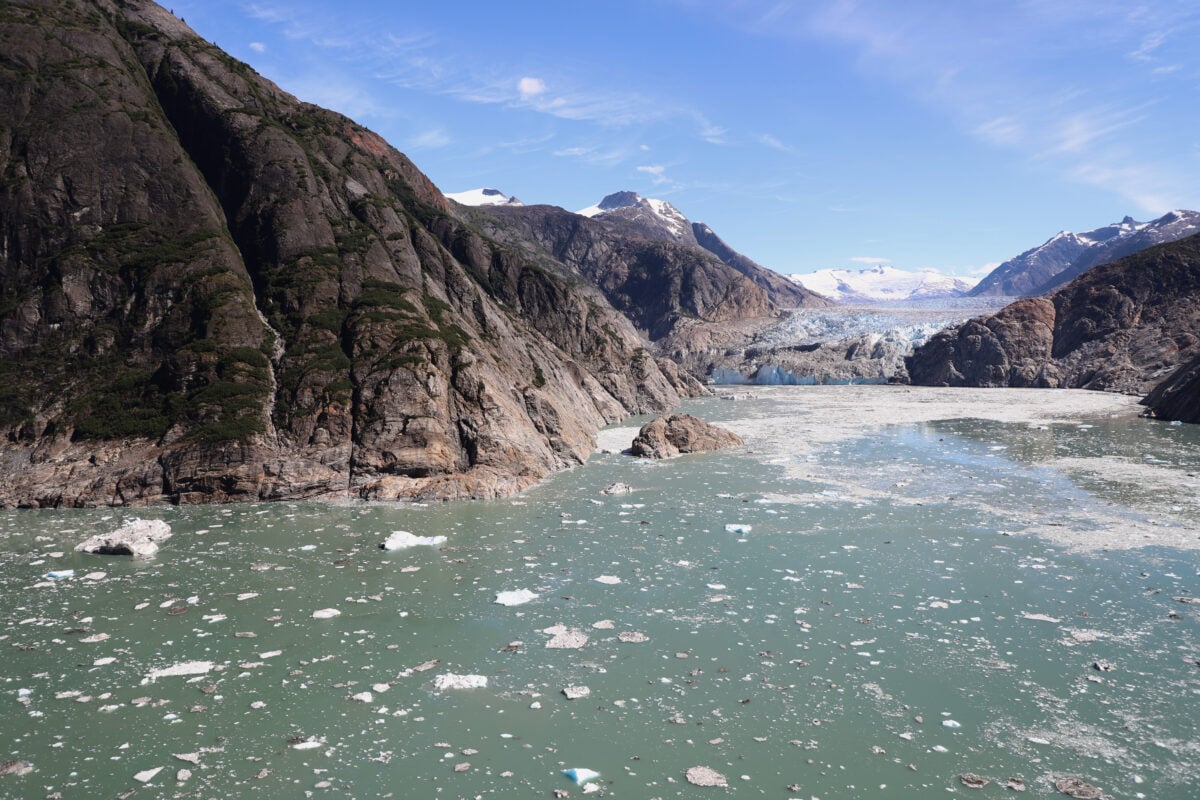
This photo provided by the U.S. Geological Survey looks up Tracy Arm fjord to the terminus of the South Sawyer Glacier about 80 miles southeast of Juneau, Alaska, on Aug. 13, 2025, days after a landslide in the area. (John Lyons/U.S. Geological Survey via AP)
This photo provided by the U.S. Geological Survey looks up Tracy Arm fjord to the terminus of the South Sawyer Glacier about 80 miles southeast of Juneau, Alaska, on Aug. 13, 2025, days after a landslide in the area. (John Lyons/U.S. Geological Survey via AP)
AP- For years, a popular part of many cruises in southeast Alaska has been sailing up Tracy Arm, a long, narrow fjord marked by steep mountains, glittering waterfalls and calving glaciers.
But this season, major cruise lines are skipping it. A massive landslide last summer sent parts of a glacier crashing into the water, generated a tsunami and pushed a wave high up the opposite mountain wall. Several companies opting out cited safety concerns with the still-hazardous slopes.
“Tracy Arm is the majestic princess, you know, she is the queen of fjords,” said travel agent Nate Vallier.
The destination cruise and tour companies have chosen as an alternative — nearby Endicott Arm and Dawes Glacier — is “still beautiful by any means, but it’s just not the same,” he said.
Tracy Arm, southeast of Juneau, is a roughly 30-mile (50-kilometer) fjord that features two tidewater glaciers — the North and South Sawyer — and wildlife, including seals and bears.
Early on Aug. 10, 2025, a landslide originating high on a slope above the toe of the South Sawyer, near the head of the fjord, sent water surging more than a quarter mile (more than half a kilometer) up the mountain wall opposite the slide and out Tracy Arm.
No ships were in the fjord, officials said, and no deaths or injuries were reported. But kayakers camped on an island near where Tracy and Endicott arms meet had much of their gear swept away by the rushing water.
Southeast Alaska, largely encompassed by a temperate rainforest, is no stranger to landslides. And while it’s long been known the fjord network in the Tracy Arm region has been susceptible, the slope that failed had not been identified as an active hazard before last summer’s collapse, said Gabriel Wolken, manager of the state’s climate and ice hazards program.
Scientists are working to understand not only what caused the slope to collapse but to understand what other hazards might exist in the fjord, he said.
The area remains unstable, said Steven Sobieszczyk, a U.S. Geological Survey spokesperson. Steep landslide areas continue to change for years after an initial slide, he said by email.
“Continued rockfall and small-scale sliding from the exposed landslide scar are expected and could impact the water, potentially causing a future localized tsunami,” he said.
Major cruise companies, including Holland America, Carnival Cruise Line and Royal Caribbean said in response to inquiries from The Associated Press that they are replacing a Tracy Arm visit with Endicott Arm. MSC Cruises, Virgin Voyages and regional tour company Allen Marine also are doing Endicott and Dawes Glacier instead. Norwegian Cruise Line said it does not have voyages sailing by Tracy Arm.
Endicott already has been a stop for some ships previously and an alternative when conditions in Tracy Arm, such as excess ice, have been unsafe.
Vallier, who owns the Alaska Travel Desk, said he would have liked cruise companies to give travelers more advance notice about itinerary changes.
After leaving Seattle, the first ships of the season are due April 21 in Ketchikan and in Juneau the following week.
Seeing a glacier — particularly a dynamic, calving glacier — is a bucket-list item for many tourists, and that’s what has made Tracy Arm so popular, he said. While the Mendenhall Glacier in Juneau is a major attraction for the capital city and cruise port, many visitors view it from across a large lake, and it has diminished or entirely retreated from view from some hiking overlooks.
Kimberly Lebeda of Wichita, Kansas, was excited when she booked tickets for a Tracy Arm excursion for her family last year. Lebeda, who researches areas she visits, said she was sold on the scenery.
But the night before the stop, they were told that due to ice in Tracy Arm, they would go up Endicott instead. Her family and others who’d booked the excursion got off the ship and onto a smaller boat with glass windows, abundant seating and snacks. They saw seals on ice floes, waterfalls and “a wall of ice” calve from Dawes Glacier, she said.
She called it “an amazing thing to witness.”
“Was it worth it? Yes, because I don’t know if I’ll ever get to do that trip again,” she said. “Again, I haven’t ever been to Tracy Arm so I can’t really compare. But to me, was it worth it and was it exciting? Absolutely.”
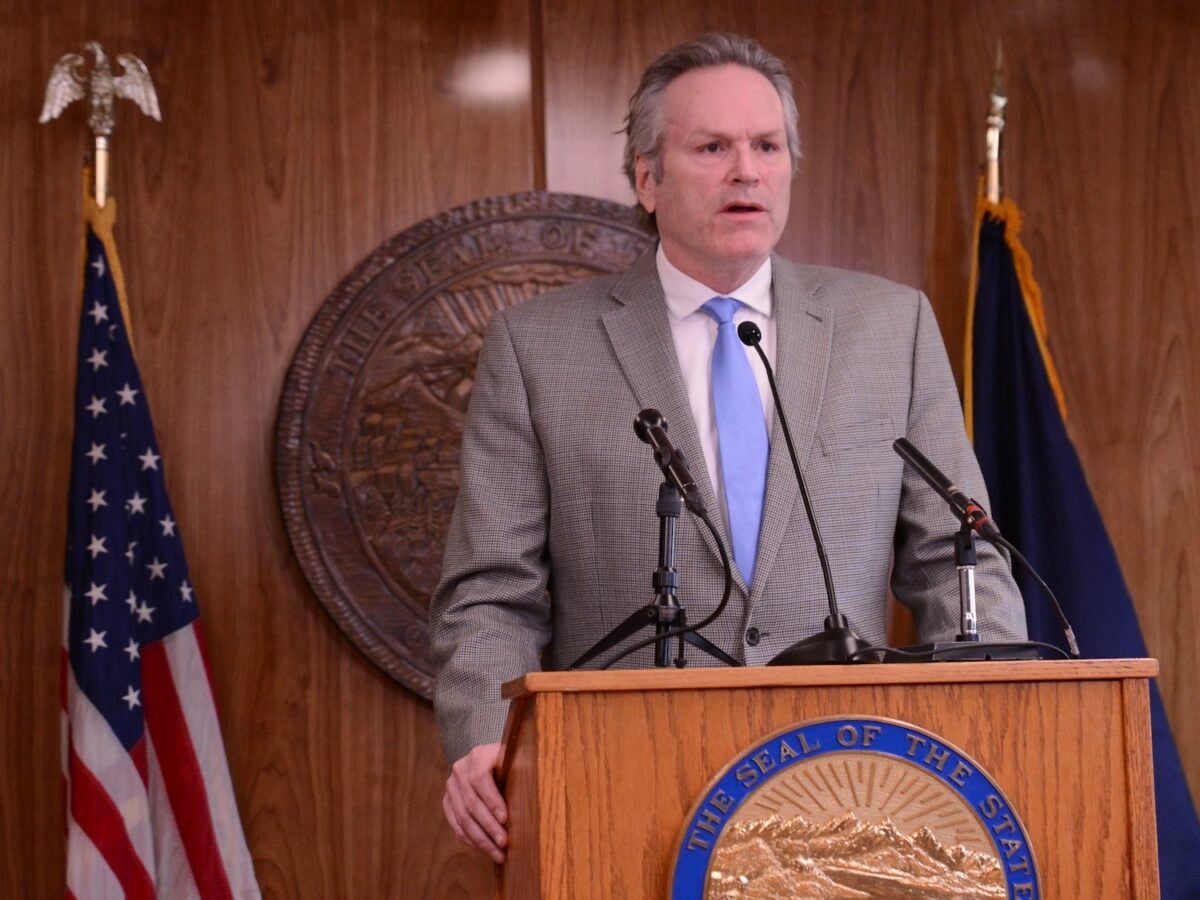
Alaska Gov. Mike Dunleavy speaks to reporters on Thursday, April 17, 2025, with Deena Bishop, commissioner of the Alaska Department of Education and Early Development, looking on in the background. (Photo by James Brooks/Alaska Beacon)
By: Corinne Smith, Alaska Beacon
Alaska Gov. Mike Dunleavy speaks to reporters on Thursday, April 17, 2025. (Photo by James Brooks/Alaska Beacon)
Gov. Mike Dunleavy signed off on a supplemental budget bill that authorizes nearly $450 million in additional state spending this year.
The budget bill covers additional costs incurred by the state this fiscal year ending in June, including funds for disaster relief, education, corrections and transportation.
The bill was approved by the Alaska State Legislature two weeks ago. Dunleavy signed the budget on Apr. 2, and transmitted it back to the Legislature on Thursday.
“I appreciate the Legislature’s support of these proposals,” Dunleavy said in a letter announcing his signature on the bill. “The supplemental budget I have signed into law today enables the State to meet current fiscal year responsibilities and represents prudent and fiscally responsible investments in emergency and fire response, public safety and statewide transportation needs.”
The budget includes $75 million for disaster relief to address the response to the Western Alaska storms last fall, and nearly $100 million for fire suppression, particularly in Interior Alaska. It includes $20 million for the Alaska Department of Corrections overtime expenses, as well as $70 million in time-sensitive funding for transportation — sought by the construction industry to unlock a federal match of $630 million for state construction projects.
It also includes $130 million for the Alaska Higher Education Fund which provides grants and scholarships for students, as well as $34.4 million for Medicaid and $12.8 million for other public assistance programs through the Alaska Department of Health.
The governor’s office submitted an additional $11.6 million request, but it was submitted too late to include in the budget bill, and will be rolled into the proposal for next year’s budget.
Additionally, the state is waiting on an appeal decision after failing a federal disparity test for education funding, and could potentially be liable for $72 million in K-12 funding for next year, according to officials with the Legislative Finance Division.
Oil revenues still uncertain
In the Legislature, the bill was delayed this year amid ongoing debate in the House of Representatives on whether to pay for the larger than usual budget bill out of state savings — an act that requires the approval of three-quarters of legislators.
Members of the House Republican minority caucus objected to spending from a state savings account, the Constitutional Budget Reserve. After the Alaska Department of Revenue projected the state would see an additional $500 million in oil revenue due to a surge in oil prices driven by the Iran war, they argued the state would not need to pull from savings to pay its bills.
Members of the multipartisan House majority caucus objected to the uncertainty of revenue forecasts and future oil prices, and argued for a draw from state savings to fund the budget bill immediately.
If oil-driven state revenues from now until the end of the fiscal year are not sufficient to cover the $450 million supplemental budget, then lawmakers agreed to draw from state savings. That means oil prices must average approximately $82 per barrel of oil through June for state revenue to cover spending, according to officials with the Legislative Finance Division.
House Speaker Rep. Bryce Edgmon, I-Dillingham, was among legislators who supported the draw from savings several weeks ago, instead of banking on uncertain future oil revenues. On Friday, he said it seems revenues will cover the budget bill.
“As appears now, oil prices are continuing to move in an upward trajectory, which means that the bill at the very end could be fully funded,” Edgmon said. “But there’s still a fair amount of time in front of us for oil prices to, you know, continue to be volatile.”
Edgmon said barring a dive in oil prices, he doesn’t expect another vote on drawing from the state savings this session.
“That’s pending a dramatic drop in oil prices, of course, which doesn’t seem to be on the horizon.”
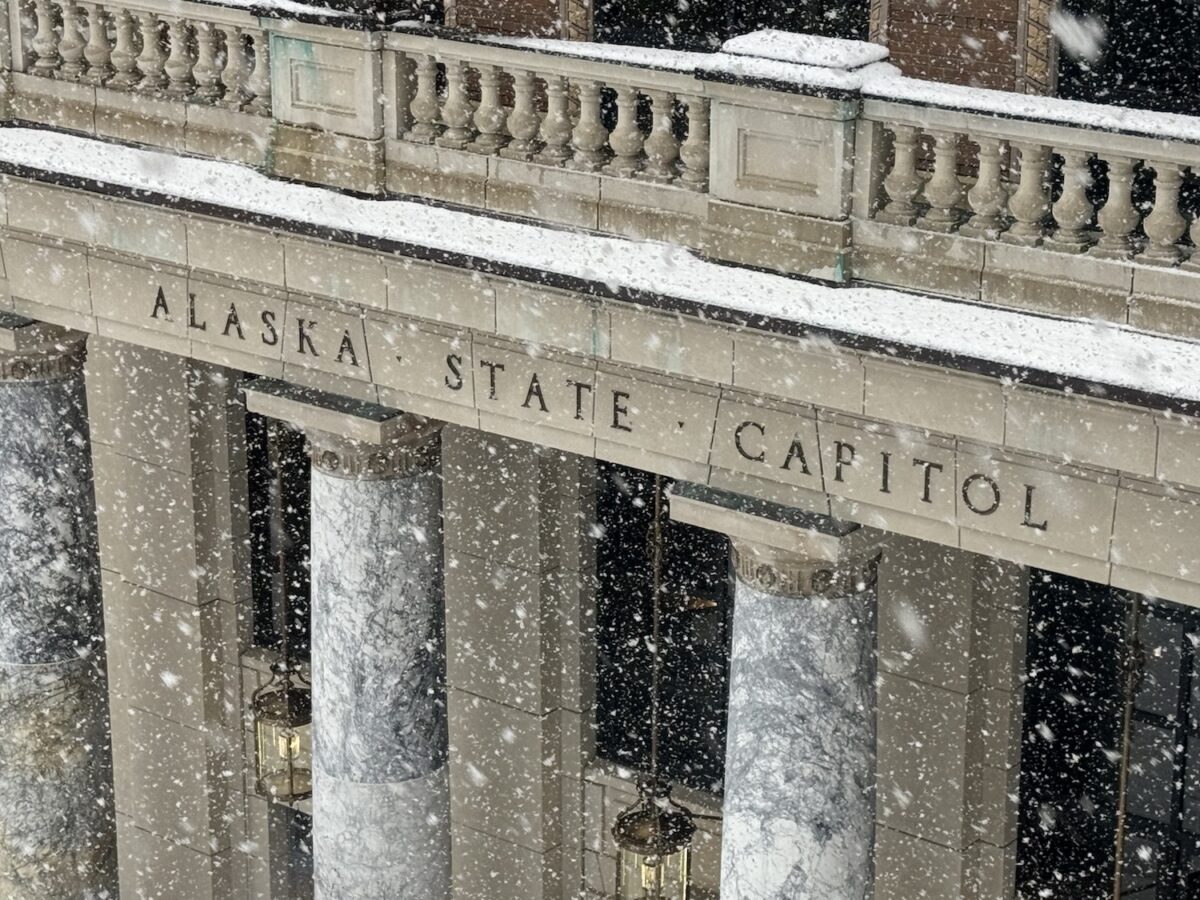
Snow falls on the Alaska State Capitol on Monday, March 16, 2026, in Juneau, Alaska. (James Brooks photo/Alaska Beacon)
By: James Brooks, Alaska Beacon
Snow falls on the Alaska State Capitol on Monday, March 16, 2026, in Juneau, Alaska. (James Brooks photo/Alaska Beacon)
The chief of staff for a member of the Alaska House of Representatives was arrested early Sunday morning in Juneau and accused of driving under the influence of alcohol.
Kathryn “Katy” Giorgio, 45, is an aide to Rep. Genevieve Mina, D-Anchorage, and pleaded not guilty to a class A misdemeanor in an initial hearing on Monday.
Her arrest came less than a week after Forrest Wolfe, a Republican and aide to Gov. Mike Dunleavy, was also arrested for driving under the influence. It was Wolfe’s second DUI arrest and Giorgio’s first.
Giorgio was released without bail. Ordinarily, DUI release conditions require that accused Alaskans stay out of bars and other places where alcohol is served.
In Giorgio’s case, Judge Kirsten Swanson and the municipal prosecutor agreed to one exception: Giorgio will be allowed to play trombone this week in the Red Dog Saloon as part of an Alaska Folk Fest concert.
Mina declined comment when reached by phone Thursday evening but confirmed that Giorgio remains a member of her staff and that the matter is an internal personnel issue.
Giorgio declined on Thursday to speak at length about the incident but said “it was a bad decision.”
“I was not driving erratically. I was a block away from my house, and it was just an unfortunate situation, and I’m working through the system to do what I have to do,” she said.
In an affidavit submitted to prosecutors, Juneau Police Department Officer Joshua Shrader said he pulled over Giorgio about 2:30 a.m. Sunday morning after observing her car speeding and “driving down the center of the road” in Juneau’s Mendenhall Valley neighborhood.
“While Giorgio was searching for her registration,” he wrote, “I noted an open can of alcohol in the center console cup holder. Inside the center console glove box, Giorgio picked up another can of alcohol and attempted to conceal it in a napkin.”
Shrader said both Giorgio and the car smelled of alcohol, and her breath alcohol level measured at 0.126, more than the legal limit of 0.08.
A status hearing on Giorgio’s case has been preliminarily scheduled for April 24. A hearing in Wolfe’s case is scheduled for May 18. According to online court records, both have hired defense attorney August Petropulos.
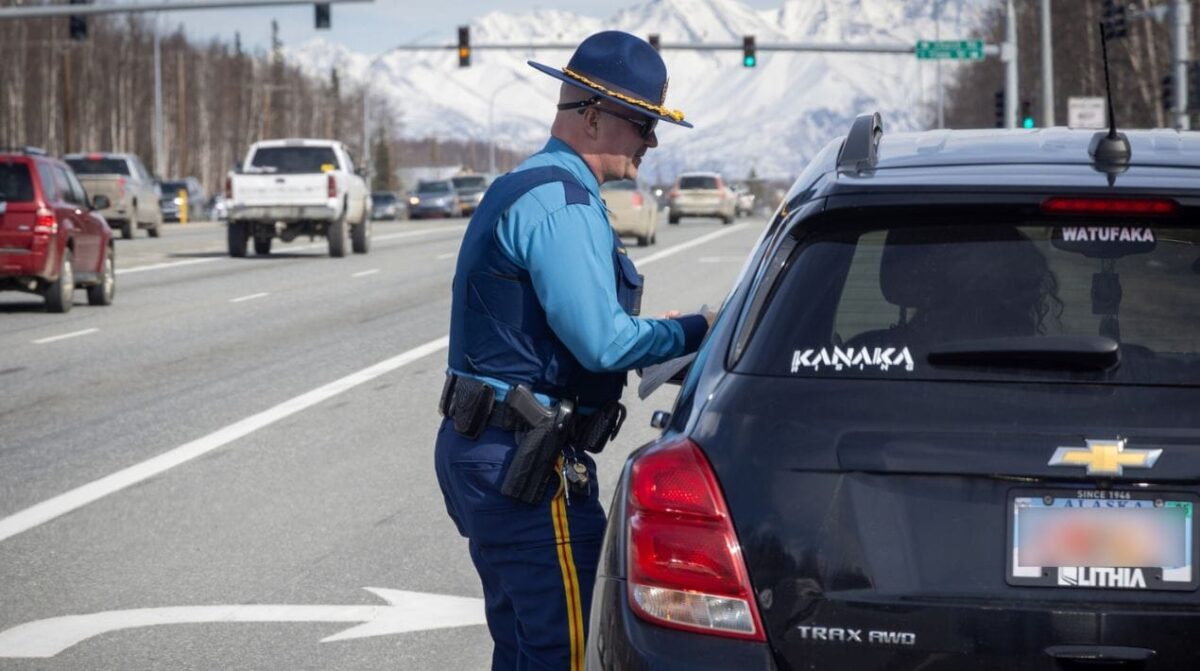
An Alaska State Trooper conducts a traffic stop outside Wasilla in early 2024. (Photo courtesy of Alaska State Troopers)
The House State Affairs committee advanced a governor’s appointee for a public seat on the Alaska Police Standards Council with some skepticism on Tuesday.
Gov. Mike Dunleavy appointed Veronica Lambertsen to serve in one of four public seats on the 13-member Alaska Police Standards Council, which oversees law enforcement standards across the state.
The council is charged with setting and enforcing standards for law enforcement certification, as well as training and retention for all police, probation, parole and correctional officers. Members are also tasked with adopting state regulations and investigating police misconduct, like officer discipline and use-of-force.
Lambertsen is a small business owner, and since 2001 has operated the Bird Creek Motel in Bird Creek, a small unincorporated area south of Anchorage, according to her resume. She has volunteered on the Turnagain Arm Community Council since 2023, which serves the communities of Bird Creek, Indian and Rainbow.
Lambertsen’s resume lists no formal educational or professional training experience, and describes her education as “homeschooled.”
Lawmakers seemed skeptical of her qualifications, and asked Lambertsen about her connection with law enforcement or public safety issues at a confirmation hearing on Tuesday.
Members of the House State Affairs Committee consider the governor’s appointees for the Alaska Police Standards Council and the Board of Parole on Apr. 7, 2026. (Photo by Corinne Smith/Alaska Beacon)
Rep. Steve St. Clair, R-Wasilla asked if she had law enforcement experience.
“Not active duty or anything,” said Lambertsen by phone. “But being a small business owner, and in reflection of owning a cafe and a motel, I’ve had a lot of experience with law enforcement, and yes, there’s a lot of incidents that have happened regularly, and there’s been a relationship.”
The council has 11 seats reserved for members in leadership positions with law enforcement or corrections, and four seats for members of the public, including two from communities of 2,500 population or less.
Rep. Rebecca Himschoot, I-Sitka asked Lambertson what perspective she would bring to the statewide council. “How will you help make this a better council?” she asked.
Lambertsen told lawmakers she would bring a “public perspective” and said she’s interested in working on standards for training.
Committee members were unsure on Tuesday if police training is required for appointees to the Council. Lambert said it was not, but added that members have the opportunity to take police standards classes.
Officials with the Alaska Department of Public Safety confirmed Wednesday public members of the council do not need to have any law enforcement connection.
Lambertsen serves as the volunteer secretary for the Anchorage chapter of Moms for Liberty, according to her resume, a far-right national group that advocates for parental rights, and is known for its advocacy against school curricula that includes LGBTQ rights. Some chapters advocate for book bans.
The group has been deemed an “antigovernment” group by the Southern Poverty Law Center, a civil rights organization, and has known ties to other extremist or hate groups.
Lawmakers did not ask about Lambertsen’s affiliation with the group, or how it would affect her role on the Alaska Police Standards Council.
Lambertsen responded to questions about her affiliation with the group by email on Wednesday, saying that her position with Moms for Liberty “had nothing to do with anti-student inclusion.”
“My understanding of Moms for Liberty was asking for curriculum being provided by teachers to educate children to be age appropriate, especially for Early Childhood Learning to 6th Grade Learning, for parents to ask questions about curriculum of the School Districts and not allow “soft porn books” in schools and libraries for children of all ages to have access to,” she said. “Certain books should be available in older age sections with accessibility to that age group.”
Lambertsen did not respond to questions about how her political views would influence her role on the council.
In an interview Wednesday, Rep. Ashley Carrick, D-Fairbanks, chair of the House State Affairs Committee, said the committee’s review process is “like a job interview” and a procedural step before a full vote before a joint session of the Legislature. But she said she has concerns about partisan conservative nominees appointed by Dunleavy, including Lambertsen, across state boards.
“It really leads to a lean of our state boards and commissions and those decision making services towards potentially a partisan flavor,” she said. “And I think after eight years of this administration, we are seeing some of the impacts of that.”
Carrick said each lawmaker does their own research on nominees for a final vote in a joint session of the Legislature. She said she prefers to contact nominees privately with concerns, rather in the committee process, and also relies on public input.
“I think at this point I would really need to hear from folks around the state if they’re also concerned,” she said. “And hopefully the hearing just brought just a little bit of attention to this appointee and what she’s being appointed for.”
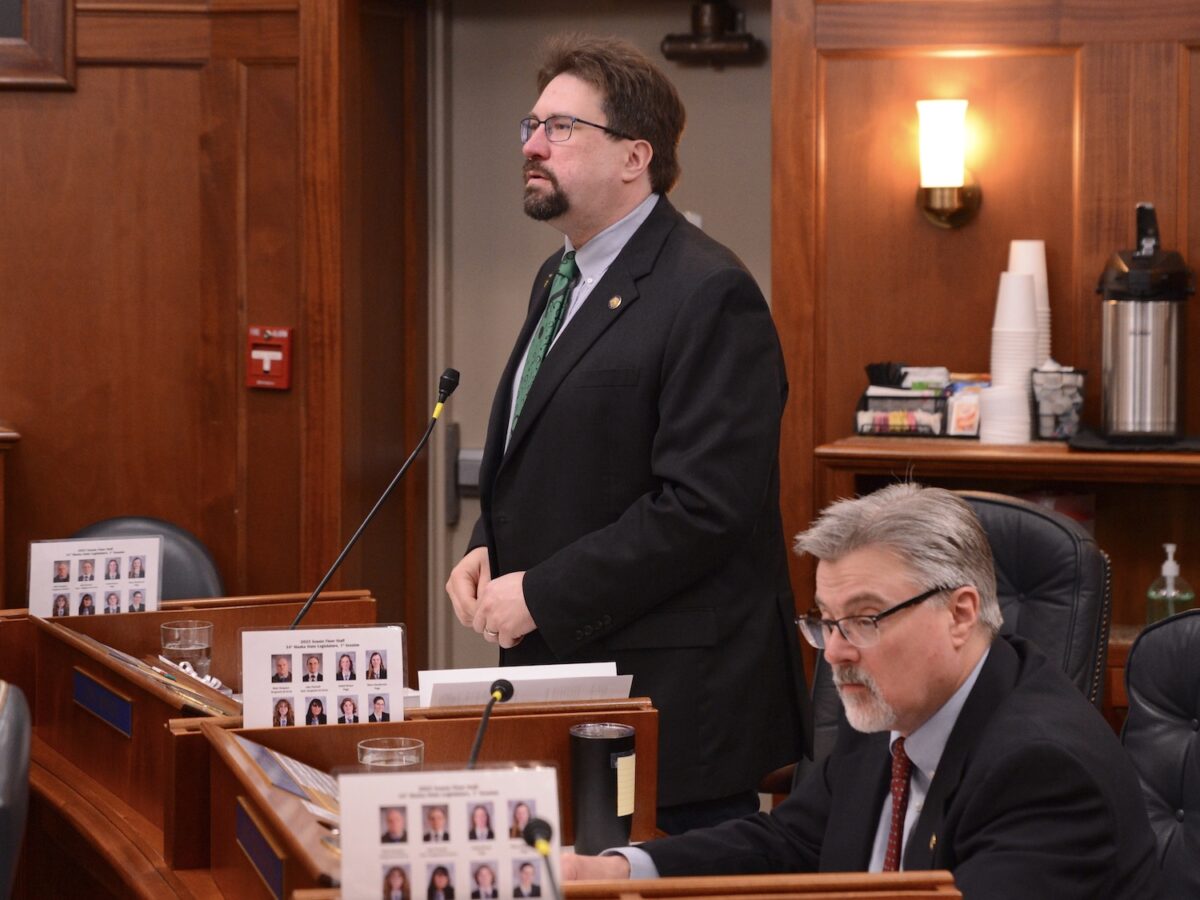
Sen. Robert Myers, R-North Pole, speaks on House Bill 57 in the Alaska Senate on Monday, April 28, 2025. (Photo by James Brooks/Alaska Beacon)
By: Sean Maguire, Alaska Beacon
Sen. Robert Myers, R-North Pole, speaks on House Bill 57 in the Alaska Senate on Monday, April 28, 2025. (Photo by James Brooks/Alaska Beacon)
The Alaska Senate last week advanced a bill that would allow for the anonymous surrendering of infants in so-called infant safety devices.
The boxes are located on the exteriors of buildings. They are climate controlled and monitored by video. When the device is opened, a 911 request is automatically made.
Alaskans have been able to surrender infants since 2008. Newborns must be given directly to police officers, firefighters, doctors or other medical personnel. They are then turned over to the Alaska Office of Children Services for adoption.
In Alaska, an infant must be aged 21 days or younger to be surrendered legally.
North Pole Republican Sen. Robb Myers is the lead sponsor of Senate Bill 9. It would allow newborns to be surrendered in climate-controlled boxes, located outside police stations, fire departments, hospitals and other locations.
Myers said that around one baby a year has been surrendered in Alaska since 2008. Despite that, three infants have been found abandoned in Alaska since 2013: Two were found dead; one newborn was discovered alive in Fairbanks in a box in winter.
Myers said safe surrender devices would help save lives. Parents can feel shame or the fear of potential recognition when giving a child to another person, he said. The climate-controlled boxes are intended to remove that barrier.
The Alaska Senate advanced the bill on an 18-2 vote. Sens. Bert Stedman, a Sitka Republican, and Löki Tobin, an Anchorage Democrat, voted no.
Tobin said the anonymity of surrendering a child into a baby box could lead to abuse of women. She said the boxes introduce the potential that traffickers could surrender babies without a mother’s consent.
“The potential misuses for these devices far outweigh the benefits,” Tobin said.
All 50 states allow for the surrendering of infants. Almost half of states allow for newborns to be surrendered in baby boxes, which has accelerated since Roe vs. Wade was overturned, particularly in Republican-led states.
If the bill passes, the Alaska Department of Public Safety would be tasked with drafting regulations for the placement of infant safety devices. Each infant safety device is estimated to cost $16,000. That excludes surveillance and security costs, which state officials say could be “significant.”
SB 9 now advances to the House for its consideration. Similar legislation has been advancing through that legislative chamber.
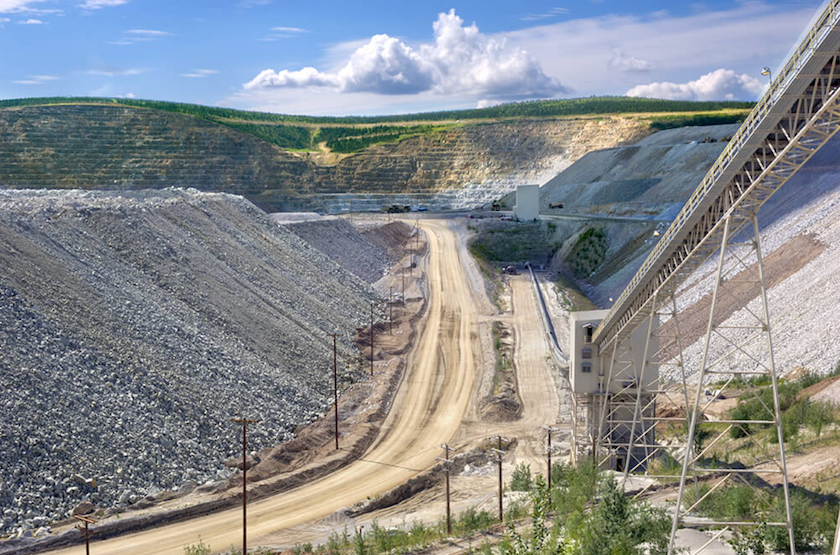
Kinross’s Fort Knox mine outside of Fairbanks in seen in this undated photo. Fort Knox produced 239,508 ounces of gold in 2024, according to the Alaska Department of Labor and Workforce Development, and it is one of the state’s six major mines. (Photo provided by Kinross Gold Corporation)
Metals mining has a prominent place in Alaska history. Today, it remains a prominent economic driver in the state.
Over the past decade, the metals mining sector has made up 3% to 4% of Alaska’s gross domestic product, and those mined metals rival Alaska seafood as top exports from the state, according to a state Department of Labor and Workforce Development analysis.
Metals such as zinc produced at the Red Dog mine in Northwest Alaska, silver produced by the Greens Creek Mine in Southeast Alaska and gold, lead and copper produced by various mines, now support an industry worth close to $3 billion a year, according to the analysis, published in the current issue of Alaska Economic Trends, the department’s monthly research magazine.
Alaska has six major metals mines, three of which produce more than one type of metal, and hundreds of small placer operations.
Among the mined products coming from Alaska is germanium, a byproduct of zinc that is classified as a critical mineral and used in electronics. In 2024, the Red Dog mine produced about 10 tons of germanium, according to the analysis, making it a critical source to the nation because China cut off deliveries of its germanium. That year, the Red Dog mine was the only U.S. mine producing germanium, though prior to 2023, a Tennessee mine was also producing the mineral, said Karinne Wiebold, the state economist who wrote the Alaska Economic Trends report.
Mining’s share of Alaska’s gross domestic product has grown considerably, as this graph shows. The graph includes values for metals mining and mining of coal, gravel and sand, but it does not include oil or gas production. Dollar figures are inflation-adjusted to 2024. (Graph provided by the Alaska Department of Labor and Workforce Development research and analysis section)
The value of Alaska’s mining sector, including coal, gravel and sand as well as metals, actually peaked in 2011 at nearly $3.5 million and close to 5% of the state’s gross domestic product. That peak reflected extremely high metals prices and the startup of the Kensington gold mine in Southeast Alaska.
Still, mining has been a strong economic factor in Alaska for the last two decades, after jumping in value in 2006. Every year since then, its total value to the state has generally been above $2 billion and usually accounted for 3% to 4% of Alaska’s gross domestic product.
Metals mining has also become a big employment driver as well, according to the analysis.
There were 3,533 metal mining and support jobs in Alaska in 2024, the most recent data available, and jobs in the sector grew by 37% over the past decade, compared to an overall state job growth rate of 0.3%, Wiebold’s analysis said.
The average metal mining job paid $135,000 in 2024, well above the state average of $71,000 that year and second only to the average pay for workers in the oil and gas sector, the analysis said.
But a large percentage of mine workers are not Alaska residents. Wiebold’s analysis puts resident hire at 56%. That puts the non-resident hire percentage in the metals mining sector well above the state average.
In 2024, the most recent year for which data is available, 22.9% of workers in the state were not Alaska residents, according to an annual report published by the Department of Labor and Workforce Development. That is the highest percentage since such records began in state average, which is the highest percentage since records started in the 1990s.
A visitor to the Donlin Gold mine site on June 23, 2025, touches core samples collected from exploration work. Donlin is one of the major Alaska projects that could be developed in the future. (Photo by Yereth Rosen/Alaska Beacon)
Wiebold noted that the nonresident hire in the mining sector is about the same as that in the oil and gas sector, which in 2024 was 40.5%, according to the state’s report.
Mining and oil and gas work in Alaska is conducive to nonresident employees because it is generally conducted at remote locations, typically with rotating schedules of two weeks on and two weeks off, she said.
“This combo means most folks don’t live near the mine and have to commute and stay at the worksite, and that there is not a significant time/cost/commute savings for living in the state,” she said by email. “As a result, miners from out of state can work in Alaska and live somewhere less expensive or more appealing to them.”
Another reason for the high percentage of nonresidents lies in Alaska’s demographics, she said. “In the last several years, with Alaska’s working age population fairly stagnant after a decade of significant declines, more jobs are being held by out of state workers,” she said.
The sector is poised for future growth, with projects like the Donlin gold mine in Southwestern Alaska, the Graphite One graphite mine in Northwestern Alaska and, potentially, the commercialization of the copper-rich but isolated Ambler Mining District in Northwestern Alaska.
But none of those proposed mines can be expected to be developed quickly, and development itself is uncertain, Wiebold’s article said.
“Mines take years to come to fruition — exploration, feasibility studies, environmental reviews, and permitting are expensive, and all have the potential to derail a project. Public concerns and controversy can also slow or stop development,” the article said.
Sen. Lyman Hoffman, D-Bethel, speaks during a joint session of the Alaska Legislature on Tuesday, March 10, 2026. (James Brooks photo/Alaska Beacon)
By: Sean Maguire, Alaska Beacon
Sen. Lyman Hoffman, D-Bethel, speaks during a joint session of the Alaska Legislature on Tuesday, March 10, 2026. (James Brooks photo/Alaska Beacon)
The Alaska Senate on Wednesday advanced a constitutional amendment that would establish a dedicated fund for public education.
If passed, lawmakers could design a new source of state revenue to go toward the fund that would be used specifically for schools. The resolution states that the Legislature could only appropriate money from the fund for public education.
The Alaska Constitution explicitly prohibits the dedication of funds in most cases. Supporters say that prohibition was intended to give the Legislature flexibility in budgeting, and avoid mandated funds.
Bethel Democratic Sen. Lyman Hoffman said before Wednesday’s vote that education is his No. 1 priority. A dedicated education fund could be a “tremendous tool” to improve schools in Alaska, he said. Hoffman co-chairs the Senate Finance Committee which sponsored the constitutional amendment.
The Legislature last year approved an historic increase in school funding through the state’s complex formula, overriding two separate vetoes by Republican Alaska Gov. Mike Dunleavy. Still, advocates say that substantially more school funding is needed with school districts facing sizable budget shortfalls and decades of deferred maintenance.
Two Alaska school districts in January sued the state, arguing that Alaska’s education funding levels violate a constitutional duty to fund schools adequately. School districts across Alaska have long complained about crumbling buildings that have reached crisis level.
Republican Sen. Bert Stedman represents Sitka, home of Mt. Edgecumbe High School, a state-run boarding school which has reported leaking roofs and buildings in disrepair. Stedman said Alaska is one of the nation’s richest states, but the condition of its schools is “kind of embarrassing.”
Surrounded by school children in the Senate’s public galleries, Stedman said that “we should be doing better for our kids.”
“Every generation needs to make a little step forward and this is our little step,” he said in support of the resolution before the final vote.
The Alaska Senate approved the resolution on a 17-3 vote. At least 14 of 20 senators are needed to support a constitutional amendment. Two-thirds of the Alaska House of Representatives would need to vote for the same resolution to put the proposal before voters at the November election.
All 14 members of the bipartisan Senate majority supported the constitutional amendment, alongside three minority Senate Republicans — Sens. Robert Yundt of Wasilla, Mike Cronk of Tok and James Kaufman of Anchorage.
Three minority Senate Republicans voted no: Sens. Robb Myers of North Pole, Cathy Tilton of Wasilla and George Rauscher of Sutton.
Myers said the drafters of the Alaska Constitution sought to block the proliferation of dedicated funds, which would consume the annual budget.
He said that establishing a dedicated fund for education “removed any sort of flexibility for the Legislature.” He said that avoiding annual debates about school funding was “not necessarily a good thing.” Education spending could effectively be “out of sight, out of mind,” he said.
Myers said the state has numerous other priorities such as health care and natural resource management, but they would not receive the same dedicated funds.
The resolution now advances to the House. If approved by 27 of 40 House members, it would then be placed before voters at the Nov. 3 election. A simple majority of voters is needed to approve an amendment to the Alaska Constitution.
A governor cannot block a constitutional amendment from appearing on the ballot with their veto pen. The Alaska Constitution was last amended in 2004.
Fishing vessels are seen in Homer’s harbor on Oct. 22, 2025. A resolution passed by state lawmakers urges federal officials to extend the ban on Russian seafood imports. Russian fish competes for market share with Alaska’s fish. (Photo by Yereth Rosen/Alaska Beacon)
A legislative resolution urging a continued and better-enforced ban on Russian seafood in the United States is headed to Gov. Mike Dunleavy.
Part of a series of actions by Alaska lawmakers to try to shore up the state’s ailing seafood industry, House Joint Resolution 29 won final passage last week and was transferred to the governor on Monday.
The resolution calls for continuation of the ban on Russian seafood imports imposed in 2022, after that country’s invasion of Ukraine. The ban was expanded in 2023 to cover imports of Russian seafood to the U.S. through a third-party country, usually China, where fish are processed.
The import ban is set to expire later this year. That makes the resolution timely, supporters aid.
Among the supporters is Jeremy Woodrow, executive director of the Alaska Seafood Marketing Institute.
Woodrow, in testimony to the Senate Resources Committee on Feb. 27, said a stockpile of Russian fish that was in the U.S. before the ban went into full effect is just now being depleted.
“We need more time to really capture the U.S. marketplace. Our industry has not recovered yet,” Woodrow said. Even though last year’s fishing season was better, it was still one of the worst years in the last 20 years, he said.
“This is one measure that will help our fishermen. We’re starting to see the fruits of this ban coming into play, but we need more time to provide stability to our industry. We need more time to see it come to fruition,” he told the committee.
In addition to seeking an extension of the import ban, the resolution calls for stronger monitoring and enforcement to “ensure fair trade, protect the state’s seafood industry, and promote sustainable and ethical seafood production.”
Legislative resolutions do not have the power of law, but they can influence actions by Congress, the federal executive branch or other institutions.
The Russian seafood import ban resolution was not among the measures introduced by the Joint Legislative Task Force Evaluating Alaska’s Seafood Industry, formed in 2024. However, it addresses an aspect of international trade, one of the issues raised by the task force. The task force’s report recommended an update to a Russia-focused resolution passed by the legislature in 2022, Senate Joint Resolution 16.
Russian king crab is displayed at a Costco in Anchorage on Nov. 14, 2022. The crab, from the Barent Sea, was distributed by Arctic Seafoods of San Francisco, and was part of inventory stockpiled before the U.S. government banned fish imports from Russia. (Photo by Yereth Rosen/Alaska Beacon)
The eight-member task force, comprising Senate and House members from fishery-dependent districts, issued its recommendation report in January 2025, at the start of last year’s session. Recommendations for action resulted in the introduction of a series of bills intended to help the industry, which has struggled with low fish prices, glutted international markets, high costs and other challenges.
Other bills focus on tax credits and revenues
One of the task force’s bills, aimed at encouraging seafood product development and diversification, is headed for a vote in the Senate this week.
That measure, Senate Bill 130, concerns the state’s fisheries product development tax credit system. Currently, seafood companies are allowed to deduct the cost of new equipment used to develop value-added products from salmon, herring, pollock, sablefish and Pacific cod. The bill would expand that to all fish species, including shellfish. That is in line with the recommendation in the task force report, which identifies arrowtooth flounder, fish meal and crab shells as examples of some underused or discarded products that could be processed into something marketable.
The bill, in the amended form before the Senate, also seeks to expand the range of technology for which investment would qualify for credits, and it would extend the sunset date for the credit to 2037. Currently, the tax credit is due to expire next year.
The revenue impact of the bill, if it wins final passage, is difficult to determine because there are several unknown variables, said the fiscal note prepared by the state Alaska Department of Revenue. Estimated annual revenues losses to the state would range from $1 million to nearly $4 million, according to the fiscal note.
Another task force bill, aimed at helping fishery-dependent local governments, had not moved out of the Senate Finance Committee as of Tuesday. That measure, Senate Bill 135, would allow municipalities to increase their share of fisheries business tax and fishery resource landing tax revenues. Currently, the state and local governments split those tax revenues equally. The bill would allow local governments to get up to 75% of the tax revenues.
The legislature passed two seafood task force bills last year, each of which had wide support. However, Dunleavy vetoed one of the bills.
The bill that escaped the governor’s veto, House Bill 116, allows for the formation and operation of member-owned commercial fishing insurance cooperatives. Such cooperativesexist in other states and were used by some Alaska fishers. The bill passed unanimously.
The vetoed bill, Senate Bill 156, would have transferred $3.69 million from a defunct state loan fund to the Alaska Commercial Fishing and Agriculture Bank. The state-owned bank needed the boost to keep serving the seafood industry, bill supporters argued. But Dunleavy argued that the cost of the action was too great for the state budget to bear.
Members of the House and Senate voted to sustain Gov. Mike Dunleavy’s veto of SB 113, a corporate income tax bill tied to education funding by a vote of 45 to 16. 46 votes were needed to override the veto on Jan. 22, 2026 (Photo by Corinne Smith/Alaska Beacon)
The Alaska Senate on Tuesday advanced a constitutional amendment that would lower the threshold for veto overrides of spending decisions.
The Alaska Constitution currently has two thresholds to override a governor’s vetoes: it takes two-thirds of legislators to override a veto of a policy bill and three-quarters of lawmakers to override a budget veto or a veto of legislation that spends money.
Anchorage Democratic Sen. Matt Claman’s proposed the constitutional amendment that would reduce vetoes of spending decisions to the same two-thirds threshold.
Sen. Matt Claman, D-Anchorage, speaks at a March 19, 2024, news conference held by the Senate majority caucus. (Photo by Yereth Rosen/Alaska Beacon)
Claman’s resolution passed the Senate along caucus lines on a 14-6 vote. All 14 members of the bipartisan Senate majority voted for the resolution while each member of the all-Republican Senate minority voted no.
At least 14 of Alaska’s 20 Senators are needed to reach the two-thirds threshold to advance a constitutional amendment. Twenty-seven of the 40 House members would need to approve Claman’s resolution for the proposed amendment to appear on November’s ballot.
The last time the Alaska Constitution was amended was in 2004.
Claman, a Democratic candidate for governor, said the drafters of the Alaska Constitution intended to create a strong executive branch. But the high hurdle to override a veto on spending decisions had “undermined the balance of power between the Legislature and the executive,” he said.
Alaska is the only state with a three-quarter veto override threshold for spending decisions.
In a statement following the vote on Tuesday, minority Senate Republicans said the governor’s veto power was one of few tools to curb the Legislature’s wide-reaching power. Members of the caucus stated that Gov. Mike Dunleavy had used that authority to veto tax bills, among other measures.
“The framers of our Constitution saw the wisdom in giving the governor considerable power to reduce state spending,” said Tok Republican Sen. Mike Cronk, the Senate minority leader. “The fiscal override threshold is high for a reason.”
While the Legislature has voted to override a governor on 40 occasions for policy bills since statehood, veto overrides for spending decisions have only occurred five times, Claman said.
The most recent override of a spending veto occurred last August in a special session Lawmakers voted to reject Dunleavy’s veto of more than $50 million in public school funding. The vote was 45-14, the minimum number of lawmakers needed to override a budget veto.
If approved by the House, the constitutional amendment would appear on the ballot at the Nov. 3 election. If approved by a majority of voters, the constitutional threshold for budget vetoes would then be lowered starting in 2027, also the beginning of a new governor’s term.
Unlike legislation, an Alaska governor cannot veto a constitutional amendment.