NOTN- Juneau voters will again decide whether to extend the city’s 3% temporary sales tax for another five years, which city staff say is critical to funding basic services.
The Assembly approved Ordinance 2026-13 Monday night, which places the question on the October 2026 ballot. The measure would continue a 3% tax from July 1, 2027, through July 1, 2032.
City Manager Katie Koester told Assembly members that Juneau’s total 5% sales tax is built from a 1% permanent base tax, a 1% temporary capital projects tax, and this 3% temporary levy that has been in place since 1983.
“The temporary 3% tax is used to fund really the bread and butter of city services. 1% is spent on operations, including police and fire, 1% is spent on streets and drainage projects and we’ve added some utility projects to that list as of late to again keep up with those utility projects. Then the other 1% goes to other needed CIP projects, often parks and playground maintenance, there’s some Eaglecrest funding in there.” Said Koester, “The 3% has been around for decades and really is part of how we’re able to provide basic city services. This ordinance puts 3% on the ballot this fall and I recommend the assembly take public testimony and adopt this ordinance.”
The ordinance passed without objection, sending the renewal to voters this fall.
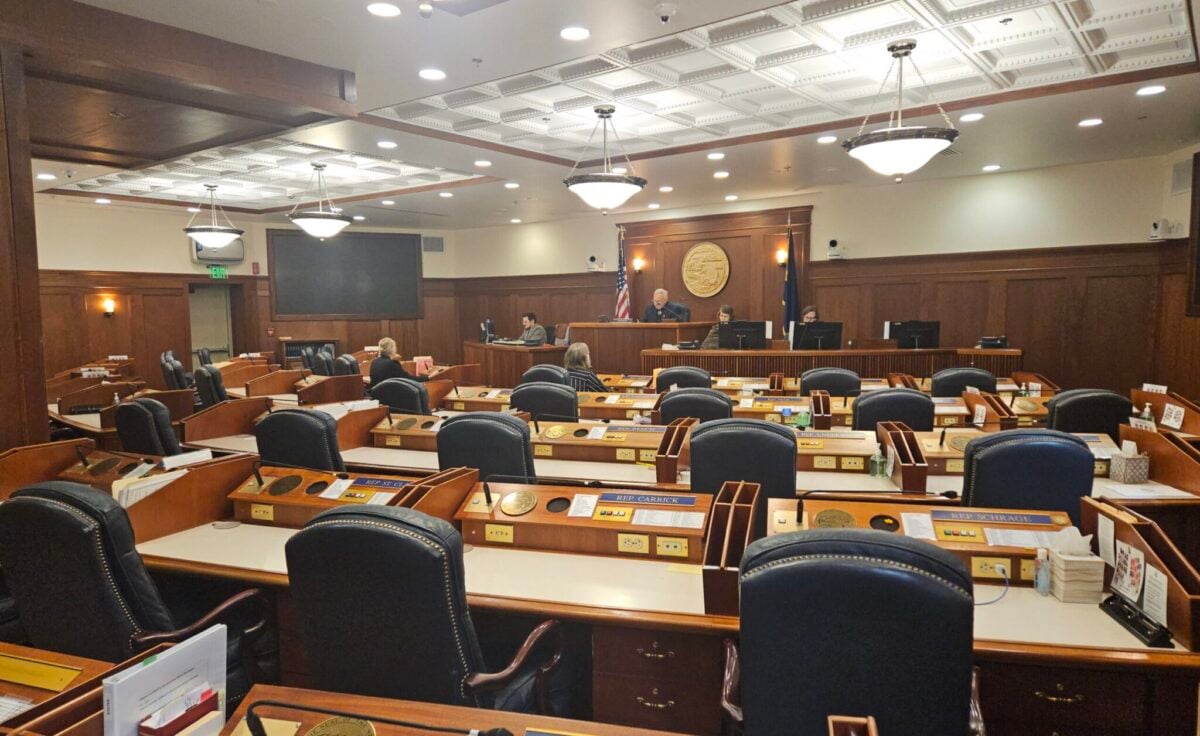
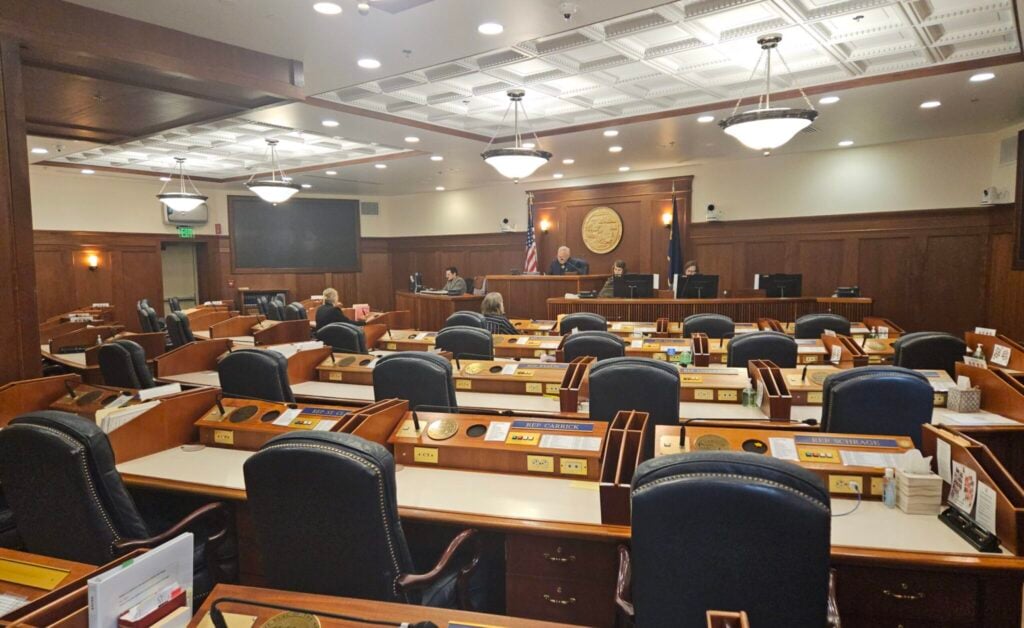
The Alaska House gavels in for the third special session in 2026 on the proposed AKLNG gasline project, with House Speaker Rep. Bryce Edgmon, I-Dillingham, presiding and Reps. DeLena Johnson, R-Palmer, and Sara Hannan, D-Juneau, in attendance on July 27, 2026. (Photo by Corinne Smith/Alaska Beacon)
The Alaska Legislature opened its third special session of 2026 with no bill, few lawmakers and little hope.
A handful of legislators gathered Monday in the state Capitol at Juneau to begin a 30-day session called by Gov. Mike Dunleavy after the failure of a compromise bill that would have provided a tax break to the developer of the proposed trans-Alaska natural gas pipeline.
But on Monday, the governor had no new alternative bill ready for legislators as the special session began.
In a statement on social media, Dunleavy said, “Before reintroducing the legislation, my administration is going to continue meeting with all parties to determine the best path forward to an agreement.”
Answering questions about those meetings, the governor’s office said it had nothing more to add.
‘I don’t believe the Legislature can do much now’
The pipeline’s lead developer, Glenfarne, has said that a reduction in the state’s petroleum property tax is necessary for it to obtain the financing needed to build the pipeline.
Passing a bill into law requires 21 votes in the House, 11 in the Senate, and the assent of the governor. In a special session called by the governor, lawmakers may only work on topics designated by the governor. In Dunleavy’s latest proclamation, he limited work to the proposed gas pipeline.
“It sounded like (the governor) is hopeful that there could be maybe some new developments, but that’s going to be his negotiation. I don’t believe the Legislature can do much now at this point,” said House Minority Leader DeLena Johnson, R-Palmer, at the Capitol on Monday.
With no legislation to consider, members of the House and Senate held pro forma “technical sessions” before adjourning until Friday, when a bill could be available.
Because no substantive action was expected on Monday, only two legislators traveled to Juneau on the first day of the special session. Speaker of the House Bryce Edgmon, I-Dillingham, and Johnson were joined by Rep. Sara Hannan, D-Juneau. In the Senate, Sen. Jesse Kiehl, D-Juneau, presided over an otherwise empty chamber.
The state House has 40 members, the state Senate has 20.
Down the hall from the House and Senate chambers, a group of cruise ship tourists watched a video about the history of the Capitol in a darkened committee room. At 10 a.m., there were more tourists than legislators.
Edgmon said that until the governor introduces a substantive bill, legislators will mostly stay away from the Capitol.
“The plan in the House is to have technical sessions, as you just saw, and to save time and certainly money (by) not bringing the Legislature back until we have something in front of us that’s worthy of bringing the entire body back … because it’s quite expensive to bring the Legislature back into session,” he said.
Typically, legislators have budgeted $1 million for a 30-day special session.
Fate of ‘pass-through’ tax is a key question
The current deadlock in negotiations is a “pass through entities tax” that would levy a form of the state’s corporate income tax on privately owned oil and gas companies, including Armstrong Oil and Gas, HEX, and Hilcorp.
That tax was added to the bill in the Senate to garner the votes of senators who are skeptical of the underlying bill, which would replace the state’s petroleum property tax with a tax on gas pumped through the as-yet-unbuilt pipeline.
The result would be billions of dollars in deferred tax revenue over a 30-year period for the state and municipalities along the route. But some lawmakers worry that the switch could also result in lower oil and gas production taxes because of writeoffs available for companies who spend on oil and gas infrastructure.
The new tax would offset that possibility, but has drawn opposition from the governor and from legislators who worry about the effects of imposing a tax on companies that are actively drilling for oil and gas within the state.
Hilcorp is expected to drill 27 gas wells in Cook Inlet this year, at a time when the region is facing a shortage of natural gas. Some legislators say Hilcorp lobbying was a key factor in the defeat of the compromise bill earlier this month.
Edgmon said he spoke with Dunleavy on Sunday. With the state’s primary election on Aug. 18 and general elections in November, time is running out for any chance of action, Edgmon said.
“Every day that goes by gets that much more difficult to reconvene the Legislature and to get them refocused on a bill,” Edgmon said.
“And so I think the clock is ticking very loudly right now, and the governor realizes that.”
Dunleavy cannot run for another term in office, and January will see a new governor and a new Legislature. If a bill doesn’t pass before then, Johnson said, “general fatigue” about the idea of a gas pipeline is part of the reason why.
“I think it’s the years of times that we tried to take this up and we never moved it forward. And so there’s just this sense that somehow it can’t be done,” she said. “I mean, I know there’s a sense of having this roadblock out there, and I think that’s kind of pervasive.”
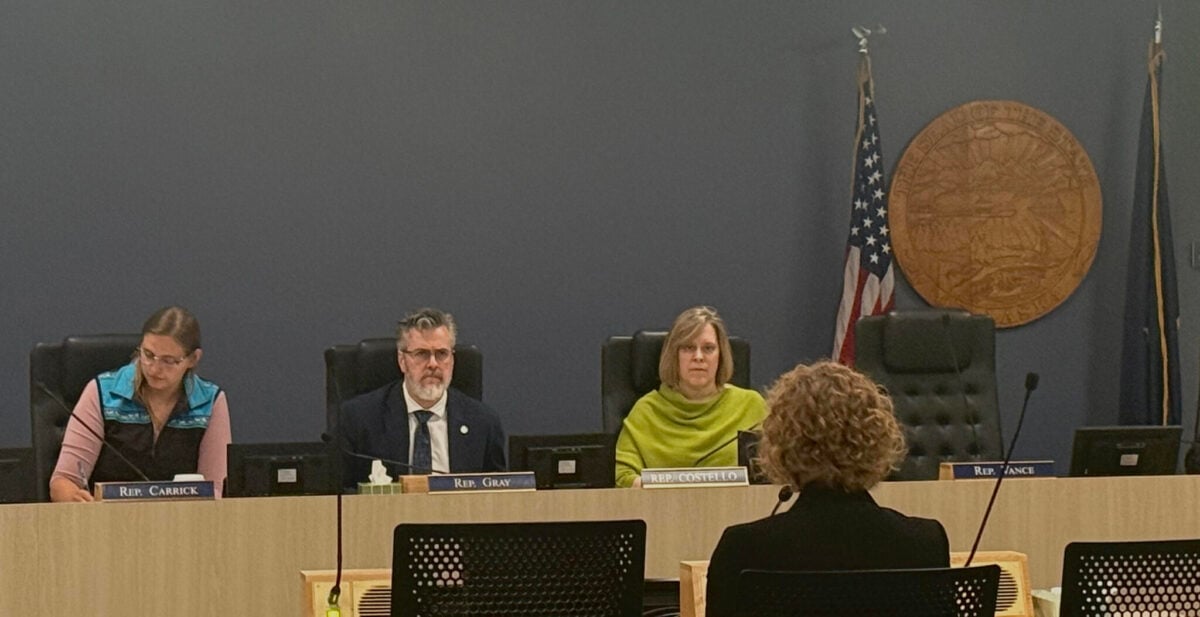
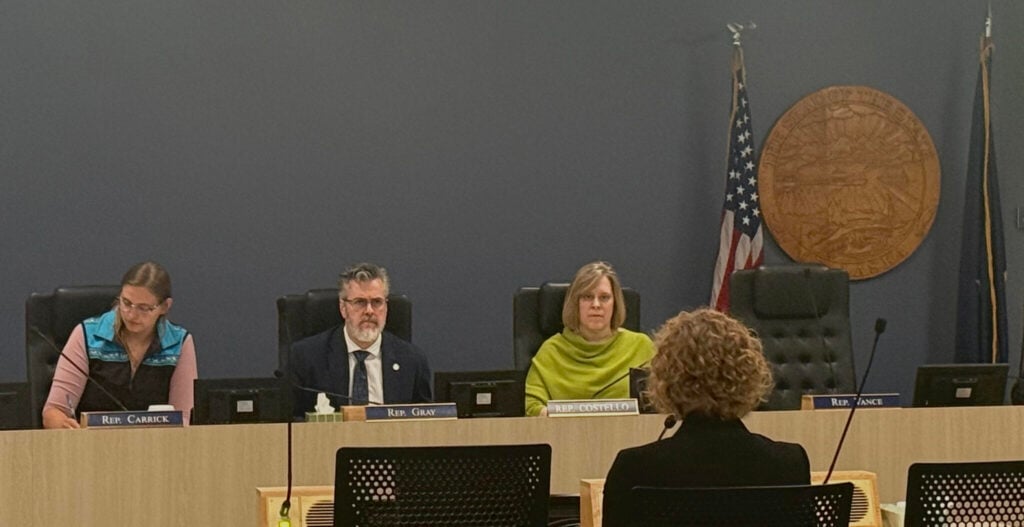
House Judiciary committee chair Rep. Andrew Gray, D-Anchorage, and committee members Rep. Ashley Carrick, D-Fairbanks and Rep. Mia Costello, R-Anchorage, listen to Carol Beecher, director of the Alaska Division of Elections, answer questions about the division’s decision to disqualify a U.S. Senate candidate at a hearing on July 22, 2026. (Photo by Kyle Johansen for Rep. Gray’s office)
Members of the House Judiciary and State Affairs committees questioned Alaska Division of Elections director Carol Beecher on Wednesday about the state’s response to a U.S. Senate candidate with the same name as the incumbent — Dan Sullivan. It was the second investigatory hearing on the subject after elections officials failed to appear at an initial hearing in June. Alaska Lieutenant Governor Nancy Dahlstrom, who oversees the division, declined an invitation to appear.
At issue was the state’s decision to disqualify the U.S. Senate candidate Dan J. Sullivan of Petersburg and its determination that he was not a “good faith” candidate. The Alaska Supreme Court nixed that decision in late June.
Carol Beecher, the new director of the Alaska Division of Elections, answers questions from reporters on Thursday, Feb. 16, 2023. (Photo by James Brooks/Alaska Beacon)
Beecher testified for nearly two hours and defended the division’s actions from the choice to disqualify Sullivan to the choice to list him without a party affiliation on the primary ballot. She also answered questions about how 3,500 Alaskan residents received notices that they have inactive voter status pending verification of citizenship.
Since the first legislative hearing, the Sullivan from Petersburg challenged the state’s decision and the fast-tracked case reached the Alaska Supreme Court. The court upheld a lower court’s ruling that Sullivan was eligible and said the division did not have the authority to add additional eligibility requirements, like whether a candidate was acting in “good faith,” beyond what is outlined in the U.S. Constitution.
Lawmakers raised concerns about how the division chose to list the candidates on the primary ballot. They asked Beecher about why the division chose to list the challenger as “Sullivan, Daniel J, Jr.” without his party affiliation as a registered Republican. It listed the incumbent senator as “Sullivan, Dan S.” and identified him as the incumbent and a Republican.
The two Sullivans are among 16 candidates for the U.S. Senate seat, including Democratic former U.S. Rep. Mary Peltola, in the primary election on August 18. The top four vote-getters will advance to the general election on November 3.
Beecher defended the division’s position that Sullivan was running with the purpose to confuse voters. She cited complaints filed by national and state Republican groups, Sullivan’s party affiliation as Republican and campaign materials as evidence of his intention to mimic the U.S. Senator Dan Sullivan and confuse Alaska voters.
“The division acted then to prevent manipulation of the ballot and to protect voters from purposeful confusion, consistent with its responsibility to maintain fair, neutral, and trustworthy elections,” she said.
She noted that the division’s action was unprecedented, but said the situation merited such a response. “The division understood all along that this action could be challenged in court, and recognizes the court’s authority to review these important questions,” she said.
Judiciary committee chair Rep. Andrew Gray, D-Anchorage, had several questions about how the division determined Sullivan was not a “good faith” candidate. “Where is the evidence that he did this to trick voters, to mislead the voters whom we are here to protect?” he asked.
“The information that we were presented with painted for us a picture of someone who was trying to confuse the ballot,” Beecher replied.
Gray probed the division’s criteria later in the hearing.“In your opinion, Director Beecher, what does it mean for a candidate to have a good faith intention to serve?” Gray asked.
“In my opinion, that it would be someone who actually wants to win, and is running because they want to to get the seat,” Beecher replied. “And in this situation, all of the facts that were presented to the division were that this was an individual who was not running to be what I would call a true candidate. This individual was running to confuse the ballot. It was an intentional attempt to gain access to the ballot for the purpose of confusing.”
Lawmakers also raised this issue of of how the candidate was listed on the primary ballot after the state Supreme Court ruling. The challenger was listed as “Daniel J. Sullivan, Jr.” when he has publicly stated he goes by his first name as “Dan.”
Beecher said it was a choice by the division. “And it’s a bit of first in time, first in place, that Dan Sullivan has already been on the ballot prior, as Dan Sullivan is known as Dan Sullivan,” she said, referring to the incumbent senator. “So it was simply a way to differentiate between the two.”
Rep. Genevieve Mina, D-Anchorage, asked Beecher about the division’s decision not to list Sullivan’s Republican party affiliation.
Beecher said she believes it was also within the division’s authority to do so. “Whether or not it has to be on the ballot, we believe that has been left to the discretion of the division, and in line with that, we made that determination,” she said.
“It also could still be litigated,” Beecher added.
Rep. Ashley Carrick, D-Fairbanks and chair of the House State Affairs Committee, said she was concerned about the precedent and the agency’s discretion to remove party information that could be informative for voters.
“Having his party affiliation may help those voters feel like they’re more informed and directed to a candidate they would rather support,” she said. “But not having his affiliation included there seems to provide less information and be more confusing.”
NOTN- A man in Juneau is facing assault charges after police say he threatened a neighbor with a handgun during a backyard dispute in the Mendenhall Valley.
Below is the full information release by JPD;
On Saturday, July 25, 2026, at approximately 7:16 p.m., the Juneau Police Department responded to a residence in the 3200 block of Tongass Boulevard following a report of an assault involving a firearm.
The preliminary investigation determined that an adult male suspect confronted another adult male in the victim’s backyard at his residence in the 3200 block of Tongass Boulevard following a verbal dispute. During the confrontation, the suspect allegedly threatened to shoot the victim while displaying a handgun. A physical struggle ensued, during which the victim was able to prevent the suspect from firing the weapon. The suspect then fled the area on foot with the firearm.
Through the investigation, officers identified the suspect as Hemaloto Fotu, 55, of Juneau, who was believed to have returned to his nearby residence in the 3200 block of Tongass Boulevard. Due to the nature of the incident and the belief that the suspect was armed, members of the Juneau Police Department’s Special Weapons and Tactics (SWAT) Team, Crisis Negotiation Team (CNT), and Drone Team responded to assist.
Using the loudspeaker on an armored vehicle, officers established communication with two occupants inside the residence—an adult female and a juvenile male. Both exited the residence without incident. Shortly afterward, officers deployed a drone inside the residence and located Fotu asleep in a bedroom. Fotu awoke to the sound of the drone and, after continued verbal commands from officers, exited the residence and was taken into custody without further incident.
During the subsequent search of the residence, investigators located a handgun believed to have been used during the assault.
Fotu was arrested and lodged at Lemon Creek Correctional Center on the following charges:
Assault in the Third Degree (a Class C Felony)
Assault in the 4th Degree (a Class A Misdemeanor)
This investigation remains ongoing. Anyone with information regarding this incident who has not yet spoken with investigators is encouraged to contact the Juneau Police Department at (907) 586-0600. Anonymous tips can also be submitted through Juneau Crime Line at www.juneaucrimeline.com
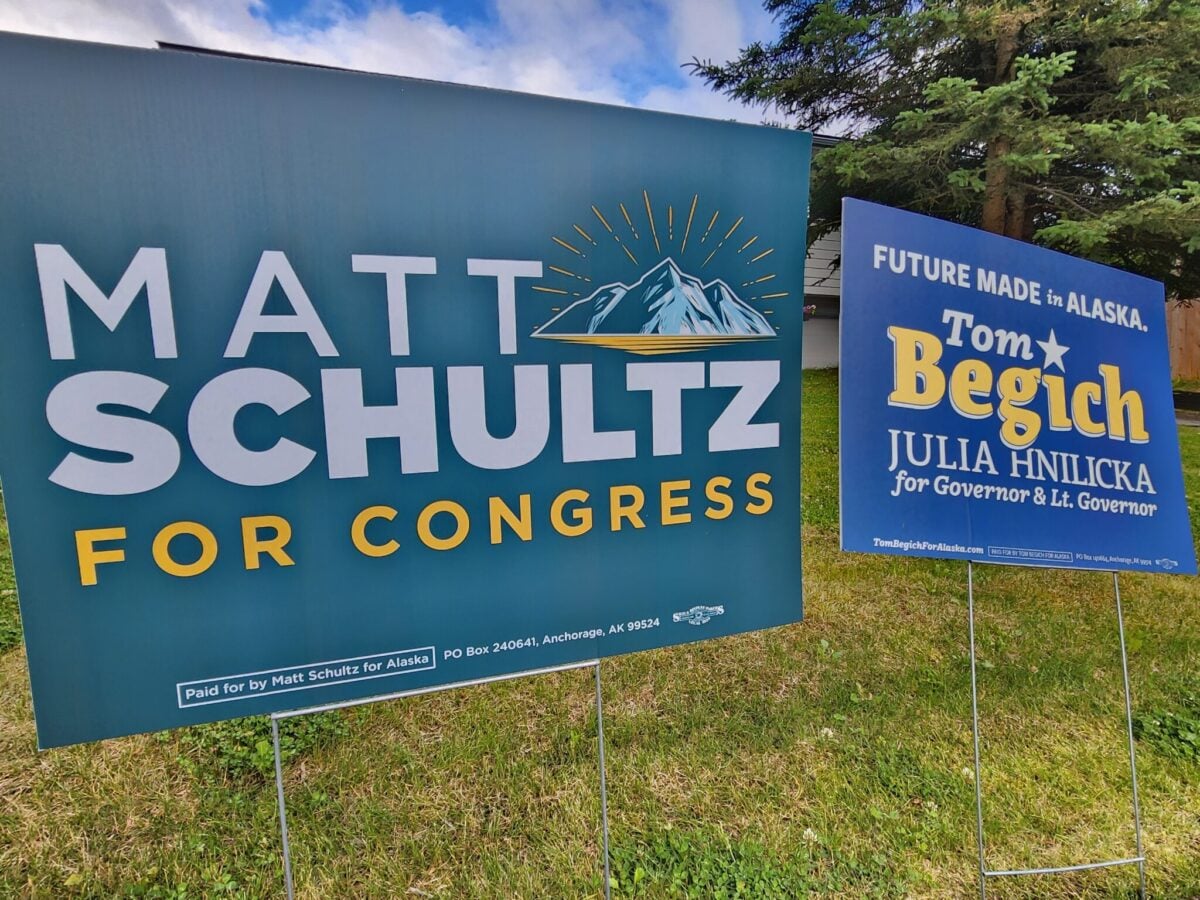
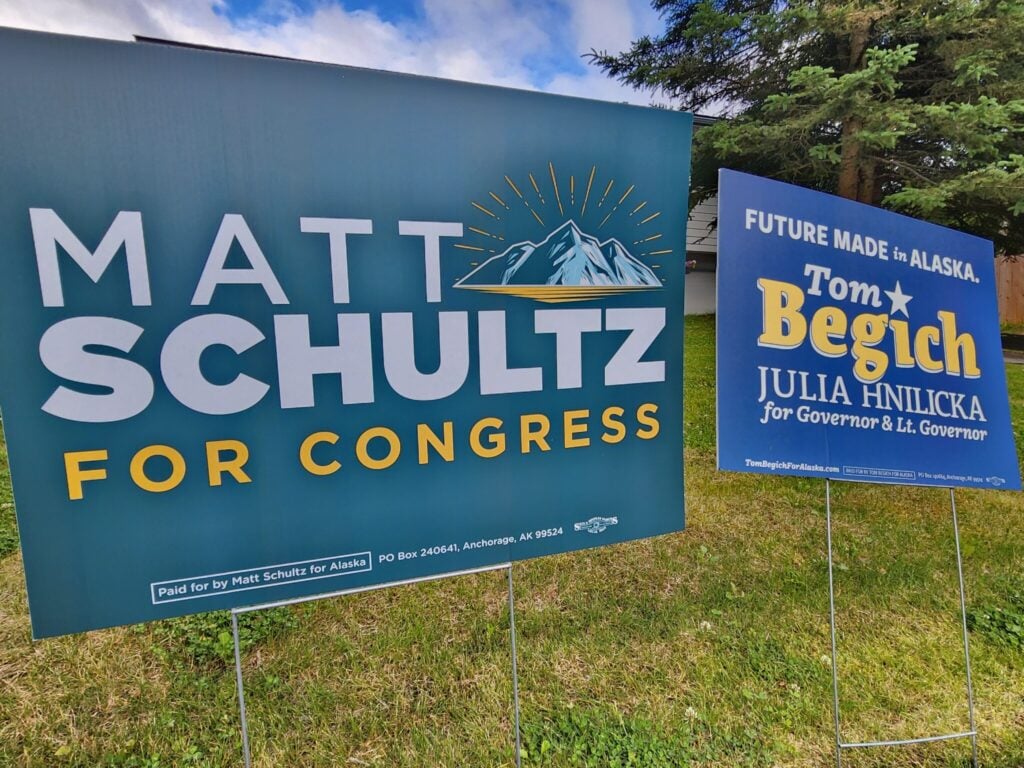
Campaign signs for Democrats Matt Schultz and Tom Begich are seen in a Midtown Anchorage yard on July 17, 2026. Schultz mounted his campaign to oust Republican U.S. Rep. Nick Begich. But he endorsed Nick’s uncle, Democratic gubernatorial candidate Tom Begich, a former state senator. Schultz suspended his campaign on July 17 and urged supporters to rally behind independent Bill Hill. (Photo by Yereth Rosen/Alaska Beacon)
On July 17, the leading Democratic candidate in Alaska’s U.S. House race suspended his campaign and announced his support for independent House candidate Bill Hill.
In an interview last week, Democrat Matt Schultz said his decision didn’t come from a lack of desire or a lack of support — it was simply a matter of money.
“One of the most disturbing things about the election process is how much … is determined by money, and I did not have a viable financial path forward,” Schultz said on July 17.
Schultz will remain on the ballot for the Aug. 18 statewide primary but is expected to withdraw after the results become final.
Campaign finance reports through June 30 showed Schultz’s campaign with $470,681 in cash on hand. Hill’s campaign had $702,626. Incumbent Republican Rep. Nick Begich’s campaign had more than $3.2 million.
Begich and Hill are also being boosted by third-party groups. In Hill’s case, Wheel Dog PAC is preparing to spend more than $1 million and has already sent mailers to voters across the state. The National Republican Congressional Committee and other groups are spending similarly to back Begich.
While Schultz has lagged in financial support, public opinion polling in the spring found him significantly ahead of Hill in Alaska’s top-four primary, but in head-to-head polling, Hill appeared to perform better against Begich than Schultz did. Neither polled ahead of Begich.
In Alaska’s election system, voters will pick one of the 14 U.S. House candidates during the Aug. 18 statewide primary. The top four vote-getters, regardless of party, advance to the general election.
“If I had made it through the primary, which — I think there’s a real good chance I would have been the the frontrunner — but I would not have had the the financial war chest required to take on Nick Begich, and the priority here is to make sure that Nick Begich does not get back into office,” Schultz said.
As a candidate, Schultz has been a solid progressive. Speaking to the Beacon and writing in a column to the Anchorage Daily News, he said he feels that some Democrats are too motivated to seek a political “middle,” even when it doesn’t make sense.
“I think that shifting to the middle is not inherently virtuous. When we think about history, there are issues like slavery or in World War II when the Nazi Party was on the rise — there’s no value in saying ‘let’s be a moderate and meet them in the middle and compromise,’” he said. “I think this is a time in history right now. The reason I was so motivated to flip the House of Representatives is because the Republican Party is pulling us into fascism. They’re attacking our democracy and handing over our freedom to billionaires and trillionaires. The stakes are so very high, and yet the folks on our side of the playing field here seem to be willing to kneel and beg for our rights instead of standing and demanding them, and I think that happened in my race as well.”
Alaska’s labor unions have backed Hill, as did the Alaska Center, a progressive environmental and pro-democracy group that hasn’t supported an independent for U.S. House since Alyse Galvin in 2020.
The Alaska Democratic Party itself declined to endorse Schultz during its April convention in Cordova, leaving open the possibility that it would support Hill instead of a party member.
The week before Schultz’s decision, the National Republican Campaign Committee signaled that it was preparing to run ads in favor of Schultz to boost his performance and help Begich.
Both Schultz and Hill released statements denouncing the strategy.
Under Alaska’s general-election system, voters are asked to rank their preferred candidates. The candidate with the lowest number of No. 1 votes is eliminated, and that candidate’s supporters have the option to give the vote to a second choice instead.
“Matt Schultz and the Alaska Democrat Party have been outspoken supporters for ranked choice voting, but when given the opportunity to present the public with their own candidate they chose to withdraw,” said Paul Smith, Begich’s campaign manager. “Despite raising nearly $1 million, making the case to progressives and traveling throughout the state, Democrats have proven that they support ranked choice voting only when it advantages them. Regardless, Alaskan voters will reject these political games and re-elect the most productive freshman Congressman on record, Congressman Nick Begich.”
Since 2022, when the system was used for the first time, statistics show that a significant number of voters have chosen to not rank a second or subsequent choice.
Hill and Schultz each said they believe that ads from the NRCC could have engendered bad feelings, reducing the odds that supporters would rank the other candidate.
Schultz said his top priority is ending Republican control of the U.S. House, and that holds whether or not he is elected.
“Once I recognized that I didn’t have a viable path forward, then it didn’t really matter what I’m being asked to sacrifice. I had to sacrifice (my candidacy) to make sure that we prevent that majority,” he said.
Reached by phone last week, Hill thanked Schultz.
“In his statement, he made it clear that it’s not about me or him. It’s about giving Alaskans the best chance to beat Nick Begich this fall,” he said.
“I think we’re both aligned on a lot of things that are not going right for Alaskans,” Hill said. “You look at things like, well, the cost of gas and groceries, the loss of health care to a lot of Alaskans who just can’t afford it with the loss of the (Affordable Care Act) premiums. There’s a lot of things that are going on in the House right now that are not benefiting Alaskans, and we definitely need to make sure that, in the long run, that there’s a change made there.”
One major difference between Hill and Schultz is that while Schultz sought to eliminate Republican control of the House, Hill is willing to join a Republican majority under certain circumstances.
“I am not committing to who I’m going to vote for (Speaker of the House, if elected), but I will tell you right up front that I’m not going to vote for Mike Johnson to be Speaker because he does not represent my values at all, and he has been the lead in doing things that have impacted Alaska negatively,” Hill said.
Asked what he will do to earn the votes of Schultz supporters, Hill said he understands that they may have concerns about his candidacy, “but I will assure them that I am there to make sure that we have a government that’s going to work on providing Alaskans with the opportunities and tools needed to build good lives, and that means things like making sure everybody has health care, to make sure that our school systems are good and solid, and providing the education that our that our children need.”
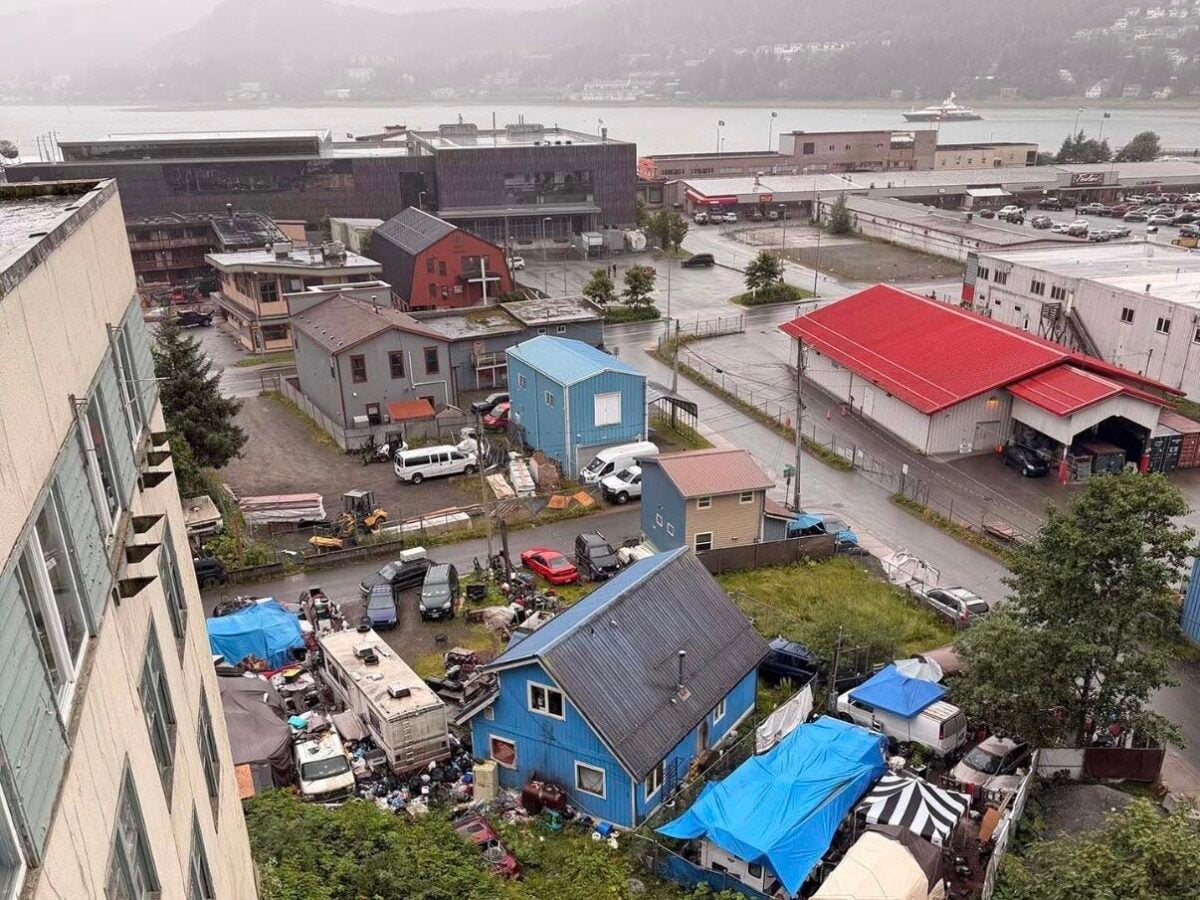
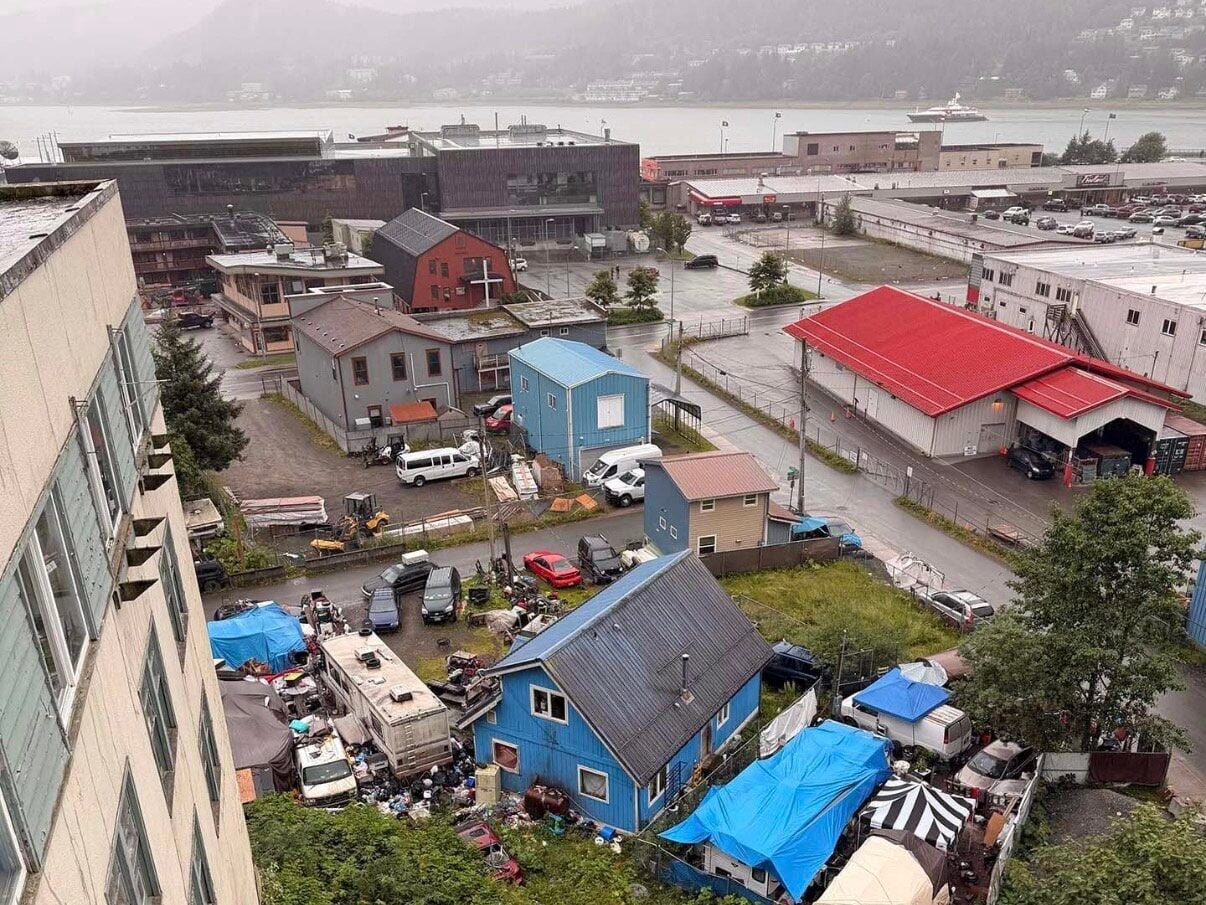
Photo courtesy of Peter Metcalfe via his Facebook post
NOTN- Residents living near the Governor’s Mansion are calling on city officials to address their safety concerns surrounding an “armed encampment” following an incident earlier this month where a young black bear was shot and later euthanized by the Department of Fish and Game due to its fatal injuries.
According to a post on the Juneau Community Collective, concerned residents living above Capital Avenue have sent a letter to the City and Borough of Juneau and nearby property owners saying the July 9 incident has prompted renewed concerns about conditions at the encampment.
The post described the site as an “armed encampment” and said residents are seeking a long-term solution to what they say are ongoing public safety issues and “outrages’ in the neighborhood.
Residents are asking others who have witnessed incidents associated with the encampment to come forward.
Below is the full letter written by Peter Metcalfe with the exclusion of addresses and personal information for resident’s privacy.
To the officials and offices named above:
The encampment on Capital Avenue, a longtime obnoxious nuisance, has become a threat to public safety.
Earlier this month, a person living in that camp shot a young black bear that was up a tree at the edge of the encampment. The animal was grievously wounded, and a Fish and Game officer had to track it down to put the young bear out of its misery.
The shots that wounded the bear were fired upward, likely toward the Fosbee, a 30-unit apartment building directly above the site. The apartment building is in our densely populated Governor’s Mansion neighborhood.
We live directly across from the Fosbee Apartments. We ask that the squatter camp on Capital Ave. be removed before someone is seriously hurt.
According to the CBJ Parcel Viewer, this encampment is on city land and shares boundaries with property owned by AEL&P, the Central Council, and a privately owned parcel (701 Capital Ave). All these properties are adversely affected by the encampment and its widely scattered piles of garbage, which are irresistible to bears.
This did not come out of nowhere. For years, the camp has created conditions no neighborhood should have to endure: clouds of toxic smoke, garbage piles measured by the truckload, and human and household waste left directly on the ground. Discarded hypodermic needles litter the area around the camp and have been dragged with other refuse by bears into the surrounding neighborhood, presenting hazards to people, pets, and wildlife.
When one of us stopped by to ask two of the occupants about the toxic smoke, their twitchy behavior was consistent with heavy methamphetamine or similar stimulant use.
Frequently, in the pre-dawn hours, residents are woken by disturbances from the site, where drugs are used openly and what appear to be drug sales occur. Now that we know the people in this camp are armed and willing to fire weapons with no regard for who is nearby, we have reason to fear for our safety.
Since the encampment is on city-owned property, CBJ clearly has the authority and responsibility to act, and its ownership removes any question of deferring to another party. The city’s own guidance calls for intervention once an encampment repeatedly harms the surrounding community, with trash accumulation and open drug use named as the triggers. This camp crossed that line years ago and has now escalated to gunfire toward occupied homes. Recent court decisions have also made clear that CBJ may enforce limits on camping on public land, so this is well within its authority.
Clearing the camp by itself will not fix this. The city has collaborated with AEL&P to remove encampments like this that have crossed the line, and with the Central Council to clean up this site.
We are now asking the city, through the Division of Lands & Resources and the Police Department, to clear the Capital Avenue camp, clean up the site, and then secure the area against re-encampment so that this stops being a recurring hazard, and to coordinate any support services the occupants may need as part of that process.
Photographs documenting current conditions at the site are attached to this letter.
We would appreciate a written response identifying who is handling this matter and what will be done. Thank you for your attention to a serious hazard in the heart of our community.
Respectfully,
Sandra and Peter Metcalfe, and on behalf of the following residents of the Governor’s Mansion neighborhood.
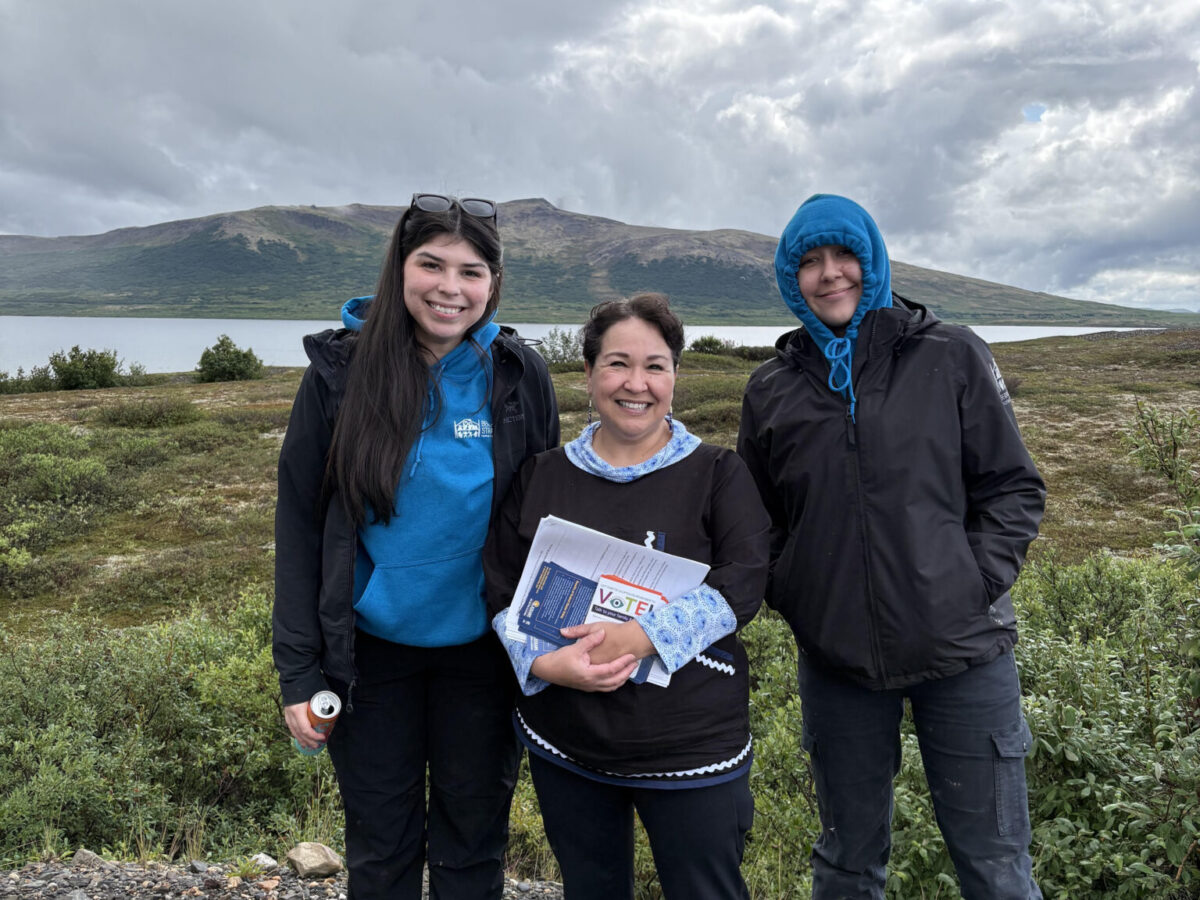
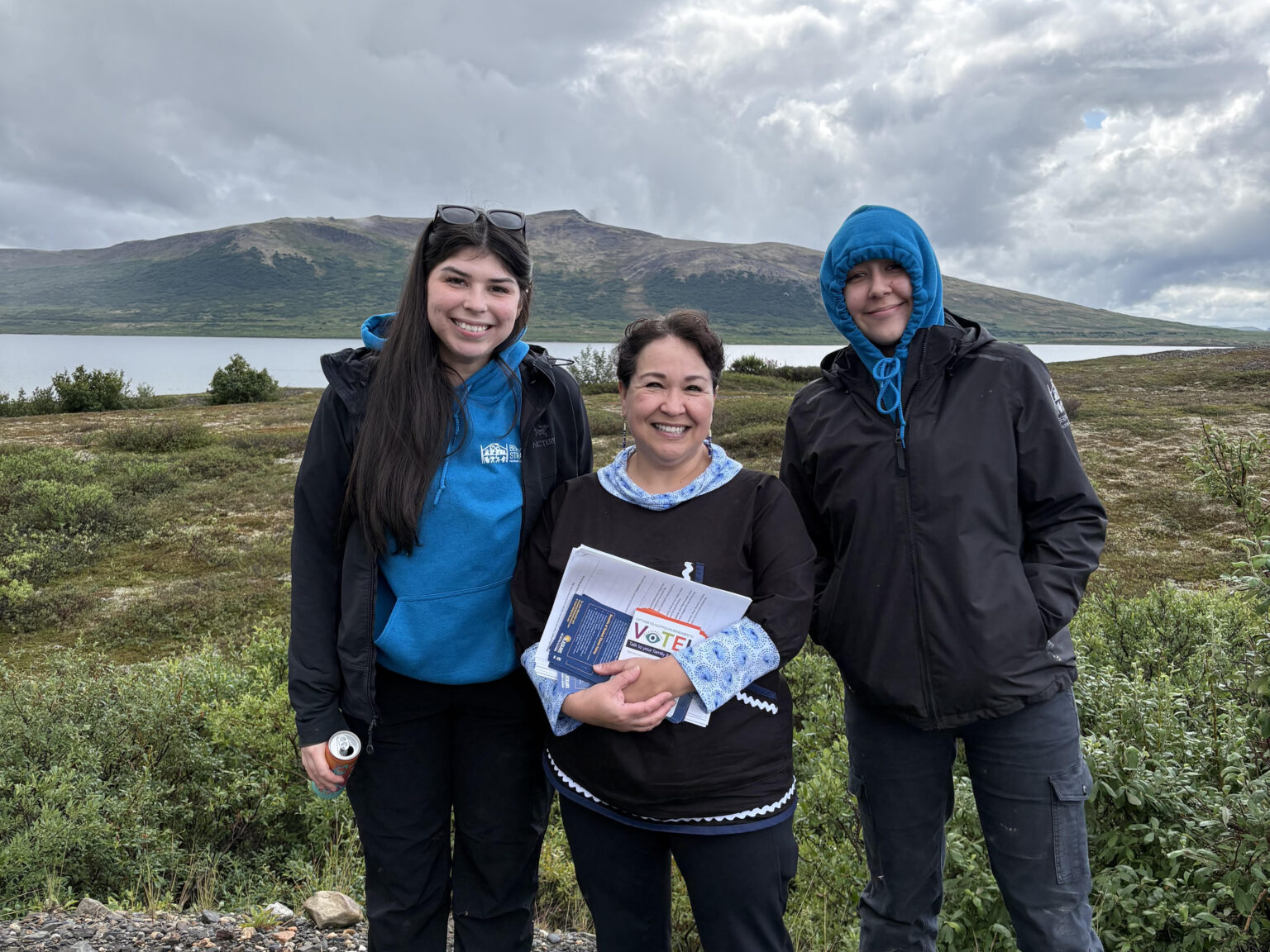
Michelle Sparck (center) poses for a photo with Bering Straits Native Corporation summer interns in Nome on July 20, 2026 during a voter outreach trip. (Photo courtesy of Michelle Sparck)
A Native-led voter mobilization group is working to boost Alaska Native voter education and turnout this election season.
Get Out the Native Vote is a non-partisan effort now underway to reach voters across the state’s vast and varied geography and get them to cast ballots in the primary elections on August 18 and the midterm elections on November 3.
Alaska Native voters make up roughly one in four Alaskan voters, said Michelle Sparck, director of the initiative, who is Cup’ik from the Southwest village of Chevak. She said part of voter education is raising awareness of when Alaska Native voters came out in force and reached a peak voter turnout of 66% in 1982. Some regions had nearly 80% voter turnout, Sparck said. That’s when decisions on subsistence policy, abortion and moving the Alaska State Capitol from Juneau were on the ballot.
“I call it the birth of the Alaska Native super voter. That generation made it a cultural value,” she said. “With that political capital that the 1980s generation built, they were able to own their sovereignty and self-determination tools.”
An Alaska voter drops their ballot into a ballot box on Nov. 1, 2024, in Anchorage City Hall. (Photo by Andrew Kitchenman/Alaska Beacon)
But voter turnout has declined significantly in the decades since. In the last election in 2024, 30% of Alaska Native voters cast their ballots. That meant Alaska Native voters made up 11% of state voters, according to data compiled by Sparck.
The mission of the campaign is to turn that decline around and reach historic highs again.
“This is what we’re capable of, and this is what this is our potential, and and I’m so excited to hold the mirror up to the communities because a lot of them really just had no idea what their performance is over the last, you know, 40-some years,” Sparck said.
“The challenge to the community is to say: own our power. We need to get out and vote,” she said. “Not should we go out and vote, we should make informed decisions.”
Get Out the Native Vote is supported by a partnership between the Alaska Federation of Natives, First Nations Institute and Cook Inlet Tribal Council with some funding from private foundations and the Carter Center, which was founded by former President Jimmy Carter. The campaign is collaborating with local, state and Tribal governments; regional Native corporations, organizations and service providers; schools; prisons and community groups to host voter education and outreach events around the state. Sparck spoke on a video call on Tuesday after returning from a voter outreach visit in Nome, and before heading to visit Utqiagvik, then the coastal community of Wainwright.
The August 18 primary falls within the summer subsistence fishing season, which is challenging for many people to find time to vote, Sparck said, but she’s found a helpful analogy.
“We’ve realized that if we describe primaries like basketball regionals, light bulbs go off their heads,” she said, smiling. “You have to win at regionals in order to make it to state. So a lot of people now know what primaries mean.”
Spark said 131 voting precincts in the state, more than a quarter, rely entirely on the U.S. Postal Service and air carriers to receive and mail their ballots.
Get Out the Native Vote working to make sure post offices are staffed, and helping the Alaska Division of Elections to recruit staff and volunteers so that each precinct has elections workers, bilingual poll workers and outreach workers to help with Native language translations. Sparck is also finding youth volunteers for a “Youth at the Booth” program, whose goal is to have two 17 and 18 year old volunteers assist at polling places and learn about elections in the process.
Particularly in the Arctic, the initiative is partnering with the North Slope Borough and local community leaders to make sure all precincts are staffed and open, in hopes of avoiding repeats of past election years where rural residents could not vote due to issues with staffing poll workers. In 2024, polling stations in rural villages of Wales and Kaktovik never opened. In Northwest and Western Alaska, voting hours were reduced in Marshall, Shaktoolik,Diomede and Kobuk. Primary ballots arrived late in at least 14 other Native villages.
“I get a lot of (precinct) chairs calling me before an election saying, ‘I don’t think I can do this.’ And we’re like, ‘You can do this. Your community can’t vote without you,’” she said. The organization’s goal is to have a well-staffed polling station in each village.
Alaska Native communities have also had the highest rates of rejected ballots, according to the Alaska Federation of Natives. One of the main issues is an incomplete witness signature on the ballot. In 2022, one in eight rural mail-in ballots were rejected, totalling more than 7,500 ballots rejected from rural Alaska.
A bipartisan elections bill that would have removed the witness signature requirement, among many other measures aimed at improving voting access, passed the Alaska State Legislature this year, but Gov. Mike Dunleavy vetoed it.
An 18 year old Ahtna shareholder registers to vote at a Get Out the Native Vote event at their Convention in June 2026 in Glennallen. (Photo courtesy of Michelle Sparck)
Between now and November, the campaign is working to distribute voter information, with guides on how to register, cast a ballot and find more information on state and federal candidates.
“So we’re trying to make things easier, but we’re building the plane as we’re flying it,” Sparck said. “You know, it’s still a work in progress, and we’re glad to have the alliances we have.”
This year, the annual Alaska Federation of Natives convention, where thousands of people from across the state convene in Anchorage, will be held one week later than usual to accommodate early voting at City Hall across the street. “So we’re excited that we’re going to have an ability to send people across the street to go vote or drop off their absentee ballots,” Sparck said.
The campaign is planning to hold voter outreach events in Alaska Department of Corrections facilities where roughly 40% of incarcerated people awaiting trial and sentencing are eligible to vote. Organizers are also working with service provider organizations to reach people who are unhoused or housing insecure, as well as foster youth who are turning 18, and inform them about their voting rights.
“We try to recognize every avenue to access voters, and especially those that are low propensity or disenfranchised. We try to meet their needs in every way, so it doesn’t mean we’re doing it 24/7, but it means we are trying to dedicate time and create the allyship and coordination with organizations that are more intimate with those groups to to best deliver that,” she said.
Get Out The Native Vote shares outreach events and regional voting updates on their Facebook page, and website at aknativevote.com.
Michelle Sparck (left) and Get Out the Native Vote volunteers smile at a tabling event in Bethel. (Photo courtesy of Michelle Sparck)
CBJ- The City and Borough of Juneau Flood Information Hotline is now available during weekdays. Residents can call the hotline with non-emergency questions and concerns related to the 2026 glacial lake outburst flood. The hotline is available at 907-500-0890 on Mondays through Fridays from 9 a.m. to 4 p.m.
Once Suicide Basin is filled, the hotline will extend operating hours to include Saturdays and Sundays from 9 a.m. to 4 p.m. Once release has begun – and a wireless emergency alert text message goes out – the hotline will move to 24/7 operations through the event.
Wooden gavel with books in background. Law and justice concept
By: James Brooks, Alaska Beacon
Wooden gavel with books in background. Courtesy of Alaska Beacon.
Two of Alaska’s largest labor organizations have sued Gov. Mike Dunleavy for failing to promptly fill two seats on the board that governs the state’s public employee pension plans.
The Alaska AFL-CIO, National Education Association-Alaska and five individuals filed suit Wednesday in Anchorage Superior Court, seeking a court order that would require the governor to fill seats on the Alaska Retirement Management Board that are designated for the teachers’ and public employees’ unions.
According to the complaint, the seats have been vacant since March 1. The unions sent lists of possible nominees to the governor four months before that, on Dec. 1.
Under state law, “a vacancy on the board of trustees shall be promptly filled.”
The unions sent a warning letter to the governor’s office in late May about the issue.
Stephen Cox, the attorney general designee whose confirmation was rejected by the Alaska Legislature this year, responded to the message. Now working as Counsel to the Governor, Cox said the law reserving seats for the unions “warrants further analysis, as it potentially encroaches upon the Governor’s constitutional appointment authority.”
Cox said the governor will be requesting a formal legal opinion from acting Attorney General Cori Mills.
“The administration does not comment on lawsuits,” said Jeff Turner, the governor’s communications director, when reached for comment.
The Beacon contacted the Department of Law on Monday afternoon as well, seeking comment about the lawsuit. It did not respond by 8 a.m. the following day.
The plaintiffs are being represented by attorney Scott Kendall, who has frequently fought cases against the Dunleavy administration.
By phone on Monday afternoon, Kendall said the issue is “very important” because the board handles billions of dollars’ worth of investments on behalf of state residents.
Two board meetings have already taken place without union representatives.
“This isn’t the, ‘Oops, this slipped through the cracks sort of issue.’ The new nominees were put forward by both unions three months before the prior terms expired. Those filings were acknowledged by the Department of Revenue, which handles this. So everything was done timely,” he said.
In the complaint, the plaintiffs state that if the issue goes to trial, Cox should not have a role because state law requires the Department of Law — through staff attorneys or hired counsel — to represent the state in legal issues.
Kendall said the legality of laws constraining a governor’s appointment powers have been repeatedly tried in court and upheld.
“To be honest, it’s befuddling. There’s a very clear statute. There’s a very clear regulation. They say these people shall be appointed promptly, and they shall be from lists from these two groups,” he said. “So I think it’s quite honestly bizarre that we’re even in this situation, but here we are nonetheless.”
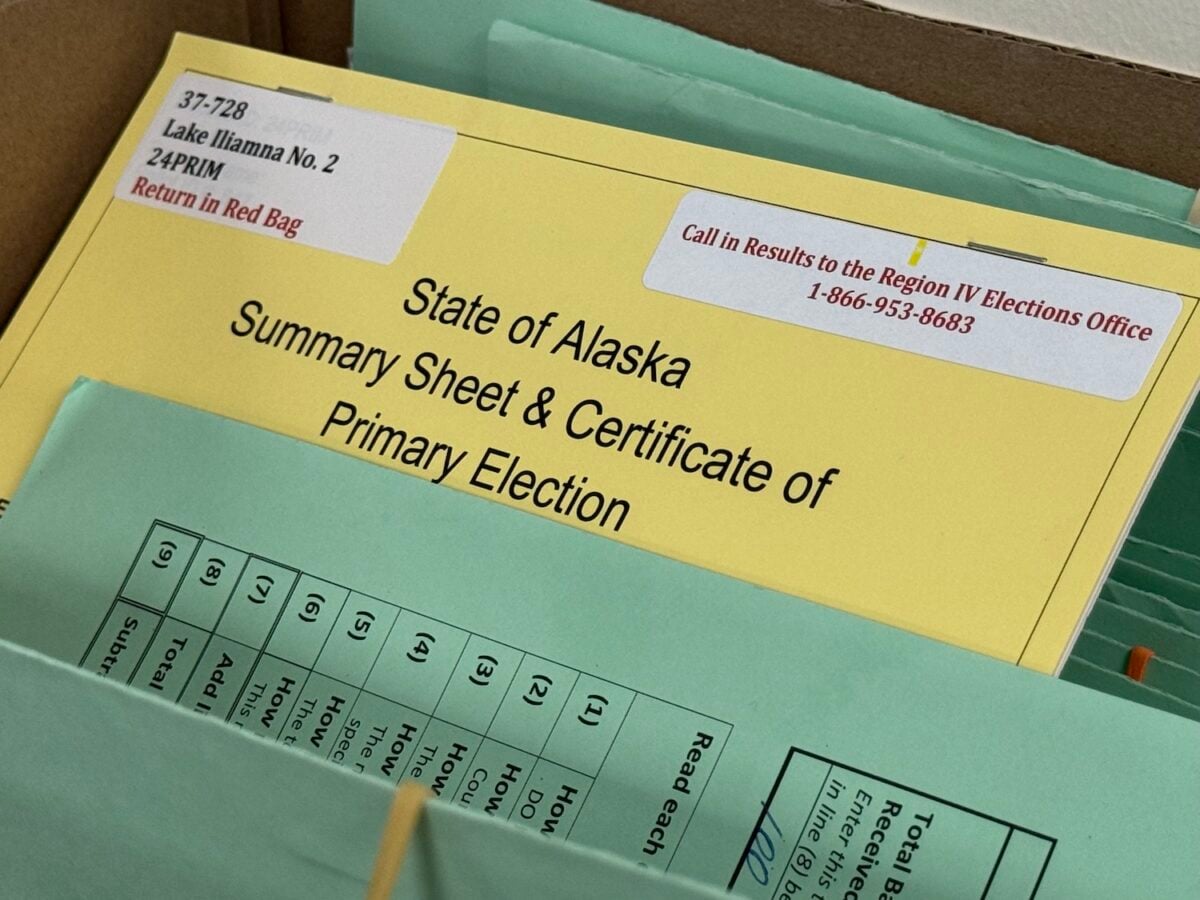
A summary sheet is seen during ballot review on Tuesday, Aug. 27, 2024, at the headquarters of the Alaska Division of Elections in Juneau. (Photo by James Brooks/Alaska Beacon)
By: James Brooks, Alaska Beacon
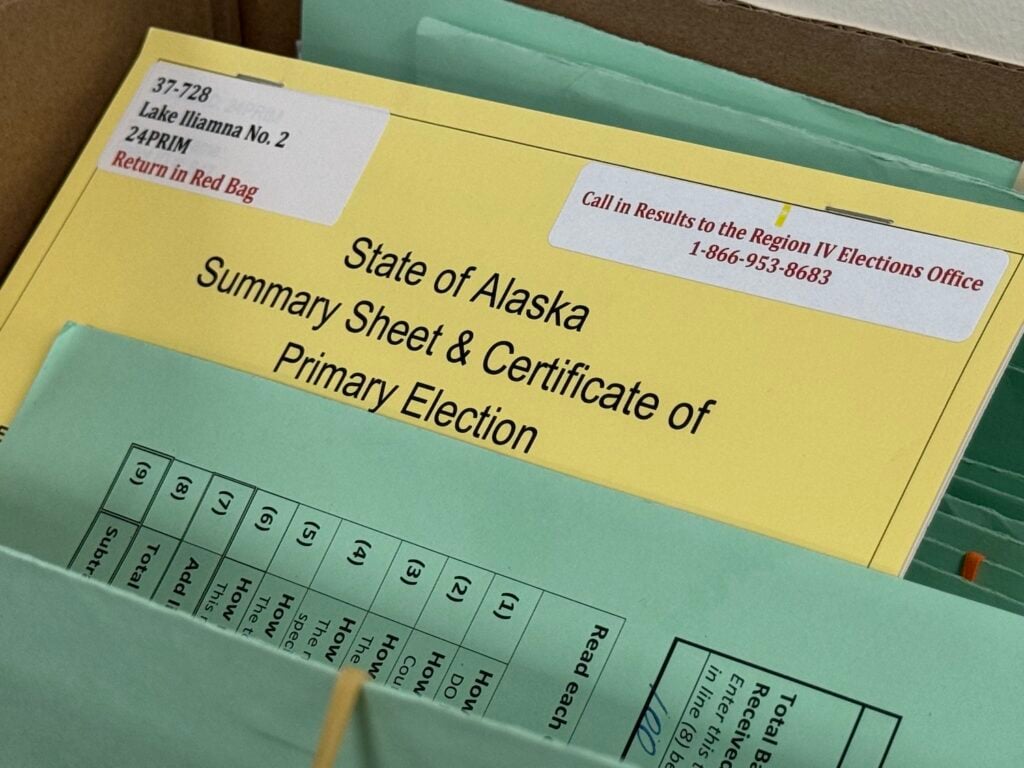
A summary sheet is seen during ballot review on Tuesday, Aug. 27, 2024, at the headquarters of the Alaska Division of Elections in Juneau. (Photo by James Brooks/Alaska Beacon)
The first two votes in Alaska’s Aug. 18 primary election have already been cast.
According to records published by the absentee and petition office of the Alaska Division of Elections, two voters — one in South Carolina and another in Hawaii — returned their ballots on July 17.
Thousands more voters will cast their ballots in the coming weeks. Absentee ballots were mailed to overseas and military voters starting July 2, and absentee ballots will start going out to the general public on July 24. Early in-person voting starts Aug. 3.
In the primary, voters will pick one candidate for each office. The top four vote-getters for each race, regardless of party, will advance to the general election on Nov. 3.
If there are four or fewer candidates running for a particular office, all candidates advance to the general election.
For Alaska’s statewide races, that isn’t an issue. There are 17 people running for governor, each running on a combined ticket with a lieutenant governor candidate:
If one of the top four finishers withdraws from the race, they are automatically replaced with the fifth-place finisher. If there are multiple withdrawals, the replacement process continues until there are four candidates.
Registration for the primary election has closed, but Alaskans may register for the general election until Oct. 4. Residents can check their voter registration at myvoterportal.alaska.gov.