Categories
Alaska News Featured Juneau News juneau Juneau Local Juneau Local Ketchikan Local News Feeds Sitka Local

Alaska lawmakers push for continued ban on Russian seafood imports

By: Yereth Rosen, Alaska Beacon

Fishing vessels are seen in Homer’s harbor on Oct. 22, 2025. A resolution passed by state lawmakers urges federal officials to extend the ban on Russian seafood imports. Russian fish competes for market share with Alaska’s fish. (Photo by Yereth Rosen/Alaska Beacon)

A legislative resolution urging a continued and better-enforced ban on Russian seafood in the United States is headed to Gov. Mike Dunleavy.

Part of a series of actions by Alaska lawmakers to try to shore up the state’s ailing seafood industry, House Joint Resolution 29 won final passage last week and was transferred to the governor on Monday.

The resolution calls for continuation of the ban on Russian seafood imports imposed in 2022, after that country’s invasion of Ukraine. The ban was expanded in 2023 to cover imports of Russian seafood to the U.S. through a third-party country, usually China, where fish are processed.

The import ban is set to expire later this year. That makes the resolution timely, supporters aid.

Among the supporters is Jeremy Woodrow, executive director of the Alaska Seafood Marketing Institute.

Woodrow, in testimony to the Senate Resources Committee on Feb. 27, said a stockpile of Russian fish that was in the U.S. before the ban went into full effect is just now being depleted.

“We need more time to really capture the U.S. marketplace. Our industry has not recovered yet,” Woodrow said. Even though last year’s fishing season was better, it was still one of the worst years in the last 20 years, he said.

“This is one measure that will help our fishermen. We’re starting to see the fruits of this ban coming into play, but we need more time to provide stability to our industry. We need more time to see it come to fruition,” he told the committee.

In addition to seeking an extension of the import ban, the resolution calls for stronger monitoring and enforcement to “ensure fair trade, protect the state’s seafood industry, and promote sustainable and ethical seafood production.”

Legislative resolutions do not have the power of law, but they can influence actions by Congress, the federal executive branch or other institutions.

The Russian seafood import ban resolution was not among the measures introduced by the Joint Legislative Task Force Evaluating Alaska’s Seafood Industry, formed in 2024. However, it addresses an aspect of international trade, one of the issues raised by the task force. The task force’s report recommended an update to a Russia-focused resolution passed by the legislature in 2022, Senate Joint Resolution 16.

Russian king crab is displayed at a Costco in Anchorage on Nov. 14, 2022. The crab, from the Barent Sea, was distributed by Arctic Seafoods of San Francisco, and was part of inventory stockpiled before the U.S. government banned fish imports from Russia. (Photo by Yereth Rosen/Alaska Beacon)

The eight-member task force, comprising Senate and House members from fishery-dependent districts, issued its recommendation report in January 2025, at the start of last year’s session. Recommendations for action resulted in the introduction of a series of bills intended to help the industry, which has struggled with low fish prices, glutted international markets, high costs and other challenges.

Other bills focus on tax credits and revenues

One of the task force’s bills, aimed at encouraging seafood product development and diversification, is headed for a vote in the Senate this week.

That measure, Senate Bill 130, concerns the state’s fisheries product development tax credit system. Currently, seafood companies are allowed to deduct the cost of new equipment used to develop value-added products from salmon, herring, pollock, sablefish and Pacific cod. The bill would expand that to all fish species, including shellfish. That is in line with the recommendation in the task force report, which identifies arrowtooth flounder, fish meal and crab shells as examples of some underused or discarded products that could be processed into something marketable.

The bill, in the amended form before the Senate, also seeks to expand the range of technology for which investment would qualify for credits, and it would extend the sunset date for the credit to 2037. Currently, the tax credit is due to expire next year.

The revenue impact of the bill, if it wins final passage, is difficult to determine because there are several unknown variables, said the fiscal note prepared by the state Alaska Department of Revenue. Estimated annual revenues losses to the state would range from $1 million to nearly $4 million, according to the fiscal note.

Another task force bill, aimed at helping fishery-dependent local governments, had not moved out of the Senate Finance Committee as of Tuesday. That measure, Senate Bill 135, would allow municipalities to increase their share of fisheries business tax and fishery resource landing tax revenues. Currently, the state and local governments split those tax revenues equally. The bill would allow local governments to get up to 75% of the tax revenues.

The legislature passed two seafood task force bills last year, each of which had wide support. However, Dunleavy vetoed one of the bills.

The bill that escaped the governor’s veto, House Bill 116, allows for the formation and operation of member-owned commercial fishing insurance cooperatives. Such cooperativesexist in other states and were used by some Alaska fishers. The bill passed unanimously.

The vetoed bill, Senate Bill 156, would have transferred $3.69 million from a defunct state loan fund to the Alaska Commercial Fishing and Agriculture Bank. The state-owned bank needed the boost to keep serving the seafood industry, bill supporters argued. But Dunleavy argued that the cost of the action was too great for the state budget to bear.

Categories
Alaska News Featured Juneau News juneau Juneau Local Juneau Local Ketchikan Local News Feeds Sitka Local

Alaska Senate advances constitutional amendment to lower override threshold for spending vetoes

By: Sean Maguire, Alaska Beacon

 Members of the House and Senate voted to sustain Gov. Mike Dunleavy’s veto of SB 113, a corporate income tax bill tied to education funding by a vote of 45 to 16. 46 votes were needed to override the veto on Jan. 22, 2026 (Photo by Corinne Smith/Alaska Beacon)

The Alaska Senate on Tuesday advanced a constitutional amendment that would lower the threshold for veto overrides of spending decisions.

The Alaska Constitution currently has two thresholds to override a governor’s vetoes: it takes two-thirds of legislators to override a veto of a policy bill and three-quarters of lawmakers to override a budget veto or a veto of legislation that spends money.  

Anchorage Democratic Sen. Matt Claman’s proposed the constitutional amendment that would reduce vetoes of spending decisions to the same two-thirds threshold.

Sen. Matt Claman, D-Anchorage, speaks at a March 19, 2024, news conference held by the Senate majority caucus. (Photo by Yereth Rosen/Alaska Beacon)

Claman’s resolution passed the Senate along caucus lines on a 14-6 vote. All 14 members of the bipartisan Senate majority voted for the resolution while each member of the all-Republican Senate minority voted no. 

At least 14 of Alaska’s 20 Senators are needed to reach the two-thirds threshold to advance a constitutional amendment. Twenty-seven of the 40 House members would need to approve Claman’s resolution for the proposed amendment to appear on November’s ballot.

The last time the Alaska Constitution was amended was in 2004.

Claman, a Democratic candidate for governor, said the drafters of the Alaska Constitution intended to create a strong executive branch. But the high hurdle to override a veto on spending decisions had “undermined the balance of power between the Legislature and the executive,” he said.

Alaska is the only state with a three-quarter veto override threshold for spending decisions.

In a statement following the vote on Tuesday, minority Senate Republicans said the governor’s veto power was one of few tools to curb the Legislature’s wide-reaching power. Members of the caucus stated that Gov. Mike Dunleavy had used that authority to veto tax bills, among other measures.

“The framers of our Constitution saw the wisdom in giving the governor considerable power to reduce state spending,” said Tok Republican Sen. Mike Cronk, the Senate minority leader. “The fiscal override threshold is high for a reason.”

While the Legislature has voted to override a governor on 40 occasions for policy bills since statehood, veto overrides for spending decisions have only occurred five times, Claman said.

The most recent override of a spending veto occurred last August in a special session Lawmakers voted to reject Dunleavy’s veto of more than $50 million in public school funding. The vote was 45-14, the minimum number of lawmakers needed to override a budget veto.

If approved by the House, the constitutional amendment would appear on the ballot at the Nov. 3 election. If approved by a majority of voters, the constitutional threshold for budget vetoes would then be lowered starting in 2027, also the beginning of a new governor’s term.

Unlike legislation, an Alaska governor cannot veto a constitutional amendment.

Categories
Featured Juneau News juneau Juneau Local Juneau Local News Feeds

Alaska mayors say governor’s proposed tax break for $46B gas line ‘needs a lot of work’

By: Sean Maguire, Alaska Beacon

A network of pipelines, seen on Aug. 23, 2018, snakes through a portion of the Greater Prudhoe Bay Unit on Alaska’s North Slope. (Photo by Yereth Rosen/Alaska Beacon)

Five Alaska mayors voiced concerns about how a proposed tax break for the Alaska LNG gas line project would impact their communities.

Republican Alaska Gov. Mike Dunleavy has proposed eliminating property taxes and other local taxes for the $46 billion megaproject. Instead, his bill would impose a volume-based tax when substantial quantities of gas are delivered from the North Slope. 

The Alaska Department of Revenue estimated Dunleavy’s bill would equate to a roughly 90% reduction in property tax revenue, once the pipeline is at full capacity. The state agency has said the pipeline will not move forward without cutting property taxes for Glenfarne, the New York-based developer of the proposed pipeline and export facilities. 

Five Alaska mayors on Friday testified to the Senate Resources Committee in support of the 800-mile pipeline, which is set to run from the North Slope to Cook Inlet. But the municipal leaders also expressed concerns about the potential loss of revenue from the governor’s tax break and the impacts on municipal services. 

‘Bottom offer’

Peter Micciche is mayor of the Kenai Peninsula Borough, one of Alaska’s largest with roughly 62,000 residents. He said a liquefaction facility, equating to 43.5% of the total project, is set to be located in the coastal region.

Micciche said the project would have tens of millions of dollars of impact annually for the Kenai Peninsula, with costs set to be borne by local communities under Dunleavy’s bill. He said the proposed elimination of all local taxes for Alaska LNG is “cutting deep into the fabric of how our communities work. And that worries me.”

He cited concerns about Dunleavy’s proposed tax rate rising by 1% annually. He said the borough’s budget increases on average by 2.5% each year, meaning that would leave the Kenai Peninsula “underwater.”

“Costs have shifted from the state to the municipalities. But we simply cannot afford additional costs,” he said to lawmakers Friday.

Micciche, a former long-time oil and gas executive, emphasized that he is excited by the project, but he considers the governor’s tax break to be “a bottom offer.”

Adam Prestidge, president of Glenfarne Alaska LNG, on Monday told the Senate Resources Committee that the company recognizes there will be impacts to municipalities from the project. He said discussions are ongoing with municipal leaders about how the company will cover some costs to ensure communities feel comfortable they “will be taken care of.”

Senate President Peter Micciche, R-Soldotna, listens to questions from senators during a break in Alaska Senate proceedings on Tuesday, May 3, 2022 at the Alaska State Capitol in Juneau. (James Brooks / Alaska Beacon)

Micciche, a former Republican Alaska Senate president, framed the scale of the challenge of negotiating acceptable legislation for communities and Glenfarne with less than half of the legislative session left until adjournment. “This bill needs a lot of work,” he said. 

“We’re ready to sit down and pen a deal that works for everyone — the developers, our community, Alaskans — and I hope to God that comes along with affordable gas,” Micciche said.

‘Once-in-a-lifetime project’

Supporters remain bullish on the gas line’s potential to be an economic boon for Alaska. Former Democratic U.S. Sen. Mark Begich has been hired by the Dunleavy administration to boost the pipeline. He told the Senate Resource Committee on Monday that it was “a once-in-a-lifetime project.”

Glenfarne owns 75% of the project while the Alaska Gasline Development Corp., a state agency, owns the remaining 25%.

Begich and Prestidge declined to answer some questions in detail about the proposed tax break and whether it was at an appropriate rate, citing the need for confidentiality in commercial agreements. Begich implored lawmakers to hold a session behind closed doors to discuss revenue questions with Glenfarne.

Under Dunleavy’s bill, the long-sought gas pipeline is expected to raise over $22.5 billion in new revenue for the state of Alaska. But over the next 36 years, it would also cost roughly $13 billion for local communities compared to current law, according to state projections.

Instead of property taxes, the governor’s bill would impose a volume-based tax of 6 cents on every thousand cubic feet of gas, which would increase by 1% annually. The tax would only be imposed once the pipeline delivers an average of 1 billion cubic feet of gas per day or 10 years after gas starts being produced. 

Edna DeVries is mayor of the Matanuska-Susitna Borough, home to around 117,000 people. She said the Mat-Su Assembly believes those thresholds are “far too high” and that they should be lowered so the borough could collect revenue sooner.  

DeVries cited a concern common to all five mayors along the proposed corridor for Alaska LNG: the impacts of constructing the pipeline on municipal budgets. 

Mayor Chris Noel of Denali Borough, home to 1,600 residents, said that construction would see added costs for waste management, fire and rescue and housing, which would likely be borne by the local community. Denali Borough does not currently collect property tax. But it would get “limited benefits” from the pipeline with no local offtake planned for the borough, Noel said. 

“The bottom-line is we cannot subsidize increased costs. We need certainty via an impact payment program during construction that actual costs will be covered by the project,” he said.

Another potential concern: education funding. Alaska’s complicated education funding formula means that as a local community’s total assessed property tax value increases, state contribution for schools is reduced. 

Concerned at the ‘precedent’

Mayor Josiah Patkotak of the North Slope Borough said he was concerned at the “precedent” set by eliminating property taxes for oil and gas projects before a final investment decision is reached. Patkotak, also a former member of the Alaska House of Representatives, cited a recent record North Slope lease sale and said oil developers could seek similar tax relief.

Rep. Louise Stutes, R-Kodiak, talks with Rep. Josiah Patkotak, I-Utqiagvik, on Tuesday, Jan. 17, 2023, as the Alaska House of Representatives convenes at the state Capitol in Juneau. (Photo by James Brooks/Alaska Beacon)

The North Slope Borough, based out of Utqiaġvik with 10,500 residents, has a long history of fiercely defending its authority to levy property taxes on oil and gas companies, he added.

Patkotak estimated Dunleavy’s proposed tax break means the borough would collect $12 billion less in revenue compared to current law. He said property tax revenue has been critical for the borough, which funds schools, fire and rescue services, airports and waste management. 

Prestidge declined to tell the Senate Resources Committee whether the proposed tax break would be make-or-break for the project. But he said if the bill failed to pass, “It makes it more difficult because it makes the gas more expensive.”

“It creates an incredible amount of uncertainty around the project,” he added.

Patkotak noted that the North Slope would not get any of the gas delivered through the pipeline with no offtake planned for the remote region.

That has long been a concern for Fairbanks, which has a population of 97,000 people. The borough has advocated for a $180 million spur to deliver gas to the Interior city.  

“We need to make sure we’re getting Alaskans’ gas to Alaskans,” said Mayor Grier Hopkins of the Fairbanks North Star Borough.

Hopkins said there are currently “no concrete” plans to build a gas offtake for Fairbanks, but discussions are ongoing with Glenfarne.

Members of the Senate Resources Committee hear testimony from borough mayor's on Gov. Mike Dunleavy's tax break proposal for the Alaska LNG gas line project on Mar. 27, 2026. (Photo by Corinne Smith/Alaska Beacon)
Members of the Senate Resources Committee hear testimony by phone from borough mayors on Gov. Mike Dunleavy’s tax break proposal for the Alaska LNG gas line project on Mar. 27, 2026. (Photo by Corinne Smith/Alaska Beacon)
Categories
Alaska News Featured Juneau News juneau Juneau Local Juneau Local Ketchikan Local News Feeds Sitka Local

Alaska Gov. Dunleavy’s aide and former legislative candidate arrested for drunk driving in Juneau

By: Corinne Smith, Alaska Beacon

 Forrest Wolfe is seen in an undated campaign photo for his run for the Alaska House of Representatives for District 21, in East Anchorage, in 2022. (Campaign photo provided by Wolfe)

A legislative aide to Alaska Gov. Mike Dunleavy, and a former candidate for the Alaska House of Representatives, was arrested and charged with driving under the influence of alcohol on Thursday in Juneau.

Forrest Wolfe, 40, was pulled over by Juneau Police at about 10:30 p.m. on Mar. 26, according to court documents, after driving erratically through a busy area of downtown Juneau. Wolfe was the sole occupant of the vehicle, a red Chevrolet Tahoe, when he was pulled over on Franklin Street. 

Wolfe exhibited a strong odor of alcohol and gave conflicting stories of his previous activities, then stopped answering questions, according to the police report. Wolfe failed a field sobriety test and then later a chemical test for alcohol, showing his breath alcohol level at 0.10, which is above the legal limit of 0.08. He was arrested and charged with a criminal misdemeanor. 

Wolfe serves as deputy legislative director for Dunleavy, a role he began in January, according to his public LinkedIn profile.

A spokesperson for Dunleavy’s office declined to comment on the arrest or any penalties by his employer on Monday, citing privacy as a personnel matter. 

Wolfe ran for the Alaska House in 2022 as a Republican representing District 21 in East Anchorage, and narrowly lost to Rep. Donna Mears, D-Anchorage, by just 150 votes

Prior to serving in the governor’s office, Wolfe served as a legislative liaison for the Alaska Department of Administration for about a year, in 2025. He worked as legislative staff for more than a decade, since 2012, for various Republican representatives. 

Wolfe posted a $500 bail and was released from Lemon Creek Correctional Center on Friday morning, according to Alaska Public Media.

Wolfe has had previous run-ins with Juneau Police for minor infractions, and was arrested and convicted for drunk driving in 2011.

Categories
Alaska News Featured Juneau News juneau Juneau Local Juneau Local Ketchikan Local News Feeds Sitka Local

Alaska Legislature passes stopgap budget, amid uncertainty around war-driven oil revenues

By: Corinne Smith, Alaska Beacon

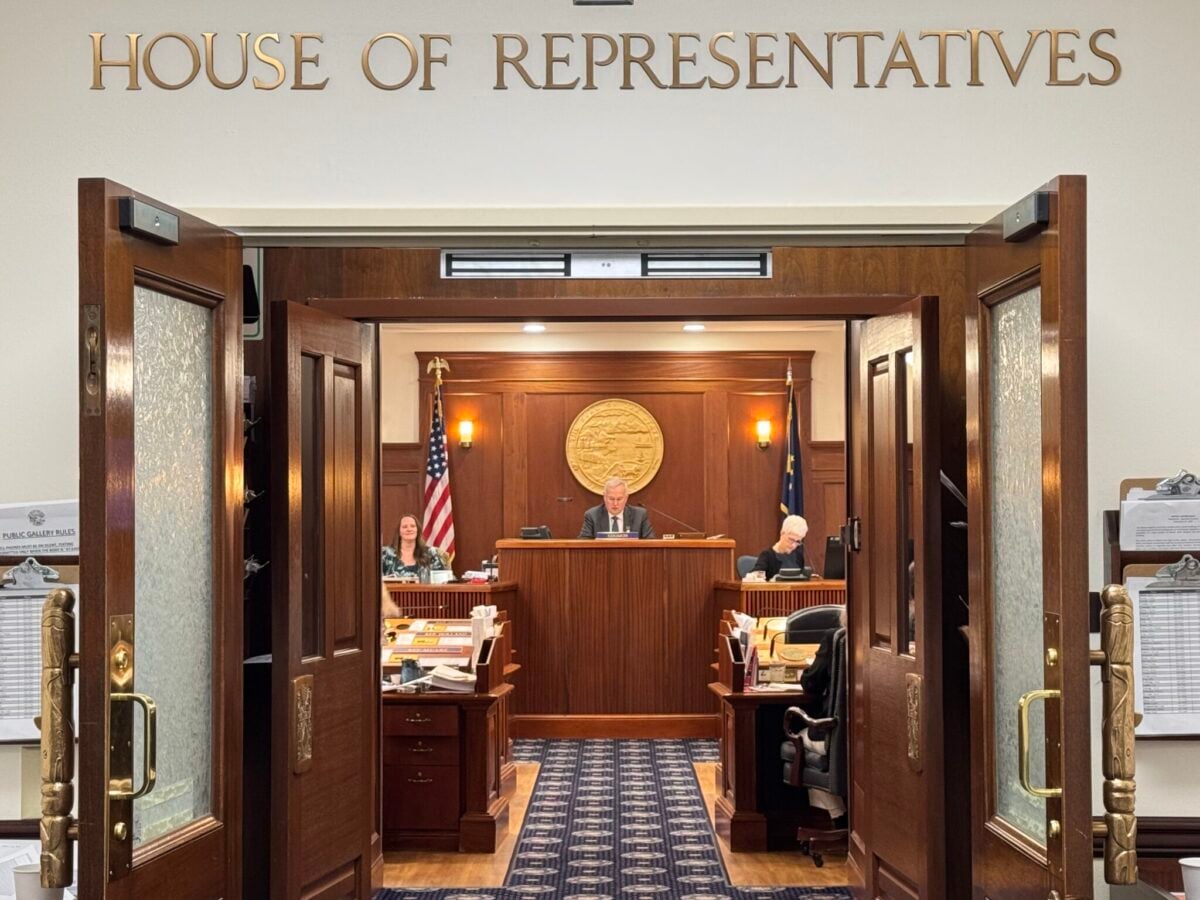
Members of the Alaska House of Representatives convene on the first day of the second session of the 34th Alaska State Legislature on Jan. 20, 2026 (Photo by Corinne Smith/Alaska Beacon)

The Alaska Legislature on Wednesday approved a stopgap budget bill amid an ongoing debate among lawmakers around war-driven oil revenues and whether to draw from state savings.

The stopgap budget bill contains $449.6 million in state spending including for disaster relief, construction, education, correctional officer overtime and some public assistance programs — expenses accrued since the Legislature and Gov. Mike Dunleavy adopted the state budget last year.

But the question of how and when all the items will be funded is still uncertain. Lawmakers chose to rely on anticipated oil revenue to fund the bill rather than drawing from savings. 

The Alaska Senate passed the budget bill by a 19 to 1 vote on Wednesday, with Sen. Robert Meyers, R-North Pole opposing. The bill was quickly transferred to the Alaska House where it passed unanimously by all 40 members. The bill now moves to the governor’s desk for his consideration.

The Legislature created a select bicameral conference committee to hammer out differences between House and Senate versions of the budget bill over the last week

The final bill includes $75 million for disaster relief to cover the state’s response to the Western Alaska storms last fall, and almost $100 million for fire suppression. It contains $20 million for the Alaska Department of Corrections for overtime spending, as well as $34.4 million for Medicaid and $12.8 million for other public assistance programs through the Alaska Department of Health. The bill allocates nearly $130 million toward the Alaska Higher Education Fund which provides grants and scholarships to students.

The spending bill also includes a time-sensitive appropriation for Alaska’s construction industry. It contains $70.2 million in state dollars to unlock roughly $630 million in federal grant funding that industry groups have said is essential for the summer construction season.

But how the nearly $450 million budget bill is funded is still in question. 

Legislators have been closely watching oil prices since the start of the Iran war, which state forecasters have projected could potentially generate hundreds of millions in state revenue for Alaska. 

Lawmakers agreed that if oil-driven state revenues from now until June 30, the end of the fiscal year, are not sufficient to cover the stopgap budget, then the Legislature will draw from state savings. That roughly pencils out to an average of $74 per barrel of oil through June to cover state spending, according to data provided by the House Finance Committee. 

But that vote to confirm drawing from savings again failed in the House on Wednesday — the fourth vote held in the House this year. To draw from Alaska’s main $3 billion savings account requires support from three-quarters of the House and Senate.

The Senate approved the immediate draw from savings on Wednesday by a 16 to 4 vote, but it failed to pass the House by a vote of 22 to 18. It takes 30 votes in the House to spend from the savings reserve. 

On Thursday, House Speaker Rep. Bryce Edgmon, I-Dillingham, expressed concern at sending the budget bill to the governor with what he said was no “backstop” funding from savings.

“So if the price of oil goes down, the governor may not have the money ultimately, to finish up or to pay for operations,” he said for this fiscal year. 

Edgmon said he is concerned with banking on future oil prices to pay the state’s bills. 

“It’s the first time, I think maybe perhaps in Alaska’s history, we’ve ever done it this way,” he said. “It’s going to be very interesting to see how this plays out, because oil prices can certainly go up as well, but they can also go down. And it’s not the way that I like to operate in terms of being fiscally responsible.”

Members of the Republican House minority caucus in opposition from drawing from savings expressed confidence in oil revenues providing enough funding to cover state expenses.

“Everything in this bill the state currently projects enough revenues to fund,” said Rep. Will Stapp, R-Fairbanks on Wednesday. “We still have many days in session, happy to revisit in the event oil price changes and we need to structure something in order to meet our obligations. That is not a requirement at this moment.” 

The stopgap budget bill now moves to Dunleavy who can sign or veto the bill or let it pass into law without his signature.

Categories
Alaska News Featured Juneau News juneau Juneau Local Juneau Local Ketchikan Local News Feeds Sitka Local

Alaska governor pitches big tax break to spur $46B gas line

By: Sean Maguire, Alaska Beacon

Alaska Gov. Mike Dunleavy delivers the annual State of the State address on Tuesday, Jan. 28, 2025, in the Alaska Capitol. (Photo by James Brooks/Alaska Beacon)

Alaska Gov. Mike Dunleavy has proposed eliminating property taxes for the Alaska LNG project to incentivize development of the $46 billion gas line and export facilities. 

The bill was introduced to the Legislature on Mar. 20 and would exempt the project from local taxes in Alaska, including property and sales taxes. Instead, a volume-based tax would be levied once the pipeline starts producing significant quantities of gas from the North Slope. 

In a statement, Dunleavy said his legislation “removes a structural barrier” that would help get the gas line built. The project is expected to create thousands of construction jobs, spur the development of new industries and potentially lower power and heating bills for consumers.

“We bring more gas into Alaska and stabilize supply — that lowers cost for families like yours and businesses,” Dunleavy said Wednesday on social media

The state of Alaska is expected to collect over $22.5 billion in new revenue from the project over the next 36 years, primarily from production taxes and royalties, according to state economists. 

In addition to exempting the project from property and sales taxes during its ramp-up period, the Alaska Department of Revenue estimates Dunleavy’s bill would equate to a 90% reduction in property tax revenue, once the pipeline is at full capacity.  

Municipal governments are expected to take the biggest hit from that change. If the project was built under current tax law, they would collect an extra $13 billion in revenue through 2062, or $360 million annually.

Some long-time lawmakers have questioned whether the pipeline will result in reduced gas prices. Others have questioned why such a sharp reduction in property taxes is needed. 

‘Industrial renaissance’

An 800-mile pipeline from the North Slope to deliver natural gas to market has been a dream in Alaska for decades. But prior efforts have all fallen short. 

Supporters say its prospects have never been stronger. Key permits are in hand, several Asian nations are interested in buying Alaska’s gas, and President Donald Trump has voiced support for the project.

Former Democratic U.S. Sen. Mark Begich has been hired by the Dunleavy administration to help advance the pipeline. He told lawmakers the 1973 oil shock helped spur development of North Slope oil. Now, war in the Middle East has upended LNG production and raised prices, which makes Alaska natural gas more attractive, he said.

“This is our moment,” he said to the House Resources Committee on Monday, calling the gas line “an incredible project.” 

Glenfarne, a New York-based company, signed on to develop the pipeline last January. It owns 75% of the project while the Alaska Gasline Development Corp., a state agency, owns the remaining 25%.

But the economics of the $46 billion gas line remain uncertain.

Glenfarne chose to split the project in two. The first phase would see construction of a pipeline for domestic consumption, with delivery of gas targeted for 2029. The second phase would construct a plant and shipping terminal in Cook Inlet for export. 

Alaska’s current tax structure means a 2% property tax can be levied on oil and gas infrastructure. 

Dunleavy’s tax proposal would impose a volume-based alternative. A new tax would be levied at 6 cents on every thousand cubic feet of gas, which would increase by 1% annually.

The tax would only be imposed once the pipeline delivers an average of 1 billion cubic feet of gas per day or 10 years after gas starts being produced. 

Dan Stickel, economist with the Department of Revenue, on Wednesday said reducing property taxes would help with front-end costs. He said the agency is not examining Dunleavy’s bill as a tax cut because it would help spur the pipeline and potentially lead to new state revenue.

Stickel told the House Resources Committee that AGDC and Glenfarne have said the project will not move forward without property tax relief. 

At full capacity, the pipeline is expected to deliver 3.5 billion cubic feet of gas per day. Southcentral Alaska’s demand for Cook Inlet gas equates to roughly 70 billion cubic feet of gas per year.

Glenfarne Group CEO and founder Brendan Duval and Alaska LNG President Adam Prestidge stand while Gov. Mike Dunleavy recognizes them during his State of the State address on Jan. 22, 2026. (Photo by Corinne Smith/Alaska Beacon)

Adam Prestidge, president of Glenfarne Alaska LNG, said the project would be an “industrial renaissance” for Alaska. It could create 7,000 jobs during construction and spur new opportunities such as data centers, he said.

Wearing a lapel pin in a House Resources Committee hearing that said “build the line,” Prestidge told lawmakers discussions on gas agreements are ongoing with Alaska utilities. He said agreements could be signed and made public in the next couple of months.

“This is the only way to significantly bring down the cost of energy for Alaskans,” he said.

‘Huge give’

The Alaska Department of Revenue estimates the state would receive $22.5 billion in revenue from the gas line through 2062. The majority of that windfall would come from production taxes and royalties. 

Compared to Alaska’s current tax regime, Dunleavy’s proposal would see the state miss out on $200 million per year from property taxes once the pipeline is at full capacity, projections show. 

The alternative tax structure proposed by the governor would see $64 million per year collected by municipalities at full gas production and $9 million annually by the state.

For municipalities, there would be a bigger hit.

The gas line is expected to be built through four municipalities that collect property taxes: the North Slope Borough, Denali Borough, Matanuska-Susitna Borough and the Kenai Peninsula Borough.  

Under Alaska’s current tax structure, municipal governments would be expected to share in $17.3 billion from the pipeline through 2062. Under Dunleavy’s tax bill, it would be below $4 billion. 

Anchorage Democratic Sen. Bill Wielechowski, vice-chair of the Senate Resources Committee, spoke at a Tuesday news conference. He said legislators would look closely at Dunleavy’s proposed tax break and determine whether a 90% cut in property taxes is appropriate. 

“I don’t know anybody in the Legislature who doesn’t want a gas pipeline. The question is, what is it going to take to get it?” Wielechowski said. 

State projections show that under both tax systems, the owners of the pipeline are expected to collect $60 billion over the next 36 years.

Anchorage Republican Sen. Cathy Giessel, chair of the Senate Resources Committee, estimates Alaska has invested $1.1 billion to build a natural gas pipeline, but nothing has been built. 

On Tuesday, Giessel cited costs like public safety that could be borne by communities along the proposed pipeline. She said it would likely take until the second phase of the project before 1 billion cubic feet of gas is produced per day. Meaning, it could take years before municipalities collect Dunleavy’s volume-based tax, she said.

“That’s a long time for these communities to have no property tax,” she said. 

State data suggests local governments would take $6.3 billion in property taxes through 2042. Dunleavy’s volume-based tax would net them $1.3 billion over the same period.

“This is a huge give to the company,” Giessel said. “Will it still be enough for them? I don’t know.” 

Mayors in impacted communities are set to testify on the governor’s tax proposal on Friday afternoon before the Senate Resources Committee. 

Categories
Alaska News Featured Juneau News juneau Juneau Local Juneau Local Ketchikan Local News Feeds Sitka Local

Alaska Senate pushes for increase in oil tax revenue, amid war-driven oil boom

By: Corinne Smith, Alaska Beacon

An oil tanker sits at the dock in Valdez, where vessels pick up crude moved from the North Slope by the Trans Alaska Pipeline System. (ConocoPhillips photo)

The Alaska Senate approved a measure to boost state taxes on oil and gas production on Wednesday. Lawmakers tacked it on to what would have been a routine renewal of a state oil royalty agreement.

Sen. Forrest Dunbar, D-Anchorage, sponsored the amendment to House Bill 194, saying it would close a corporate income tax loophole and potentially capture more than $100 million in new state revenues each year — at a time when Alaska is in dire need of revenue to pay for state services. 

Sen. Forrest Dunbar, D-Anchorage speaks on the Senate floor on Mar. 25, 2026 (Photo by Corinne Smith/Alaska Beacon)

“Can we afford this loophole while we close schools? Can we afford this tax subsidy while we slash the permanent fund dividend? Can we afford this tax subsidy while our infrastructure languishes, while we struggle to recruit and retain state troopers and firefighters and maintenance crews?” Dunbar said. “The answer is no.”

The provision would impose the state’s corporate tax rate on oil and gas companies doing business in the state, at a maximum rate of 9.4% for companies whose net profits are more than $5 million per year. 

Alaska’s oil prices are surging amid the Iran War, and state forecasters are projecting hundreds of millions in potential state revenue in the coming months. Despite the spike in oil prices, Dunbar said lawmaker action to capture more revenue from the oil and gas industry is long overdue. 

“There is still a long term revenue problem in this state, regardless of short term prices connected to the Iran war,” he said. “Now is the time to do this. Prices for oil are high. These corporations are doing very well. You fix the roof when the sun is shining.”

The Senate approved the amendment by an 11 to 8 vote, then passed the underlying legislation by a 12 to 7 vote, with Sen. Kelly Merrick, R-Eagle River, absent. 

The original legislation was introduced by the governor, and passed the Alaska House last year. It would renew a three-year oil royalty agreement between the state and Marathon Petroleum Corporation, for state owned oil to be processed at its refinery in Nikiski, on the Kenai Peninsula. The proposed contract is estimated to generate between $4 million to $18 million in state revenue.

However the bill’s sponsor, Sen. Jesse Bjorkman, R-Soldotna, objected to the new oil tax provision, saying the Senate should take time to evaluate how the tax measure would affect the broader industry and energy supply for Alaskans. 

“I’m a no vote on this amendment, because we do need a legitimate plan,” he said. “We don’t rush things. We don’t do things in a half-cocked manner, because that’s how mistakes are made.”

He said lawmakers should model potential revenue measures so they know how they will function within a state fiscal plan.

Lawmakers have been hotly debating Alaska’s oil and gas tax structure for years. A bill introduced last year, Senate Bill 92, would change the way the state’s corporate income tax applies to the oil company Hilcorp, which is an S-corporation, and the state’s largest oil producer. Hilcorp is a privately held, Texas-based energy company that since 2020 has operated the Prudhoe Bay oil field in the North Slope, as well as most of the operations in Cook Inlet. 

That bill is currently in the Senate Rules Committee and has not moved this year. 

The measure approved by the Senate on Wednesday would enact state taxes not just on Hilcorp but many companies, and collect revenues that would otherwise be leaving the state, Dunbar said in an interview after the vote.

“To be clear, it’s not just Hilorp that might be affected by this, but that is one of the large, obvious holes we see in our oil tax structure right now that is causing us to shift tens of millions, and over the long term, hundreds of millions of dollars, from schools and roads and the permanent fund dividend to out of state companies and individuals,” he said.

The amended bill now goes to the House for a concurrence vote. 

Dunbar urged support for the measure, citing financial woes in his own district where the Anchorage School Board has voted to close three elementary schools and cut hundreds of staff positions to help address a $90 million budget shortfall. 

“I hope they agree that it’s not an acceptable world where the price is high and this industry is booming and we are closing Lake Otis Elementary School because we don’t have enough money,” he said.

Categories
Alaska News Featured Juneau News juneau Juneau Local Juneau Local Ketchikan Local News Feeds Sitka Local

Alaska legislators advance stopgap spending bill intended to address construction and disasters

By: James Brooks, Alaska Beacon

Members of the bicameral conference committee charged with writing a compromise supplemental budget sign the final documents on Monday, March 23, 2026, at the Alaska Capitol in Juneau. (James Brooks photo/Alaska Beacon)

The Alaska Legislature is preparing to re-vote on a key spending bill that will cover millions of dollars in disaster response and construction projects in the current fiscal year.

On Monday, a bicameral conference committee voted 5-1 to send an amended version of the bill to final votes in the House and Senate. Those votes may take place Wednesday.

The state’s fast-track supplemental budget contains $449.3 million in spending — expenses accrued since legislators and Gov. Mike Dunleavy adopted the state budget last year.

Legislators are separately working on a budget for the next fiscal year, which begins July 1. A vote on that is expected at the end of the legislative session in May. 

The supplemental budget bill includes $70.2 million to unlock grant-funded construction projects principally paid for by the federal government — a major lobbying priority for the state’s construction industry.

It also includes tens of millions for the state response to last year’s wildfire season and millions more as a down payment for the state’s response to ex-Typhoon Halong, which devastated Western Alaska last fall.

The new spending would largely be paid for with new revenue the state expects because of higher oil prices caused by the Iran war. 

As long as prices remain high through June 30, the end of the fiscal year, legislators expect there will be enough general-purpose money to cover the expenses, plus a smaller package of budget amendments already proposed by Dunleavy. 

Those amendments arrived too late to be added to the supplemental bill. 

If oil prices don’t match expectations, the bill contains language that would allow the state to use the Constitutional Budget Reserve, the state’s principal savings account, to cover the difference plus $20 million in “headroom.” 

That clause may run into problems in the House, where the 19-person House Republican minority caucus has voted several times against spending from the reserve.

It takes 30 votes in the House and 15 in the Senate to spend from the reserve; while the Senate has met that threshold and is expected to do so again this week, it isn’t clear whether the House will do so.

The 21-person, predominantly Democratic coalition that controls the House would need to attract at least nine minority votes, and in earlier votes, it was unable to do so — something that forced the bill into a bicameral conference committee for further negotiations.

Rep. Will Stapp, R-Fairbanks and the minority’s negotiator on the conference committee, was the only lawmaker to vote against the revised bill on Monday, saying he doesn’t believe any kind of spending from the reserve is necessary at this point.

Members of the House majority have argued that allowing reserve spending — if necessary — would provide surety for construction businesses making summer plans. 

They have also argued that time is of the essence: Delaying action on the bill would mean those companies might have to defer purchasing and hiring decisions ahead of the summer construction season.

Members of the House minority argued that as previously written, the bill would have allowed members of the majority to direct the spending of hundreds of millions from the reserve, even if it wasn’t needed to balance the supplemental budget.

That version was cut to less than $375 million in spending, an attempt to attract minority votes, but while that approach worked in the Senate, it did not succeed in the House.

When the House failed to pass the reserve vote, lawmakers there sent the bill to the conference committee for further work.

While that committee was able to finalize a draft compromise, it won’t be clear until later whether that compromise can pass out of the Legislature.

Categories
Alaska News Featured Juneau News juneau Juneau Local Juneau Local Ketchikan Local News Feeds Sitka Local

Federal ‘SAVE Act’ risks denying thousands of Alaskans the ability to vote, Murkowski says

By: James Brooks, Alaska Beacon

U.S. Sen. Lisa Murkowski, R-Alaska, speaks Thursday, March 19, 2026, on the floor of the U.S. Senate, in this screenshot of a video broadcast by the Senate. (Screenshot)

An elections bill being debated by the U.S. Senate could cost thousands of Alaskans the ability to vote in this year’s elections, Sen. Lisa Murkowski said Thursday in a lengthy speech on Capitol Hill.

The SAVE America Act, supported by President Donald Trump and most congressional Republicans, is ostensibly intended to prevent noncitizens from voting in American elections, but its implementation could prevent many Americans from being able to vote. 

“While disenfranchisement may not be the intent of the SAVE America Act … I think that we will see that. In fact, I fully expect it to be an outcome of this,” Murkowski said.

The act would require that voters present photo ID when they vote, and that people present documentary proof of citizenship when they register to vote. That would mean presenting proof of citizenship in person at an elections office or other specially licensed state license.

“This would be a major, major departure from how most Alaskans currently register to vote,” Murkowski said. 

In 2024, about 29,000 Alaskans registered to vote. Most of those — 25,000 or so — would have run into problems if the current bill had been law at that time, she said.

Most of Alaska’s voter registrations are done online or through the state’s motor-voter or PFD voter process. The bill could allow citizenship verification, but it’s not clear how that would happen, Murkowski.

Mandating in-person registration would have big effects in Alaska. 

The state has only six in-person elections offices, mostly on the Railbelt, and fewer than a dozen DMV offices where residents could present proof of citizenship. 

Some other state agencies might also be able to accept that proof, but the bill’s requirements take effect immediately, and it contains no funding for states to make changes that would allow remote offices to verify ID.

In practice, that means the bill would require rural residents to fly to urban Alaska, Murkowski said.

In addition, anyone seeking to register would have to have either a passport — roughly 50% of Alaskans don’t have one, Murkowski said — or some other form of appropriate ID. 

Alaska driver’s licenses wouldn’t be good enough to register to vote, nor would most tribal IDs, because they don’t specifically label someone as a citizen or not.

The bill allows someone to self-certify their citizenship if they sign an affidavit, but that clause only applies if the person has already made “reasonable efforts” to obtain a copy of a valid ID.

It isn’t clear what that means, Murkowski said.

The bill also would end Alaska’s practice of allowing anyone to cast an absentee ballot for any reason. It would restrict absentee voting to a subset of specifically identified voters, including people living out of the state where they are registered to vote.

Murkowski said she hasn’t seen evidence that these kinds of measures are needed to address a small-scale problem.

Voting by noncitizens is rare in Alaska. A report obtained by the Alaska Beacon through a public records request showed 70 possible cases since 2015. At least 11 people on that list have been charged in state court. 

“That’s basically seven a year,” Murkowski said.

“You look at what we’re trying to chase here with this balance — with disenfranchising so many who would be faced with almost insurmountable challenges in order to register or vote — I look at this and on balance, it doesn’t weigh,” she said.

Earlier this year, Rep. Nick Begich III, R-Alaska, voted in support of the bill as it passed out of the House, saying afterward that he doesn’t think it will be hard to comply with the bill.

Sen. Dan Sullivan, R-Alaska, has said he supports the act despite its ramifications for the state.

“I do think that having the ability to show an ID and proof of citizenship to keep elections safe is important, and it’s supported by the vast majority of Americans,” he said in response to a question during a February forum hosted by the Juneau Chamber of Commerce.

At that forum, he was confronted by an angry attendee who questioned how he could speak on Elizabeth Peratrovich Day, a state holiday honoring an Alaska Native civil rights leader, and support a bill that would have detrimental effects on Alaska Native voters.

“I have a very, very, very strong record as it relates to the franchise for our people, in particular, the Alaska Native community,” he said, referring to actions he took during the 2010 Alaska election, when he served as attorney general. 

“I think voting, in my view, should be easy, but cheating on voting should not be,” Sullivan said.

While Sullivan has said he supports the bill, he also told reporters last month that he doesn’t support overriding the Senate’s filibuster to pass it.

In practice, the filibuster means that the bill would require 60 votes, not 50 and the vice president, to advance through the Senate.

With all of the Senate’s Democrats and Murkowski opposed to the SAVE Act, the bill — at least as of Friday — lacks the support it needs to become law.

Categories
Alaska News Featured Juneau News juneau Juneau Local Juneau Local Ketchikan Local News Feeds Sitka Local

Alaska’s U.S. senators back effort to waive $100k visa fee for public school employees

By: Corinne Smith, Alaska Beacon

Alaska U.S. Senators Lisa Murkowski and Dan Sullivan (Alaska Beacon file photos)

Alaska’s Republican U.S. senators are pushing the Trump administration to waive a recently hiked visa fee for all public school employees.

The Trump administration raised the fee for highly skilled workers visas, known as the H-1B visa program, from $5,000 to $100,000 per visa in September. That has consequences for Alaska school districts, which have grown to rely on international hiring to fill teaching and staff positions.

“As soon as this proclamation was released last year, I have been sounding the alarm with the administration about the importance of the H-1B visa program to Alaska’s school districts,” U.S.  Sen. Lisa Murkowski said in a prepared statement announcing the bill. 

Murkowski introduced legislation in the U.S. Senate on Mar. 12, saying it would help alleviate financial strain for Alaska’s school districts. U.S. Sen. Dan Sullivan signed on as a cosponsor of the bill on Tuesday. 

The H-1B visa program provides non-immigrant visas for U.S. employers to recruit highly skilled workers, with at least a bachelor’s degree, in fields such as healthcare, technology or education. The visa is valid for up to six years. 

“Our public school classrooms have been facing a staffing crisis for years, but teachers in Alaska on H-B visas have been instrumental in bridging that shortage and serving our students with talent and care,” Murkowski wrote. “This legislation offers a commonsense exemption that will ensure Alaska’s schoolchildren have access to more high-quality educators while keeping class sizes reasonable.”

The Alaska House of Representatives introduced a resolution this month urging the visa waiver for teachers. 

There are close to 600 international teachers working in Alaska and 341 of them use H-1B visas, according to data provided by the Alaska Council of School Administrators, which assists districts in recruitment and hiring. 

“In some rural districts, visa teachers make up 50% to nearly 80% of the teaching staff,” said Lisa Parady, the council’s director, in a statement with the bill’s announcement. “School districts already invest $6,000 to $12,000 per teacher to recruit and sponsor educators through the H-1B visa process. Adding a $100,000 federal visa fee has made it financially impossible for many districts to continue hiring the teachers their students depend on.”

Alaska districts are also in the process of hiring teachers for next year, and officials say the fee imposes an impossible financial barrier. 

Cyndy Mika, superintendent of the Kodiak Island Borough School District, said in a written statement with the bill’s announcement that nearly 20% of teachers district wide — and 75% of village teachers — are international hires through visa programs. 

“These educators are not replacing American teachers—we simply do not have applicants for these positions,” she said. “Without access to international educators, districts like Kodiak will struggle to fill classrooms and provide consistent learning environments for students.”

The situation is exacerbated in Alaska’s rural districts by recent additional restrictions on the J-1 visa program, which requires visa-holding teachers to be placed in areas with access to health care services, transportation and other public services. 

Tammy Dodd, superintendent of the Bering Strait School District, said in a statement the new J-1 visa restrictions put rural districts at a unique disadvantage. 

“So the H-1B visa is the only choice,” she said. “The Bering Strait School District employs 86 international teachers, which is roughly 40% of certified staffing. With the new fee in place, the district would be unable to replace those positions with international hires.”

Murkowski sent a letter of concern to the former U.S. Sec. Kristi Noem with the Department Homeland Security, which administers the visa program. Noem responded in a letter on Dec. 15 shared by the senator’s office. Noem wrote that some exemptions are possible.

“Exceptions to the $100,000 payment are extremely rare and are granted only in extraordinarily compelling circumstances. Petitioning employers may seek an exception by sending their request,” Noem wrote.

“Evidence should support the alien worker’s presence in the United States as an H-1B worker is in the national interest, no American worker is available for fill the role, the alien worker does not pose a threat to security or welfare of the United States, and requiring the petitioning employer to pay the $100,000 payment would significantly undermine the interests of the United States,” she wrote. 

Jennifer Schmitz, director of the Alaska Educator Retention and Recruitment Center, a division of the Alaska Council of School Administrators, said by email Monday that some districts have sought individual exemptions from DHS for teachers with pending H-1B visa applications, but have received no response and no timeline from the department.