NOTN- A 50-year-old Juneau man was arrested this week after investigators intercepted a package containing more than 200 grams of fentanyl that was shipped to the capital city, according to a press release by the Southeast Alaska Cities Against Drugs (SEACAD) task force.
Investigators identified the suspicious package on October 12 and determined it contained about 219 grams of fentanyl, SEACAD said. The next day, the package was delivered to Joshua R. Riley, who allegedly took it to All-Star Auto, a business in the 900 block of West 10th Street.
Officers executed a search warrant after he opened the package. In addition to the fentanyl, SEACAD agents said they seized other drugs, including 10.12 grams of heroin, 8.2 grams of psilocybin mushrooms, 4.89 grams of methamphetamine, and another 0.66 grams of fentanyl in a separate package. A digital scale was also found.
Riley was arrested and taken to Lemon Creek Correctional Center on federal charges of Attempted Possession with Intent to Deliver and Conspiracy to Distribute Controlled Substances.
The seized narcotics have an estimated combined street value of about $111,000, SEACAD said.
SEACAD, Southeast Alaska Cities Against Drugs, is a regional task force comprised of municipal police departments from Juneau, Ketchikan, Sitka, Haines, Skagway, Petersburg, Hoonah, Wrangell, Craig, and Yakutat, the Alaska State Troopers, Federal Bureau of Investigation, Drug Enforcement Administration, United States Postal Inspection Service, and Coast Guard Investigative Service. Together, they work to investigate drug importation and distribution in the Southeast Alaska region.
NOTN- Alaska Senator Lisa Murkowski is joining a bipartisan group of lawmakers urging the Office of Management and Budget to guarantee back pay for federal workers affected by the ongoing government shutdown.
In a letter sent to OMB Director Russell Vought, the lawmakers said the Government Employee Fair Treatment Act of 2019 clearly requires all federal employees, whether furloughed or working without pay, to receive full back pay once the shutdown ends.
The group says OMB recently removed affirmation of that guarantee.
The full letter can be viewed below;
Dear Director Vought:
The Office of Management and Budget’s (OMB) recent update to the Frequently Asked Questions During a Lapse in Appropriations document implies that furloughed federal workers are not entitled to back pay. Additionally, a draft OMB memo stated the administration would deny back pay to furloughed federal workers for the current government shutdown. During the 2018-2019 shutdown, we worked with President Trump to enact the Government Employee Fair Treatment Act (GEFTA) of 2019, the intent of which is clear – federal employees are entitled to retroactive pay in the event of a government shutdown. We applauded President Trump for signing this bipartisan bill into law.
On January 16, 2019, the Senate unanimously passed the Government Employee Fair Treatment Act to guarantee back pay for all impacted federal workers once a government shutdown ends. This law was enacted during the longest government shutdown which lasted 35 days at the end of 2018, and into the beginning of 2019. Prior to the law’s passage, Congress had to pass specific legislation after each shutdown to ensure furloughed workers received back pay.
Explicitly, the law guarantees back pay for all federal employees in the event of a government shutdown. “Each employee of the United States Government or of a District of Columbia public employer furloughed as a result of a covered lapse in appropriations shall be paid for the period of the lapse in appropriations, and each excepted employee who is required to perform work during a covered lapse in appropriations shall be paid for such work, at the employee’s standard rate of pay, at the earliest date possible after the lapse in appropriations ends, regardless of scheduled pay dates, and subject to the enactment of appropriations Acts ending the lapse.” The law requires that retroactive pay be required in the event of any government shutdown after December 22, 2018.
The law is clear: all impacted government employees, regardless of excepted or furloughed status, are entitled to back pay after a government shutdown ends, which is consistent with the guidance currently provided by federal agencies, including the Office of Personnel Management (OPM). OPM’s shutdown guidance from September 2025 still states that furloughed federal workers will be provided back pay once the government reopens. The decision by OMB to remove critical guidance on federal employee back pay is causing unnecessary stress for the federal workforce comprised of nearly 2.2 million employees.
Thus, we request you immediately clarify and update the Frequently Asked Questions During a Lapse in Appropriations Document and other relevant materials to affirm that furloughed employees will receive back pay, as is required by law.
A campsites is seen on Oct. 8, 2025, near the intersection of the Seward Highway and Northern Lights Boulevard in Anchorage. (Photo by Yereth Rosen/Alaska Beacon)
The Alaska Department of Transportation and Public Facilities is planning to remove trash, waste, and the belongings of unhoused Alaskans from land near state highways, continuing an offensive that began last year.
In a public notice published last week, the department said it is seeking bids from contractors who can perform “the as needed removal of unauthorized encampments … at various locations within the state” that are managed by DOT&PF.
The department did not say how much it proposes to spend on the removal, only that “approval or continuation of a contract resulting from this (invitation to bid) is contingent upon legislative appropriation.”
Alaska’s hub cities, particularly Anchorage, have a large population of unhoused residents.
Camps already removed by Alaska DOT&PF
Since November 2024, the Alaska Department of Transportation and Public Facilities has identified eight encampments that it has removed:
NW/SW/SE quadrants of the 36th/Seward Highway Intersection (Anch)
East Fireweed Road/Parks Highway (Mat-Su)
Minnesota/International off-ramp (Anch)
Seward Meridian/Blue Lupine (Mat-Su)
NE quadrant of the Tudor/Seward Highway intersection (Anch)
A Street – between 36th Avenue and 38th Avenue (Anch)
Seward Highway – south side, Campbell Creek Bridge (Anch)
International Airport Road & Minnesota Drive – Northeast Interchange Area (Anch)
Last year, the U.S. Supreme Court ruled that it is legal for local governments to ban outdoor camping, even if no homeless shelter space is available. That move has provided the legal justification for large-scale camp removal nationwide, and since the ruling, DOT&PF has removed eight encampments in southcentral Alaska.
According to the proposed contract, the winning bidder will be available “on an on-call, as-needed, and/or urgent basis.” The contract will last for one year, but it can be renewed up to four times for additional one-year terms.
The contract is expected to be issued by Nov. 11 and would go into effect in December.
“This is a continuation of the work the department has always undertaken and was of particular focus, in coordination with local government partners, starting last year to remove encampments within state highway (right of way),” said Shannon McCarthy, a spokesperson for the department, by email.
Under state law and federal regulations, McCarthy said, the department must ensure that rights of way — the land designated for transportation — are actually used for transportation and are clear of things that might obstruct the right of way or could cause a safety risk.
“In addition, encampments in the ROW (right of way) have increased the risk of pedestrians vs. vehicle crashes, caused traffic conflicts that result in serious injury and fatalities, prevented the public from using these rights-of-way, and severely limit the intended highway buffer zones for purposes such as safety pullouts, noise buffers, stormwater retention/filtration areas, and other transportation and functional purposes,” McCarthy wrote.
In April, DOT&PF Commissioner Ryan Anderson signed a new policy describing how DOT will remove encampments.
Under that policy, encampments underneath bridges, near utility structures or on medians are the highest priority to be removed.
The policy also requires consultation with the Alaska Department of Law “to ensure constitutional and civil rights protections are observed.”
U.S. Coast Guard MH-60 Jayhawk helicopter aircrews conduct overflights of Kipnuk, Alaska, after coastal flooding impacted several western Alaska communities, Oct. 12, 2025. (U.S. Coast Guard photo courtesy of Air Station Kodiak)
Search and rescue efforts continued into Monday in the Kuskokwim River delta in the aftermath of devastating storm surge and hurricane-force winds brought by the remnants of Typhoon Halong. The storm tore homes from their foundations and sent them floating away.
One woman was found dead in Kwigillingok on Monday, according to Alaska State Troopers.
U.S. Coast Guard MH-60 Jayhawk helicopter aircrews conduct overflights of Kipnuk, Alaska, after coastal flooding impacted several western Alaska communities, Oct. 12, 2025. (U.S. Coast Guard photo courtesy of Air Station Kodiak)
The search for two more people unaccounted for in that community will continue, by boat and air, the state troopers said on a Facebook post. Search and rescue is being conducted by the U.S. Coast Guard, Alaska Army National Guard and Alaska Air National Guard, as well as state troopers.
The storm damaged boats, roads, airports, and power and sewer infrastructure over a vast region, and damage assessments were not immediately available as emergency rescue efforts entered a second day.
“We’re moving quickly. We’re moving as fast as we can,” said Gov. Mike Dunleavy at a news conference in Anchorage on Monday with state officials and the congressional delegation.
Fifty-one people and two dogs were rescued in Kwigillingok and Kipnuk on Sunday, Troopers said, located on the Bering Sea coast. Those predominantly Alaska Native coastal communities saw the most severe impacts of the storm, with a storm surge of up to 6.6 feet above normal and high winds that inundated communities.
“Preservation of life is our top priority,” said Capt. Christopher Culpepper, commander of U.S. Coast Guard Sector Western Alaska and U.S. Arctic.
“Several of these villages have been completely devastated,” Culpepper said. “Absolutely flooded, several feet deep, and so this took homes off of foundations. This put people in peril, where folks were swimming, floating, trying to find debris to hold on to in the cover of darkness, at nighttime.”
U.S. Coast Guard Sector Western Alaska and U.S. Arctic Commanding Officer Captain Christopher Culpepper speaks at an Oct. 13, 2025, news conference about rescue work and the response to Typhoon Halong damages in Western Alaska. Behind him and also participating in the news conference held in Gov. Mike Dunleavy’s Anchorage office, is David Kramer, a meterologist with the National Weather Service. (Photo by Yereth Rosen/Alaska Beacon)
“And so as the sun broke on the first day, devastation became more and more apparent,” Culpepper said, referring to Sunday as the storm lifted. “Coast Guard helicopter crews, along with Army National Guard and Air National crews, particularly two pairs of rescue jumpers that also assisted … picked people up off their homes,” he said, and were taken to higher ground. Several people were medically evacuated to Bethel.
Some people trapped in floating homes early Sunday used their cellphones to call for help. Some of those calls reached the State Emergency Operations Center, said incident commander Mark Roberts.
“The folks that were in houses that were floating and didn’t know where they were, was one of the most tragic things our folks in the state EOC have ever faced,” Roberts said. “And some of them called into the state EOC, and we just stayed on the phone with them to talk.”
Members of the Alaska National Guard and Alaska State Defense Forces living in western Alaska, up to 80 personnel, have been activated, said Maj. Gen. Torrence Saxe, commissioner of the Alaska Department of Military and Veterans Affairs, which oversees the Alaska National Guard.
“This may end up being the largest off-the-road-system response for the National Guard in about 45 years,” Saxe said.
Over 50 airports were impacted by the storm but largely cleared as of Monday to allow planes to land with emergency supplies and personnel. The coastal communities throughout the region are only accessible by small plane or boat. “There also have been numerous reports to us of roadway damage, boardwalk damage – boardwalks are the roads in this region – and then also the various power outages and lighting problems throughout the region,” said Ryan Anderson, commissioner of the Alaska Department of Transportation.
More than 1,000 people were displaced from their homes across the region, according to estimates from the Yukon-Kuskokwim Health Corporation, the region’s largest healthcare provider.
Roughly 400 people are sheltering in the local school in Kwigillingok, and 680 people in Kipnuk are at the school there, they said. Thirty seven homes in Kwigillingok were destroyed.
Emergency supplies, including water, food, hygiene products, baby formula and bedding are being flown into coastal communities, according to a statement on Monday by YKHC. “The need is great,” they said. The response effort is coordinated between YKHC, Alaska Native Tribal Health Consortium (ANTHC), the Association of Village Council Presidents and the state of Alaska, to assess and respond to community needs.
Medical providers and prescription medications were being sent to Kwigillingok, Kipnuk, Tuntutuliak and Chefornak, they said, and plans were underway to evacuate about 40 people, including elders and pregnant women, to Bethel.
Alaska State Sen. Lyman Hoffman, D-Bethel, said over 1,000 emergency meals had been delivered already to coastal villages, but those supplies would run out.
State Sen. Lyman Hoffman, D-Bethel, speaks at an Oct. 13, 2015, news conference about the impacts of Typhoon Halong’s to Western Alaska. Behind him and also speaking at the news conference, which was held at Gov. Mike Dunleavy’s Anchorage office, are National Weather Service meteorologist David Kreamer, U.S. Coast Guard Sector Western Alaska and U.S. Arctic Commanding Officer Captain Christopher Culpepper and Ryan Anderson, commissioner of the Alaska Department of Transportation and Public Facilities. (Photo by Yereth Rosen/Alaska Beacon)
“They need additional food supplies, and it’s difficult to get people out there,” he said.
He said Kipnuk’s runway was still damaged, and planes could not land there. Power is still out there as well. “There has to be a short-term assessment done of those homes that are out there, whether they are livable or not livable … and needs to be made as quickly as possible,” Hoffman said. “Winter is coming.”
The state of Alaska has activated a multi-agency emergency response, and with the governor’s extended disaster relief declaration, residents and communities are eligible for recovery assistance, including temporary housing assistance.
“We’ve had a few injuries; we’re moving into a higher-level care as needed, and then we’re moving right on in to support sheltering, and then right on into the next to support the ability for people to live in a safe, warm place through the winter,” Roberts said.
U.S. Sen. Dan Sullivan, R-Alaska, said he was communicating with officials with the Federal Emergency Management Agency, who would provide assistance.
“FEMA right now is in direct contact with our state and local officials and has an incident management team on the ground and a FEMA search and rescue group pre-positioned on standby,” Sullivan said. “As we move into the recovery phase – and we’re not there yet – the federal agencies need to act very quickly. We’re going to be seeing freeze-up and very cold weather, probably quite soon. So they have committed to being very ready to move into that phase of operations once we get there.”
Sen. Lisa Murkowski, R-Alaska, underscored the trauma residents are experiencing from this disaster. “When the waters subside, when the analysis is complete — we have many, many families (and) we have communities that are in trauma, that will be in shock over the loss and so, making sure that we have trauma specialists, if you will, that are culturally in tune with the region and with the people there is something that I think we all need to be challenged to think about,” she said.
While the Trump administration has recently cut or frozen significant amounts of federal funding for rural Alaska, like for infrastructure and climate resilience initiatives, Murkowski said she will continue to push officials for federal support.
“I think this disaster that we are seeing is yet one more reason why the delegation needs to lean in and make sure that the administration fully understands the value of what it means to to have a level of preparedness, to have a level of resilience in an area that is so exposed on our western flank,” she said.
This week’s disaster came as the remnants of Typhoon Halong battered the region Saturday night into Sunday, sweeping north across the western Alaska coast. The National Weather Service reported hurricane-force winds up to 107 mph in the Kusilvak Census Area, 100 mph in Toksook Bay and 98 mph in the island of St. George in the Bering Sea.
The storm has now weakened over Canada and is moving east, said meteorologist David Kramer, but flood warnings are still in effect for the Kuskokwim Delta and western and northwest Arctic coasts through Tuesday.
Another storm is forecasted for the Kuskokwim River delta region early on Wednesday morning, with winds gusting up to 40 mph from the southeast, and water levels from one to three feet.
“From the records that we set recently, over six feet, this is significantly less impact,” Kramer said. “The main concerns are high water levels, rough surf and the potential for some coastal erosion.”
Alaska Lt. Gov. Nancy Dahlstrom (Photo by Greg Knight/News of the North)
NOTN- Lt. Gov. Nancy Dahlstrom announced last week that she is officially running for governor, saying she hopes to lead Alaska toward “a stronger, more self-sufficient future” built on resource development, job creation and a focus on public safety.
In an interview with News of the North on Tuesday, Dahlstrom said she was motivated to launch her campaign because she wants to “make Alaska a place where families can put down roots, businesses can grow, and communities can thrive.”
“I decided to step up and run for Governor because I believe in Alaska’s future.” Said Dahlstrom, “I want our kids and grandkids to be able to stay here and have successful lives. And I know that we have some challenges, but we have many, many opportunities right in front of us, and I think I’m the person that can help bring some of these things to fruition.”
Dahlstrom, who has served as lieutenant governor since 2022 under Gov. Mike Dunleavy, previously served in the Alaska House of Representatives and as the state’s corrections commissioner. She says these experiences have shaped her vision for Alaska.
“Serving in the legislature, I was able to craft legislation that really tightened crime laws and made Alaska safer for everyone.” Dahlstrom said, “I feel confident the experience I have is going to be beneficial for Alaska.”
Dahlstrom said her top priorities include lowering energy costs, expanding resource development, and supporting job creation as a way to improve both economic and mental health across the state.
“Having a job is probably the one thing you need to help have good mental health. When people have a job, they feel successful about themselves, and they’re moving forward, their mental health is better.” Said Dahlstrom, “We’re high on mental health and substance use issues, and we need to be working towards fixing that.”
Dahlstrom also called for “unleashing Alaska’s resources,” including mining and drilling.
“I’m going to continue helping the government, the State, the President and others in Alaska in unleashing our resources, so we are able to mine and drill to get the wonderful things we have in this State, there’s going to be jobs everywhere, and it’s going to be a wonderful situation.”
If elected, Dahlstrom said her first 100 days in office would focus on meeting with legislative leaders and reviewing department budgets.
Dahlstrom, who moved to Alaska as a teenager and said she “fell in love with the state.”
“I came here when I was 18 for a vacation, and I just never wanted to leave,” she said.
Dahlstrom joins a crowded republican race for governor, following term-limited Mike Dunleavy.
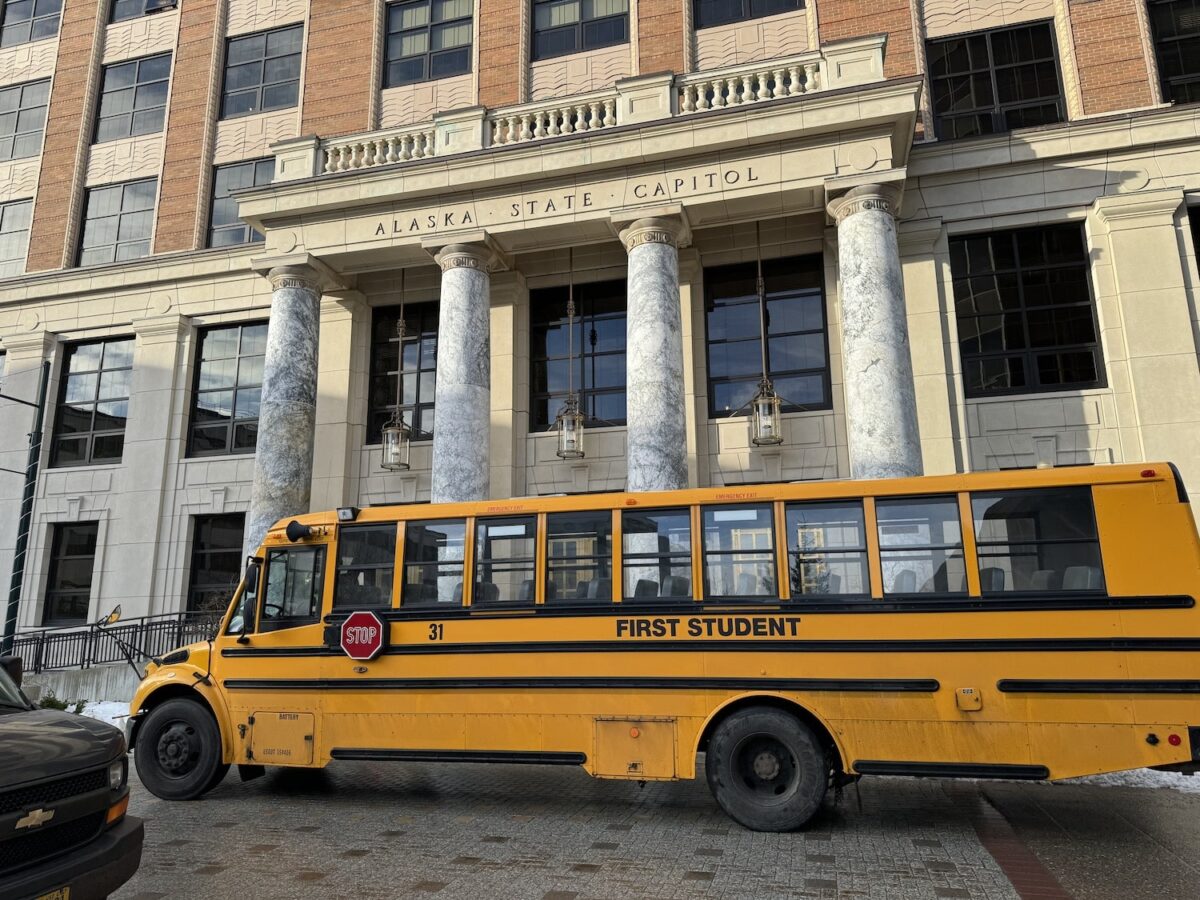
A school bus passes in front of the Alaska Capitol on Tuesday, Feb. 6, 2024. (Photo by James Brooks/Alaska Beacon)
By: Corinne Smith, Alaska Beacon
A school bus passes in front of the Alaska Capitol on Tuesday, Feb. 6, 2024. (Photo by James Brooks/Alaska Beacon)
Officials with the Alaska Department of Education and Early Development have walked back a proposal to limit local governments’ funding for public schools, instead asking the State Board of Education to take no action on the item this week.
The State Board of Education was set to vote this week on a controversial measure that many school officials and education advocates say would bar local municipalities from providing much-needed funding and support services to local schools.
Instead the board voted unanimously on Thursday, at a DEED official’s request, to take no action and return the proposal to the department for further development.
A screenshot of the Alaska State Board of Education during their quarterly meeting, where Education Commissioner Deena Bishop addresses the proposed regulation change to local contributions on Oct. 8, 2025 (Screenshot)
“As a result of the feedback we received, the department will be recommending that the state board take no action on this item, return the proposed regulation to the board or to the department for further collaboration and input with key stakeholders,” said Heather Heineken, the division director for finance and support services for the department, to the board Wednesday, the first day of a two-day meeting.
The proposal came under sharp criticism and public alarm beginning in June, when DEED introduced the measure as an emergency regulation change. Officials said the move was intended to redefine the amount local municipalities provide for schools — called the local contribution — to include “services provided at no charge to a district by the city or borough.”
At the time, DEED officials said it was a way to address the balance of funding for schools ↣— in Alaska’s complex school funding formula which includes local, state and federal funding — and avoid failing a federal disparity test.
The disparity test is required by the U.S. Department of Education to regulate the spread between the highest and lowest funded districts, because of the way the state uses some federal funding, called impact aid. The state failed the test earlier this year, but is in the process of appealing the ruling.
Education Commissioner Deena Bishop, however, reversed that argument and told board members further discussion was needed with districts and financial offices to clarify what “in-kind” contributions are being made and how they were accounted for. She said that was needed to align with state law and standards for equity between districts.
“We’re not reacting to the federal government. What we are (doing) is trying to meet the state statute that calls for that equitable funding,” Bishop told the board on Wednesday.
Public raises alarm at unclear change to local contributions
State board members received more than 600 public comments, mostly opposing the measure, in June and July when the regulation was introduced, calling the proposed change vague and potentially limiting vital municipal funding for schools.
During public comment on Thursday, several district officials expressed opposition and concern.
Valdez School District Superintendent Jason Weber said the change could jeopardize essential city funding, including for transportation and school meals.
“Our Food Service Program is also at a breaking point. Even after raising lunch prices by $1 per meal last year, we’re still operating at a deficit. Every dollar cut from food service funding is $1 taken away from the plates of kids, these regulations would directly reduce the food we can provide for our students, something no community should have to accept,” he said.
“Each Alaskan community has unique needs and challenges the decisions about how to support and operate schools should be made by those who live and work closest to them, not through a one size fits all mandate from the state level, undermining local authority threatens the very foundation of community supported education in Alaska,” Weber said.
Juneau School District Superintendent Frank Hauser pointed to the state’s own appeal of the federal disparity test as evidence the change is unnecessary.
“According to DEED’s July 14 letter, the state would meet the disparity standard, not with a regulation change, which isn’t even mentioned, but by a different accounting method,” Hauser said.
Hauser asked board members to vote the regulation down.
“I am terrified of version 3.0 of this regulation. Each subsequent attempt at this regulation change has had exponentially more negative impacts, impacts beyond what the department realizes, even to REAAS, home school and correspondence students, instead of enacting the oft quoted definition of insanity, doing the same thing over and over and expecting different results, I ask you today to take a different direction and ask the department to stop with this effort altogether,” he said.
During public comment, district officials also raised concerns at a recent DEED Facebook post, which shared a statement over an image of a burning dumpster fire, calling several Anchorage officials’ out by name, saying that their information was “inaccurate” and saying DEED no longer was pushing the proposal. Commenters called the social media post “unprofessional” and not “positive or proactive communication.”
Anchorage officials had penned an op-ed in the Anchorage Daily News, opposing the regulation change, saying it could “gut” the district and strip $15 million in municipal funding, including for school buses and school resource officers.
State board members vote to return proposal to DEED
Before the vote, several state board members questioned whether the proposal should come back to the board.
“I guess I’m questioning now, is it really an issue, or is that needs to be addressed, or does it just need to go away?” asked board member Pamela Dupras on Thursday.
Bishop responded that DEED will gather more feedback, and work with districts to adhere to state law and requirements for equitability. She also pointed to the new Legislative Task Force on Education Funding that may take up the issue and recommend new legislation to define local contributions.
Bishop said DEED would work with district officials and finance departments to further clarify the requirements. “I’m glad that you’re pulling this back,” she said.
She also acknowledged the frustration of districts. “Every two weeks from August until now, I’ve been sharing the same message that, yes, we do not want to put this forward. So I understand the frustration with what was in writing, certainly superintendents that attended all those meetings knew the intent,” she said.
“I think just the stress about school funding, a lot of trust isn’t there,” Bishop added. “The Department wants to earn that trust back and continue with the work.”
The Gates of the Arctic National Park and Preserve, where the Ambler Road project would pass through, is visible from Ambler, Alaska, Sunday, Sept. 28, 2025. (AP Photo/Annika Hammerschlag)
Senators voted 50-46 Thursday to repeal a land management plan for a large swath of Alaska that was adopted in the final weeks of Democratic President Joe Biden’s administration. Lawmakers voted to roll back similar plans for land in Montana and North Dakota earlier this week.
The timing of Biden’s actions made the plans vulnerable to the Congressional Review Act, which allows Congress to terminate rules that are finalized near the end of a president’s term. The resolutions require a simple majority in each chamber and take effect upon the president’s signature.
Trump ordered approval of the Ambler Road project earlier this week, saying it will unlock access to copper, cobalt and other critical minerals that the United States needs to compete with China on artificial intelligence and other resource development. Copper is used in the production of cars, electronics and even renewable energy technologies such as wind turbines.
The road was approved in Trump’s first term, but was later blocked by Biden after an analysis determined the project would threaten caribou and other wildlife and harm Alaska Native tribes that rely on hunting and fishing.
The Biden-era restrictions also included a block on new mining leases in the nation’s most productive coal-producing region, the Powder River Basin in Montana and Wyoming. On Monday, the Trump administration held the biggest coal sale in that area in more than a decade, drawing a single bid of $186,000 for 167.5 million tons of coal, or about a tenth of a penny per ton.
Trump has largely cast aside Biden’s goal to reduce climate-warming emissions from the burning of coal and other fossil fuels extracted from federal land. Instead, he and congressional Republicans have moved to open more taxpayer-owned land to fossil fuel development, hoping to create more jobs and revenue. The Republican administration also has pushed to develop critical minerals, including copper, cobalt, gold and zinc.
A decision on whether to accept the recent bid from the Navajo Transitional Energy Co. is pending, and the lease cannot be issued until the Montana land plan is altered. The dirt-cheap value reflects dampened industry interest in coal despite Trump’s efforts. Many utilities have switched to cheaper natural gas or renewables such as wind and solar power.
Administration officials expressed disappointment that they did not receive “stronger participation” in the Montana sale. In a statement, Interior Department spokesperson Aubrie Spady blamed a “decades long war on coal” by Biden and former Democratic President Barack Obama.
Republican Sen. Tim Sheehy of Montana said the repeal of the land-management plan in his state was “putting an end to disastrous Biden-era regulations that put our resource economy on life support.”
Republican Sen. Dan Sullivan of Alaska called the Biden-era plan for 13 million acres in the central Yukon region “a clear case of federal overreach that locks up Alaska’s lands, ignores Alaska Native voices … and blocks access to critical energy, gravel & mineral resources.”
The GOP legislation “restores balance, strengthens U.S. energy & mineral security and upholds the law,” Sullivan said in a statement.
Democrats urged rejection of the repeals, arguing that Trump’s fossil fuel-friendly agenda is driving up energy prices because renewable sources are being sidelined even as the tech industry’s power demands soar for data centers and other projects.
“We are seeing dramatic increases in the price of energy for American consumers and businesses and the slashing of American jobs, so that Donald Trump can give an easy pass to the fossil fuel industry,” Democratic Sen. Tim Kaine of Virginia said Wednesday on the Senate floor.
Last week, the administration canceled almost $8 billion in grants for clean energy projects in 16 states that Democratic presidential candidate Kamala Harris won in the 2024 election.
Ashley Nunes, public lands specialist at the Center for Biological Diversity, an environmental group, said Republicans were unleashing “a wholesale assault on America’s public lands.” Using the Congressional Review Act to erase land management plans “will sow chaos across the country and turn our most cherished places into playgrounds for coal barons and industry polluters,” she said.
In a complaint filed Friday and a motion for summaryjudgment on Monday, the Legislature’s contracted attorney asks a Juneau Superior Court judge to decide whether or not a governor may issue an executive order during a special legislative session.
The lawsuit had been expected for months.
In August, Dunleavy issued an order seeking to create an Alaska Department of Agriculture, shortly before lawmakers convened for a special session called by the governor. Speaker of the House Bryce Edgmon, I-Dillingham, and Senate President Gary Stevens, R-Kodiak, rejected the validity of the order.
Representatives for the governor’s office said they believed the order was valid and that it would take effect unless lawmakers voted it down.
The leaders of the House and Senate said they did not want to take up the order, because doing so risked setting a precedent, effectively declaring that executive orders could be issued during a special session.
The question that could be decided in court is whether issuing an order in a special session is legal. And does it matter if the order is identical to one that’s already been issued and voted upon?
Alaska is one of two states without a cabinet-level Department of Agriculture, and creating one is seen as a key first step for boosting food production in Alaska.
“The parties require the court’s prompt assistance to resolve this legal dispute before January 1, 2026,” wrote attorney Kevin Cuddy. “Otherwise, there is a risk that the state will move forward with a Department of Agriculture that may have been unconstitutionally created, and thus without legal authority to act.”
The Alaska Department of Law, which will represent the governor in the case, has been served with the lawsuit but has not yet filed its reply.
Patty Sullivan, a spokeswoman for the Department of Law, said by email, “We are working on a briefing schedule with the counsel for the Legislature and the court. Our goal is to expedite the case and ensure that a decision is made before the legislative session begins.”
Alaska’s constitution forbids lawsuits by the executive branch against the legislative branch; the inverse is not true. Lawmakers have now sued Dunleavy four times since he took office in 2018.
U.S. Sen. Dan Sullivan, R-Alaska, speaks to the Alaska Legislature on Thursday, March 20, 2025. (Photo by James Brooks/Alaska Beacon)
The FBI searched the cellphone records of Republican Alaska Sen. Dan Sullivan and seven other U.S. senators and a member of the U.S. House as part of its investigation into the Jan. 6, 2021 insurrection at the U.S. Capitol, a newly released document shows.
The call logs cover several days during and around the insurrection, when rioters stormed the Capitol in an attempt to support then-incumbent President Donald Trump, who falsely claimed to have won reelection in 2020.
The logs do not show that the FBI obtained phone call recordings, only that an investigating agent was interested in who the senators were talking to, when they talked, how long they talked, and where the callers were. The document, released this week by the U.S. Senate Judiciary Committee, does not say why those senators were identified in particular and it does not say whether any investigative leads resulted from the records.
According to a news release from the committee, the FBI sought and obtained data about the senators’ phone use in the days before, on and after the Jan. 6 insurrection, from Jan. 4 through Jan. 7, 2021.
The U.S. Department of Justice indicted Trump in 2023 for allegedly conspiring to overturn the results of the 2020 presidential election, but the special prosecutor in charge of the investigation abandoned that case after Trump was re-elected in 2024. Department policy says that sitting presidents cannot face criminal prosecution, and after the 2021 insurrection, the U.S. Supreme Court issued a decision limiting a president’s liability for conduct while in office.
Asked whether Sullivan had any contact with people who participated in or organized the riot at the U.S. Capitol, Devyn Shea, a spokesperson for Sullivan, said, “absolutely not.”
In a written statement, Sullivan called the FBI investigation “an absolute outrage.”
“We’ve just learned the Biden FBI was engaged in what appears to be an unprecedented fishing expedition against at least nine sitting Republican members of Congress — none of whom were under any type of investigation — surveilling our personal cell phone calls with family members, staff and colleagues. This is a new low in the political weaponization of the Justice Department,” Sullivan’s statement said.
The other seven senators were Cynthia Lummis (R-Wyo.), Lindsey Graham (R-S.C.), Josh Hawley (R-Mo.), Tommy Tuberville (R-Ala.), Ron Johnson (R-Wis.), Marsha Blackburn (R-Tenn.), and Bill Hagerty (R-Tenn.). Rep. Mike Kelly (R-Pa.) was also on the FBI list.
Some senators, including Hawley and Tuberville, voted to object to the certification of the electoral results of the 2020 election.
Sullivan voted to support the certification of the election, and in a statement the day after the Jan. 6 violence at the Capitol, he called the event “sad” and “dispiriting.”
All have been supporters of Trump and his policies; in office, Sullivan has been a reliable vote for the president and his agenda.
In this screenshot from a White House news conference, Interior Secretary Doug Burgum points to a map of Alaska on Monday, Oct. 6, 2025, as he announces the Trump administration’s decision to reverse a Biden administration action that canceled a right-of-way permit for the Ambler Road. (Screenshot)
The action removes a major hurdle for the project, but developers would still need to overcome lawsuits and opposition from environmental and tribal groups. They would also need approval from NANA and Doyon Ltd., two Alaska Native regional corporations who own land in the road’s path.
Ambler Road, planned by the state of Alaska’s development bank and supported by state officials and Alaska’s congressional delegation, would link the Dalton Highway with a mineral-rich region of northwest Alaska, providing access to the mining of rare minerals needed for batteries and high-technology manufacturing.
“It’s an economic gold mine, so to speak. I signed this years ago, and Biden un-signed it for me,” Trump told reporters on Monday at the White House.
Last year, the U.S. Bureau of Land Management concluded that the road would have a litany of negative impacts, and the Biden administration issued a record of decision saying that the best route for the project was no route at all.
The Alaska Industrial Development and Export Authority, Alaska’s state-owned investment bank and the road’s developer, sued the Biden administration, seeking a reversal.
U.S. Interior Secretary Doug Burgum, speaking at the White House on Monday, said the state of Alaska requested an appeal of that decision, and that under federal law, President Trump has the executive authority to make decisions on land use.
The appeal in question was filed by AIDEA under Section 1106 of the Alaska National Interest Lands Conservation Act of 1980.
“This opens up a wealth of resources,” Burgum said, adding that the federal government will also take partial ownership of Trilogy Metals, one of several firms exploring for minerals in northwest Alaska.
As currently planned, the road would consist of a gravel strip stretching from the Dalton Highway almost to Kotzebue. It is envisioned as a toll road, with no public access, and the cost of construction would be paid for via fees levied on users, similar to the way the AIDEA-funded DeLong Mountain Transportation System provides a port for lead and zinc exported from the Red Dog Mine in northwest Alaska.
In a special late-September meeting, AIDEA’s board voted to authorize limited negotiations with landowners in the road’s path.
The road is expected to cross more than 10 miles of land owned by Doyon Ltd., the regional Alaska Native corporation for Interior Alaska.
To date, that corporation hasn’t expressed official support or opposition for the road. Sarah Obed, senior vice president of external affairs for Doyon, said by email that Monday’s announcement was “not a surprise to Doyon” because of a different executive order signed earlier this year.
NANA Regional Corp. owns more than 20 miles of land in the path of the road. In a written statement, NANA President and CEO John Lincoln said the company “appreciates the Trump Administration and Governor Dunleavy’s support for economic development in Alaska and their work towards stabilizing the federal permitting process” but he declined to express support for the road.
Lincoln said that still stands: “Our position on the Ambler Access Project has not changed and will only be reconsidered if and when our established criteria are satisfied, in consultation with shareholders, local communities, and other stakeholders.”
Trump’s action on Monday restores a federal right-of-way grant issued in 2021, at the end of the first Trump administration. It also requires federal agencies to issue clean-water permits and other approvals needed for the road.
A lawsuit challenging the 2021 right-of-way grant remains open in the U.S. District Court in Anchorage. Attorney Bridget Psarianos, with the nonprofit law firm Trustees for Alaska, is one of the attorneys challenging that right-of-way.
By phone, she said she hasn’t ever seen a president use the authority that Trump did on Monday.
“He’s wielding this presidential power like a cudgel, including to overturn decisions that his own agencies have made and provided good reasons for,” she said.
The Tanana Chiefs Conference, a group of 39 Interior villages and 37 federally recognized tribes, opposes the road. In a statement Monday, it said it was “deeply disappointed by the decision.”
“This decision is a direct affront to the voices of Alaska Native people,” said Chief/Chairman Brian Ridley in a written statement. He added that TCC will continue to fight the project.
Psarianos, by phone, said that the BLM opposed the project in 2024 “because they found that there would be significant impacts to subsistence and to communities and their health along the road corridor.”
Athan Manuel, director of the environmental nonprofit Sierra Club’s Lands Protection Program, offered similar thoughts in a written statement. “This order ignores those voices in favor of corporate polluters. The Ambler Road will lead to significant harm to fragile Alaskan landscapes and the local communities and wildlife that rely on them,” he said.
Most of the road’s path is on land owned or controlled by the state of Alaska; an easement allowing the road remains under consideration by the Alaska Department of Natural Resources, but approval is expected.
In a statement published after Trump’s announcement on Monday, Gov. Mike Dunleavy thanked the president for his action, saying, “this decision will unleash development opportunities, create new jobs for Alaskans and secure access to strategic minerals.”
Similarly, all three members of Alaska’s congressional delegation expressed support for Trump’s decision.
“By advancing this access, we are creating new opportunities for Alaskans while strengthening America’s supply chain and reducing dependence on foreign adversaries for our critical mineral needs,” said U.S. Rep. Nick Begich, R-Alaska. “I applaud the President’s decision to support this appeal, and I look forward to working with the Administration, state leaders, and Alaska Native communities to ensure this project moves forward in a way that benefits all Alaskans.”
U.S. Republican Sens. Lisa Murkowski and Dan Sullivan also thanked the president for his action.
“The President’s re-approval will unlock a world-class mining district, deliver quality-of-life benefits for communities in the region, and help grow Alaska’s economy. It will also improve our national security by strengthening our mineral security and enabling us to produce more of our most important resources here at home,” Murkowski said.
Sullivan said, “I’m glad to see another critically important project for our state’s economy and working families being put back on track.”